H-2A Visa for Agricultural Workers in Florida
Discover how the H-2A visa helps Florida growers meet seasonal labor needs. Learn about the application process, common pitfalls, and how Florida Immigration Lawyers can assist you.

The H-2A visa allows U.S. employers to bring foreign nationals to the United States to fill temporary agricultural jobs. It is crucial for Florida growers who need seasonal labor. Key takeaways include:
- Eligibility criteria for the H-2A visa.
- Application steps and timelines.
- Common pitfalls and how to avoid them.
Introduction
In Coral Springs, Florida, agricultural businesses play a pivotal role in the local economy. However, the seasonal nature of farming often necessitates additional labor that cannot be sourced locally. This is where the H-2A visa becomes indispensable. With recent policy changes affecting immigration, understanding the H-2A visa process is more critical than ever for both employers and workers. Call Florida Immigration Lawyers at 1-844-967-3536 for a free consultation.
Florida's agricultural sector is incredibly diverse, encompassing everything from citrus groves and vegetable farms to nurseries and aquaculture operations. This rich variety of crops and livestock demands a consistent, yet often seasonal, workforce. The ability to secure reliable labor at crucial times, such as planting and harvesting seasons, directly impacts the profitability and sustainability of these businesses, which in turn supports the state's broader economy.
The H-2A program serves as a lifeline for many Florida growers facing persistent labor shortages, allowing them to bridge the gap between available domestic workers and their operational needs. Navigating the complexities of this visa category, especially with evolving regulations and increased scrutiny, requires a deep understanding of federal immigration and labor laws. For employers, ensuring compliance is paramount to avoid penalties and maintain access to this vital labor source. For workers, understanding their rights and responsibilities under the H-2A program is equally important for a successful and lawful stay.
What is the H-2A Visa?
As of 2026, the H-2A visa allows U.S. agricultural employers to hire foreign nationals for temporary or seasonal agricultural work. This program is vital for Florida's agricultural sector, which heavily relies on seasonal labor to maintain productivity.
The H-2A visa is a non-immigrant visa that permits foreign agricultural workers to enter the United States for a specified period, usually not exceeding 10 months. The process involves several steps, including obtaining a labor certification from the Department of Labor and approval from USCIS.
The "temporary or seasonal" nature of the work is a key defining characteristic of the H-2A program. This means the employer's need for the services or labor must be for a limited period, typically tied to a recurring event like a harvest cycle, or a one-time occurrence that will end in the near future. Examples of qualifying work include planting, cultivating, harvesting, packing fruits and vegetables, and raising livestock. Employers must genuinely attest that their need for these workers is not permanent or ongoing throughout the year, but rather cyclical and specific to certain times.
Beyond simply providing a workforce, the H-2A program also carries significant responsibilities for employers. These include providing free housing to workers, offering transportation from the housing to the worksite, and in some cases, reimbursement for travel costs from the worker's home country. Employers must also pay their H-2A workers at least the Adverse Effect Wage Rate (AEWR), which is set by the Department of Labor to ensure that the employment of foreign workers does not negatively impact the wages of similarly employed U.S. workers. These protections ensure that both employers and workers benefit from a structured and regulated system.
How Do You Apply for an H-2A Visa?
Applying for an H-2A visa involves multiple steps. Here's a straightforward guide:
- Employers must first submit a job order with the State Workforce Agency.
- Next, file an ETA-9142A application with the Department of Labor.
- Once certified, submit Form I-129 to USCIS.
- Finally, the workers apply for the visa at a U.S. consulate in their home country.
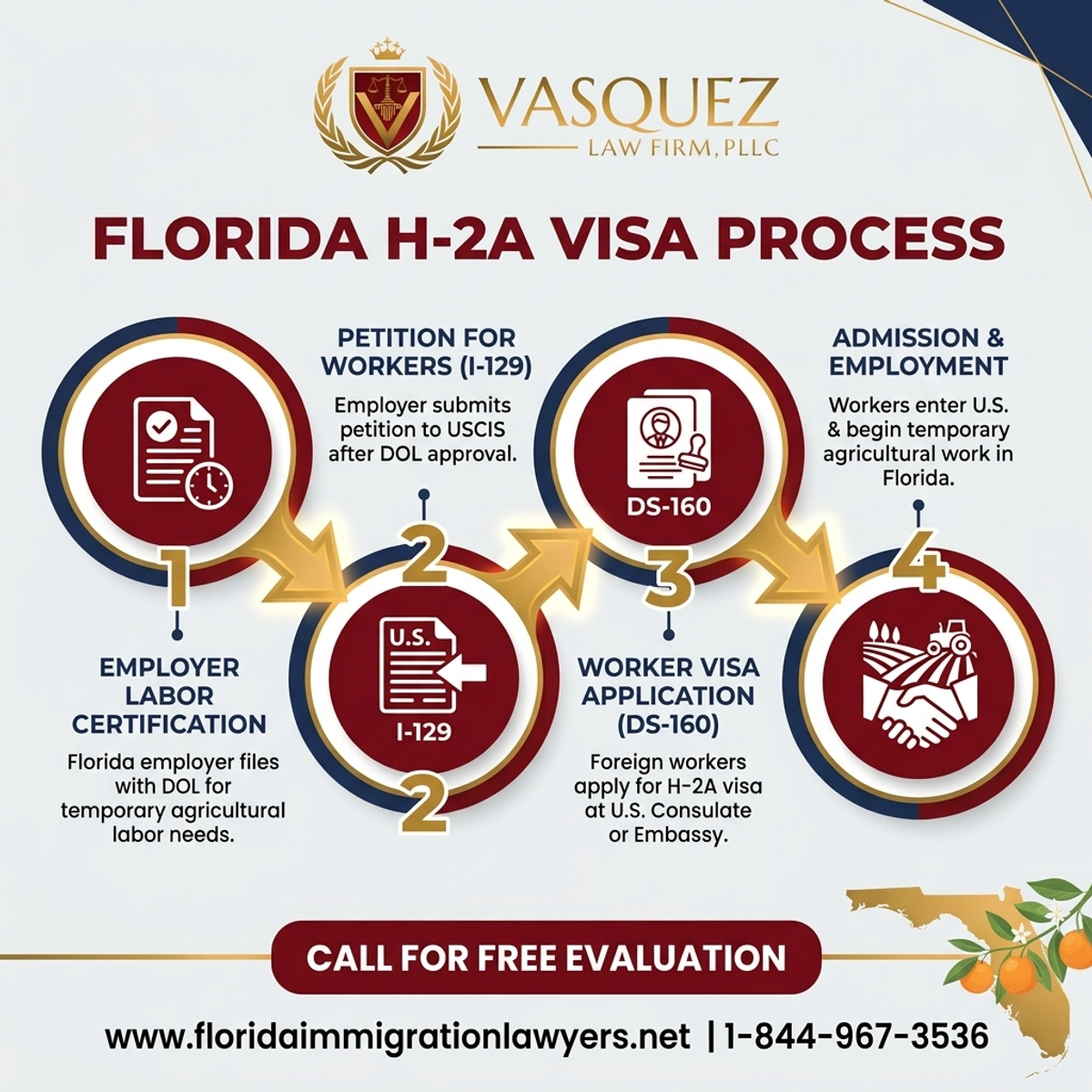
Step-by-Step Process — H-2A Visa for Agricultural Workers in Florida
Each step requires careful attention to detail to avoid delays or denials. Timely submission and accurate documentation are crucial.
The initial submission of a job order to the State Workforce Agency (SWA) is a critical first step. This job order must clearly outline the job duties, minimum requirements, hours, wages, and the temporary nature of the work. The SWA then attempts to recruit qualified U.S. workers for a specified period. This domestic recruitment phase is mandatory and demonstrates the employer's good faith effort to hire locally before seeking foreign labor. Documentation of these recruitment efforts, including advertising and interview results, must be meticulously maintained.
Following the SWA process, employers file the ETA-9142A application with the Department of Labor (DOL). This application is essentially a request for a temporary labor certification, where the employer attests to meeting all H-2A program requirements, including offering the AEWR, providing housing, and transportation. The DOL reviews this application rigorously to ensure compliance and to certify that no able, willing, and qualified U.S. workers are available to perform the work, and that employing foreign workers will not adversely affect U.S. workers' wages or working conditions. An approved labor certification is the cornerstone of the entire H-2A process.
Once the labor certification is approved by the DOL, the employer then files Form I-129, Petition for a Nonimmigrant Worker, with U.S. Citizenship and Immigration Services (USCIS). This petition requests permission for the specific foreign nationals to enter the U.S. to fill the certified positions. USCIS scrutinizes the petition to ensure all eligibility criteria are met and that the employer is capable of fulfilling their obligations. Employers can opt for premium processing for an expedited review, though this comes with an additional fee. Finally, upon USCIS approval, the prospective workers apply for their H-2A visas at a U.S. embassy or consulate in their home country, undergoing an interview and biometric screening. This multi-layered process, while thorough, is designed to protect both workers and the U.S. labor market.
Document Checklist for H-2A Visa
- Approved labor certification from the Department of Labor.
- Form I-129, Petition for Nonimmigrant Worker.
- Proof of temporary need and inability to find U.S. workers.
- Visa application form DS-160 for each worker.
Beyond these primary documents, a comprehensive H-2A application package typically includes a range of supporting evidence. For the proof of temporary need, employers should provide detailed business plans, crop schedules, historical labor data, and any other documentation that clearly demonstrates the cyclical or seasonal nature of their labor requirements. This helps USCIS understand the genuine, non-permanent demand for foreign workers.
Regarding the inability to find U.S. workers, employers must submit extensive documentation of their recruitment efforts. This includes copies of all job advertisements (newspaper, radio, online), detailed logs of interviews conducted with U.S. applicants, reasons for not hiring U.S. workers, and correspondence with the State Workforce Agency. This evidence is crucial for demonstrating a good-faith effort to recruit domestically before resorting to foreign labor, a fundamental requirement of the H-2A program.
Furthermore, employers should be prepared to include copies of their federal EIN, proof of financial stability to ensure they can meet wage and housing obligations, detailed housing inspection reports (if providing housing), and transportation plans for workers. For the workers themselves, copies of valid passports and any previous visa history will be required for consular processing. Organizing these documents meticulously and ensuring consistency across all submissions can significantly streamline the application process and reduce the likelihood of requests for evidence or denials. Consulting with Florida Immigration Lawyers can help ensure your checklist is complete and accurate.
Timeline and Processing Expectations for H-2A Visa
| Stage | Typical Timeframe | Notes |
|---|---|---|
| Job Order Submission | 15-30 days | Submit to State Workforce Agency. |
| Labor Certification | 60-90 days | Department of Labor reviews the application. |
| USCIS Petition Approval | 2-4 weeks | Processing times may vary. |
| Consular Processing | 1-2 months | Depends on the consulate. |
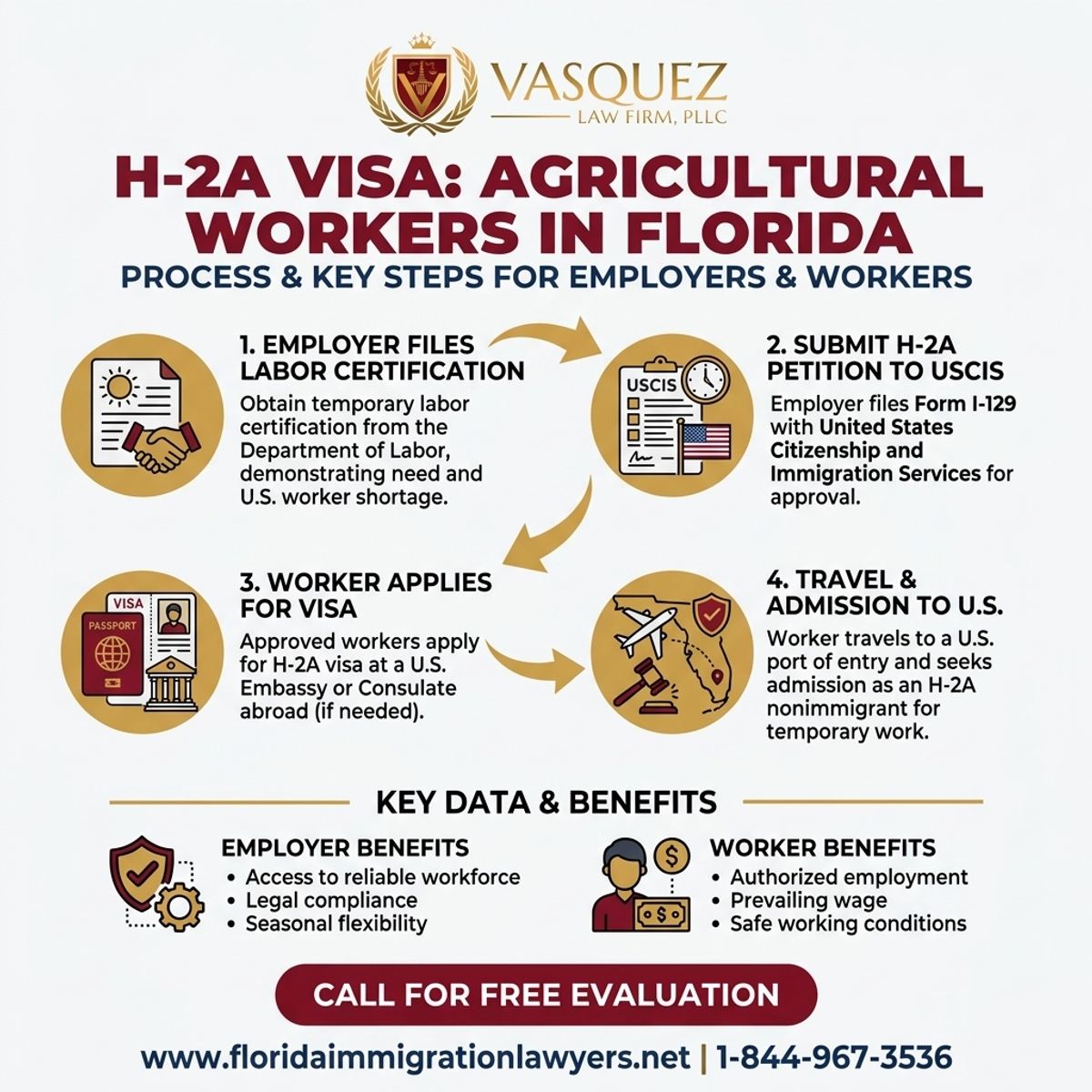
Key Statistics — H-2A Visa for Agricultural Workers in Florida
While the table provides typical timeframes, it is crucial for employers to understand that these are estimates and actual processing times can fluctuate significantly. Factors such as the volume of applications, staffing levels at government agencies, and the complexity or completeness of individual submissions can all impact how quickly an H-2A petition moves through the system. For instance, peak agricultural seasons often coincide with higher application volumes, potentially leading to longer waits at the Department of Labor and USCIS.
To mitigate potential delays, employers should initiate the H-2A application process well in advance of their anticipated start date for workers. A general rule of thumb is to begin at least 75 to 90 days prior, allowing for ample buffer time in case of requests for evidence (RFEs) from USCIS or unexpected consular backlogs. Proactive planning, meticulous document preparation, and staying informed about current processing times on the official USCIS and DOL websites are essential strategies. This foresight helps ensure that your critical workforce arrives precisely when needed, preventing costly disruptions to your agricultural operations.
Cost Factors and Fee Breakdown for H-2A Visa
| Item | Typical Fee | Notes |
|---|---|---|
| Filing Fee for Form I-129 | Variable | Check current USCIS fees. |
| Consular Processing Fee | Variable | Fees vary by consulate. |
| Attorney Fees | Variable | Depends on complexity. |
The financial commitment for H-2A employers extends far beyond just government filing fees. Employers are generally responsible for a significant portion of the costs associated with bringing H-2A workers to the U.S., including recruitment expenses, housing, and transportation. This comprehensive financial responsibility underscores the program's intent to ensure that foreign workers are not exploited and that their presence does not adversely affect the U.S. labor market by driving down wages or conditions.
Additional cost factors include the Adverse Effect Wage Rate (AEWR), which employers must pay, and which is often higher than the state or federal minimum wage. Employers must also budget for workers' compensation insurance, daily transportation for workers to and from the worksite, and the costs associated with maintaining compliant housing, including utilities and any necessary repairs or upgrades. In some cases, employers may also incur costs for background checks, medical examinations, or other pre-employment screenings. Understanding and accurately budgeting for these various expenses is critical for any agricultural business considering the H-2A program, and a detailed consultation with Florida Immigration Lawyers can help clarify the full financial picture.
Common Mistakes to Avoid
- Filing incomplete applications: Ensure all documents are complete
Sources and References
- U.S. Citizenship and Immigration Services (USCIS)
- Executive Office for Immigration Review (EOIR)
- U.S. Department of State - Bureau of Consular Affairs
- Immigration and Nationality Act (INA), 8 U.S.C. Chapter 12
Do Not Navigate This Process Alone
Our experienced immigration attorneys are ready to fight for you. Get a free, confidential consultation today.
Se Habla Español
Frequently Asked Questions
Harold Estrada-Rodriguez
Florida Immigration Attorney · FL Bar No. 1041171
Florida Bar attorney handling Florida-jurisdiction immigration matters. Bilingual representation, free consultations.
Available 24/7 - Free Evaluations
Related Legal Services
Our Florida immigration attorneys can help you with immigration practice areas, free immigration consultation and experienced immigration attorneys. Call today at 1-844-967-3536 for a free consultation.
Related Links
Related Topics
Free Legal Consultation
Discuss your case with our experienced attorneys. We're available 24/7.
Se Habla Español - Estamos aquí para ayudarle.
Related Articles
H-4 EAD Rules for Florida Spouses | FL Immigration Lawyers
Discover the rules for obtaining an H-4 EAD in Florida, allowing spouses of H-1B visa holders to work legally. Our detailed guide covers eligibility, timelines, costs, and common mistakes. Contact Florida Immigration Lawyers for assistance.
H-2A Visa Florida: Guide for Agricultural Growers 2026
Florida's agricultural sector relies heavily on a stable workforce, making the H-2A visa program a critical solution for growers facing labor shortages. This comprehensive guide for 2026 details the H-2A application process, document requirements, and expected timelines for Florida agricultural employers, including those in Hialeah. Learn about the multi-agency process involving the Department of Labor and USCIS, and understand your responsibilities regarding wages, housing, and transportation. We also highlight common mistakes to avoid and explain when legal counsel is essential to ensure compliance and a successful outcome. Florida Immigration Lawyers provides expert guidance to help you navigate these complexities and secure the temporary farm labor your operations need.
Credible Fear Interview Preparation Florida 2026 | VLF Florida
Navigating a credible fear interview in Florida is a high-stakes process for individuals seeking asylum and facing expedited removal. This comprehensive guide from Florida Immigration Lawyers provides essential preparation strategies, including understanding your rights, gathering critical documents, and practicing your testimony. We detail the step-by-step process, typical timelines as of 2026, and associated cost factors. Learn how to avoid common mistakes and identify when immediate legal counsel is necessary to protect your right to pursue an asylum claim. Our experienced team offers free consultations and 24/7 support across Florida.
Child Status Protection Act: CSPA & Aging Out Florida
The Child Status Protection Act (CSPA) is a vital law for families in Florida, protecting children from 'aging out' of immigration eligibility due to processing delays. This act allows a child's age to be locked in for immigration purposes, ensuring they remain eligible as derivative beneficiaries for green cards or visas. Our comprehensive guide explains CSPA eligibility, the complex age calculation, required documentation, and critical deadlines like the 'one-year seeking to acquire' rule. We cover common mistakes to avoid and highlight when expert legal counsel from Florida Immigration Lawyers is essential, especially for families in West Palm Beach and across the state. Understanding CSPA can secure your child's future in the U.S.
