Credible Fear Interview Preparation Florida 2026
Navigating a credible fear interview in Florida is a high-stakes process for individuals seeking asylum and facing expedited removal. This comprehensive guide from Florida Immigration Lawyers provides essential preparation strategies, including understanding your rights, gathering critical documents, and practicing your testimony. We detail the step-by-step process, typical timelines as of 2026, and associated cost factors. Learn how to avoid common mistakes and identify when immediate legal counsel is necessary to protect your right to pursue an asylum claim. Our experienced team offers free consultations and 24/7 support across Florida.
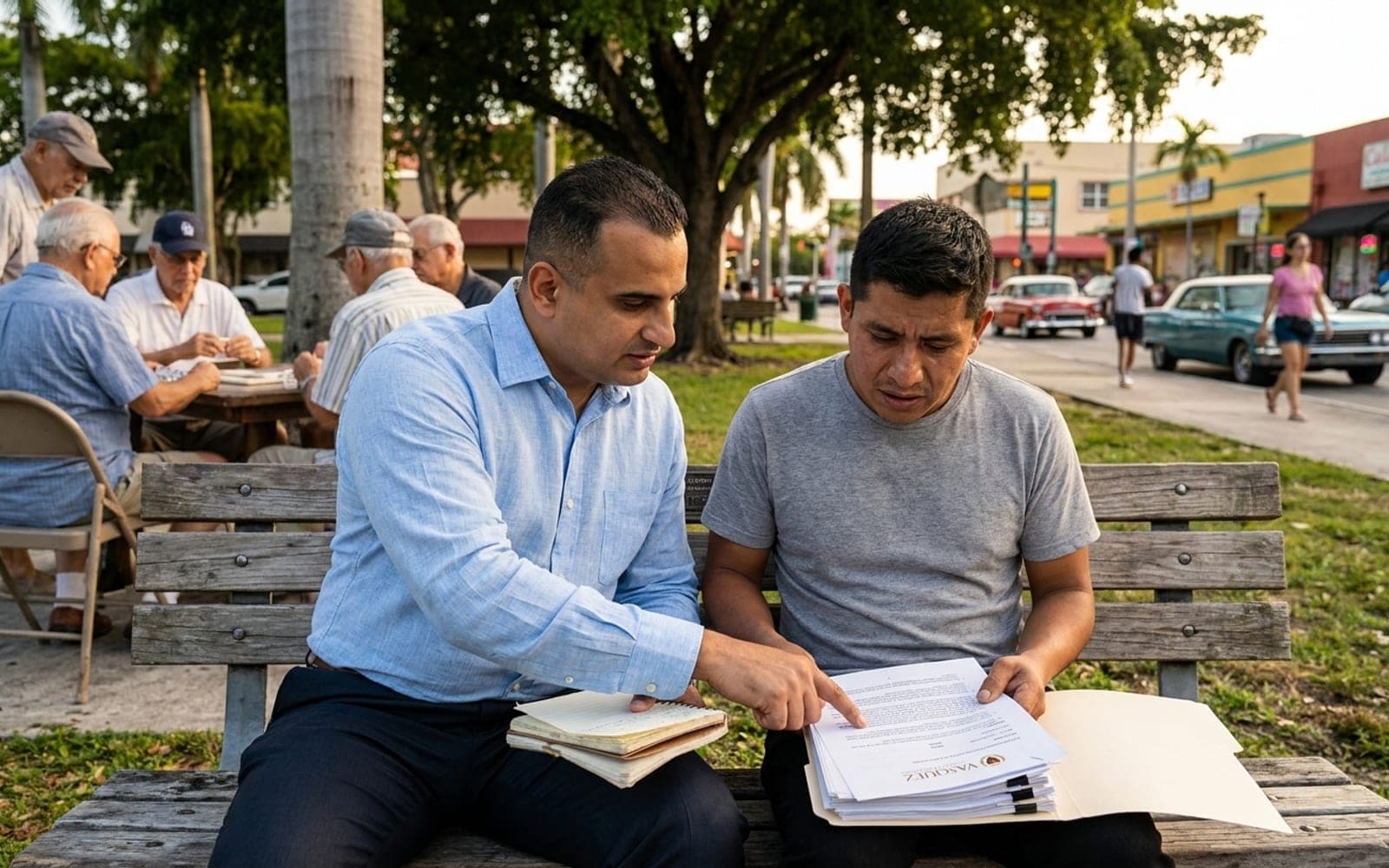
A credible fear interview (CFI) is a crucial step for individuals in Florida facing expedited removal who express a fear of returning to their home country. Conducted by an asylum officer, this interview determines if there is a “significant possibility” that the individual could establish eligibility for asylum or withholding of removal. Proper preparation is paramount, as the outcome directly impacts whether a person can pursue their asylum claim before an immigration judge or face immediate deportation. Understanding your rights, gathering evidence, and seeking legal counsel are essential for navigating this complex process effectively in Florida.
- The CFI is for individuals in expedited removal who claim fear of return.
- An asylum officer determines if a "significant possibility" for asylum exists.
- Successful CFI leads to a hearing before an immigration judge.
- Preparation involves understanding rights, gathering evidence, and legal guidance.
- Failure can result in immediate deportation from Florida.
Facing immigration challenges in the United States, especially when you fear returning to your home country, can be an incredibly daunting experience. For many individuals arriving in Florida, expressing a fear of persecution or torture upon return triggers a critical process: the credible fear interview. This interview, often conducted while in detention, is your first and most vital opportunity to present your case to U.S. immigration authorities. It's a gateway to seeking asylum and a chance to avoid immediate deportation under expedited removal procedures.
The stakes in a credible fear interview are incredibly high. A positive outcome allows you to pursue your asylum claim before an immigration judge, while a negative one can lead to swift removal from the U.S. This comprehensive guide from Florida Immigration Lawyers is designed to equip you with the knowledge and strategies needed for effective credible fear interview preparation in Florida. We will walk you through the process, highlight essential documents, discuss timelines as of 2026, and help you understand when legal assistance is indispensable. Do not navigate this complex journey alone. Call Florida Immigration Lawyers at 1-844-YO-PELEO for a free consultation to discuss your specific situation.
What is a Credible Fear Interview (CFI)? Understanding Expedited Removal in Florida
A credible fear interview (CFI) is a screening process conducted by a USCIS asylum officer for individuals subject to expedited removal who indicate an intention to apply for asylum or express a fear of persecution or torture if returned to their country of origin. The purpose is to determine if there is a "significant possibility" that the individual could establish eligibility for asylum or other forms of protection, such as withholding of removal or protection under the Convention Against Torture.
The CFI is a crucial initial step that can determine the trajectory of an individual's immigration case in the United States. It is not a final decision on asylum eligibility but rather a preliminary assessment. The process is designed to quickly identify individuals with potentially legitimate claims for protection while efficiently processing those without such claims. This distinction is vital for anyone held in detention centers across Florida, such as the Krome Service Processing Center or Baker County Detention Center, where these interviews frequently occur.
The Purpose of a CFI
The primary purpose of the credible fear interview is to act as a safeguard against sending individuals back to countries where they face genuine threats. It is a direct result of international and U.S. legal obligations to protect refugees. An asylum officer will listen to your story, review any evidence you present, and assess whether your fear is credible and consistent with the legal definition of asylum. This involves evaluating if your fear is subjectively genuine and objectively reasonable, based on persecution or torture on account of race, religion, nationality, political opinion, or membership in a particular social group. Understanding this purpose helps you frame your narrative effectively.
Who is Subject to Expedited Removal?
Expedited removal applies to non-citizens who arrive in the U.S. without proper documentation or who present fraudulent documents, and who have not been admitted or paroled into the country. This typically includes individuals encountered at U.S. ports of entry or within 100 miles of the border and within 14 days of entry. If such an individual expresses a fear of return, they are then referred for a credible fear interview. Without a credible fear claim, individuals under expedited removal can be removed from the U.S. quickly, often without a hearing before an immigration judge. This procedure is outlined in Section 235(b)(1)(A) of the Immigration and Nationality Act (INA).
How Do I Prepare for a Credible Fear Interview in Florida? A Step-by-Step Guide
Preparing for a credible fear interview in Florida involves understanding the legal standards, organizing your narrative, and gathering supporting evidence. As of 2026, the process remains rigorous, and thorough preparation is your best defense. This preparation is critical to demonstrate a "significant possibility" that you could establish eligibility for asylum, withholding of removal, or protection under the Convention Against Torture.
The interview is your opportunity to clearly articulate why you fear returning to your home country. It is not a casual conversation but a formal proceeding where your statements are recorded and will be used to make a determination. Many individuals in Florida, particularly those detained in facilities like the Glades County Detention Center, find this process overwhelming. However, with a structured approach, you can significantly improve your chances of a positive outcome.
Step 1: Understand Your Rights
Before your interview, it is vital to understand your rights. You have the right to be represented by an attorney or other accredited representative at no expense to the government. You also have the right to a competent interpreter if you do not speak English. Do not proceed with the interview if you do not have an interpreter in your native language, or if you feel the interpreter is not accurately conveying your statements. You have the right to review any written summary of your statements and to make corrections. Knowing these rights empowers you to ensure fairness in the process.
Step 2: Gather Your Evidence and Documents
While often conducted in detention with limited access to documents, it's essential to present any available evidence. This includes identification documents, police reports, medical records, news articles, or any other materials that corroborate your story of persecution or torture. Even if you don't have physical documents, preparing a detailed mental timeline of events and names can be crucial. If you have family or friends outside detention, they might be able to help gather and submit documents to your attorney or directly to USCIS if instructed. Every piece of evidence, no matter how small, can strengthen your claim.
Step 3: Practice Your Testimony
Your testimony is the core of your credible fear claim. Practice telling your story clearly, chronologically, and consistently. Focus on the specific events that led to your fear, the actors involved, and how these events relate to your race, religion, nationality, political opinion, or social group. Be prepared for direct and sometimes probing questions from the asylum officer. Avoid speculation or exaggeration; stick to the facts as you experienced them. A coherent and believable narrative is far more impactful than a confused or inconsistent one. Remember, the officer is looking for credibility and consistency.
Step 4: Seek Legal Counsel
This is arguably the most critical step. An experienced immigration attorney from Florida Immigration Lawyers can help you understand the legal standards, prepare your testimony, identify and gather relevant evidence, and represent you during the interview. Legal representation significantly increases your chances of a positive credible fear finding. An attorney can also advise you on what to expect, how to answer difficult questions, and how to articulate your fear in a legally relevant way. They can also advocate on your behalf, ensuring your rights are protected throughout the process, especially if you are detained in Florida.
What Documents Do I Need for a Credible Fear Interview? Your Essential Checklist
While the circumstances surrounding a credible fear interview often limit access to extensive documentation, presenting any available evidence can significantly strengthen your claim. Asylum officers look for consistency and corroboration. Therefore, even minimal documentation can be highly impactful. As of 2026, the emphasis remains on substantiating your narrative of fear and persecution. Individuals undergoing this process in Florida, particularly those in detention, should try to communicate with family or legal counsel to gather relevant materials.
Remember that even if you cannot obtain physical documents before the interview, detailing the existence of such documents and explaining why they are unavailable can still be helpful. The goal is to provide as much verifiable information as possible to support your claim of a "significant possibility" of asylum eligibility. Your attorney can guide you on what specific documents are most relevant to your unique case.
Personal Identification and Travel Documents
These documents help establish your identity and nationality, which are foundational to any immigration claim. While not directly proving fear, they are necessary for the immigration process itself.
- Passport or national identification card
- Birth certificate
- Any travel documents used to enter the U.S.
- Previous visa applications or immigration records
Evidence of Persecution or Harm
This category is crucial for demonstrating the basis of your fear. Collect anything that illustrates the threats, harm, or persecution you have faced or would face upon return.
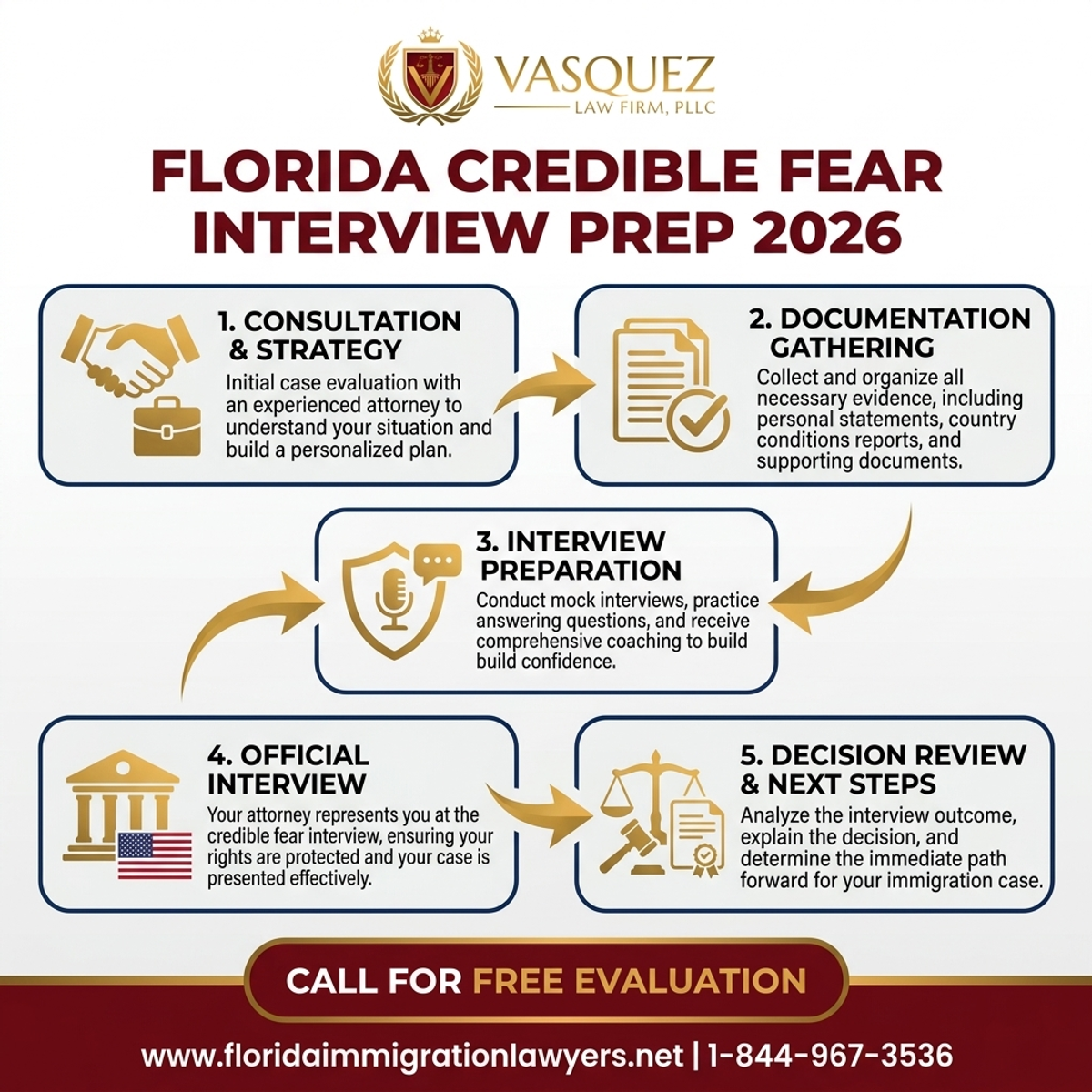
Step-by-Step Process — Credible Fear Interview Preparation Florida 2026
- Police reports documenting threats, attacks, or arrests
- Medical records or forensic reports detailing injuries from persecution
- Court documents related to your persecution or legal proceedings in your home country
- Photos or videos depicting harm, threats, or destroyed property
- Letters or messages from persecutors
- News articles or human rights reports about conditions in your home country, especially those relevant to your specific situation or social group
Supporting Statements and Affidavits
Statements from others who can corroborate your story or provide context can be powerful evidence, especially if direct documentary evidence is scarce.
- Affidavits from witnesses to your persecution (if available and verifiable)
- Letters of support from family, friends, or community leaders detailing your situation
- Expert witness statements on country conditions or specific forms of persecution (often submitted later in the asylum process, but good to know about)
What is the Timeline for a Credible Fear Interview Process in 2026?
The timeline for a credible fear interview process in Florida can vary, but generally, it is designed to be expedited due to the nature of the expedited removal proceedings. As of 2026, USCIS aims to conduct these interviews quickly, often within a few days of an individual expressing a fear of return. However, various factors, including detention center capacity, interpreter availability, and legal counsel scheduling, can influence the exact timeframe. Understanding these typical timeframes helps manage expectations during a highly stressful period.
It is important to remember that delays can occur, and while the goal is speed, the process must also ensure due process. For individuals detained in Florida, the urgency is particularly pronounced, as prolonged detention can be emotionally and physically taxing. An attorney can help monitor your case and advocate for timely processing. This table outlines typical expectations:
| Stage | Typical Timeframe | Notes |
|---|---|---|
| Expression of Fear / Referral for CFI | Immediately upon apprehension | Occurs at port of entry or within U.S. border zones. |
| CFI Scheduling | Within 2-5 days of referral | Can vary based on detention location (e.g., Krome, Glades) and resources. |
| Credible Fear Interview | Within 1-2 weeks of detention/referral | Conducted by a USCIS Asylum Officer. |
| CFI Decision | Within 1-2 days post-interview | Officer will issue a written decision. |
| Immigration Judge Review (if negative) | Within 7 days of negative finding | Mandatory if requested by the applicant after a negative CFI. |
| Referral to Immigration Court (if positive) | Varies, typically 1-4 weeks | Case docketed with the Executive Office for Immigration Review (EOIR) for full asylum proceedings. |
What Are the Costs Associated with a Credible Fear Interview in Florida?
The credible fear interview itself does not involve any government filing fees. This means that individuals undergoing the CFI process in Florida will not be charged by USCIS for the interview itself. However, while the interview is free, there are significant indirect costs that can arise, primarily related to legal representation. As of 2026, legal fees remain the primary financial consideration for individuals navigating this critical stage of the immigration process.
Understanding these potential costs is important for planning and making informed decisions. Many individuals in detention may have limited financial resources, making access to legal aid or pro bono services crucial. Florida Immigration Lawyers offers free consultations to help assess your situation and discuss potential legal fees transparently. This table outlines typical cost factors:
| Item | Typical Fee | Notes |
|---|---|---|
| USCIS Credible Fear Interview Filing Fee | $0 | There are no government fees for the CFI itself. |
| Legal Consultation | Free to hundreds of dollars | Many firms, including Florida Immigration Lawyers, offer free initial consultations. |
| Legal Representation for CFI | Varies widely ($1,500 - $5,000+) | Depends on attorney experience, complexity of case, and time spent. Can include preparation, representation, and follow-up. |
| Interpreter Fees (if privately retained) | Varies ($50 - $200 per hour) | USCIS provides interpreters for the CFI, but you may want your own for attorney meetings. |
| Document Translation Costs | Varies ($20 - $50+ per page) | For translating supporting documents not in English. |
| Travel Costs (for family/witnesses) | Varies | If family or witnesses need to travel to meet with attorneys or for potential future court dates. |
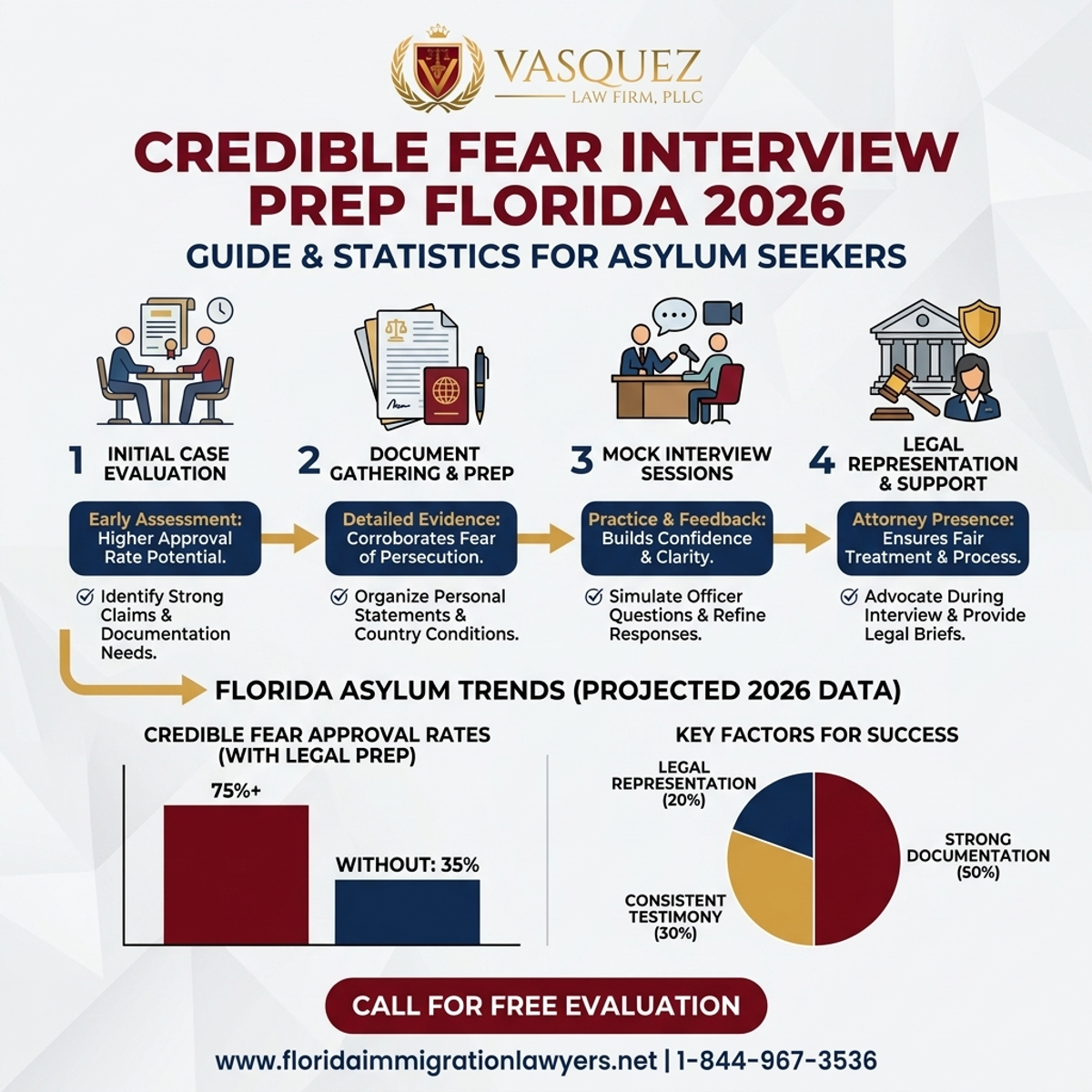
Key Statistics — Credible Fear Interview Preparation Florida 2026
Do not navigate this process alone. Contact Florida Immigration Lawyers today to ensure you have guidance through every step of your credible fear interview and subsequent asylum claim.
Common Mistakes to Avoid During Your Credible Fear Interview
The credible fear interview is a high-stakes process where even small errors can have significant consequences. Avoiding these common mistakes can dramatically improve your chances of a positive outcome and further your asylum claim.
-
Failing to Disclose All Fears: Many individuals, out of fear or embarrassment, may not fully articulate all reasons for their fear of returning home. It's crucial to share every detail, even if it seems minor, as it could be legally relevant to your claim. Withholding information can lead to a negative finding.
-
Inconsistency in Story: Providing different details about your persecution or fear to different officials (e.g., CBP, asylum officer) can severely damage your credibility. Practice your story and ensure consistency in key facts, dates, and names.
-
Lack of Specificity: General statements like "I'm afraid to go back" are insufficient. You must provide specific details about who harmed you, what they did, when it happened, where it occurred, and why they targeted you. The more specific, the better.
-
Not Requesting an Interpreter or Accepting a Poor One: If you do not speak English fluently, you have the right to a competent interpreter. Do not proceed if one is not provided or if you feel the interpreter is not accurately translating your words. This can lead to miscommunication and misrepresentation of your claim.
-
Failing to Mention Persecutor's Motive: Your fear must be tied to one of the five protected grounds (race, religion, nationality, political opinion, or membership in a particular social group). Clearly explain how your persecutors' actions were motivated by one of these factors.
-
Not Seeking Legal Representation: Attempting to navigate the complex legal standards and procedures of a CFI without an attorney is a significant disadvantage. Lawyers understand what asylum officers are looking for and can help you present your strongest case.
-
Signing Documents You Don't Understand: Never sign any document presented to you by immigration officials unless you fully understand its content and implications. If you have an attorney, always consult them first.
-
Not Requesting a Review by an Immigration Judge: If you receive a negative credible fear finding, you have the right to request a review of that decision by an immigration judge. Failing to do so within the strict timeframe means you waive your right to further appeal and face immediate deportation.
-
Failing to Provide Any Evidence: Even if you are detained and have limited access, try to mention any documents or witnesses that could support your claim. Even a verbal account of evidence can be noted and later followed up by your attorney.
-
Exaggerating or Lying: While tempting to make your story sound more dramatic, any exaggeration or fabrication will severely damage your credibility if discovered. Stick to the truth, as inconsistencies are often detected and can lead to a negative outcome.
When to Call a Lawyer for Your Credible Fear Interview
Given the critical nature of the credible fear interview, securing legal representation as early as possible is always advisable. The moments immediately following your apprehension and expression of fear are crucial. If you or a loved one are in immigration detention in Florida and have expressed a fear of returning to your home country, contacting an experienced immigration attorney should be your top priority.
You should absolutely call Florida Immigration Lawyers if any of the following scenarios apply:
- You have been placed in expedited removal proceedings.
- You have expressed a fear of returning to your home country.
- You are currently detained in an immigration facility in Florida (e.g., Krome, Glades, Baker County).
- You do not fully understand the credible fear process or your rights.
- You are struggling to articulate your fear due to language barriers, trauma, or confusion.
- You received a negative credible fear finding and need to request an immigration judge review.
- You have a complex case involving multiple forms of persecution, sensitive personal details, or intricate legal arguments.
- You fear retribution or further persecution if you share certain details without legal protection.
- You need help gathering evidence or obtaining documents from your home country or from family members.
Our attorneys at Florida Immigration Lawyers are deeply familiar with the nuances of credible fear interviews and asylum law. We can provide immediate assistance, ensure your rights are protected, and help you build the strongest possible case. Don't wait until it's too late; a timely intervention can make all the difference.
About Florida Immigration Lawyers
Florida Immigration Lawyers is an immigration law firm dedicated to serving individuals and families across the entire state of Florida. With years of specialized experience, our team of compassionate and knowledgeable attorneys is committed to providing exceptional legal representation for a wide range of immigration matters. From credible fear interviews and asylum claims to family visas, deportation defense, and naturalization, we understand the complexities and emotional toll of the U.S. immigration system.
We pride ourselves on our client-focused approach, offering personalized strategies tailored to each unique situation. Our firm is available 24/7 to address urgent needs, and we offer free consultations to help you understand your options without financial burden. We are proud to offer bilingual services, ensuring that language is never a barrier to quality legal assistance. When your future in the U.S. is on the line, trust Florida Immigration Lawyers to be your steadfast advocate. Call us today at 1-844-YO-PELEO or visit our website at Vasquez Law Firm to learn more about how we can help you.
Sources and References
- U.S. Citizenship and Immigration Services (USCIS) - Credible Fear and Reasonable Fear
- Executive Office for Immigration Review (EOIR) - Credible Fear and Reasonable Fear Processing
- 8 U.S.C. § 1225 - Inspection of aliens applying for admission; expedited removal of inadmissible arriving aliens; referral for interview by asylum officer
- 8 C.F.R. § 208.30 - Procedures for asylum claims in the context of expedited removal
- Immigration and Nationality Act (INA) Section 235(b)(1)(A)
Related services: asylum and refugee protection, immigration waivers, humanitarian protection programs, DACA renewal and applications.
This article provides general legal information and is not intended as legal advice. Every case is unique, and outcomes depend on specific facts and circumstances. Contact an attorney for advice about your particular situation.
Don't face the complexities of a credible fear interview in Florida without legal guidance. Your future and safety depend on it. Call Florida Immigration Lawyers today at 1-844-YO-PELEO for a free, confidential consultation. Se Habla Español - Estamos aquí para ayudarle.
If you need legal assistance, learn more about Florida deportation defense legal team, or call us at 1-844-YO-PELEO for a free consultation.
Do Not Navigate This Process Alone
Our experienced immigration attorneys are ready to fight for you. Get a free, confidential case review today.
Se Habla Español
Or leave your details and we’ll call you:
Free Evaluation in 24 Hours
Or talk to us right now

AI voice assistant — available 24/7
FreeFrequently Asked Questions

William J. Vásquez
Founding Attorney · Vasquez Law Firm
U.S. Air Force veteran and immigration attorney with years of hands-on U.S. immigration experience. J.D., NCCU School of Law. AILA member. Admitted to the 4th, 5th, and 11th Circuit Courts.
Available 24/7 - Free Evaluations
Reviewed for legal accuracy by William J. Vásquez
Licensed in North Carolina; U.S. immigration is federal practice.
Related Legal Services
Our Florida immigration attorneys can help you with free immigration consultation, business immigration and deportation defense. Call today at 1-844-YO-PELEO for a free case review.
Related Links
Related Topics
Free Legal Case Review
Discuss your case with our experienced attorneys. We're available 24/7.
Se Habla Español - Estamos aquí para ayudarle.
Related Articles
EAD Advance Parole Combo Card in Florida: What You Need
An EAD advance parole combo card allows individuals with pending adjustment applications to both work and travel abroad without jeopardizing their green card application. Learn how to apply in Florida, what documents you need, and common mistakes to avoid.
PERM Labor Certification in Florida: A 2026 Guide
Learn all about the PERM labor certification process in Florida, essential for employers sponsoring green card applicants. Understand the steps, document requirements, and common mistakes to avoid in this 2026 guide.
Dual Citizenship Lawyer in Florida: What You Need to Know
For Florida residents, the concept of dual citizenship, or holding two passports, offers a compelling blend of opportunities and challenges. While the U.S. generally permits dual nationality, the path to achieving this status requires a meticulous understanding of both U.S. immigration laws and the citizenship policies of your country of origin. This guide explores the definition of dual citizenship, the detailed step-by-step process for U.S. naturalization, and the significant benefits and potential pitfalls involved. We cover essential documentation, typical timelines, and cost considerations for 2026, providing crucial insights for anyone in Orlando, Miami, or across Florida considering this important legal step. Learn about common mistakes to avoid and understand when to seek professional legal counsel to navigate this complex process successfully. Florida Immigration Lawyers is here to provide expert, bilingual support for your dual citizenship journey.
Immigration Lawyer Orlando Free Consultation in Florida
For individuals and families in Orlando, Florida, navigating the complexities of U.S. immigration law requires expert guidance. An immigration lawyer in Orlando offers crucial support for everything from visa applications and green card processes to naturalization and deportation defense. This comprehensive guide details what a free consultation covers, providing a step-by-step overview of immigration pathways, essential document checklists, and expected timelines in 2026. We also highlight common mistakes to avoid, discuss the critical role of legal counsel in deportation and asylum cases, and explain why choosing a local Orlando immigration attorney is beneficial. Florida Immigration Lawyers is dedicated to serving the diverse community of Orlando with compassionate, effective legal solutions, ensuring you receive personalized advice and robust representation for a successful immigration journey.