Orlando Immigration Criminal Defense Attorney: Florida 2026
For immigrants in Orlando, Florida, a criminal charge or conviction can jeopardize their future in the U.S. An Orlando immigration criminal defense attorney specializes in navigating the complex intersection of criminal and immigration law, offering vital defense strategies and advocating for criminal waivers like Form I-601. This comprehensive guide from Florida Immigration Lawyers explores common grounds of inadmissibility, the I-601 application process, associated costs, and crucial mistakes to avoid. Learn how expert legal counsel can help protect your immigration status and provide a path forward, even in the face of challenging criminal issues in Florida. Secure your rights and future with dedicated legal support.

An Orlando immigration criminal defense attorney specializes in cases where an individual's immigration status is jeopardized by criminal charges or convictions in Florida. They provide essential legal guidance to navigate complex federal immigration laws and state criminal proceedings, often focusing on strategies like criminal waivers (e.g., Form I-601) to overcome grounds of inadmissibility or deportability. Their role is crucial in protecting an immigrant's right to remain in the U.S., adjust status, or avoid removal, especially for those facing issues in Orlando and across Florida.
- Criminal convictions can severely impact immigration status, leading to inadmissibility or deportation.
- An I-601 criminal waiver may forgive certain criminal grounds of inadmissibility, requiring proof of extreme hardship.
- Seeking an Orlando immigration criminal defense attorney early is vital for effective defense and strategy.
- Florida's specific state laws and court outcomes can have distinct federal immigration consequences.
- The process involves complex documentation, legal arguments, and adherence to strict deadlines.
Facing criminal charges or having a past conviction while navigating the U.S. immigration system can be one of the most stressful and complex challenges an individual can encounter. For immigrants in Florida, particularly in vibrant areas like Orlando, a seemingly minor legal issue can have devastating consequences, potentially leading to inadmissibility, denial of benefits, or even deportation. Understanding the intricate intersection of criminal and immigration law is not just important—it's absolutely critical for protecting your future in the United States.
At Florida Immigration Lawyers, we understand the profound anxiety that accompanies these situations. Our dedicated team of attorneys specializes in providing robust defense and strategic guidance for individuals whose immigration status is at risk due to criminal matters. We are here to help you navigate these turbulent waters, offering clarity and a path forward. Our comprehensive guide will explain criminal waivers, common inadmissibility grounds, and the vital role of an Orlando immigration criminal defense attorney.
You do not have to face these challenges alone. If you or a loved one in Florida is dealing with criminal charges that impact immigration status, immediate legal counsel is paramount. Call Florida Immigration Lawyers at 1-844-967-3536 for a free case review and let us help you protect your rights and future.
Overview of Criminal Waivers in Florida Immigration
Immigration law is notoriously unforgiving when it comes to criminal offenses. Even a seemingly minor arrest or conviction from years past can resurface and halt an immigration application or trigger removal proceedings. A criminal waiver is a legal mechanism designed to forgive certain grounds of inadmissibility or deportability that arise from criminal activity. These waivers are not automatic; they require a compelling case demonstrating why the U.S. government should overlook the criminal act and grant the individual a path to legal status.
In Florida, where a diverse population interacts with various state and federal legal systems, understanding these waivers is particularly important. A conviction in a Florida state court, even if it seems resolved at the state level, can still carry severe federal immigration consequences under the Immigration and Nationality Act (INA). For instance, an individual might have completed their sentence and probation, believing their legal troubles are behind them, only to discover that USCIS or an immigration judge views their record as a bar to a green card or citizenship. This is where an experienced Orlando immigration criminal defense attorney becomes indispensable, helping to identify the specific grounds of inadmissibility and determining the appropriate waiver strategy.
The most common criminal waivers include Form I-601, Application for Waiver of Grounds of Inadmissibility, and Form I-212, Application for Permission to Reapply for Admission into the United States After Deportation or Removal. Each waiver has specific eligibility criteria and requires extensive documentation and legal arguments. Navigating these complexities successfully often hinges on demonstrating “extreme hardship” to a qualifying U.S. citizen or lawful permanent resident spouse, parent, or in some cases, child. The legal standard for extreme hardship is high, demanding a thorough and persuasive presentation of evidence. Without a clear understanding of these requirements, many applicants face denials, making professional legal assistance crucial for those in Orlando and throughout Florida seeking to protect their immigration standing.
What is a criminal waiver for immigration purposes in Florida?
A criminal waiver for immigration purposes is a formal request to forgive specific grounds of inadmissibility or deportability that arise from criminal offenses, allowing an individual to proceed with their immigration application or avoid removal from the United States. In Florida, these waivers are crucial tools for immigrants whose path to legal status is blocked by past or current criminal issues, providing a potential remedy to otherwise disqualifying circumstances under U.S. immigration law.
The Immigration and Nationality Act (INA) outlines numerous grounds of inadmissibility and deportability, many of which are triggered by criminal activity. For example, convictions for Crimes Involving Moral Turpitude (CIMT) or controlled substance offenses can render an individual inadmissible, meaning they cannot lawfully enter or remain in the U.S. (See INA § 212(a)(2), 8 U.S.C. § 1182(a)(2)). A criminal waiver, such as the Form I-601, seeks to overcome these bars by persuading USCIS or an immigration judge that the positive factors in an applicant’s case, particularly the extreme hardship to a qualifying relative, outweigh the negative impact of the criminal record. This process is particularly nuanced in Florida, where the specifics of state criminal convictions (e.g., plea bargains, probation, expungements) may be interpreted differently under federal immigration law. An Orlando immigration criminal defense attorney can accurately assess your Florida criminal record against federal immigration definitions to determine waiver eligibility. The goal is to provide a second chance for individuals who have demonstrated rehabilitation and have strong ties to the U.S. through qualifying family members, mitigating the harsh consequences that criminal offenses can impose on an immigrant’s life in Florida.
How do I apply for an I-601 criminal waiver in Orlando, Florida?
Applying for an I-601 criminal waiver in Orlando, Florida, involves preparing a detailed application package for USCIS, demonstrating extreme hardship to a qualifying U.S. citizen or lawful permanent resident relative if the waiver is not granted. This process typically includes gathering extensive documentation, writing a compelling legal brief, and attending interviews, often requiring the expertise of an Orlando immigration criminal defense attorney to navigate its complexities effectively.
The I-601 waiver is a complex application that demands meticulous preparation and a deep understanding of immigration law. For individuals in Orlando and surrounding Florida areas, this process can feel overwhelming without professional guidance. The core of a successful I-601 application lies in proving “extreme hardship” to a qualifying U.S. citizen or lawful permanent resident spouse, parent, or in some cases, child. This means demonstrating that your relative would suffer significantly beyond what is typical if you were denied admission to the U.S. or removed. This hardship can be financial, medical, psychological, or involve other significant burdens. A skilled attorney will help you identify and gather the necessary evidence to build a robust case, ensuring that all legal requirements are met and presented persuasively to USCIS.
Step-by-Step Guide for I-601 Application:
- Determine Eligibility: First, identify the specific ground of inadmissibility you need to waive. This requires a thorough review of your criminal record and immigration history. An attorney can help determine if an I-601 is the appropriate waiver and if you have a qualifying relative.
- Gather Comprehensive Documentation: Collect all necessary supporting documents, including police reports, court dispositions, character references, and extensive evidence of extreme hardship to your qualifying relative.
- Complete Form I-601 Accurately: Fill out the Form I-601, Application for Waiver of Grounds of Inadmissibility, with extreme care and precision. Any errors or omissions can lead to delays or denials.
- Develop a Compelling Hardship Argument: This is the most crucial part. Work with your attorney to construct a detailed legal brief and narrative explaining why your qualifying relative would suffer extreme hardship if the waiver is not granted.
- Submit the Application Package: File the complete I-601 application package with USCIS. In many cases, the I-601 is filed concurrently with another immigration application, such as Form I-485 (Application to Register Permanent Residence or Adjust Status) or with a consular processing application.
- Attend Interview (if required): Be prepared to attend an interview at a USCIS office in Florida (e.g., Orlando Field Office) or a U.S. Embassy/Consulate abroad, where you and your qualifying relative may be questioned about your case and hardship claim.
- Receive Decision: USCIS will review your application and issue a decision. If approved, you can proceed with the underlying immigration process. If denied, your attorney can advise on potential appeals or other relief options.
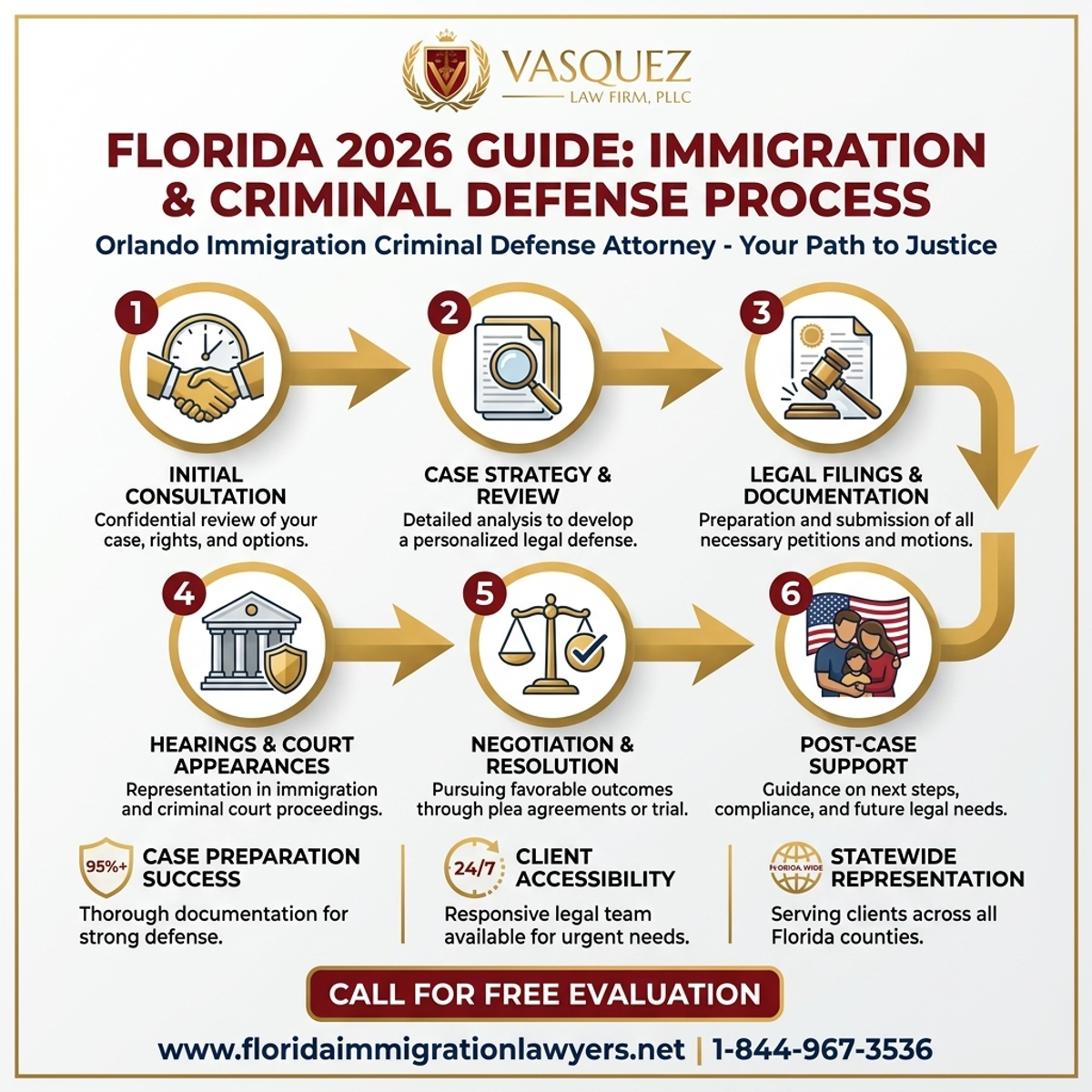
Step-by-Step Process — Orlando Immigration Criminal Defense Attorney: Florida 2026 Guide
Document Checklist for I-601 Waiver:
- Completed Form I-601, signed and dated.
- Copy of your birth certificate and passport.
- Marriage certificate (if applicable) and birth certificates of qualifying children.
- Evidence of the qualifying relative's U.S. citizenship or lawful permanent resident status.
- All police records, court dispositions, and sentencing documents related to your criminal history.
- Proof of rehabilitation (e.g., counseling records, community service, employment history).
- Affidavits from your qualifying relative and other individuals attesting to hardship and good moral character.
- Financial records demonstrating financial dependence or hardship (e.g., tax returns, pay stubs, debt statements).
- Medical records and psychological evaluations detailing health conditions or mental health impacts on the qualifying relative.
- Educational records for qualifying children, if applicable.
- Country conditions reports (if the qualifying relative would have to relocate abroad).
- Any other evidence supporting the extreme hardship claim.
I-601 Waiver Application Timeline and Processing Expectations (as of 2026):
| Stage | Typical Timeframe | Notes |
|---|---|---|
| Legal Consultation & Eligibility Assessment | 1-2 weeks | Crucial first step with an Orlando immigration criminal defense attorney. |
| Document Gathering & Case Preparation | 3-6 months | Involves collecting extensive personal, financial, medical, and legal records. |
| Form I-601 Submission & Receipt | 1-2 weeks | USCIS acknowledges receipt of application. |
| USCIS Processing & Review | 12-24 months | Varies significantly by USCIS service center and case complexity. Check USCIS processing times online. |
| Request for Evidence (RFE) / Interview (if applicable) | Variable | RFEs can extend processing; interviews are scheduled based on case needs. |
| Decision Notification | 1-6 months after interview/RFE response | Final decision on the waiver application. |
What are the common grounds for inadmissibility related to criminal convictions?
Common grounds for inadmissibility due to criminal convictions include crimes involving moral turpitude (CIMT), controlled substance offenses, multiple criminal convictions, and aggravated felonies, as defined by sections 212(a)(2) and 101(a)(43) of the Immigration and Nationality Act (INA). These offenses can prevent an individual from obtaining a visa, adjusting status, or even re-entering the United States, making a criminal waiver essential for many.
The U.S. government maintains a strict stance on criminal activity when it comes to immigration benefits. For anyone seeking to immigrate to Florida or adjust their status within the state, understanding these grounds is paramount. A Crime Involving Moral Turpitude (CIMT) is broadly defined as a crime that is inherently base, vile, or depraved, contrary to the accepted rules of morality and the duties owed between persons or to society in general. Examples often include theft, fraud, assault with intent to harm, and certain sex offenses. Even a single conviction or admission of a CIMT can lead to inadmissibility, though exceptions exist for very minor offenses (e.g., the petty offense exception for those with a maximum possible sentence of one year and a sentence of six months or less). However, navigating these exceptions requires expert legal interpretation.
Controlled Substance Offenses are another significant ground for inadmissibility. A conviction for any law relating to a controlled substance, or even an admission of having committed such an offense, can render an individual inadmissible. This includes possession, distribution, or trafficking of illegal drugs, regardless of the quantity or perceived minor nature of the offense under state law. For instance, a marijuana possession charge in Florida, even if decriminalized or subject to state medical use laws, can still be a federal immigration problem. The INA does not distinguish between different types of controlled substances in the same way state laws might. Furthermore, a finding that an individual is a known drug trafficker can also lead to inadmissibility, even without a conviction. (See INA § 212(a)(2)(A)(i)(II) and § 212(a)(2)(C), 8 U.S.C. § 1182(a)(2)(A)(i)(II) and § 1182(a)(2)(C)).
Multiple Criminal Convictions also pose a significant challenge. If an individual has been convicted of two or more offenses (other than purely political offenses) for which the aggregate sentences to confinement were five years or more, they are inadmissible, regardless of whether the offenses involved moral turpitude. This ground catches individuals with several minor convictions that, when combined, exceed the five-year threshold. Finally, Aggravated Felonies represent the most severe category of criminal offenses for immigration purposes. These are not necessarily felonies under state law; rather, they are a specific list of crimes defined by the INA (INA § 101(a)(43), 8 U.S.C. § 1101(a)(43)), which include offenses such as murder, rape, sexual abuse of a minor, drug trafficking, firearms trafficking, and certain theft offenses with a sentence of at least one year. A conviction for an aggravated felony almost invariably leads to mandatory detention and deportation, with very limited avenues for relief. Given the severity of these consequences, anyone in Orlando or across Florida facing criminal charges with immigration implications needs an Orlando immigration criminal defense attorney immediately to explore all possible defenses and waivers.
What are the costs associated with an I-601 criminal waiver application in 2026?
As of 2026, the costs for an I-601 criminal waiver application primarily include the USCIS filing fee, which can be substantial, along with significant legal fees for an experienced Orlando immigration criminal defense attorney. Additional expenses may arise from obtaining supporting documents, expert evaluations (e.g., psychological assessments), and travel for interviews, making the total investment vary widely depending on case complexity and the specific evidence required.
Understanding the financial commitment involved in an I-601 waiver application is crucial for proper planning. The USCIS filing fee for Form I-601 is a mandatory component and is subject to change. It is essential to always check the official USCIS website or consult with an attorney for the most current fee schedule, as incorrect fees can lead to application rejection and delays. Beyond government fees, the largest expense for most applicants is legal representation. Given the intricate nature of criminal waivers and the high standard of proof required for extreme hardship, retaining a skilled Orlando immigration criminal defense attorney is an investment in your future. Legal fees can vary significantly based on the complexity of your criminal history, the amount of evidence needed to prove extreme hardship, the time required to prepare the legal brief, and the attorney's experience and reputation.
Additionally, there are several other potential costs that applicants should anticipate. Obtaining all necessary supporting documents, such as official police reports, court dispositions, and medical records, may incur fees from various agencies. For cases requiring strong evidence of psychological or emotional hardship, a psychological evaluation from a licensed professional is often recommended or even necessary. These evaluations can be costly but are frequently invaluable in building a compelling hardship case. Furthermore, if documents are not in English, certified translations will be required, adding another layer of expense. Travel expenses for attending interviews, whether at a local USCIS field office in Florida or at a U.S. Embassy or Consulate abroad, should also be factored into the overall budget. While the total cost can be substantial, successfully obtaining a criminal waiver allows individuals to pursue their immigration goals, making it a worthwhile investment for many families in Orlando and across the state.
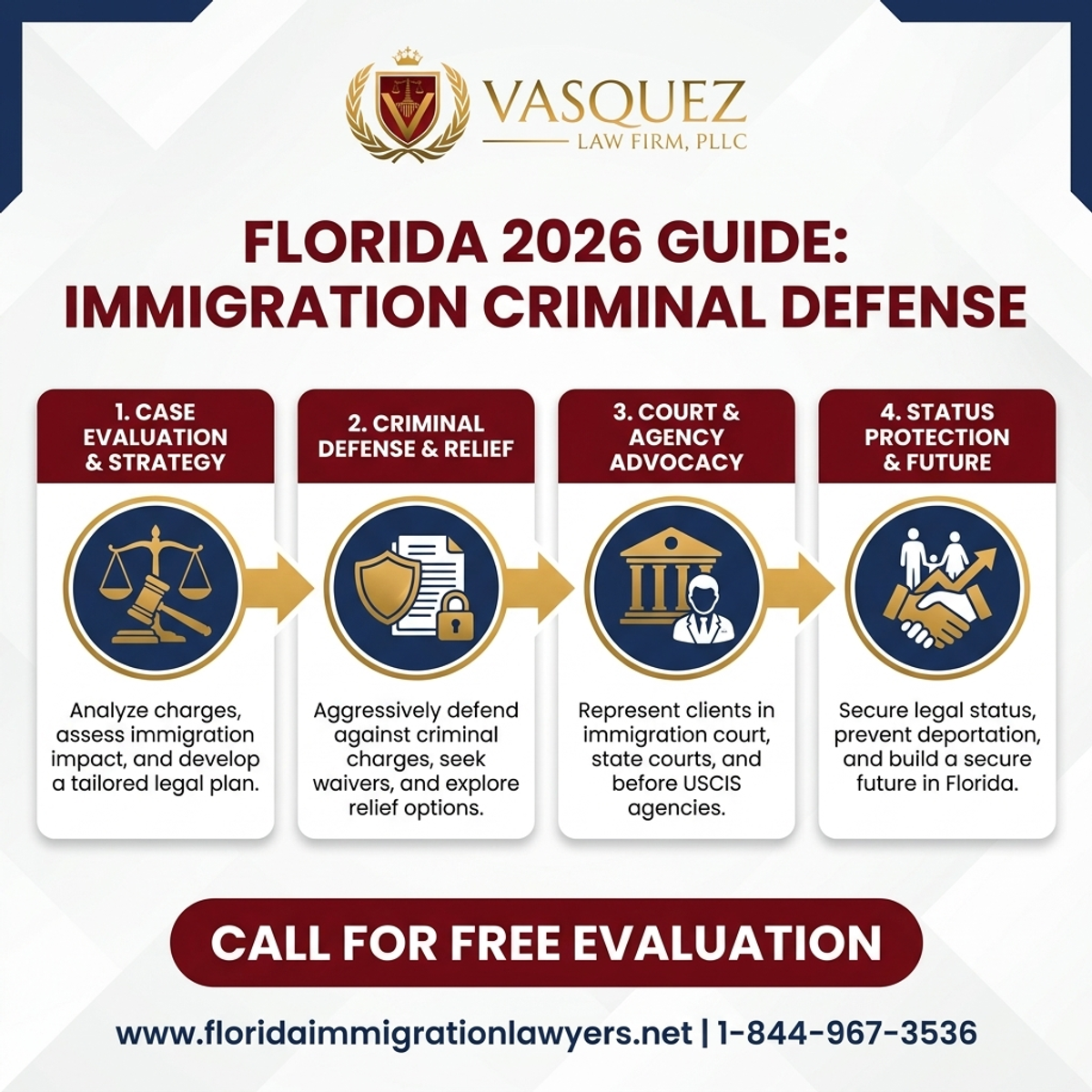
Key Statistics — Orlando Immigration Criminal Defense Attorney: Florida 2026 Guide
Estimated Costs for I-601 Criminal Waiver Application (as of 2026):
| Item | Typical Fee (Estimate) | Notes |
|---|---|---|
| USCIS Form I-601 Filing Fee | Refer to USCIS website | Mandatory government fee, subject to change. Check official site for current amount. |
| Attorney Fees (Legal Representation) | $5,000 - $15,000+ | Varies widely based on case complexity, attorney experience, and required work. |
| Psychological Evaluation for Hardship | $1,000 - $3,000 | Often crucial for proving extreme psychological or emotional hardship. |
| Document Translation Services | $50 - $500+ | Cost per page/document, depends on language and volume. |
| Obtaining Criminal Records/Court Documents | $20 - $200+ | Fees charged by courts or law enforcement agencies. |
| Travel Expenses (for interviews) | Varies | Depends on distance to USCIS office or consulate. |
| Medical Examinations (if required for underlying application) | $200 - $500+ | Separate from I-601, but often part of overall immigration process. |
Navigating Deportation Defense with Criminal Convictions in Florida
For immigrants in Florida, a criminal conviction can quickly escalate into removal (deportation) proceedings. When this happens, the case moves from state criminal court to federal immigration court, often at the Orlando Immigration Court, where the stakes are incredibly high. An individual facing deportation due to criminal grounds needs a specialized defense strategy that addresses both the criminal history and the immigration implications. This is where the expertise of an Orlando immigration criminal defense attorney becomes paramount, providing a critical line of defense against removal.
Deportation defense involving criminal convictions is one of the most challenging areas of immigration law. The U.S. Department of Justice's Executive Office for Immigration Review (EOIR) oversees these proceedings, and immigration judges have the authority to order removal. Many criminal convictions, particularly aggravated felonies, can lead to mandatory detention and very limited forms of relief from removal. However, even in seemingly dire situations, there may be defenses available. These can include challenging the validity of the underlying conviction for immigration purposes, arguing for forms of relief such as cancellation of removal, or demonstrating eligibility for a criminal waiver if one is applicable to the specific ground of deportability. The key is to understand how the specific Florida criminal conviction is classified under federal immigration law – a distinction that can be complex and counterintuitive.
An effective deportation defense strategy starts with a thorough review of the criminal record, including plea agreements, sentencing documents, and transcripts. An attorney may be able to argue that a conviction does not meet the federal definition of a deportable offense or that it falls under an exception. For instance, sometimes a Florida state law conviction for a particular offense might not perfectly align with the federal immigration definition of an aggravated felony, creating an opportunity for defense. Additionally, for individuals who are lawful permanent residents and meet certain criteria, cancellation of removal for LPRs (under INA § 240A(a)) might be an option, requiring a showing of continuous residence, good moral character, and no aggravated felony conviction. For non-LPRs, cancellation of removal (under INA § 240A(b)) may be available in limited circumstances, requiring a showing of extreme and unusual hardship to a qualifying U.S. citizen or LPR spouse, parent, or child. The process demands a deep understanding of BIA (Board of Immigration Appeals) and federal court precedents, making professional legal representation from a firm like Florida Immigration Lawyers indispensable for anyone facing criminal-based deportation in Orlando or elsewhere in Florida.
Do not navigate this process alone. Contact Florida Immigration Lawyers today for a free case review.
Common Mistakes to Avoid in Criminal Immigration Cases
Navigating the intersection of criminal and immigration law is fraught with potential pitfalls. Even minor missteps can have permanent, detrimental effects on your immigration status. Here are common mistakes to avoid:
- Not Understanding the Immigration Definition of “Conviction”: Many individuals assume that if a state court withholds adjudication, expunges a record, or offers a diversion program, their immigration issues are resolved. However, federal immigration law has its own broad definition of “conviction” (INA § 101(a)(48)(A), 8 U.S.C. § 1101(a)(48)(A)) that often includes these outcomes, making them still count against you for immigration purposes.
- Failing to Disclose All Criminal History: Attempting to conceal any arrest, charge, or conviction, no matter how minor or old, on immigration forms or during interviews is a severe mistake. It can lead to charges of misrepresentation, fraud, and permanent bars from the U.S.
- Attempting to File Waivers Without Legal Counsel: Criminal waivers like Form I-601 are highly complex. Filing without an experienced Orlando immigration criminal defense attorney often results in incomplete applications, insufficient evidence of hardship, and ultimately, denial.
- Insufficient Evidence of “Extreme Hardship”: The burden of proof for extreme hardship is high. Many applicants underestimate the amount and quality of evidence required, leading to a weak case and denial. Generic letters or basic financial statements are rarely enough.
- Missing Deadlines: Immigration proceedings and applications are subject to strict deadlines. Missing a filing deadline, interview date, or response time for a Request for Evidence (RFE) can lead to automatic denials or even orders of removal.
- Traveling Internationally Without Proper Clearance: After a criminal conviction, even if a waiver is pending or approved, traveling outside the U.S. without explicit permission or a clear understanding of reentry rules can trigger new grounds of inadmissibility upon return, especially if you have been previously removed.
- Assuming a State Pardon Clears Immigration Issues: While a state pardon can restore rights at the state level, it generally does not eliminate grounds of inadmissibility or deportability under federal immigration law. Specific types of pardons might have limited immigration benefits, but this is rare and requires expert analysis.
- Providing Inconsistent Information: Any discrepancies between information provided on different immigration forms, during interviews, or in supporting documents can raise red flags and lead to accusations of fraud or misrepresentation.
- Not Addressing All Grounds of Inadmissibility: If an individual has multiple criminal issues, they might be inadmissible on several different grounds. A waiver must address *all* applicable grounds; failing to waive even one can result in a denial of the entire application.
- Failing to Prepare for Interviews: Interviews with USCIS or at a consulate are critical. Lack of preparation, inconsistent answers, or inability to articulate key aspects of your case, particularly related to hardship, can jeopardize your application.
When to Call an Orlando Immigration Criminal Defense Attorney
The moment you or a loved one in Florida faces criminal charges, or if you have a past criminal record that could affect your immigration status, is the exact moment to call an experienced Orlando immigration criminal defense attorney. Early intervention is not just advisable; it is often the single most important factor in achieving a positive outcome. Waiting until an application is denied or removal proceedings have begun significantly limits your options and complicates your defense.
Specific scenarios that absolutely demand immediate legal help include:
- Any Arrest or Criminal Charge: Even a seemingly minor arrest in Florida can trigger severe immigration consequences. An attorney can advise on plea bargains that minimize immigration impact or explore post-conviction relief.
- Receiving a Notice to Appear (NTA): If you receive an NTA from the Executive Office for Immigration Review (EOIR), it means the government intends to deport you. This is a removal proceeding, and you need a lawyer immediately to represent you in immigration court.
- Application Denied Due to Criminal History: If your visa, green card, or naturalization application is denied because of a criminal record, an attorney can review the denial, assess grounds for appeal, or identify potential waivers.
- Previous Deportation or Removal: If you were previously deported and wish to re-enter the U.S., you will likely need a Form I-212 waiver, which is highly complex and requires expert legal guidance.
- Uncertainty About Your Criminal Record's Impact: If you have any criminal history, even if it's old or you believe it's expunged, it's crucial to have an attorney review it to understand its potential immigration consequences before applying for any benefits or traveling internationally.
Florida Immigration Lawyers has a proven track record of helping clients in Orlando and throughout Florida navigate these intricate challenges. Our attorneys possess a deep understanding of both criminal and immigration law, allowing us to craft tailored strategies that protect your rights and pursue the most favorable outcome possible. We offer comprehensive services, from evaluating your criminal record and assessing waiver eligibility to representing you in immigration court. Don't let criminal issues jeopardize your future in the U.S. Contact us today.
About Florida Immigration Lawyers
Florida Immigration Lawyers is a leading immigration law firm dedicated to serving individuals and families across the entire state of Florida. With a profound understanding of the complexities of U.S. immigration law, our experienced attorneys provide compassionate yet tenacious legal representation for a wide range of immigration matters, including family-based petitions, employment visas, deportation defense, asylum claims, and criminal immigration waivers.
Our commitment extends to protecting the rights and futures of immigrants facing challenging circumstances, particularly those whose immigration status is impacted by criminal charges or convictions. We pride ourselves on offering personalized legal strategies tailored to each client's unique situation, ensuring that every case receives the attention and expertise it deserves. Our firm is available 24/7 to address urgent concerns, offering free case reviews to help you understand your options without financial obligation. We believe that everyone deserves access to high-quality legal representation, and we strive to make that a reality for our clients in Orlando, Miami, Tampa, Jacksonville, and all other Florida communities.
If you need an Orlando immigration criminal defense attorney or assistance with any immigration matter, trust Florida Immigration Lawyers to be your advocate. Contact us today at 1-844-967-3536 or visit our website at https://www.floridaimmigrationlawyers.net to schedule your free consultation. We are here to help you navigate your immigration journey with confidence and peace of mind.
Sources and References
- U.S. Citizenship and Immigration Services (USCIS)
- Executive Office for Immigration Review (EOIR)
- U.S. Department of State
- 8 U.S.C. Chapter 12 - Immigration and Nationality Act (INA)
- INA § 212(a)(2) - Criminal and Related Grounds of Inadmissibility
- INA § 101(a)(43) - Definition of Aggravated Felony
- INA § 101(a)(48)(A) - Definition of Conviction
- INA § 240A(a) - Cancellation of Removal for Certain Permanent Residents
- INA § 240A(b) - Cancellation of Removal and Adjustment of Status for Certain Nonpermanent Residents
- 8 CFR Part 212 - Documentary Requirements: Nonimmigrants; Waivers; Admission of Certain Inadmissible Aliens; Parole
- USCIS Policy Manual - Volume 9, Waivers
Related services: immigration practice areas, family immigration services, citizenship and naturalization.
This article provides general legal information and is not intended as legal advice. Every case is unique, and outcomes depend on specific facts and circumstances. Contact an attorney for advice about your particular situation. Immigration laws are complex and subject to change; always verify current regulations with official government sources or a qualified legal professional.
Your immigration future in Florida is too important to leave to chance, especially when facing criminal allegations or convictions. The complexities of federal immigration law, combined with state criminal proceedings, require the specialized knowledge and experience of a dedicated legal team. At Florida Immigration Lawyers, we are committed to providing aggressive and compassionate representation to protect your rights and help you achieve your immigration goals.
If you are in Orlando or anywhere in Florida and need an immigration criminal defense attorney, do not hesitate. Take the critical first step towards securing your future. Call Florida Immigration Lawyers now for a free, confidential case review. Our team is ready to listen, advise, and fight for you. Call 1-844-967-3536 today! Se Habla Espanol - Estamos aqui para ayudarle.
If you need legal assistance, learn more about immigration lawyers in Florida, or call us at 1-844-967-3536 for a free consultation.
Do Not Navigate This Process Alone
Our experienced immigration attorneys are ready to fight for you. Get a free, confidential consultation today.
Se Habla Español
Or leave your details and we’ll call you:
Free Evaluation in 24 Hours
Or talk to us right now
AI voice assistant — available 24/7
FreeFrequently Asked Questions

William J. Vásquez
Founding Attorney · Vasquez Law Firm
U.S. Air Force veteran and immigration attorney with years of hands-on U.S. immigration experience. J.D., NCCU School of Law. AILA member. Admitted to the 4th, 5th, and 11th Circuit Courts.
Available 24/7 - Free Evaluations
Reviewed for legal accuracy by William J. Vásquez
Licensed in North Carolina; U.S. immigration is federal practice.
Related Legal Services
Our Florida immigration attorneys can help you with immigration practice areas, free immigration consultation and experienced immigration attorneys. Call today at 1-844-967-3536 for a free consultation.
Related Links
Related Topics
Free Legal Consultation
Discuss your case with our experienced attorneys. We're available 24/7.
Se Habla Español - Estamos aquí para ayudarle.
Related Articles
Immigration Lawyer Orlando Free Consultation in Florida
For individuals and families in Orlando, Florida, navigating the complexities of U.S. immigration law requires expert guidance. An immigration lawyer in Orlando offers crucial support for everything from visa applications and green card processes to naturalization and deportation defense. This comprehensive guide details what a free consultation covers, providing a step-by-step overview of immigration pathways, essential document checklists, and expected timelines in 2026. We also highlight common mistakes to avoid, discuss the critical role of legal counsel in deportation and asylum cases, and explain why choosing a local Orlando immigration attorney is beneficial. Florida Immigration Lawyers is dedicated to serving the diverse community of Orlando with compassionate, effective legal solutions, ensuring you receive personalized advice and robust representation for a successful immigration journey.
VAWA Self-Petition for Abused Spouses in Florida 2026
For abused spouses in Florida, the VAWA self-petition offers a crucial, confidential pathway to immigration relief and a green card, independent of an abusive U.S. citizen or lawful permanent resident spouse. This guide from Florida Immigration Lawyers details eligibility, the step-by-step filing process for Form I-360, essential documentation, and typical processing times as of 2026. We also cover associated costs, highlight common mistakes to avoid, and explain when it is vital to seek legal assistance. Understanding your rights under the Violence Against Women Act is paramount to securing safety and stability. Our Orlando-based firm is dedicated to providing compassionate, expert legal support to survivors across Florida, ensuring they can rebuild their lives free from fear.
Immigration Lawyer Orlando Free Consultation: Your Options
Navigating immigration court proceedings in Florida can be incredibly complex and stressful. For those in Orlando, finding an experienced immigration lawyer for a free consultation is a crucial first step. This comprehensive guide from Florida Immigration Lawyers explains what to expect during removal proceedings, including the stages from Notice to Appear (NTA) to appeals, and outlines various forms of relief like asylum or cancellation of removal. We detail how to find the right legal representation, discuss potential costs, and highlight common mistakes to avoid. With several immigration courts across Florida, understanding the process and securing expert legal counsel is paramount to protecting your rights and securing a favorable outcome. Florida Immigration Lawyers offers free case reviews to help individuals across the state navigate these challenging legal waters with confidence and clarity, providing dedicated support every step of the way.
Voluntary Departure vs. Deportation in Florida 2026
Navigating immigration challenges in Florida, particularly the distinction between voluntary departure and deportation, is critical for non-citizens. Voluntary departure offers a chance to leave the U.S. without a formal deportation order, potentially easing future re-entry. It requires strict eligibility, including good moral character and financial means to depart, typically within 60-120 days. In contrast, deportation results in severe re-entry bars, often for 5, 10, or 20 years. This guide explores the process, documentation, costs, and critical mistakes to avoid, emphasizing the importance of timely departure and legal counsel. Florida Immigration Lawyers provides expert guidance for individuals in Orlando, Miami, and across the state, offering free case reviews to help protect your immigration future. Understanding these differences is paramount to making informed decisions and avoiding irreversible consequences.