VAWA Self-Petition for Abused Spouses in Florida 2026
For abused spouses in Florida, the VAWA self-petition offers a crucial, confidential pathway to immigration relief and a green card, independent of an abusive U.S. citizen or lawful permanent resident spouse. This guide from Florida Immigration Lawyers details eligibility, the step-by-step filing process for Form I-360, essential documentation, and typical processing times as of 2026. We also cover associated costs, highlight common mistakes to avoid, and explain when it is vital to seek legal assistance. Understanding your rights under the Violence Against Women Act is paramount to securing safety and stability. Our Orlando-based firm is dedicated to providing compassionate, expert legal support to survivors across Florida, ensuring they can rebuild their lives free from fear.

A VAWA (Violence Against Women Act) self-petition allows certain abused spouses, children, and parents of U.S. citizens or lawful permanent residents to apply for immigration benefits independently, without the abuser's knowledge or cooperation. This crucial pathway provides protection and a path to a green card for victims of domestic violence, extreme cruelty, or other forms of abuse who reside in Florida or whose abuse occurred here. It is a confidential process, distinct from divorce or criminal proceedings, focusing solely on the victim's eligibility for immigration relief. Seeking legal counsel is vital to navigate this complex process successfully and ensure all requirements are met.
- VAWA provides a confidential path to a green card for abused immigrants.
- Eligibility requires proof of abuse by a U.S. citizen or LPR spouse, parent, or child.
- The process is independent of the abuser and protects victims from deportation.
- A successful VAWA petition (Form I-360) can lead to lawful permanent residency.
- Legal assistance is highly recommended due to the sensitive nature and complexity.
Navigating the complex world of immigration law can be daunting, especially when you are facing the added challenges of domestic violence or extreme cruelty. For many individuals in Florida, the dream of a safe and stable life in the United States seems out of reach due to an abusive relationship with a U.S. citizen or lawful permanent resident spouse. However, the Violence Against Women Act (VAWA) offers a beacon of hope through its self-petitioning provisions. This vital legislation allows abused spouses to seek immigration relief independently, without needing the abuser's cooperation or knowledge, providing a confidential and secure pathway to legal status.
At Florida Immigration Lawyers, we understand the profound courage it takes to escape an abusive situation and seek protection. Our firm is dedicated to empowering survivors in Orlando and across Florida, ensuring they understand their rights and available immigration options. This comprehensive guide will walk you through the intricacies of the VAWA self-petition process, from eligibility requirements and necessary documentation to timelines, costs, and common pitfalls. Our goal is to provide clarity and support as you embark on this journey toward safety and independence. You do not have to endure abuse in silence; there are legal avenues to secure your future.
If you are an abused spouse in Florida considering a VAWA self-petition, do not hesitate to seek expert legal guidance. Call Florida Immigration Lawyers at 1-844-967-3536 for a free, confidential case review. We are here to help you understand your options and protect your rights.
What is a VAWA Self-Petition for Abused Spouses in Florida?
A VAWA self-petition, filed using Form I-360, Petition for Amerasian, Widow(er), or Special Immigrant, is an immigration pathway designed to protect victims of domestic violence. Specifically, it allows certain abused spouses, children, and parents of U.S. citizens (USCs) or Lawful Permanent Residents (LPRs) to petition for immigration benefits on their own behalf, without the involvement of the abuser. This provision is critical because it prevents abusers from using their immigration status as a tool of control, coercing their victims into remaining in abusive relationships by threatening deportation or withholding immigration sponsorship.
For abused spouses in Florida, the VAWA self-petition offers a confidential and independent route to applying for a green card. The process is entirely separate from any divorce or criminal proceedings, focusing solely on the immigration eligibility of the abused individual. Once the I-360 petition is approved, the self-petitioner becomes an immediate relative (if the abuser was a USC) or receives a priority date in a family-preference category (if the abuser was an LPR), allowing them to then apply for adjustment of status (Form I-485) to become a lawful permanent resident within the United States, or apply for an immigrant visa abroad. This relief is available regardless of whether the abuser is still alive or if the marriage has ended, provided certain conditions are met regarding the abuse and the relationship.
The intent of VAWA, codified in sections like INA 204(a)(1)(A)(iii) and 8 CFR 204.2(c), is to ensure that victims are not trapped in abusive situations due to their immigration status. It recognizes that domestic violence is a serious crime that impacts individuals across all communities, including the diverse immigrant population in Florida. Our Orlando immigration lawyers are well-versed in these protections and can guide you through every step, helping you gather the necessary evidence to demonstrate eligibility and build a strong case for your VAWA self-petition.
Who is Eligible for a VAWA Self-Petition (I-360)?
To be eligible for a VAWA self-petition as an abused spouse, you must meet several specific criteria established by U.S. Citizenship and Immigration Services (USCIS). These requirements are designed to ensure that the protections are extended to those genuinely in need. Understanding these criteria is the first critical step in pursuing your immigration relief.
-
Bona Fide Marriage: You must have been legally married to a U.S. citizen or lawful permanent resident. It is essential to demonstrate that you entered the marriage in good faith, meaning you genuinely intended to establish a life together, not solely for immigration purposes. Even if the marriage has ended through divorce, you may still be eligible if the divorce occurred within two years of filing your I-360 petition and was related to the abuse.
-
Abuse Suffered: You must have been subjected to battery or extreme cruelty by your U.S. citizen or LPR spouse. Abuse can take many forms, including physical, sexual, psychological, emotional, or financial. While physical abuse leaves visible marks, extreme cruelty encompasses a broader range of behaviors that inflict severe mental or psychological harm. USCIS considers the totality of circumstances, so detailed affidavits and supporting evidence are crucial.
-
Residency with Abuser: You must have resided with your abuser in the United States. This does not mean you had to live together for the entire duration of the marriage, but there must be evidence of cohabitation. For individuals in Florida, this typically means living together in a shared residence in cities like Orlando, Miami, or Tampa.
-
Good Moral Character: You must demonstrate that you are a person of good moral character. This generally involves providing your criminal record (or lack thereof) and other evidence that you have not committed certain crimes or engaged in activities that would disqualify you. USCIS reviews your entire history to make this determination, emphasizing your conduct during your time in the U.S.
-
Residency in the U.S. or Abuse Abroad: While you generally must reside in the United States when filing, you may also be eligible if the abuse occurred in the U.S. or if your abuser is a U.S. government employee or member of the U.S. uniformed services, and you are residing abroad. For Florida residents, proving your presence in the state during the abuse is usually straightforward.
Meeting these criteria can be challenging, especially when dealing with the emotional aftermath of abuse. Our dedicated team at Florida Immigration Lawyers can help you assess your eligibility, gather compelling evidence, and prepare a robust I-360 petition to maximize your chances of approval. We provide compassionate and confidential legal support to survivors throughout Florida.
How to File a VAWA Self-Petition (I-360) in Florida: A Step-by-Step Guide
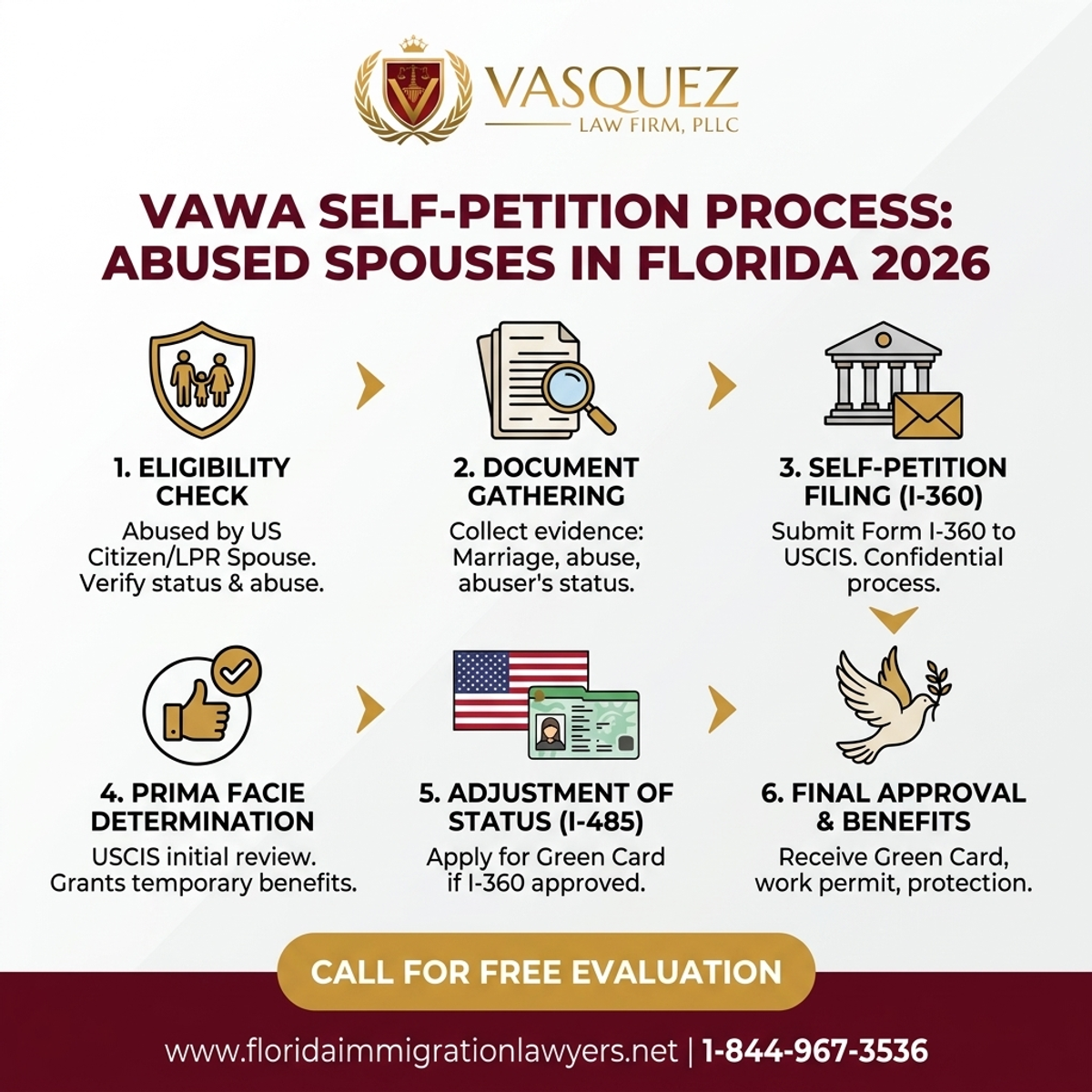
Filing a VAWA self-petition is a multi-step process that requires meticulous attention to detail and thorough documentation. For abused spouses in Florida, understanding each stage is crucial to a successful outcome. Here is a general step-by-step guide to help you navigate the process:
-
Consult with an Immigration Attorney: This is arguably the most critical first step. A qualified attorney specializing in VAWA cases, like those at Florida Immigration Lawyers, can assess your eligibility, help you gather evidence, prepare your petition, and represent you throughout the process. They can identify potential challenges and ensure your application is as strong as possible. This initial consultation is vital for understanding the specific nuances of your situation.
-
Gather Evidence of Abuse and Relationship: Begin collecting all available evidence that proves your marriage was bona fide and that you suffered battery or extreme cruelty. This includes affidavits from you and witnesses, police reports, medical records, counseling reports, photos, emails, text messages, financial records, and any other documentation that supports your claims. Evidence of your abuser's U.S. citizen or LPR status is also necessary.
-
Prepare Form I-360, Petition for Amerasian, Widow(er), or Special Immigrant: Carefully complete Form I-360. This form is central to your VAWA self-petition. Ensure all sections are accurately filled out, providing comprehensive details about your marriage, the abuse you endured, your good moral character, and your cohabitation with the abuser. An attorney can help you articulate your story clearly and compellingly, which is crucial for USCIS to understand your circumstances fully.
-
Draft a Personal Declaration: Your personal declaration is a powerful component of your petition. In this detailed statement, you will describe the history of your relationship, the abuse you suffered, and how it impacted your life. This narrative should be thorough, truthful, and emotionally compelling, providing USCIS with a clear understanding of your experiences. This statement is often the most impactful piece of evidence.
-
Compile Supporting Documentation: Organize all your evidence meticulously. This includes proof of your abuser's immigration status (e.g., birth certificate, green card copy), marriage certificate, divorce decrees (if applicable), birth certificates of any children, and all evidence of abuse and good moral character. Create a detailed table of contents for your submission to make it easy for USCIS to review.
-
File Your Petition with USCIS: Mail your completed Form I-360, personal declaration, and all supporting documentation to the appropriate USCIS address. As of 2026, there is no filing fee for the VAWA I-360 self-petition itself. However, if you concurrently file Form I-485 (Application to Register Permanent Residence or Adjust Status), you will need to pay the associated fees for that application. USCIS will send you a receipt notice (Form I-797C) confirming they received your application.
Step-by-Step Process — VAWA Self-Petition for Abused Spouses in Florida 2026
-
Attend Biometrics Appointment: After filing, you will receive a notice for a biometrics appointment at a local Application Support Center (ASC), such as the one in Orlando, Florida. At this appointment, your fingerprints, photograph, and signature will be collected for background checks.
-
Respond to Requests for Evidence (RFEs) or Notices of Intent to Deny (NOIDs): USCIS may send an RFE if they need more information or clarification. A NOID indicates they intend to deny your petition unless you provide additional compelling evidence. Responding thoroughly and promptly to these notices, ideally with legal assistance, is critical to the success of your case.
-
Receive Decision on I-360: If your I-360 petition is approved, USCIS will send you an approval notice. This means you have established your eligibility as a VAWA self-petitioner. If denied, an attorney can help you understand the reasons and explore options like appealing the decision.
-
Apply for Adjustment of Status (I-485) or Immigrant Visa: Once your I-360 is approved, you can apply for a green card. If you are in the U.S. and eligible, you will file Form I-485. If you are outside the U.S. or are not eligible for adjustment of status, you will pursue consular processing through the National Visa Center and a U.S. embassy or consulate abroad. This final step leads to lawful permanent residency.
Essential Documents for Your VAWA I-360 Self-Petition
A successful VAWA self-petition hinges on submitting a comprehensive and compelling package of evidence. USCIS requires specific documents to verify your eligibility and substantiate your claims of abuse and a bona fide marriage. Gathering these materials can be overwhelming, but a systematic approach, guided by an experienced attorney, can simplify the process for abused spouses in Florida.
Here is a detailed checklist of essential documents you should prepare for your I-360 petition:
-
Form I-360, Petition for Amerasian, Widow(er), or Special Immigrant: The completed and signed form, without any filing fee for VAWA self-petitioners.
-
Your Personal Declaration: A detailed, sworn statement describing the abuse, the bona fides of your marriage, your good moral character, and other relevant facts. This is often the most critical piece of evidence.
-
Proof of Abuser's U.S. Citizen or LPR Status:
- Copy of abuser's birth certificate (if USC)
- Copy of abuser's U.S. passport (if USC)
- Copy of abuser's Certificate of Naturalization (if USC)
- Copy of abuser's Permanent Resident Card (Green Card, Form I-551) (if LPR)
-
Proof of Bona Fide Marriage:
- Marriage certificate
- Birth certificates of any children born to you and the abuser
- Joint bank accounts, credit card statements, property deeds, leases, utility bills
- Photos of your wedding, family gatherings, and shared life
- Affidavits from friends, family, or religious leaders attesting to the legitimacy of your marriage
- Correspondence (letters, emails, texts) between you and your abuser, especially showing shared life or emotional context
-
Evidence of Battery or Extreme Cruelty:
- Police reports, arrest records, or court documents related to domestic violence incidents
- Medical records or reports from doctors, hospitals, or emergency rooms detailing injuries
- Psychological evaluations or counseling reports from mental health professionals
- Affidavits from witnesses (friends, family, neighbors, co-workers) who observed the abuse or its effects
- Shelter records or letters from domestic violence support organizations in Florida (e.g., Harbor House of Central Florida in Orlando)
- Copies of restraining orders or protection orders
- Photographs of injuries or property damage
- Emails, text messages, or voicemails from the abuser demonstrating control, threats, or abuse
- Financial records showing economic abuse or control
-
Proof of Good Moral Character:
- Police clearances from all places you have lived since age 16 (both in the U.S. and abroad)
- Court disposition documents for any arrests or convictions, even minor ones
- Affidavits from individuals attesting to your good moral character
-
Proof of Residence with Abuser:
- Joint leases, utility bills, mail addressed to both of you at the same address
- Affidavits from landlords or neighbors
-
Other Supporting Documents:
- Your birth certificate
- Copies of your passport, I-94 arrival/departure record, or any other immigration documents
- If applicable, divorce decree from the abuser (must be finalized within two years of filing and related to the abuse)
Organizing these documents thoroughly and presenting them clearly is vital. Florida Immigration Lawyers can help you compile a robust package, ensuring no critical piece of evidence is overlooked and that your case is presented effectively to USCIS.
How Long Does a VAWA I-360 Self-Petition Take in 2026?
As of 2026, the processing times for a VAWA I-360 self-petition can vary significantly based on the volume of applications, the complexity of your case, and the specific USCIS service center handling your petition. While USCIS provides general processing timeframes on its website, it's important to remember these are estimates and not guarantees. The journey from filing your I-360 to receiving a green card involves multiple stages, each with its own timeline.
Generally, you can expect the initial I-360 petition to take anywhere from 12 to 24 months for a decision. If approved, the subsequent adjustment of status (Form I-485) can add another 6 to 18 months, depending on your eligibility category and the local USCIS field office, such as the one in Orlando, Florida. Delays can occur if USCIS issues a Request for Evidence (RFE) or if background checks take longer than usual. It is also important to note that the approval of an I-360 VAWA petition provides deferred action and work authorization, offering significant relief while awaiting the final green card decision.
Here’s a typical timeline breakdown for the VAWA self-petition process in 2026:
| Stage | Typical Timeframe (As of 2026) | Notes |
|---|---|---|
| Preparation of I-360 Petition | 1-3 Months | Gathering documents, drafting declarations, attorney review. Highly dependent on applicant's readiness. |
| USCIS Receipt Notice (I-797C) | 2-4 Weeks after filing | Confirmation that USCIS has received your I-360 petition. |
| Biometrics Appointment | 1-3 Months after receipt | Scheduled at a local Application Support Center (ASC), like the one in Orlando. |
| Prima Facie Determination | Within 6 Months (often sooner) | USCIS determines if your petition is approvable on its face. Can lead to work authorization (EAD) eligibility. |
| I-360 Petition Adjudication | 12-24 Months | Time for USCIS to review all evidence and make a decision on your VAWA petition. May include an RFE. |
| I-360 Approval | Variable after adjudication | Upon approval, you are granted deferred action and become eligible for an EAD and often an I-485. |
| Adjustment of Status (I-485) Application | 6-18 Months (after I-360 approval) | If filed concurrently or after I-360 approval, this is the final step to a green card. Includes interview at a USCIS field office. |
| Green Card Issuance | 1-2 Months after I-485 approval | Your permanent resident card (Form I-551) is mailed to you. |
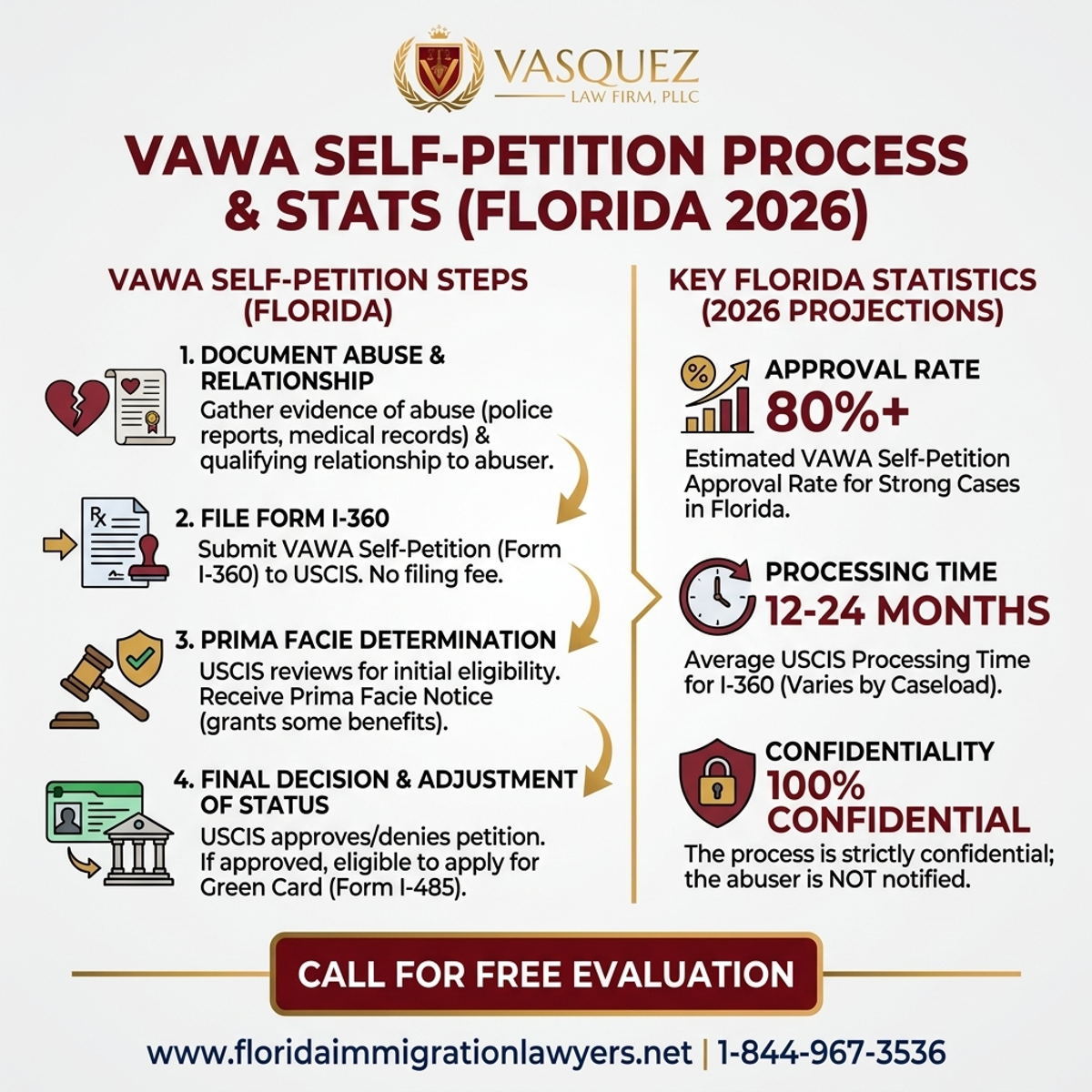
Key Statistics — VAWA Self-Petition for Abused Spouses in Florida 2026
It's important to remember that these are average estimates. Each case is unique, and factors such as the thoroughness of your application, the volume of cases at the service center, and even policy changes can affect the actual processing time. Working with an experienced immigration lawyer can help minimize delays by ensuring your application is complete and well-supported from the outset.
What Are the Costs for a VAWA Self-Petition in Florida?
Understanding the financial aspects of a VAWA self-petition is important for abused spouses in Florida planning their immigration journey. Fortunately, one of the significant benefits of the VAWA program is the waiver of certain USCIS filing fees for the primary petition, providing much-needed relief to vulnerable individuals. However, while the I-360 itself is free to file, there are other potential costs associated with the overall process.
As of 2026, the filing fee for Form I-360, Petition for Amerasian, Widow(er), or Special Immigrant, when filed as a VAWA self-petition, is $0. This is a critical provision designed to ensure that financial hardship does not prevent victims of abuse from seeking protection. However, if you concurrently file other forms, such as Form I-485 (Application to Register Permanent Residence or Adjust Status), Form I-765 (Application for Employment Authorization), or Form I-131 (Application for Travel Document), those associated fees generally apply, unless you qualify for a fee waiver for those specific forms based on your income or receipt of public benefits. Attorney fees are also a significant consideration, though invaluable for ensuring a strong application.
| Item | Typical Fee (As of 2026) | Notes |
|---|---|---|
| Form I-360 (VAWA Self-Petition) | $0 | No USCIS filing fee for VAWA self-petitioners. |
| Form I-485 (Adjustment of Status) | Variable (e.g., ~$1,225) | Fee typically required for green card application, unless a fee waiver is granted. Includes biometrics fee. |
| Form I-765 (Employment Authorization Document - EAD) | Variable (e.g., ~$470) | Fee typically required for work permit, unless filed concurrently with I-485 or a fee waiver is granted. |
| Form I-131 (Travel Document - Advance Parole) | Variable (e.g., ~$630) | Fee typically required for travel permit, unless filed concurrently with I-485 or a fee waiver is granted. |
| Medical Examination | $200 - $500 | Required for Form I-485. Performed by a USCIS-approved civil surgeon. Costs vary by provider. |
| Attorney Fees | Variable (Consultation required) | Legal fees for representation, document preparation, and guidance. This is a crucial investment for success. |
| Translation Services | Variable | Costs for translating documents not in English, if applicable. |
| Postal Fees/Courier | Minimal | Costs for mailing applications securely. |
It is important to discuss all potential costs with your attorney during your initial consultation. Florida Immigration Lawyers offers free case reviews, allowing you to understand the process and associated expenses without upfront financial commitment. We can also help you determine if you qualify for fee waivers for subsequent applications like the I-485, I-765, and I-131, which can significantly reduce your overall financial burden. Our goal is to make the path to safety and legal status as accessible as possible for survivors in Orlando and across Florida.
Life After VAWA Approval: Achieving Your Green Card in Florida
Receiving an approval for your VAWA I-360 self-petition is a momentous achievement, marking a critical step towards independence and lawful permanent residency. This approval signifies that USCIS has recognized your eligibility as an abused spouse and has granted you deferred action. Deferred action means that USCIS will not pursue removal (deportation) proceedings against you, providing a significant layer of protection and peace of mind for survivors in Florida.
Upon I-360 approval, you become eligible to apply for an Employment Authorization Document (EAD) by filing Form I-765, if you haven't already. An EAD allows you to work legally in the United States, providing financial independence from your abuser and enhancing your ability to rebuild your life in Florida. Furthermore, the approval of your VAWA petition allows you to proceed with the final step: applying for a green card, also known as Adjustment of Status (Form I-485), if you are physically present in the U.S. and meet other eligibility criteria. If you are outside the U.S. or ineligible for adjustment of status, you would pursue consular processing.
The adjustment of status application involves submitting Form I-485, along with supporting documents, undergoing a medical examination by a USCIS-approved civil surgeon in Florida, and potentially attending an interview at a local USCIS field office, such as the one in Orlando. During this interview, an immigration officer will verify the information in your application and ensure you are admissible to the United States. Our attorneys at Florida Immigration Lawyers will prepare you thoroughly for this interview, ensuring you feel confident and ready to answer any questions. Once your I-485 is approved, you will receive your permanent resident card, granting you the full rights and responsibilities of a lawful permanent resident and offering a fresh start away from abuse.
Do not navigate this process alone. The journey from abuse to independence and legal status can be complex, but you don't have to face it by yourself. Contact Florida Immigration Lawyers today at 1-844-967-3536 for a free case review. Our compassionate team is here to provide the expert legal support you deserve.
Common Mistakes to Avoid in Your VAWA Self-Petition
The VAWA self-petition process is intricate and highly sensitive. Even minor errors or omissions can lead to significant delays, Requests for Evidence (RFEs), or even denial. For abused spouses in Florida, understanding and avoiding these common pitfalls is crucial to a successful outcome. Here are some key mistakes to watch out for:
-
Failing to Provide Sufficient Evidence of Abuse: Many applicants underestimate the amount and type of evidence required. USCIS needs compelling proof of battery or extreme cruelty, not just a statement. Lack of police reports or medical records can be compensated with detailed affidavits, psychological evaluations, and extensive personal declarations. Incomplete evidence is a primary reason for RFEs and denials.
-
Inadequate Proof of Bona Fide Marriage: USCIS scrutinizes whether the marriage was entered in good faith. Simply submitting a marriage certificate is not enough. Failing to provide joint financial documents, shared leases, photos, and witness affidavits can lead to questions about the legitimacy of the marriage, even in cases of severe abuse.
-
Not Filing a Timely Petition After Divorce: If you are divorced from your abuser, you generally have a two-year window from the date of the divorce to file your VAWA self-petition, provided the divorce was related to the abuse. Missing this deadline can result in ineligibility, losing your chance for VAWA relief.
-
Lack of Detail in the Personal Declaration: Your personal declaration is your story, and it needs to be detailed, consistent, and emotionally resonant. Vague statements or a lack of specific dates, events, and impacts of the abuse can weaken your case. USCIS needs to understand the full scope of your suffering.
-
Failure to Prove Good Moral Character: Any criminal history, even minor infractions, must be disclosed and properly addressed. Concealing information or failing to provide certified court dispositions can be detrimental. USCIS requires comprehensive evidence of your good moral character, and any perceived deception can lead to denial.
-
Not Responding Promptly or Adequately to RFEs: If USCIS sends a Request for Evidence, it means they need more information to make a decision. Failing to respond within the given timeframe, or submitting an insufficient response, will almost certainly lead to a denial. Legal guidance is vital for crafting a strong RFE response.
-
Attempting to Handle the Case Without Legal Representation: While it is legally possible to self-file, the complexity, emotional toll, and high stakes of a VAWA petition make legal representation invaluable. An attorney can ensure all requirements are met, evidence is compelling, and your rights are protected, significantly increasing your chances of success.
-
Assuming Abuse Must Be Physical: Many victims incorrectly believe that only physical violence qualifies as abuse for VAWA purposes. However, extreme cruelty, which includes psychological, emotional, verbal, and financial abuse, is equally valid. Failing to document and articulate these non-physical forms of abuse can weaken a strong case.
When to Call a Lawyer for Your VAWA Self-Petition
Deciding to pursue a VAWA self-petition is a courageous step, and having experienced legal counsel by your side can make all the difference. While the option to self-file exists, the complexities of immigration law, the sensitive nature of abuse, and the high stakes involved make professional legal assistance invaluable. You should consider contacting Florida Immigration Lawyers if any of the following scenarios apply to you:
-
You are currently experiencing abuse: If you are living in an abusive situation in Florida, a lawyer can help you understand your immediate safety options and simultaneously guide you through the VAWA process, ensuring your immigration status doesn't prevent you from seeking help.
-
Your abuser is threatening to withdraw their petition or have you deported: This is a common tactic abusers use to maintain control. A VAWA self-petition allows you to bypass the abuser's control entirely, and an attorney can help you secure this independent pathway swiftly.
-
You have a complicated immigration history: Previous deportations, criminal records, or other immigration issues can complicate your VAWA case. An attorney can assess these factors and advise on potential waivers or strategies to overcome inadmissibility.
-
You are unsure if you meet eligibility requirements: The criteria for VAWA are specific. A lawyer can thoroughly evaluate your situation, determine your eligibility, and advise on the strength of your case.
-
You lack sufficient documentation: Gathering evidence of abuse and a bona fide marriage can be challenging, especially in sensitive situations. An attorney can help you identify alternative forms of evidence and build a strong case even with limited traditional documentation.
-
You received a Request for Evidence (RFE) or Notice of Intent to Deny (NOID): These notices from USCIS indicate a problem with your application. A lawyer can help you understand the issues and prepare a comprehensive, timely, and persuasive response.
-
You are overwhelmed or distressed by the process: Dealing with the aftermath of abuse while navigating a complex legal system can be emotionally draining. An attorney provides not only legal expertise but also a crucial layer of support and advocacy, allowing you to focus on your well-being.
At Florida Immigration Lawyers, we are committed to providing compassionate and effective legal representation to survivors of domestic violence in Orlando and throughout Florida. We offer confidential consultations to discuss your unique circumstances and help you take the first step towards a safer future. Our team understands the nuances of VAWA law and is here to advocate fiercely on your behalf.
About Florida Immigration Lawyers
Florida Immigration Lawyers is a leading immigration law firm dedicated to serving individuals and families across the entire state of Florida. With a deep understanding of the complexities of U.S. immigration law, our experienced attorneys provide compassionate, comprehensive, and effective legal representation. We specialize in a wide range of immigration matters, including family-based petitions, business immigration, asylum claims, deportation defense, and humanitarian relief options like the VAWA self-petition for abused spouses. Our firm is committed to protecting the rights and interests of immigrants, helping them achieve their dreams of a secure future in the United States.
We pride ourselves on our client-centered approach, offering personalized attention and strategic guidance tailored to each unique case. Our team understands the sensitive nature of cases involving domestic violence and extreme cruelty, approaching every client with empathy and discretion. We are available 24/7 to answer your questions and provide support. For a free case review and to discuss your immigration options, call Florida Immigration Lawyers at 1-844-967-3536. Visit our website at https://www.floridaimmigrationlawyers.net to learn more about how we can assist you. Se Habla Espanol – estamos aquí para ayudarle.
Sources and References
- U.S. Citizenship and Immigration Services (USCIS)
- USCIS Form I-360, Petition for Amerasian, Widow(er), or Special Immigrant
- Executive Office for Immigration Review (EOIR)
- U.S. Department of State
- 8 U.S.C. § 1154 (Section 204 of the Immigration and Nationality Act)
- 8 U.S.C. § 1255 (Section 245 of the Immigration and Nationality Act - Adjustment of Status)
- 8 CFR § 204.2(c) (Code of Federal Regulations - Petitions for aliens as spouses of U.S. citizens or lawful permanent residents)
Related services: family petition process, family-based green cards, fiancé visa (K-1), marriage-based immigration.
This article provides general legal information and is not intended as legal advice. Every case is unique, and outcomes depend on specific facts and circumstances. Immigration laws are complex and subject to change. Contact an attorney for advice about your particular situation.
If you are an abused spouse seeking a path to safety and legal status in Florida, remember that you are not alone. The compassionate and experienced team at Florida Immigration Lawyers is ready to help you navigate the VAWA self-petition process with confidence and care. We offer free, confidential consultations to discuss your specific needs and develop a tailored legal strategy. Take the first step towards a brighter future today. Call us at 1-844-967-3536 for your free case review. Se Habla Espanol – Estamos aqui para ayudarle.
If you need legal assistance, learn more about our family immigration practice, or call us at 1-844-967-3536 for a free consultation.
Do Not Navigate This Process Alone
Our experienced immigration attorneys are ready to fight for you. Get a free, confidential consultation today.
Se Habla Español
Or leave your details and we’ll call you:
Free Evaluation in 24 Hours
Or talk to us right now

AI voice assistant — available 24/7
FreeFrequently Asked Questions

William J. Vásquez
Founding Attorney · Vasquez Law Firm
U.S. Air Force veteran and immigration attorney with years of hands-on U.S. immigration experience. J.D., NCCU School of Law. AILA member. Admitted to the 4th, 5th, and 11th Circuit Courts.
Available 24/7 - Free Evaluations
Reviewed for legal accuracy by William J. Vásquez
Licensed in North Carolina; U.S. immigration is federal practice.
Related Legal Services
Our Florida immigration attorneys can help you with citizenship and naturalization, family immigration services and immigration practice areas. Call today at 1-844-967-3536 for a free consultation.
Related Links
Related Topics
Free Legal Consultation
Discuss your case with our experienced attorneys. We're available 24/7.
Se Habla Español - Estamos aquí para ayudarle.
Related Articles
Immigration Lawyer Orlando Free Consultation in Florida
For individuals and families in Orlando, Florida, navigating the complexities of U.S. immigration law requires expert guidance. An immigration lawyer in Orlando offers crucial support for everything from visa applications and green card processes to naturalization and deportation defense. This comprehensive guide details what a free consultation covers, providing a step-by-step overview of immigration pathways, essential document checklists, and expected timelines in 2026. We also highlight common mistakes to avoid, discuss the critical role of legal counsel in deportation and asylum cases, and explain why choosing a local Orlando immigration attorney is beneficial. Florida Immigration Lawyers is dedicated to serving the diverse community of Orlando with compassionate, effective legal solutions, ensuring you receive personalized advice and robust representation for a successful immigration journey.
Immigration Lawyer Orlando Free Consultation: Your Options
Navigating the complexities of U.S. immigration law in Florida, especially in Orlando, requires expert legal guidance. Many individuals face challenges ranging from deportation defense to securing visas or pursuing citizenship. This comprehensive guide details what a free consultation with an immigration lawyer in Orlando entails, how to prepare for it, and the crucial role legal representation plays in ensuring a successful outcome. We cover essential documents, typical timelines as of 2026, and cost factors, emphasizing the importance of avoiding common mistakes. Florida Immigration Lawyers offers compassionate, strategic legal support for all immigration matters, available 24/7 with free case reviews across the state. Learn how to protect your rights and secure your future in the United States with trusted legal counsel.
Voluntary Departure vs. Deportation in Florida 2026
Navigating immigration challenges in Florida, particularly the distinction between voluntary departure and deportation, is critical for non-citizens. Voluntary departure offers a chance to leave the U.S. without a formal deportation order, potentially easing future re-entry. It requires strict eligibility, including good moral character and financial means to depart, typically within 60-120 days. In contrast, deportation results in severe re-entry bars, often for 5, 10, or 20 years. This guide explores the process, documentation, costs, and critical mistakes to avoid, emphasizing the importance of timely departure and legal counsel. Florida Immigration Lawyers provides expert guidance for individuals in Orlando, Miami, and across the state, offering free case reviews to help protect your immigration future. Understanding these differences is paramount to making informed decisions and avoiding irreversible consequences.
How to Choose an Immigration Lawyer in Florida 2026
Selecting the right immigration lawyer in Florida is a critical decision that can profoundly impact your future. With complex regulations and varying case types, finding an attorney who specializes in your specific needs, possesses a strong reputation, and communicates transparently is paramount. This guide from Florida Immigration Lawyers provides actionable steps, from verifying credentials with the Florida Bar and understanding fee structures to recognizing common pitfalls like 'notario' scams. Learn how to effectively vet potential legal counsel, prepare necessary documents, and set realistic expectations for your immigration journey in 2026. Empower yourself to make an informed choice and secure expert legal representation for your family, business, or defense immigration needs in Orlando and across Florida.