Voluntary Departure vs. Deportation in Florida 2026
Navigating immigration challenges in Florida, particularly the distinction between voluntary departure and deportation, is critical for non-citizens. Voluntary departure offers a chance to leave the U.S. without a formal deportation order, potentially easing future re-entry. It requires strict eligibility, including good moral character and financial means to depart, typically within 60-120 days. In contrast, deportation results in severe re-entry bars, often for 5, 10, or 20 years. This guide explores the process, documentation, costs, and critical mistakes to avoid, emphasizing the importance of timely departure and legal counsel. Florida Immigration Lawyers provides expert guidance for individuals in Orlando, Miami, and across the state, offering free case reviews to help protect your immigration future. Understanding these differences is paramount to making informed decisions and avoiding irreversible consequences.

Voluntary departure is a discretionary relief that allows certain non-citizens to leave the U.S. at their own expense within a specified period, typically 60-120 days, avoiding a formal order of deportation (removal). This option can significantly impact future re-entry into the U.S., often preventing the severe bars to admission associated with deportation orders. It requires demonstrating good moral character, having the financial means to depart, and not having committed certain serious crimes. Seeking legal counsel is vital to determine eligibility and navigate the complexities of this process effectively.
- Voluntary departure allows self-funded departure, avoiding a formal deportation order.
- It generally prevents the 5, 10, or 20-year re-entry bars imposed by deportation.
- Eligibility requires good moral character and no aggravated felonies.
- Failure to depart on time results in an automatic deportation order and a 10-year bar.
- Consulting an immigration lawyer is crucial for assessing eligibility and managing the process.
Facing immigration challenges in Florida can be incredibly daunting, especially when your future in the United States is at stake. The terms voluntary departure and deportation are often used interchangeably, but they carry vastly different legal implications for non-citizens. Understanding these distinctions is not just a matter of semantics; it can be the difference between a pathway back to the U.S. and a prolonged, perhaps permanent, separation from your life here. Many individuals in Orlando, Miami, and throughout Florida find themselves in removal proceedings, grappling with the fear and uncertainty of what comes next.
This comprehensive guide from Florida Immigration Lawyers aims to demystify the complexities surrounding voluntary departure versus formal deportation. We will explore what each term means, the eligibility requirements for voluntary departure, the application process, and the significant consequences of each outcome. Our goal is to provide clear, actionable information so you can make informed decisions about your immigration future in Florida. If you or a loved one are facing removal proceedings, you do not have to navigate this challenging journey alone. For immediate assistance and a clear understanding of your options, call Florida Immigration Lawyers at 1-844-967-3536 for a free case review.
What is Voluntary Departure and How Does It Work in Florida?
Voluntary departure is a form of discretionary relief from removal proceedings that allows eligible non-citizens to leave the United States at their own expense within a specified timeframe, typically 60 to 120 days, without receiving a formal order of deportation. This option is outlined under Section 240B of the Immigration and Nationality Act (INA). The primary benefit of voluntary departure is that it prevents the non-citizen from being subject to the statutory bars to re-entry that often accompany a formal removal order, making it potentially easier to seek re-admission to the U.S. in the future. In Florida, requests for voluntary departure are typically made before or during proceedings at immigration courts such as those in Orlando, Miami, or Pompano Beach, which fall under the Executive Office for Immigration Review (EOIR).
To be eligible for voluntary departure, an individual must meet several strict criteria. As of 2026, these generally include demonstrating good moral character for at least five years, having no prior aggravated felony convictions, possessing the financial means to depart the U.S. and arrange for their own travel, and waiving certain rights to appeal the immigration judge's decision. The Immigration Judge (IJ) or the Department of Homeland Security (DHS) has the ultimate discretion to grant voluntary departure, weighing all factors of the case. It is a highly sought-after form of relief because it allows for a more dignified exit and avoids the severe long-term immigration consequences of a formal deportation. Understanding these stringent requirements and presenting a compelling case is paramount, especially given the strict enforcement environment in Florida. Consulting with an experienced attorney is crucial to assess your eligibility and present your case effectively to the Executive Office for Immigration Review (EOIR).
What Are the Key Differences Between Voluntary Departure and Deportation?
The core distinction between voluntary departure and deportation lies in the legal consequences and future implications for an individual's ability to return to the United States. While both result in leaving the country, voluntary departure avoids the harsh penalties associated with a formal removal order. Deportation, also known as removal, is a legally binding order issued by an Immigration Judge or the Department of Homeland Security, forcing a non-citizen to leave the U.S. and imposing significant bars to future re-entry. These bars can range from 5, 10, or 20 years to a permanent ban, depending on the reasons for deportation, such as criminal convictions or prior immigration violations, as stipulated in INA 212(a)(9).
In contrast, an individual granted voluntary departure leaves the U.S. on their own accord within a set period. This avoids the formal finding of inadmissibility or deportability that a removal order creates. For families across Florida, from Jacksonville to Fort Myers, this difference is monumental. A person who receives voluntary departure may have a clearer path to apply for visas or other immigration benefits to return to the U.S. in the future, as they do not carry the stigma of a deportation record. The absence of a formal removal order means they avoid the automatic re-entry bans, though they still must apply for a new visa and meet all eligibility requirements. Furthermore, if an individual fails to depart within the voluntary departure period, the voluntary departure order automatically converts into a formal deportation order, leading to a 10-year bar to re-entry under INA 240B(d)(1) and (2). This conversion can have devastating consequences, underscoring the importance of strict compliance. Navigating these nuanced differences requires precise legal guidance to protect your long-term immigration goals.
How Do I Apply for Voluntary Departure in Florida? (Step-by-Step Guide)
Applying for voluntary departure in Florida involves a structured process that requires careful attention to detail and strict adherence to legal requirements. As of 2026, this option can be requested either before removal proceedings officially begin (though this is rare and generally requires DHS consent) or, more commonly, during your immigration court hearings before an Immigration Judge.
-
Initial Legal Consultation and Eligibility Assessment: The first critical step is to consult with an experienced immigration attorney. They will thoroughly review your immigration history, any criminal record, and your personal circumstances to determine if you meet the strict eligibility criteria for voluntary departure under INA 240B. This includes assessing your good moral character, your ability to pay for your departure, and ensuring you have not committed any aggravated felonies or other disqualifying offenses. This initial assessment is crucial for residents across Florida, including those attending court in Orlando or Miami.
-
Requesting Voluntary Departure: If deemed eligible, your attorney will help you formally request voluntary departure. This can be done either at the master calendar hearing or, more often, at an individual merits hearing before the Immigration Judge. The request must be a clear and unequivocal waiver of appeal rights concerning the voluntary departure decision itself.
-
Presenting Evidence: You must provide compelling evidence to the Immigration Judge demonstrating your eligibility. This includes proof of good moral character (e.g., letters of recommendation, community involvement, tax records), evidence of your financial ability to fund your own departure (e.g., bank statements, job offer abroad, travel tickets), and proof of identity and nationality. The IJ will consider all factors, including any equities you have in the U.S., but the primary focus is on meeting the statutory requirements.
-
Immigration Judge's Decision and Conditions: If the Immigration Judge grants voluntary departure, they will specify a departure period, usually 60 to 120 days from the date of the order. The IJ may also require you to post a voluntary departure bond to ensure you leave the country. This bond is typically returned once proof of departure is provided to DHS. It is imperative to understand and strictly adhere to all conditions set by the judge.
-
Timely Departure: The most critical step is to depart the United States within the exact timeframe specified by the Immigration Judge. Failure to do so will automatically convert the voluntary departure order into a formal order of deportation, triggering a 10-year bar to re-entry and potential civil penalties. Proof of departure, such as a boarding pass or passport stamp from your home country, should be submitted to the appropriate DHS office to confirm compliance.
Step-by-Step Process — Voluntary Departure vs. Deportation in Florida 2026
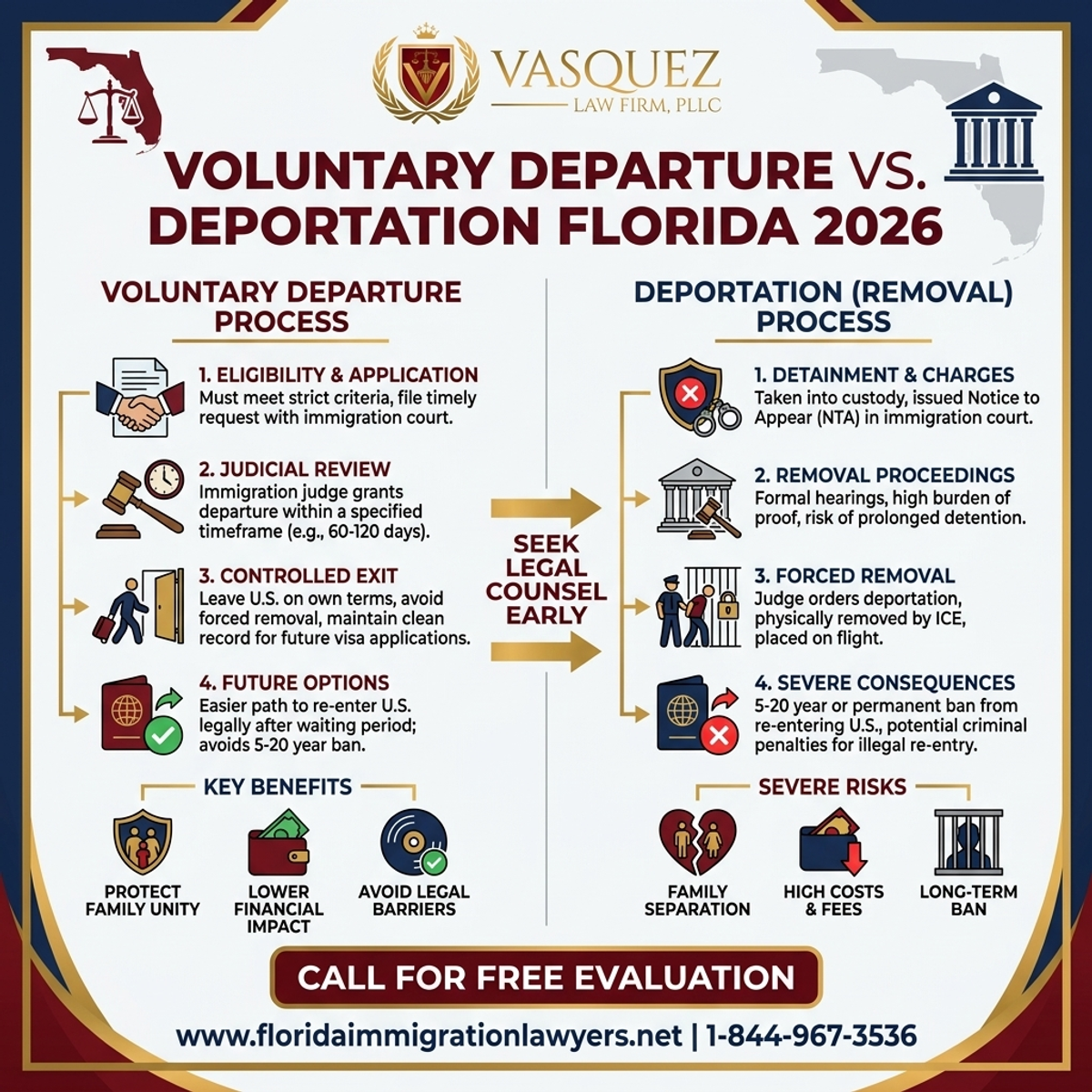
Timeline and Processing Expectations for Voluntary Departure in Florida
The timeline for obtaining and complying with a voluntary departure order can vary depending on the stage of your removal proceedings and the specific immigration court in Florida. Here is a general overview:
| Stage | Typical Timeframe | Notes |
|---|---|---|
| Attorney Consultation & Eligibility Assessment | 1-2 weeks | Crucial for understanding options and preparing your case. |
| Request to Immigration Judge (IJ) | During Master Calendar or Individual Hearing | Can be made early in proceedings or at the conclusion of a merits hearing. |
| IJ Decision & Order | Typically during hearing | Decision is usually rendered immediately after argument; conditions set. |
| Departure Period | 60-120 days from order date | Strict deadline; failure to depart leads to automatic deportation and 10-year bar. |
| Proof of Departure Submission | Immediately after departure | Submit to DHS for bond return and record closure. |
Given the strict deadlines and potential consequences, it is highly recommended to work with an experienced legal team like Florida Immigration Lawyers to manage your case effectively. Our attorneys are well-versed in the procedures of Florida's immigration courts and can provide the guidance you need.
What Documents Do I Need for a Voluntary Departure Request? (Document Checklist)
To successfully request voluntary departure, you must present a comprehensive set of documents to the Immigration Judge and the Department of Homeland Security. These documents serve to prove your identity, nationality, good moral character, and financial ability to depart the U.S. As of 2026, the following checklist outlines the types of documents typically required:
- Proof of Identity and Nationality:
- Valid passport from your country of origin.
- Original birth certificate.
- Any national identity cards.
- Immigration Documents:
- Your Notice to Appear (Form I-862).
- Any prior immigration applications or petitions (e.g., I-130, I-485, I-589).
- Arrival/Departure Record (Form I-94).
- Any documents related to previous immigration court proceedings or orders.
- Proof of Good Moral Character:
- Letters of recommendation from employers, community leaders, religious figures, or close friends/family attesting to your character.
- Evidence of community involvement (e.g., volunteer work, club memberships).
- Tax returns for the past five years demonstrating compliance with U.S. tax laws.
- Any certificates or awards for good conduct.
- Police clearance certificates from all places you have resided in the U.S. and abroad, if requested.
- Proof of Financial Ability to Depart:
- Recent bank statements showing sufficient funds for travel.
- Paid airline tickets or other travel arrangements to your home country.
- Affidavits of support from family or friends who will cover your travel expenses, if applicable, along with their financial documentation.
- Proof of assets that can be liquidated to cover travel costs.
- Evidence of No Disqualifying Criminal History:
- Certified copies of court dispositions for any arrests or convictions, showing no aggravated felonies or certain other serious crimes.
- FBI background check results, if requested.
- Personal Affidavits:
- A personal statement detailing your request for voluntary departure, your ties to your home country, and your commitment to depart on time.
Gathering these documents can be a meticulous process. In Florida, where immigration courts are busy, having all your documentation organized and complete is essential for a smooth presentation. An attorney from Florida Immigration Lawyers can assist you in compiling this critical evidence to bolster your case for voluntary departure. This thorough preparation is particularly important for individuals in the Orlando area, where the immigration court frequently handles complex cases. For more information on what constitutes good moral character, you can refer to the USCIS Policy Manual.
What Are the Costs Associated with Voluntary Departure in 2026?
While the act of requesting voluntary departure itself does not typically involve a direct filing fee to USCIS or EOIR, there are several associated costs that individuals must consider. These expenses primarily stem from legal representation, potential bond requirements, and the actual cost of travel. Understanding these financial aspects is crucial for anyone considering this option in Florida, as they can significantly influence your ability to comply with the terms of the order.
| Item | Typical Fee (Estimate) | Notes |
|---|---|---|
| Attorney Consultation | $0 - $300 | Many firms, including Florida Immigration Lawyers, offer free initial case reviews. |
| Attorney Representation | $3,000 - $10,000+ | Varies significantly based on case complexity, attorney experience, and duration of proceedings. |
| Voluntary Departure Bond | $500 - $5,000+ | Required by the Immigration Judge in some cases to ensure timely departure. This amount is returned upon proof of departure. |
| Travel Expenses | Varies widely | Cost of airfare, ground transportation, and other travel-related expenses to your home country. This is a personal expense. |
| Document Preparation/Translation | $50 - $500+ | Costs for obtaining certified copies of documents, criminal records, and professional translations if necessary. |
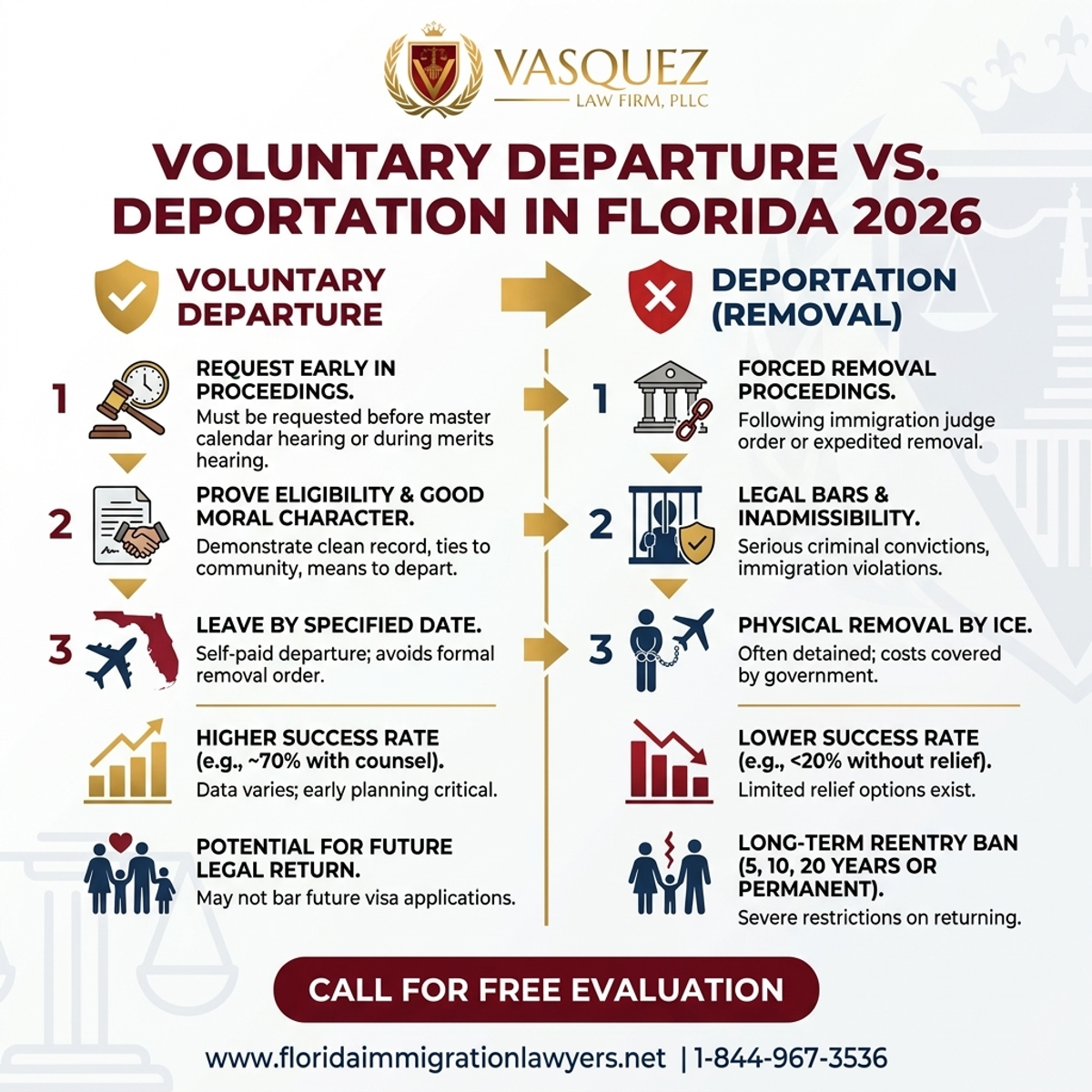
Key Statistics — Voluntary Departure vs. Deportation in Florida 2026
It is important to budget for these costs, especially the travel expenses, as you are responsible for funding your own departure. The voluntary departure bond, if imposed by the Immigration Judge under INA 240B(b)(3), must be paid within the specified timeframe and will be refunded once you provide satisfactory proof of your timely departure to the Department of Homeland Security. While attorney fees may seem substantial, the investment in experienced legal counsel can be invaluable. A skilled lawyer can significantly increase your chances of being granted voluntary departure and help you avoid the much more severe and costly consequences of a formal deportation order. For a clear understanding of potential legal costs and a free assessment of your case, contact Florida Immigration Lawyers today.
What Happens if I Overstay My Voluntary Departure Order?
Failing to depart the United States within the specific period granted for voluntary departure carries severe and immediate consequences. This is one of the most critical aspects to understand about this form of relief, especially for individuals in Florida who might be navigating the complexities of their immigration status. The Immigration and Nationality Act is very clear on this matter, and the penalties for non-compliance are automatic and unforgiving.
If you fail to depart by the date set by the Immigration Judge, your voluntary departure order will automatically convert into a final order of deportation (removal). This means you will incur all the negative consequences associated with a formal deportation, even though you were initially granted a more favorable outcome. Furthermore, under INA 240B(d)(2), you will automatically be subject to a 10-year bar from re-entry to the United States. This bar applies from the date of the scheduled departure and can be extremely difficult, if not impossible, to waive. It significantly complicates any future attempts to obtain a visa or other immigration benefits.
Beyond the automatic deportation order and the 10-year bar, overstaying your voluntary departure can also lead to civil penalties and make you a priority for arrest and detention by Immigration and Customs Enforcement (ICE) in Florida. Any future immigration applications you file, even after the 10-year bar has expired, will be viewed with extreme scrutiny, and you may face a presumption of inadmissibility. This underscores the paramount importance of strict adherence to the departure deadline. If you anticipate any issues with departing on time, it is imperative to contact your immigration attorney immediately to explore any possible, albeit limited, options. The U.S. government, through agencies like USCIS and ICE, maintains detailed records of all immigration proceedings and compliance. Therefore, attempts to disregard the order will be noted and will have long-lasting adverse effects on your immigration record.
Do not navigate this process alone. Contact Florida Immigration Lawyers today.
Common Mistakes to Avoid in Voluntary Departure Cases
Navigating the complexities of voluntary departure requires meticulous attention to detail. Even minor errors can lead to severe consequences, potentially converting a favorable outcome into a formal deportation. Here are some common mistakes individuals make and how to avoid them:
-
Missing the Departure Deadline: This is arguably the most critical mistake. Failing to leave the U.S. by the exact date specified by the Immigration Judge automatically converts your voluntary departure into a formal deportation order and triggers a 10-year bar to re-entry. Always have your travel plans solidified well in advance of the deadline.
-
Not Understanding Eligibility Requirements: Many individuals assume they are eligible without fully understanding the strict criteria, such as good moral character, lack of aggravated felonies, and financial ability. An attorney can accurately assess your eligibility to avoid wasted time and effort.
-
Failing to Gather All Necessary Documents: Incomplete or missing documentation for your good moral character, financial means, or identity can lead to denial of voluntary departure. Start collecting all required evidence early.
-
Providing False or Misleading Information: Any misrepresentation or fraud in your application or testimony can lead to an immediate denial of voluntary departure and potentially severe penalties, including criminal charges and permanent bars from the U.S.
-
Not Having a Solid Travel Plan and Funds: The Immigration Judge needs to be convinced you have the means and a concrete plan to depart. Vague intentions or insufficient funds can lead to denial. Secure your tickets and show proof of funds.
-
Not Filing Proof of Departure with DHS: Even if you depart on time, if you fail to provide satisfactory proof (e.g., boarding pass, passport stamp) to the Department of Homeland Security, your voluntary departure bond may not be returned, and your record may not be properly updated, potentially causing future issues.
-
Attempting to Re-enter Without Proper Authorization: Voluntary departure does not grant automatic re-entry. You must still apply for a new visa and be deemed admissible. Attempting to re-enter without proper authorization can result in a new removal order and further bars.
-
Not Seeking Legal Counsel: Navigating immigration court procedures and the nuances of voluntary departure is extremely complex. Attempting to do so without an experienced immigration attorney significantly reduces your chances of success and increases the risk of making critical errors.
-
Ignoring Criminal History Implications: Certain criminal convictions, particularly aggravated felonies, automatically disqualify individuals from voluntary departure. Failing to disclose or properly address a criminal record will lead to denial.
-
Waiving Appeal Rights Without Understanding Consequences: When you accept voluntary departure, you generally waive your right to appeal the decision. Ensure you fully understand this waiver and its implications before agreeing.
When to Call a Lawyer for Voluntary Departure or Deportation Defense
The moment you receive a Notice to Appear (NTA) in immigration court, or any communication from ICE or DHS, is the moment you should contact an immigration lawyer. These situations are highly time-sensitive and can have profound, life-altering consequences if not handled correctly. An experienced attorney can be your most valuable asset in navigating the complex legal landscape of U.S. immigration law, especially concerning voluntary departure and deportation defense.
You should immediately seek legal counsel if you are facing any of the following scenarios:
- You have received a Notice to Appear (NTA) to begin removal proceedings.
- You have been detained by ICE in Florida or are at risk of detention.
- You have a prior deportation order or a complex immigration history.
- You have any criminal charges or convictions, even minor ones, that could impact your immigration status.
- You believe you may be eligible for voluntary departure but are unsure of the requirements or process.
- You are considering appealing an Immigration Judge's decision.
- You have fears of persecution or torture if returned to your home country, indicating a potential need for asylum or deportation defense.
- You have been denied voluntary departure and need to explore other forms of relief.
Florida Immigration Lawyers has extensive experience representing individuals throughout Florida in removal proceedings. We understand the local immigration courts in Orlando, Miami, and Pompano Beach, and we are dedicated to providing aggressive and compassionate advocacy. Our team can assess your case, advise you on your eligibility for voluntary departure or other forms of relief, prepare your defense, and represent you effectively before the Immigration Judge. Do not wait until it is too late; early intervention by a skilled lawyer can make all the difference.
About Florida Immigration Lawyers
Florida Immigration Lawyers is a leading immigration law firm dedicated to serving individuals and families across the entire state of Florida. With a deep understanding of U.S. immigration law and a commitment to our clients, we provide comprehensive legal services tailored to meet your unique needs. Our experienced attorneys specialize in a wide range of immigration matters, including deportation defense, family-based petitions, employment visas, citizenship applications, and asylum cases. We pride ourselves on offering personalized, empathetic legal guidance, ensuring that every client feels heard, understood, and confidently represented.
We believe that everyone deserves dedicated legal representation, especially when facing complex immigration challenges. Our firm is available 24/7 to address your urgent concerns and offers free initial case reviews to help you understand your options without financial obligation. Whether you are in Orlando, Miami, Tampa, or anywhere else in Florida, our team is here to fight for your rights and help you achieve your immigration goals. Choose Florida Immigration Lawyers for unwavering support and expert legal counsel. Visit us at www.floridaimmigrationlawyers.net or call us directly at 1-844-967-3536.
Sources and References
- U.S. Citizenship and Immigration Services (USCIS)
- Executive Office for Immigration Review (EOIR)
- U.S. Department of State
- 8 U.S.C. § 1229c - Voluntary departure (Immigration and Nationality Act Section 240B)
- 8 U.S.C. § 1182(a)(9) - Inadmissible aliens (Immigration and Nationality Act Section 212(a)(9))
- 8 CFR Part 240 - Proceedings to Determine Admissibility or Deportability; Apprehension, Custody, Detention, and Removal of Aliens; Voluntary Departure
- USCIS Policy Manual, Volume 12, Part D - Good Moral Character
Related services: immigration waivers, humanitarian protection programs, DACA renewal and applications, temporary protected status (TPS).
This article provides general legal information and is not intended as legal advice. Every case is unique, and outcomes depend on specific facts and circumstances. Contact an attorney for advice about your particular situation. Immigration laws are subject to change, and this content should not be considered a substitute for professional legal consultation.
Understanding the critical differences between voluntary departure and deportation is essential for anyone facing removal proceedings in Florida. The choices you make now can profoundly impact your future immigration prospects. Do not leave your future to chance. Contact Florida Immigration Lawyers today for a free, confidential case review. Our dedicated team is ready to provide the expert legal guidance and representation you need to navigate this complex process successfully. Call us at 1-844-967-3536 to discuss your options.
Se Habla Espanol - Estamos aqui para ayudarle.
Do Not Navigate This Process Alone
Our experienced immigration attorneys are ready to fight for you. Get a free, confidential consultation today.
Se Habla Español
Or leave your details and we’ll call you:
Free Evaluation in 24 Hours
Or talk to us right now

AI voice assistant — available 24/7
FreeFrequently Asked Questions

William J. Vásquez
Founding Attorney · Vasquez Law Firm
U.S. Air Force veteran and immigration attorney with years of hands-on U.S. immigration experience. J.D., NCCU School of Law. AILA member. Admitted to the 4th, 5th, and 11th Circuit Courts.
Available 24/7 - Free Evaluations
Reviewed for legal accuracy by William J. Vásquez
Licensed in North Carolina; U.S. immigration is federal practice.
Related Legal Services
Our Florida immigration attorneys can help you with business immigration, asylum protection and deportation defense. Call today at 1-844-967-3536 for a free consultation.
Related Links
Related Topics
Free Legal Consultation
Discuss your case with our experienced attorneys. We're available 24/7.
Se Habla Español - Estamos aquí para ayudarle.
Related Articles
Immigration Lawyer Orlando Free Consultation in Florida
For individuals and families in Orlando, Florida, navigating the complexities of U.S. immigration law requires expert guidance. An immigration lawyer in Orlando offers crucial support for everything from visa applications and green card processes to naturalization and deportation defense. This comprehensive guide details what a free consultation covers, providing a step-by-step overview of immigration pathways, essential document checklists, and expected timelines in 2026. We also highlight common mistakes to avoid, discuss the critical role of legal counsel in deportation and asylum cases, and explain why choosing a local Orlando immigration attorney is beneficial. Florida Immigration Lawyers is dedicated to serving the diverse community of Orlando with compassionate, effective legal solutions, ensuring you receive personalized advice and robust representation for a successful immigration journey.
How to Choose an Immigration Lawyer in Florida 2026
Selecting the right immigration lawyer in Florida is a critical decision that can profoundly impact your future. With complex regulations and varying case types, finding an attorney who specializes in your specific needs, possesses a strong reputation, and communicates transparently is paramount. This guide from Florida Immigration Lawyers provides actionable steps, from verifying credentials with the Florida Bar and understanding fee structures to recognizing common pitfalls like 'notario' scams. Learn how to effectively vet potential legal counsel, prepare necessary documents, and set realistic expectations for your immigration journey in 2026. Empower yourself to make an informed choice and secure expert legal representation for your family, business, or defense immigration needs in Orlando and across Florida.
VAWA Immigration Lawyer: Your 2026 Guide in Florida
For individuals in Florida experiencing domestic abuse from a U.S. citizen or lawful permanent resident, VAWA (Violence Against Women Act) immigration relief offers a confidential pathway to a green card. This article, updated for 2026, provides a comprehensive guide to understanding VAWA self-petitioning, including eligibility criteria, the step-by-step application process, essential documentation, and expected timelines. Learn about the crucial role of a VAWA immigration lawyer in navigating complex requirements, ensuring confidentiality, and protecting your rights throughout the process. We cover common mistakes to avoid and highlight when to seek expert legal counsel to secure your safety and immigration status in Florida. Florida Immigration Lawyers offers free case reviews and compassionate support.
U Visa Certification in Florida: Law Enforcement Guide 2026
For non-citizen crime victims in Florida, the U visa offers a vital path to protection and legal status. This comprehensive guide details the crucial process of obtaining U visa certification from law enforcement, a mandatory step for victims who have suffered substantial abuse and are willing to assist in criminal investigations. Learn about eligibility criteria, the role of agencies like the Orlando Police Department, the step-by-step application process, and expected timelines for 2026. We also cover cost factors and common pitfalls to avoid. Florida Immigration Lawyers provides expert assistance for victims across Florida, ensuring they can navigate these complex legal challenges with confidence and compassion. Discover how our dedicated team can help you pursue justice and secure your future.