U Visa Certification in Florida: Law Enforcement Guide 2026
For non-citizen crime victims in Florida, the U visa offers a vital path to protection and legal status. This comprehensive guide details the crucial process of obtaining U visa certification from law enforcement, a mandatory step for victims who have suffered substantial abuse and are willing to assist in criminal investigations. Learn about eligibility criteria, the role of agencies like the Orlando Police Department, the step-by-step application process, and expected timelines for 2026. We also cover cost factors and common pitfalls to avoid. Florida Immigration Lawyers provides assistance for victims across Florida, ensuring they can navigate these complex legal challenges with confidence and compassion. Discover how our dedicated team can help you pursue justice and secure your future.
U Visa certification in Florida is a crucial step for eligible crime victims seeking immigration relief. It involves a qualifying law enforcement agency or official signing Form I-918, Supplement B, U Nonimmigrant Status Certification. This document confirms the victim's helpfulness in the investigation or prosecution of a qualifying criminal activity. Without this certification, the U visa application cannot proceed. Florida law enforcement agencies, from local police to state attorneys, play a vital role in protecting vulnerable individuals and supporting their path to safety and legal status.
- U Visa certification requires a signed I-918, Supplement B from law enforcement.
- It confirms the victim's helpfulness in a qualifying criminal investigation.
- Law enforcement agencies across Florida are authorized to provide this certification.
- The U visa offers protection and a path to legal status for crime victims.
- Consulting an attorney is essential for navigating the complex application process.
Experiencing a crime is a traumatic event, and for non-citizen victims in Florida, the fear of deportation can often prevent them from seeking justice or cooperating with law enforcement. However, the U nonimmigrant status, commonly known as the U visa, provides a pathway to protection and legal residency for those who have suffered substantial physical or mental abuse as a result of certain crimes and are willing to assist authorities. This humanitarian relief is critical for fostering safer communities across the Sunshine State, from bustling Orlando to the serene Keys, by empowering victims to come forward without fear.
Understanding the intricate process of securing U visa certification from law enforcement in Florida is paramount. This comprehensive guide, updated for 2026, will walk you through the eligibility requirements, the role of law enforcement, the application steps, and what to expect. At Florida Immigration Lawyers, we are dedicated to helping crime victims navigate these complex legal waters with compassion and experience. If you or a loved one needs assistance with a U visa application, do not hesitate to call Florida Immigration Lawyers at 1-844-YO-PELEO for a free case review. We are here to help you understand your rights and pursue justice.
What is U Visa Certification and Who is Eligible in Florida?
U Visa certification is a formal acknowledgment from a qualifying law enforcement agency or official that a crime victim has been, is being, or is likely to be helpful in the investigation or prosecution of a qualifying criminal activity. This certification, provided on Form I-918, Supplement B, is a non-negotiable component of the U visa application. Eligibility for the U visa extends to victims who have suffered substantial physical or mental abuse from a qualifying criminal activity, possess information about the crime, and have been helpful or are likely to be helpful to law enforcement. In Florida, this includes victims of crimes like domestic violence, sexual assault, trafficking, and aggravated assault, among others, ensuring that all victims, regardless of immigration status, can seek protection.
The U nonimmigrant status was created by Congress to strengthen the ability of law enforcement agencies to investigate and prosecute cases of domestic violence, sexual assault, trafficking, and other crimes, while also protecting victims. To be eligible for a U visa, you must demonstrate several key factors. First, you must be the victim of a qualifying criminal activity, as defined by 8 U.S.C. § 1101(a)(15)(U). This list includes a wide range of crimes, such as abduction, abusive sexual contact, blackmail, domestic violence, extortion, false imprisonment, female genital mutilation, hostage taking, incest, involuntary servitude, kidnapping, murder, obstruction of justice, peonage, perjury, prostitution, rape, sexual assault, sexual exploitation, slave trade, stalking, torture, trafficking, unlawful criminal restraint, and witness tampering. The crime must have occurred in the U.S. or violated U.S. law.
Second, you must have suffered substantial physical or mental abuse as a result of the qualifying criminal activity. USCIS evaluates this on a case-by-case basis, considering the nature of the injury, the severity of the crime, and the duration of the abuse. Third, you must possess information concerning the qualifying criminal activity. This means you have knowledge about the crime that can assist law enforcement. Finally, you must have been, be being, or be likely to be helpful to a federal, state, or local law enforcement official in the investigation or prosecution of the criminal activity. This last requirement is where the U visa certification becomes essential. For individuals in Florida, this could involve cooperating with local police departments in Orlando, sheriff's offices in Miami-Dade, or even state attorneys throughout the state. Understanding these criteria is the first step toward securing your future.
How Does Law Enforcement in Florida Provide I-918 Supplement B Certification?
Law enforcement agencies in Florida provide I-918 Supplement B certification by reviewing a victim's request and verifying their helpfulness in a qualifying criminal investigation or prosecution. This process typically begins when a victim, often with the assistance of an attorney, submits Form I-918, Supplement B, along with a cover letter and supporting documentation, to the relevant agency. The certifying official, who must be from an agency with authority to investigate or prosecute the qualifying crime, then assesses whether the victim meets the helpfulness criteria. Agencies like the Orlando Police Department, the Miami-Dade Police Department, or the Florida Department of Law Enforcement are authorized to sign these certifications, signifying their commitment to victim protection and public safety.
The role of law enforcement in the U visa certification process is pivotal, acting as the gateway for victims to access this critical immigration relief. When a victim or their legal representative requests certification, the law enforcement agency is expected to review the facts of the case. The certifying official must determine if the victim suffered a qualifying crime and if their assistance has been, is being, or will be helpful to the investigation or prosecution. This official could be a police chief, sheriff, district attorney, prosecutor, judge, or any other official with authority to detect, investigate, or prosecute criminal activities. In Florida, this includes various state, county, and municipal agencies.
For example, if you were a victim of a severe assault in Tampa, you would typically seek certification from the Tampa Police Department or the State Attorney's Office for Hillsborough County. The certification process is not uniform across all agencies; some may have specific protocols or forms in addition to the I-918, Supplement B. It is crucial to approach the correct agency and official. A well-prepared request, often drafted by an experienced immigration attorney, can significantly streamline this process by clearly outlining the victim's helpfulness and meeting the agency's requirements. Agencies are often more receptive when they understand the purpose of the certification and how it aids their investigations by encouraging victim cooperation. This collaboration between victims, legal counsel, and law enforcement is essential for the success of U visa petitions in Florida.
What is the Step-by-Step U Visa Application Process in 2026?
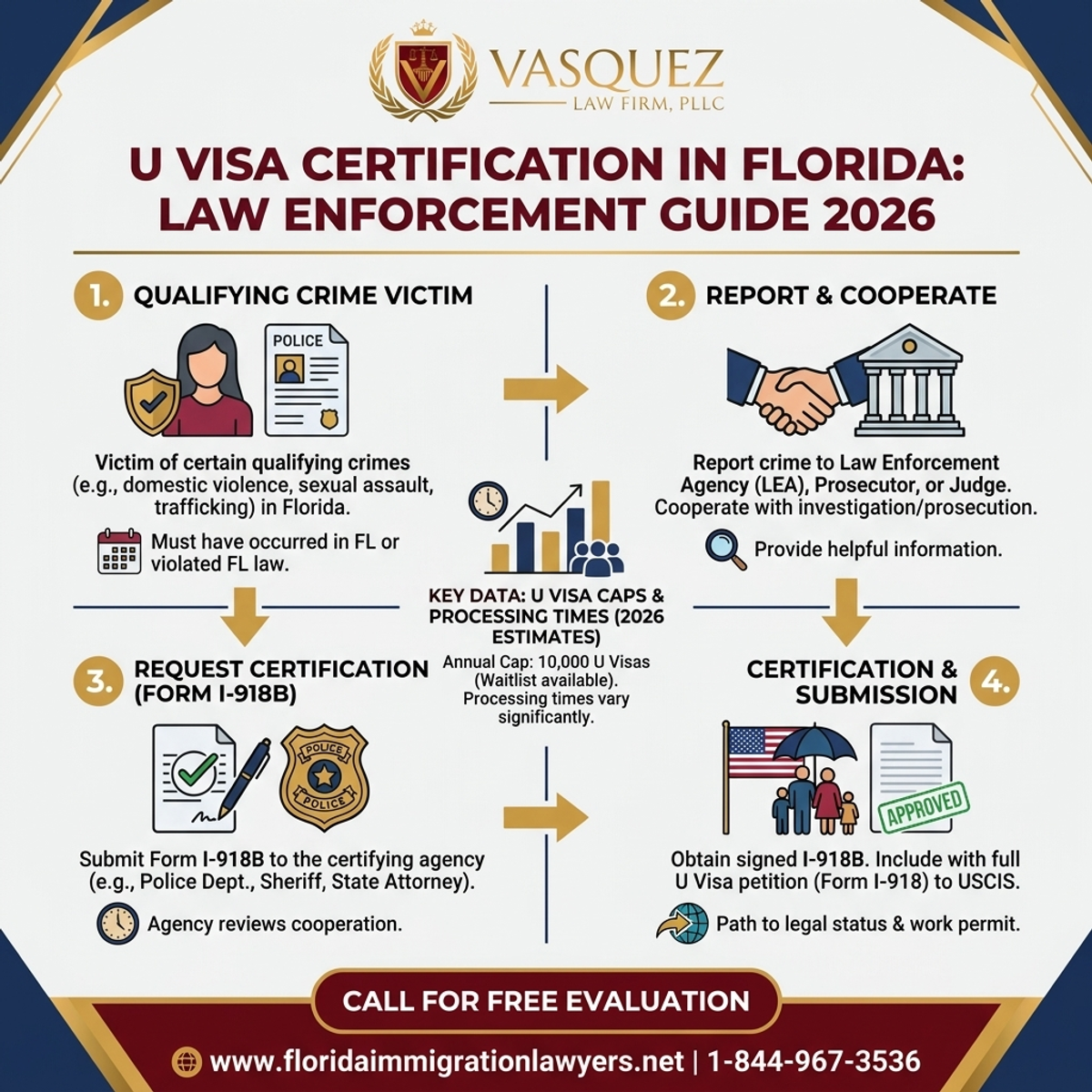
As of 2026, the U visa application process involves several critical steps, starting with obtaining the crucial law enforcement certification. After securing the signed Form I-918, Supplement B, the victim prepares and files Form I-918, Petition for U Nonimmigrant Status, along with Form I-192, Application for Advance Permission to Enter as Nonimmigrant, and all supporting evidence, with USCIS. This comprehensive package must demonstrate eligibility for both the U visa and any necessary waivers of inadmissibility. Following submission, applicants typically receive a receipt notice, followed by a biometric appointment, and then a period of waiting for a decision, which can be lengthy due to annual caps.
-
Obtain Law Enforcement Certification (I-918, Supplement B): This is the foundational step. You, or your attorney, must submit a request for certification to the relevant Florida law enforcement agency (e.g., Orlando Police Department, Miami-Dade Sheriff's Office, State Attorney's Office). The agency reviews your helpfulness in the investigation or prosecution of the qualifying crime and, if approved, signs and returns the I-918, Supplement B. This step is critical, as USCIS will not consider a U visa petition without it. It's important to be persistent and provide all necessary documentation to the agency.
-
Gather Supporting Documentation: Collect all evidence to support your petition. This includes proof of the qualifying criminal activity (police reports, court documents), evidence of substantial physical or mental abuse (medical records, psychological evaluations), evidence of helpfulness (correspondence with law enforcement, affidavits), and personal identification documents (birth certificate, passport, photos). Thorough documentation is key to a strong application.
-
File Forms I-918 and I-192 with USCIS: Prepare and submit Form I-918, Petition for U Nonimmigrant Status, and Form I-192, Application for Advance Permission to Enter as Nonimmigrant (if applicable, to waive certain inadmissibility grounds). Include the signed I-918, Supplement B, and all supporting documents. Mail the complete package to the USCIS Vermont Service Center. Ensure all forms are correctly filled out and signed.
-
Receive Receipt Notice and Biometrics Appointment: After USCIS receives your application, you will receive a Form I-797C, Notice of Action, confirming receipt. Subsequently, you will receive an appointment notice for biometrics (fingerprints, photos, signature) at an Application Support Center (ASC), such as the one in Orlando or Miami. Attending this appointment is mandatory.
Step-by-Step Process — U Visa Certification in Florida: Law Enforcement Guide 2026
-
Waitlist Placement and Adjudication: Due to the annual cap of 10,000 U visas, eligible applicants are often placed on a waitlist. While on the waitlist, USCIS may grant deferred action and work authorization. Once a U visa becomes available, USCIS will adjudicate your petition. This can involve requests for additional evidence (RFEs) or an interview. If approved, you will receive U nonimmigrant status for four years.
-
Apply for Adjustment of Status (Green Card): After three years in U nonimmigrant status, you may be eligible to apply for lawful permanent residency (a Green Card) by filing Form I-485, Application to Register Permanent Residence or Adjust Status, provided you meet all other eligibility requirements and continue to cooperate with law enforcement if requested. This is the final step towards long-term security in the U.S.
What are the Typical U Visa Processing Timelines and Expectations in 2026?
As of 2026, U visa processing timelines can be extensive, primarily due to the annual statutory cap of 10,000 U visas. While obtaining law enforcement certification might take a few weeks to several months, USCIS processing of the I-918 petition typically ranges from 5 to 7 years from the date of filing until a final decision. Applicants are initially placed on a waitlist, during which time many receive deferred action and employment authorization. This extended wait emphasizes the need for careful preparation and patience throughout the entire process, particularly for crime victims in Florida seeking protection and stability.
Understanding the expected timelines is crucial for managing expectations and planning your future. The U visa process, governed by 8 U.S.C. § 1101(a)(15)(U) and 8 CFR § 214.14, is known for its lengthy adjudication periods. The waitlist and deferred action process are designed to provide some relief during this extended period. USCIS posts average processing times on its website, but these are estimates and can fluctuate. It is important to stay informed and consult with your attorney about any significant delays or changes to policy.
| Stage | Typical Timeframe (As of 2026) | Notes |
|---|---|---|
| Law Enforcement Certification (I-918, Supp B) | 1-6 months | Varies significantly by agency and jurisdiction in Florida. Some agencies have dedicated U visa units. |
| USCIS Receipt Notice (I-918) | 2-4 weeks after filing | Confirmation that USCIS has received your petition. |
| Biometrics Appointment | 3-6 months after filing | Scheduled at a local Application Support Center (ASC), e.g., in Orlando or Miami. Mandatory attendance. |
| Prima Facie Determination | 12-18 months after filing | If USCIS determines you meet the basic eligibility criteria, you may receive work authorization and deferred action while on the waitlist. |
| Waitlist Placement | 3-5 years after Prima Facie determination | Due to the 10,000 annual cap, eligible applicants are placed on a waitlist. |
| Final U Visa Adjudication | 5-7 years from filing date | Once a visa number becomes available, USCIS makes a final decision. |
| Adjustment of Status (Green Card) | After 3 years in U status | Eligible U visa holders can apply for lawful permanent residency. |
What are the Cost Factors and Fees for a U Visa Application?
The cost factors for a U visa application involve USCIS filing fees, which can be significant, alongside potential legal fees for attorney representation. As of 2026, while Form I-918, Petition for U Nonimmigrant Status, does not have a filing fee, Form I-192, Application for Advance Permission to Enter as Nonimmigrant, typically does. However, U visa applicants are often eligible for fee waivers for Form I-192 and other related applications like work permits. The most substantial cost for many applicants will be legal fees for an experienced immigration attorney, which are highly recommended given the complexity of the process and the need for strong advocacy, especially when dealing with Florida law enforcement agencies.
Navigating the various fees and potential costs associated with a U visa application can be daunting. It is important to understand that while USCIS charges fees for many immigration benefits, specific provisions exist for U visa applicants. The intent is to ensure that victims of crime are not unduly burdened by financial constraints when seeking protection. However, some fees may still apply, and legal counsel is an investment that can significantly improve your chances of success.
| Item | Typical Fee (As of 2026) | Notes |
|---|---|---|
| Form I-918, Petition for U Nonimmigrant Status | $0 | No filing fee required for the U visa petition itself. |
| Form I-192, Application for Advance Permission to Enter as Nonimmigrant | $930 (subject to change) | This fee is for waiving certain grounds of inadmissibility. U visa applicants are generally eligible for a fee waiver for this form by filing Form I-912, Request for Fee Waiver. |
| Biometrics Services Fee | Included in I-192 or waived | The fee for fingerprinting and photos is typically covered by the I-192 fee or waived if I-192 is waived. |
| Form I-765, Application for Employment Authorization (EAD) | $470 (subject to change) | Filed after receiving prima facie approval or U status. U visa applicants are eligible for a fee waiver for this form. |
| Attorney Fees | Varies widely ($3,000 - $10,000+) | Highly recommended for guidance, preparation of forms, evidence, and advocacy with law enforcement and USCIS. Many firms offer payment plans. |
| Translation Services | Varies (per page/document) | If any supporting documents are not in English, certified translations are required. |
| Medical Examination (for I-485) | Varies ($200 - $500+) | Required when adjusting status to a Green Card. |
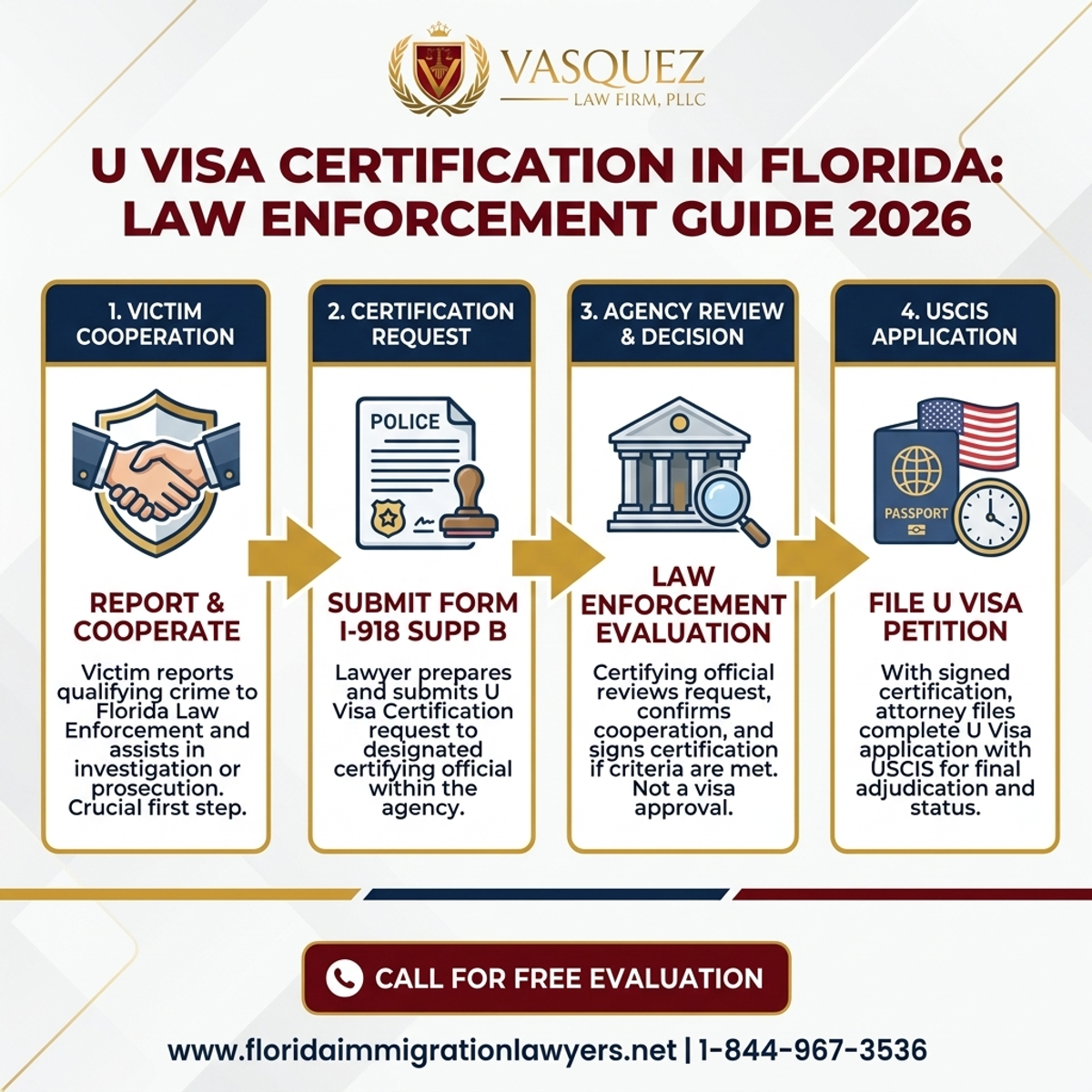
Key Statistics — U Visa Certification in Florida: Law Enforcement Guide 2026
Do not navigate this process alone. The complexities of immigration law, particularly for victims of crime, require experienced legal guidance. Contact Florida Immigration Lawyers today for a free case review and let our dedicated team assist you.
Common Mistakes to Avoid in Your U Visa Certification and Application
Navigating the U visa certification and application process can be fraught with potential pitfalls. Avoiding these common mistakes can significantly improve your chances of success and prevent unnecessary delays. Many of these errors stem from a lack of understanding of specific legal requirements or procedural nuances.
- Failing to Obtain Law Enforcement Certification: This is the most critical mistake. Without a signed I-918, Supplement B, your U visa petition will be rejected. Ensure you are contacting the correct agency and official.
- Submitting an Incomplete I-918, Supplement B: The certification form must be fully completed and signed by an authorized official. Any missing information can lead to rejection or requests for evidence.
- Contacting the Wrong Law Enforcement Agency: You must request certification from an agency involved in the investigation or prosecution of your specific crime. Approaching an unrelated agency in Florida will be unproductive.
- Not Providing Sufficient Evidence of Helpfulness: Law enforcement needs clear documentation or testimony of your cooperation. Vague claims of helpfulness are often insufficient.
- Missing Deadlines or Ignoring RFEs: USCIS provides strict deadlines for responding to Requests for Evidence (RFEs). Failure to respond promptly or adequately can lead to denial.
- Inadequate Documentation of Abuse: Strong evidence of substantial physical or mental abuse (medical records, police reports, psychological evaluations) is crucial. Vague statements often fall short.
- Filing Without a Fee Waiver for I-192/I-765: Many U visa applicants are eligible for fee waivers. Filing without requesting one when eligible can cause financial strain or unnecessary rejections.
- Not Disclosing All Criminal History (Even Minor): Any past arrests, charges, or convictions, even if expunged or dismissed, must be disclosed. Failure to do so can be considered misrepresentation and lead to denial.
- Failing to Maintain Cooperation with Law Enforcement: While your application is pending, you are expected to continue cooperating with law enforcement if requested. Withdrawal of cooperation can jeopardize your status.
- Attempting to Navigate the Process Alone: The U visa process is highly complex. Without legal counsel, you risk making critical errors that could result in denial or significant delays.
When to Call a Florida Immigration Lawyer for Your U Visa Case
You should call a Florida immigration lawyer for your U visa case as soon as possible, especially if you are a crime victim seeking protection. The complexities of obtaining U visa certification from law enforcement, preparing a robust petition, and navigating USCIS procedures require guidance. If you've been a victim of a qualifying crime in Orlando, Miami, or anywhere else in Florida, an attorney can help you understand your eligibility, gather necessary evidence, and advocate on your behalf. This is particularly crucial if you face language barriers, have a complex criminal history, or are unsure how to approach law enforcement officials.
Specific scenarios that warrant immediate legal assistance include: if a law enforcement agency has denied your certification request; if you have a prior deportation order or other immigration violations; if you have a criminal record that might make you inadmissible; or if you are struggling to collect the necessary police reports or medical documentation. An experienced lawyer from Florida Immigration Lawyers can help you prepare a compelling case, anticipate potential challenges, and ensure all forms are accurately filed. We understand the sensitive nature of these cases and provide compassionate, strategic representation, protecting your rights every step of the way. Don't risk your future by going it alone; let us be your advocate.
About Florida Immigration Lawyers
Florida Immigration Lawyers is an immigration law firm dedicated to serving individuals and families across the entire state of Florida. With a deep understanding of U.S. immigration laws and a compassionate approach, we provide comprehensive legal services to immigrants and their families. Our experienced attorneys focus on a wide range of immigration matters, including U visas, family-based petitions, deportation defense, asylum, citizenship, and business immigration. We are committed to achieving the strongest possible outcomes for our clients, guiding them through every step of their immigration journey.
Our firm is known for its client-centered service, attention to detail, and unwavering advocacy. We offer free case reviews to assess your unique situation and provide clear, actionable advice. Available 24/7, our bilingual team is ready to assist you in English and Spanish, ensuring that language is never a barrier to accessing quality legal representation. Whether you are in Orlando, Miami, Tampa, or any other Florida city, Florida Immigration Lawyers is your trusted partner for navigating complex immigration challenges. Call us today at 1-844-YO-PELEO to schedule your free consultation.
Sources and References
- U.S. Citizenship and Immigration Services (USCIS)
- Executive Office for Immigration Review (EOIR)
- U.S. Department of State
- 8 U.S.C. Chapter 12 - Immigration and Nationality Act (INA) § 101(a)(15)(U) and § 214(p)
- 8 CFR Part 214.14 - U Nonimmigrant Status
- USCIS Policy Manual, Volume 3, Part B, Chapter 5 - U Nonimmigrant Status
Related services: asylum and refugee protection, asylum application process, refugee status and resettlement.
This article provides general legal information and is not intended as legal advice. Every case is unique, and outcomes depend on specific facts and circumstances. Immigration laws are subject to change. Contact an attorney for advice about your particular situation.
If you are a crime victim in Florida and believe you may be eligible for a U visa, do not face this challenging process alone. The dedicated team at Florida Immigration Lawyers is here to provide the legal guidance and compassionate support you need. Protect your future and pursue justice with confidence. Call us today at 1-844-YO-PELEO for your free case review. Se Habla Espanol - Estamos aqui para ayudarle.
If you need legal assistance, learn more about learn about our immigration practice, or call us at 1-844-YO-PELEO for a free consultation.
Do Not Navigate This Process Alone
Our experienced immigration attorneys are ready to fight for you. Get a free, confidential case review today.
Se Habla Español
Or leave your details and we’ll call you:
Free Evaluation in 24 Hours
Or talk to us right now
AI voice assistant — available 24/7
FreeFrequently Asked Questions

William J. Vásquez
Founding Attorney · Vasquez Law Firm
U.S. Air Force veteran and immigration attorney with years of hands-on U.S. immigration experience. J.D., NCCU School of Law. AILA member. Admitted to the 4th, 5th, and 11th Circuit Courts.
Available 24/7 - Free Evaluations
Reviewed for legal accuracy by William J. Vásquez
Licensed in North Carolina; U.S. immigration is federal practice.
Related Legal Services
Our Florida immigration attorneys can help you with free immigration consultation, business immigration and deportation defense. Call today at 1-844-YO-PELEO for a free case review.
Related Links
Related Topics
Free Legal Case Review
Discuss your case with our experienced attorneys. We're available 24/7.
Se Habla Español - Estamos aquí para ayudarle.
Related Articles
Immigration Lawyer Orlando Free Consultation in Florida
For individuals and families in Orlando, Florida, navigating the complexities of U.S. immigration law requires expert guidance. An immigration lawyer in Orlando offers crucial support for everything from visa applications and green card processes to naturalization and deportation defense. This comprehensive guide details what a free consultation covers, providing a step-by-step overview of immigration pathways, essential document checklists, and expected timelines in 2026. We also highlight common mistakes to avoid, discuss the critical role of legal counsel in deportation and asylum cases, and explain why choosing a local Orlando immigration attorney is beneficial. Florida Immigration Lawyers is dedicated to serving the diverse community of Orlando with compassionate, effective legal solutions, ensuring you receive personalized advice and robust representation for a successful immigration journey.
EAD Advance Parole Combo Card in Florida 2026
For individuals with a pending Form I-485, Application to Register Permanent Residence or Adjust Status, the EAD Advance Parole Combo Card is an essential document. This single card combines the authorization to work legally in the U.S. (Employment Authorization Document - EAD) with permission to travel internationally and re-enter without abandoning your green card application (Advance Parole). This guide from Florida Immigration Lawyers provides a comprehensive overview for applicants in Florida in 2026, covering eligibility, the step-by-step application process, required documents, expected processing times, and associated costs. We also highlight common mistakes to avoid and when to seek legal counsel to ensure a smooth and successful immigration journey. Understanding this vital card is key to maintaining stability while awaiting your permanent residency approval.
EAD Advance Parole Combo Card in Florida: What You Need
An EAD advance parole combo card allows individuals with pending adjustment applications to both work and travel abroad without jeopardizing their green card application. Learn how to apply in Florida, what documents you need, and common mistakes to avoid.
Dual Citizenship Lawyer in Florida: What You Need to Know
For Florida residents, the concept of dual citizenship, or holding two passports, offers a compelling blend of opportunities and challenges. While the U.S. generally permits dual nationality, the path to achieving this status requires a meticulous understanding of both U.S. immigration laws and the citizenship policies of your country of origin. This guide explores the definition of dual citizenship, the detailed step-by-step process for U.S. naturalization, and the significant benefits and potential pitfalls involved. We cover essential documentation, typical timelines, and cost considerations for 2026, providing crucial insights for anyone in Orlando, Miami, or across Florida considering this important legal step. Learn about common mistakes to avoid and understand when to seek professional legal counsel to navigate this complex process successfully. Florida Immigration Lawyers is here to provide expert, bilingual support for your dual citizenship journey.