Child Status Protection Act: CSPA & Aging Out Florida
The Child Status Protection Act (CSPA) is a vital law for families in Florida, protecting children from 'aging out' of immigration eligibility due to processing delays. This act allows a child's age to be locked in for immigration purposes, ensuring they remain eligible as derivative beneficiaries for green cards or visas. Our comprehensive guide explains CSPA eligibility, the complex age calculation, required documentation, and critical deadlines like the 'one-year seeking to acquire' rule. We cover common mistakes to avoid and highlight when expert legal counsel from Florida Immigration Lawyers is essential, especially for families in West Palm Beach and across the state. Understanding CSPA can secure your child's future in the U.S.

Quick Answer: Child Status Protection Act (CSPA) in Florida
The Child Status Protection Act (CSPA) is a crucial U.S. immigration law designed to prevent certain derivative beneficiaries from "aging out" of eligibility for a visa or green card due to processing delays. As of 2026, CSPA allows an individual's age to be locked in on the date a visa becomes available, provided they seek to acquire permanent residence within one year of visa availability. This protection is vital for many families in Florida, ensuring that children who turn 21 during the lengthy immigration process can still be considered a "child" for immigration purposes.
- CSPA prevents children from "aging out" due of processing delays.
- It locks in a child's age at the time a visa becomes available.
- Beneficiaries must "seek to acquire" permanent residence within one year.
- Applies to various family-based and employment-based categories.
- Consult a Florida immigration lawyer for specific eligibility and application guidance.
Understanding the Child Status Protection Act (CSPA) in Florida
Imagine your family has waited years for an immigration visa, only for your child to turn 21 just before it becomes available. This heartbreaking scenario, known as "aging out," once meant losing eligibility as a derivative beneficiary. Fortunately, the Child Status Protection Act (CSPA) was enacted to provide relief, safeguarding the immigration future of countless families, particularly here in Florida.
For families in West Palm Beach, Miami, Orlando, and across the Sunshine State, understanding CSPA is paramount. Immigration processes can be notoriously slow, and these delays should not unfairly penalize children. This comprehensive guide from Florida Immigration Lawyers will demystify CSPA, explain its eligibility requirements, walk you through the application process, and highlight common pitfalls to avoid as of 2026.
Navigating complex immigration laws requires expert guidance. If you are concerned about a child aging out, do not hesitate. Call Florida Immigration Lawyers at 1-844-967-3536 for a free consultation. Our experienced attorneys are ready to help protect your family's future.
What is the Child Status Protection Act (CSPA) in Florida?
The Child Status Protection Act (CSPA), codified primarily under 8 U.S.C. § 1153(h) of the Immigration and Nationality Act (INA), is a federal law passed in 2002. It provides a specific formula for calculating the age of certain beneficiaries of immigrant visa petitions to prevent them from "aging out" and losing their eligibility for a green card when they turn 21 years old while their petition is pending. This protection is especially critical in states like Florida, where a significant immigrant population often faces long processing times.
Before CSPA, if a child turned 21 before their parent's or their own immigrant visa became available, they would often lose their status as an immediate relative or derivative beneficiary. This meant they would have to file a new, separate petition, often facing even longer waiting periods. CSPA was created to remedy this unfair situation caused by bureaucratic delays. It ensures that the time a visa petition is pending is subtracted from the child's actual age, effectively freezing their age for immigration purposes at a more favorable point. This allows many children in Florida to remain eligible for the same visa category as their parents or other qualifying relatives, preserving family unity.
The law applies to various family-sponsored preference categories, employment-based preference categories, and diversity visa applicants. Understanding how CSPA calculates age is key, as it is not a simple subtraction. The formula takes into account the period the visa petition was pending, subtracting it from the child's age on the date the visa became available. This complex calculation often requires the expertise of an immigration attorney to ensure accuracy and determine eligibility.
How Does CSPA Prevent Child Aging Out for Florida Residents?
The Child Status Protection Act (CSPA) prevents children from aging out by providing a specific formula to calculate their "CSPA age." This CSPA age is determined by taking the child's actual age on the date an immigrant visa becomes available (either the final action date or the filing date, depending on the visa bulletin chart used) and subtracting the number of days the visa petition was pending with USCIS. If this calculated CSPA age is under 21, the child remains eligible for the original visa category, provided they meet the "one-year seeking to acquire" requirement. This mechanism is crucial for many families living in Florida, from Jacksonville to West Palm Beach, who are navigating the often-protracted immigration system.
For example, if a U.S. citizen parent filed an I-130 petition for their child, and that petition took three years to be approved, CSPA would subtract those three years from the child's age when their visa number becomes available. This can effectively "freeze" their age below 21, even if they are chronologically older. The "seeking to acquire" requirement means the child or their parent must take action to pursue permanent residence within one year of the visa becoming available, such as filing Form I-485 (Adjustment of Status) or submitting Form DS-260 (Immigrant Visa Application). Failing to meet this one-year deadline is a common mistake that can invalidate CSPA protection, underscoring the importance of timely action and legal counsel.
Step-by-Step Guide to Applying for CSPA Benefits
Applying for CSPA benefits involves understanding eligibility and taking timely action. Here’s a general guide for families in Florida:
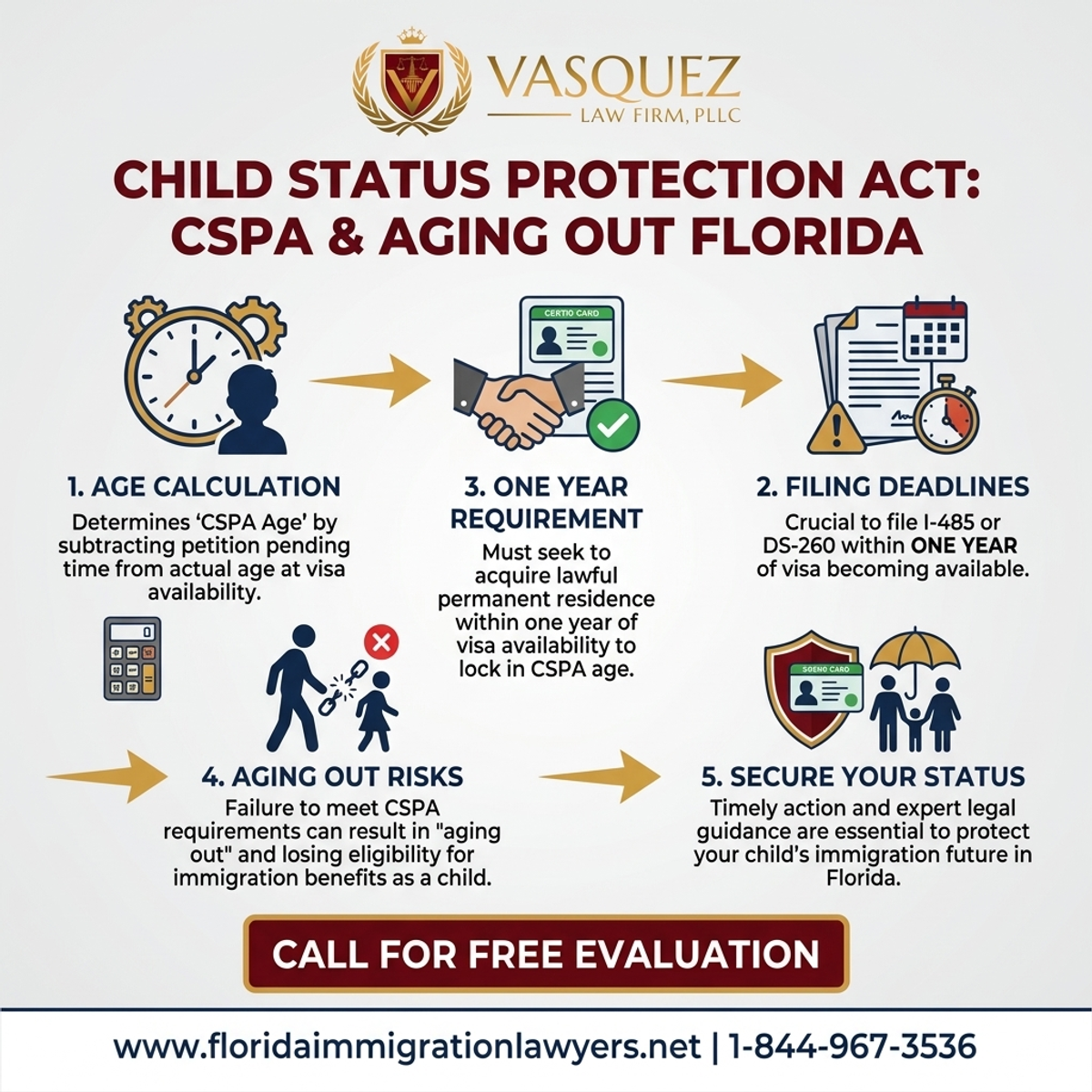
Step-by-Step Process — Child Status Protection Act: CSPA & Aging Out Florida
- Determine Eligibility: First, identify if the underlying visa petition (e.g., I-130, I-140) falls under a CSPA-eligible category. This includes most family-sponsored preference categories (F1, F2A, F2B, F3, F4), employment-based preference categories, and Diversity Visa programs. Immediate relatives (children of U.S. citizens) do not typically "age out" as there is no visa backlog, but CSPA can apply if they were initially petitioned in a preference category and later became an immediate relative.
- Calculate CSPA Age: This is the most critical step. Take the child's age on the date the visa becomes available (check the Department of State Visa Bulletin for Final Action Dates or Dates for Filing). Subtract the number of days the original petition was pending with USCIS (from filing date to approval date). If the result is under 21, the child is CSPA-protected.
- Meet the "Seeking to Acquire" Requirement: The CSPA-eligible child or their parent must "seek to acquire" lawful permanent resident status within one year of the visa becoming available. This means filing Form I-485 (Application to Register Permanent Residence or Adjust Status) with USCIS if adjusting status in the U.S., or submitting Form DS-260 (Immigrant Visa Electronic Application) to the National Visa Center (NVC) if processing abroad. Missing this deadline is a frequent reason for CSPA denial.
- Submit Required Documentation: Along with the adjustment of status or immigrant visa application, provide all supporting documents. This includes birth certificates, marriage certificates, petition approval notices, and any evidence supporting the CSPA age calculation.
- Attend Interview (if applicable): Be prepared for an interview at a USCIS office in Florida (e.g., Miami, Orlando, Tampa) or a U.S. embassy/consulate abroad. During the interview, the CSPA age calculation may be reviewed.
Who is Eligible for CSPA Protection as a Derivative Beneficiary?
CSPA protection is extended to specific categories of derivative beneficiaries who would otherwise age out. The primary beneficiaries are typically children of U.S. citizens or lawful permanent residents (LPRs), or children who are derivative beneficiaries of their parents' family-sponsored or employment-based petitions. As of 2026, understanding these categories is vital for anyone in Florida seeking to utilize CSPA. Generally, CSPA applies to children under 21 who are beneficiaries of:
- Family-Sponsored Preference Petitions: This includes F1 (unmarried sons/daughters of U.S. citizens), F2A (spouses and children of LPRs), F2B (unmarried sons/daughters of LPRs), F3 (married sons/daughters of U.S. citizens), and F4 (siblings of U.S. citizens). The calculation method varies slightly depending on the category.
- Employment-Based Preference Petitions: Children who are derivative beneficiaries of an employment-based petition (e.g., EB-1, EB-2, EB-3) filed by their parent may also be protected.
- Diversity Visa (DV) Program: Children included in a winning Diversity Visa lottery application can also benefit from CSPA.
- Asylee/Refugee Adjustments: Certain children of asylees or refugees may also be eligible for CSPA protection when adjusting status.
It's important to note that CSPA does not apply to immediate relatives of U.S. citizens (unmarried children under 21), as there is no visa waiting list for this category. However, if a child was initially petitioned in a preference category and then their parent naturalized, making them an immediate relative, CSPA can apply to lock in their age from the date of the parent's naturalization. The complexities of these scenarios, especially concerning the date of visa availability and the "one-year seeking to acquire" rule, necessitate thorough review by an experienced immigration attorney. Florida Immigration Lawyers regularly assists clients in West Palm Beach and across Florida with these intricate CSPA eligibility questions.
Required Documents and Processing Timelines for CSPA Cases
Successfully navigating a CSPA case in Florida requires meticulous documentation and an understanding of typical processing timelines. Gathering all necessary documents accurately and promptly is crucial to avoid delays or denials. While specific requirements may vary based on the underlying petition and whether you are adjusting status in the U.S. or processing through consular processing abroad, a general checklist applies.
The processing times for CSPA cases are not separate; they are integrated into the overall processing of the underlying visa petition (I-130, I-140, etc.) and the subsequent application for permanent residence (I-485 or DS-260). As of 2026, USCIS and the Department of State continue to experience varying backlogs. It is essential to monitor the USCIS processing times tool and the Department of State Visa Bulletin regularly. Timely action, especially regarding the "one-year seeking to acquire" rule, is paramount once a visa becomes available.
Essential Document Checklist for CSPA Cases
- Birth Certificate: Original and a certified translation (if not in English) for the derivative child.
- Marriage Certificate: For the petitioning parent(s) and, if applicable, for the derivative child if their marital status changed.
- Petition Approval Notice: Form I-797, Notice of Action, for the approved I-130 or I-140 petition.
- Visa Bulletin Records: Documentation of the date the visa became available, typically by referencing historical Visa Bulletins.
- Proof of "Seeking to Acquire" Action: Evidence of filing Form I-485 (e.g., receipt notice) or submitting Form DS-260 (e.g., confirmation page) within one year of visa availability.
- Passport and Visa Photos: Current, government-compliant photographs.
- Medical Examination Report: Form I-693 (for adjustment of status) completed by a USCIS-approved civil surgeon.
- Affidavit of Support: Form I-864 from the petitioner and any joint sponsors.
- Police Clearances: From all countries where the applicant has resided for certain periods.
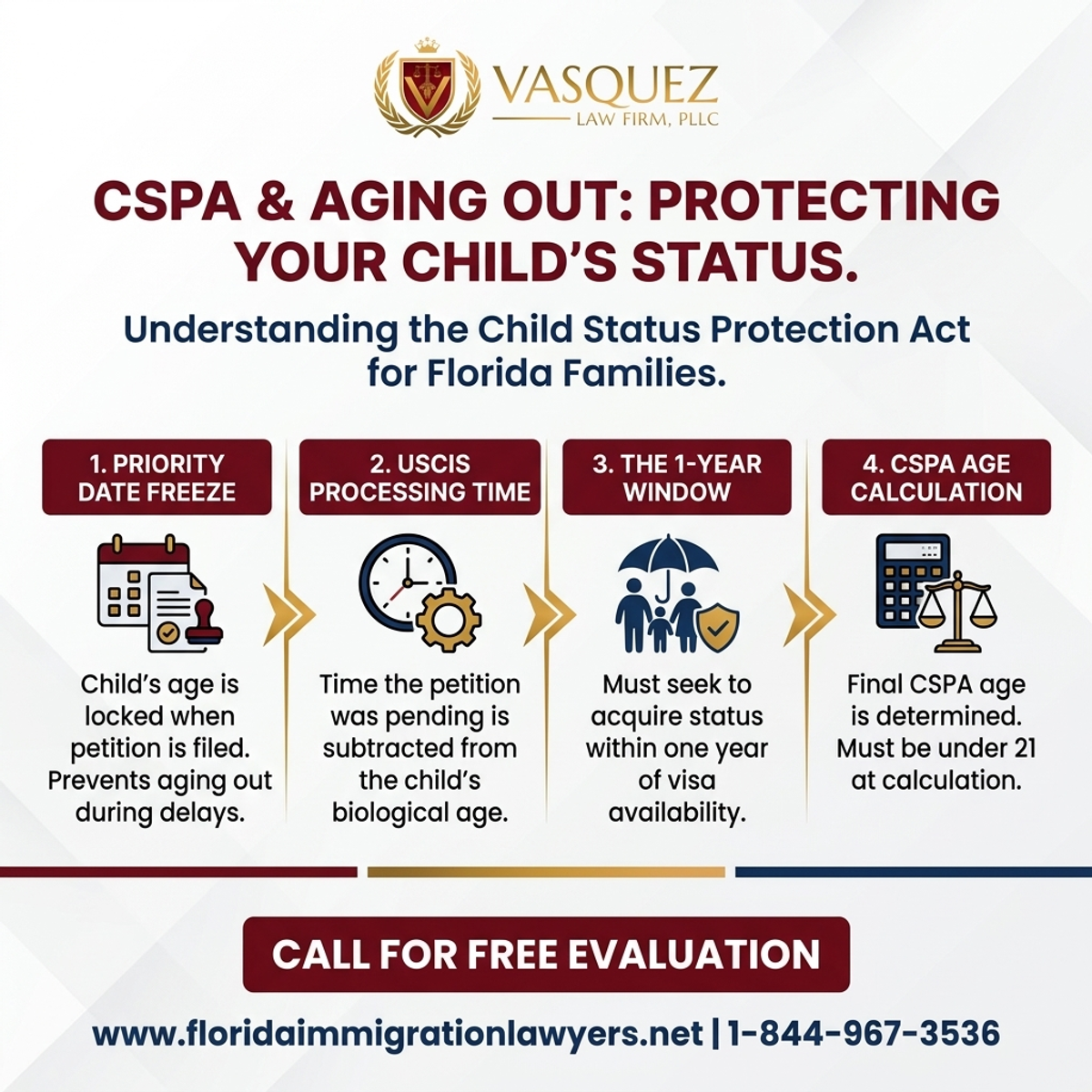
Key Statistics — Child Status Protection Act: CSPA & Aging Out Florida
Typical Processing Expectations (As of 2026)
Please note that these are general estimates and actual times can vary significantly based on the specific USCIS office, NVC, or U.S. Consulate involved, as well as the complexity of the case and current caseloads.
| Stage | Typical Timeframe | Notes |
|---|---|---|
| Petition Filing (I-130/I-140) | 6 months - several years | Varies greatly by visa category, preference level, and country of chargeability. |
| Petition Approval | Integrated with filing time | The time from filing to approval is subtracted from the child's age for CSPA. |
| Visa Availability | Varies significantly | Determined by the Visa Bulletin; can be immediate or decades for some categories. |
| "Seeking to Acquire" Action | Within 1 year of visa availability | Crucial CSPA requirement; failure to act within this window often results in loss of protection. |
| Adjustment of Status (I-485) | 1-3 years (after visa availability) | Processing at USCIS field offices in Florida (e.g., Miami, Orlando) can fluctuate. |
| Consular Processing (DS-260) | 6-18 months (after NVC processing and visa availability) | Involves NVC processing and interview at a U.S. Embassy/Consulate abroad. |
Cost Factors and Fee Breakdown for CSPA-Related Filings
While the Child Status Protection Act itself does not have a separate filing fee, the process of applying for permanent residence under CSPA involves several associated costs. These fees are subject to change by USCIS and the Department of State, so it is always advisable to check the most current fee schedules on the official USCIS website. As of 2026, families in Florida should anticipate various expenses related to the underlying visa petition and the subsequent application for a green card.
Understanding these costs upfront can help families plan financially for their immigration journey. Beyond government filing fees, there are often additional expenses such as legal fees for attorney representation, medical examination costs, translation services, and travel expenses for interviews or biometrics appointments. For residents of West Palm Beach and surrounding areas, our firm offers clear guidance on all potential costs involved in a CSPA-related immigration case.
Typical Fee Breakdown (As of 2026)
These figures are estimates and can change. Always verify current fees with USCIS or the Department of State.
| Item | Typical Fee | Notes |
|---|---|---|
| Form I-130 (Petition for Alien Relative) | Approx. $535 | Filed by the U.S. citizen or LPR petitioner. |
| Form I-485 (Application to Adjust Status) | Approx. $1,225 (includes biometrics) | Filed by the beneficiary if adjusting status in the U.S. |
| Form DS-260 (Immigrant Visa Application) | Approx. $325 | For consular processing abroad, paid to the Department of State. |
| Affidavit of Support Fee (DS-260 route) | Approx. $120 | For consular processing abroad, paid to the Department of State. |
| USCIS Immigrant Fee | Approx. $220 | Required for beneficiaries receiving immigrant visas abroad before green card production. |
| Medical Examination (Form I-693) | Varies, approx. $200-$500 | Paid to a USCIS-approved civil surgeon; costs are not set by USCIS. |
| Legal Fees | Varies significantly | Costs for attorney representation depend on case complexity and firm. |
| Document Translation/Notarization | Varies | Costs for certified translations of foreign documents. |
Do not navigate this process alone. The complexities of CSPA calculations and the potential for costly mistakes make professional legal guidance invaluable. Contact Florida Immigration Lawyers today to discuss your case and ensure every step is handled correctly.
Common Mistakes to Avoid in CSPA Cases
Navigating the Child Status Protection Act can be intricate, and even minor errors can lead to significant delays or outright denial of CSPA benefits. Being aware of these common mistakes can save families in Florida considerable stress and protect their immigration future.
- Miscalculating the CSPA Age: The CSPA age calculation is not straightforward. It requires precise dates for petition filing, approval, and visa availability. A single day's error can mean the difference between eligibility and aging out. Consequences: Loss of CSPA protection, requiring a new petition and potentially decades of additional waiting.
- Failing to "Seek to Acquire" Within One Year: This is arguably the most frequent and critical mistake. Once a visa becomes available, the beneficiary must take action (file I-485 or submit DS-260) within one year. Consequences: Automatic loss of CSPA protection, regardless of the calculated CSPA age.
- Not Monitoring the Visa Bulletin: The Department of State Visa Bulletin updates monthly, indicating visa availability. Missing these updates means missing the crucial date for CSPA age calculation and the start of the one-year "seeking to acquire" window. Consequences: Failure to act timely, leading to loss of CSPA benefits.
- Incorrectly Identifying the "Visa Available" Date: For some categories, the visa availability date can refer to the Final Action Date or the Dates for Filing in the Visa Bulletin. Using the wrong date can lead to an incorrect CSPA age calculation. Consequences: Misleading eligibility assessment and potential denial.
- Assuming CSPA Applies to All Categories: CSPA has specific applicability. For instance, it generally doesn't apply to immediate relatives of U.S. citizens (unless they converted from a preference category). Consequences: Unnecessary delays and expenses pursuing an ineligible claim.
- Changes in Marital Status: For some CSPA-eligible categories (e.g., F2A, F2B), the child must remain unmarried. Marriage before receiving the green card can nullify eligibility, even with CSPA protection. Consequences: Loss of eligibility for the original visa category.
- Not Disclosing Prior Immigration Issues: Concealing past immigration violations, criminal history, or misrepresentations can jeopardize the entire application, even if CSPA applies. Consequences: Denial, potential removal proceedings, and bars to future immigration benefits.
- Delaying Legal Counsel: Waiting until the child is very close to their 21st birthday or after they have already aged out makes CSPA application significantly harder, if not impossible. Consequences: Missed opportunities for protection and irreversible loss of eligibility.
When to Call a Florida Immigration Lawyer for CSPA Cases
The complexities of the Child Status Protection Act mean that expert legal guidance is often not just helpful, but essential. While this article provides general information, your family's situation is unique, and a slight misstep can have profound consequences. You should consider calling Florida Immigration Lawyers if you encounter any of the following scenarios:
- Uncertainty about CSPA Eligibility: If you are unsure whether your child qualifies for CSPA protection, especially with complex family structures or multiple petitions.
- Difficulty Calculating CSPA Age: The calculation is precise and critical. Any doubt in determining the exact CSPA age warrants professional review.
- Approaching 21st Birthday or Visa Availability: Time is of the essence. If your child is nearing 21 or a visa is becoming available, immediate action is required to meet the "one-year seeking to acquire" deadline.
- Previous Denial or Request for Evidence (RFE): If USCIS has denied your CSPA claim or issued an RFE, an attorney can help analyze the reasons and formulate an effective response.
- Complex Case History: Any prior immigration issues, criminal records, or changes in family status (marriage, divorce, naturalization) can complicate CSPA applicability.
- Consular Processing vs. Adjustment of Status: Deciding the best path for permanent residence (in the U.S. or abroad) and understanding the specific CSPA rules for each can be challenging.
- Need for Florida-Specific Guidance: Our firm is well-versed in the nuances of immigration processes within Florida, including local USCIS offices and immigration court procedures in West Palm Beach, Miami, and Orlando.
Don't risk your child's future on guesswork. A free consultation with Florida Immigration Lawyers can provide clarity and a strategic plan tailored to your specific circumstances.
About Florida Immigration Lawyers
Florida Immigration Lawyers is a leading immigration law firm dedicated to serving individuals and families throughout Florida. With a deep understanding of U.S. immigration law and its impact on diverse communities, we provide compassionate yet aggressive legal representation. Our attorneys are committed to helping clients navigate complex immigration challenges, including family-based petitions, CSPA cases, asylum claims, deportation defense, and citizenship applications.
We pride ourselves on offering personalized service and strategic advice tailored to each client's unique needs. Our firm serves all of Florida, including West Palm Beach, Miami, Orlando, Tampa, and Jacksonville. We understand the importance of family unity and work tirelessly to protect your loved ones' immigration future. Our team is available 24/7 for support, and we offer free consultations to help you understand your options without financial obligation. Choose Florida Immigration Lawyers for experienced, dedicated, and accessible legal counsel.
Phone: 1-844-967-3536
Website: https://www.floridaimmigrationlawyers.net
Sources and References
- U.S. Citizenship and Immigration Services (USCIS)
- U.S. Department of State - Visa Bulletin
- Executive Office for Immigration Review (EOIR)
- 8 U.S.C. § 1153(h) - Child Status Protection Act
- 8 U.S.C. Chapter 12 - Immigration and Nationality Act
- USCIS Policy Manual, Volume 7 - Adjustment of Status, Part A - Adjustment of Status Policies and Procedures, Chapter 7 - Child Status Protection Act (CSPA)
- 22 CFR Part 40 - Regulations Pertaining to Visa Issuance
Related services: immigration practice areas, family immigration services, citizenship and naturalization.
This article provides general legal information and is not intended as legal advice. Every case is unique, and outcomes depend on specific facts and circumstances. Immigration laws are complex and subject to change. Contact an attorney for advice about your particular situation.
Is your child's immigration future at risk due to aging out? Don't wait until it's too late. Protect your family with experienced legal counsel. Call Florida Immigration Lawyers today for a free, confidential consultation at 1-844-967-3536. Se Habla Espanol - Estamos aqui para ayudarle.
If you need legal assistance, learn more about our immigration law practice, or call us at 1-844-967-3536 for a free consultation.
Do Not Navigate This Process Alone
Our experienced immigration attorneys are ready to fight for you. Get a free, confidential consultation today.
Se Habla Español
Frequently Asked Questions
Harold Estrada-Rodriguez
Florida Immigration Attorney · FL Bar No. 1041171
Florida Bar attorney handling Florida-jurisdiction immigration matters. Bilingual representation, free consultations.
Available 24/7 - Free Evaluations
Related Legal Services
Our Florida immigration attorneys can help you with citizenship and naturalization, family immigration services and immigration practice areas. Call today at 1-844-967-3536 for a free consultation.
Related Links
Related Topics
Free Legal Consultation
Discuss your case with our experienced attorneys. We're available 24/7.
Se Habla Español - Estamos aquí para ayudarle.
Related Articles
Credible Fear Interview Preparation Florida 2026 | VLF Florida
Navigating a credible fear interview in Florida is a high-stakes process for individuals seeking asylum and facing expedited removal. This comprehensive guide from Florida Immigration Lawyers provides essential preparation strategies, including understanding your rights, gathering critical documents, and practicing your testimony. We detail the step-by-step process, typical timelines as of 2026, and associated cost factors. Learn how to avoid common mistakes and identify when immediate legal counsel is necessary to protect your right to pursue an asylum claim. Our experienced team offers free consultations and 24/7 support across Florida.
Immigration Lawyer Hialeah Florida: Your Trusted Legal Guide
For those in Hialeah, Florida, navigating the complexities of U.S. immigration law requires expert legal guidance. Our comprehensive guide explains why retaining an experienced immigration lawyer in Hialeah, Florida, is crucial for family-based petitions, employment visas, deportation defense, and naturalization. We cover essential services, common pitfalls, and offer a step-by-step overview of the immigration process, including timelines and cost factors. With a focus on Florida-specific challenges and local resources, this article empowers you with the knowledge to make informed decisions. Learn how Florida Immigration Lawyers can provide the dedicated support you need for a successful immigration journey.
TPS Florida Eligible Countries 2026 | FL Immigration Lawyers
Explore Temporary Protected Status (TPS) eligibility for Florida in 2026, focusing on countries facing turmoil and how to apply. Contact Florida Immigration Lawyers for personalized assistance.
Understanding the Asylum One-Year Deadline in Florida
The asylum one-year filing deadline is critical for those seeking refuge in the U.S. Understanding exceptions and preparing your application carefully can influence the outcome of your asylum case. Contact Florida Immigration Lawyers for expert guidance.