H-2A Visa Florida: Guide for Agricultural Growers 2026
Florida's agricultural sector relies heavily on a stable workforce, making the H-2A visa program a critical solution for growers facing labor shortages. This comprehensive guide for 2026 details the H-2A application process, document requirements, and expected timelines for Florida agricultural employers, including those in Hialeah. Learn about the multi-agency process involving the Department of Labor and USCIS, and understand your responsibilities regarding wages, housing, and transportation. We also highlight common mistakes to avoid and explain when legal counsel is essential to ensure compliance and a successful outcome. Florida Immigration Lawyers provides expert guidance to help you navigate these complexities and secure the temporary farm labor your operations need.

The H-2A visa program allows Florida agricultural employers to bring foreign nationals to the U.S. for temporary or seasonal agricultural work when insufficient U.S. workers are available. This program is crucial for Florida growers facing labor shortages, ensuring essential farm labor is secured for planting, cultivating, and harvesting. To qualify, employers must demonstrate a temporary need, offer prevailing wages, and provide housing and transportation. Navigating the complex application process, which involves both the Department of Labor and USCIS, requires meticulous attention to detail and strict compliance with federal regulations.
- Addresses temporary agricultural labor shortages for Florida growers.
- Employers must meet specific wage, housing, and transportation standards.
- Involves a multi-agency application process (DOL, USCIS, State Department).
- Crucial for Florida's agricultural economy, including areas like Hialeah.
- Strict compliance is essential to avoid penalties and ensure program integrity.
Florida's agricultural industry is a cornerstone of the state's economy, renowned for its vast citrus groves, vibrant vegetable farms, and ornamental nurseries. Yet, maintaining this productivity often faces a significant challenge: securing a reliable and sufficient workforce. Many Florida growers struggle to find enough domestic laborers willing and able to perform demanding seasonal farm work. This labor shortage can jeopardize harvests, impact profitability, and threaten the future of vital agricultural operations across the state, from the Panhandle to South Florida, including regions around Hialeah.
Fortunately, the H-2A visa program offers a critical solution, allowing eligible agricultural employers to hire foreign temporary workers for seasonal or peak load needs. This program is designed to fill labor gaps without adversely affecting the wages and working conditions of U.S. workers. Understanding the intricacies of the H-2A visa process is paramount for Florida growers seeking to leverage this essential resource effectively in 2026. This comprehensive guide will walk you through the application steps, document requirements, timelines, and common pitfalls, providing the knowledge you need to navigate this complex system. Don't let labor shortages hinder your success. Call Florida Immigration Lawyers at 1-844-967-3536 for a free consultation and expert guidance tailored to your specific agricultural needs.
What is the H-2A Visa Program for Florida Agricultural Workers?
The H-2A visa program is a non-immigrant visa category established under the Immigration and Nationality Act (INA), specifically 8 U.S.C. § 1101(a)(15)(H)(ii)(a), to address temporary labor shortages in the U.S. agricultural sector. For Florida growers, this means the ability to legally employ foreign nationals to perform agricultural labor or services of a temporary or seasonal nature. This program is vital for the state's diverse agricultural needs, from harvesting strawberries in Plant City to tending nurseries near Homestead and citrus groves throughout Central Florida. Employers must prove that there are not enough U.S. workers who are able, willing, qualified, and available to do the temporary work, and that employing H-2A workers will not negatively impact the wages and working conditions of similarly employed U.S. workers. The program is strictly regulated to protect both foreign and domestic workers, requiring employers to adhere to specific standards regarding wages, housing, and transportation. This ensures fair labor practices while providing Florida farms with the essential workforce they need to thrive.
The H-2A program is administered jointly by the U.S. Department of Labor (DOL) and U.S. Citizenship and Immigration Services (USCIS). The DOL certifies the temporary need and the unavailability of U.S. workers, while USCIS approves the petition for the foreign workers. Once approved, workers then apply for their visas through U.S. Embassies or Consulates abroad, overseen by the U.S. Department of State. This multi-agency process, while complex, provides a structured legal pathway for Florida's agricultural businesses to maintain their operations. Understanding each agency's role is crucial for a successful application. Florida Immigration Lawyers offers comprehensive assistance for immigration matters, including the H-2A visa process, helping employers navigate these requirements effectively.
How Do Florida Growers Apply for H-2A Agricultural Workers?
Florida growers apply for H-2A agricultural workers through a multi-step process involving the U.S. Department of Labor (DOL) and U.S. Citizenship and Immigration Services (USCIS). This application typically begins with the employer filing a job order with the State Workforce Agency (SWA) in Florida, followed by an Application for Temporary Employment Certification with the DOL. Once the DOL certifies the need, the employer then petitions USCIS for the temporary workers. This ensures that all regulatory requirements are met, from demonstrating a genuine labor shortage to offering fair wages and suitable working conditions.
Step-by-Step Guide to the H-2A Application Process:
- Submit a Job Order to the Florida State Workforce Agency (SWA): Approximately 60 to 75 days before the first date of need, the employer must submit a job order to Florida's SWA (e.g., CareerSource Florida). This order must describe the job, wages, and working conditions, including the offer of housing and transportation. The SWA will then attempt to recruit U.S. workers for at least 30 days.
- File Form ETA-9142A with the Department of Labor (DOL): Concurrently, or shortly after submitting the job order, the employer files a Form ETA-9142A, Application for Temporary Employment Certification, with the DOL's Office of Foreign Labor Certification (OFLC). This form outlines the employer's attestations regarding wages, housing, and other conditions, and must include a copy of the SWA job order. The DOL reviews this for compliance with 20 CFR Part 655, Subpart B regulations.
- Conduct Required Recruitment Efforts: While the DOL processes the application, the employer must actively recruit U.S. workers. This includes advertising in newspapers, contacting former U.S. employees, and other specified methods. Documentation of these efforts, including any responses and reasons for non-hire, is critical.
- Receive Temporary Labor Certification from DOL: If the DOL determines that there are insufficient U.S. workers and that the employment of H-2A workers will not adversely affect U.S. workers, it will issue a Temporary Labor Certification. This certification is a prerequisite for filing with USCIS.
- File Form I-129 with USCIS: Within a specified timeframe after receiving DOL certification, the employer files Form I-129, Petition for a Nonimmigrant Worker, with USCIS. This petition requests approval for the specific H-2A workers. It must include the DOL certification and all supporting documentation. Florida Immigration Lawyers can assist business immigration clients with this critical step.
- Worker Visa Application and Interview: Once USCIS approves the I-129 petition, the prospective H-2A workers apply for their visas at a U.S. Embassy or Consulate in their home country. This typically involves an interview, submission of required documents, and biometric data collection.
- Entry into the U.S.: Upon visa approval, H-2A workers can travel to the U.S. and enter at a port of entry. They will be admitted for the period specified in the DOL certification.
What Documents Are Required for the H-2A Visa Process in 2026?
Successfully navigating the H-2A visa process in 2026 requires meticulous preparation and submission of a comprehensive set of documents to both the Department of Labor (DOL) and U.S. Citizenship and Immigration Services (USCIS). Missing or incorrect documentation is a primary cause of delays and denials, making a thorough understanding of these requirements essential for Florida growers. This checklist provides a general overview, but specific circumstances may necessitate additional forms or evidence. Always consult with an experienced immigration attorney to ensure all necessary paperwork is correctly prepared and submitted according to the latest regulations.
H-2A Document Checklist:
- Department of Labor (DOL) Forms:
- Form ETA-9142A, Application for Temporary Employment Certification.
- Form ETA-790, Agricultural and Food Processing Clearance Order (Job Order).
- Copies of all newspaper advertisements used for U.S. worker recruitment.
- Detailed recruitment report, including names of U.S. applicants, contact information, and specific, job-related reasons for non-hire.
- Proof of contact with former U.S. employees and other recruitment sources.
- Documentation of housing inspection and compliance with local/federal standards (e.g., Florida Department of Health inspection reports).
- Proof of workers’ compensation insurance or equivalent coverage.
- Employer's Federal Employer Identification Number (FEIN).
- USCIS Forms and Supporting Documents:
- Form I-129, Petition for a Nonimmigrant Worker.
- Approved Temporary Labor Certification from DOL (Form ETA-9142A).
- Employer's letter of support detailing the nature of the work, the temporary need, and the number of workers requested.
- Evidence of the employer's ability to pay the offered wages (e.g., tax returns, financial statements).
- Detailed itinerary of services or engagements, if applicable.
- Copies of any previous H-2A approvals or relevant immigration documents.
- Worker-Specific Documents (for Consular Processing):
- Valid passport.
- Form DS-160, Online Nonimmigrant Visa Application.
- Receipt for visa application fee.
- Passport-style photographs.
- Any other documents requested by the U.S. Embassy or Consulate.
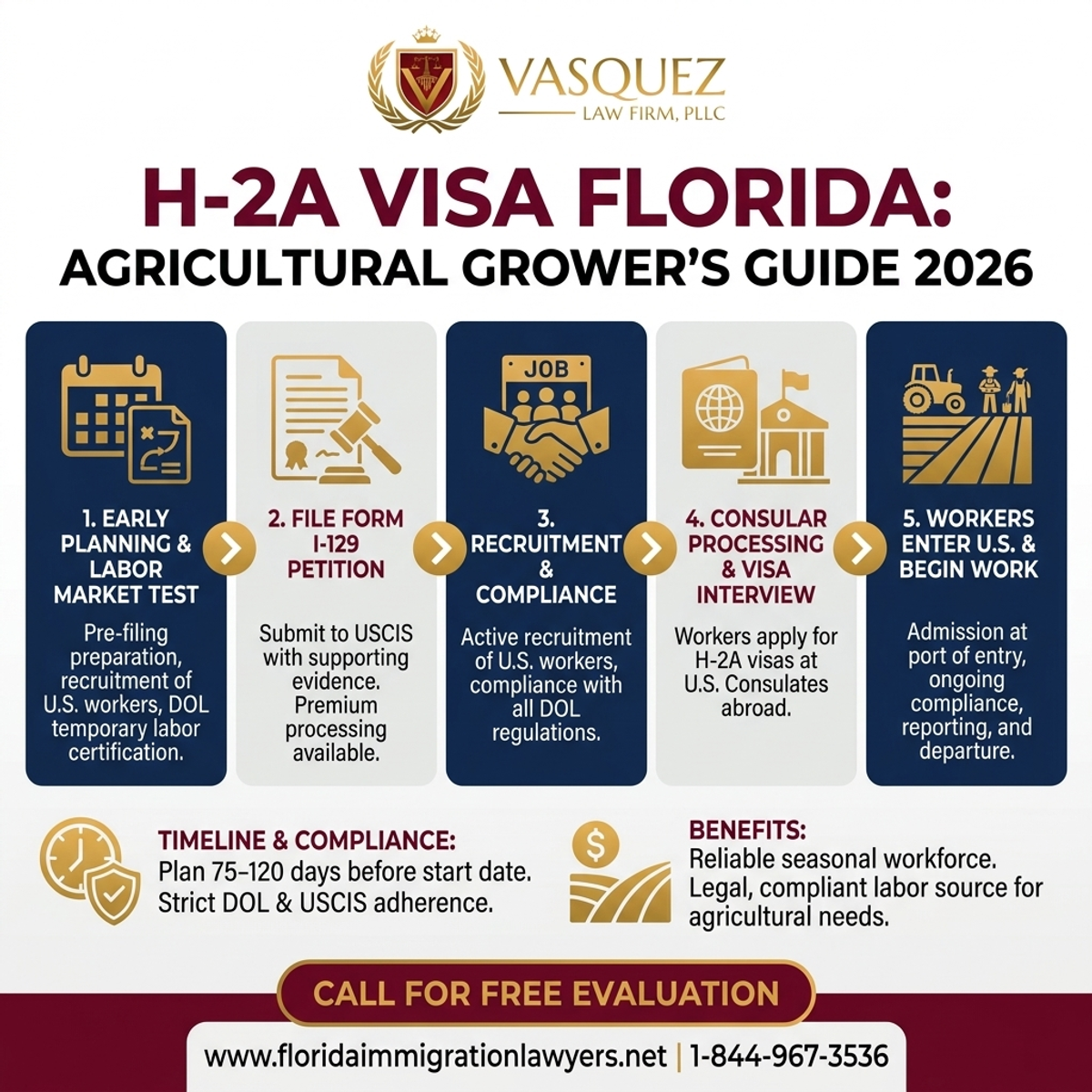
Step-by-Step Process — H-2A Visa Florida: Guide for Agricultural Growers 2026
H-2A Visa Processing Timeline and Expectations for Florida Growers
The H-2A visa processing timeline can vary significantly based on factors such as the time of year, government agency backlogs, and the completeness of the application. However, understanding the typical stages and their durations is crucial for Florida growers to plan their labor needs effectively. As of 2026, employers should generally anticipate a minimum of 60-90 days for the entire process, from initial DOL filing to worker arrival, though it can extend to 120 days or more in complex cases or during peak agricultural seasons. Early planning and proactive engagement are key to minimizing delays and ensuring workers arrive when needed for critical planting or harvesting cycles.
Typical H-2A Visa Processing Timeline (As of 2026):
| Stage | Typical Timeframe | Notes |
|---|---|---|
| Job Order with SWA | 60-75 days before need | Mandatory recruitment period for U.S. workers in Florida. |
| DOL Temporary Labor Certification (ETA-9142A) | 30-45 days | Includes review, recruitment oversight, and certification decision. |
| USCIS Form I-129 Petition Processing | 15 days (Premium Processing) to 2-3 months (Regular) | Premium processing is available for an additional fee to expedite USCIS review. |
| Consular Processing (Visa Interview) | 1-4 weeks | Varies by embassy/consulate; includes scheduling and interview. |
| Travel and Entry into U.S. | Few days to 1 week | Upon visa approval, workers can travel. |
| Total Estimated Time | 60-120+ days | Start early! Factors like RFE (Request for Evidence) can add weeks. |
Understanding H-2A Visa Costs and Fees for Florida Farm Labor
The financial commitment for Florida growers utilizing the H-2A visa program extends beyond just wages, encompassing various government filing fees, recruitment expenses, and mandated worker benefits. As of 2026, these costs can accumulate, making it essential for employers to budget accurately and understand their financial obligations from the outset. While specific fee amounts are subject to change by government agencies, the categories of expenses generally remain consistent. Employers are responsible for most of these costs, which are designed to ensure fair treatment of temporary workers and compliance with federal labor laws, as outlined in 8 U.S.C. § 1188 (INA 218).
Typical H-2A Visa Costs and Fees (As of 2026):
| Item | Typical Fee | Notes |
|---|---|---|
| DOL Application Fee (ETA-9142A) | No direct fee | Costs are associated with recruitment and compliance. |
| USCIS Form I-129 Filing Fee | Varies (e.g., $460-$715) | Per petition, not per worker. Check USCIS website for current fees. |
| USCIS Premium Processing (Optional) | Varies (e.g., $2,805) | Expedites I-129 processing to 15 calendar days. |
| Consular Visa Application Fee (DS-160) | Varies (e.g., $205) | Paid by the worker, but often reimbursed by employer as part of required costs. |
| Recruitment Costs | Varies ($500-$2,000+) | Newspaper ads, job board postings, legal fees for compliance. |
| Transportation Costs | Varies ($300-$1,000+ per worker) | Employer must pay for transportation from place of recruitment to job site and return. |
| Housing Costs | Varies (significant) | Employer must provide free, compliant housing to all H-2A workers. |
| Workers' Compensation Insurance | Varies (per state/risk) | Mandatory, equivalent to U.S. workers. |
| Legal Fees | Varies ($3,000-$10,000+) | For expert assistance with application, compliance, and potential issues. |
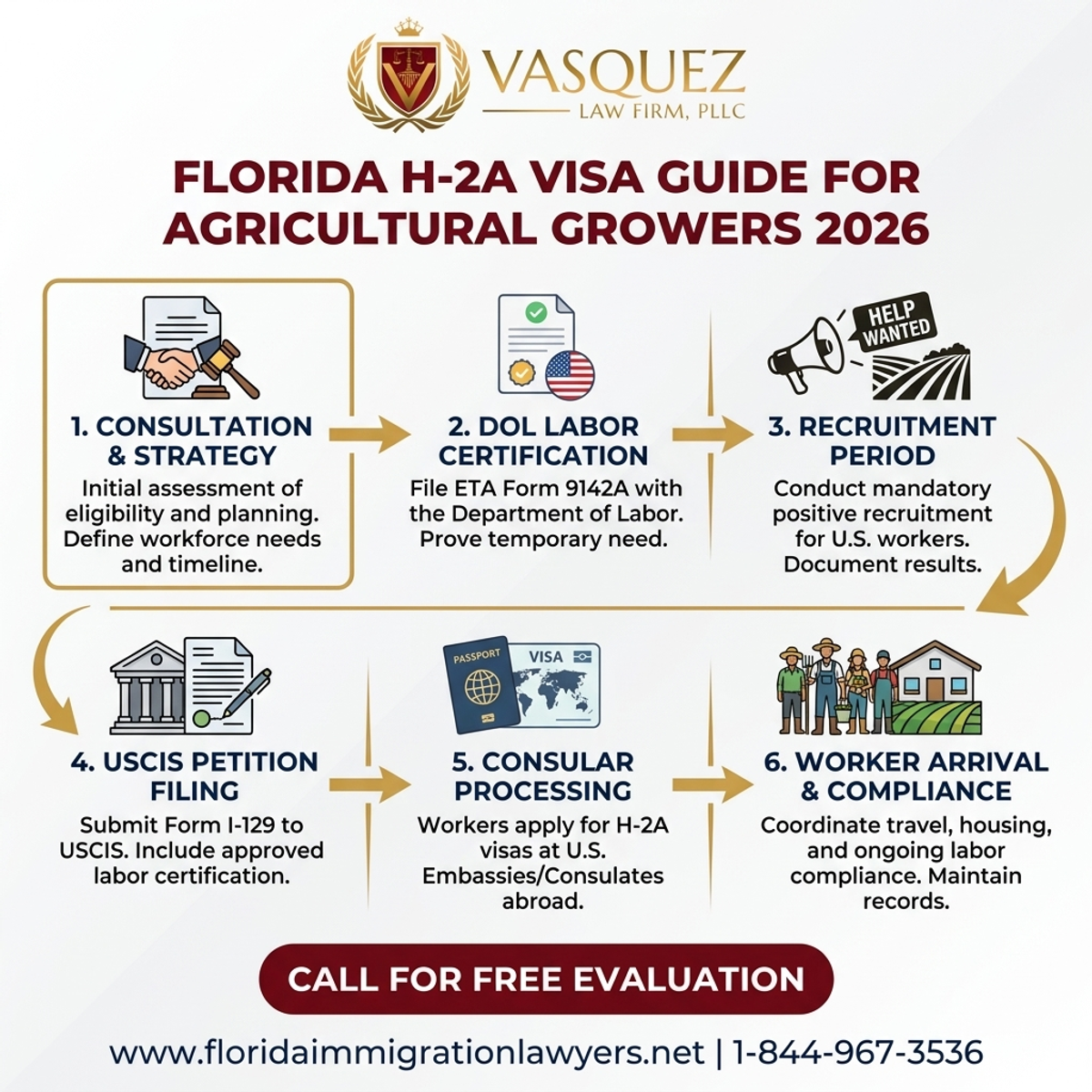
Key Statistics — H-2A Visa Florida: Guide for Agricultural Growers 2026
Hialeah and Florida-Specific Considerations for H-2A Employers
Florida's agricultural landscape is incredibly diverse, presenting unique opportunities and challenges for H-2A employers. From the vast sugar cane fields around Lake Okeechobee to the vegetable farms in South Florida near Hialeah and the citrus groves in the central region, each area has specific labor needs and local market dynamics. Employers in Hialeah, for instance, may benefit from a diverse local population with agricultural experience, yet still face shortages for specific seasonal tasks. Understanding the local economic conditions, prevailing wage rates in different counties, and the availability of local housing options is paramount for a successful H-2A program.
Furthermore, Florida has specific state regulations that may interact with federal H-2A requirements, particularly concerning housing standards, transportation safety, and wage payments. Employers must ensure compliance with both federal Department of Labor (DOL) rules and Florida state laws to avoid penalties. For example, the Florida Department of Health inspects H-2A housing to ensure it meets health and safety standards. Proximity to consular offices in countries like Mexico and Central America, where many H-2A workers originate, can also influence recruitment and visa processing times. Florida Immigration Lawyers has deep experience with these regional nuances, providing tailored advice to growers across the state, including those in and around Hialeah, ensuring their H-2A applications are robust and compliant with all applicable laws.
Do not navigate this complex process alone. The success of your agricultural operations in Florida depends on securing a reliable workforce while adhering to stringent legal requirements. Contact Florida Immigration Lawyers today for a free consultation at 1-844-967-3536 and let our experienced team provide the clarity and support you need.
Common Mistakes to Avoid in the H-2A Visa Process
Navigating the H-2A visa program can be complex, and even minor errors can lead to significant delays, denials, or costly penalties. Florida growers must be acutely aware of common pitfalls to ensure a smooth and compliant process. Avoiding these mistakes is crucial for securing your temporary agricultural workforce when you need them most.
- Late Filing of Applications: Submitting Forms ETA-9142A or I-129 past the designated deadlines can result in automatic denials, forcing employers to reapply and potentially miss critical planting or harvest seasons. The DOL and USCIS have strict timeframes that must be observed.
- Inadequate U.S. Worker Recruitment: Employers must demonstrate a genuine effort to recruit U.S. workers. Failure to properly advertise, contact former employees, or maintain detailed recruitment records can lead to DOL certification denial, as it suggests an insufficient attempt to find domestic labor.
- Non-Compliance with Wage Requirements: Offering wages below the Adverse Effect Wage Rate (AEWR) or the prevailing wage for the occupation and area in Florida is a serious violation. This can lead to back pay orders, fines, and debarment from the program.
- Failure to Provide Compliant Housing: H-2A employers are required to provide free, safe, and sanitary housing to their workers. Housing that does not meet federal and state (e.g., Florida Department of Health) standards will result in certification denial or revocation, impacting worker welfare and legal standing.
- Incomplete or Inaccurate Documentation: Any missing forms, unsigned documents, or inconsistencies in the application package can trigger Requests for Evidence (RFEs) from USCIS or DOL, causing significant delays and potentially leading to denials.
- Improper Handling of Transportation Costs: Employers are responsible for paying for workers' transportation from their home country to the job site and return. Failing to cover these costs or making workers pay for them is a violation of program rules.
- Lack of Workers' Compensation Insurance: Employers must provide workers' compensation insurance or an equivalent benefit. Operating without this coverage leaves both the employer and workers vulnerable and is a serious compliance breach.
- Failure to Retain Records: DOL and USCIS require employers to maintain extensive records related to recruitment, wages, housing, and transportation for a specific period. Inadequate record-keeping can lead to adverse findings during audits.
- Misrepresenting the Temporary Nature of Work: The H-2A program is strictly for temporary or seasonal agricultural work. Attempting to use it for permanent or year-round positions can lead to severe penalties and program debarment.
- Ignoring Post-Certification Obligations: Approval is not the end. Employers must continue to comply with all program requirements throughout the workers' employment, including maintaining wages, housing, and working conditions.
When to Call a Lawyer for Your H-2A Visa Needs in Florida
While this guide provides a comprehensive overview, the H-2A visa process is filled with intricate legal details and strict compliance requirements that can overwhelm even experienced Florida growers. Knowing when to seek professional legal assistance can save you time, money, and prevent costly mistakes. It is highly recommended to consult with an experienced immigration attorney from Florida Immigration Lawyers if you encounter any of the following scenarios or have particular concerns about your H-2A application.
You should call a lawyer if you are a first-time H-2A applicant, as setting up the program correctly from the start is paramount. If your application has been denied or you've received a Request for Evidence (RFE) from DOL or USCIS, legal counsel is essential to address the issues effectively. Furthermore, if you are facing a DOL audit or investigation regarding your H-2A practices, an attorney can help you navigate the process and protect your interests. Any significant changes to your agricultural operation, such as expanding your workforce or altering job duties, warrant legal review to ensure continued compliance. Moreover, if you have any doubts about meeting prevailing wage requirements, providing compliant housing, or managing recruitment efforts, proactive legal advice can prevent future problems. Don't risk your farm's future on a misunderstanding of complex immigration laws. Our dedicated attorneys are here to help.
About Florida Immigration Lawyers
Florida Immigration Lawyers is a leading immigration law firm dedicated to serving the diverse needs of individuals, families, and businesses throughout Florida. With a deep understanding of both federal immigration law and the unique local context of Florida, including areas like Hialeah, we provide comprehensive legal services to guide our clients through complex immigration challenges. Our firm specializes in various practice areas, including business immigration, family immigration, asylum, deportation defense, and naturalization. We are committed to delivering personalized, compassionate, and effective legal representation, striving to achieve the best possible outcomes for those we serve.
We pride ourselves on our client-focused approach, offering free consultations to assess your situation and explain your options clearly. Our team is available 24/7 to address urgent concerns, recognizing that immigration matters often require immediate attention. Whether you are a Florida grower seeking to secure temporary agricultural workers through the H-2A program, an individual pursuing family reunification, or a business looking to expand its international workforce, Florida Immigration Lawyers is here to help. We serve clients across all of Florida, ensuring access to high-quality legal support. Contact us today at 1-844-967-3536 or visit our contact page to schedule your free consultation. Se Habla Español.
Sources and References
- U.S. Citizenship and Immigration Services (USCIS)
- U.S. Department of State
- Executive Office for Immigration Review (EOIR)
- 8 U.S.C. Chapter 12 - Immigration and Nationality Act, Section 1101(a)(15)(H)(ii)(a) (INA 101(a)(15)(H)(ii)(a))
- 8 U.S.C. Chapter 12 - Immigration and Nationality Act, Section 1188 (INA 218)
- 20 CFR Part 655, Subpart B - Temporary Agricultural Employment of H-2A Aliens in the United States
Related services: immigration practice areas, family immigration services, citizenship and naturalization.
This article provides general legal information and is not intended as legal advice. Every case is unique, and outcomes depend on specific facts and circumstances. Contact an attorney for advice about your particular situation.
Securing the vital workforce your Florida agricultural business needs doesn't have to be a daunting task. With the right legal partner, you can navigate the H-2A visa program with confidence and ensure compliance every step of the way. Don't let labor shortages impact your harvest or your bottom line. Take the proactive step to protect your operations and secure your future. Call Florida Immigration Lawyers today at 1-844-967-3536 for your free consultation. Se Habla Español - Estamos aquí para ayudarle.
Do Not Navigate This Process Alone
Our experienced immigration attorneys are ready to fight for you. Get a free, confidential consultation today.
Se Habla Español
Frequently Asked Questions
Harold Estrada-Rodriguez
Florida Immigration Attorney · FL Bar No. 1041171
Florida Bar attorney handling Florida-jurisdiction immigration matters. Bilingual representation, free consultations.
Available 24/7 - Free Evaluations
Related Legal Services
Our Florida immigration attorneys can help you with immigration practice areas, free immigration consultation and experienced immigration attorneys. Call today at 1-844-967-3536 for a free consultation.
Related Links
Related Topics
Free Legal Consultation
Discuss your case with our experienced attorneys. We're available 24/7.
Se Habla Español - Estamos aquí para ayudarle.
Related Articles
Credible Fear Interview Preparation Florida 2026 | VLF Florida
Navigating a credible fear interview in Florida is a high-stakes process for individuals seeking asylum and facing expedited removal. This comprehensive guide from Florida Immigration Lawyers provides essential preparation strategies, including understanding your rights, gathering critical documents, and practicing your testimony. We detail the step-by-step process, typical timelines as of 2026, and associated cost factors. Learn how to avoid common mistakes and identify when immediate legal counsel is necessary to protect your right to pursue an asylum claim. Our experienced team offers free consultations and 24/7 support across Florida.
Child Status Protection Act: CSPA & Aging Out Florida
The Child Status Protection Act (CSPA) is a vital law for families in Florida, protecting children from 'aging out' of immigration eligibility due to processing delays. This act allows a child's age to be locked in for immigration purposes, ensuring they remain eligible as derivative beneficiaries for green cards or visas. Our comprehensive guide explains CSPA eligibility, the complex age calculation, required documentation, and critical deadlines like the 'one-year seeking to acquire' rule. We cover common mistakes to avoid and highlight when expert legal counsel from Florida Immigration Lawyers is essential, especially for families in West Palm Beach and across the state. Understanding CSPA can secure your child's future in the U.S.
Immigration Lawyer Hialeah Florida: Your Trusted Legal Guide
For those in Hialeah, Florida, navigating the complexities of U.S. immigration law requires expert legal guidance. Our comprehensive guide explains why retaining an experienced immigration lawyer in Hialeah, Florida, is crucial for family-based petitions, employment visas, deportation defense, and naturalization. We cover essential services, common pitfalls, and offer a step-by-step overview of the immigration process, including timelines and cost factors. With a focus on Florida-specific challenges and local resources, this article empowers you with the knowledge to make informed decisions. Learn how Florida Immigration Lawyers can provide the dedicated support you need for a successful immigration journey.
TPS Florida Eligible Countries 2026 | FL Immigration Lawyers
Explore Temporary Protected Status (TPS) eligibility for Florida in 2026, focusing on countries facing turmoil and how to apply. Contact Florida Immigration Lawyers for personalized assistance.
