H-4 EAD Rules for Florida Spouses | FL Immigration Lawyers
Discover the rules for obtaining an H-4 EAD in Florida, allowing spouses of H-1B visa holders to work legally. Our detailed guide covers eligibility, timelines, costs, and common mistakes. Contact Florida Immigration Lawyers for assistance.

Spouses of H-1B visa holders in Florida can apply for an H-4 EAD (Employment Authorization Document) to work legally in the U.S. As of 2026, this process involves specific eligibility criteria and documentation. Key takeaways include:
- Eligibility depends on the H-1B spouse's status.
- Processing times can vary; expect several months.
- Legal assistance is recommended to navigate complexities.
Introduction
Imagine moving to Kissimmee, Florida, with dreams of building a life and career, only to find that your work opportunities are limited by your visa status. For many spouses of H-1B visa holders, this is a reality. However, the H-4 EAD provides a pathway to gainful employment. This article explores the H-4 EAD process, its benefits, and how Florida Immigration Lawyers can assist you. Call us at 1-844-967-3536 for a free consultation.
The H-4 EAD is more than just a work permit; it represents freedom and opportunity for thousands of individuals who often arrive in the U.S. with significant professional skills and aspirations. Florida, with its vibrant economy and diverse job market, offers numerous prospects for H-4 spouses. Gaining work authorization not only allows them to pursue their careers but also contributes significantly to the household income, enhances financial stability, and fosters a greater sense of independence and integration into American society.
Navigating the U.S. immigration system can be daunting, especially when dealing with specific visa categories and their associated benefits. This guide aims to demystify the H-4 EAD application process for those residing in Florida, providing clear, actionable steps and highlighting potential pitfalls to avoid. Understanding the nuances of eligibility, required documentation, and processing timelines is crucial for a successful application and to fully leverage the opportunities available to H-4 visa holders.
What is the H-4 EAD and How Does it Work?
The H-4 EAD is a work permit available to certain spouses of H-1B visa holders in the U.S. It allows the holder to work legally in the country. To qualify, the H-1B spouse must have an approved I-140 petition or be granted H-1B status beyond the six-year limit under the AC21 Act. Understanding these criteria is crucial for eligibility.
Introduced in 2015, the H-4 EAD rule was a landmark change, designed to alleviate the financial and professional burdens on H-1B families, particularly those stuck in the green card backlog. Before this rule, H-4 spouses were largely restricted from working, leading to a loss of talent and economic contribution. The EAD allows H-4 visa holders to work for any employer, start their own business, or pursue self-employment, offering unparalleled flexibility compared to many other work visas.
For H-4 spouses in Florida, this means they can actively participate in the local economy, whether in tech hubs like Orlando, healthcare sectors in Miami, or the tourism industry across the state. This authorization is not tied to a specific employer, providing the freedom to seek opportunities that align with their skills and career goals, rather than being limited by their spouse's employer or industry. It empowers them to build their own professional lives while their H-1B spouse continues their journey towards permanent residency.
Eligibility Criteria
Eligibility for the H-4 EAD depends on the status of the H-1B spouse. If they have an an approved I-140 or have extended their stay under AC21, the H-4 spouse can apply for work authorization. It is vital to confirm these conditions before applying.
Specifically, the H-1B spouse must either be the beneficiary of an approved Form I-140, Immigrant Petition for Alien Worker, which signifies that their employer has initiated the process for them to obtain a green card. Alternatively, the H-1B spouse must have been granted an extension of H-1B status beyond the six-year maximum allowed under the American Competitiveness in the Twenty-First Century Act of 2000 (AC21). This typically happens if their PERM labor certification or I-140 petition was filed at least 365 days before their six-year H-1B limit expires.
For example, if an H-1B professional working in Tampa has an approved I-140 petition, their H-4 spouse becomes eligible to apply for the EAD. Even if the H-1B spouse has not yet reached the six-year limit but has an approved I-140, the H-4 spouse can apply. It's crucial for both spouses to maintain their underlying H-1B and H-4 nonimmigrant statuses throughout the application process. Any lapse in status could jeopardize the EAD application.
How Long Does it Take to Get an H-4 EAD in Florida?
As of 2026, obtaining an H-4 EAD in Florida can take several months. Exact timelines depend on processing speeds at local USCIS offices. It is advisable to apply early to avoid delays.
| Stage | Typical Timeframe | Notes |
|---|---|---|
| Application Submission | 2-3 weeks | Submit Form I-765 |
| USCIS Processing | 3-5 months | Varies by office |
| Receipt of EAD | 1-2 weeks | Upon approval |
Processing times for H-4 EAD applications can fluctuate significantly based on the volume of applications USCIS receives, staffing levels, and policy changes. While the table provides a general estimate, it's not uncommon for some applications to take longer, especially if a Request for Evidence (RFE) is issued. An RFE means USCIS requires additional information or clarification, which can add several weeks or even months to the overall processing time.
To minimize potential delays, applicants should ensure their Form I-765 is meticulously filled out, all required documentation is included, and the correct filing fee is submitted. Applying for the H-4 EAD concurrently with an H-4 status extension or change of status (Form I-539) can sometimes streamline the process, as USCIS may process them together. However, it's essential to consult the latest USCIS guidance or a legal expert like Florida Immigration Lawyers to determine the best strategy for your specific situation. Proactive communication and diligent follow-up can help manage expectations and address any issues promptly.
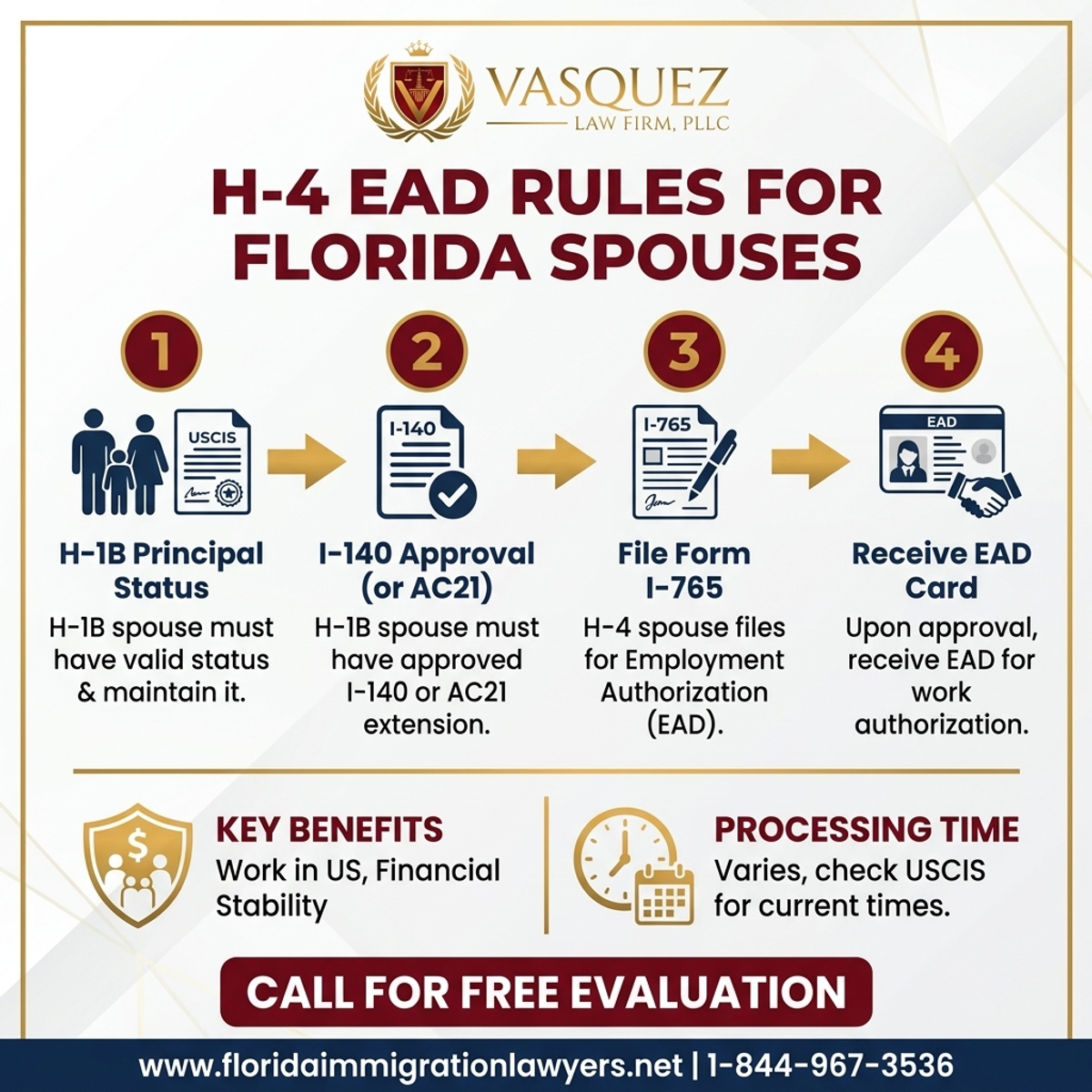
Step-by-Step Process — H-4 EAD Rules for Florida Spouses
What Documents are Required for an H-4 EAD Application?
To apply for an H-4 EAD, you will need to gather several documents:
- A copy of the H-1B spouse’s I-797 approval notice.
- Proof of marriage, such as a marriage certificate.
- Copies of the applicant's passport and visa.
- Form I-765, completed and signed.
- Two passport-sized photos.
- Fee payment as required by USCIS.
Each document plays a critical role in establishing your eligibility and identity. For instance, the H-1B spouse's I-797 approval notice (Form I-797A or I-797B) is crucial as it demonstrates their current valid H-1B status and, more importantly, whether their I-140 has been approved or if they have an AC21 extension. Ensure you provide the most recent approval notice. The marriage certificate must be official and, if not in English, must be accompanied by a certified translation.
Regarding your passport and visa, clear, legible copies of all pages with a visa stamp, entry stamp (I-94), and biographical data are essential. The Form I-765, Application for Employment Authorization, must be filled out completely and accurately, ensuring you use the most current version available on the USCIS website. Any errors or omissions can lead to delays or rejection. The two passport-sized photos must meet specific USCIS requirements, typically taken within 30 days of filing the application, with a white background and no glasses or head coverings (unless for religious reasons).
Finally, the fee payment must be precise. USCIS only accepts specific payment methods, usually a check or money order, and the exact amount must be included. Always verify the current fee on the USCIS website before mailing your application, as fees are subject to change without prior notice. Organizing these documents neatly with cover letters and tabs can greatly assist USCIS officers in processing your application efficiently.
How Much Does It Cost to Apply for an H-4 EAD?
While specific fees can change, here is a typical breakdown:
| Item | Typical Fee | Notes |
|---|---|---|
| Form I-765 Filing | Consult USCIS | Fees are subject to change |
| Biometrics Fee | Consult USCIS | If applicable |
| Legal Assistance | Varies | Recommended for complex cases |
The filing fee for Form I-765 is a primary cost, and it's imperative to check the USCIS website for the most up-to-date amount before preparing your payment. USCIS periodically adjusts its fees, and submitting an incorrect amount will result in your application being rejected and returned, causing significant delays. In some cases, a biometrics fee may also be required, particularly if you are also filing an H-4 extension or change of status concurrently. This fee covers the cost of fingerprinting and photo capture.
Beyond the direct USCIS fees, applicants should budget for other potential expenses. These might include costs for obtaining certified copies of documents, professional passport photos, postage for sending your application via certified mail, and potentially translation services if any supporting documents are not in English. The cost of legal assistance, while variable, is an investment that can save time, prevent errors, and provide peace of mind, especially for those with complex immigration histories or who prefer expert guidance. Florida Immigration Lawyers offers transparent fee structures and free consultations to help you understand these costs.
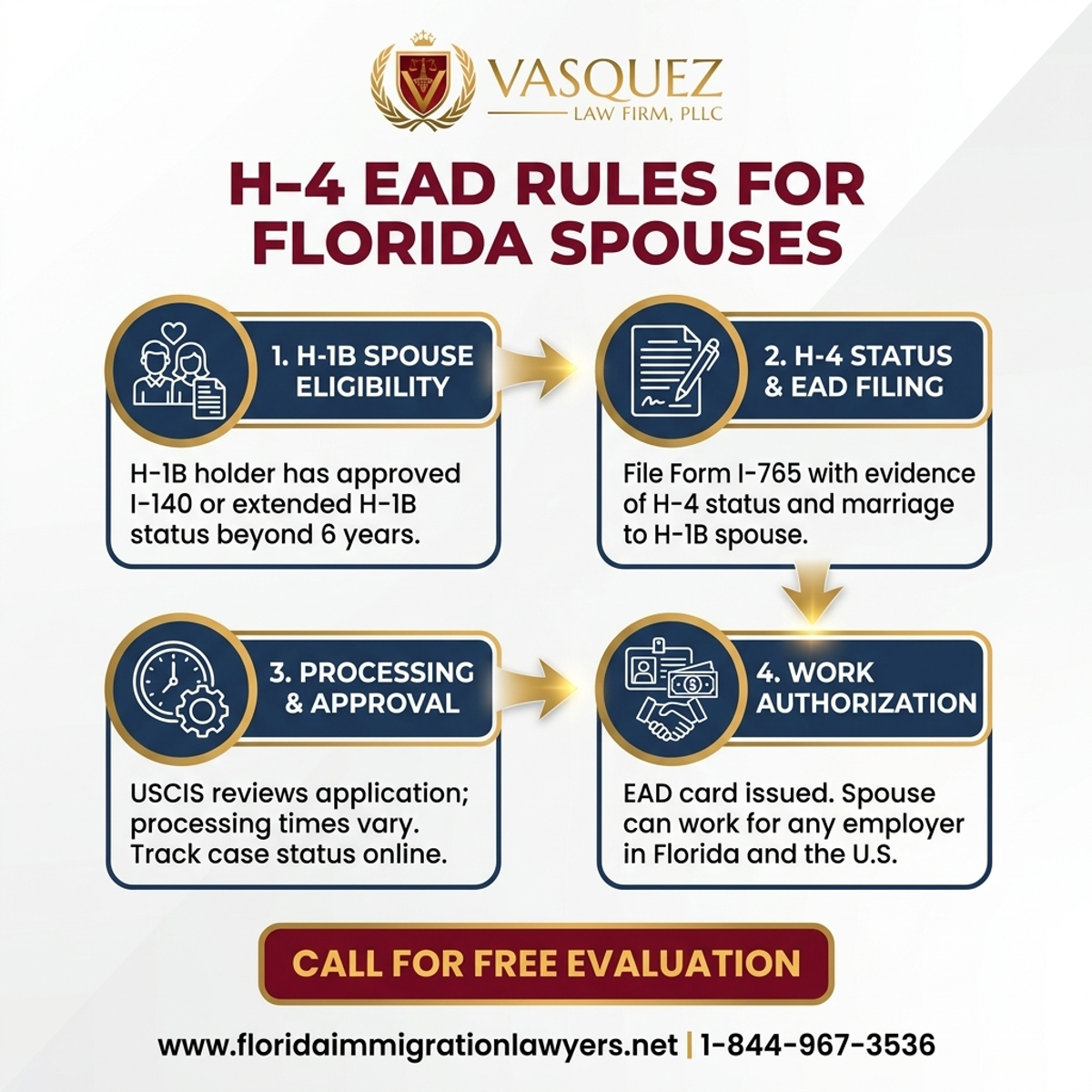
Key Statistics — H-4 EAD Rules for Florida Spouses
Steps to Apply for an H-4 EAD
- Confirm Eligibility: Ensure that your spouse meets the eligibility requirements.
- Prepare Documentation: Gather all necessary documents including marriage certificate and H-1B approval.
- Complete Form I-765: Fill out the application accurately.
- Submit Application: Send your application to the appropriate USCIS office.
- Await Processing: Check for updates and respond to any USCIS requests.
- Receive EAD: Upon approval, receive your work authorization card.
Let's delve deeper into each step to ensure a smooth application process. First, 'Confirm Eligibility' involves more than a quick check; it requires verifying the H-1B spouse's I-140 approval through their I-797 notice or confirming their H-1B extension under AC21. This often means coordinating with the H-1B spouse's employer or their immigration attorney to obtain necessary documentation and confirm their status. A misstep here can invalidate the entire application.
'Prepare Documentation' is a meticulous phase. Beyond simply gathering documents, it involves ensuring all copies are clear and legible, and that any foreign-language documents are translated by a certified translator, complete with a certification of translation. Organize your documents logically with a cover letter outlining the contents. For 'Complete Form I-765,' always download the latest version from the USCIS website, as older forms may be rejected. Pay close attention to every field, answering truthfully and completely, and double-check for typos or errors before signing.
When you 'Submit Application,' it's highly recommended to send your package via certified mail with a return receipt requested. This provides proof of mailing and delivery, which can be invaluable if there are any disputes or delays. After submission, 'Await Processing' involves regularly checking your case status online using the receipt number provided by USCIS. Be prepared to respond promptly to any Request for Evidence (RFE) or notice for a biometrics appointment. Finally, once you 'Receive EAD,' review the card carefully for any errors. The EAD card is your official proof of work authorization in the U.S.
Common Mistakes to Avoid
- Incomplete Forms: Failing to fill out Form I-765 correctly can delay your application.
- Incorrect Fees: Submitting the wrong fee amount can result in rejection.
- Missing Documentation: Ensure all required documents are included to avoid processing delays.
- Not Checking USCIS Updates: Regulations and fees can change; always verify current information.
- Ignoring Biometric Appointments: Missing these can lead to denial of your application.
- Waiting to Apply: Start the application process early to avoid issues with timing.
- Not Seeking Legal Advice: Consult with an attorney to navigate complex cases.
- Assuming Automatic Approval: Meeting eligibility does not guarantee approval.
Avoiding these common pitfalls is paramount for a smooth H-4 EAD application process. An incomplete Form I-765, for instance, might seem minor, but even a single unanswered question or an unsigned form can lead to your application being returned without processing, forcing you to restart and incur significant delays. Always review the form multiple times and consider having a second pair of eyes, or a legal professional, check it.
Submitting an incorrect fee is another frequent error. USCIS fees change periodically, and if you send an outdated or wrong amount, your entire package will be rejected. This is why always consulting the official USCIS website for current fees is critical. Similarly, missing documentation, such as an uncertified marriage certificate or an outdated H-1B approval notice, will trigger a Request for Evidence (RFE), which adds months to the processing time. Organize your documents clearly and ensure everything on the checklist is included.
Furthermore, failing to check USCIS updates means you might use an old form version or be unaware of new requirements. Missing a biometrics appointment, which USCIS schedules for identity verification, is a serious oversight that can directly lead to the denial of your application
Sources and References
- U.S. Citizenship and Immigration Services (USCIS)
- Executive Office for Immigration Review (EOIR)
- U.S. Department of State - Bureau of Consular Affairs
- Immigration and Nationality Act (INA), 8 U.S.C. Chapter 12
Do Not Navigate This Process Alone
Our experienced immigration attorneys are ready to fight for you. Get a free, confidential consultation today.
Se Habla Español
Frequently Asked Questions
Harold Estrada-Rodriguez
Florida Immigration Attorney · FL Bar No. 1041171
Florida Bar attorney handling Florida-jurisdiction immigration matters. Bilingual representation, free consultations.
Available 24/7 - Free Evaluations
Related Legal Services
Our Florida immigration attorneys can help you with deportation defense, citizenship and naturalization and family immigration services. Call today at 1-844-967-3536 for a free consultation.
Related Links
Related Topics
Free Legal Consultation
Discuss your case with our experienced attorneys. We're available 24/7.
Se Habla Español - Estamos aquí para ayudarle.
Related Articles
DED Venezuela Haiti Eligibility in Florida | VLF Florida
Deferred Enforced Departure (DED) offers temporary protection for Venezuelans and Haitians in Florida. Discover eligibility, application steps, and common pitfalls in our comprehensive guide. Contact Florida Immigration Lawyers at 1-844-967-3536 for assistance.
H-2A Visa for Agricultural Workers in Florida | VLF Florida
Discover how the H-2A visa helps Florida growers meet seasonal labor needs. Learn about the application process, common pitfalls, and how Florida Immigration Lawyers can assist you.
H-2A Visa Florida: Guide for Agricultural Growers 2026
Florida's agricultural sector relies heavily on a stable workforce, making the H-2A visa program a critical solution for growers facing labor shortages. This comprehensive guide for 2026 details the H-2A application process, document requirements, and expected timelines for Florida agricultural employers, including those in Hialeah. Learn about the multi-agency process involving the Department of Labor and USCIS, and understand your responsibilities regarding wages, housing, and transportation. We also highlight common mistakes to avoid and explain when legal counsel is essential to ensure compliance and a successful outcome. Florida Immigration Lawyers provides expert guidance to help you navigate these complexities and secure the temporary farm labor your operations need.
Credible Fear Interview Preparation Florida 2026 | VLF Florida
Navigating a credible fear interview in Florida is a high-stakes process for individuals seeking asylum and facing expedited removal. This comprehensive guide from Florida Immigration Lawyers provides essential preparation strategies, including understanding your rights, gathering critical documents, and practicing your testimony. We detail the step-by-step process, typical timelines as of 2026, and associated cost factors. Learn how to avoid common mistakes and identify when immediate legal counsel is necessary to protect your right to pursue an asylum claim. Our experienced team offers free consultations and 24/7 support across Florida.
