Citizenship Interview Tips Florida: Your 2026 Guide
Securing U.S. citizenship is a pivotal step for many Florida residents, including those in Homestead. This 2026 guide offers comprehensive tips for the naturalization interview, covering the USCIS process, essential preparation steps, and crucial documents. Learn how to effectively study for the English and civics tests, understand timelines, and budget for associated costs. We also highlight common mistakes to avoid and identify when professional legal assistance is indispensable. Florida Immigration Lawyers provides expert guidance, ensuring you approach your citizenship interview with confidence and clarity. Call us for a free consultation to navigate this vital journey successfully.

Preparing for your U.S. citizenship interview in Florida in 2026 requires diligent study and careful documentation. The interview, conducted by USCIS, assesses your English proficiency, knowledge of U.S. civics, and good moral character. Success hinges on a thorough review of your N-400 application, studying the 100 civics questions, practicing English reading and writing, and gathering all necessary original documents. Understanding the process and potential pitfalls can significantly improve your chances of approval, paving the way to becoming a U.S. citizen.
- Review your N-400 application thoroughly.
- Study the 100 civics questions and English test components.
- Organize all required original documents and copies.
- Be honest and accurate in all your responses.
- Consider legal counsel for complex cases or to ensure comprehensive preparation.
Embarking on the journey to U.S. citizenship is a significant milestone for many residents in Florida, including those in vibrant communities like Homestead. The naturalization process, culminating in the crucial citizenship interview, can seem daunting. You've worked hard, built a life, and now you're ready to take the final step to become a U.S. citizen. However, navigating the intricate requirements of the U.S. Citizenship and Immigration Services (USCIS) can be complex, especially with evolving policies and procedures.
This comprehensive guide is designed to equip you with the essential knowledge and practical tips for your naturalization interview in Florida for 2026. We'll walk you through what to expect, how to prepare effectively, common mistakes to avoid, and when seeking professional legal assistance from a Florida immigration lawyer can make all the difference. Our goal is to empower you to approach your interview with confidence and clarity, whether you're in Miami, Orlando, Tampa, or right here in Homestead, Florida. Don't leave your future to chance. Call Florida Immigration Lawyers at 1-844-967-3536 for a free consultation and let us help you prepare for this important step.
What is the naturalization interview process in Florida in 2026?
As of 2026, the naturalization interview process in Florida involves a detailed evaluation by a USCIS officer to confirm your eligibility for U.S. citizenship. This interview assesses your English language ability, knowledge of American history and government (civics), and your commitment to the principles of the U.S. Constitution, ensuring you meet all statutory requirements.
The naturalization interview is a critical step after you've filed Form N-400, Application for Naturalization, with USCIS. Once your application is received and processed, you will typically receive a biometrics appointment notice. After your biometrics are collected, USCIS will schedule your interview at one of their field offices in Florida, such as the Miami, Orlando, or Tampa offices. During the interview, the USCIS officer will review your N-400 application, ask questions to verify the information, and administer the English and civics tests. This includes testing your ability to read, write, and speak basic English, and answering questions from a list of 100 civics questions. The officer will also assess your good moral character, which is a fundamental requirement for naturalization under USCIS Policy Manual, Volume 12, Part D, Chapter 1. Understanding each component is vital for a successful outcome in your citizenship process.
The interview is a chance for the USCIS officer to confirm that all the information on your N-400 is accurate and up-to-date. They will ask questions about your background, family, employment, travel history, and any interactions you've had with law enforcement. It's essential to be truthful and consistent with the information provided in your application. Any discrepancies or new information must be disclosed. The officer will also ask about your commitment to the U.S. Constitution and your willingness to take the Oath of Allegiance. This comprehensive review ensures that only eligible individuals are granted the privilege of U.S. citizenship, upholding the integrity of the immigration system. Preparing thoroughly for this stage is paramount for anyone seeking to become a U.S. citizen in Florida.
How can I best prepare for my USCIS citizenship interview?
To best prepare for your USCIS citizenship interview, you should dedicate time to reviewing your application, studying for the English and civics tests, and organizing all required documentation. Diligent preparation will build your confidence and help ensure a smooth interview process.
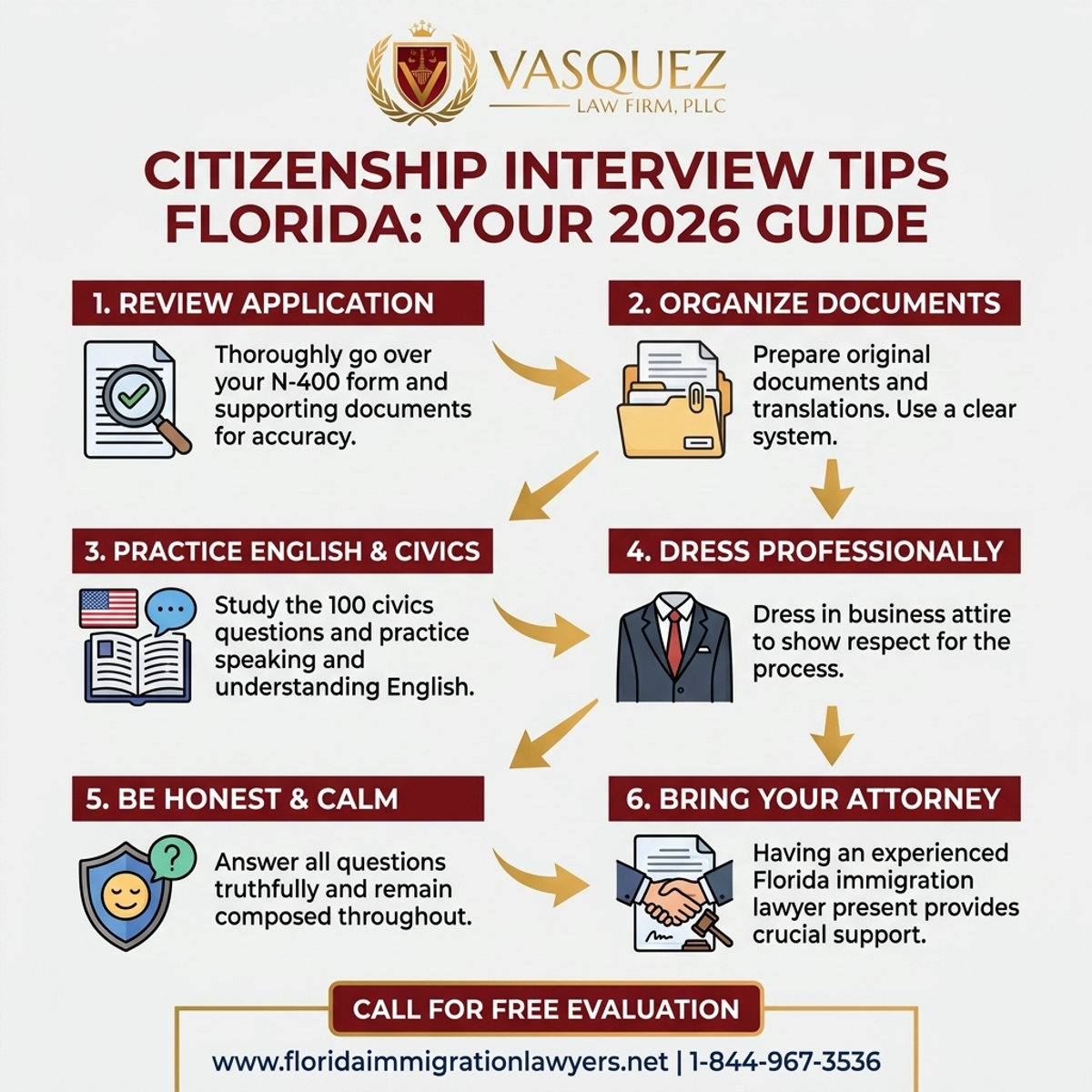
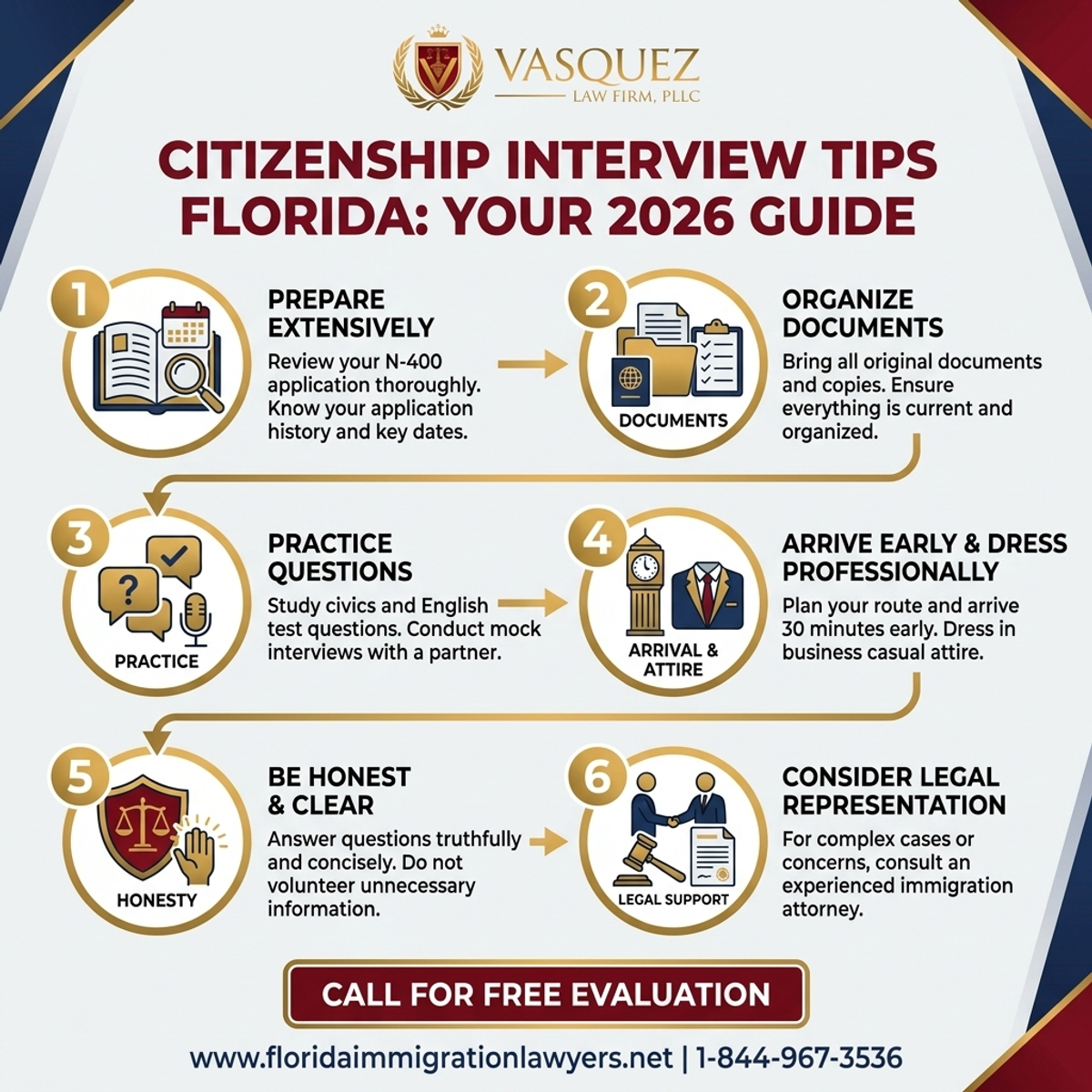
Effective preparation is the cornerstone of a successful naturalization interview. Many applicants find the prospect of the interview intimidating, but with a structured approach, you can feel confident and ready. Here is a step-by-step guide to help you prepare:
- Review Your N-400 Application Thoroughly: Read through every question and answer on your submitted Form N-400. Ensure you remember all the details, especially dates, addresses, and employment history. The officer will use this document as the basis for many questions.
- Study for the English Test: The English test has three components: speaking, reading, and writing. Your speaking ability will be assessed throughout the interview. For reading, you'll need to read one out of three sentences correctly. For writing, you'll write one out of three sentences correctly. Practice reading simple sentences and writing dictated sentences.
- Study for the Civics Test: You must answer 6 out of 10 questions correctly from the official list of 100 civics questions. These questions cover U.S. history, government, and geography. USCIS provides study materials, including flashcards and audio versions. Focus on understanding the concepts, not just memorizing answers.
- Gather All Required Original Documents and Copies: Collect all original documents listed on your interview notice, such as your Green Card, passport, marriage certificates, tax returns, and any court dispositions. Make sure you also have copies of everything.
- Practice Interview Questions: Familiarize yourself with common interview questions beyond the N-400, such as questions about your good moral character, your understanding of the Oath of Allegiance, and your commitment to the U.S. Constitution. Consider practicing with a friend or family member.
- Dress Professionally and Arrive Early: Presenting yourself well demonstrates respect for the process. Arrive at least 30 minutes before your scheduled interview time to account for security checks and unexpected delays, especially at busy USCIS field offices in areas like Miami or Tampa.
- Seek Legal Guidance if Needed: If you have a complex case, such as a criminal record, previous immigration issues, or extensive travel, it is highly advisable to contact us for legal assistance. An attorney can help you prepare for specific challenges and even accompany you to the interview.
What documents do I need for my naturalization interview?
For your naturalization interview, you will need to bring your interview notice, your Green Card, identification, and all original documents that support your N-400 application, including those proving continuous residence, good moral character, and marital status.
Having a well-organized set of documents is crucial for a smooth citizenship interview. The USCIS officer will need to verify the information you provided on your Form N-400. Failing to present requested documents can lead to delays or even a denial of your application. Here is a comprehensive document checklist:
- USCIS Interview Notice: The official letter from USCIS scheduling your interview.
- Permanent Resident Card (Green Card): Your original Form I-551.
- State-Issued Identification: Your driver's license or state ID.
- Passports and Travel Documents: All current and expired passports, and any re-entry permits or travel documents used during your permanent residency.
- Marriage Certificate(s) and Divorce Decree(s): If applicable, original certificates for all marriages and final divorce decrees for all previous marriages for both you and your current spouse.
- Birth Certificates of Children: For all your children, whether they live with you or not.
- Tax Returns: Copies of your federal income tax returns for the past 5 years (or 3 years if applying based on marriage to a U.S. citizen).
- Selective Service Registration Card: If you are a male applicant who resided in the U.S. between ages 18 and 26. You can verify your registration at www.sss.gov.
- Certified Court Dispositions/Arrest Records: If you have any arrests, citations, or criminal history, you must provide certified court dispositions for each incident, even if charges were dismissed or expunged. This is a critical aspect of demonstrating good moral character.
- Proof of Financial Support: If you have ever received public benefits, you might need to provide documentation.
- Evidence of Spouse's U.S. Citizenship: If applying based on marriage to a U.S. citizen, provide your spouse's birth certificate, naturalization certificate, or U.S. passport.
- Any documents requested in your interview notice: Always read your notice carefully for specific document requests.
Step-by-Step Process — Citizenship Interview Tips Florida: Your 2026 Guide
Remember to bring original documents and, if possible, photocopies of everything for the USCIS officer. For more detailed information, consult the official USCIS N-400 Application instructions and related guidelines.
Understanding the Timeline and Processing Expectations for Florida Naturalization
The timeline for naturalization in Florida can vary significantly based on factors like the specific USCIS field office (e.g., Miami, Orlando, Tampa), the completeness of your application, and the complexity of your case. As of 2026, applicants should anticipate several months from filing to oath ceremony.
While USCIS strives for efficiency, the path to citizenship involves multiple stages, each with its own processing time. Understanding these typical timeframes can help manage your expectations. Keep in mind that these are general estimates, and individual cases may differ. For the most current and personalized estimates, always check the USCIS Processing Times tool online. Factors such as a high volume of applications, requests for additional evidence, or a need for further background checks can extend these timelines. For residents of Homestead and South Florida, the Miami Field Office is typically the primary processing center, and its workload can influence local wait times. Staying informed about your application status online is always recommended. Here's a general overview of the naturalization timeline:
| Stage | Typical Timeframe (As of 2026) | Notes |
|---|---|---|
| Form N-400 Filing to Receipt Notice | 1-2 weeks | Confirmation that USCIS has received your application. |
| Biometrics Appointment | 3-5 weeks after receipt | Scheduled at a local Application Support Center (ASC) for fingerprints, photos, and signature. |
| Interview Scheduling | 6-12 months after biometrics | Varies significantly by USCIS field office workload and case complexity. Could be longer for complex cases. |
| Interview to Decision | Same day to a few weeks | Officer may issue a decision on the spot, or send a decision notice by mail. Some cases require a Request for Evidence (RFE). |
| Oath Ceremony | 2-6 weeks after approval | The final step where you take the Oath of Allegiance and receive your Certificate of Naturalization. Some offices conduct same-day oath ceremonies. |
It is important to remember that these timeframes are subject to change. The overall process can take anywhere from 8 months to over 1.5 years from the initial filing of the N-400 to the oath ceremony. Expedited processing is rarely granted and only in very specific, humanitarian circumstances. Consistent communication with USCIS, or through your legal representative, is key to staying updated on your application's progress. Be patient, but also be proactive in responding to any USCIS requests for information or documents.
Cost Factors and Fee Breakdown for U.S. Citizenship
The cost of pursuing U.S. citizenship primarily involves USCIS filing fees for Form N-400 and may include additional expenses for legal assistance, document translation, and travel. While specific fee amounts can change, it's crucial to budget for these anticipated costs.
Applying for naturalization, while a rewarding endeavor, does come with associated costs. The primary expense is the USCIS filing fee for Form N-400, Application for Naturalization. It's important to note that USCIS fees are subject to change, so always verify the current amounts on the official USCIS website before filing. As of 2026, the fee structure generally includes the application fee and a biometrics services fee, which are often combined. Fee waivers may be available for eligible applicants who meet specific income guidelines or receive certain public benefits. Beyond government fees, other significant costs can include legal representation, especially beneficial for navigating complex immigration services, and costs for obtaining necessary supporting documents or translations. Planning for these expenses is an integral part of your naturalization journey in Florida.
| Item | Typical Fee (As of 2026) | Notes |
|---|---|---|
| USCIS Form N-400 Filing Fee | (Varies, check USCIS website) | This fee covers the processing of your application. Always verify the latest fee on USCIS.gov. |
| Biometrics Services Fee | (Varies, check USCIS website) | Often included with the N-400 fee. Covers fingerprinting and background checks. |
| Attorney Legal Fees | (Varies by case complexity) | Costs for legal consultation, application preparation, interview coaching, and representation. Highly recommended for complex cases. |
| Document Translation Services | (If needed) | Required for any foreign-language documents submitted to USCIS. Must be certified translations. |
| Travel Expenses | (To USCIS office) | Consider transportation, parking, and potential lodging costs if your designated Florida USCIS field office is far from your home, such as for residents of Homestead traveling to Miami. |
| Postal/Courier Fees | (If applicable) | Costs for mailing your application and supporting documents securely. |
Key Statistics — Citizenship Interview Tips Florida: Your 2026 Guide
While the government fees are non-negotiable (unless a fee waiver is granted), investing in legal counsel can be a cost-effective decision in the long run. An experienced immigration attorney can help you avoid costly mistakes, ensure your application is complete and accurate, and provide invaluable guidance throughout the entire process. This can save you time, stress, and potential re-filing fees if your initial application is denied due to errors. For a clear understanding of potential costs for your specific situation, contact Florida Immigration Lawyers for a personalized assessment.
Do not navigate this process alone. The journey to U.S. citizenship is too important to face without expert guidance. Contact Florida Immigration Lawyers today for comprehensive support and peace of mind. We are here to champion your case.
Common Mistakes to Avoid During Your Citizenship Interview
Many applicants, despite their best intentions, make common errors that can delay or jeopardize their naturalization application. Being aware of these pitfalls can help you avoid them.
- Submitting an Incomplete or Inaccurate N-400: Errors or omissions on your application form can lead to requests for evidence (RFEs), delays, or even denial. Always double-check every detail before submission.
- Failing the English or Civics Test: Underestimating the difficulty of these tests is a common mistake. Dedicated study using official USCIS materials is essential.
- Lack of Supporting Documents: Not bringing all original and copies of required documents to your interview can cause significant delays as USCIS will issue an RFE, or even lead to a denial.
- Poor Communication or Misrepresentation: Providing inconsistent information, being evasive, or misrepresenting facts during the interview can raise red flags about your good moral character. Always be honest and straightforward.
- Ignoring Criminal History: Any arrests, even if charges were dropped or expunged, must be disclosed. Failing to provide certified court dispositions is a major red flag and can lead to denial.
- Not Disclosing All Marriages/Divorces: All previous marriages and divorces, both yours and your current spouse's, must be fully disclosed and documented, regardless of how long ago they occurred.
- Failure to Update Address with USCIS: If you move, you must update your address with USCIS within 10 days. Missing important notices due to an outdated address can severely impact your case.
- Missing Appointments: Failing to appear for your biometrics appointment or interview without prior rescheduling can result in your application being deemed abandoned and denied.
- Not Registering for Selective Service (for eligible males): Males residing in the U.S. between ages 18-26 must register for Selective Service. Failure to do so, unless exempt, can impact naturalization eligibility.
- Lying During the Interview: Any false statements under oath during the interview can lead to severe penalties, including a permanent bar from future immigration benefits.
- Going Alone Without Legal Counsel for Complex Cases: If you have any complexities in your immigration history, attempting the interview without an attorney's guidance can be a costly mistake.
When to Call a Florida Immigration Lawyer for Your Citizenship Interview
While many applicants successfully navigate the naturalization process independently, certain situations warrant the invaluable expertise of a Florida immigration lawyer. If you find yourself facing any of the following scenarios, consulting with an attorney from Florida Immigration Lawyers is highly recommended:
- Criminal History: Even minor arrests or citations can impact your good moral character assessment. An attorney can analyze your record, advise on necessary documentation, and prepare you for questions.
- Previous Immigration Denials or Issues: If you've had past visa denials, deportations, or other immigration complications, a lawyer can help address these issues proactively.
- Complex Marital History: Multiple marriages, divorces, or a history of marital fraud allegations can complicate your case.
- Extensive Travel History: If you have prolonged absences from the U.S. that may jeopardize your continuous residence requirement, legal counsel can help determine eligibility.
- Language Barriers: While the interview includes an English test, if you struggle with communication or understanding complex legal terms, an attorney can ensure your answers are clear and accurate.
- Disabilities Requiring Accommodations: If you need special accommodations for the interview due to a physical or developmental disability, an attorney can assist with the N-648 Medical Certification for Disability Exceptions.
- Concerns about Good Moral Character: Any issues that might question your good moral character, beyond criminal history, should be discussed with a lawyer.
- Fear or Anxiety about the Interview: An attorney can provide comprehensive preparation, reducing stress and increasing your confidence. Our experienced attorneys at Florida Immigration Lawyers understand the nuances of USCIS procedures and can provide personalized guidance, helping you prepare for the specific challenges of your case. We can clarify requirements, help gather documents, and even accompany you to your interview. If you are concerned about potential deportation or other adverse outcomes, our deportation defense expertise can be crucial.
About Florida Immigration Lawyers
Florida Immigration Lawyers is a leading immigration law firm dedicated to serving individuals and families across the entire state of Florida, including the Homestead area. Our team of highly experienced and compassionate attorneys understands the complexities and emotional toll that immigration matters can bring. We specialize in a wide range of immigration services, including naturalization, family-based petitions, asylum, deportation defense, and business immigration. We pride ourselves on providing personalized, strategic legal solutions tailored to each client's unique needs. With a deep commitment to our community and a track record of success, we strive to make the immigration process as smooth and stress-free as possible for our clients. We offer free consultations and are available 24/7 to answer your questions and provide the expert legal guidance you deserve. Let us be your trusted partner on your journey to U.S. citizenship and beyond. Call us today at 1-844-967-3536 or visit our website at https://www.floridaimmigrationlawyers.net.
Sources and References
- U.S. Citizenship and Immigration Services (USCIS)
- Executive Office for Immigration Review (EOIR)
- U.S. Department of State (travel.state.gov)
- 8 U.S.C. Chapter 12 - Immigration and Nationality Act (INA)
- 8 U.S.C. § 1427 (INA § 316) - Requirements for Naturalization
- 8 CFR Part 316 - General Requirements for Naturalization
- USCIS Policy Manual, Volume 12 - Citizenship and Naturalization
Related services: citizenship test preparation, dual citizenship guidance, family-based immigration.
This article provides general legal information and is not intended as legal advice. Every case is unique, and outcomes depend on specific facts and circumstances. Contact an attorney for advice about your particular situation. Immigration laws are subject to change.
Your dream of U.S. citizenship is within reach. Don't let uncertainty or complexity stand in your way. Take the proactive step to secure your future. Contact Florida Immigration Lawyers today at 1-844-967-3536 for a free, confidential consultation. Se Habla Espanol - Estamos aqui para ayudarle.
Do Not Navigate This Process Alone
Our experienced immigration attorneys are ready to fight for you. Get a free, confidential consultation today.
Se Habla Español
Frequently Asked Questions
Harold Estrada-Rodriguez
Florida Immigration Attorney · FL Bar No. 1041171
Florida Bar attorney handling Florida-jurisdiction immigration matters. Bilingual representation, free consultations.
Available 24/7 - Free Evaluations
Related Legal Services
Our Florida immigration attorneys can help you with immigration practice areas, free immigration consultation and experienced immigration attorneys. Call today at 1-844-967-3536 for a free consultation.
Related Links
Related Topics
Free Legal Consultation
Discuss your case with our experienced attorneys. We're available 24/7.
Se Habla Español - Estamos aquí para ayudarle.
Related Articles
J-1 Waiver Physician Placement in Florida | VLF Florida
Explore how the J-1 waiver helps foreign physicians work in Florida's underserved areas, focusing on Orlando's opportunities through the Conrad 30 program. Learn about application steps, timelines, and common mistakes. Contact Florida Immigration Lawyers for expert guidance.
DED Venezuela Haiti Eligibility in Florida | VLF Florida
Deferred Enforced Departure (DED) offers temporary protection for Venezuelans and Haitians in Florida. Discover eligibility, application steps, and common pitfalls in our comprehensive guide. Contact Florida Immigration Lawyers at 1-844-967-3536 for assistance.
H-4 EAD Rules for Florida Spouses | FL Immigration Lawyers
Discover the rules for obtaining an H-4 EAD in Florida, allowing spouses of H-1B visa holders to work legally. Our detailed guide covers eligibility, timelines, costs, and common mistakes. Contact Florida Immigration Lawyers for assistance.
H-2A Visa for Agricultural Workers in Florida | VLF Florida
Discover how the H-2A visa helps Florida growers meet seasonal labor needs. Learn about the application process, common pitfalls, and how Florida Immigration Lawyers can assist you.
