Immediate Relative Petition Process in Florida | VLF Florida
Learn about the immediate relative petition process in Florida. Ensure your family is united by successfully navigating the I-130 petition. Call Florida Immigration Lawyers at 1-844-967-3536 for a free consultation.

Immediate Relative Petition Process in Florida | VLF Florida
For many U.S. citizens, the dream of uniting with family members in America is a powerful motivator. The U.S. immigration system offers a specific pathway for this: the Immediate Relative Petition. This category is unique because it allows certain close family members of U.S. citizens to immigrate without being subject to numerical quotas or lengthy waiting lists, making it one of the most direct routes to obtaining a Green Card. If you're a U.S. citizen in Florida looking to bring your spouse, unmarried child under 21, or parent to the United States, understanding this process is your first crucial step.
At VLF Florida, we understand the complexities and emotional weight of family immigration. Our goal is to demystify the immediate relative petition process, providing clear guidance and expert legal support every step of the way. While the process is federal, having experienced Florida immigration attorneys who understand local nuances and USCIS field office procedures can make a significant difference in the success and efficiency of your petition.
Understanding Immediate Relatives: Who Qualifies?
The term "immediate relative" in U.S. immigration law has a very specific definition. It refers to a select group of family members who are exempt from the annual visa quotas that apply to other family-sponsored categories. This exemption means that once the petition is approved, a visa is immediately available, significantly shortening the waiting time for a Green Card. The three categories of immediate relatives are:
-
Spouses of U.S. Citizens: This includes legally married husbands and wives. The marriage must be legitimate and not entered into solely for immigration purposes. Both opposite-sex and same-sex marriages are recognized equally under U.S. immigration law.
-
Unmarried Children Under 21 of U.S. Citizens: This category includes biological children, stepchildren (if the marriage creating the step-parent relationship occurred before the child turned 18), and adopted children (if the adoption meets specific legal requirements).
-
Parents of U.S. Citizens: A U.S. citizen must be at least 21 years old to petition for their parent(s). This includes biological parents, step-parents (if the marriage occurred before the citizen turned 18), and adoptive parents (if the adoption meets specific legal requirements).
It's crucial to correctly identify the qualifying relationship from the outset. Misclassifying the relationship or failing to provide sufficient proof can lead to significant delays or even denial of the petition. This is where the expertise of an experienced immigration attorney becomes invaluable, ensuring that your case is categorized and presented accurately from the very beginning.
The Core of the Process: Form I-130, Petition for Alien Relative
The journey to bringing your immediate relative to the U.S. begins with filing Form I-130, Petition for Alien Relative. This form is filed by the U.S. citizen petitioner on behalf of their foreign national relative (the beneficiary). The purpose of the I-130 is to establish that a valid family relationship exists between the petitioner and the beneficiary, as defined by U.S. immigration law.
Filling out the I-130 accurately is paramount. Any errors or omissions can result in Requests for Evidence (RFEs) from USCIS, which prolong the process, or even a denial. The form requires detailed information about both the petitioner and the beneficiary, including personal details, addresses, employment history, and previous immigration history. It also asks for information about the relationship itself, such as marriage dates or birth details.
Along with the completed Form I-130, you must submit the required filing fee to USCIS. This fee is subject to change, so always check the official USCIS website for the most current amount. The petition is typically filed at a specific USCIS Lockbox facility, depending on where the petitioner resides. Once filed, USCIS will issue a receipt notice (Form I-797C, Notice of Action), confirming that they have received your petition and providing a receipt number you can use to track your case online.
Essential Supporting Documentation
The success of your Immediate Relative Petition hinges on providing compelling documentary evidence to prove the qualifying relationship. USCIS scrutinizes these documents carefully to prevent fraud and ensure eligibility. Here's a breakdown of the essential documents typically required:
-
Proof of U.S. Citizenship (Petitioner): This can include a copy of your U.S. birth certificate, naturalization certificate, certificate of citizenship, or a valid unexpired U.S. passport.
-
Proof of Relationship (Beneficiary):
- For Spouses: A certified copy of your marriage certificate.
- For Children: A certified copy of the child's birth certificate listing the U.S. citizen parent(s).
- For Parents: A certified copy of the U.S. citizen's birth certificate listing the parent(s).
-
Proof of Bona Fide Marriage (for Spouses): This is arguably the most critical part of a spousal petition. USCIS needs to be convinced that your marriage is genuine and not just for immigration purposes. Evidence can include:
- Joint bank accounts, credit cards, or investments.
- Joint leases or mortgage documents.
- Utility bills in both names.
- Birth certificates of children born to the marriage.
- Affidavits from friends and family who can attest to the legitimacy of the marriage.
- Photographs of the couple together over time (wedding, holidays, family events).
- Life insurance policies, wills, or trusts naming each other as beneficiaries.
Step-by-Step Process — Immediate Relative Petition Process in Florida | VLF Florida
-
Biometrics: After filing, both the petitioner and beneficiary (if adjusting status in the U.S.) will typically receive an appointment notice for biometrics (fingerprints, photos, and signature). This is used for background checks.
-
Translations: Any document not in English must be accompanied by a certified English translation.
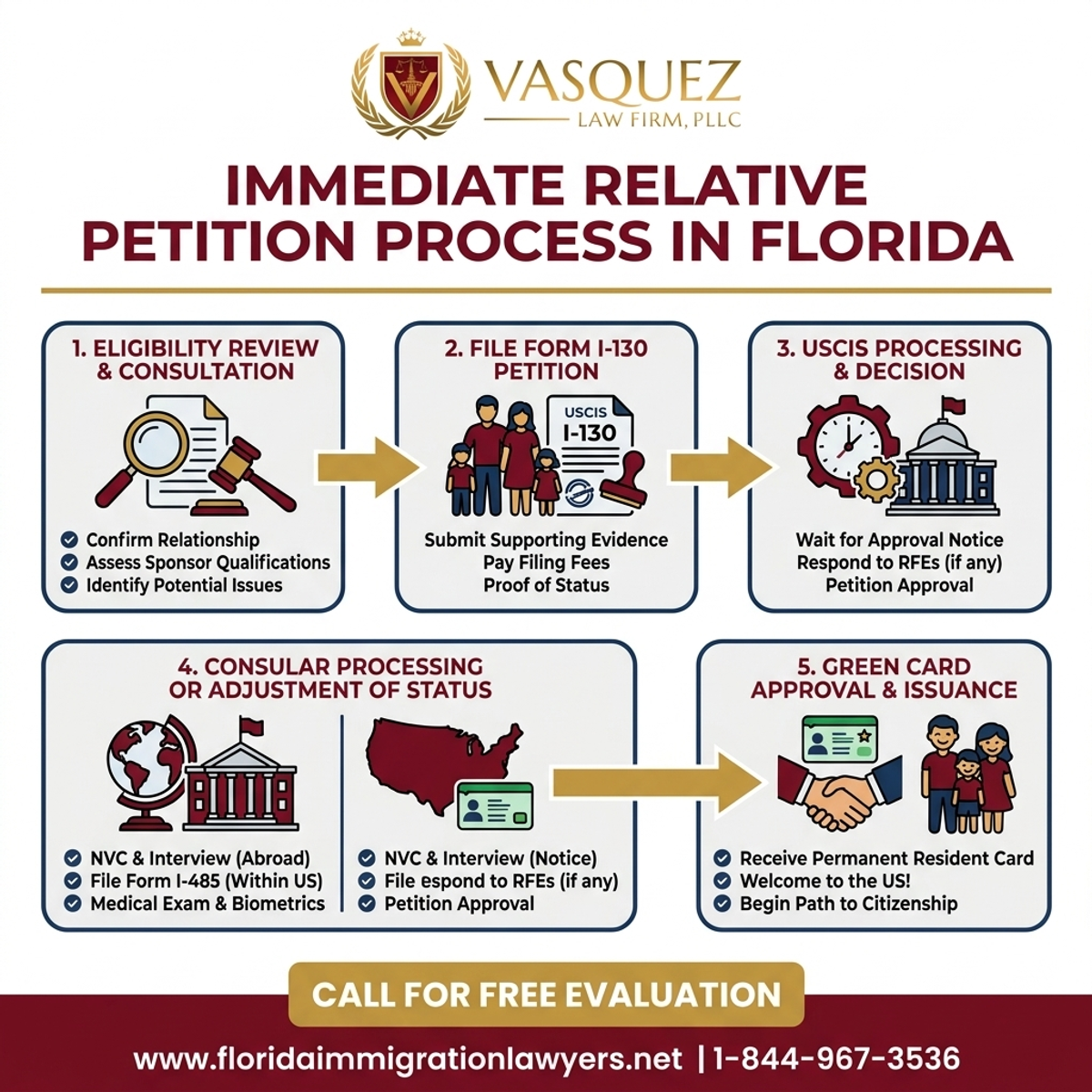
Organizing and presenting these documents correctly is vital. A missing document or an improperly translated one can cause significant delays. An immigration lawyer can help you compile a comprehensive and compelling evidence package.
Navigating the Path to a Green Card: Adjustment of Status vs. Consular Processing
Once the Form I-130 is approved, the next critical step is for the immediate relative to apply for their Green Card (Lawful Permanent Resident status). The path they take depends primarily on whether they are currently inside or outside the United States.
Adjustment of Status (AOS)
If the immediate relative is already physically present in the U.S. and meets certain eligibility criteria, they may be able to apply for Adjustment of Status. This allows them to obtain their Green Card without having to leave the country. Key requirements for AOS typically include:
- Lawful entry into the U.S. (even if they overstayed a visa, immediate relatives generally can still adjust status if they had a lawful entry).
- No serious criminal history or certain immigration violations that would bar adjustment.
- Having an approved I-130 petition (or filing it concurrently with the I-485).
The primary application for AOS is Form I-485, Application to Register Permanent Residence or Adjust Status. Often, the I-130 and I-485 can be filed concurrently, streamlining the process. Along with the I-485, applicants typically file for work authorization (Form I-765) and a travel permit (Form I-131), which allow them to work and travel internationally while their Green Card application is pending. The AOS process usually culminates in an interview at a USCIS field office, where an officer will review the application and supporting documents and ask questions about the relationship and the applicant's eligibility. It's crucial to be well-prepared for this interview, as any discrepancies or inconsistencies could lead to complications, potentially even triggering deportation defense proceedings if serious issues arise.
Consular Processing
If the immediate relative lives outside the U.S. or is ineligible for Adjustment of Status, they will undergo Consular Processing. This involves the National Visa Center (NVC) and a U.S. Embassy or Consulate in their home country. After the I-130 is approved by USCIS, it is forwarded to the NVC. The NVC will then instruct the beneficiary to pay fees, submit additional forms (such as Form DS-260, Immigrant Visa Application), and gather civil documents (birth certificates, marriage certificates, police certificates, etc.). A crucial part of this stage is the Affidavit of Support (Form I-864), where the U.S. citizen petitioner (and sometimes a joint sponsor) promises to financially support the immigrant, ensuring they will not become a public charge.
Once all documents are submitted and reviewed by the NVC, an interview is scheduled at the appropriate U.S. Embassy or Consulate. Before the interview, the beneficiary must undergo a medical examination with an authorized panel physician. The consular interview is the final step, where a consular officer will review the case and make a decision. If approved, the immigrant visa is issued, allowing the immediate relative to enter the U.S. as a lawful permanent resident. An attorney can provide invaluable assistance in preparing for both AOS interviews and consular interviews, ensuring all documentation is in order and helping clients anticipate potential questions.
Common Challenges and Pitfalls in the Immediate Relative Process
While the immediate relative path is often the most straightforward, it is by no means immune to challenges. Many applicants encounter hurdles that can delay or even jeopardize their case. Awareness of these common pitfalls can help you prepare more effectively:
-
Incomplete or Inaccurate Documentation: The most frequent cause of delays is submitting an incomplete petition or one with errors. This often leads to Requests for Evidence (RFEs) from USCIS, which can significantly extend processing times.
-
Proving Bona Fide Marriage: For spousal petitions, proving that the marriage is genuine and not entered into solely for immigration purposes is critical. Lack of sufficient joint evidence or inconsistencies in testimony can lead to intense scrutiny and potential denial.
-
Criminal History or Immigration Violations: Certain criminal convictions or past immigration violations (such as unlawful presence, previous deportations, or misrepresentations) can render a beneficiary inadmissible to the U.S. In some cases, waivers may be available, but these are complex and require expert legal guidance. If these issues are not properly addressed, they can lead to deportation defense proceedings.
-
Public Charge Rule: The petitioner must demonstrate the financial ability to support the beneficiary. If the petitioner's income is below the federal poverty guidelines, a joint sponsor may be required. Failure to meet this requirement can lead to denial.
Key Statistics — Immediate Relative Petition Process in Florida | VLF Florida
-
Previous Marriages or Divorces: If either party has been previously married, proof of termination of all prior marriages (divorce decrees, death certificates) must be provided. Failure to do so can invalidate the current marriage for immigration purposes.
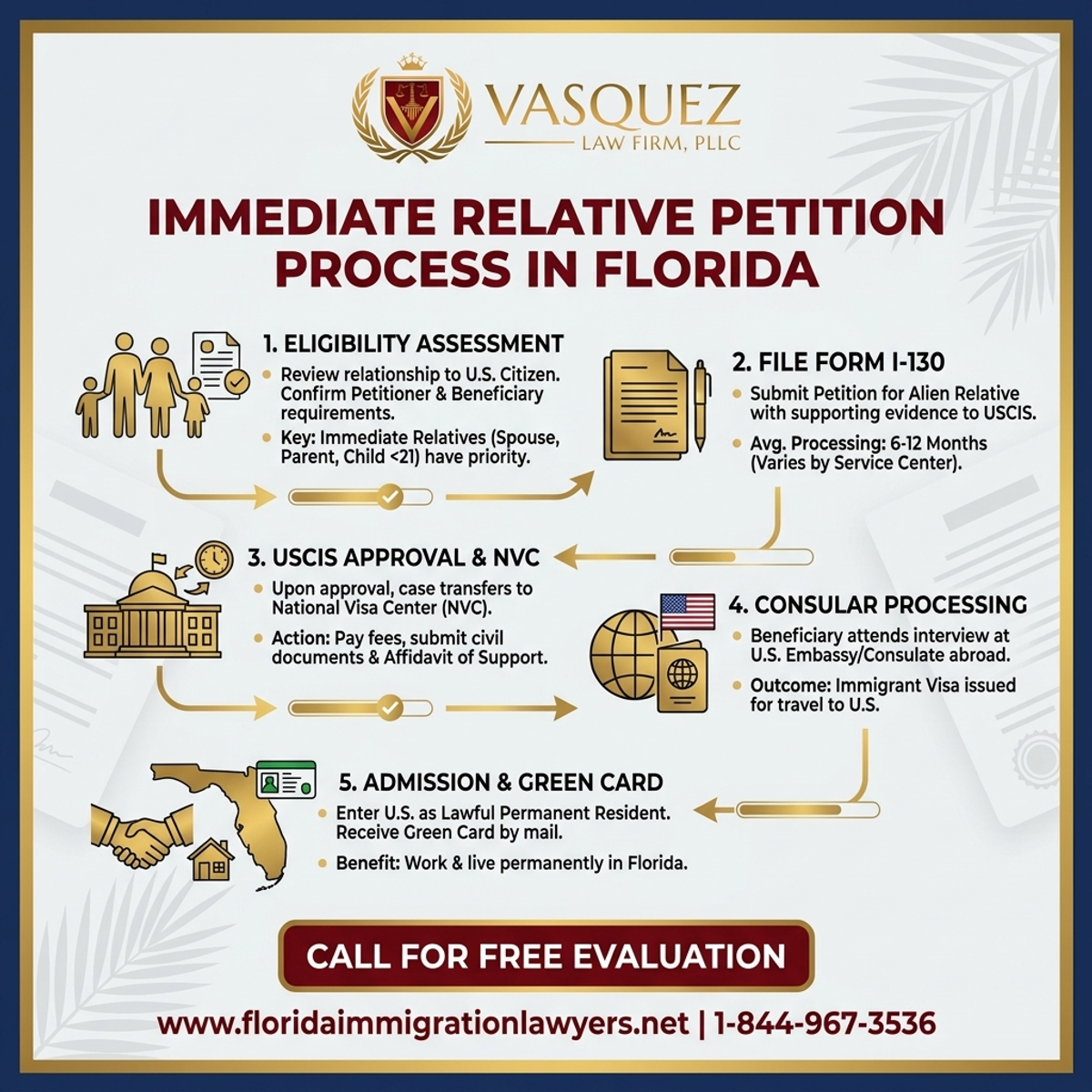
Navigating these complexities often requires a deep understanding of immigration law and policy. Attempting to manage these issues without legal counsel can lead to costly mistakes and prolonged separation from your loved ones.
Timelines and Expectations for Immediate Relative Petitions
While immediate relative petitions are exempt from visa quotas, they are not exempt from processing times. The duration of the entire process can vary significantly based on several factors, including:
-
USCIS Processing Times: The time it takes for USCIS to process Form I-130 varies by service center and can range from several months to over a year. These times are regularly updated on the USCIS website.
-
National Visa Center (NVC) Processing: For consular processing cases, the NVC stage involves document collection and review, which can take several months depending on how quickly the applicant submits all required paperwork.
-
Embassy/Consulate Interview Wait Times: The wait time for an interview at a U.S. Embassy or Consulate abroad can vary greatly depending on the country and the specific consulate's workload.
-
Adjustment of Status (AOS) Processing: For those adjusting status in the U.S., the I-485 processing time, including the interview, can also take many months, sometimes exceeding a year or more, depending on the USCIS field office.
It's important to set realistic expectations and understand that delays can occur. You can generally check the status of your case online using the receipt number provided by USCIS. While frustrating, patience is key. Responding promptly to any requests from USCIS or the NVC can help keep your case moving forward.
Why Expert Legal Guidance is Crucial in Florida Immigration
The immediate relative petition process, while seemingly straightforward on paper, involves intricate legal requirements, extensive documentation, and the potential for complex challenges. For families in Florida, navigating this federal system can be particularly daunting without professional assistance. Here's why retaining an experienced immigration attorney from VLF Florida is not just beneficial, but often crucial:
-
Ensuring Accuracy and Completeness: An attorney will meticulously prepare your petition and all supporting documents, minimizing the risk of RFEs or denials due to errors or omissions. We know exactly what USCIS and the NVC are looking for.
-
Strategic Case Preparation: We assess your unique situation to identify potential issues, such as past immigration violations, criminal history, or difficulties in proving a bona fide marriage, and develop a strategy to address them proactively. This includes preparing necessary waivers or additional evidence.
-
Interview Preparation: Whether it's an Adjustment of Status interview at a local USCIS office or a consular interview abroad, we prepare you thoroughly, helping you understand the types of questions to expect and how to respond confidently and truthfully.
-
Responding to Challenges: If you receive an RFE, a Notice of Intent to Deny (NOID), or face a denial, our attorneys are equipped to formulate a robust response or pursue an appeal, protecting your rights and your family's future.
-
Comprehensive Immigration Solutions: Beyond immediate relative petitions, VLF Florida offers a wide range of immigration services. If your situation involves more complex issues, such as asylum claims or deportation defense, our team has the expertise to provide holistic legal support. You can learn more about our dedicated attorneys and their commitment to client success.
-
Peace of Mind: Knowing that your case is being handled by experienced professionals allows you to focus on your family, reducing stress and uncertainty throughout the process.
Connect with VLF Florida Today
The journey to family unity in the United States is a significant one, filled with hope and potential challenges. By understanding the immediate relative petition process and securing knowledgeable legal representation, you can navigate this path with greater confidence and efficiency. Don't leave your family's future to chance.
If you are a U.S. citizen in Florida ready to petition for your immediate relative, or if you have questions about your specific situation, we invite you to reach out to VLF Florida. Our team is dedicated to providing personalized, effective immigration solutions. Contact us today for a consultation to discuss your immediate relative petition and take the first step towards reuniting your family.
Sources and References
- U.S. Citizenship and Immigration Services (USCIS)
- Executive Office for Immigration Review (EOIR)
- U.S. Department of State - Bureau of Consular Affairs
- Immigration and Nationality Act (INA), 8 U.S.C. Chapter 12
Do Not Navigate This Process Alone
Our experienced immigration attorneys are ready to fight for you. Get a free, confidential consultation today.
Se Habla Español
Frequently Asked Questions
Florida Immigration Lawyers
Immigration Attorney | Founder, Vasquez Law Firm
U.S. Air Force veteran and immigration attorney with thousands of cases resolved. J.D., NCCU School of Law. AILA member. Admitted to the 4th, 5th, and 11th Circuit Courts.
Available 24/7 - Free Evaluations
Related Legal Services
Our Florida immigration attorneys can help you with asylum protection, deportation defense and citizenship and naturalization. Call today at 1-844-967-3536 for a free consultation.
Related Links
Related Topics
Free Legal Consultation
Discuss your case with our experienced attorneys. We're available 24/7.
Se Habla Español - Estamos aquí para ayudarle.
Related Articles
Criminal Waiver for Immigration in Florida | VLF Florida
Learn about obtaining a criminal waiver for immigration in Florida, focusing on the I-601 form and overcoming past convictions for a better future. Contact Florida Immigration Lawyers at 1-844-967-3536 for a free consultation.
Immigration Medical Exam: Florida Civil Surgeons Guide
Navigating the immigration medical exam process in Florida is crucial for green card applicants. Learn how to find a certified civil surgeon in Fort Lauderdale and what to expect. Contact Florida Immigration Lawyers for expert guidance.
T Visa for Human Trafficking Victims in Florida | VLF Florida
Discover how the T visa can provide a path to safety and legal residency for human trafficking victims in Florida. Learn about the application process, eligibility criteria, and benefits. Our team at Florida Immigration Lawyers is here to help. Contact us today for a free consultation.
Military Naturalization: Expedited Path for Florida Service
Non-citizen service members in Florida, including those at MacDill Air Force Base, can pursue U.S. citizenship through military naturalization, an expedited process recognizing their sacrifice. This pathway waives certain residency requirements and offers faster processing under INA Sections 328 and 329. Understanding the eligibility criteria, detailed application steps, and essential documentation is crucial for a successful outcome. While the N-400 application fee is typically waived for military applicants, navigating the process can still be complex. Florida Immigration Lawyers provides expert guidance, helping service members avoid common mistakes and ensuring a smooth journey to becoming U.S. citizens. Contact us for a free consultation to learn how we can assist you.
