Criminal Waiver for Immigration in Florida
Learn about obtaining a criminal waiver for immigration in Florida, focusing on the I-601 form and overcoming past convictions for a better future. Contact Florida Immigration Lawyers at 1-844-YO-PELEO for a free consultation.

Criminal Waiver for Immigration in Florida | VLF Florida
Navigating the complex intersection of criminal history and U.S. immigration law can be one of the most challenging hurdles for individuals seeking to live, work, or remain in the United States. In Florida, as across the nation, a past criminal conviction, even a minor one, can render an individual ‘inadmissible’ or ‘deportable’ under immigration statutes. This often necessitates a criminal waiver, a critical legal tool designed to overcome certain grounds of inadmissibility or deportability. Understanding who qualifies, what types of waivers exist, and the intricate application process is paramount for anyone facing this situation. At VLF Florida, our dedicated immigration attorneys focus on guiding clients through these complex legal waters, offering assistance to secure the strongest possible outcome.
What is a Criminal Waiver for Immigration?
A criminal waiver, formally known as a Waiver of Grounds of Inadmissibility, is a petition filed with U.S. Citizenship and Immigration Services (USCIS) or an Executive Office for Immigration Review (EOIR) immigration court. Its purpose is to ask the government to overlook certain criminal offenses that would otherwise prevent an individual from obtaining a visa, adjusting status, or re-entering the United States after deportation. These waivers are not granted lightly; applicants must demonstrate compelling reasons why they should be allowed to overcome their past transgressions, often involving proof of extreme hardship to a qualifying U.S. citizen or lawful permanent resident relative.
Who Needs a Criminal Waiver?
Many individuals find themselves in need of a criminal waiver. This includes applicants for green cards (adjustment of status), individuals seeking immigrant or non-immigrant visas from abroad, and those who have been ordered deported but seek to return to the U.S. Common scenarios include:
- Individuals with convictions for crimes involving moral turpitude (CIMT).
- Those with multiple criminal convictions.
- Applicants with a history of drug-related offenses.
- Individuals who have previously been deported and are seeking re-entry.
- Those who have committed fraud or misrepresentation in immigration matters.
It's crucial to understand that not all crimes are waivable. Certain severe offenses, such as aggravated felonies or particularly egregious drug trafficking crimes, can lead to permanent bars to immigration relief. An experienced immigration lawyer can assess your specific criminal record and determine your eligibility for a waiver.
Types of Criminal Waivers: I-601 and I-212
The two most common types of criminal waivers are the Form I-601, Application for Waiver of Grounds of Inadmissibility, and the Form I-212, Application for Permission to Reapply for Admission into the United States After Deportation or Removal.
Form I-601: Waiver of Grounds of Inadmissibility
The I-601 waiver is used to overcome various grounds of inadmissibility, including many criminal offenses. To be eligible for an I-601 waiver based on criminal grounds, applicants typically must demonstrate that their denial of admission would result in “extreme hardship” to a qualifying U.S. citizen or lawful permanent resident spouse, parent, or in some cases, child. The definition of “extreme hardship” is complex and requires detailed evidence regarding medical conditions, financial burdens, educational disruption, emotional distress, and other factors. This waiver is often filed by individuals seeking to adjust their status within the U.S. or by those applying for immigrant visas at U.S. consulates abroad.
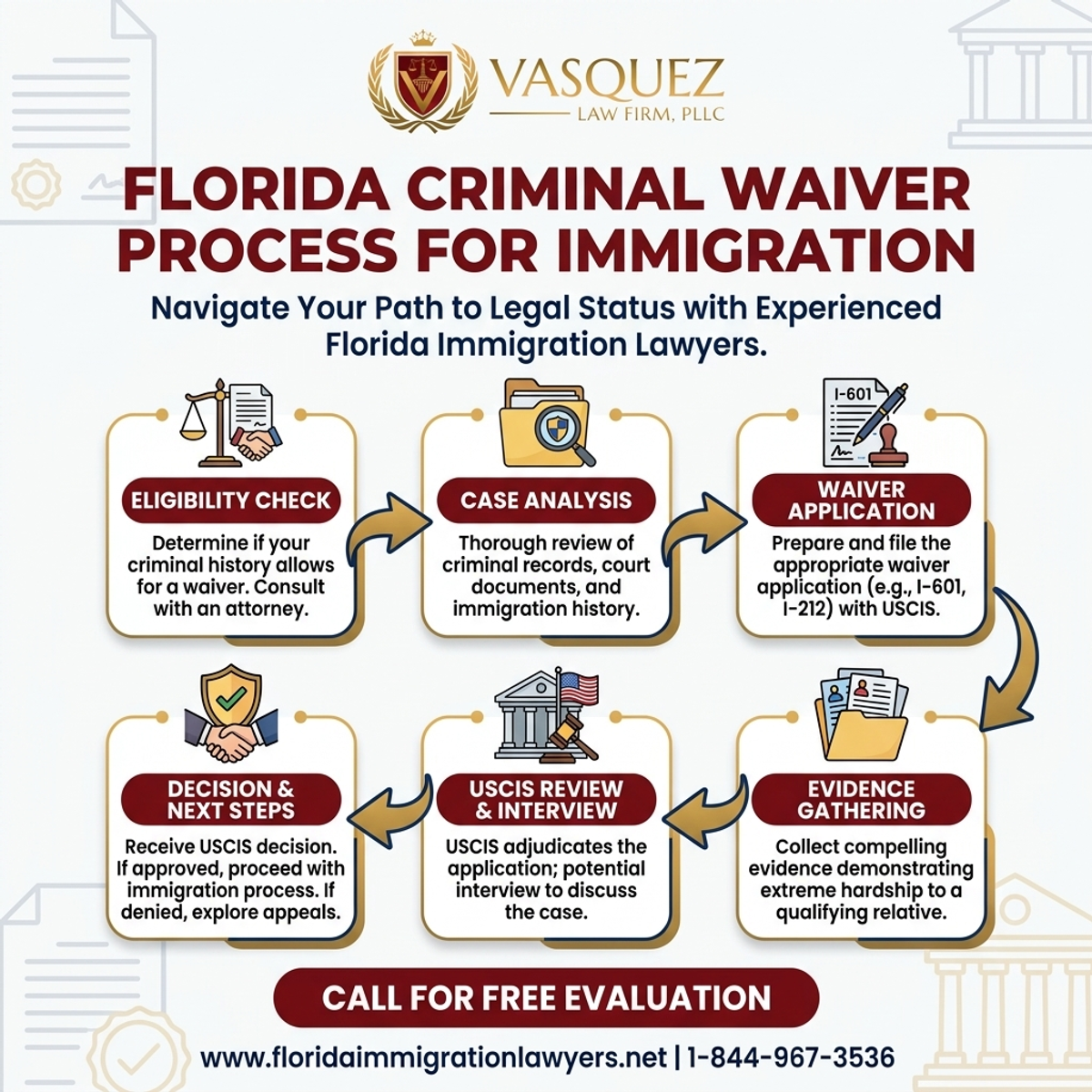
Step-by-Step Process — Criminal Waiver for Immigration in Florida | VLF Florida
Form I-212: Permission to Reapply After Deportation
The I-212 waiver is specifically for individuals who have previously been deported or removed from the United States and are seeking to re-enter. A prior deportation carries a statutory bar to re-entry, typically for 5, 10, or 20 years, or even permanently, depending on the reason for deportation. The I-212 waiver asks USCIS for permission to overcome this bar. While it doesn't always require a showing of extreme hardship, the applicant must demonstrate that their admission would not be contrary to the national welfare, safety, or security of the United States. Factors considered include the reasons for the prior deportation, the applicant's rehabilitation, and any ties to the U.S.
Understanding Grounds of Inadmissibility and Deportability
To fully grasp the necessity of a criminal waiver, it's essential to understand the specific grounds under which a non-citizen can be deemed inadmissible or deportable due to criminal activity. The Immigration and Nationality Act (INA) outlines various categories that can trigger these severe consequences, making the path to legal status or continued residency incredibly challenging without proper legal intervention.
Crimes Involving Moral Turpitude (CIMT)
One of the most common and broad categories is Crimes Involving Moral Turpitude (CIMT). While the INA does not explicitly define CIMT, case law generally interprets it as an act that is inherently base, vile, or depraved, and contrary to the accepted rules of morality and the duties owed between persons or to society in general. Examples often include theft, fraud, assault with intent to harm, certain domestic violence offenses, and sexual offenses. Even a single conviction for a CIMT can lead to inadmissibility, though a 'petty offense exception' may apply if the crime was minor and the sentence was short. However, the interpretation of what constitutes a CIMT can be highly nuanced and jurisdiction-specific, underscoring the need for expert legal analysis.
Aggravated Felonies
Aggravated felonies represent a particularly severe class of crimes under immigration law. Despite the name, not all aggravated felonies are considered felonies under state or federal criminal law. This category includes a wide range of offenses, from murder and rape to drug trafficking, firearms offenses, certain theft offenses, and even some misdemeanors that carry a sentence of at least one year. A conviction for an aggravated felony almost always leads to mandatory detention, makes an individual deportable, and often bars them from nearly all forms of immigration relief, including asylum and most waivers. Navigating an aggravated felony conviction requires immediate and specialized legal counsel.
Drug-Related Offenses
Drug-related offenses are treated with extreme severity under immigration law. A conviction for, or even an admission of, a violation of any law or regulation relating to a controlled substance (other than a single offense of possession of 30 grams or less of marijuana for personal use) can render an individual inadmissible. This includes possession, distribution, manufacturing, and trafficking. Even minor drug convictions can have devastating immigration consequences, often making waivers difficult to obtain. The only waiver typically available for drug offenses is for a single offense of simple possession of 30 grams or less of marijuana, and even then, it requires a showing of extreme hardship.
Other Criminal Grounds
Beyond CIMTs, aggravated felonies, and drug offenses, other criminal grounds for inadmissibility and deportability exist. These include multiple criminal convictions (even if not CIMTs), prostitution and commercialized vice, human trafficking, money laundering, and certain national security-related offenses. Furthermore, a conviction for domestic violence, stalking, child abuse, child neglect, or child abandonment can also lead to deportability. Each of these categories has specific legal definitions and implications that require careful review by an attorney experienced in both criminal and immigration law.
The I-601 Waiver Application Process in Detail
Applying for an I-601 waiver is an exhaustive process that demands meticulous attention to detail, comprehensive documentation, and a compelling legal argument. It is far more than simply filling out a form; it involves building a robust case to demonstrate why the U.S. government should exercise its discretion to forgive a past transgression.
Proving Extreme Hardship
The cornerstone of most I-601 waivers is proving “extreme hardship” to a qualifying U.S. citizen or lawful permanent resident relative (spouse, parent, or in some cases, child). This is not merely inconvenience or normal hardship; it must be truly exceptional and unusual. USCIS considers a wide array of factors, including:
- Health: Serious medical conditions of the qualifying relative that require specialized treatment in the U.S. or would be exacerbated by relocation.
- Financial: Significant financial losses, inability to find comparable employment in the foreign country, or dependence on the applicant's income.
- Education: Disruption to a child's education, special educational needs, or inability to pursue higher education abroad.
- Personal Ties: Strong family and community ties in the U.S., including care for elderly parents or disabled children.
- Country Conditions: Adverse conditions in the foreign country, such as political instability, lack of medical care, or high crime rates, that would impact the qualifying relative.
- Psychological Impact: Severe emotional or psychological distress to the qualifying relative due to separation or relocation.
Each factor must be supported by extensive evidence, including medical records, financial statements, expert psychological evaluations, school records, affidavits from family and community members, and country condition reports.
Required Documentation
The documentation required for an I-601 waiver is extensive and varies based on the specific grounds of inadmissibility and the hardship factors being presented. Generally, it includes:
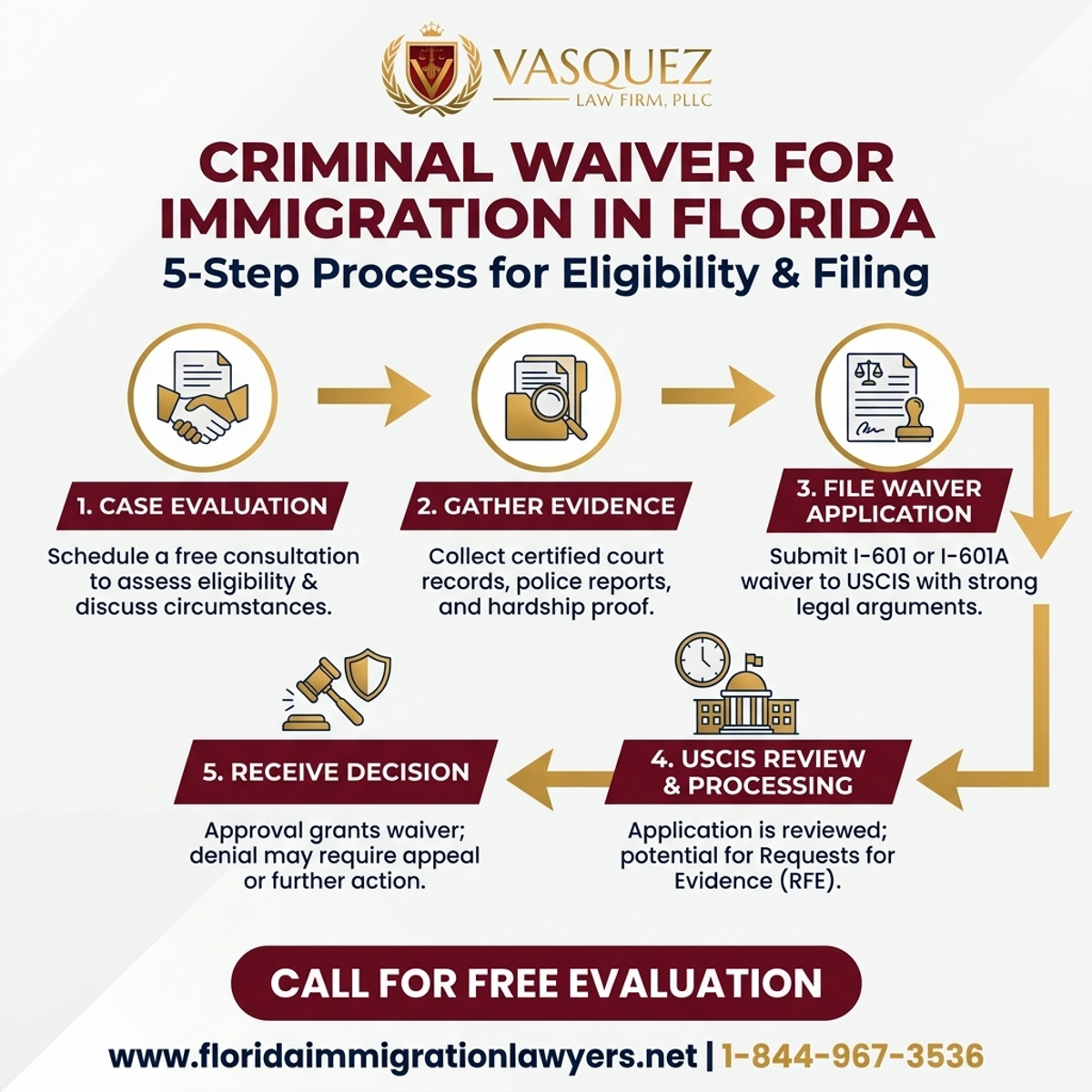
Key Statistics — Criminal Waiver for Immigration in Florida | VLF Florida
- Completed Form I-601.
- Proof of the qualifying relative's U.S. citizenship or LPR status (birth certificate, passport, green card).
- Proof of relationship to the applicant (marriage certificate, birth certificates).
- Detailed affidavits from the applicant, qualifying relative, and other supporting individuals explaining the hardship.
- Financial documents: tax returns, pay stubs, bank statements, property deeds, debt statements.
- Medical records: diagnoses, treatment plans, prognoses, and letters from doctors.
- Educational records: school transcripts, enrollment verification, letters from teachers or counselors.
- Country condition reports: evidence of safety concerns, economic instability, or lack of resources in the foreign country.
- Evidence of rehabilitation: if the waiver is for a criminal offense, evidence of remorse, rehabilitation programs, community service, and good moral character since the conviction.
The Role of the Qualifying Relative
The qualifying relative is central to the I-601 waiver. Their willingness to provide detailed information, participate in interviews, and articulate the hardship they would face is critical. The waiver is fundamentally about the impact on *them*, not primarily on the applicant. Their testimony and personal statements are often among the most powerful pieces of evidence in the application.
Interview and Decision
After submission, USCIS reviews the application. In some cases, an interview may be required, either with the applicant or the qualifying relative, or both. The decision can take many months, and a denial can have severe consequences, potentially leading to a permanent bar from the U.S. This lengthy and detailed process highlights why professional legal assistance is not just beneficial, but often essential.
Navigating Specific Criminal Convictions and Their Impact
The specific nature of a criminal conviction significantly impacts its waivability and the strategy required for a successful immigration outcome. Understanding how different types of offenses are viewed under immigration law is crucial.
DUI/DWI and Immigration
While a single DUI/DWI conviction is generally not considered a Crime Involving Moral Turpitude (CIMT) and thus may not directly trigger inadmissibility on criminal grounds, it can still pose significant problems. Multiple DUI convictions, or a DUI conviction combined with other aggravating factors (like injury to another person or child endangerment), can be interpreted as a pattern of behavior that indicates a lack of good moral character, which is a requirement for many immigration benefits, including naturalization. Furthermore, a DUI can lead to issues with medical inadmissibility if it's determined that the individual has a physical or mental disorder with associated harmful behavior, or a history of drug or alcohol abuse. This can require a medical waiver (Form I-601) in addition to proving good moral character.
Domestic Violence and Immigration
Domestic violence convictions are particularly problematic under immigration law. The Violence Against Women Act (VAWA) and other statutes specifically target domestic violence offenses. A conviction for a crime of domestic violence, stalking, child abuse, child neglect, or child abandonment can render an individual deportable. While some waivers may be available, they are often complex and require demonstrating significant rehabilitation and other mitigating factors. For victims of domestic violence, specific protections and self-petitioning options may exist, but for perpetrators, the path to immigration relief is extremely challenging and often involves a high burden of proof to overcome the severe statutory bars.
Petty Offense Exception
The petty offense exception is a critical provision that can save individuals with minor criminal histories from inadmissibility. It applies to individuals who have committed only one crime involving moral turpitude, and the maximum penalty possible for that crime did not exceed one year of imprisonment, and the individual was not sentenced to a term of imprisonment in excess of six months. This exception means that a single, minor CIMT might not require a waiver. However, determining if a crime falls under the petty offense exception requires a detailed legal analysis of the specific statute of conviction and the sentence received. Misinterpreting this exception can lead to severe consequences, including denial of benefits or even deportation.
The Critical Role of Legal Representation in Criminal Waivers
Given the immense stakes and the intricate nature of immigration and criminal law, securing experienced legal representation is not merely advisable but often indispensable. An immigration attorney specializing in criminal waivers can be the difference between a successful outcome and a life-altering denial. This is particularly true in Florida, where local court procedures and federal immigration regulations must both be navigated.
Experience in Immigration and Criminal Law
Our attorneys possess a unique dual understanding of both criminal defense and immigration law. This expertise allows us to:
- Accurately Assess Your Case: We can analyze your criminal record, identify all potential grounds of inadmissibility or deportability, and determine if a waiver is even possible. This often involves reviewing court documents, police reports, and sentencing orders to understand the precise nature of the conviction under immigration statutes.
- Advise on Plea Bargains: For individuals currently facing criminal charges, we can advise on the immigration consequences of different plea bargains, helping to mitigate future immigration issues. This proactive approach can prevent the need for a waiver altogether or make it more feasible.
- Identify the Correct Waiver: With multiple types of waivers and specific eligibility criteria, choosing the right waiver strategy is crucial. We ensure the correct forms are filed and the appropriate legal arguments are made based on your unique circumstances.
Crafting a Strong Waiver Petition
A successful waiver petition is a meticulously constructed legal argument backed by compelling evidence. Our team excels at:
- Gathering Comprehensive Evidence: We guide you through the process of collecting all necessary documentation, from court records and police reports to medical evaluations, financial statements, and affidavits from family and community members.
- Developing a Compelling Hardship Argument: For I-601 waivers, demonstrating “extreme hardship” is paramount. We work closely with you and your qualifying relative to articulate the profound impact separation or relocation would have, presenting a persuasive narrative supported by expert opinions and detailed evidence.
- Preparing Affidavits and Statements: We help you and your witnesses draft clear, concise, and impactful affidavits that effectively convey the necessary information and emotional context to USCIS.
- Addressing Rehabilitation: If your waiver is related to a criminal offense, we help you demonstrate rehabilitation through evidence of remorse, participation in counseling, community service, and positive contributions since the conviction.
Representing You Before USCIS
The process doesn't end with filing. Our legal team provides continuous support and representation throughout the entire waiver process:
- Responding to RFEs: We expertly respond to Requests for Evidence (RFEs) from USCIS, ensuring all additional information is provided accurately and promptly.
- Preparing for Interviews: If an interview is required, we thoroughly prepare you and your qualifying relative, ensuring you understand the types of questions that may be asked and how to answer them effectively.
- Advocating on Your Behalf: We act as your advocate, communicating directly with USCIS and other government agencies, and ensuring your case is presented in the strongest possible light.
Facing immigration challenges due to a criminal record can feel overwhelming. With VLF Florida, you don't have to navigate it alone. Our experienced attorneys are here to provide the dedicated and knowledgeable legal support you need. Contact us today for a consultation to discuss your specific situation.
Beyond Waivers: Related Immigration Challenges
While criminal waivers are a critical tool, a criminal record can intertwine with various other aspects of immigration law, creating complex challenges that extend beyond the waiver application itself. Our firm provides comprehensive legal services to address these interconnected issues, ensuring a holistic approach to your immigration journey.
Criminal Convictions and Asylum Claims
For individuals seeking asylum in the U.S., a criminal conviction can severely complicate or even bar their claim. Certain criminal offenses, particularly aggravated felonies, can lead to an asylum seeker being deemed ineligible for asylum or withholding of removal, even if they have a well-founded fear of persecution. This is known as the 'aggravated felony bar' or 'particularly serious crime' bar. In such cases, the focus shifts to proving that the crime does not fall into these categories, or exploring other forms of relief if available. Understanding the specific definitions of these bars and how they apply to your criminal history is crucial for any asylum applicant with a criminal record.
Deportation Defense for Criminal Offenses
One of the most immediate and severe consequences of a criminal conviction for a non-citizen is the risk of deportation (removal). If you have been arrested or convicted of a crime, you may be placed into removal proceedings. In these cases, a criminal waiver might be part of a broader deportation defense strategy. Our attorneys are adept at defending clients in immigration court, challenging the government's allegations, seeking various forms of relief from removal (including waivers, cancellation of removal, or adjustment of status), and fighting to keep families together. The interplay between criminal court outcomes and immigration court proceedings requires a nuanced understanding of both legal systems.
General Immigration Law Services
Beyond the specific issues of waivers, criminal convictions can impact nearly every aspect of immigration law, from visa applications and green card renewals to naturalization. A criminal record can raise questions about 'good moral character,' a prerequisite for many immigration benefits. Our firm offers a full spectrum of immigration law services, ensuring that all potential implications of a criminal history are addressed across your entire immigration journey. Whether you are applying for a family-based visa, employment-based visa, or seeking to become a U.S. citizen, we provide strategic advice and representation to navigate these complexities.
Conclusion
A criminal waiver for immigration in Florida is a complex and often daunting undertaking, but it is a vital pathway for many individuals seeking to regularize their status in the United States. With the right legal guidance, understanding the nuances of inadmissibility, the specific requirements for waivers like the I-601 and I-212, and the critical role of demonstrating extreme hardship, a positive outcome is achievable. At VLF Florida, our experienced immigration attorneys are committed to providing compassionate and effective legal representation, helping you overcome past challenges and build a secure future. Don't let a criminal record define your immigration journey. Contact VLF Florida today for a comprehensive consultation to discuss your options and develop a tailored strategy.
FAQs About Criminal Waivers for Immigration in Florida
- What is the primary purpose of a criminal waiver in immigration?
The primary purpose is to allow an individual who is otherwise inadmissible or deportable due to a criminal conviction to still obtain an immigration benefit, such as a visa, green card, or re-entry into the U.S. - What does 'inadmissibility' mean in the context of criminal waivers?
Inadmissibility means that an individual is barred from entering the U.S. or adjusting their status to lawful permanent resident due to certain factors, including specific criminal convictions. - Can all criminal convictions be waived?
No, not all criminal convictions are waivable. Severe offenses like aggravated felonies or certain drug trafficking crimes often carry permanent bars to most immigration relief. - What is 'extreme hardship' and why is it important for an I-601 waiver?
'Extreme hardship' refers to exceptional and unusual suffering that a qualifying U.S. citizen or lawful permanent resident relative would endure if the applicant were denied admission or forced to relocate. It is a critical component for many I-601 waivers. - Who is a 'qualifying relative' for an I-601 waiver?
Typically, a qualifying relative is a U.S. citizen or lawful permanent resident spouse, parent, or in some specific cases, a child of the applicant. - What is the difference between an I-601 and an I-212 waiver?
An I-601 waiver addresses various grounds of inadmissibility, including criminal ones, often requiring a showing of extreme hardship. An I-212 waiver is specifically for individuals who have been previously deported or removed and seek permission to reapply for admission. - How long does it take to get a decision on a criminal waiver?
Processing times for criminal waivers can vary significantly, often taking several months to over a year, depending on the type of waiver, the complexity of the case, and USCIS caseloads. - Should I apply for a criminal waiver on my own?
Given the complexity of immigration and criminal law, the extensive documentation required, and the high stakes involved, it is highly recommended to seek assistance from an experienced immigration attorney. - Can a DUI conviction affect my immigration status?
While a single DUI may not always be a direct ground for inadmissibility, multiple DUIs or DUIs with aggravating factors can indicate a lack of good moral character, affecting eligibility for various immigration benefits and potentially leading to medical inadmissibility issues. - What if I am currently facing criminal charges?
If you are currently facing criminal charges, it is crucial to consult with an attorney experienced in both criminal and immigration law immediately. The outcome of your criminal case can have profound and lasting implications for your immigration status.Sources and References
- U.S. Citizenship and Immigration Services (USCIS)
- Executive Office for Immigration Review (EOIR)
- U.S. Department of State - Bureau of Consular Affairs
- Immigration and Nationality Act (INA), 8 U.S.C. Chapter 12
Do Not Navigate This Process Alone
Our experienced immigration attorneys are ready to fight for you. Get a free, confidential case review today.
Se Habla Español
Or leave your details and we’ll call you:
Free Evaluation in 24 Hours
Or talk to us right now

AI voice assistant — available 24/7
FreeFrequently Asked Questions

William J. Vásquez
Founding Attorney · Vasquez Law Firm
U.S. Air Force veteran and immigration attorney with years of hands-on U.S. immigration experience. J.D., NCCU School of Law. AILA member. Admitted to the 4th, 5th, and 11th Circuit Courts.
Available 24/7 - Free Evaluations
Reviewed for legal accuracy by William J. Vásquez
Licensed in North Carolina; U.S. immigration is federal practice.
Related Legal Services
Our Florida immigration attorneys can help you with business immigration, deportation defense and family immigration services. Call today at 1-844-YO-PELEO for a free case review.
Related Links
Related Topics
Free Legal Case Review
Discuss your case with our experienced attorneys. We're available 24/7.
Se Habla Español - Estamos aquí para ayudarle.
Related Articles
Certificate of Eligibility for Expungement in Florida 2026
For non-U.S. citizens in Florida, understanding how a state expungement impacts immigration status is critical. A certificate of eligibility for expungement in Florida allows a criminal record to be sealed or expunged under state law. However, federal immigration agencies often disregard such state-level relief, still considering the original criminal offense as a conviction for immigration purposes. This can have severe implications for visa applications, green card eligibility, naturalization, and even lead to deportation. This guide clarifies the Florida expungement process, its limited effect on federal immigration law, and key steps to protect your status in 2026. Learn about common mistakes, required documents, timelines, and when to seek expert legal counsel from Florida Immigration Lawyers to navigate these complex issues effectively.
Immigration Lawyer Orlando Free Consultation in Florida
For individuals and families in Orlando, Florida, navigating the complexities of U.S. immigration law requires expert guidance. An immigration lawyer in Orlando offers crucial support for everything from visa applications and green card processes to naturalization and deportation defense. This comprehensive guide details what a free consultation covers, providing a step-by-step overview of immigration pathways, essential document checklists, and expected timelines in 2026. We also highlight common mistakes to avoid, discuss the critical role of legal counsel in deportation and asylum cases, and explain why choosing a local Orlando immigration attorney is beneficial. Florida Immigration Lawyers is dedicated to serving the diverse community of Orlando with compassionate, effective legal solutions, ensuring you receive personalized advice and robust representation for a successful immigration journey.
Work Permit EAD Application Process in Florida 2026
Applying for a work permit, or Employment Authorization Document (EAD), in Florida is a crucial step for many non-citizens seeking to work legally in the U.S. This comprehensive guide from Florida Immigration Lawyers details the 2026 application process, including eligibility criteria, necessary documentation for Form I-765, typical processing times, and associated costs. We highlight the importance of accurate submission and offer insights into common pitfalls to avoid. Our firm, based in Orlando, Florida, provides expert legal assistance for asylum seekers, adjustment of status applicants, and other eligible individuals. Learn how to prepare for your EAD application and understand when professional legal counsel can make a significant difference in achieving a successful outcome. Secure your right to work with knowledgeable support.
Change of Status B-2 to F-1 in Florida: Key Steps
Changing your status from a B-2 tourist visa to an F-1 student visa in Florida involves several crucial steps. This guide provides a comprehensive overview, including the 2026 I-539 processing times, document requirements, and common pitfalls to avoid. Learn how to navigate the process effectively with help from Florida Immigration Lawyers.