L-1 Visa Attorneys in Central Florida: 2026 Insights
Explore the intricacies of the L-1 visa for intracompany transfers in Florida. Discover application steps, common mistakes, and when to seek legal advice.
L-1 Visa Attorneys in Central Florida: 2026 Insights
For multinational companies looking to transfer key employees to their U.S. offices, the L-1 intracompany transferee visa is an indispensable tool. This non-immigrant visa category allows U.S. employers to bring in executives, managers, and specialized knowledge professionals from their foreign affiliated offices. In Central Florida, a hub for international business and tourism, understanding the nuances of the L-1 visa process is crucial for smooth operations and talent acquisition. As we look towards 2026, staying informed about evolving USCIS guidelines and best practices is more important than ever.
Our firm focuses on immigration law, providing comprehensive legal services to businesses and individuals seeking L-1 visas. We understand the unique challenges and opportunities that arise when navigating U.S. immigration policies, especially for intracompany transfers. This guide will delve into the intricacies of the L-1 visa, offer insights into the application process, and highlight why legal counsel is vital for success.
Understanding the L-1 Visa Category
The L-1 visa is designed for employees of international companies who are being transferred to a parent, branch, affiliate, or subsidiary in the United States. It facilitates the movement of essential personnel, ensuring that global businesses can operate efficiently across borders. There are two primary subcategories within the L-1 visa:
L-1A Visa: Managers and Executives
The L-1A visa is for intracompany transferees who will serve in a managerial or executive capacity in the U.S. This classification is highly sought after because it offers a direct pathway to permanent residency (Green Card) through the EB-1C multinational executive or manager category. To qualify for an L-1A, the employee must have been employed abroad in a managerial or executive capacity for at least one continuous year within the three years preceding their application. The U.S. position must also be managerial or executive in nature.
A 'managerial capacity' generally refers to the ability to supervise and control the work of other supervisory, professional, or managerial employees, or to manage an essential function within the organization. An 'executive capacity' involves directing the management of the organization or a major component or function, establishing goals and policies, and exercising wide latitude in discretionary decision-making. Proving these capacities often requires detailed organizational charts, job descriptions, and evidence of the employee's authority and responsibilities both abroad and in the U.S.
L-1B Visa: Specialized Knowledge Professionals
The L-1B visa is for intracompany transferees who possess 'specialized knowledge.' This means knowledge of the petitioning organization's product, service, research, equipment, techniques, management, or other interests and its application in international markets, or an advanced level of knowledge of the organization's processes and procedures. Like the L-1A, the employee must have been employed abroad for at least one continuous year within the three years preceding their application, and the U.S. position must require this specialized knowledge.
Demonstrating specialized knowledge can be more challenging than proving managerial or executive capacity, as the definition is often subject to interpretation by USCIS. It typically requires showing that the knowledge is proprietary, unique, or not readily available in the U.S. labor market. Documentation might include training materials, project descriptions, patents, or testimonials from colleagues and clients highlighting the employee's unique contributions. Both L-1A and L-1B visas are initially granted for up to three years, with potential extensions. L-1A holders can extend up to a maximum of seven years, while L-1B holders can extend up to five years.
Key Requirements for L-1 Visa Eligibility
Beyond the employee's role, several other critical requirements must be met for an L-1 visa petition to be approved:
Qualifying Organization
Both the U.S. and foreign entities must have a qualifying relationship (parent, branch, affiliate, or subsidiary). This relationship must be proven through corporate documents such as articles of incorporation, stock certificates, and financial statements. The entities must also be actively engaged in providing goods or services, not just acting as a passive investment.
Employee's Relationship to the Organization
The employee must have been employed abroad by a qualifying organization for at least one continuous year within the three years immediately preceding the filing of the petition. This employment must have been in a managerial, executive, or specialized knowledge capacity.
Employee's Prior Employment Abroad
The one-year foreign employment requirement is strict. It must be continuous and full-time. Brief trips to the U.S. during this period are generally acceptable, but the primary employment must have been outside the U.S.
Nature of Employment in the U.S.
The employee must be coming to the U.S. to provide services in a managerial, executive, or specialized knowledge capacity for a qualifying organization. For new U.S. offices, specific rules apply, often requiring evidence of sufficient physical premises and a viable business plan.
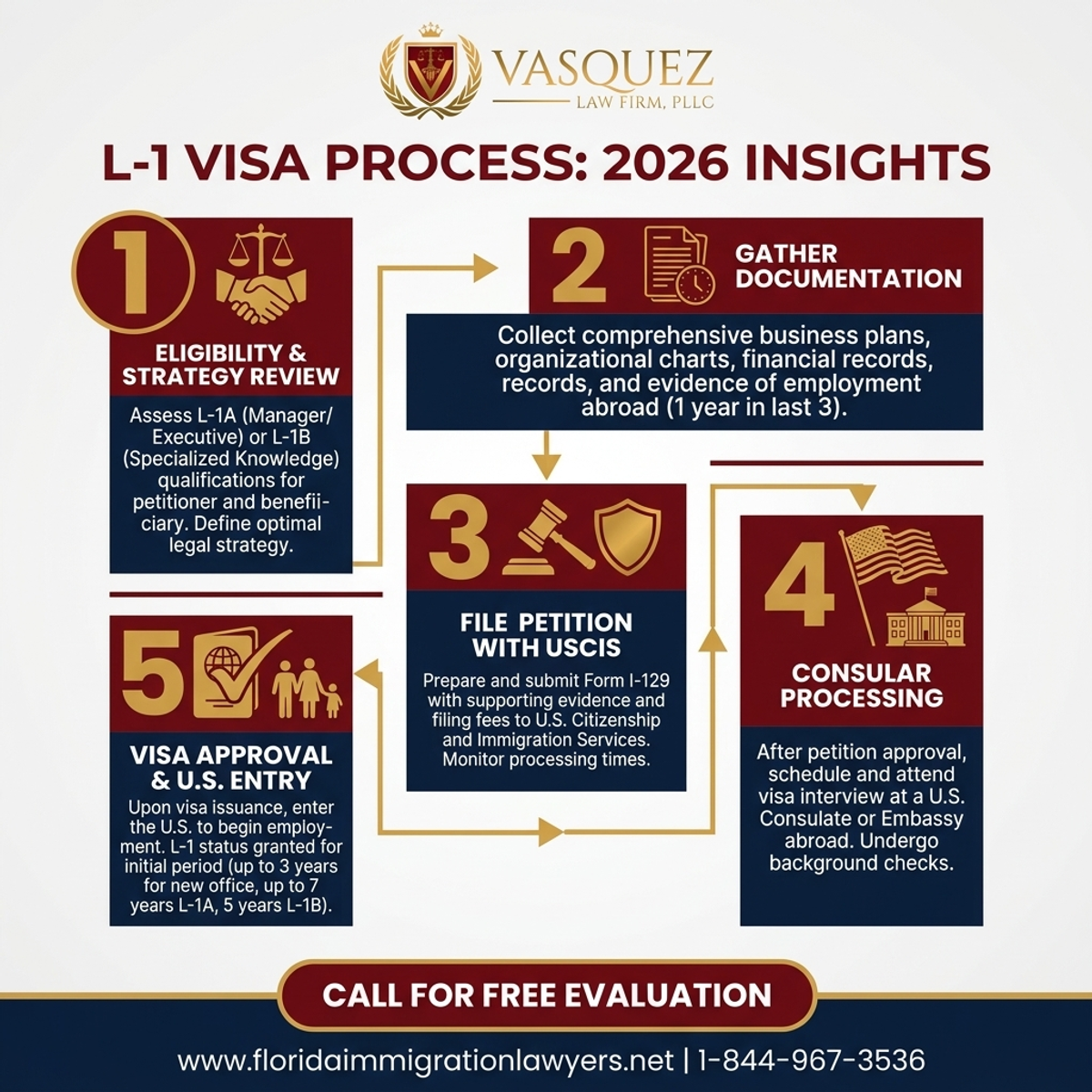
The L-1 Visa Application Process: Step-by-Step
The L-1 visa process involves several stages, requiring meticulous preparation and documentation:
Petition Filing (Form I-129)
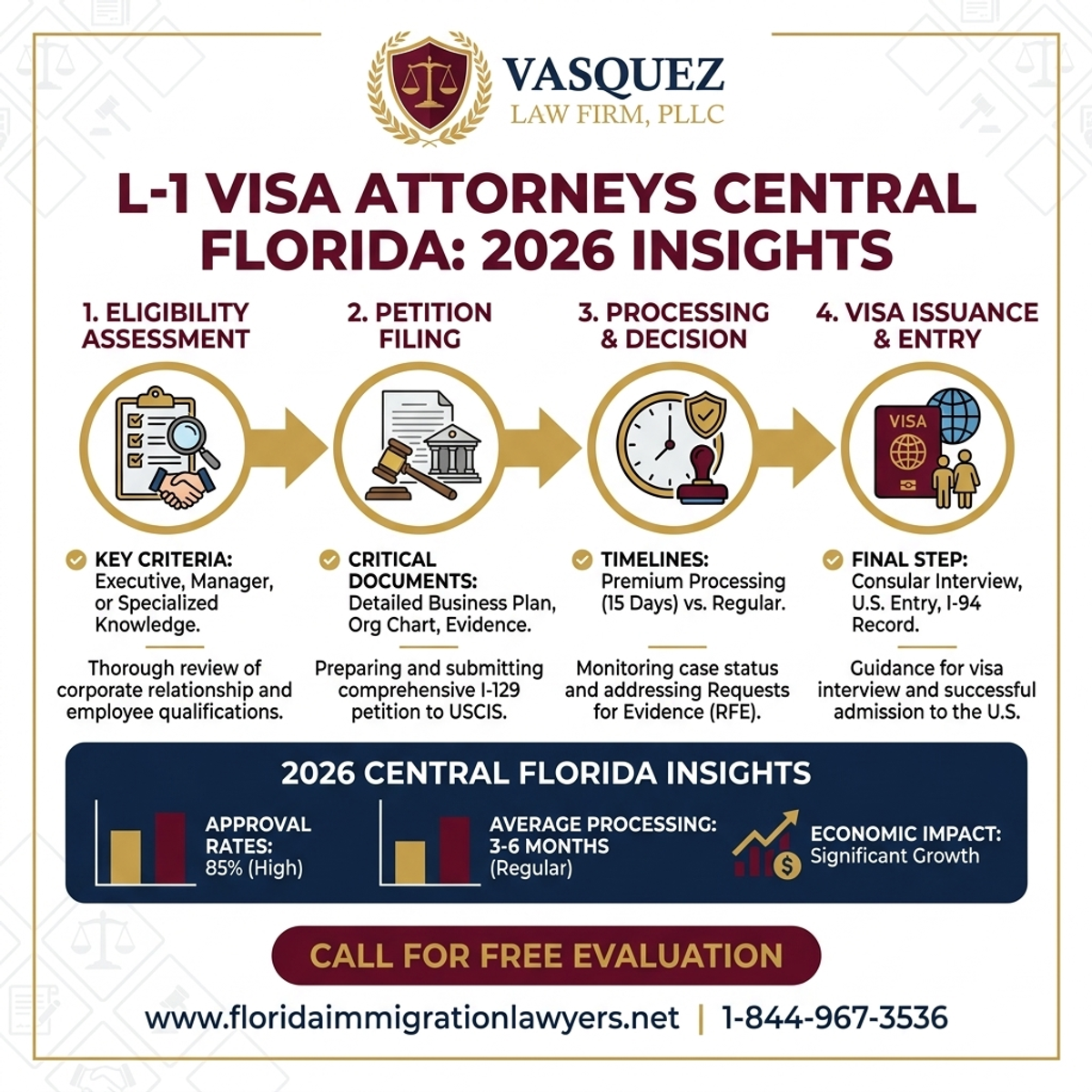
The U.S. employer files Form I-129, Petition for a Nonimmigrant Worker, with U.S. Citizenship and Immigration Services (USCIS). This petition must include extensive supporting documentation proving the qualifying relationship between entities, the employee's eligibility, and the nature of the U.S. position. Premium processing is available for an additional fee, which guarantees USCIS action within 15 calendar days.
Consular Processing or Adjustment of Status
Once the I-129 petition is approved, if the employee is outside the U.S., they will apply for the L-1 visa stamp at a U.S. embassy or consulate in their home country (consular processing). If the employee is already in the U.S. in another valid nonimmigrant status, they may be eligible to apply for a change of status to L-1 (adjustment of status) with USCIS.
Step-by-Step Process — L-1 Visa Attorneys in Central Florida: 2026 Insights
Blanket L Petitions
For larger, well-established multinational companies, a Blanket L Petition may be an option. This allows companies to pre-qualify with USCIS to transfer multiple L-1 employees without filing individual I-129 petitions for each. Once a blanket petition is approved, individual employees can apply directly at a U.S. consulate with a Form I-129S, saving time and administrative burden. Our experienced attorneys can help determine if your company qualifies for this streamlined process.
Navigating Complexities and Common Challenges in L-1 Visa Petitions
While the L-1 visa offers significant advantages for multinational corporations, its application process is fraught with potential pitfalls. USCIS scrutinizes L-1 petitions carefully, and even minor discrepancies or insufficient evidence can lead to Requests for Evidence (RFEs) or outright denials. Understanding and preparing for these complexities is paramount to a successful outcome.
Proving Managerial/Executive Capacity (L-1A)
One of the most frequent challenges in L-1A petitions is adequately demonstrating that the foreign employee will truly serve in a managerial or executive capacity in the U.S. USCIS often looks beyond job titles, focusing on the actual duties and responsibilities. For L-1A, the employee must primarily manage other professionals or an essential function, not just perform day-to-day operational tasks. This means providing detailed organizational charts, clear job descriptions outlining supervisory authority, and evidence of the employee's decision-making power. Simply stating that an employee is a 'manager' without substantiating evidence of their direct reports or the scope of their functional management will likely result in an RFE. We guide clients in crafting compelling narratives and gathering robust evidence to meet these stringent requirements.
Demonstrating Specialized Knowledge (L-1B)
The L-1B category, focused on 'specialized knowledge,' presents its own set of hurdles. The definition of specialized knowledge can be subjective, leading to inconsistent interpretations by USCIS adjudicators. Petitioners must prove that the employee's knowledge is truly unique, proprietary, or not easily replicable in the U.S. labor market. This often requires detailed explanations of the company's products, services, processes, and how the employee's specific expertise is critical to the U.S. operations. Evidence might include proprietary training manuals, patents, trade secrets, or project documentation highlighting the employee's unique contributions. Simply having advanced technical skills is often not enough; the knowledge must be tied specifically to the petitioning organization's unique operations. Our team assists in articulating the specialized nature of an employee’s knowledge in a manner that resonates with USCIS guidelines.
Small Business and Startup Considerations
New U.S. offices and smaller companies face additional scrutiny. For a new office L-1 petition, the U.S. entity must demonstrate that it has secured sufficient physical premises, has a viable business plan, and will be able to support a managerial, executive, or specialized knowledge position within one year of approval. This often requires providing detailed financial projections, lease agreements, and evidence of initial capital investment. USCIS wants assurance that the new office is not merely a shell company but a legitimate business operation. Our firm has extensive experience helping startups and small businesses navigate these complex initial L-1 requirements, ensuring all necessary documentation is in place to establish credibility and viability.
Avoiding RFEs and Denials
The best way to navigate these complexities is through meticulous preparation and a thorough understanding of USCIS expectations. Common reasons for RFEs include insufficient evidence of the qualifying relationship, inadequate proof of managerial/executive capacity or specialized knowledge, or failure to demonstrate that the U.S. entity is a viable operation. Denials often follow if an RFE is not adequately addressed. Working with an experienced L-1 visa attorney significantly reduces the risk of these issues. We proactively identify potential weak points in a petition, help gather comprehensive documentation, and craft persuasive arguments to present a strong case to USCIS from the outset. In cases where an RFE is issued, we provide strategic guidance to formulate a robust and timely response, maximizing the chances of approval. Our experience extends to various immigration challenges, ensuring a holistic approach to your legal needs.
Why Choose an L-1 Visa Attorney in Central Florida?
The L-1 visa process is complex and constantly evolving. Partnering with an experienced immigration attorney, especially one with local expertise in Central Florida, offers invaluable advantages:
Local Expertise and USCIS Trends
Our firm is deeply familiar with the specific requirements and trends observed by USCIS service centers handling petitions from Central Florida. This local insight can be critical in anticipating potential challenges and preparing a robust application. We stay abreast of the latest policy changes and adjudication patterns to provide the most current and effective legal strategies.
Comprehensive Immigration Services
Beyond L-1 visas, our firm offers a full spectrum of immigration services. Whether you need assistance with family-based petitions, employment-based visas, or even complex cases like asylum applications, our team has the knowledge and experience to guide you. This comprehensive approach ensures that all your immigration needs can be addressed under one roof, providing continuity and peace of mind.
Key Statistics — L-1 Visa Attorneys in Central Florida: 2026 Insights
Beyond the L-1: Pathways to Green Cards
For many L-1A visa holders, the ultimate goal is often permanent residency. The L-1A visa provides a favorable path to an EB-1C multinational executive or manager Green Card, which typically does not require a PERM labor certification and often has shorter processing times than other employment-based categories. Our attorneys can help you strategize and prepare for this transition, ensuring a seamless journey from nonimmigrant to immigrant status. We provide long-term planning, advising on the best strategies for you and your family to achieve your immigration goals in the U.S.
2026 Insights and Future Trends
Looking ahead to 2026, several factors may influence the L-1 visa landscape. Economic shifts, technological advancements, and evolving immigration policies can all impact eligibility and processing times. Increased scrutiny on 'specialized knowledge' and 'managerial capacity' is likely to continue, emphasizing the need for meticulously prepared petitions. Furthermore, geopolitical events and U.S. domestic policy changes could introduce new requirements or modify existing ones. Staying informed through reliable legal counsel is the best way to navigate these potential changes successfully.
We continuously monitor legislative developments and USCIS pronouncements to provide our clients with up-to-date advice. Our proactive approach ensures that your L-1 visa strategy is not only compliant with current regulations but also adaptable to future changes, safeguarding your business and your employees' interests. We are committed to helping companies in Central Florida thrive by facilitating the smooth transfer of their most valuable global talent.
Conclusion: L-1 Visa Attorneys in Central Florida
The L-1 visa is a powerful tool for multinational companies operating in Central Florida, enabling them to transfer essential talent to their U.S. operations. However, the process is intricate, demanding precise adherence to USCIS regulations and robust documentation. From proving managerial capacity or specialized knowledge to navigating the nuances of new office petitions, legal guidance is indispensable.
Our dedicated team of immigration attorneys is here to assist you every step of the way. With deep expertise in L-1 visas and a comprehensive understanding of broader immigration law, we are equipped to handle your most complex cases. Don't leave your company's global mobility or your employees' futures to chance. Contact us today for a consultation and let us help you achieve your L-1 visa goals in Central Florida and beyond.
Sources and References: L-1 Visa Attorneys in Central Florida
- U.S. Citizenship and Immigration Services (USCIS)
- Executive Office for Immigration Review (EOIR)
- U.S. Department of State - Bureau of Consular Affairs
- Immigration and Nationality Act (INA), 8 U.S.C. Chapter 12
Do Not Navigate This Process Alone
Our experienced immigration attorneys are ready to fight for you. Get a free, confidential case review today.
Se Habla Español
Or leave your details and we’ll call you:
Free Evaluation in 24 Hours
Or talk to us right now

AI voice assistant — available 24/7
FreeFrequently Asked Questions

William J. Vásquez
Founding Attorney · Vasquez Law Firm
U.S. Air Force veteran and immigration attorney with years of hands-on U.S. immigration experience. J.D., NCCU School of Law. AILA member. Admitted to the 4th, 5th, and 11th Circuit Courts.
Available 24/7 - Free Evaluations
Reviewed for legal accuracy by William J. Vásquez
Licensed in North Carolina; U.S. immigration is federal practice.
Related Legal Services
Our Florida immigration attorneys can help you with family immigration services, immigration lawyer cost in Florida and experienced immigration attorneys. Call today at 1-844-YO-PELEO for a free case review.
Related Links
Related Topics
Free Legal Case Review
Discuss your case with our experienced attorneys. We're available 24/7.
Se Habla Español - Estamos aquí para ayudarle.
Related Articles
Certificate of Eligibility for Expungement in Florida 2026
For non-U.S. citizens in Florida, understanding how a state expungement impacts immigration status is critical. A certificate of eligibility for expungement in Florida allows a criminal record to be sealed or expunged under state law. However, federal immigration agencies often disregard such state-level relief, still considering the original criminal offense as a conviction for immigration purposes. This can have severe implications for visa applications, green card eligibility, naturalization, and even lead to deportation. This guide clarifies the Florida expungement process, its limited effect on federal immigration law, and key steps to protect your status in 2026. Learn about common mistakes, required documents, timelines, and when to seek expert legal counsel from Florida Immigration Lawyers to navigate these complex issues effectively.
Immigration Lawyer Orlando Free Consultation in Florida
For individuals and families in Orlando, Florida, navigating the complexities of U.S. immigration law requires expert guidance. An immigration lawyer in Orlando offers crucial support for everything from visa applications and green card processes to naturalization and deportation defense. This comprehensive guide details what a free consultation covers, providing a step-by-step overview of immigration pathways, essential document checklists, and expected timelines in 2026. We also highlight common mistakes to avoid, discuss the critical role of legal counsel in deportation and asylum cases, and explain why choosing a local Orlando immigration attorney is beneficial. Florida Immigration Lawyers is dedicated to serving the diverse community of Orlando with compassionate, effective legal solutions, ensuring you receive personalized advice and robust representation for a successful immigration journey.
Work Permit EAD Application Process in Florida 2026
Applying for a work permit, or Employment Authorization Document (EAD), in Florida is a crucial step for many non-citizens seeking to work legally in the U.S. This comprehensive guide from Florida Immigration Lawyers details the 2026 application process, including eligibility criteria, necessary documentation for Form I-765, typical processing times, and associated costs. We highlight the importance of accurate submission and offer insights into common pitfalls to avoid. Our firm, based in Orlando, Florida, provides expert legal assistance for asylum seekers, adjustment of status applicants, and other eligible individuals. Learn how to prepare for your EAD application and understand when professional legal counsel can make a significant difference in achieving a successful outcome. Secure your right to work with knowledgeable support.
Change of Status B-2 to F-1 in Florida: Key Steps
Changing your status from a B-2 tourist visa to an F-1 student visa in Florida involves several crucial steps. This guide provides a comprehensive overview, including the 2026 I-539 processing times, document requirements, and common pitfalls to avoid. Learn how to navigate the process effectively with help from Florida Immigration Lawyers.