Military Naturalization: Expedited Path for Florida Service
Non-citizen service members in Florida, including those at MacDill Air Force Base, can pursue U.S. citizenship through military naturalization, an expedited process recognizing their sacrifice. This pathway waives certain residency requirements and offers faster processing under INA Sections 328 and 329. Understanding the eligibility criteria, detailed application steps, and essential documentation is crucial for a successful outcome. While the N-400 application fee is typically waived for military applicants, navigating the process can still be complex. Florida Immigration Lawyers provides expert guidance, helping service members avoid common mistakes and ensuring a smooth journey to becoming U.S. citizens. Contact us for a free consultation to learn how we can assist you.

Military naturalization provides a streamlined and often expedited pathway to U.S. citizenship for non-citizen members of the U.S. armed forces, including those serving at Florida bases like MacDill. This special provision recognizes their dedication and sacrifice, allowing them to bypass certain residency and physical presence requirements. Eligible service members can apply for naturalization under Sections 328 or 329 of the Immigration and Nationality Act (INA), even from overseas, with the process typically faster than civilian naturalization. Our firm, Florida Immigration Lawyers, regularly assists service members in Fort Lauderdale and across Florida with their N-400 military applications, ensuring a smooth journey to citizenship.
- Expedited process for U.S. military members.
- Waiver of certain residency and physical presence requirements.
- Eligibility under INA Sections 328 or 329.
- Assistance available for service members at Florida bases.
- Free consultations with experienced immigration lawyers.
Military Naturalization: Expedited Path for Service Members in Florida
Are you a non-citizen serving in the U.S. armed forces, perhaps stationed at a base like MacDill Air Force Base in Florida, dreaming of becoming a U.S. citizen? The U.S. government recognizes the immense sacrifices made by military personnel. Because of this, it offers an expedited and distinct pathway to naturalization for those who serve. This special process, known as military naturalization, simplifies many of the requirements typically faced by civilian applicants, making U.S. citizenship more accessible for our brave service members.
Navigating the complexities of immigration law can be challenging, even with the streamlined military provisions. Understanding your eligibility, gathering the correct documentation, and correctly filing your application are critical steps. For service members in Fort Lauderdale and throughout Florida, having knowledgeable legal guidance is invaluable. This comprehensive guide will explore the benefits, requirements, and step-by-step process for military naturalization, focusing on how service members in Florida can achieve their dream of U.S. citizenship.
We will delve into the specific legal provisions, common pitfalls, and how Florida Immigration Lawyers can provide the expert assistance you need. Do not navigate this important journey alone. Call Florida Immigration Lawyers at 1-844-967-3536 for a free consultation to discuss your military naturalization case today.
Understanding Military Naturalization: Benefits and Eligibility
Military naturalization is a special pathway to U.S. citizenship for non-citizen members of the U.S. armed forces. This includes individuals serving in the Army, Navy, Marine Corps, Air Force, Coast Guard, and certain components of the National Guard and Selected Reserve. The Immigration and Nationality Act (INA) provides specific provisions, particularly Sections 328 and 329, that allow for a faster and more flexible naturalization process compared to standard civilian applications. These provisions acknowledge the unique circumstances and contributions of military personnel.
One of the primary benefits of military naturalization is the waiver of the general residency and physical presence requirements. Typically, civilian applicants must reside in the U.S. as a lawful permanent resident for at least five years (or three years if married to a U.S. citizen) and demonstrate physical presence. For military members, active duty service for certain periods can waive these requirements entirely. This means you may not need to be a lawful permanent resident for a specific duration before applying. Additionally, military service can count as residence and physical presence for naturalization purposes, even if performed overseas.
Eligibility for military naturalization generally falls under two main categories: wartime service (INA 329) and peacetime service (INA 328). Under INA 329, individuals who have served honorably in the U.S. armed forces during designated periods of hostilities can apply for naturalization immediately, without prior lawful permanent residency, and often from overseas. For peacetime service under INA 328, applicants generally must be lawful permanent residents at the time of application and have served honorably for at least one year. Both provisions require good moral character, an understanding of U.S. history and government, and basic English language proficiency, though some waivers may apply for older or long-serving individuals.
For service members stationed at Florida bases, such as MacDill Air Force Base in Tampa, Naval Air Station Jacksonville, Naval Station Mayport, or Homestead Air Reserve Base, the process is largely the same as for service members elsewhere. However, utilizing local resources and having a Florida-based legal team can provide significant advantages. Our attorneys are familiar with the USCIS field offices in Florida, including those in Miami, Orlando, and Tampa, which process many military naturalization applications. Understanding these local nuances is crucial for a smooth application process. We are committed to helping you navigate these unique provisions and achieve your citizenship goals.
Key Differences from Civilian Naturalization
The military naturalization process offers several distinct advantages over the standard civilian path. As mentioned, the most significant is the waiver of residency and physical presence requirements. Civilian applicants must demonstrate continuous residence and physical presence in the U.S. for several years. Military members can often apply after a much shorter period of service, or even immediately during periods of hostilities, regardless of their physical location globally.
Another key difference is the handling of the N-400, Application for Naturalization. While the same form is used, military applicants file it with specific supporting documentation, including Form N-426, Request for Certification of Military or Naval Service. This form is essential as it verifies your honorable service. The processing of military applications is often expedited by USCIS, recognizing the urgency and importance of granting citizenship to those serving our nation. Furthermore, the oath of allegiance ceremony for military members can sometimes be conducted at military installations, or even overseas, offering greater flexibility. These unique provisions highlight the government's commitment to supporting service members and their families.
Step-by-Step Guide to Military Naturalization in Florida
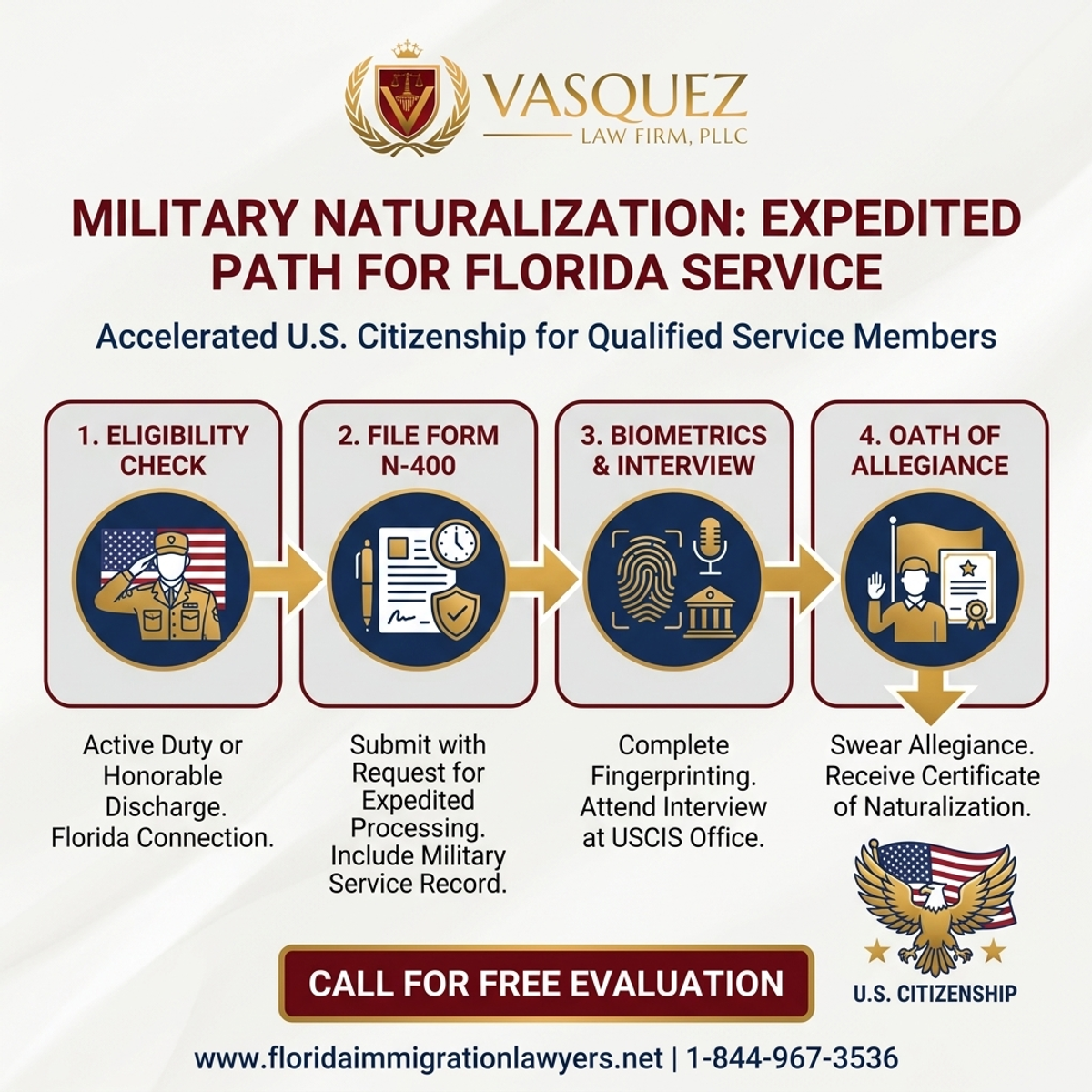
The military naturalization process, while expedited, still requires careful attention to detail. For service members in Florida, understanding each step is vital to ensure a successful application. This guide outlines the typical stages involved, from initial eligibility checks to the final oath ceremony. Remember, while this overview is helpful, individual circumstances can vary, and legal counsel is highly recommended.
-
Determine Eligibility: First, ensure you meet the basic requirements under INA 328 or 329. This involves verifying your honorable service, good moral character, and English language/civics knowledge (unless waived). For those serving in Florida, this initial assessment can be done with a local attorney who understands the specific guidance issued by USCIS. Ensure you have proof of your military service, such as enlistment contracts, discharge papers, or service records. USCIS provides detailed guidance for military personnel on their website.
-
Obtain Form N-426, Request for Certification of Military or Naval Service: This form is crucial. It must be completed by your commanding officer or a designated military official to verify your honorable service. You will submit this form along with your N-400 application. Obtaining this certification can sometimes take time, so it is wise to start this process early. Ensure all sections are accurately filled out and signed by the appropriate authority.
-
Complete Form N-400, Application for Naturalization: Fill out the N-400 accurately and completely. Pay close attention to sections specifically for military applicants. Provide all requested personal information, residency history, and details about your military service. Any errors or omissions can lead to delays or even denial. Our Florida Immigration Lawyers can help you meticulously prepare this form, ensuring all details are correct and legally sound.
-
Gather Supporting Documents: Collect all necessary supporting documents, including your N-426, copies of your military ID, birth certificate, marriage certificate (if applicable), permanent resident card (if you are a lawful permanent resident), and any other documents requested by USCIS. A comprehensive checklist is provided in the next section.
-
File Your Application: Mail your completed N-400, N-426, and all supporting documents to the appropriate USCIS Lockbox facility. There is typically no filing fee for military naturalization applications, which is another significant benefit. Ensure you keep copies of everything you submit for your records. Consider sending your application via certified mail with a return receipt requested to confirm delivery.
-
Attend Biometrics Appointment (if required): USCIS may schedule you for a biometrics appointment to collect your fingerprints, photograph, and signature. This is for background checks. Even though military members undergo extensive background checks, USCIS may still require this step. Be sure to attend this appointment as scheduled.
-
Attend the Naturalization Interview: You will be scheduled for an interview with a USCIS officer. During this interview, the officer will review your application, ask questions about your eligibility, military service, good moral character, and test your English and civics knowledge. Be prepared to answer truthfully and provide any additional documents requested. For service members in Florida, interviews typically take place at a local USCIS field office, such as the one in Miami or Orlando.
-
Receive Decision and Attend Oath Ceremony: If your application is approved, you will receive a notice for your Oath of Allegiance Ceremony. This is the final step where you take the oath and officially become a U.S. citizen. Sometimes, military members can take their oath at a military base or even overseas. You will receive your Certificate of Naturalization at this ceremony. This is a momentous occasion, representing the culmination of your service and dedication.
Essential Document Checklist for Military Naturalization
A well-organized and complete set of documents is crucial for a successful military naturalization application. Missing or incorrect documents can cause significant delays or even lead to a denial. Use this checklist as a guide, but always refer to the specific instructions for Form N-400 and consult with an immigration attorney to ensure all necessary paperwork is included.
- Form N-400, Application for Naturalization: The primary application form, completed thoroughly and accurately.
- Form N-426, Request for Certification of Military or Naval Service: This form must be certified by your commanding officer or a designated military official. It verifies your honorable service.
- Copies of your military identification card: Front and back.
- Copies of your Permanent Resident Card (Green Card): If you are a lawful permanent resident.
- Copies of your birth certificate: If applicable, with certified English translation if not originally in English.
- Copies of your marriage certificate: If you are married, with certified English translation if not originally in English.
- Copies of any divorce decrees or death certificates: For previous marriages, with certified English translation.
- Copies of any court disposition documents: For any arrests, citations, or convictions, even minor ones.
- Photographs: Two identical passport-style photographs taken within 30 days of filing (check current N-400 instructions for specific requirements).
- Proof of current military status: Such as recent Leave and Earnings Statements (LES) or orders.
- Evidence of name changes: If applicable, such as court orders or marriage certificates.
- Selective Service registration proof: If you are a male applicant between 18 and 26 years old.
Step-by-Step Process — Military Naturalization: Expedited Path for Florida Service
It is always recommended to make copies of all documents you submit for your personal records. An experienced immigration attorney can help you compile this checklist and ensure every piece of documentation is correctly prepared and submitted. This attention to detail significantly reduces the risk of RFEs (Requests for Evidence) or processing delays. For service members in Florida, our firm can help streamline this entire document gathering process.
Timeline and Processing Expectations for Military Naturalization
One of the most appealing aspects of military naturalization is the typically expedited processing time compared to civilian applications. While there are no absolute guarantees, USCIS generally prioritizes these applications. However, specific timelines can vary based on several factors, including the USCIS field office processing your case, the volume of applications, and the completeness of your submission.
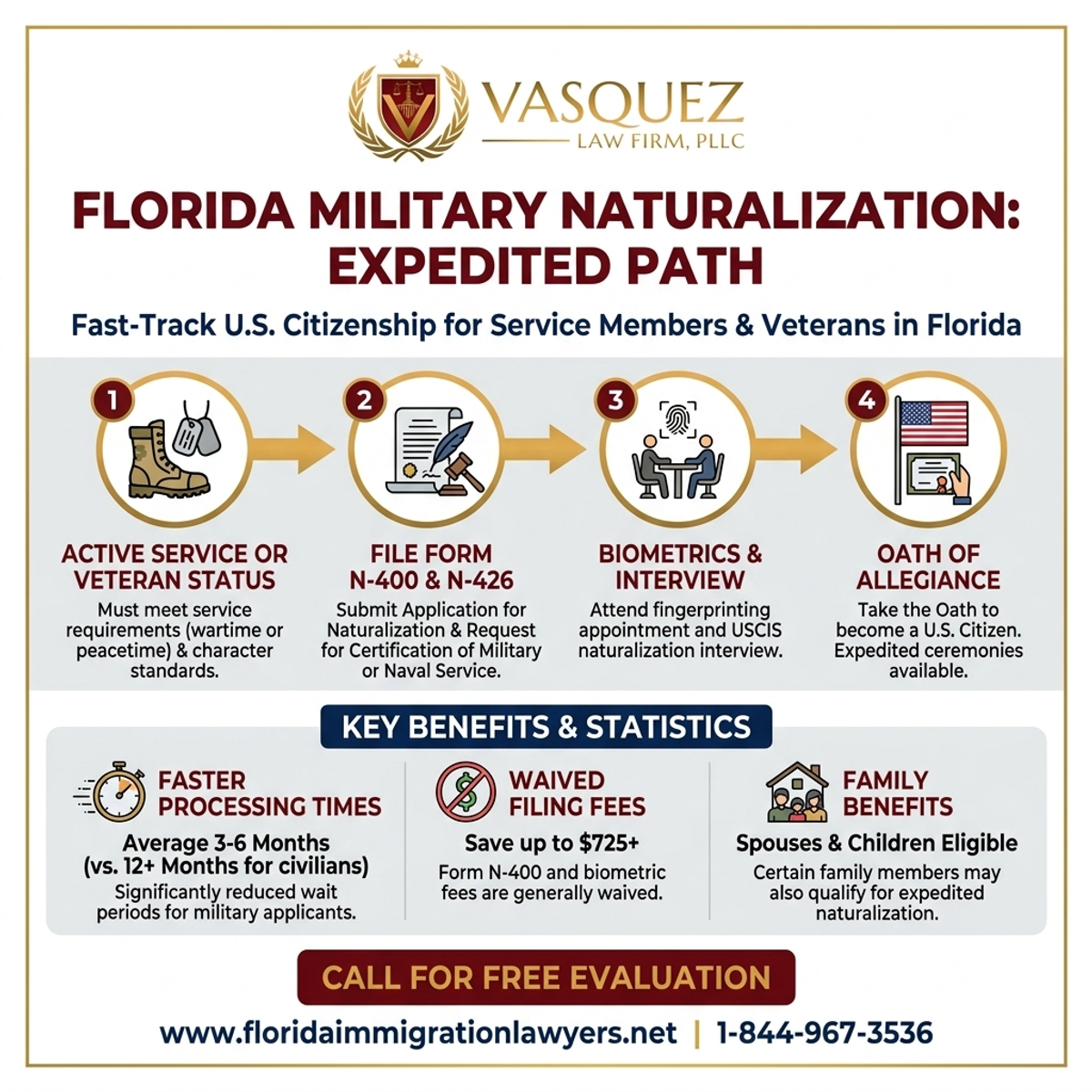
For military members, the process from filing Form N-400 to the oath ceremony can often take significantly less time than the standard civilian process, sometimes as quickly as a few months. This is especially true for those applying under INA 329 for wartime service, where applications are often processed with extreme urgency. For peacetime service under INA 328, the process is still generally faster than civilian naturalization, but may take several months to over a year, depending on current backlogs.
Here is a general breakdown of what to expect:
- Form N-426 Certification: This step is often the longest initial wait, as it depends on your military unit's administrative efficiency. It can take a few weeks to several months.
- USCIS Receipt Notice: Within 1-2 weeks of filing, you should receive a Form I-797C, Notice of Action, confirming receipt of your application.
- Biometrics Appointment: If required, this typically occurs 3-5 weeks after filing.
- Interview Scheduling: After biometrics and background checks, you might wait anywhere from 2-6 months for your interview notice.
- Interview and Decision: The interview itself is usually 20-30 minutes. A decision may be given on the spot, or a notice will be mailed within a few weeks.
- Oath Ceremony: If approved, the oath ceremony could be scheduled within a few days to a few months after the interview.
Factors that can influence processing times include:
- Completeness of Application: Incomplete applications or those with errors will cause delays due to Requests for Evidence (RFEs).
- Background Checks: Delays can occur if there are issues with background checks or security clearances.
- USCIS Office Workload: Different USCIS field offices in Florida (e.g., Miami, Orlando, Tampa) may have varying processing times.
- Deployment Schedules: USCIS often works with military members to accommodate deployment schedules, but this can also introduce unique timing considerations.
It is important to continuously monitor your case status through the USCIS website and respond promptly to any requests for additional information. Staying organized and proactive can significantly impact your application's timeline. Our firm helps service members track their applications and address any potential delays promptly. The Executive Office for Immigration Review (EOIR) also provides resources, though USCIS handles naturalization applications.
Cost Factors and Fee Breakdown for Military Naturalization
One of the significant advantages for military personnel seeking naturalization is the waiver of certain fees. Unlike civilian applicants, who typically face substantial application and biometrics fees, most service members are exempt from these costs when applying for naturalization under the special military provisions. This financial relief is another way the U.S. government supports those who serve.
Specifically, the filing fee for Form N-400, Application for Naturalization, is generally waived for military applicants. Additionally, the biometrics services fee, which civilian applicants must pay, is also waived. This means that for many service members, the direct cost of filing the application with USCIS is zero. This waiver applies to both those applying under INA 328 (peacetime service) and INA 329 (wartime service).
While the government fees are waived, there might still be other associated costs that applicants should consider:
Key Statistics — Military Naturalization: Expedited Path for Florida Service
- Legal Fees: While not mandatory, hiring an experienced immigration attorney is a wise investment. Attorneys can help ensure your application is complete, accurate, and submitted correctly, minimizing delays and potential issues. This can be particularly valuable for complex cases or if you have any past immigration or legal issues. Our firm, Florida Immigration Lawyers, offers competitive rates and free initial consultations to discuss these options.
- Document Translation Fees: If any of your supporting documents (e.g., birth certificates, marriage licenses) are not in English, you will need to provide certified English translations. Professional translation services incur costs that vary based on the document's length and complexity.
- Photocopying and Mailing Costs: While minor, the cost of making copies of all documents and sending your application via certified mail can add up. It is important to keep copies of everything for your records.
- Travel Expenses: You may incur costs for traveling to your biometrics appointment or naturalization interview at a USCIS field office, especially if you are stationed far from a major city like Fort Lauderdale, Miami, or Orlando.
Despite these potential ancillary costs, the overall financial burden for military naturalization is significantly lower than for civilian naturalization. This makes the path to citizenship more accessible for service members and their families. It is always recommended to budget for these potential expenses and to discuss any financial concerns with your legal counsel during your free consultation. Our goal is to make this process as smooth and affordable as possible for you.
Common Mistakes to Avoid in Military Naturalization
Even with an expedited process, mistakes in a military naturalization application can lead to significant delays or even denial. Being aware of these common pitfalls can help service members in Florida avoid unnecessary complications.
-
Failing to Obtain Form N-426 Certification: This is perhaps the most critical document for military naturalization. Without a properly certified N-426, USCIS cannot verify your honorable service, which is the cornerstone of your eligibility. Always ensure your commanding officer completes and signs this form accurately and on time.
-
Incomplete or Inaccurate N-400 Application: Errors, omissions, or inconsistencies on Form N-400 can trigger Requests for Evidence (RFEs) or even a denial. Double-check every section, ensuring all questions are answered truthfully and completely. This includes your travel history, marital status, and any past interactions with law enforcement.
-
Not Disclosing All Arrests or Citations: Even minor infractions, such as traffic tickets (unless parking violations), must be disclosed. Failing to report any arrest, citation, or conviction, regardless of how minor or whether charges were dropped, can be seen as a lack of good moral character and lead to serious problems, including allegations of misrepresentation.
-
Lack of Good Moral Character: While military service is highly regarded, it does not automatically waive all good moral character requirements. Certain criminal offenses, false statements, or a history of specific negative behaviors can still disqualify an applicant. It is crucial to address any potential character issues upfront with an attorney.
-
Not Responding to RFEs Promptly: If USCIS sends a Request for Evidence, it is vital to respond fully and within the specified timeframe. Ignoring an RFE or providing insufficient information will almost certainly lead to a denial of your application.
-
Insufficient English or Civics Knowledge: While some waivers exist, most military applicants must still demonstrate basic English proficiency and knowledge of U.S. history and government. Not preparing for these tests can lead to failure and a delayed or denied application. Utilize available study materials and practice tests.
-
Applying Too Soon or Too Late: Understanding the specific eligibility period based on your service type (peacetime vs. wartime) is crucial. Applying before meeting the minimum service requirement or delaying significantly after a qualifying period could complicate your case. For example, those applying under INA 329 for wartime service must apply while still serving or within six months of an honorable discharge.
-
Failure to Update USCIS on Address Changes: If you move while your application is pending, especially if deployed or relocated to a different base in Florida, you must update USCIS with your new address immediately using Form AR-11. Failure to do so can result in missed notices and critical communications.
-
Not Seeking Legal Counsel for Complex Cases: While many military naturalization cases are straightforward, situations involving criminal history, past immigration violations, or complex deployments warrant professional legal advice. Attempting to navigate these complexities alone can be risky.
-
Misunderstanding the Oath of Allegiance: The oath is a solemn promise. Not fully understanding its implications or having reservations about any part of it can cause issues during the ceremony or interview. Be prepared to affirm your allegiance wholeheartedly.
When to Call a Florida Immigration Lawyer for Military Naturalization
While military naturalization offers a clear path to citizenship, certain situations absolutely warrant the expertise of a seasoned immigration lawyer. Our team at Florida Immigration Lawyers specializes in assisting service members in Fort Lauderdale and across the state with their naturalization needs. We understand the unique challenges faced by military personnel and are here to provide comprehensive support.
You should consider calling an attorney if:
- You have a criminal record: Even minor arrests, charges, or convictions can significantly impact your good moral character assessment. An attorney can evaluate your record, advise on potential waivers, and help present your case effectively to USCIS, especially when dealing with Florida court systems.
- You have a complex immigration history: This includes previous visa denials, periods of unlawful presence, or prior deportation proceedings. These issues can complicate naturalization and require expert navigation.
- You have received a Request for Evidence (RFE) or Notice of Intent to Deny (NOID): These notices indicate that USCIS has concerns about your application. An attorney can help you understand the issues, gather the necessary evidence, and prepare a robust response to protect your application.
- You have served during specific periods of hostility (INA 329): While expedited, applying under wartime provisions has specific timing and eligibility rules that an attorney can clarify, ensuring you meet all criteria.
- You are currently deployed or anticipate deployment: An attorney can help manage your application from afar, work with USCIS to accommodate your service, and ensure communications are maintained, even if you are stationed overseas.
- You have concerns about the English or civics test: If you have a medical condition or are over a certain age and have served for a long time, you may be eligible for waivers. An attorney can help determine your eligibility and prepare the necessary documentation.
- You need assistance with Form N-426 certification: Sometimes, obtaining timely and accurate certification from your command can be challenging. An attorney can help facilitate this process and address any administrative hurdles.
- You simply want peace of mind: The naturalization process is a significant life event. Having an expert guide you through every step, from document preparation to interview coaching, can alleviate stress and increase your chances of a successful outcome.
Our firm is dedicated to serving those who serve our country. We offer free, confidential consultations to assess your situation and provide clear, actionable advice. Let us put our experience to work for you.
About Florida Immigration Lawyers
Florida Immigration Lawyers is a leading immigration law firm dedicated to serving individuals and families across the entire state of Florida. With offices strategically located to serve communities from Fort Lauderdale to Jacksonville, Miami to Tampa, and Orlando to Pensacola, we bring unparalleled expertise and a deep commitment to our clients. Our team of skilled attorneys specializes in a wide range of immigration matters, including military naturalization, asylum, deportation defense, family-based petitions, business immigration, and more.
We understand the profound impact immigration issues have on people's lives and approach every case with empathy, professionalism, and unwavering dedication. Our mission is to provide effective, personalized legal solutions, ensuring our clients receive the highest quality representation. We pride ourselves on being accessible, offering free consultations, and being available 24/7 to address urgent concerns. We are fluent in English and Spanish, ensuring that language is never a barrier to justice. When you choose Florida Immigration Lawyers, you choose a partner committed to your success and well-being. Call us today at 1-844-967-3536 or visit floridaimmigrationlawyers.net to learn more about how we can help you achieve your immigration goals.
Sources and References
- U.S. Citizenship and Immigration Services (USCIS) - Military Members
- Executive Office for Immigration Review (EOIR)
- U.S. Department of State - Travel.State.Gov
- 8 U.S.C. § 1439 - Naturalization through service in the armed forces of the United States (Immigration and Nationality Act Section 328)
- 8 U.S.C. § 1440 - Naturalization through active-duty service in the armed forces during wartime (Immigration and Nationality Act Section 329)
- 8 CFR Part 328 - Naturalization based on honorable service in the armed forces of the United States and on separation from such service under honorable conditions
- 8 CFR Part 329 - Naturalization based on active duty service in the armed forces during specified periods of hostilities
- USCIS Policy Manual, Volume 12, Part I, Chapter 2 - Eligibility Requirements for Military Members
Related services: citizenship test preparation, dual citizenship guidance, family-based immigration.
This article provides general legal information and is not intended as legal advice. Every case is unique, and outcomes depend on specific facts and circumstances. Contact an attorney for advice about your particular situation. Immigration laws are subject to change.
Your service to our nation is a profound act of dedication, and you deserve a clear path to U.S. citizenship. Do not let the complexities of immigration law stand in your way. Florida Immigration Lawyers is here to provide the expert legal support you need for your military naturalization process. We are committed to helping you achieve your American dream.
Call us today for a free, confidential consultation: 1-844-967-3536. Se Habla Español - Estamos aquí para ayudarle.
If you need legal assistance, learn more about get citizenship help today, or call us at 1-844-967-3536 for a free consultation.
Do Not Navigate This Process Alone
Our experienced immigration attorneys are ready to fight for you. Get a free, confidential consultation today.
Se Habla Español
Frequently Asked Questions
Florida Immigration Lawyers
Immigration Attorney | Founder, Vasquez Law Firm
U.S. Air Force veteran and immigration attorney with thousands of cases resolved. J.D., NCCU School of Law. AILA member. Admitted to the 4th, 5th, and 11th Circuit Courts.
Available 24/7 - Free Evaluations
Related Legal Services
Our Florida immigration attorneys can help you with asylum protection, deportation defense and citizenship and naturalization. Call today at 1-844-967-3536 for a free consultation.
Related Links
Related Topics
Free Legal Consultation
Discuss your case with our experienced attorneys. We're available 24/7.
Se Habla Español - Estamos aquí para ayudarle.
Related Articles
How to Change B-2 to F-1 Status in Florida | VLF Florida
Learn how to change your status from B-2 to F-1 in Florida with this comprehensive guide. We cover everything from application steps to common mistakes. Call Florida Immigration Lawyers at 1-844-967-3536 for a free consultation.
Dual Citizenship in Florida: What You Need to Know
Dual citizenship offers many benefits, including the ability to live and work in two countries. Explore your options in Florida, and learn about the application process, eligibility requirements, and common pitfalls to avoid.
Parole in Place for Military Families in Florida | VLF Florida
Parole in Place offers vital immigration relief for military families in Florida. Learn about eligibility, the application process, and how to avoid common pitfalls. Contact Florida Immigration Lawyers at 1-844-967-3536 for a free consultation.
RFE Response Florida: Expert Guide for USCIS Requests
Receiving a Request for Evidence (RFE) from USCIS can be a critical moment for any immigration applicant in Florida. This notice indicates that your application requires additional information or supporting documents to proceed. Understanding how to interpret your RFE, gather the precise evidence requested, and submit a timely, comprehensive response is vital for a successful outcome. This guide provides a detailed step-by-step process, essential document checklists, and insights into navigating RFE timelines. Florida Immigration Lawyers emphasizes the importance of avoiding common mistakes and highlights when professional legal assistance is indispensable. Our firm offers expert guidance to help you confidently address your RFE, safeguarding your immigration future in Florida. Contact us for a free consultation.
