How to Change B-2 to F-1 Status in Florida | VLF Florida
Learn how to change your status from B-2 to F-1 in Florida with this comprehensive guide. We cover everything from application steps to common mistakes. Call Florida Immigration Lawyers at 1-844-967-3536 for a free consultation.

How to Change B-2 to F-1 Status in Florida
Navigating the U.S. immigration system can be a complex journey, especially when you're looking to change your non-immigrant status. For many individuals who initially enter the United States on a B-2 tourist visa but later decide to pursue academic studies, changing their status to an F-1 student visa is a crucial step. This process, while common, requires meticulous attention to detail, a thorough understanding of U.S. Citizenship and Immigration Services (USCIS) regulations, and careful planning. In Florida, a state known for its diverse educational institutions and vibrant international community, understanding the specific requirements and procedures for this change is paramount. This comprehensive guide will walk you through the essential steps, eligibility criteria, required documentation, and potential challenges involved in transitioning from a B-2 tourist to an F-1 student status, ensuring you are well-prepared for a successful application.
Understanding B-2 (Tourist) and F-1 (Student) Visas
Before delving into the change of status process, it’s vital to understand the fundamental differences between a B-2 tourist visa and an F-1 student visa. A B-2 visa is issued to individuals who wish to enter the U.S. temporarily for tourism, visiting friends or family, medical treatment, or participation in non-academic courses of short duration. The core intent behind a B-2 visa is a temporary stay without the intent to immigrate or engage in formal academic study. Holders of a B-2 visa are generally prohibited from enrolling in degree-seeking programs or extensive academic courses.
Conversely, an F-1 visa is specifically designed for international students who wish to pursue a full course of study at an academic institution approved by the Student and Exchange Visitor Program (SEVP) in the United States. The primary purpose of an F-1 visa holder's stay is education. This distinction in intent is critical for a successful change of status application. USCIS scrutinizes applications to ensure that the applicant did not have a 'preconceived intent' to study when they initially entered on a B-2 visa. Demonstrating a legitimate change in circumstances or intent after entering the U.S. is key to overcoming this hurdle. Understanding these foundational differences will help you articulate your reasons for the change of status more effectively and align your application with USCIS expectations.
Eligibility Criteria for B-2 to F-1 Change of Status
To successfully change your status from B-2 to F-1, you must meet several stringent eligibility requirements. Failing to meet even one criterion can lead to a denial of your application. The primary conditions include:
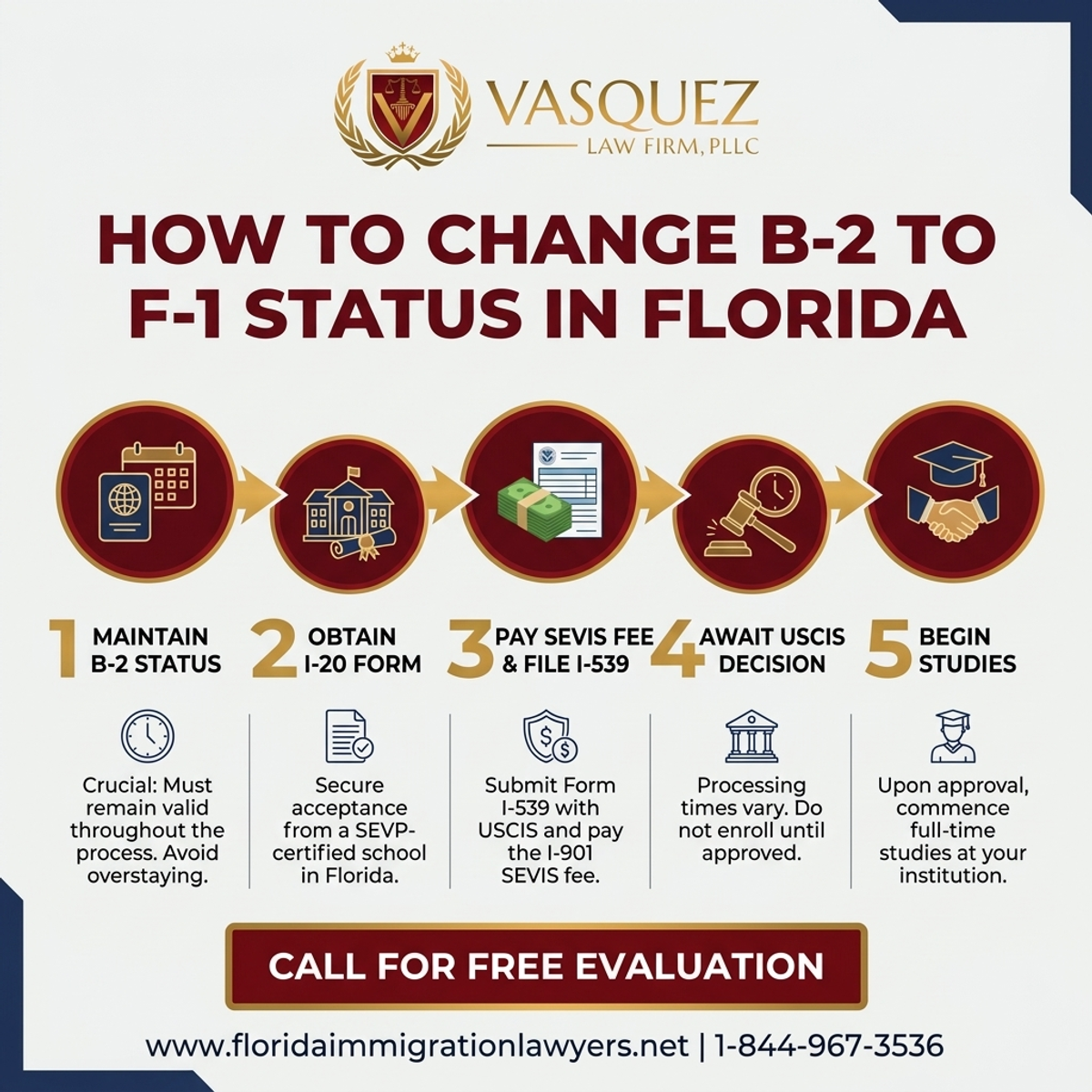
- Maintaining Valid B-2 Status: You must be in valid B-2 non-immigrant status at the time you file your Form I-539, Application to Extend/Change Nonimmigrant Status. This means you have not overstayed your authorized period of admission (as indicated on your I-94 record) and have not violated any terms of your B-2 visa (e.g., engaging in unauthorized employment). It's generally recommended to apply well before your I-94 expiration date, ideally at least 30-60 days prior.
- Non-Immigrant Intent: You must demonstrate that you intend to depart the U.S. after completing your studies. While you are changing to a student visa, you must still prove that your overall intent is non-immigrant. This can be evidenced by ties to your home country, such as property, family, and job prospects.
- Acceptance to an SEVP-Approved School: You must be accepted by a school that is certified by the Student and Exchange Visitor Program (SEVP). Upon acceptance, the school will issue you a Form I-20, Certificate of Eligibility for Nonimmigrant Student Status. This document is crucial for your application.
- Financial Capability: You must prove that you have sufficient funds to cover your tuition, living expenses, and other costs for the duration of your intended study without resorting to unauthorized employment. This can include personal savings, parental support, scholarships, or a combination thereof. Detailed bank statements, sponsorship letters, and scholarship awards are common forms of evidence.
- No Preconceived Intent: As mentioned, USCIS will examine whether you had the intent to study when you first entered the U.S. on a B-2 visa. If USCIS believes you used the B-2 visa as a way to enter and then immediately change to F-1, your application may be denied. It’s advisable to have a clear reason for your change of intent, such as discovering a passion for a particular field or receiving an unexpected scholarship after your arrival.
The Step-by-Step Application Process: Form I-539
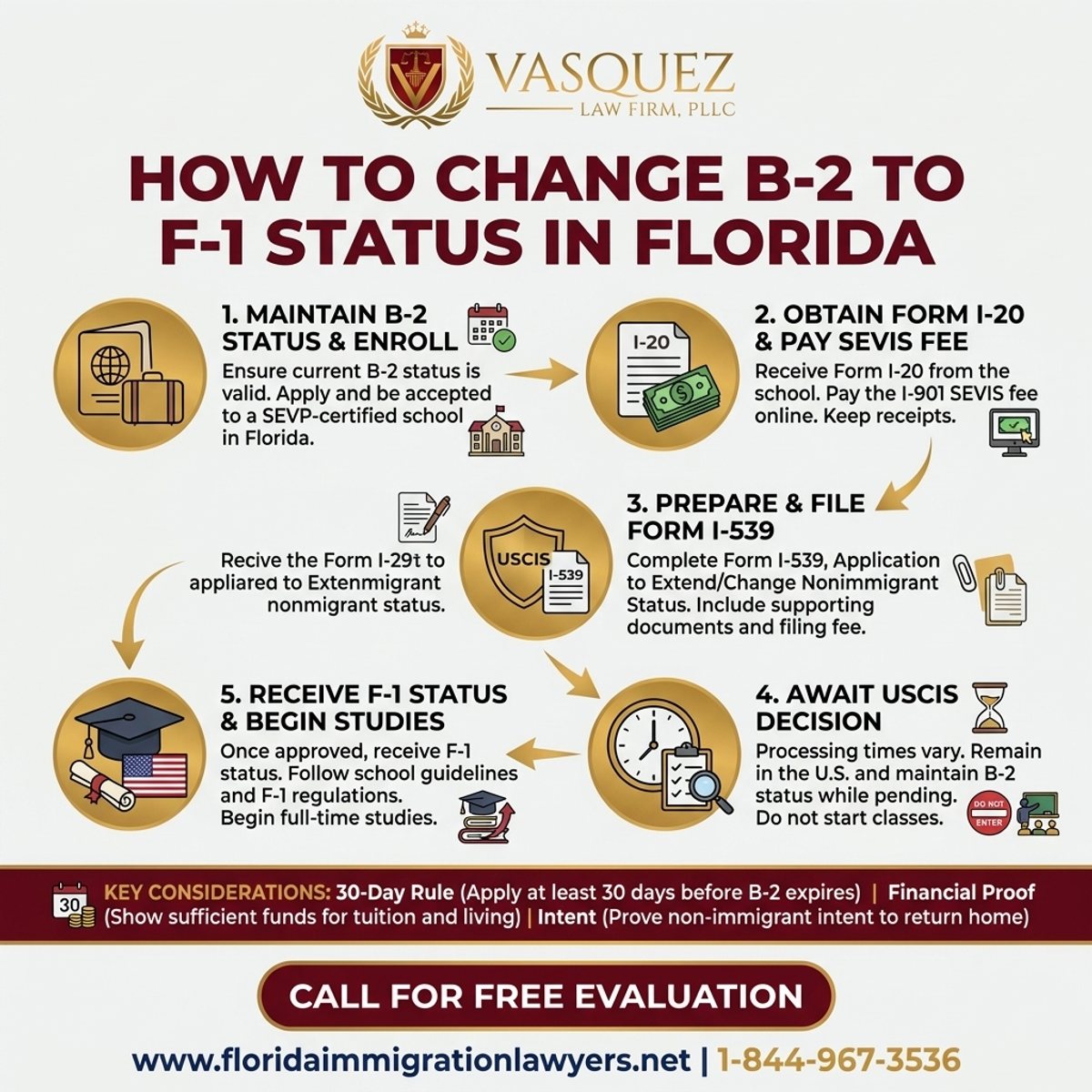
The core of your change of status application is Form I-539, Application to Extend/Change Nonimmigrant Status. Here’s a breakdown of the typical process:
- Receive Form I-20 from Your School: Once accepted into an SEVP-approved program, your Designated School Official (DSO) will issue you an I-20. Ensure all information on the I-20 is accurate and sign it.
- Pay the SEVIS I-901 Fee: Before filing your I-539, you must pay the SEVIS (Student and Exchange Visitor Information System) fee. This fee supports the SEVIS system, which tracks F-1 students. Keep the receipt as proof of payment.
- Complete Form I-539: Fill out Form I-539 carefully and completely. Pay close attention to Part 2, Question 2, where you indicate your request to change to F-1 status. Include all requested personal and travel history information.
- Gather Supporting Documents: Collect all necessary documents, including your I-20, financial evidence, passport, I-94 record, and a personal statement. (See next section for a detailed list).
- Write a Cover Letter and Personal Statement: A cover letter summarizing your application contents is helpful. A personal statement (or letter of intent) is crucial to explain why you are changing status, your academic goals, and how you meet the eligibility criteria, particularly addressing the 'no preconceived intent' issue.
- Mail Your Application: Send the completed Form I-539, all supporting documents, and the filing fee to the appropriate USCIS Lockbox facility. It is highly recommended to send your application via certified mail with a return receipt requested to track delivery.
- Biometrics Appointment: After filing, you will likely receive an appointment notice for biometrics (fingerprints and photos) at an Application Support Center (ASC). Attend this appointment as scheduled.
- Receive a Decision: USCIS processing times can vary significantly. You can check the status of your case online using the receipt number provided by USCIS. If approved, you will receive an I-797 Approval Notice indicating your new F-1 status. If denied, the notice will explain the reasons.
Step-by-Step Process — How to Change B-2 to F-1 Status in Florida | VLF Florida
Essential Documents Required for Your Application
A complete application package is critical for a smooth process. Here’s a list of documents you should prepare:
- Form I-539: Completed and signed.
- Form I-539A: If applying with dependents (e.g., spouse or children changing to F-2 status).
- I-539 Filing Fee: Check the current fee on the USCIS website.
- SEVIS I-901 Fee Payment Confirmation: Proof that you paid the SEVIS fee.
- Form I-20: Original Certificate of Eligibility for Nonimmigrant Student Status, signed by you and your DSO.
- Financial Evidence: Original bank statements, scholarship letters, affidavits of support from sponsors, and any other documents proving you have sufficient funds.
- Copy of Passport: Including the biographical page, visa stamp, and entry stamps.
- Copy of I-94 Arrival/Departure Record: You can retrieve this electronically from the CBP website.
- Copies of Previous Visas and I-797 Approval Notices: If applicable.
- Personal Statement/Letter of Intent: Explaining your desire to study, your academic goals, and why you are changing status.
- Academic Transcripts and Diplomas: From previous institutions, if relevant to your application.
- Proof of Ties to Home Country: While not strictly required for F-1, it can help demonstrate non-immigrant intent (e.g., property deeds, job offers, family ties).
- Passport-style Photos: Two recent photos, meeting USCIS specifications.
Maintaining Your F-1 Status After Approval
Once your change of status to F-1 is approved, it’s crucial to understand and adhere to the regulations governing F-1 students to maintain your legal status. Failure to do so can result in serious consequences, including falling out of status and potential deportation defense issues.
- Full Course of Study: You must enroll in and maintain a full course of study at your SEVP-approved school. Your DSO can provide details on what constitutes a full course for your program.
- Reporting Changes: Inform your DSO of any changes to your address, name, or program of study within 10 days.
- Employment Restrictions: F-1 students have strict limitations on employment. On-campus employment is generally permitted, but off-campus work requires authorization (Curricular Practical Training - CPT or Optional Practical Training - OPT) and approval from your DSO and/or USCIS.
- Duration of Status: Your F-1 status is valid for the duration of your program, plus any authorized period of OPT, and a 60-day grace period to depart the U.S. or change status.
- Travel: If you travel outside the U.S. while your change of status application is pending, it is generally considered abandonment of the application. Once approved, you will need a valid F-1 visa stamp in your passport to re-enter the U.S. after international travel.
Key Statistics — How to Change B-2 to F-1 Status in Florida | VLF Florida
Common Challenges and Potential Pitfalls
The B-2 to F-1 change of status process is not without its challenges. Being aware of these can help you prepare and mitigate risks:
- Preconceived Intent: This is arguably the biggest hurdle. If USCIS believes you entered on a B-2 visa with the primary intention of changing to F-1, your application will likely be denied. Presenting a compelling narrative of how your intent changed after arrival is vital.
- Falling Out of Status: If your B-2 status expires while your I-539 application is pending, you are generally considered to be in a 'period of authorized stay' as long as you filed on time. However, if your application is denied, you will immediately be out of status and may need to depart the U.S. promptly.
- Application Delays: USCIS processing times can be lengthy and unpredictable, potentially impacting your planned start date for studies. It's crucial to apply as early as possible.
- Denial: A denial means you must leave the U.S. or seek other legal avenues. A denial can also impact future visa applications.
- Travel During Processing: Traveling outside the U.S. while your I-539 is pending will almost certainly lead to the abandonment of your application.
Seeking Professional Legal Guidance
Given the intricacies and potential pitfalls involved in changing your immigration status, seeking professional legal guidance is not just advisable, but often essential. An experienced immigration lawyer can provide invaluable support throughout the entire process, significantly increasing your chances of a successful outcome.
Our team of dedicated attorneys at VLF Florida specializes in U.S. immigration law and understands the nuances of B-2 to F-1 change of status applications. We can help you:
- Assess Eligibility: Determine if you meet all the necessary criteria and identify any potential red flags in your case.
- Prepare Documentation: Ensure all forms are correctly filled out and all supporting documents are meticulously organized and compelling.
- Craft Your Personal Statement: Help you articulate a strong and convincing narrative regarding your change of intent, addressing any concerns USCIS might have.
- Respond to RFEs: If USCIS issues a Request for Evidence (RFE), we can help you prepare a comprehensive and timely response.
- Navigate Complex Scenarios: For individuals with unique circumstances, such as a history of visa issues or concerns about falling out of status, legal counsel is critical. We can also advise on other complex areas of immigration law, such as asylum applications or strategies for deportation defense, should your situation unexpectedly change.
The immigration landscape is constantly evolving, and having expert legal representation ensures you are always up-to-date with the latest regulations and best practices. Don't leave your academic future to chance. Our goal is to make your transition as smooth and stress-free as possible, allowing you to focus on your studies and future in Florida. We invite you to contact us for a consultation to discuss your specific situation.
Frequently Asked Questions
[Existing 8 FAQs content would go here, as per original content stats. Not generated as per instructions to only include changed fields.]
Conclusion
Changing your status from a B-2 tourist to an F-1 student in Florida is a significant decision that opens doors to educational opportunities in the United States. While the process is well-defined, its complexity demands careful preparation, strict adherence to USCIS regulations, and a clear understanding of your responsibilities. From demonstrating genuine non-immigrant intent to meticulously gathering all required documentation, each step is crucial for a successful outcome. The journey can be challenging, but with diligent effort and the right support, you can achieve your academic aspirations.
Don't navigate this intricate process alone. The experienced immigration law experts at VLF Florida are here to guide you through every stage, providing personalized advice and ensuring your application is as strong as possible. We are committed to helping you achieve your educational goals in the U.S. Visit our attorneys page to learn more about our dedicated team, or contact us directly for a free consultation. Let us help you confidently pursue your academic future.
Sources and References
- U.S. Citizenship and Immigration Services (USCIS)
- Executive Office for Immigration Review (EOIR)
- U.S. Department of State - Bureau of Consular Affairs
- Immigration and Nationality Act (INA), 8 U.S.C. Chapter 12
Do Not Navigate This Process Alone
Our experienced immigration attorneys are ready to fight for you. Get a free, confidential consultation today.
Se Habla Español
Frequently Asked Questions
Florida Immigration Lawyers
Immigration Attorney | Founder, Vasquez Law Firm
U.S. Air Force veteran and immigration attorney with thousands of cases resolved. J.D., NCCU School of Law. AILA member. Admitted to the 4th, 5th, and 11th Circuit Courts.
Available 24/7 - Free Evaluations
Related Legal Services
Our Florida immigration attorneys can help you with experienced immigration attorneys, business immigration and asylum protection. Call today at 1-844-967-3536 for a free consultation.
Related Links
Related Topics
Free Legal Consultation
Discuss your case with our experienced attorneys. We're available 24/7.
Se Habla Español - Estamos aquí para ayudarle.
Related Articles
Dual Citizenship in Florida: What You Need to Know
Dual citizenship offers many benefits, including the ability to live and work in two countries. Explore your options in Florida, and learn about the application process, eligibility requirements, and common pitfalls to avoid.
Parole in Place for Military Families in Florida | VLF Florida
Parole in Place offers vital immigration relief for military families in Florida. Learn about eligibility, the application process, and how to avoid common pitfalls. Contact Florida Immigration Lawyers at 1-844-967-3536 for a free consultation.
RFE Response Florida: Expert Guide for USCIS Requests
Receiving a Request for Evidence (RFE) from USCIS can be a critical moment for any immigration applicant in Florida. This notice indicates that your application requires additional information or supporting documents to proceed. Understanding how to interpret your RFE, gather the precise evidence requested, and submit a timely, comprehensive response is vital for a successful outcome. This guide provides a detailed step-by-step process, essential document checklists, and insights into navigating RFE timelines. Florida Immigration Lawyers emphasizes the importance of avoiding common mistakes and highlights when professional legal assistance is indispensable. Our firm offers expert guidance to help you confidently address your RFE, safeguarding your immigration future in Florida. Contact us for a free consultation.
Immigration Lawyer in Cape Coral Southwest Florida
Navigating immigration in Cape Coral, Southwest Florida can be complex. Discover how a local immigration lawyer can help you achieve your goals. Call us for a free consultation.
