RFE Response Florida: Expert Guide for USCIS Requests
Receiving a Request for Evidence (RFE) from USCIS can be a critical moment for any immigration applicant in Florida. This notice indicates that your application requires additional information or supporting documents to proceed. Understanding how to interpret your RFE, gather the precise evidence requested, and submit a timely, comprehensive response is vital for a successful outcome. This guide provides a detailed step-by-step process, essential document checklists, and insights into navigating RFE timelines. Florida Immigration Lawyers emphasizes the importance of avoiding common mistakes and highlights when professional legal assistance is indispensable. Our firm offers expert guidance to help you confidently address your RFE, safeguarding your immigration future in Florida. Contact us for a free consultation.

A Request for Evidence (RFE) from USCIS in Florida is an official notice indicating that your immigration application lacks sufficient information or supporting documents. Responding to an RFE correctly and promptly is crucial to avoid delays or denials. It requires a meticulous review of the RFE notice, gathering specific evidence, and submitting a comprehensive package before the deadline. Many RFEs concern employment eligibility, family relationships, or an applicant's legal status. Seeking legal counsel from experienced Florida immigration lawyers can significantly improve your response's accuracy and strength, helping to safeguard your immigration future.
- An RFE means USCIS needs more information to make a decision on your case.
- Always respond by the deadline specified in the RFE notice.
- Provide only the requested evidence and ensure it is accurate and complete.
- Consulting an immigration attorney is highly recommended for complex RFEs.
- Failure to respond adequately can lead to application denial.
Navigating the complex landscape of U.S. immigration law can be challenging, especially when you receive a Request for Evidence (RFE) from USCIS. For individuals and families across Florida, from the vibrant communities of Homestead to the bustling cities of Miami and Orlando, an RFE can feel like a significant setback. It signifies that the U.S. Citizenship and Immigration Services needs more information or documentation to continue processing your application. This could be for a green card, a work visa, or even naturalization.
Understanding the implications of an RFE and knowing how to respond effectively is paramount. A well-prepared and timely response can mean the difference between approval and denial. This comprehensive guide from Florida Immigration Lawyers aims to demystify the RFE process, providing you with the knowledge and steps necessary to address such a request with confidence. We understand the anxieties involved and are here to offer clarity and support. Do not face this critical stage alone. Call Florida Immigration Lawyers at 1-844-967-3536 for a free consultation and let our experienced team help you craft a robust RFE response Florida residents can rely on.
Understanding Your USCIS Request for Evidence (RFE) in Florida
A Request for Evidence (RFE) is a formal notification from USCIS stating that your immigration petition or application is incomplete or lacks sufficient supporting documentation. It is not an automatic denial, but rather an opportunity to provide additional information that USCIS deems necessary to make a decision on your case. Receiving an RFE can be unsettling, but it is a common part of the immigration process. It means your application has been reviewed, and the adjudicating officer requires clarification or further proof regarding specific aspects.
The RFE notice itself will explicitly detail what information or documents are needed. It will also specify a deadline by which you must submit your response, typically ranging from 30 to 87 days from the date of the notice. It is crucial to read the RFE carefully and understand precisely what is being requested. Ignoring an RFE or submitting an incomplete response will almost certainly lead to a denial of your application. Many RFEs stem from applications filed without the guidance of an experienced immigration attorney, highlighting the importance of legal assistance from the outset.
For applicants in Florida, whether you filed through the USCIS Field Office in Miami, Orlando, or Tampa, the RFE process remains consistent. However, local nuances or specific examiner tendencies can sometimes influence the types of evidence requested. Our firm, Florida Immigration Lawyers, is well-versed in these regional considerations. We help clients understand why their RFE was issued and guide them in compiling a targeted and compelling response. This proactive approach ensures that every piece of evidence directly addresses USCIS's concerns, strengthening your overall case.
Common Reasons for an RFE
RFEs are issued for a wide array of reasons, often relating to the specific type of immigration benefit sought. For family-based petitions, common RFEs might request further proof of a bona fide marriage, such as joint bank accounts, utility bills, or photographs. For employment-based petitions, USCIS might ask for additional evidence of the employer's ability to pay the proffered wage, the beneficiary's qualifications, or the legitimacy of the job offer. In other cases, an RFE could seek clarification on an applicant's lawful entry, continuous residence, or criminal history. The key is that the initial submission did not fully satisfy the legal requirements outlined in the Immigration and Nationality Act (INA) or relevant regulations.
Step-by-Step Guide to Responding to an RFE from Florida
Responding to a USCIS RFE requires a structured and diligent approach. Following these steps can help ensure your response is comprehensive and submitted correctly, minimizing further delays. This process is critical for anyone in Florida seeking to maintain their immigration trajectory.
-
Carefully Read and Understand the RFE: The very first step is to thoroughly read the entire RFE notice. Do not skim it. Identify every specific document or piece of information requested. Highlight key phrases and deadlines. Often, an RFE will cite specific sections of the Immigration and Nationality Act (INA) or the Code of Federal Regulations (CFR) that the evidence pertains to. Understanding these legal references can provide context for what USCIS is looking for. For example, an RFE might reference 8 CFR 204.2(a)(1)(iii) regarding proof of a valid marriage.
-
Organize Your Existing Documents: Before gathering new evidence, review the documents you initially submitted. This helps you understand what might have been missing or unclear. Sometimes, you may already possess the requested evidence but failed to include it or present it clearly in your initial filing. This step is crucial for avoiding redundancy and ensuring a focused response. Organize your documents chronologically or by category to make them easy to review.
-
Gather the Requested Evidence: Systematically collect all the documents and information specified in the RFE. Do not send more than what is requested unless it directly clarifies a point or strengthens the requested evidence. Ensure all documents are clear, legible, and properly translated if not in English. For example, if USCIS requests proof of joint financial assets for a marriage-based green card, gather joint bank statements, tax returns, and property deeds. If you cannot obtain a requested document, provide a detailed explanation and alternative evidence.
-
Prepare a Cover Letter: A well-structured cover letter is essential. It should clearly list all the documents you are submitting in response to the RFE. Reference the RFE notice by its date and receipt number. The cover letter acts as a roadmap for the USCIS officer, demonstrating that you have addressed each point raised in the RFE. This helps the officer quickly locate the requested information within your submission. It also provides an opportunity to briefly explain any complex aspects of your evidence.
-
Assemble Your Response Package: Compile your response package in the order listed in your cover letter. Include the original RFE notice on top of your submission. Make copies of everything for your records. Ensure all pages are numbered and consider using tabs to separate different sections or categories of documents. This meticulous organization reflects professionalism and makes the adjudicator's job easier, which can be beneficial to your case.
-
Submit by the Deadline: Mail your complete RFE response to the USCIS address specified in the RFE notice. Use a traceable mailing service (e.g., certified mail with return receipt, FedEx, UPS) to prove that you sent the package and when it was delivered. Missing the deadline will almost certainly result in a denial of your application, with no opportunity to appeal based on a late response. The deadline is usually calculated from the date on the RFE notice, not the date you receive it.
-
Track Your Case: After submission, continue to monitor your case status online using your USCIS receipt number. USCIS will typically issue a confirmation that they have received your RFE response. Be prepared for potential follow-up requests or an interview, although often a well-responded RFE leads directly to a decision.
Gathering Required Documentation
The types of documents requested in an RFE are as varied as the immigration applications themselves. For a family-based petition, you might need additional birth certificates, marriage licenses, divorce decrees, or proof of joint residency. Employment-based cases often require updated employment verification letters, educational transcripts, professional licenses, or evidence of significant experience. Always ensure that any foreign documents are accompanied by certified English translations. The quality and authenticity of your documents are crucial; submitting fraudulent or unverified documents can lead to severe penalties, including potential deportation proceedings. Always prioritize clarity and completeness in your submissions.
Essential Document Checklist for Your RFE Response
While every RFE is unique, a general checklist can help you organize your thoughts and ensure you are providing comprehensive evidence. Remember to refer to your specific RFE notice for exact requirements. This checklist is a guide for applicants throughout Florida, including those in Homestead and surrounding areas, to help them prepare a robust response.
- Original RFE Notice: Always include the original RFE notice on top of your response package.
- Cover Letter: A detailed letter outlining all submitted documents and how they address each point of the RFE.
- Proof of Identity: Copies of passports, national IDs, birth certificates, or driver's licenses for all applicants and petitioners involved.
- Proof of Relationship (for family petitions): Marriage certificates, birth certificates, joint bank statements, utility bills, lease agreements, property deeds, insurance policies, affidavits from friends and family, photographs, and communication records.
- Proof of Financial Support (Affidavit of Support, Form I-864): Updated tax returns, W-2s, pay stubs, employment verification letters, bank statements, and asset documentation for the sponsor.
- Proof of Employment/Qualifications (for employment petitions): Employment verification letters, job offer letters, educational degrees and transcripts, professional licenses, detailed resumes, letters of recommendation, and evidence of specialized skills.
- Proof of Lawful Entry and Status: Copies of I-94 records, visa stamps, previous approval notices (I-797), and any other documentation showing lawful entry and maintenance of status.
- Criminal Records: Certified court dispositions for any arrests or convictions, even if dismissed or expunged, along with police clearance certificates.
- Medical Exam Results: If requested, a sealed envelope from a USCIS-approved civil surgeon containing Form I-693.
- Translations: Certified English translations for any documents not originally in English, accompanied by a translator's certification.
- Photographs: Passport-style photos if specifically requested, adhering to USCIS guidelines.
- Biographic Information: Any updated personal information or corrections to previously submitted forms.
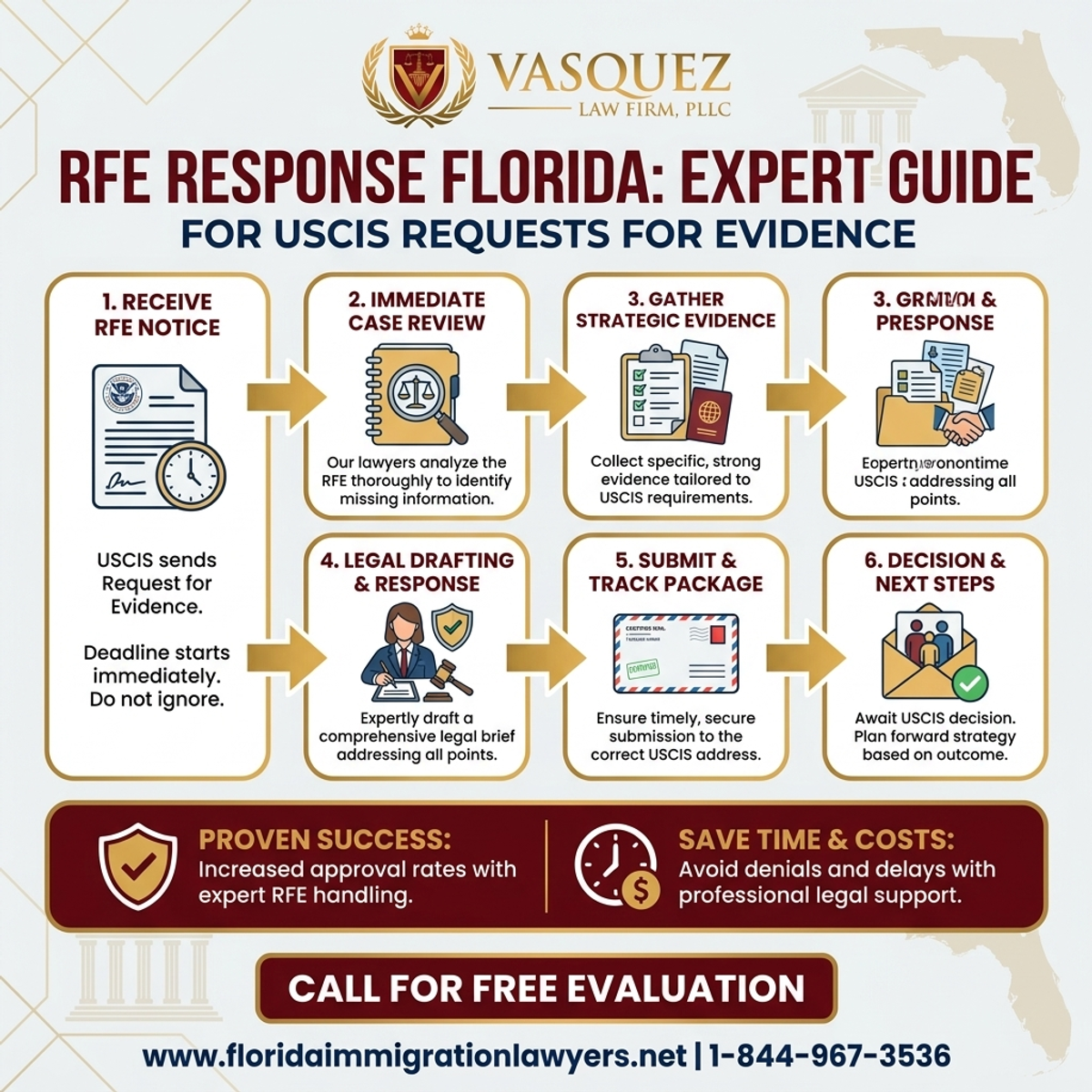
Step-by-Step Process — RFE Response Florida: Expert Guide for USCIS Requests
Navigating RFE Timelines and Processing Expectations in Florida
The timeline for responding to an RFE is strict and non-negotiable. USCIS typically provides 30 to 87 days from the date the RFE was issued for you to submit your response. This deadline is printed clearly on the RFE notice. It is critical to note that the clock starts ticking from the date on the notice, not the date you receive it. Missing this deadline will almost certainly lead to the denial of your application or petition, often without the possibility of appeal. Therefore, immediate action upon receiving an RFE is essential.
Once USCIS receives your RFE response, the processing clock for your application essentially restarts. The adjudicating officer will review the newly submitted evidence to determine if it sufficiently addresses their concerns. USCIS aims to process RFE responses efficiently, but the exact timeline can vary widely depending on the type of application, the complexity of the RFE, and the current workload at the service center or field office handling your case. You can monitor your case status online using the receipt number provided on your original application and the RFE notice.
For individuals in Florida, processing times can sometimes be influenced by the specific USCIS office involved. While national processing times are generally published on the USCIS website, local field offices in Miami, Orlando, or Tampa may have slightly different backlogs or interview schedules. After an RFE response, some cases may proceed directly to approval, while others might require an interview to further clarify details or verify information. Being prepared for either scenario, with the assistance of an experienced immigration attorney, can help manage expectations and reduce stress during this waiting period. Understanding the typical processing times for your specific application type after an RFE is crucial for planning your future in Florida.
Cost Factors and Professional Fees for RFE Assistance
Responding to a Request for Evidence does not typically involve additional filing fees paid directly to USCIS, as these fees are generally covered by your initial application submission. However, there are several indirect costs and potential professional fees that applicants in Florida should consider when preparing an RFE response. These costs primarily relate to gathering the necessary evidence and, most importantly, securing expert legal assistance to ensure a robust and accurate submission.
One significant cost factor can be obtaining new documents. This might include fees for certified copies of birth certificates, marriage licenses, divorce decrees, court records, or police clearances from various government agencies. If any of your supporting documents are not in English, you will incur costs for certified translations. These translation services must meet USCIS requirements, typically involving a signed statement from the translator affirming their competence and the accuracy of the translation. Additionally, if the RFE requests a new medical examination (Form I-693), you will need to pay the civil surgeon's fees, which can vary.
The most valuable investment, however, is often in legal representation. While it is possible to respond to an RFE on your own, the complexities of immigration law and the precise nature of RFE requests often warrant the expertise of an immigration attorney. Florida Immigration Lawyers offers services specifically tailored to RFE responses. Our fees cover a comprehensive review of the RFE, strategic advice on gathering evidence, drafting a compelling cover letter, organizing the entire submission, and ensuring compliance with all USCIS regulations. This professional guidance can save you time, reduce stress, and significantly increase the likelihood of a favorable outcome. We provide transparent fee structures during your initial consultation, ensuring you understand all potential costs upfront.
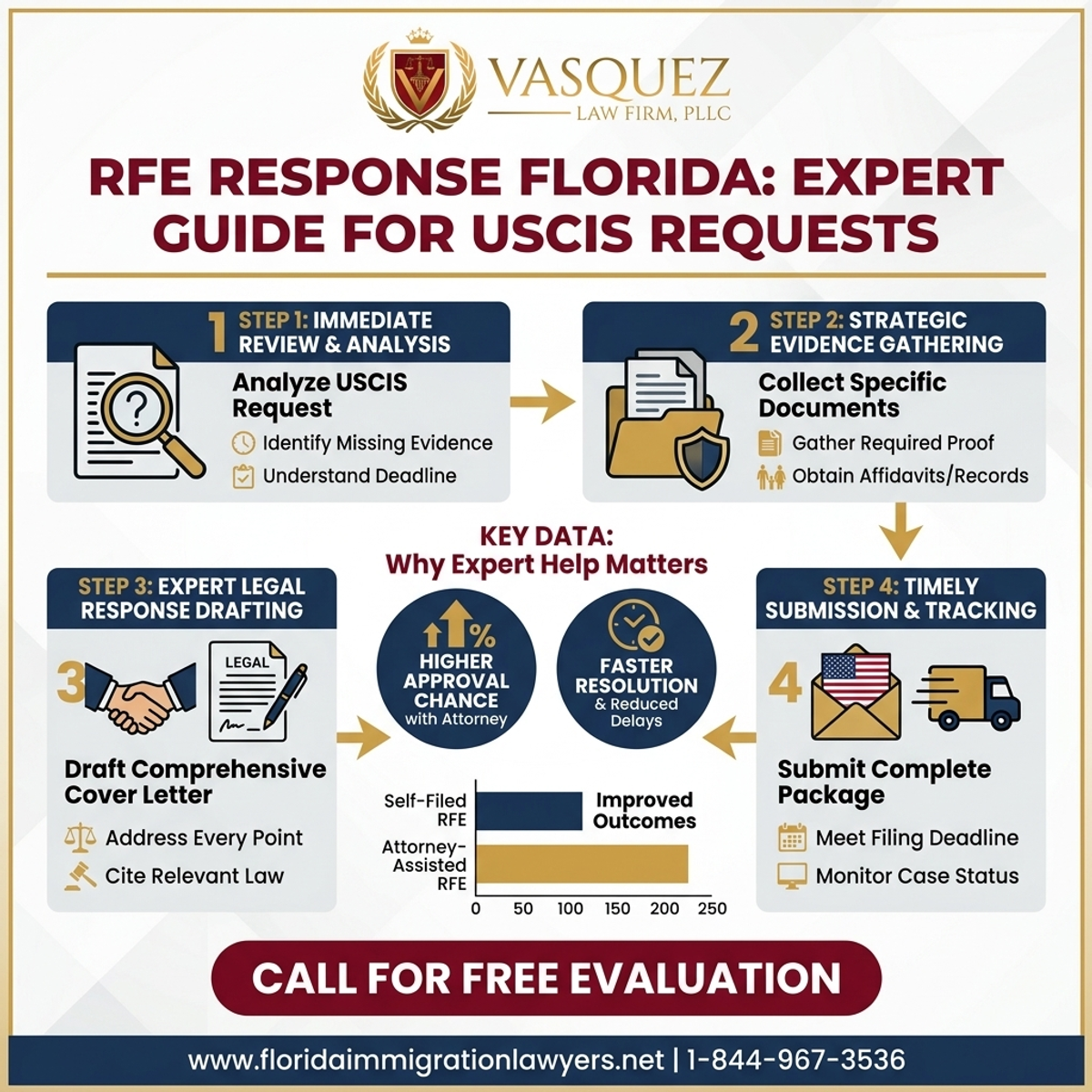
Key Statistics — RFE Response Florida: Expert Guide for USCIS Requests
Do not navigate this process alone. Contact Florida Immigration Lawyers today to ensure your RFE response is handled with the expertise it deserves.
Common Mistakes to Avoid When Responding to an RFE
Responding to an RFE can be a make-or-break moment for your immigration case. Avoiding common pitfalls is crucial for a successful outcome. Here are several mistakes Florida applicants often make:
-
Ignoring the Deadline: This is perhaps the most critical mistake. Missing the RFE deadline, typically 30 to 87 days, will almost always lead to an immediate denial of your application without further review. Always prioritize timely submission.
-
Not Reading the RFE Carefully: Applicants sometimes rush through the RFE notice and misunderstand what USCIS is truly requesting. This can lead to submitting irrelevant documents or failing to address specific concerns, resulting in further delays or denial.
-
Submitting Incomplete Evidence: Providing only a portion of the requested documents or information can be as detrimental as not responding at all. USCIS needs complete answers to all their questions to make an informed decision.
-
Submitting Irrelevant or Excessive Evidence: While completeness is vital, overwhelming USCIS with unnecessary documents can confuse the adjudicator and slow down processing. Only provide what is specifically asked for or directly supports the requested information.
-
Failing to Provide Certified Translations: Any document not in English must be accompanied by a certified English translation. Without it, USCIS cannot review the document, and it will be considered unsubmitted evidence.
-
Not Explaining Missing Documents: If you genuinely cannot obtain a specific document, do not simply omit it. Provide a detailed explanation of why it is unavailable and offer alternative evidence that proves the same point. For example, if a birth certificate is unavailable, present school records or affidavits.
-
Sending Original Documents (Unless Requested): Generally, USCIS prefers copies of documents. Sending originals, especially irreplaceable ones, can lead to their loss. Only send originals if the RFE explicitly requests them.
-
Assuming USCIS Knows Your Case: Each RFE is handled by an officer who may not be familiar with your entire file. Your response must be self-contained and clear, as if they are seeing your case for the first time with the RFE in hand.
-
Not Keeping Copies for Your Records: Always make a complete copy of your entire RFE response package before mailing it. This serves as your proof of submission and a reference if USCIS has follow-up questions or issues.
-
Failing to Seek Legal Advice: Many RFEs involve complex legal issues or nuanced evidentiary requirements. Attempting to respond without an experienced immigration attorney can lead to critical errors, particularly for those unfamiliar with INA or 8 U.S.C. requirements.
-
Using Informal or Unprofessional Language: All communications with USCIS, including cover letters and explanations, should be formal, respectful, and professional. Avoid emotional language or personal anecdotes that do not directly contribute to the legal argument.
When to Call a Florida Immigration Lawyer for Your RFE
While some RFEs may seem straightforward, the consequences of an inadequate response are too severe to take lightly. There are several clear indicators that you should immediately seek the counsel of an experienced immigration lawyer, especially if you are in Florida. Florida Immigration Lawyers are here to provide the expertise needed to navigate these critical situations.
You should contact an attorney if the RFE is lengthy, complex, or requests evidence that you find difficult to understand or obtain. If the RFE cites specific legal statutes (e.g., sections of the Immigration and Nationality Act or 8 U.S.C.) that you are unfamiliar with, legal guidance is essential. Furthermore, if the RFE questions your eligibility for the benefit, suggests potential fraud, or indicates issues with your immigration history, immediate legal intervention is paramount. These situations often require sophisticated legal arguments and a deep understanding of immigration law to resolve successfully.
Our team at Florida Immigration Lawyers specializes in helping individuals and families across Florida, including Homestead, Miami, and Orlando, respond effectively to RFEs. We can help you interpret the RFE, identify the precise evidence needed, assist with gathering difficult-to-obtain documents, and prepare a comprehensive and persuasive response package. We understand the specific requirements of USCIS and the Executive Office for Immigration Review (EOIR) and can ensure your submission meets all legal standards. Do not risk your immigration future by trying to navigate a complex RFE alone. Let our dedicated attorneys provide the strategic support and peace of mind you deserve.
About Florida Immigration Lawyers
Florida Immigration Lawyers is a leading law firm dedicated to providing exceptional legal representation to individuals and families throughout Florida. With a deep understanding of the complexities of U.S. immigration law, our experienced attorneys offer compassionate and effective advocacy for a wide range of immigration matters. From RFE responses and visa applications to asylum claims and deportation defense, we are committed to helping our clients achieve their immigration goals.
Our firm prides itself on personalized service, strategic legal advice, and unwavering dedication to our clients' success. We serve all of Florida, offering accessible and reliable legal support to diverse communities. We understand that immigration challenges can be stressful and life-altering, which is why we approach every case with empathy and meticulous attention to detail. Choose Florida Immigration Lawyers for a partner who will stand by you every step of the way. You can reach us 24/7 at 1-844-967-3536 or visit our website at https://www.floridaimmigrationlawyers.net for a free consultation.
Sources and References
- U.S. Citizenship and Immigration Services (USCIS)
- Executive Office for Immigration Review (EOIR)
- U.S. Department of State
- Immigration and Nationality Act (INA) - 8 U.S.C. Chapter 12
- Code of Federal Regulations (CFR) - Title 8 (Aliens and Nationality)
- USCIS Policy Manual
Related services: immigration practice areas, family immigration services, citizenship and naturalization.
This article provides general legal information and is not intended as legal advice. Every case is unique, and outcomes depend on specific facts and circumstances. Contact an attorney for advice about your particular situation. Immigration laws are subject to change.
Do not let a Request for Evidence jeopardize your immigration journey. Take proactive steps and secure expert legal guidance today. Contact Florida Immigration Lawyers for a free consultation at 1-844-967-3536. Se Habla Espanol - Estamos aqui para ayudarle.
If you need legal assistance, learn more about immigration lawyers in Florida, or call us at 1-844-967-3536 for a free consultation.
Do Not Navigate This Process Alone
Our experienced immigration attorneys are ready to fight for you. Get a free, confidential consultation today.
Se Habla Español
Or leave your details and we’ll call you:
Free Evaluation in 24 Hours
Or talk to us right now

AI voice assistant — available 24/7
FreeFrequently Asked Questions

William J. Vásquez
Founding Attorney · Vasquez Law Firm
U.S. Air Force veteran and immigration attorney with years of hands-on U.S. immigration experience. J.D., NCCU School of Law. AILA member. Admitted to the 4th, 5th, and 11th Circuit Courts.
Available 24/7 - Free Evaluations
Reviewed for legal accuracy by William J. Vásquez
Licensed in North Carolina; U.S. immigration is federal practice.
Related Legal Services
Our Florida immigration attorneys can help you with experienced immigration attorneys, business immigration and asylum protection. Call today at 1-844-967-3536 for a free consultation.
Related Links
Related Topics
Free Legal Consultation
Discuss your case with our experienced attorneys. We're available 24/7.
Se Habla Español - Estamos aquí para ayudarle.
Related Articles
Military Naturalization Expedited in Florida Bases
Explore military naturalization options for families at Florida bases, including parole in place benefits in Miami. Learn how to expedite your application with expert guidance from Florida Immigration Lawyers.
Immigration Lawyer Orlando Free Consultation 2026
Explore the cost of an immigration lawyer in Orlando in 2026. Understand attorney fees, what to expect during a consultation, and how to make the best choice for your immigration needs.
F-1 to H-4 Change of Status I-539 Processing Time 2026
For international students in Florida, transitioning from an F-1 student visa to an H-4 dependent visa involves filing Form I-539 with USCIS. This guide focuses on the critical I-539 processing times at the Texas Service Center in 2026, which can range from 8 to 18 months or more. We outline the strict eligibility criteria, including maintaining lawful F-1 status and being the spouse or child of an H-1B visa holder. The article details a comprehensive step-by-step application process, an essential document checklist, and a transparent overview of associated costs and typical timelines. Avoid common pitfalls like filing after your I-20 expires or submitting incomplete documentation. Florida Immigration Lawyers offers expert legal assistance throughout Florida, ensuring your application is meticulously prepared and submitted. Understand when professional legal counsel is indispensable to navigate this complex immigration pathway successfully.
TPS Re-Registration Deadlines in Florida 2026
Learn about TPS re-registration deadlines in Florida for 2026. Ensure you maintain your status by understanding the requirements and timeline. Contact Florida Immigration Lawyers for guidance.