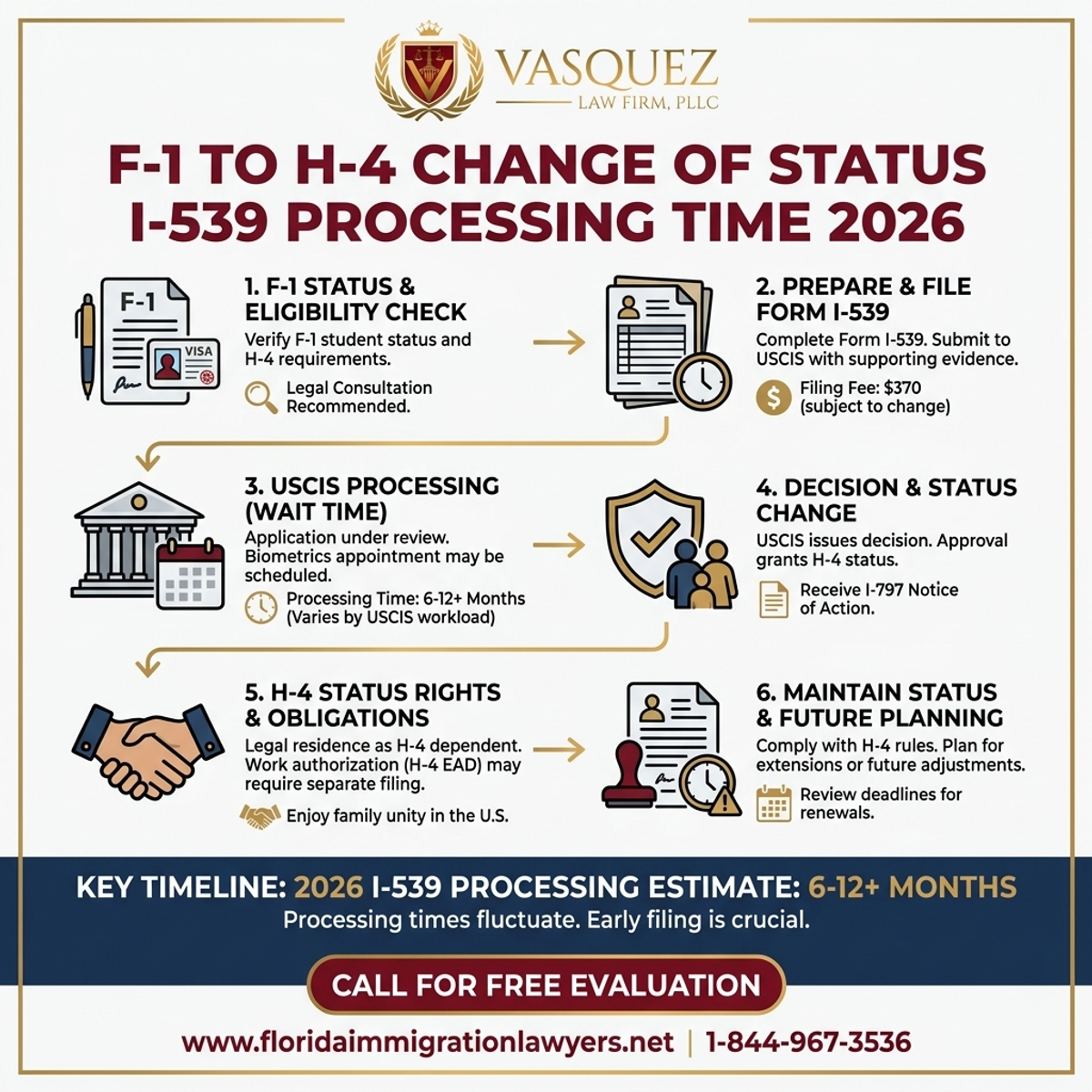
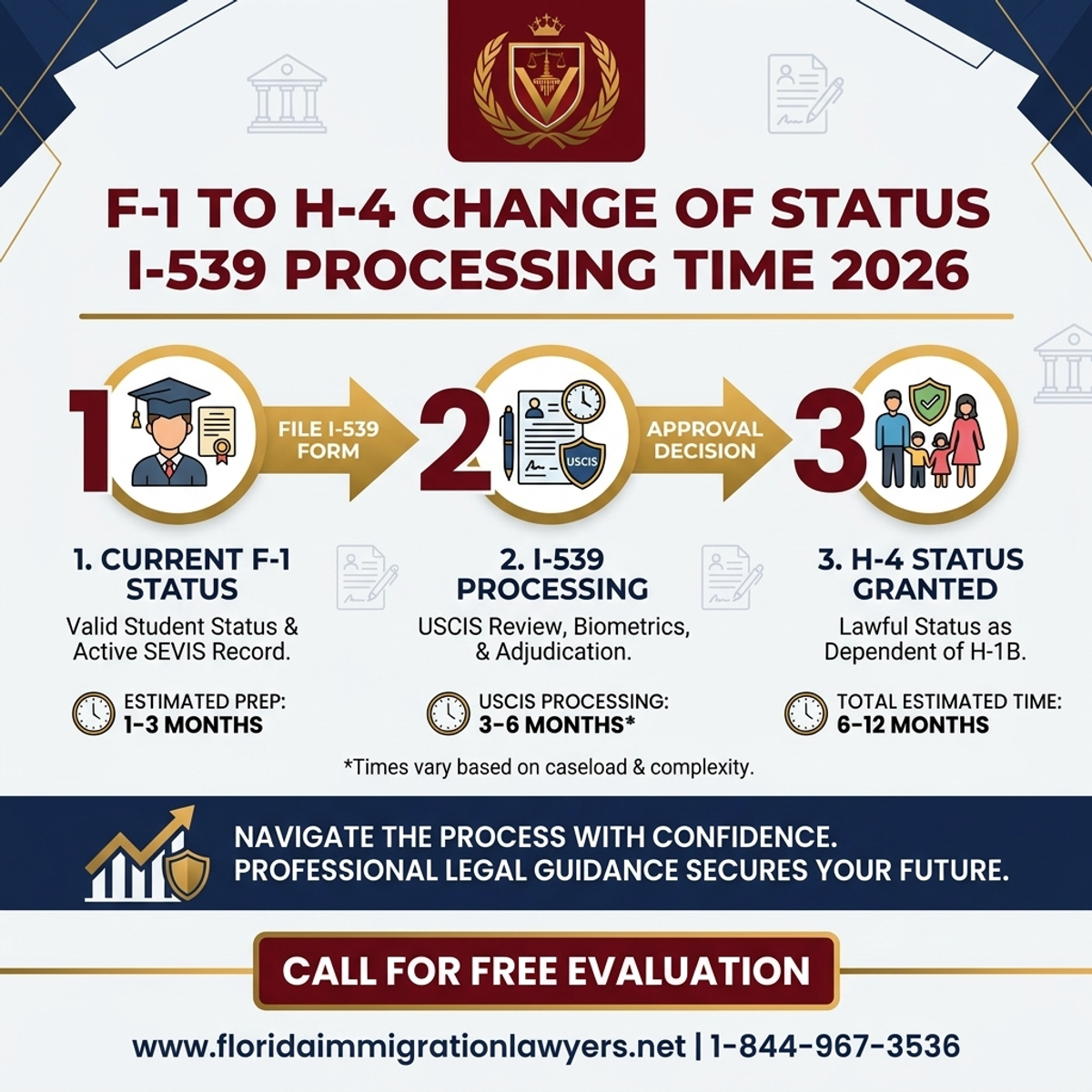
F-1 to H-4 Change of Status I-539 Processing Time 2026
For international students in Florida, transitioning from an F-1 student visa to an H-4 dependent visa involves filing Form I-539 with USCIS. This guide focuses on the critical I-539 processing times at the Texas Service Center in 2026, which can range from 8 to 18 months or more. We outline the strict eligibility criteria, including maintaining lawful F-1 status and being the spouse or child of an H-1B visa holder. The article details a comprehensive step-by-step application process, an essential document checklist, and a transparent overview of associated costs and typical timelines. Avoid common pitfalls like filing after your I-20 expires or submitting incomplete documentation. Florida Immigration Lawyers offers expert legal assistance throughout Florida, ensuring your application is meticulously prepared and submitted. Understand when professional legal counsel is indispensable to navigate this complex immigration pathway successfully.
William J. VásquezPublished on July 23, 2026
0 views
Changing from an F-1 student visa to H-4 dependent status in 2026 typically involves filing Form I-539, Application to Extend/Change Nonimmigrant Status, with USCIS. For applications processed at the Texas Service Center, current processing times for F-1 to H-4 changes can range from 8 to 18 months or more, varying based on caseload and individual case complexities. It is crucial to file your application while your F-1 status is still valid and maintain your legal presence in the U.S. during the adjudication period. Consulting an experienced immigration attorney, especially in Florida, is highly recommended to navigate this intricate process effectively.
Processing Time: 8-18+ months at Texas Service Center as of 2026.
Key Form: USCIS Form I-539.
Eligibility: Must maintain F-1 status until filing and be spouse/child of H-1B holder.
Location Impact: While processing is national, local attorney guidance in Florida is vital.
Crucial Step: File before your F-1 I-20 expires.
F-1 to H-4 Change of Status I-539 Processing Time 2026 Florida
Navigating the complex landscape of U.S. immigration law can be a daunting task, especially when transitioning between nonimmigrant statuses. For many international students in Florida, the journey from an F-1 student visa to an H-4 dependent visa represents a significant life change, often tied to a spouse's H-1B employment. Understanding the intricacies of this process, particularly the I-539 processing time at the Texas Service Center in 2026, is crucial for effective planning and preventing potential issues. This comprehensive guide will walk you through the eligibility requirements, the step-by-step application process, essential documents, and what to expect regarding timelines and costs for your status change.
Whether you are pursuing higher education in Miami, working towards a degree in Orlando, or residing in Pembroke Pines, the rules for changing your immigration status are federal. However, having local legal support from experienced attorneys who understand the unique needs of Florida residents can make a significant difference. Our firm, Florida Immigration Lawyers, is dedicated to assisting individuals throughout the state with their immigration challenges. Do not navigate this complex process alone. Call Florida Immigration Lawyers at 1-844-967-3536 for a free consultation to discuss your specific situation and ensure a smooth transition.
What is an F-1 to H-4 Change of Status and Who is Eligible?
An F-1 to H-4 change of status allows an international student currently holding an F-1 nonimmigrant visa to transition to H-4 dependent status. This change is typically sought when the F-1 student marries an H-1B visa holder or is the child (under 21) of an H-1B visa holder. The H-4 visa is exclusively for immediate family members of H-1B nonimmigrants, providing a pathway to remain in the U.S. legally as a dependent. This status change is a critical step for many individuals looking to align their immigration status with their family situation while continuing to reside in the United States.
To be eligible for an F-1 to H-4 change of status, you must meet several key criteria. First and foremost, you must have maintained your lawful F-1 status up until the point of filing your Form I-539 application. This means you must have been enrolled full-time, adhered to all F-1 visa regulations, and your I-20 must still be valid. Second, you must be the spouse or unmarried child (under 21) of a principal H-1B nonimmigrant who currently holds or is concurrently applying for H-1B status. Furthermore, you must not have committed any immigration violations that would render you ineligible for a change of status, such as unauthorized employment or significant periods of unlawful presence. Understanding these requirements is fundamental before initiating the application process, as any misstep can lead to denial and potential complications.
How Do I Apply for an F-1 to H-4 Change of Status in Florida?
Applying for an F-1 to H-4 change of status involves a meticulous, multi-step process with U.S. Citizenship and Immigration Services (USCIS). For residents in Florida, the application is filed centrally and processed by a designated USCIS Service Center, often the Texas Service Center, depending on the applicant's location. The primary form for this change is Form I-539, Application to Extend/Change Nonimmigrant Status. It is imperative to complete this form accurately and submit all required supporting documentation to avoid delays or denials. Careful preparation and adherence to instructions are key to a successful application.
Verify Eligibility and Gather Documents: Before anything else, ensure you meet all eligibility requirements as outlined above. Collect all necessary documents, including your passport, visa, I-94 record, I-20 forms, marriage certificate (if applicable), and your spouse's H-1B approval notice (Form I-797) and petition (Form I-129). This initial step is critical for a smooth application process and helps prevent common mistakes.
Complete Form I-539: Fill out Form I-539 accurately and completely. Pay close attention to all sections, especially those asking for your current status, the status you are requesting, and your biographical information. Any discrepancies or incomplete fields can lead to a Request for Evidence (RFE) or denial.
Prepare Supporting Evidence: Assemble all required supporting documents. This typically includes copies of your identification documents, proof of your relationship to the H-1B holder, evidence of your spouse's H-1B status, and proof of your maintained F-1 status. Organize these documents clearly and logically.
Draft a Cover Letter: While not strictly required, a cover letter can be very helpful. It should clearly list the contents of your application package, the purpose of your application (F-1 to H-4 change of status), and highlight key documents. This assists USCIS officers in reviewing your submission efficiently.
Pay Filing Fees: Include the correct filing fee for Form I-539. As of 2026, USCIS fees are subject to change, so always verify the current fee on the official USCIS website for Form I-539 before submission. Make sure to pay with a personal check, money order, or cashier's check payable to the U.S. Department of Homeland Security.
Mail the Application: Send your complete application package to the correct USCIS Service Center. For F-1 to H-4 changes, this is typically the Texas Service Center, but always double-check the "Where to File" section on the USCIS website for Form I-539 based on your current residence. Use a reliable mailing service with tracking.
Maintain Status While Pending: Once you have properly filed your I-539 application, you are generally permitted to remain in the U.S. while USCIS processes your request, even if your F-1 I-20 expires. This is known as "period of authorized stay." However, you cannot engage in any F-1 authorized employment after your I-20 expires if the I-539 is still pending. It is crucial to monitor your case status online using the receipt number provided by USCIS.
What Documents Do I Need for an F-1 to H-4 Change of Status?
A complete and well-organized document submission is vital for a successful F-1 to H-4 change of status application. Missing documents or insufficient evidence can lead to significant delays, Requests for Evidence (RFEs), or even denial of your application. Ensure you gather all required documents before compiling your application package. These documents serve as proof of your eligibility, your relationship to the H-1B principal, and your maintained lawful status in the U.S. This comprehensive checklist is designed to help you prepare thoroughly.
Completed and signed Form I-539, Application to Extend/Change Nonimmigrant Status.
Copy of your valid passport (biographic page and visa stamp).
Copy of your current I-94 Arrival/Departure Record (print from CBP website).
All F-1 Form I-20s (Certificate of Eligibility for Nonimmigrant Student Status), including any previous and current ones.
Copies of any previous EAD cards (if applicable, e.g., for OPT).
Evidence of financial support to cover your expenses while in H-4 status (e.g., bank statements, affidavit of support from spouse).
Copy of your marriage certificate (if applying as a spouse).
Copy of your birth certificate (if applying as a child).
Copy of your spouse's H-1B Approval Notice (Form I-797, Approval Notice).
Copy of your spouse's H-1B Petition (Form I-129, Petition for a Nonimmigrant Worker), including all supporting documents submitted with it.
Copy of your spouse's passport, visa, and I-94 record.
Proof of your spouse's current employment (e.g., recent pay stubs, employment verification letter).
Any other documents requested by USCIS or deemed relevant by your attorney to support your eligibility.
Filing fee payment (check or money order) for Form I-539.
Step-by-Step Process — F-1 to H-4 Change of Status I-539 Processing Time 2026 Florida
What is the I-539 Processing Time for F-1 to H-4 at the Texas Service Center in 2026?
The I-539 processing time for an F-1 to H-4 change of status at the Texas Service Center in 2026 is a primary concern for many applicants. As of early 2026, USCIS processing times remain dynamic and can fluctuate based on application volume, staffing levels, and policy changes. While the official USCIS website provides estimated processing times, these are subject to change and should be considered as general guidance. Typically, you can expect processing to take several months, and it is vital to monitor the latest updates directly from USCIS.
For F-1 to H-4 change of status applications filed with the Texas Service Center, applicants should generally anticipate a waiting period ranging from 8 to 18 months, or potentially longer. This timeframe can be influenced by whether your spouse's H-1B petition is filed concurrently or has already been approved. Premium processing is not available for Form I-539 for H-4 status, meaning applicants must prepare for a lengthy waiting period. It is crucial to plan accordingly, ensuring you maintain lawful status and do not depart the U.S. while your application is pending, as this can lead to abandonment of your I-539. For the most up-to-date estimates, always check the USCIS Processing Times page and select Form I-539 and the Texas Service Center.
Typical Timeline and Processing Expectations (As of 2026)
Understanding the typical stages and timeframes can help manage expectations for your F-1 to H-4 change of status. While specific processing times can vary, this table provides a general overview of what applicants in Florida might expect when their I-539 is processed at the Texas Service Center in 2026.
Stage
Typical Timeframe
Notes
Application Submission to Receipt Notice
2-4 weeks
USCIS acknowledges receipt with Form I-797C, Notice of Action.
Biometrics Appointment (if required)
3-6 months after filing
Appointment at an Application Support Center (ASC) in Florida.
Request for Evidence (RFE) (if applicable)
Variable, can add 2-4+ months
USCIS requests additional documents/information. Response time varies.
Case Adjudication
8-18+ months from filing
Decision issued (approval or denial).
Approval Notice Mailing
1-2 weeks after approval
Form I-797, Approval Notice, is mailed to you or your attorney.
What are the Costs Associated with an F-1 to H-4 Change of Status?
The financial aspect of an F-1 to H-4 change of status is an important consideration for applicants in Florida. The primary cost is the USCIS filing fee for Form I-539. However, there may be other associated expenses, such as attorney fees, translation costs, and fees for obtaining supporting documents. While USCIS fees are standard nationwide, legal fees can vary depending on the complexity of your case and the services provided by your chosen immigration law firm. It is always wise to budget for these potential costs to ensure a smooth application process without unexpected financial burdens.
As of 2026, USCIS fees are subject to change, so always verify the most current amounts directly on the official USCIS website or consult with an immigration attorney. Generally, the Form I-539 filing fee is a fixed amount. There is also a biometrics services fee, which is often required for I-539 applications, though there are specific exceptions. If you choose to retain legal counsel from a firm like Florida Immigration Lawyers, you will incur attorney fees, which cover the preparation, review, and submission of your application, as well as communication with USCIS on your behalf. These fees are an investment in ensuring your application is complete and correctly filed, minimizing risks of denial or delays.
Typical Cost Factors (As of 2026)
Item
Typical Fee
Notes
USCIS Form I-539 Filing Fee
Variable (check USCIS website)
Mandatory fee for the application.
Biometrics Services Fee
Variable (check USCIS website)
Required for most I-539 applicants to collect fingerprints and photos.
Attorney Fees
Varies significantly
Cost for legal representation, guidance, and application preparation.
Document Translation Fees
Varies by document
If any supporting documents are not in English, certified translations are required.
Postage/Courier Fees
$25-$75+
For secure mailing of your application package to USCIS.
Key Statistics — F-1 to H-4 Change of Status I-539 Processing Time 2026 Florida
Do not navigate this process alone. The complexities of immigration law, coupled with ever-changing policies, make professional guidance invaluable. Contact Florida Immigration Lawyers today at 1-844-967-3536 for a free consultation. Our team is ready to provide the support and expertise you need to successfully change your F-1 status to H-4.
Common Mistakes to Avoid During F-1 to H-4 Change of Status
Applying for an F-1 to H-4 change of status can be complex, and even minor errors can lead to significant delays or outright denial of your application. Being aware of these common pitfalls can help you avoid unnecessary stress and ensure a smoother process. It is crucial to pay close attention to detail and, when in doubt, seek professional legal advice. Here are some of the most frequent mistakes applicants make:
Filing After I-20 Expiration: Submitting Form I-539 after your F-1 I-20 has expired or after your grace period has ended is a critical error. Generally, you must file while your F-1 status is still valid. Filing out of status can lead to denial, and in some cases, accrual of unlawful presence.
Failing to Maintain F-1 Status: Not adhering to F-1 visa regulations (e.g., unauthorized employment, not maintaining full-time enrollment) before filing can render you ineligible for a change of status. USCIS will scrutinize your F-1 history.
Incomplete or Inaccurate Form I-539: Any missing information, incorrect dates, or inconsistent answers on Form I-539 can trigger a Request for Evidence (RFE) or even a denial. Double-check every field carefully.
Insufficient Supporting Documentation: Failing to include all required documents, such as a valid marriage certificate, your spouse's H-1B approval, or proof of financial support, will result in an RFE and prolong the processing time.
Incorrect Filing Fees: Submitting the wrong fee amount or an expired form of payment will cause your application to be rejected. Always verify the current fees on the USCIS website.
Departing the U.S. While I-539 is Pending: If you leave the United States while your I-539 application for change of status is pending, USCIS will consider your application abandoned. This can lead to complications upon re-entry.
Not Responding to RFEs in Time: If USCIS issues an RFE, you will have a specific deadline to respond. Failing to submit the requested information by the due date will likely lead to a denial.
Assuming H-4 EAD Eligibility: Not all H-4 dependents are eligible for an Employment Authorization Document (EAD). Only certain H-4 spouses of H-1B holders who meet specific criteria can apply for an EAD. Do not assume you can work immediately upon H-4 approval.
Ignoring Biometrics Appointment Notice: If USCIS sends a notice for a biometrics appointment, failing to attend will result in the abandonment or denial of your application. Attend all scheduled appointments.
Not Consulting an Attorney: Attempting to navigate the complexities of immigration law without legal guidance can be a costly mistake. An experienced immigration attorney can help identify potential issues, ensure all documents are correct, and represent your best interests.
When to Call a Florida Immigration Lawyer for Your F-1 to H-4 Change of Status
While some immigration processes appear straightforward, the F-1 to H-4 change of status can present unique challenges that warrant professional legal assistance. Engaging a Florida immigration lawyer is not just for complex cases; it provides peace of mind and ensures accuracy, especially with the significant impact immigration decisions have on your future. Our firm, Florida Immigration Lawyers, serves clients across the state, including those in Pembroke Pines and surrounding areas, providing dedicated support for status changes.
You should consider contacting an immigration lawyer if you:
Are unsure about your eligibility requirements or have a history of minor immigration issues.
Have previously been out of status, even for a short period, or have questions about maintaining status.
Receive a Request for Evidence (RFE) from USCIS and need assistance in providing a comprehensive response.
Are concerned about the lengthy processing times and want to ensure your application is as strong as possible.
Need help organizing and reviewing complex documentation, including foreign language documents requiring certified translation.
Your spouse's H-1B petition has unique circumstances, such as being filed concurrently with your I-539 or involving a change of employer.
Want to explore all potential options and understand the legal implications of your status change thoroughly.
A knowledgeable attorney from Florida Immigration Lawyers can provide invaluable guidance, help you avoid common mistakes, and advocate on your behalf throughout the entire process. We understand the nuances of immigration law and are committed to protecting your interests.
About Florida Immigration Lawyers
Florida Immigration Lawyers is a leading immigration law firm dedicated to serving individuals and families across the entire state of Florida. With a deep understanding of U.S. immigration laws and policies, our experienced attorneys provide comprehensive legal services tailored to your specific needs. We pride ourselves on offering compassionate, client-focused representation, guiding you through every step of your immigration journey, from visa applications and status adjustments to complex deportation defense cases.
Our firm handles a wide range of immigration matters, including family-based immigration, business immigration, naturalization, asylum, and removal defense. We are committed to providing accessible and effective legal solutions, ensuring that every client receives personalized attention and strategic advice. With offices conveniently located and a team available 24/7 for free consultations, we are here to help you achieve your immigration goals. Visit floridaimmigrationlawyers.net or call us at 1-844-967-3536 to learn how we can assist you.
This article provides general legal information and is not intended as legal advice. Every case is unique, and outcomes depend on specific facts and circumstances. Contact an attorney for advice about your particular situation.
Changing your immigration status is a pivotal moment that requires careful attention to detail and a thorough understanding of U.S. immigration law. Do not leave your future to chance. Our dedicated team at Florida Immigration Lawyers is here to provide the expert guidance and support you need. Contact us today for a free consultation at 1-844-967-3536. Se Habla Espanol - Estamos aqui para ayudarle.
No, you generally cannot work while your F-1 to H-4 change of status application is pending. Once your F-1 I-20 expires, any F-1 authorized employment (like OPT) must cease. You can only begin working once your H-4 status is approved and, if eligible, you have obtained an Employment Authorization Document (EAD) based on your H-4 status. Working without authorization can lead to severe immigration consequences.
If your F-1 I-20 expires while your properly filed Form I-539 for change of status to H-4 is pending, you are generally allowed to remain in the U.S. in a 'period of authorized stay.' You do not accrue unlawful presence during this time. However, you must cease all F-1 related activities, including study, and cannot work. It is crucial to avoid leaving the U.S. while your application is pending.
No, it is highly advisable not to travel outside the U.S. while your Form I-539 change of status application is pending. If you depart the U.S., USCIS will consider your I-539 application abandoned. To re-enter, you would need to obtain an H-4 visa stamp at a U.S. consulate abroad, which requires a separate application process and can be time-consuming.
No, premium processing is generally not available for Form I-539 applications filed for a change of status from F-1 to H-4. This means applicants must go through the standard processing queues, which can take many months. You must plan accordingly for the extended waiting period and maintain your legal status throughout.
If your spouse's H-1B petition is pending, you can file your I-539 for H-4 change of status concurrently. USCIS will typically adjudicate both petitions together. It is crucial to clearly indicate on your I-539 that it is being filed concurrently with your spouse's H-1B petition and include all relevant receipt numbers if available.
Florida Immigration Lawyers can provide comprehensive assistance by evaluating your eligibility, preparing and reviewing all necessary forms and supporting documents, drafting a compelling cover letter, and communicating with USCIS on your behalf. We help you avoid common mistakes, respond to RFEs, and ensure your application is strong and meticulously presented, giving you the best chance for approval.
If your F-1 status has already expired, you generally cannot apply for a change of status from F-1 to H-4 within the U.S. You would likely need to depart the U.S. and apply for an H-4 visa at a U.S. consulate abroad. There are very limited exceptions for 'extraordinary circumstances,' but these are rare. Consult an attorney immediately if you are in this situation.
Yes, most applicants filing Form I-539 for a change of status, including F-1 to H-4, are required to attend a biometrics appointment at a USCIS Application Support Center (ASC). USCIS will send you a notice with the date, time, and location of your appointment. Failing to attend this appointment can lead to the denial of your application.
William J. Vásquez
Founding Attorney · Vasquez Law Firm
U.S. Air Force veteran and immigration attorney with years of hands-on U.S. immigration experience. J.D., NCCU School of Law. AILA member. Admitted to the 4th, 5th, and 11th Circuit Courts.
Available 24/7 - Free Evaluations
Reviewed for legal accuracy by William J. Vásquez
Licensed in North Carolina; U.S. immigration is federal practice.