T Visa for Human Trafficking Victims in Florida
Discover how the T visa can provide a path to safety and legal residency for human trafficking victims in Florida. Learn about the application process, eligibility criteria, and benefits. Our team at Florida Immigration Lawyers is here to help. Contact us today for a free consultation.

T Visa for Human Trafficking Victims in Florida | VLF Florida
Human trafficking is a grave crime affecting countless individuals, often leaving them in unimaginable situations of exploitation and fear. For victims in Florida, finding a pathway to safety, recovery, and legal stability is paramount. The T Nonimmigrant Status, commonly known as the T Visa, is a crucial lifeline provided by the U.S. government specifically designed to protect victims of severe forms of human trafficking. It offers a temporary legal status, work authorization, and a potential path to permanent residency, allowing survivors to rebuild their lives free from their traffickers' control.
Understanding the intricacies of the T Visa application process can be overwhelming, especially for individuals who have endured such trauma. This comprehensive guide aims to demystify the requirements, application steps, and benefits of the T Visa, with a particular focus on how it applies to victims residing in Florida. Our firm, VLF Florida, is dedicated to providing compassionate and expert legal assistance to human trafficking survivors, helping them navigate the complex immigration system. If you are a victim of human trafficking, know that you are not alone, and legal avenues exist to secure your future.
Understanding the T Visa: Eligibility Requirements
To qualify for a T Visa, applicants must meet several stringent criteria established by U.S. immigration law. These requirements are designed to ensure the visa is granted to genuine victims of severe forms of human trafficking. Here’s a detailed breakdown:
Defining "Severe Form of Human Trafficking"
This is a critical first step in determining eligibility. U.S. law defines severe forms of trafficking in two main categories:
- Sex Trafficking: When a commercial sex act is induced by force, fraud, or coercion, or when the person induced to perform such an act is under the age of 18.
- Labor Trafficking: The recruitment, harboring, transportation, provision, or obtaining of a person for labor or services, through the use of force, fraud, or coercion for the purpose of subjection to involuntary servitude, peonage, debt bondage, or slavery. It's important to note that the "force, fraud, or coercion" element is key, and victims often don't realize they are being trafficked due to manipulation and psychological control.
Physical Presence in the U.S.
You must be physically present in the United States, American Samoa, the Commonwealth of the Northern Mariana Islands, or at a U.S. port of entry on account of such trafficking. This means your presence here is a direct result of the trafficking situation, not for other unrelated reasons.
Cooperation with Law Enforcement
You must comply with any reasonable request for assistance in the investigation or prosecution of acts of trafficking. This requirement can be waived for children under 18 or individuals who are unable to cooperate due to physical or psychological trauma. It's crucial to understand that cooperation does not necessarily mean testifying in court; it can involve providing information to investigators, participating in interviews, or identifying traffickers.
Extreme Hardship Upon Removal
You must demonstrate that you would suffer extreme hardship involving unusual and severe harm if you were removed from the United States. This assessment considers various factors, including the risk of retaliation from traffickers or their associates, lack of support networks in your home country, the psychological impact of returning to a dangerous environment, and the potential for re-trafficking. The cumulative effect of these factors is carefully evaluated.
Age Consideration
If you are under 18 years of age, the cooperation requirement can be waived, acknowledging the particular vulnerability of child victims and the potential for severe trauma that might hinder their ability to assist law enforcement.
Meeting these criteria can be complex, and gathering the necessary evidence often requires the guidance of an experienced immigration attorney to build a robust case.
The T Visa Application Process: A Step-by-Step Guide
Applying for a T Visa involves a meticulous process that requires careful attention to detail and comprehensive documentation. Here are the key steps involved:
Step 1: Gathering Evidence
The success of your T Visa application hinges on providing compelling evidence that substantiates your claims of being a trafficking victim and meeting all eligibility criteria. This includes, but is not limited to:
- Personal Statement: A detailed narrative of your experience as a trafficking victim, explaining how you were trafficked, the force, fraud, or coercion used, and how your presence in the U.S. is due to trafficking. This statement is often the most critical piece of evidence.
- Law Enforcement Documentation: Affidavits or certifications from law enforcement agencies (e.g., FBI, ICE, local police, state attorneys) confirming your cooperation in an investigation or prosecution. If you haven't directly cooperated, documentation of efforts to contact law enforcement or reasons for inability to cooperate (e.g., fear, trauma, age) are crucial.
- Corroborating Evidence: Any documents, photos, emails, texts, social media interactions, witness statements, medical records, psychological evaluations, or financial records that support your claims of trafficking and extreme hardship. Evidence of physical or psychological abuse, deprivation of liberty, or exploitation is highly valuable.
Step 2: Filing Form I-914 and I-914A
- Form I-914, Application for T Nonimmigrant Status: This is the primary application form that you, as the principal victim, must complete and submit to U.S. Citizenship and Immigration Services (USCIS).
- Form I-914A, Supplement A, Application for Family Member of T-1 Nonimmigrant: If you have eligible family members (spouse, children, parents, or unmarried siblings under 18) you wish to include in your application, they must file this supplement. This allows for family unity and ensures their protection as well.
All forms must be meticulously completed, signed, and submitted with all supporting documentation to the designated USCIS address. Errors or omissions can lead to delays or even denial.
Step 3: Biometrics Appointment
After filing, you will likely receive a notice to attend a biometrics appointment at an Application Support Center (ASC). Here, your fingerprints, photograph, and signature will be collected for background checks and identity verification. This is a standard part of most immigration applications.
Step 4: Interview (If Required)
While not all T Visa applicants are interviewed, USCIS may request one to clarify information, gather additional details about your case, or assess your credibility. Preparing for an interview with your attorney is crucial to ensure you can articulate your story clearly and confidently, despite the trauma you may have experienced.
Step 5: Decision
USCIS will review your application and evidence. If approved, you will be granted T Nonimmigrant Status for a period, typically four years. During this time, you will also receive an Employment Authorization Document (EAD), allowing you to work legally in the U.S. This decision marks a significant turning point in a survivor's life, offering a chance at stability and independence.
The application process can be lengthy and emotionally taxing. Having an experienced legal team, like the attorneys at VLF Florida, can significantly ease the burden and improve the chances of a successful outcome.
Benefits of T Nonimmigrant Status for Survivors
The T Visa provides a comprehensive set of protections and opportunities for human trafficking victims, enabling them to escape their past and build a new future:
- Protection from Deportation: One of the most immediate and critical benefits is protection from removal from the United States. This provides a sense of security that is invaluable for survivors who may fear being sent back to dangerous situations. This protection also serves as a critical component of deportation defense for those already in removal proceedings.
- Work Authorization: T Visa holders receive an Employment Authorization Document (EAD), allowing them to work legally in the U.S. This is vital for financial independence, self-sufficiency, and rebuilding a stable life free from exploitation.
- Path to Lawful Permanent Residence (Green Card): After three years in T Nonimmigrant Status, or upon the completion of the investigation or prosecution of the trafficking crime (whichever comes first), T Visa holders can apply for adjustment of status to become lawful permanent residents. This is a significant step towards long-term stability and integration into American society.
- Eligibility for Family Members: Certain qualifying family members can also obtain T Nonimmigrant Status. This includes spouses, children, parents (if the principal applicant is under 21), and unmarried siblings under 18 (if the principal applicant is under 21). This allows families to stay together, heal collectively, and support each other.
- Access to Public Benefits: T Visa holders may be eligible for certain public benefits and services designed to assist victims of trafficking, including healthcare, housing assistance, food assistance, and social services. These resources are crucial for recovery and reintegration.
- Trauma-Informed Support: The T Visa process is designed to be trauma-informed, recognizing the unique vulnerabilities of trafficking survivors. This approach aims to minimize re-traumatization during the legal process.
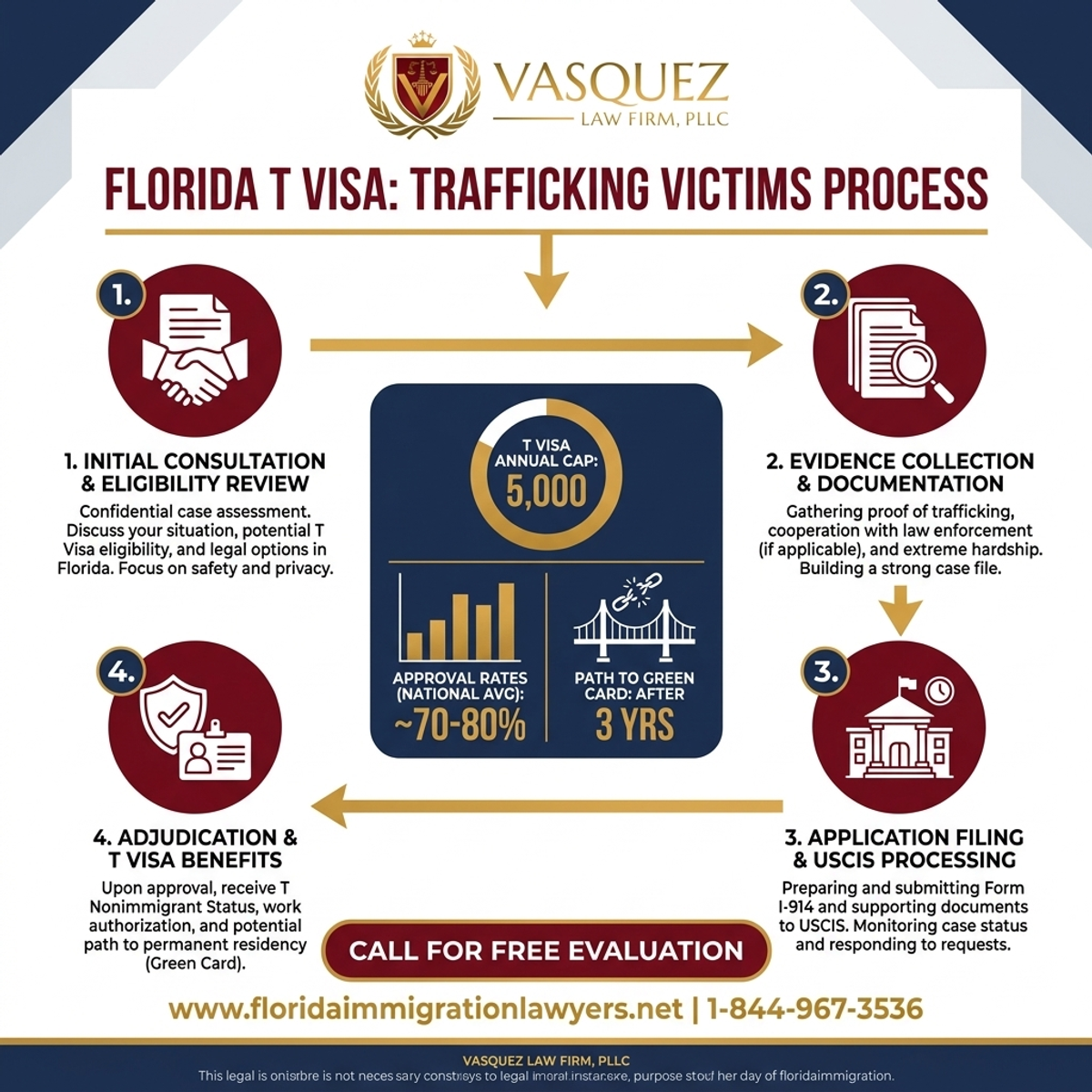
Step-by-Step Process — T Visa for Human Trafficking Victims in Florida | VLF Florida
Florida's Commitment to Human Trafficking Victims and Local Support
Florida stands as a critical battleground in the fight against human trafficking, given its extensive coastline, major international airports, and robust tourism industry, which unfortunately create vulnerabilities for both sex and labor trafficking. Recognizing this grim reality, the state has made significant strides in establishing comprehensive frameworks to combat trafficking and support its victims. Florida law enforcement agencies, state attorneys, and non-profit organizations work collaboratively to identify victims, prosecute traffickers, and provide essential services.
For T Visa applicants in Florida, understanding the local landscape of support can be immensely beneficial. The state has numerous victim service organizations that offer safe housing, counseling, medical care, legal advocacy, and educational resources. These organizations often work in conjunction with federal agencies like Homeland Security Investigations (HSI) and the FBI, as well as local police departments, to ensure victims receive holistic care and that their cases are properly investigated. Florida's Department of Children and Families (DCF) also plays a role in identifying and assisting child victims of trafficking.
Furthermore, Florida's legal community, including firms like VLF Florida, plays a pivotal role in assisting survivors. Our attorneys are deeply familiar with both federal immigration laws pertaining to the T Visa and the specific resources available within Florida. We collaborate with local victim advocates and law enforcement to ensure our clients' needs are met beyond just their immigration status. Navigating the legal system while recovering from trauma requires a specialized approach, and our commitment is to provide compassionate, culturally sensitive, and effective representation. We believe that every survivor deserves the opportunity to rebuild their life in safety and dignity, and securing a T Visa is often the first critical step on that journey.
Distinction from Other Immigration Remedies
While the T Visa is specifically for victims of human trafficking, other immigration remedies exist for individuals who have suffered severe harm. For example, the U Visa is available for victims of certain crimes (e.g., domestic violence, sexual assault, blackmail) who have suffered substantial physical or mental abuse and are helpful to law enforcement in the investigation or prosecution of those crimes. Similarly, individuals fleeing persecution in their home countries due to race, religion, nationality, political opinion, or membership in a particular social group may qualify for asylum. Understanding which immigration pathway is most appropriate for your unique circumstances is crucial, and an immigration attorney can help you determine the best course of action.
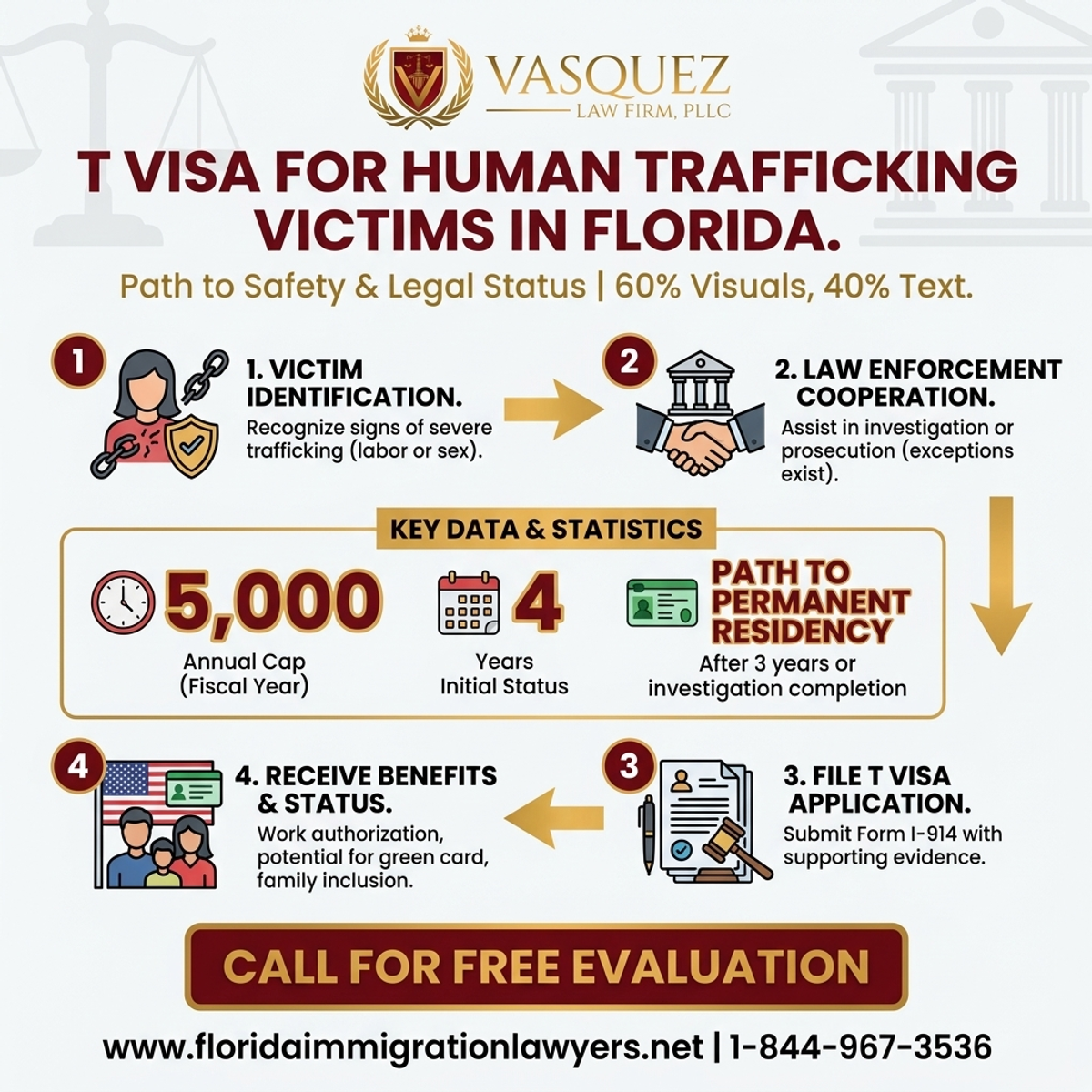
Key Statistics — T Visa for Human Trafficking Victims in Florida | VLF Florida
After T Visa Approval: The Path to a Green Card
Securing a T Visa is a monumental achievement, but it's often just one step on a longer journey toward full recovery and stability. Once T Nonimmigrant Status is granted, recipients are encouraged to continue working with support organizations and to focus on their healing. After the required period (typically three years or when the trafficking investigation/prosecution is complete, whichever comes first), T Visa holders become eligible to apply for adjustment of status to become lawful permanent residents (green card holders). This involves filing Form I-485, Application to Register Permanent Residence or Adjust Status.
The process for adjustment of status requires demonstrating continued eligibility and admissibility to the U.S., including passing background checks and attending an interview. It's another complex stage where legal guidance is invaluable to ensure a smooth transition to permanent residency and secure your long-term future in the United States.
The Importance of Expert Legal Counsel
The journey to obtaining a T Visa is fraught with legal complexities, emotional challenges, and bureaucratic hurdles. Victims of human trafficking are often in a vulnerable state, making it incredibly difficult to navigate the intricate immigration system alone. An experienced immigration attorney can provide invaluable support by:
- Assessing Eligibility: Thoroughly evaluating your unique situation to determine if you meet all the stringent requirements for a T Visa.
- Gathering Evidence: Assisting in collecting and organizing the necessary documentation, including sensitive personal statements and law enforcement certifications, while employing a trauma-informed approach.
- Liaising with Law Enforcement: Helping to facilitate communication and cooperation with investigative agencies, ensuring your rights are protected throughout the process.
- Protecting Your Rights: Ensuring that your rights are protected throughout the application process and that you are not subjected to further trauma or exploitation.
- Representing You: Preparing you for interviews and representing you before USCIS, advocating fiercely on your behalf.
- Appealing Denials: If an application is denied, an attorney can help evaluate options for appeal or reconsideration, exploring every possible avenue for a positive outcome.
At VLF Florida, our team of dedicated attorneys understands the unique needs of trafficking survivors. We approach each case with empathy, discretion, and a steadfast commitment to achieving the best possible outcome. We are here to provide comprehensive immigration legal services, from initial consultation to final resolution, empowering survivors to reclaim their lives.
Seek Help Today: Your Path to Freedom Starts Here
If you or someone you know is a victim of human trafficking in Florida, do not hesitate to seek help. The T Visa offers a pathway to freedom, safety, and a new beginning. Contact VLF Florida today for a confidential and free consultation. Our compassionate legal team is ready to listen, provide expert guidance, and advocate fiercely on your behalf. We understand the courage it takes to come forward, and we are here to support you every step of the way. Call us at (844) 967-3536 or visit our contact page to schedule your consultation. Your journey to justice and safety starts here.
Sources and References
- U.S. Citizenship and Immigration Services (USCIS)
- Executive Office for Immigration Review (EOIR)
- U.S. Department of State - Bureau of Consular Affairs
- Immigration and Nationality Act (INA), 8 U.S.C. Chapter 12
Do Not Navigate This Process Alone
Our experienced immigration attorneys are ready to fight for you. Get a free, confidential case review today.
Se Habla Español
Or leave your details and we’ll call you:
Free Evaluation in 24 Hours
Or talk to us right now
AI voice assistant — available 24/7
FreeFrequently Asked Questions

William J. Vásquez
Founding Attorney · Vasquez Law Firm
U.S. Air Force veteran and immigration attorney with years of hands-on U.S. immigration experience. J.D., NCCU School of Law. AILA member. Admitted to the 4th, 5th, and 11th Circuit Courts.
Available 24/7 - Free Evaluations
Reviewed for legal accuracy by William J. Vásquez
Licensed in North Carolina; U.S. immigration is federal practice.
Related Legal Services
Our Florida immigration attorneys can help you with deportation defense, family immigration services and immigration lawyer cost in Florida. Call today at 1-844-YO-PELEO for a free case review.
Related Links
Related Topics
Free Legal Case Review
Discuss your case with our experienced attorneys. We're available 24/7.
Se Habla Español - Estamos aquí para ayudarle.
Related Articles
EAD Advance Parole Combo Card in Florida 2026
For individuals with a pending Form I-485, Application to Register Permanent Residence or Adjust Status, the EAD Advance Parole Combo Card is an essential document. This single card combines the authorization to work legally in the U.S. (Employment Authorization Document - EAD) with permission to travel internationally and re-enter without abandoning your green card application (Advance Parole). This guide from Florida Immigration Lawyers provides a comprehensive overview for applicants in Florida in 2026, covering eligibility, the step-by-step application process, required documents, expected processing times, and associated costs. We also highlight common mistakes to avoid and when to seek legal counsel to ensure a smooth and successful immigration journey. Understanding this vital card is key to maintaining stability while awaiting your permanent residency approval.
Immigration Lawyer Orlando Free Consultation in Florida
For individuals and families in Orlando, Florida, navigating the complexities of U.S. immigration law requires expert guidance. An immigration lawyer in Orlando offers crucial support for everything from visa applications and green card processes to naturalization and deportation defense. This comprehensive guide details what a free consultation covers, providing a step-by-step overview of immigration pathways, essential document checklists, and expected timelines in 2026. We also highlight common mistakes to avoid, discuss the critical role of legal counsel in deportation and asylum cases, and explain why choosing a local Orlando immigration attorney is beneficial. Florida Immigration Lawyers is dedicated to serving the diverse community of Orlando with compassionate, effective legal solutions, ensuring you receive personalized advice and robust representation for a successful immigration journey.
USCIS Oath Ceremony Schedule 2026: Your Guide to Citizenship
Achieving U.S. citizenship culminates in the naturalization oath ceremony, a pivotal moment for immigrants in Florida. This comprehensive guide from Florida Immigration Lawyers details the USCIS oath ceremony schedule for 2026, outlining what to expect from your Form N-445 notice to the final pledge of allegiance. We cover the entire naturalization process, including eligibility requirements, the step-by-step application (Form N-400), necessary documents, typical timelines for Florida field offices like Orlando, Miami, and Tampa, and associated costs. Learn how to prepare for your ceremony, avoid common mistakes that could delay your path, and understand when legal counsel becomes indispensable. Our firm is dedicated to providing expert guidance, ensuring a smooth and successful journey to becoming a U.S. citizen. Get a free case review from our bilingual team today.
Annual Asylum Fee: Preparation for Florida Interviews
As of 2026, there is no annual asylum fee in the U.S. Preparing for your asylum interview in Florida is crucial for success. Learn more about the process, necessary documentation, and common mistakes to avoid. Florida Immigration Lawyers are here to help.