H-1B Visa for Florida Employers: 2026 Sponsorship Guide
For Florida employers, navigating the H-1B visa process in 2026 is essential for securing skilled foreign talent in specialty occupations. This comprehensive guide details everything from initial eligibility and the crucial Labor Condition Application (LCA) to the competitive H-1B cap lottery and subsequent USCIS petition filing. We cover the extensive documentation required, provide typical processing timelines, and break down the associated costs, including government fees and legal expenses. Florida businesses must also understand their ongoing compliance responsibilities post-approval to avoid penalties. Learn to sidestep common mistakes that can lead to delays or denials, such as underpaying the prevailing wage or failing to demonstrate a clear employer-employee relationship for third-party placements. Whether you're a first-time sponsor or need assistance with an RFE, understanding when to seek expert legal counsel is vital. Florida Immigration Lawyers offers strategic guidance to ensure your H-1B sponsorship efforts are compliant and successful, helping your business thrive in Florida's dynamic economy.
Sponsoring an H-1B visa in Florida allows employers to hire highly skilled foreign professionals in specialty occupations. As of 2026, the process involves several key stages: LCA filing, I-129 petition, potential H-1B lottery, and consular processing or adjustment of status. Employers must adhere to strict wage and working condition requirements, ensuring compliance with U.S. labor laws. Navigating the H-1B cap, complex documentation, and evolving immigration policies necessitates meticulous preparation and often, experienced legal counsel to avoid costly delays or denials.
- H-1B visas are for specialty occupations requiring a bachelor's degree or higher.
- Employers must file a Labor Condition Application (LCA) with the DOL before petitioning USCIS.
- The annual H-1B cap often requires participation in a lottery, typically in March for an October start date.
- Compliance with prevailing wage and working conditions is mandatory throughout the H-1B worker's employment.
- Seek legal counsel to navigate complex regulations and optimize the sponsorship process.
Florida's dynamic economy, particularly in tech, healthcare, and finance sectors across cities like Jacksonville, Miami, and Orlando, thrives on innovation and specialized talent. Many Florida employers find themselves needing to recruit skilled professionals from abroad to fill critical roles that U.S. workers may not adequately staff. This is where the H-1B visa program becomes an invaluable tool, enabling businesses to bring in foreign talent for specialty occupations. However, the path to H-1B sponsorship is often complex, fraught with intricate regulations, strict deadlines, and an annual lottery system that can be daunting for even experienced human resources departments.
Understanding the nuances of the H-1B visa process in 2026 is crucial for any Florida employer considering international recruitment. From initial eligibility assessments to the final approval and ongoing compliance, each step demands careful attention to detail and a thorough understanding of U.S. immigration law. This comprehensive guide is designed to equip Florida employers with the knowledge needed to successfully navigate the H-1B sponsorship journey. We will cover everything from eligibility and application steps to timelines, costs, common pitfalls, and when to seek expert legal assistance.
Do not let the complexity of immigration law deter your business from accessing the global talent pool. For personalized guidance and to ensure your H-1B petitions are robust and compliant, call Florida Immigration Lawyers at 1-844-YO-PELEO for a free consultation. Our team is ready to assist you in securing the talent your Florida business needs to thrive.
What is the H-1B Visa and Why is it Crucial for Florida Employers in 2026?
The H-1B visa is a non-immigrant visa that allows U.S. employers to temporarily employ foreign workers in specialty occupations. These occupations generally require a bachelor's degree or higher in a specific field, such as IT professionals, engineers, doctors, scientists, and architects. For Florida employers, the H-1B program is vital for several reasons. It provides a legal pathway to address skill gaps in high-demand industries, fostering innovation and competitiveness within the state. As of 2026, with an increasingly globalized economy, access to international talent is not just an advantage, but often a necessity for growth and development, especially in tech hubs like Jacksonville and the burgeoning biomedical sector in Gainesville.
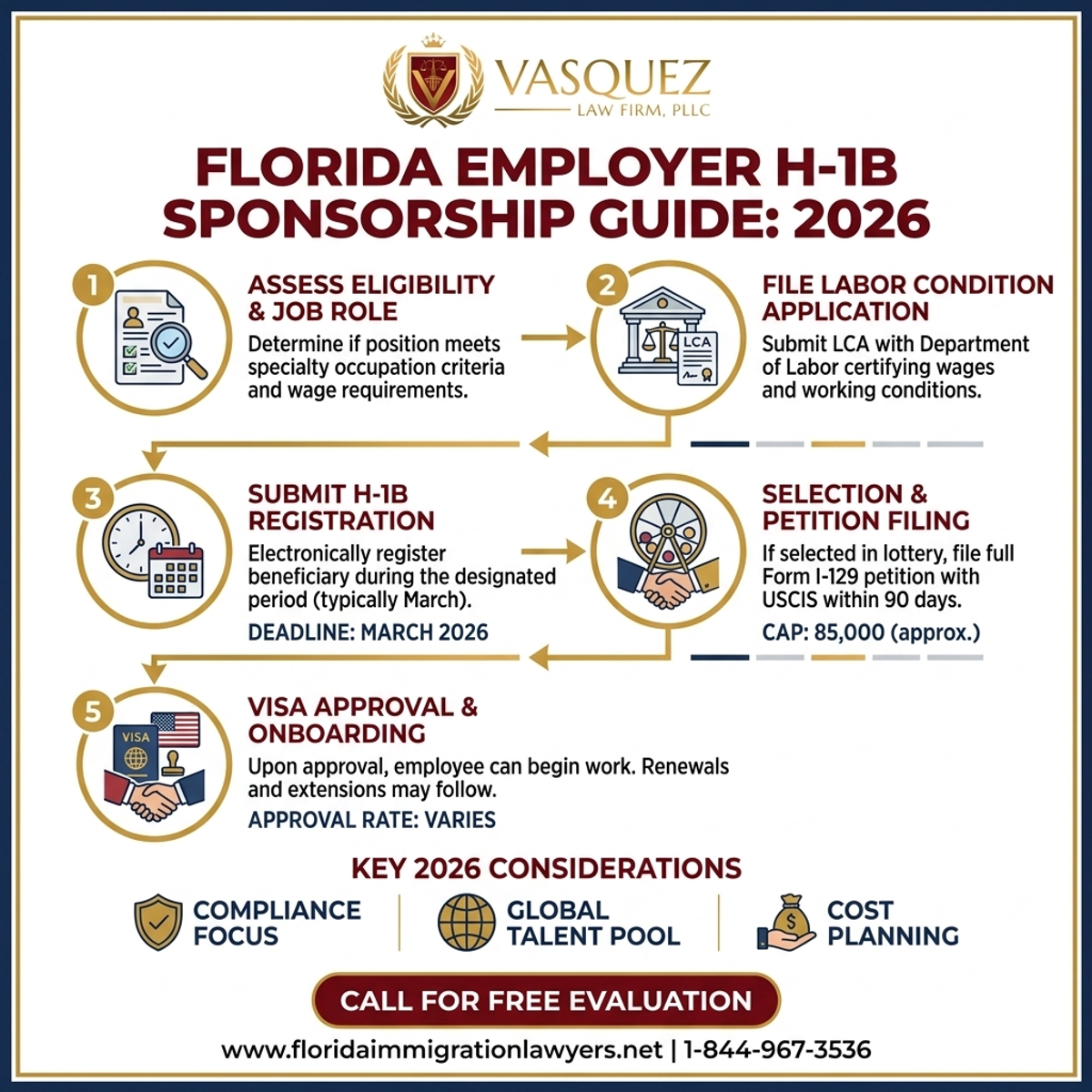
The H-1B visa initially grants a stay of up to three years, which can be extended to a maximum of six years. For some beneficiaries, extensions beyond six years are possible under specific circumstances, particularly if they are pursuing lawful permanent residency. This temporary nature allows Florida companies to meet immediate talent needs without committing to permanent sponsorship upfront, offering flexibility. The program is subject to an annual cap of 85,000 visas, including 20,000 for those with a U.S. master's degree or higher, making the process highly competitive, especially for employers in populous states like Florida. Understanding the H-1B cap and lottery system is paramount for strategic planning.
Beyond filling immediate vacancies, employing H-1B workers can bring diverse perspectives and specialized expertise that can drive innovation and expand market reach for Florida businesses. For instance, a tech company in Miami might hire an H-1B software engineer with niche skills in AI development, or a hospital in Orlando might sponsor a foreign physician to serve underserved communities. The ability to tap into this global talent pool directly impacts a company's capacity to innovate, grow, and contribute to Florida's overall economic prosperity. However, employers must commit to strict compliance, including paying prevailing wages and providing appropriate working conditions, as outlined by the Department of Labor.
How Can Florida Employers Sponsor an H-1B Visa for a Foreign Worker?
Sponsoring an H-1B visa for a foreign worker in Florida involves a structured, multi-step process that requires careful planning and adherence to strict regulations. As of 2026, the process typically begins with the employer identifying a specialty occupation role and a qualified candidate, followed by several critical filings with government agencies. Employers in areas like Tampa or Fort Lauderdale must be prepared for the competitive nature of the H-1B cap and lottery, which often dictates the timeline for new petitions. Successful sponsorship hinges on meticulous preparation and a thorough understanding of each stage.
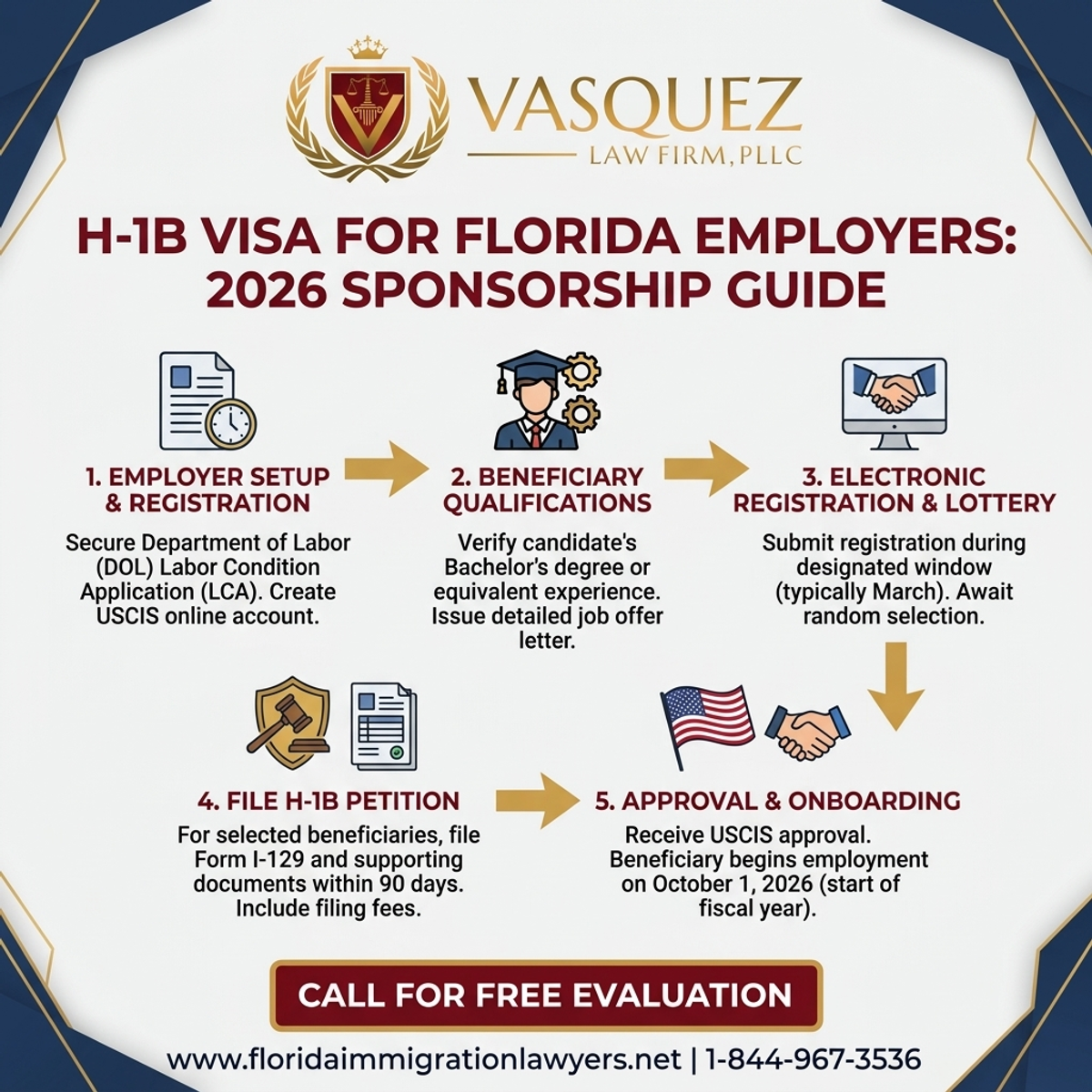
Here is a step-by-step guide for Florida employers:
-
Determine Eligibility and Job Requirements: First, ensure the position qualifies as a 'specialty occupation,' meaning it requires a bachelor's degree or higher in a specific field. The foreign worker must also meet the minimum educational and experience requirements for that role. This initial assessment is critical and sets the foundation for the entire process, impacting how the Labor Condition Application (LCA) is prepared. The job duties and educational requirements must align closely with the H-1B criteria.
-
Obtain a Certified Labor Condition Application (LCA): Before filing an H-1B petition, the employer must file Form ETA-9035, a Labor Condition Application (LCA), with the U.S. Department of Labor (DOL). This document attests that the employer will pay the H-1B worker at least the prevailing wage for the occupation in the specific geographic area (e.g., Jacksonville, Florida) or the actual wage paid to other employees with similar experience and qualifications, whichever is higher. The LCA also attests to providing working conditions that will not adversely affect other workers. The DOL typically processes LCAs within 7-10 business days.
-
Register for the H-1B Cap Lottery (if applicable): If the H-1B petition is subject to the annual cap, the employer must register the prospective H-1B worker electronically with USCIS during the designated registration period, typically in March. USCIS then conducts a lottery to select enough registrations to meet the annual cap. Only selected registrations can proceed to file a full H-1B petition. This electronic registration system has been in place since 2020 and streamlines the initial selection process for employers.
-
File Form I-129, Petition for a Nonimmigrant Worker: For selected registrations or cap-exempt petitions, the employer files Form I-129, Petition for a Nonimmigrant Worker, with U.S. Citizenship and Immigration Services (USCIS). This petition includes the certified LCA, evidence of the worker's qualifications, job offer details, and the employer's ability to pay the required wage. All supporting documentation must be meticulously organized and presented to avoid Requests for Evidence (RFEs) or denials. This is where a robust legal strategy is essential.
-
Await USCIS Decision: USCIS reviews the I-129 petition. Processing times can vary significantly, from several weeks with premium processing to several months for standard processing. If approved, USCIS sends an I-797 Approval Notice. If the worker is already in the U.S. and seeking a change of status, the approval notice usually grants the new H-1B status. If the worker is outside the U.S., they will need to attend a visa interview at a U.S. embassy or consulate.
-
Consular Processing or Adjustment of Status: If the worker is outside the U.S., they must attend an interview at a U.S. embassy or consulate abroad (consular processing) to obtain the H-1B visa stamp in their passport. If the worker is already in the U.S. in a different non-immigrant status, the I-129 approval may also include a change of status, allowing them to begin H-1B employment on the effective date, typically October 1st for cap-subject petitions. Navigating this final step correctly is vital for the worker to legally commence employment in Florida.
What Documents Are Required for an H-1B Visa Petition in Florida?
A successful H-1B visa petition for a Florida employer hinges on the submission of a comprehensive and accurate set of documents. Missing or incorrect documentation is a primary cause of Requests for Evidence (RFEs) and denials, significantly delaying the process. Employers in cities like Orlando or Tallahassee must gather specific information from both the sponsoring company and the prospective H-1B employee. Diligence in this phase is paramount, as USCIS scrutinizes every piece of evidence to ensure compliance with 8 CFR §214.2(h) and the Immigration and Nationality Act (INA).
Here is a general checklist of essential documents:
Step-by-Step Process — H-1B Visa for Florida Employers: 2026 Sponsorship Guide
- Certified Labor Condition Application (LCA): Form ETA-9035, approved by the U.S. Department of Labor.
- Form I-129, Petition for a Nonimmigrant Worker: The primary petition form filed with USCIS.
- H-1B Data Collection and Filing Fee Exemption Supplement: Required supplement to Form I-129.
- Employer's Federal Employer Identification Number (FEIN): Proof of the company's legal existence.
- Company Financials: Recent tax returns, annual reports, and financial statements to demonstrate the employer's ability to pay the H-1B wage.
- Company Business Plan/Brochures: To establish the nature of the business and the need for the H-1B position.
- Job Offer Letter and Detailed Job Description: Outlining duties, responsibilities, salary, and educational requirements for the specialty occupation.
- Beneficiary's Educational Credentials: Diplomas, transcripts, degree evaluations (if from foreign institutions), and any professional licenses.
- Beneficiary's Work Experience Letters: To demonstrate qualifications for the specialty occupation.
- Beneficiary's Resume/CV: Detailed professional history.
- Beneficiary's Passport Copies: Including biographical page and any previous U.S. visas/stamps.
- Beneficiary's Visa Status Documents (if applicable): I-94 arrival/departure record, previous I-797 approval notices, EAD cards, etc., if already in the U.S.
- Marriage Certificate and Birth Certificates: For any dependents (H-4 visa applicants) to prove relationship.
- Photographs: Passport-style photos for the beneficiary and any dependents.
- Prevailing Wage Determination: Documentation supporting the prevailing wage used in the LCA (e.g., from DOL's FLCDataCenter).
- Client Letters/Vendor Agreements: If the H-1B worker will be placed at a third-party client site, to establish employer-employee relationship and specialty occupation duties.
What is the Typical H-1B Visa Processing Timeline for Employers in 2026?
The H-1B visa processing timeline for Florida employers in 2026 can vary significantly depending on several factors, including whether the petition is subject to the annual cap, the availability of premium processing, and the specific USCIS service center handling the case. Understanding these timelines is crucial for strategic business planning and managing expectations, especially for companies in fast-paced sectors in Jacksonville or Miami. The H-1B cap lottery adds a significant variable to the overall schedule, as it dictates when petitions can actually be filed. As of the current year, employers should anticipate a multi-month process from initial preparation to final approval.
Here is a typical timeline for a cap-subject H-1B petition:
| Stage | Typical Timeframe (As of 2026) | Notes |
|---|---|---|
| Initial Assessment & LCA Preparation | 2-4 weeks | Employer identifies role and candidate, gathers internal info. |
| LCA Filing & Certification | 7-10 business days | Filed with DOL; mandatory before I-129 petition. |
| H-1B Registration Period | Mid-March (approx. 2 weeks) | Electronic registration with USCIS for cap-subject petitions. |
| H-1B Lottery & Selection Notification | Late March / Early April | USCIS conducts lottery; results typically announced within a week of registration closing. |
| I-129 Petition Preparation | 2-4 weeks (after selection) | Gathering all supporting documents and preparing the petition package. |
| I-129 Petition Filing Window | April 1st - June 30th (approx.) | Selected petitions must be filed within this 90-day window. |
| USCIS Processing (Standard) | 3-10 months | Varies by service center and workload. Check USCIS processing times online. |
| USCIS Processing (Premium) | 15 calendar days | Expedited processing available for an additional fee. |
| Petition Approval (I-797) | Upon completion of USCIS review | If approved, effective date is typically October 1st for cap-subject cases. |
| Consular Processing (if applicable) | 2-8 weeks (after approval) | Visa interview at a U.S. embassy/consulate abroad. |
| Start of H-1B Employment | October 1st (for cap-subject) | Earliest date H-1B employment can commence. |
It is important to note that these are approximate timelines. Factors such as Requests for Evidence (RFEs), government shutdowns, or policy changes can significantly impact the actual processing duration. Employers in Florida should always consult the official USCIS processing times page for the most current information and plan accordingly. Proactive preparation and legal guidance are essential to navigate these varying timelines effectively.
What Are the Costs Associated with Sponsoring an H-1B Visa in Florida?
Sponsoring an H-1B visa for a foreign worker in Florida involves several mandatory fees and potential additional costs that employers must budget for. These fees are set by the U.S. government and can change, so it's essential to consult the most current USCIS fee schedule. As of 2026, the total cost for an H-1B petition can range from a few thousand dollars to over ten thousand, depending on various factors such as company size, the need for premium processing, and legal fees. Employers in areas like Fort Myers or Sarasota should factor these expenses into their recruitment strategies to avoid unexpected financial burdens.
Here is a breakdown of typical fees and costs:
| Item | Typical Fee (As of 2026) | Notes |
|---|---|---|
| USCIS I-129 Filing Fee | Variable (e.g., $460) | Mandatory fee for the petition. |
| American Competitiveness and Workforce Improvement Act (ACWIA) Fee | $750 (for employers with 1-25 FTEs); $1,500 (for employers with 26+ FTEs) | Mandatory fee, subject to employer size. |
| Fraud Prevention and Detection Fee | $500 | Mandatory fee for initial H-1B petitions and employer changes. |
| Public Law 114-113 Fee (if applicable) | $4,000 | Applies to employers with 50 or more employees, where more than 50% are in H-1B or L-1 status. |
| H-1B Cap Registration Fee | $10 | Mandatory fee per registration for the annual lottery. |
| Premium Processing Fee (Optional) | $2,805 | Expedites USCIS processing to 15 calendar days. Highly recommended for urgent needs. |
| Attorney Fees | Variable ($2,500 - $7,000+) | Costs for legal services, including preparation, filing, and RFE responses. Varies by complexity and firm. |
| Educational Credential Evaluation (Optional) | $100 - $500 | If the foreign degree needs to be evaluated for U.S. equivalency. |
| Translation Fees (Optional) | Variable | For documents not in English. |
| Travel Costs (if applicable) | Variable | For consular processing interviews or relocation. |
Key Statistics — H-1B Visa for Florida Employers: 2026 Sponsorship Guide
Most of these fees are typically paid by the employer, as per DOL regulations, especially the ACWIA and Fraud Prevention fees. Employers cannot require the H-1B worker to pay these fees. Legal fees, however, can sometimes be negotiated, but it is generally advisable for the employer to cover these as well to ensure a smooth and compliant process. Given the significant investment, partnering with an experienced immigration law firm like Florida Immigration Lawyers can help manage costs and ensure a successful outcome, particularly when navigating complex scenarios or potential RFEs.
Navigating the H-1B Cap and Lottery for Florida Businesses
The annual H-1B cap and its associated lottery system present one of the most significant challenges for Florida businesses seeking to sponsor foreign talent. With only 85,000 new H-1B visas available each fiscal year (65,000 regular cap + 20,000 for U.S. master's degree holders), demand consistently far outstrips supply. This competitive environment means that many eligible Florida employers, from startups in Gainesville to established corporations in West Palm Beach, may not have their H-1B registrations selected in the lottery. Understanding this system is crucial for strategic workforce planning in 2026.
The H-1B cap process begins with an electronic registration period, typically in March, for petitions intended for an October 1st start date. During this period, employers submit basic information about their company and the prospective H-1B worker to USCIS. If USCIS receives more registrations than available visas, a random selection (lottery) is conducted. Only those registrations selected in the lottery are then eligible to file a full H-1B petition. This system, implemented to streamline the process, means that even a perfectly prepared petition may not proceed if the registration isn't selected.
For Florida businesses, strategic approaches to the H-1B cap include: early planning to meet registration deadlines; considering cap-exempt organizations (such as universities, non-profit research organizations, or government research organizations, which are not subject to the annual cap); and exploring alternative visa options if the H-1B lottery is unsuccessful. For instance, an employer might consider an O-1 visa for individuals with extraordinary ability or an L-1 visa for intracompany transferees if applicable. Furthermore, some H-1B workers may be exempt from the cap if they are extending their current H-1B status, changing employers, or working for a cap-exempt organization.
The H-1B cap lottery adds an element of unpredictability to hiring foreign talent. This makes it vital for Florida employers to have a robust strategy and potentially explore parallel immigration pathways with the guidance of an experienced attorney. A lawyer can help assess the likelihood of success, prepare backup plans, and ensure all submissions are accurate and timely, maximizing the chances of securing the necessary talent for your operations, whether in Jacksonville's burgeoning tech scene or Tampa's healthcare industry. Proactive engagement with an immigration lawyer is the best defense against the uncertainties of the annual cap.
Compliance and Post-Approval Responsibilities for H-1B Employers in Florida
H-1B visa sponsorship does not end with petition approval. Florida employers have significant ongoing compliance responsibilities to ensure they adhere to U.S. immigration and labor laws throughout the H-1B worker's employment. Failure to meet these obligations can result in severe penalties, including fines, debarment from immigration programs, and even criminal charges. The U.S. Department of Labor (DOL) conducts audits and investigations to ensure employers are compliant with the terms of the Labor Condition Application (LCA), particularly regarding wages and working conditions. Employers in Florida, from small businesses in Gainesville to large corporations in Miami, must maintain meticulous records and understand their post-approval duties.
Key compliance responsibilities include:
- Maintaining Public Access File (PAF): Employers must create and maintain a Public Access File for each H-1B worker. This file contains specific documents related to the LCA, such as the certified LCA, prevailing wage determination, actual wage memorandum, and a summary of benefits offered to H-1B workers. This file must be made available to the public upon request and kept for at least one year beyond the period of employment specified on the LCA.
- Paying Prevailing Wage: Employers must pay the H-1B worker at least the prevailing wage for the occupation in the area of employment or the actual wage paid to other employees with similar experience and qualifications, whichever is higher. This wage must be paid for all non-productive time due to the employer's decision (e.g., benching).
- Providing Appropriate Working Conditions: The working conditions for H-1B workers must not be less favorable than those provided to similarly employed U.S. workers. This includes benefits, hours, and other terms of employment.
- Notifying DOL of Material Changes: If there are material changes to the H-1B worker's employment (e.g., significant change in job duties, new work location, reduction in hours), the employer may need to file an amended H-1B petition with USCIS and potentially a new LCA with the DOL.
- Record Keeping: Employers must keep comprehensive records related to the H-1B employment, including payroll records, LCA documentation, and I-9 forms. These records must be retained for specific periods as mandated by law.
- Termination Responsibilities: If an H-1B worker is terminated before the end of their authorized stay, the employer is generally responsible for the reasonable cost of return transportation of the worker to their home country. The employer must also notify USCIS of the termination.
The complexities of H-1B compliance underscore the importance of ongoing legal support. An experienced immigration attorney can help Florida employers establish robust internal compliance protocols, conduct internal audits, and respond effectively to any government inquiries or investigations. This proactive approach minimizes risk and ensures that your business remains in good standing with all relevant immigration and labor authorities, safeguarding your ability to continue hiring international talent.
Do not navigate this process alone. Contact Florida Immigration Lawyers today to ensure your H-1B sponsorship and compliance efforts are handled with precision and expertise. Our dedicated team is here to support your Florida business.
Common H-1B Sponsorship Mistakes Florida Employers Should Avoid
Sponsoring an H-1B visa is a complex undertaking, and even minor errors can lead to significant delays, Requests for Evidence (RFEs), or outright denials. Florida employers must be vigilant to avoid common pitfalls that can jeopardize their ability to secure essential foreign talent. Understanding these mistakes is the first step toward a successful H-1B petition process.
-
Failing to File a Certified LCA: Many employers overlook the critical step of obtaining a certified Labor Condition Application (LCA) from the DOL before filing the I-129 petition. Filing the I-129 without a certified LCA will result in an immediate denial. Ensure the LCA is fully certified and valid for the entire period of employment requested.
-
Underpaying the Prevailing Wage: Employers are legally required to pay the H-1B worker the higher of the actual wage or the prevailing wage for the occupation in the specific geographic area. Failing to meet this wage requirement, or incorrectly determining the prevailing wage, is a serious violation that can lead to back wage liabilities and penalties during DOL audits.
-
Missing H-1B Cap Registration Deadlines: For cap-subject petitions, the electronic registration period is typically in March. Missing this short window means the employer must wait until the next fiscal year to try again. Proactive planning is essential to ensure timely registration and participation in the lottery.
-
Insufficient Evidence of Specialty Occupation: USCIS often issues RFEs if the petition does not clearly demonstrate that the position qualifies as a 'specialty occupation' or that the beneficiary possesses the required qualifications. A vague job description or a general degree may not suffice. Provide detailed evidence linking job duties to degree requirements.
-
Lack of Employer-Employee Relationship for Third-Party Placements: For H-1B workers placed at client sites, USCIS scrutinizes the employer-employee relationship to ensure the petitioner has sufficient control over the worker. Without robust client letters, vendor agreements, and clear control over the worker's tasks, the petition may face an RFE or denial, especially in areas like Jacksonville where contract work is common.
-
Incomplete or Inconsistent Documentation: Submitting a petition with missing forms, unsigned documents, or inconsistencies between different forms can trigger RFEs and delays. Every piece of documentation must be accurate, complete, and consistent across the entire filing. Double-check all dates, names, and addresses.
-
Neglecting Post-Approval Compliance: The responsibilities don't end with approval. Failing to maintain a Public Access File, properly notify USCIS of material changes (like a new work location), or pay the required wage throughout employment can lead to severe penalties. Ongoing compliance is critical for long-term success.
-
Ignoring USCIS Processing Time Fluctuations: Relying on outdated processing times can lead to missed start dates or panicked premium processing requests. Always check the official USCIS website for the most current processing times and factor in potential delays when planning. This is especially true for Florida businesses with tight operational schedules.
When to Call a Florida Immigration Lawyer for H-1B Sponsorship
Navigating the H-1B visa process, particularly for Florida employers, is fraught with legal complexities that can significantly impact a business's ability to secure essential talent. While some employers may attempt to manage the process internally, certain scenarios strongly necessitate the expertise of a seasoned immigration lawyer. Florida Immigration Lawyers are uniquely positioned to provide the guidance needed for successful H-1B sponsorship, protecting your business from potential pitfalls and ensuring full compliance with federal regulations.
You should consider calling a Florida immigration lawyer if:
- You are a first-time H-1B sponsor: The initial learning curve for H-1B petitions is steep. An attorney can guide you through every step, ensuring proper documentation and adherence to all requirements from the outset.
- Your company has complex corporate structures or third-party placements: If your H-1B worker will be placed at a client site, proving the employer-employee relationship is crucial and often challenging. Legal counsel is essential to prepare a robust petition that addresses USCIS's scrutiny.
- You have received a Request for Evidence (RFE): An RFE indicates that USCIS requires more information or clarification. Responding effectively to an RFE often requires in-depth legal analysis and strategic argumentation, which an experienced lawyer can provide.
- Your H-1B petition has been denied: A denial can be devastating, but it may not be the end of the road. An attorney can analyze the reasons for denial and advise on options, such as filing a motion to reopen/reconsider or appealing the decision.
- You are concerned about prevailing wage determinations or LCA compliance: Ensuring compliance with wage requirements and maintaining a Public Access File can be intricate. A lawyer can help determine the correct prevailing wage and establish compliant internal processes.
- You need to explore cap-exempt options or alternative visas: If your H-1B registration wasn't selected in the lottery, or if your organization is cap-exempt, an attorney can help identify and pursue other suitable visa categories or confirm cap-exempt status.
- You are undergoing a DOL audit or investigation: If the Department of Labor contacts your company regarding H-1B compliance, immediate legal representation is vital to protect your business's interests and navigate the audit process effectively.
- You are planning for long-term immigration strategies: An attorney can help integrate H-1B sponsorship into a broader long-term immigration strategy, including potential pathways to permanent residency for your key employees.
Florida Immigration Lawyers has extensive experience assisting businesses across Florida with their H-1B visa needs. We understand the specific challenges faced by employers in Jacksonville, Miami, Orlando, and throughout the state. Our business immigration team is dedicated to providing strategic, compliant, and efficient legal solutions. Contact us at 1-844-YO-PELEO to discuss your specific H-1B sponsorship requirements.
About Florida Immigration Lawyers
Florida Immigration Lawyers is a leading immigration law firm dedicated to serving businesses and individuals across the entire state of Florida. With a deep understanding of U.S. immigration law and its unique application within Florida's diverse communities, our firm provides comprehensive legal services designed to meet the complex needs of our clients. From navigating the intricacies of H-1B visa sponsorships for employers in Jacksonville to assisting families with family-based petitions in Miami, our experienced attorneys are committed to delivering exceptional results.
Our team comprises compassionate and highly skilled legal professionals who are passionate about immigration law. We offer personalized attention, strategic advice, and aggressive representation, ensuring that every client receives the highest standard of service. We specialize in a wide range of immigration matters, including work visas, family visas, asylum, deportation defense, citizenship, and business immigration solutions like the H-1B visa. We pride ourselves on our accessibility, offering free consultations and being available 24/7 to address urgent concerns.
Choosing Florida Immigration Lawyers means choosing a partner who understands the nuances of both federal immigration policy and the local Florida context. Our attorneys are not just legal advisors; they are advocates who stand by your side throughout the entire immigration journey. We are here to simplify complex processes, provide clarity, and work tirelessly to achieve your immigration goals. Visit our attorneys page to learn more about our team and our commitment to justice.
Sources and References
- U.S. Citizenship and Immigration Services (USCIS)
- Executive Office for Immigration Review (EOIR)
- U.S. Department of State (travel.state.gov)
- 8 U.S.C. Chapter 12 - Immigration and Nationality Act (INA)
- 8 CFR §214.2(h) - Petitions for nonimmigrant workers
- U.S. Department of Labor (DOL) - Employment and Training Administration (ETA)
- American Competitiveness and Workforce Improvement Act (ACWIA)
Related services: H-1B specialty occupation visas, L-1 intracompany transfer visas, work visas for professionals, investment and entrepreneur visas.
This article provides general legal information and is not intended as legal advice. Every case is unique, and outcomes depend on specific facts and circumstances. Contact an attorney for advice about your particular situation.
Ready to secure top talent for your Florida business through the H-1B visa program? Don't leave your success to chance. Contact Florida Immigration Lawyers today for a free, confidential consultation. Call us at 1-844-YO-PELEO. Se Habla Español - Estamos aqui para ayudarle.
Do Not Navigate This Process Alone
Our experienced immigration attorneys are ready to fight for you. Get a free, confidential case review today.
Se Habla Español
Or leave your details and we’ll call you:
Free Evaluation in 24 Hours
Or talk to us right now

AI voice assistant — available 24/7
FreeFrequently Asked Questions

William J. Vásquez
Founding Attorney · Vasquez Law Firm
U.S. Air Force veteran and immigration attorney with years of hands-on U.S. immigration experience. J.D., NCCU School of Law. AILA member. Admitted to the 4th, 5th, and 11th Circuit Courts.
Available 24/7 - Free Evaluations
Reviewed for legal accuracy by William J. Vásquez
Licensed in North Carolina; U.S. immigration is federal practice.
Related Legal Services
Our Florida immigration attorneys can help you with asylum protection, citizenship and naturalization and immigration practice areas. Call today at 1-844-YO-PELEO for a free case review.
Related Links
Related Topics
Free Legal Case Review
Discuss your case with our experienced attorneys. We're available 24/7.
Se Habla Español - Estamos aquí para ayudarle.
Related Articles
EAD Advance Parole Combo Card in Florida 2026
For individuals with a pending Form I-485, Application to Register Permanent Residence or Adjust Status, the EAD Advance Parole Combo Card is an essential document. This single card combines the authorization to work legally in the U.S. (Employment Authorization Document - EAD) with permission to travel internationally and re-enter without abandoning your green card application (Advance Parole). This guide from Florida Immigration Lawyers provides a comprehensive overview for applicants in Florida in 2026, covering eligibility, the step-by-step application process, required documents, expected processing times, and associated costs. We also highlight common mistakes to avoid and when to seek legal counsel to ensure a smooth and successful immigration journey. Understanding this vital card is key to maintaining stability while awaiting your permanent residency approval.
Immigration Lawyer Orlando Free Consultation in Florida
For individuals and families in Orlando, Florida, navigating the complexities of U.S. immigration law requires expert guidance. An immigration lawyer in Orlando offers crucial support for everything from visa applications and green card processes to naturalization and deportation defense. This comprehensive guide details what a free consultation covers, providing a step-by-step overview of immigration pathways, essential document checklists, and expected timelines in 2026. We also highlight common mistakes to avoid, discuss the critical role of legal counsel in deportation and asylum cases, and explain why choosing a local Orlando immigration attorney is beneficial. Florida Immigration Lawyers is dedicated to serving the diverse community of Orlando with compassionate, effective legal solutions, ensuring you receive personalized advice and robust representation for a successful immigration journey.
USCIS Oath Ceremony Schedule 2026: Your Guide to Citizenship
Achieving U.S. citizenship culminates in the naturalization oath ceremony, a pivotal moment for immigrants in Florida. This comprehensive guide from Florida Immigration Lawyers details the USCIS oath ceremony schedule for 2026, outlining what to expect from your Form N-445 notice to the final pledge of allegiance. We cover the entire naturalization process, including eligibility requirements, the step-by-step application (Form N-400), necessary documents, typical timelines for Florida field offices like Orlando, Miami, and Tampa, and associated costs. Learn how to prepare for your ceremony, avoid common mistakes that could delay your path, and understand when legal counsel becomes indispensable. Our firm is dedicated to providing expert guidance, ensuring a smooth and successful journey to becoming a U.S. citizen. Get a free case review from our bilingual team today.
Annual Asylum Fee: Preparation for Florida Interviews
As of 2026, there is no annual asylum fee in the U.S. Preparing for your asylum interview in Florida is crucial for success. Learn more about the process, necessary documentation, and common mistakes to avoid. Florida Immigration Lawyers are here to help.