Not every work visa is an H-1B. Trainees, performers, cultural exchange participants, religious workers and seasonal employees each have their own category, and their families have separate rules too. This guide covers H-3, P, Q-1, R-1, H-2B and H-4. The H-3 lets someone receive training not available in their home country, and the training cannot mainly provide productive employment. Vague programs that look like ordinary jobs are a common reason for denial. Each category has its own evidence requirements, and our Orlando office handles these matters for Florida employers, workers and families.
- H-3 trainees must receive training that is not available in their home country.
- H-3 training cannot be used mainly to provide productive employment.
- Vague programs that look like ordinary jobs are a common reason for denial.
- Each category, including P, Q-1, R-1, H-2B and H-4, has its own evidence requirements.
Introduction
Not every work visa is an H-1B. Trainees, performers, cultural exchange participants, religious workers and seasonal employees each have their own category, and the family members who come with them have their own rules too. This guide explains several of those categories, including H-3, P, Q-1, R-1, H-2B and H-4, and when it makes sense to bring in a lawyer. To discuss your situation, call 1-844-YO-PELEO or contact us.
Vasquez Law Firm handles these matters for employers, workers and families throughout Florida from our Orlando office. The categories below are used by sponsors as different as theaters, cultural organizations, congregations, landscaping companies and training programs, and each has evidence requirements that differ from the common work visas.
This page is general information, not legal advice. Caps, forms, fees and policies change, so confirm current requirements with USCIS and the Department of Labor, and speak with a lawyer about your own facts.
H-3 Trainee Visas
The H-3 visa lets a foreign national come to the United States to receive training that is not available in their home country, from an employer or organization in the U.S. The training cannot be used mainly to provide productive employment, and it must be designed to help the trainee build a career outside the United States. A separate H-3 track covers special education exchange visitor programs for training in educating children with disabilities.
An H-3 lawyer helps the sponsoring organization write a structured training program with a clear curriculum, supervision and an explanation of why similar training is unavailable abroad. Vague programs that look like ordinary jobs are a common reason for denial. A strong program describes the schedule, the topics, how progress is measured and how the trainee will use the skills after returning home.
P Visas for Athletes, Entertainers and Culturally Unique Artists
The P category covers:
- P-1A for internationally recognized athletes, individually or as part of a team, and P-1B for members of internationally recognized entertainment groups.
- P-2 for artists and entertainers in a reciprocal exchange program between a U.S. organization and one abroad.
- P-3 for artists and entertainers coming to perform, teach or coach in a program that is culturally unique.
Most P petitions require a written consultation from an appropriate labor organization, plus contracts and an itinerary of events. A lawyer coordinates those pieces so the tour schedule and the petition match. Because a P petition depends on dates and venues, a change in the itinerary may require an amended filing.
Artist Visas: P or O-1B?
People often look for an artist visa without knowing which category fits. Solo artists with sustained recognition in their field may qualify for the O-1B visa for extraordinary ability in the arts, which is not tied to a group or a specific cultural program. Group performers, reciprocal exchange artists and culturally unique performers usually fit the P category better. Comparing the evidence you have, such as reviews, contracts and letters from people in the field, against each category's criteria is the first step.
The choice can affect the timeline, the evidence and the consultation from a labor organization or peer group. A lawyer who looks at both options before filing can help avoid a denial caused by choosing the wrong one.
Whichever category you choose, the quality of the evidence decides the case. Reviews, programs, recordings, contracts, letters from respected figures in the field and records of past performances all help. Gather them early, since a letter from a union or peer group can take weeks to obtain and a petition filed without it may be rejected or delayed.
Q-1 International Cultural Exchange
The Q-1 visa is for participants in an international cultural exchange program that provides practical training and employment while sharing the history, culture and traditions of the participant's home country. Theme parks, museums and similar employers sometimes use this category. The program must take place in a setting open to the public, and the cultural component must be an essential part of the job.
A lawyer reviews whether the employer's program actually meets those requirements before the petition is filed. Employers should be prepared to explain how the cultural element is built into the work, how participants are paid and how the program is designed to promote cultural exchange rather than simply fill a job.
R-1 Religious Workers
The R-1 visa allows ministers and people in religious vocations or occupations to work for a qualifying nonprofit religious organization in the U.S. In general, the worker must have been a member of the same religious denomination for at least two years immediately before the petition is filed, and must work at least part time, as defined by the regulations, for the sponsoring organization. USCIS may conduct site inspections.
A lawyer helps the congregation document its tax-exempt status, the role, the compensation and the worker's membership history. Congregations should keep records of how the position is funded and be ready to welcome an inspector, since a site visit that cannot confirm the details can delay or sink a petition.
Religious organizations should also think about what comes next. R-1 status is time-limited, and a worker who hopes to stay long term may need to look at an employment-based green card for religious workers, which has its own rules and deadlines. Raise that goal at the first consultation so that the filings can be planned together.
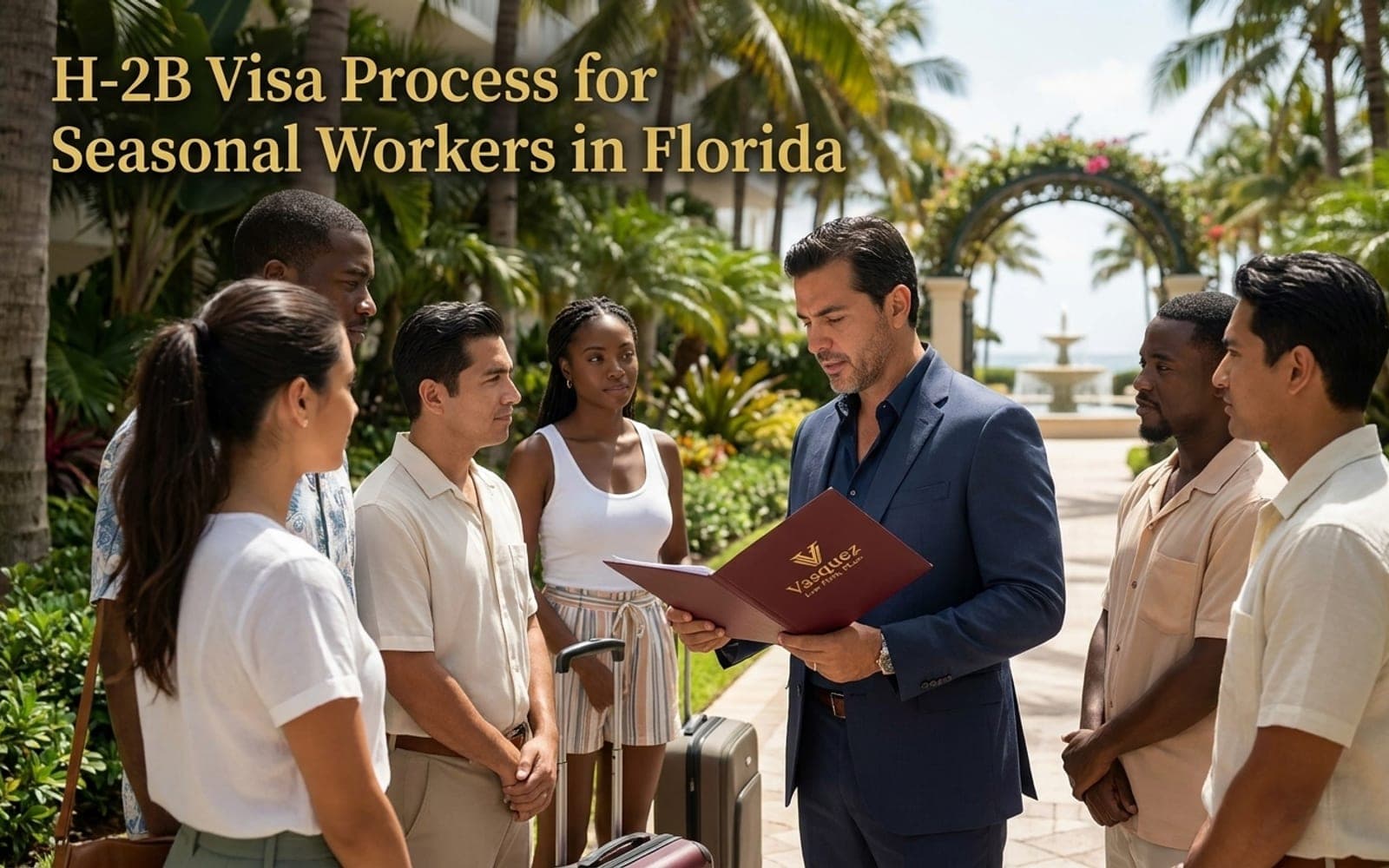
H-2B Temporary Non-Agricultural Workers
H-2B covers temporary non-agricultural jobs when the employer's need is seasonal, peak-load, intermittent or one-time, such as landscaping, hospitality, construction and seafood processing. The employer must first obtain a temporary labor certification from the U.S. Department of Labor showing there are not enough qualified U.S. workers and that hiring foreign workers will not hurt wages and working conditions. The program is subject to an annual numerical limit and applies only to nationals of eligible countries, with limited exceptions.
A lawyer helps employers plan their recruitment and filing timeline around those requirements. Employers who wait until the season begins often find that the window has closed, so planning months ahead is wise.
H-4 Dependents and the H-4 EAD
Spouses and unmarried children under 21 of H-1B workers can hold H-4 status. H-4 status by itself does not permit work. Certain H-4 spouses may apply for an employment authorization document, generally when the H-1B spouse has an approved I-140 immigrant petition or has extended H-1B status under specific provisions of law. Policies in this area have changed before, so current rules should be checked for each case.
A lawyer reviews whether the H-4 extension and the work permit application can be filed together, and how a gap could affect a job. If your work permit card is about to expire, contact counsel early. See our work permit page for more on employment authorization.
Dependents also need to keep their own records. Keep copies of the principal worker's approval notice, your own I-94 record and every extension, because the dates must line up. If the principal worker changes employers or status, the dependents' status may need to change too, and a gap can affect the right to stay or to work.
Family Categories: IR1 Spouses and Parents
Workers on temporary visas often have relatives who are U.S. citizens, and two family categories come up regularly:
- IR1: the immigrant visa for the spouse of a U.S. citizen, issued when the couple has been married for two years or more when the spouse is admitted. If the marriage is newer, the spouse receives a CR1 visa and conditional residence. A lawyer prepares the I-130 petition, the National Visa Center documents and the consular interview.
- Parents of U.S. citizens: a citizen who is at least 21 can petition for a parent. Parents are immediate relatives, so they do not wait for a visa number in a preference category. A lawyer checks whether the parent can adjust status in the U.S. or must complete consular processing, and whether any waiver is needed.
Our family petitions page explains these filings in more detail.
How the Process Works for Florida Sponsors and Workers
The steps vary by category, but most cases follow this outline:
- Consult a lawyer to identify the category that fits the work, the sponsor and the person's background.
- Gather the evidence the category requires, such as a training plan, labor organization consultation, tax-exempt records or a temporary need statement.
- Where required, obtain the labor certification or the labor organization's written consultation.
- File the petition with USCIS and keep the receipt notice.
- After approval, the worker applies for a visa abroad or changes status if eligible.
- The worker enters the United States, begins the approved activity and keeps track of the dates and conditions of the status.
Your lawyer should explain which of these steps apply and who is responsible for each.
Document Checklist for Special Work Visa Petitions
- H-3: a detailed training plan, the sponsor's background and the trainee's qualifications.
- P visas: contracts, an itinerary of events, reviews or evidence of recognition, and the labor organization consultation.
- Q-1: a description of the cultural exchange program and the sponsor's evidence that it is open to the public.
- R-1: proof of the organization's nonprofit status, a description of the role and compensation, and records of the worker's membership.
- H-2B: business records, a statement of the temporary need and recruitment records.
- H-4: the principal worker's approval notice and marriage and birth certificates.
- Family cases: marriage certificate, proof of the relationship, and the citizen's proof of status.
Bring what you have to the first consultation. A lawyer can help you decide what is missing and how to fill the gaps.
Timeline and Processing Expectations
Special work visa cases can involve several agencies in sequence: a labor organization or the Department of Labor, then USCIS, then a consulate. Some categories have caps or filing windows, and some require a petition to be filed within a certain period before the start date. USCIS, the Department of Labor and the State Department publish current processing information on their websites. We do not quote times because they change, and no lawyer can promise a timeline.
Plan backward from the date the work must begin, leaving room for a request for evidence or a consular delay. Workers should avoid committing to travel or leaving a current job before the approval is in hand.
| Stage | What happens | Who acts |
|---|
| Category review | Choose the category and plan the evidence | Sponsor, worker and lawyer |
| Consultation or certification | Labor organization consultation or labor certification, where required | Labor organization or Department of Labor |
| Petition filing | File with USCIS with the evidence and itinerary | Sponsor and USCIS |
| Visa stage | Consular application and interview, or change of status | Worker, consulate or USCIS |
| Arrival and compliance | Work begins; extensions and amendments as needed | Sponsor and worker |
Cost Factors and Fee Breakdown
Costs include agency fees, program-specific costs and legal fees.
| Item | Amount | Notes |
|---|
| Petition fee (Form I-129) | Check USCIS for the current fee | Fees and added fees depend on the classification |
| Labor certification or consultation costs | Varies by case | Depends on the category and any recruitment |
| Consular visa fee | Check the court or agency for current fees | Set by the State Department |
| H-4 extension or work permit | Check USCIS for the current fee | Depends on the forms filed |
| Legal fees | Varies by case | Depends on the category and the evidence needed |
Fee schedules and form editions change, so confirm current amounts on the agency's website before filing. Ask the lawyer to explain in writing which costs the sponsor pays and which the worker pays, since the rules differ by program.
Legal fees vary with the complexity of the petition, such as the number of performers or workers and the amount of evidence. No lawyer can promise an approval or a timeline, but careful preparation reduces avoidable problems.
Common Mistakes to Avoid
- Filing an H-3 petition with a training plan that looks like a regular job.
- Choosing P when the artist fits O-1B better, or the other way around, without comparing the evidence.
- Describing a Q-1 program without showing that the cultural component is an essential part of the work.
- Letting an R-1 position go forward without clear records of funding and the worker's membership history.
- Waiting until the season begins to plan H-2B.
- Assuming an H-4 spouse can work without checking the current rules.
- Relying on an unlicensed preparer instead of a licensed attorney.
When to Call a Lawyer
Call a lawyer before you commit to a sponsor, a tour or a training program, before the season begins, when you receive a request for evidence or denial, and before an H-4 or work permit expiration. A short review at the start often prevents a rejected filing later. Call 1-844-YO-PELEO or contact us to book a consultation. You can also start with our work visa services overview.
About Vasquez Law Firm
Vasquez Law Firm practices immigration law only. Our only office is at 1111 E Amelia Street in Orlando. We serve employers and families anywhere in Florida by secure video and phone, and in person in Orlando, in English and Spanish. William J. Vásquez is the founding attorney. Call 1-844-YO-PELEO or contact us.
Sources and References
Related services: work permit and EAD lawyers, immigration lawyers in Florida
Other ways people search for this
People look for this help under different names. Related searches include immigration lawyer fl; p-visa lawyer; q-1-visa lawyer; artist visa lawyer; h4 ead lawyer; ir1 visa attorney; parent sponsorship visa attorney; r 1 visa attorney; h2b visa lawyer; immigration attorney for h4 visa.
This article is general information, not legal advice. Every case is different; speak with an immigration lawyer about your situation.