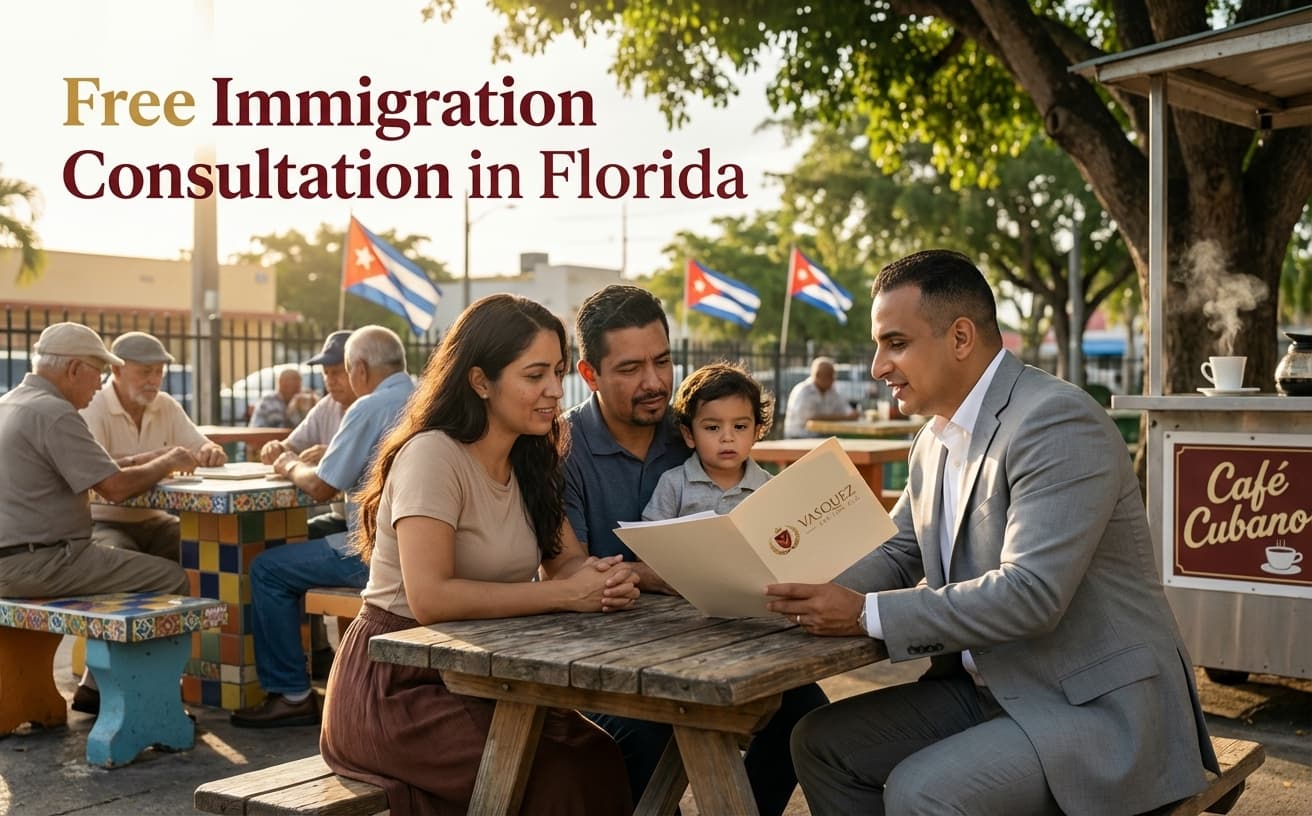
A green card lawyer evaluates your eligibility, spots risks before filing and speaks for you if the government pushes back. Forms are the easy part: they are public and available to anyone. The hard part is knowing which form applies, whether you qualify and what the government will see when it compares your answers with its records. A single wrong answer about an arrest, an old entry or a previous marriage can lead to denial or a misrepresentation finding. Licensed attorneys differ from notarios and form preparers, and you can verify a Florida license.
- Forms are public; the hard part is knowing which applies and whether you are eligible.
- A wrong answer about an arrest, entry or marriage can cause denial or a misrepresentation finding.
- A lawyer asks follow-up questions that the forms themselves do not ask.
- Licensed lawyers differ from notarios and other preparers, and a Florida license can be verified.
Introduction
When people look for a green card lawyer, they are often really asking a different question: what can a lawyer do that a form-filling service cannot? This guide explains what a green card lawyer does, how licensed attorneys differ from other kinds of immigration help, and what to expect when you hire one in Florida. To talk about your case, call 1-844-YO-PELEO or contact us.
The short answer is that a lawyer evaluates eligibility, spots risks before filing and speaks for you if the government pushes back. Vasquez Law Firm is an immigration-only firm in Orlando that serves Florida families by video, phone and in person, and the guidance below reflects the questions clients ask most often.
This page is general information, not legal advice. Green card rules, forms and fees change, so always confirm current requirements with USCIS, and speak with a lawyer about your own situation.
Forms Are the Easy Part
Green card forms are available to anyone, and the instructions are public. What is hard is knowing which form applies, whether you are eligible to file it, and what the government will see when it compares your answers to your records. A single wrong answer about a past arrest, an old entry or a previous marriage can lead to a denial or, worse, a finding of misrepresentation that follows a person for years.
A lawyer is trained to ask the follow-up questions that a form does not ask. Have you ever used another name? Were you ever stopped at the border? Did you work before you had permission? The answers shape the strategy, and finding them out before the application is filed is much better than discovering them at an interview.
Who Provides Immigration Help: Lawyers, Representatives and Preparers
Immigration help is sold by several kinds of providers, and the differences matter:
- Licensed attorneys are members of a state bar, are bound by ethical rules and can represent you in court and before agencies.
- Accredited representatives work for recognized nonprofit organizations and can represent people before the agencies in a limited way.
- Document preparers and notarios are not lawyers. In the United States a notary public does not have the same role as a notario in many Latin American countries, and a preparer may not give legal advice. Mistakes made by preparers have cost many people their cases.
Before you pay anyone, ask whether the person is a licensed lawyer and verify the license with the state bar. A Florida lawyer's status can be checked on the Florida Bar website.
What a Green Card Lawyer Reviews First
A green card lawyer starts with three questions: what is the basis for the green card, where is the person now, and what in the past could complicate the case. The basis might be a spouse, a parent, a child, an employer, a protection claim or another category. The location decides whether the person adjusts status in the country or processes through a consulate. The past includes entries, overstays, arrests, prior petitions and denials.
From there, the lawyer explains which paths are open and which are not. Sometimes the answer is straightforward. Sometimes the answer is that a waiver is needed first, or that a different category fits better. If waiting is the wiser course, a lawyer says so rather than filing something that is likely to fail. You can read more on our green card page.
How the Green Card Process Works in Florida
The details vary by category, but most green card cases follow a recognizable sequence:
- Consultation and history review. The lawyer identifies the basis for the green card and reviews entries, status, arrests and prior filings.
- Choosing the path. The lawyer explains whether adjustment of status inside the United States or consular processing abroad fits your situation.
- Petition. A family member or employer files the underlying petition, unless you qualify to self-petition or apply through a humanitarian category.
- Application and evidence. The green card application is prepared with identity documents, civil records, financial support documents where required and medical information.
- Biometrics and notices. The agency collects fingerprints and may send requests for more information that must be answered by their deadlines.
- Interview and decision. Many cases include an interview. The agency then approves the case, asks for more, or denies it.
Your lawyer should explain each step in plain language, tell you what documents are needed and keep you updated when notices arrive.
Problems That Call for Early Advice
Past unlawful presence or entry
Time spent in the United States without permission can affect eligibility, and leaving the country can sometimes trigger bars on returning. Do not travel or file anything until a lawyer has reviewed the history, because the consequences can be hard to reverse.
Criminal records
Some arrests and convictions have immigration consequences that differ from their criminal consequences. The firm advises on the immigration side and works with the client's criminal defense lawyer, but it does not handle criminal cases.
Public benefits and financial support
Family-based cases usually require a financial sponsor, and applicants are reviewed for the likelihood of relying on certain public benefits. The rules are technical and change over time, so a lawyer should confirm the current approach.
Interviews and requests for evidence
USCIS can ask for more information or schedule an interview. Preparing for these steps, with a copy of the file in hand, is often the difference between a smooth process and a confusing one.
Document Checklist for a Green Card Consultation
- Passport and any prior passports, with visas and entry stamps.
- Your I-94 record and any immigration papers you have received.
- Birth certificate and, if relevant, marriage certificate and proof that earlier marriages ended.
- Every notice from USCIS, a consulate or an immigration court, including old ones.
- Court records for any arrest or charge, even if the case was dismissed.
- Your sponsor's proof of status and recent tax and income records, for family cases.
- For employment cases, job offer letters, pay records and degree documents.
- A list of the key dates in your immigration history: entries, departures, addresses and employers.
If you have none of the notices, a denial or a court date, bring your passport, identity documents and the date list. If any document is lost, tell the lawyer early so that replacements can be requested while the case is being planned.
Timeline and Processing Expectations
Green card timelines depend on the category, the location of the applicant, the office handling the case and the workload at the time. Immediate relatives of U.S. citizens are not subject to annual visa limits, while many family and employment categories depend on priority dates published in the monthly Visa Bulletin. Because these dates and the agencies' processing times change, we do not quote them. USCIS and the State Department publish current information on their websites.
A lawyer can explain how the published information applies to your case and what to do while you wait, such as keeping your address current, responding to notices on time and avoiding trips that could cause trouble.
| Stage | What happens | Who acts |
|---|
| Review | Identify the category, the path and any risks | Client and lawyer |
| Petition | File the family or employer petition, or a humanitarian application | Petitioner or applicant |
| Waiting for a visa number | Applies only where annual limits create a wait | Applicant, with State Department and USCIS |
| Application and biometrics | File the green card application; attend the biometrics appointment | Applicant and USCIS or consulate |
| Interview and decision | Answer questions, provide evidence, receive a decision | Applicant, sponsor and officer |
Employment-Based and Family-Based Green Cards Compared
Most green card clients fall into one of two broad groups. Family-based cases start with a relationship to a U.S. citizen or permanent resident, such as a spouse, parent, child or sibling. The petitioner must prove the status and the relationship, and in most family cases must also sign an affidavit promising financial support. The category determines whether the applicant waits for a visa number, so a spouse of a citizen is in a very different position from a sibling of a citizen.
Employment-based cases start with a job or with the applicant's own record. Some categories require an employer to sponsor the worker and, in many cases, to obtain a labor certification from the Department of Labor before the immigrant petition is filed. Other categories, such as certain extraordinary ability or national interest cases, may allow the applicant to file without a specific employer, depending on the facts. A lawyer helps decide which category fits and whether the person's current visa will remain valid while the case is pending.
Humanitarian paths, such as asylum-based and certain protection-based green cards, follow their own rules and are handled differently. If your situation involves fear of return or a crime committed against you, mention it at the first consultation so the lawyer can screen all possible options, not only the one you came in asking about.
Keeping Your Records in Order
Whether or not you hire a lawyer, keep a folder with every immigration document you have ever received: approval and receipt notices, passport pages, entry records, court papers and copies of anything you signed. Write down dates of entry, addresses and employers while your memory is fresh. Many delays come from missing papers rather than from the law itself, and a well-organized file helps a lawyer give you faster, more accurate advice.
Keep copies in two places, such as a paper folder and a secure digital backup. When you move, update your address with USCIS promptly so that notices reach you.
What Happens After Your Green Card Is Approved
Approval is not the end of the process. Your card arrives by mail, and you should check every detail on it, including your name, date of birth and category, as soon as it arrives. Errors made by the government can usually be corrected, but the sooner you act the easier it is. If the card is conditional, calendar the filing window for removing conditions right away.
Permanent residents have obligations as well as rights. You must keep your address current with USCIS, carry your card, avoid long stays abroad that could suggest you abandoned your residence and keep up with tax obligations. When you become eligible, you may decide to apply for citizenship, and a lawyer can review your travel and history first so the application is not a surprise.
Questions to Ask Any Lawyer Before Hiring
The answers to a few simple questions tell you more than any advertisement. Ask which category the lawyer thinks applies to you and why, what could cause a delay or a denial in your case, who will work on your file and how you will be updated, and what exactly is included in the service and what is not. Ask how the lawyer would handle the specific risk in your file, and whether the arrangement will be put in writing.
Be cautious about any lawyer who guarantees an outcome. A candid assessment of your options, including the possibility that waiting or choosing another route is wiser, is a better sign than a promise.
Cost Factors and Fee Breakdown
A green card case has government fees and legal fees, and the amounts depend on the category.
| Item | Amount | Notes |
|---|
| Petition filing fee | Check USCIS for the current fee | Depends on whether the petition is family-based or employment-based |
| Green card application fee | Check USCIS for the current fee | Differs for adjustment of status and consular processing |
| Medical exam | Varies by case | Paid to the doctor; vaccines may be required |
| Consular and visa fees | Check the court or agency for current fees | Applies when the applicant processes abroad |
| Legal fees | Varies by case | Depends on the history and the work involved |
Fee schedules and form editions change, so confirm the current amounts on the agency's website before filing.
Ask any lawyer to describe what the legal fee covers, such as responses to requests for evidence and interview preparation, and what would be billed separately.
Common Mistakes to Avoid
- Filing before a lawyer has reviewed your entries, arrests and prior applications.
- Traveling abroad while a case is pending without checking the consequences.
- Answering a form question from memory instead of from your records.
- Paying a notario or unlicensed preparer who promises a fast result.
- Ignoring a notice or an interview date.
- Hiding an old problem, which usually comes out later in a worse form.
When to Call a Lawyer
Call a lawyer before you file anything if you have a past overstay, an arrest, a previous removal order, a prior denial or any doubt about how you entered, and call right away if you have received a notice, a denial or a court date. If you have none of these, a short review before filing can still confirm that you are using the right category and path. Call 1-844-YO-PELEO or use the contact page to request a consultation.
About Vasquez Law Firm
Vasquez Law Firm practices immigration law only. Our only office is at 1111 E Amelia Street in Orlando. People in Tampa, Miami, Jacksonville, Pensacola and elsewhere in Florida can have a consultation by secure video or phone, send documents electronically and meet in person in Orlando when it makes sense. William J. Vásquez is the founding attorney, and consultations are in English and Spanish. Call 1-844-YO-PELEO or contact us.
Sources and References
Related services: green card lawyers, immigration lawyers in Florida
Other ways people search for this
People look for this help under different names. Related searches include green card lawyer near me; green card attorney near me; green card lawyers near me; green cards attorney near me; green card immigration lawyer near me; adjustment of status attorneys near me; adjustment of status lawyer near me; consular processing attorneys near me; consular processing lawyers near me; adjustment of status attorney near me; immigration lawyer for green card near me; consular processing attorney near me; green card immigration law firm; green card immigration lawyer consultation; green card interview attorney; green card lawyer online; green card us immigration law firm; green card us law firm; green card visa lawyer; hire lawyer for green card; immigration attorney adjustment of status; immigration lawyer green card application; immigration lawyer us green card; lawyer immigration green card; greencard attorney; permanent residence lawyer; work green card lawyers; employer sponsored green card lawyer; i485 lawyer; immigration lawyer for us green card; immigration lawyer permanent residency; lawyer for permanent residence; work green card law firm; best green card lawyer; green cards attorney; best immigration attorney for green card; immigration attorney green card; immigration lawyer for green card application; immigration attorney for adjustment of status; attorney for adjustment of status.
This article is general information, not legal advice. Every case is different; speak with an immigration lawyer about your situation.