Adjustment of Status Gulfport FL: 2026 Green Card Guide
For foreign nationals in Gulfport, FL, and across Florida, adjusting status offers a path to a green card without leaving the U.S. This comprehensive 2026 guide details eligibility, the I-485 application process, required documents, typical timelines, and associated costs. Learn about family-based and employment-based adjustments, waivers for inadmissibility, and life while your application is pending. Avoid common mistakes and understand when to seek legal counsel. Florida Immigration Lawyers provides compassionate guidance for your journey to permanent residency.
Adjustment of Status (AoS) in Gulfport, FL, allows eligible foreign nationals already present in the United States to apply for lawful permanent resident status (a green card) without having to return to their home country. As of 2026, the process typically involves filing Form I-485, undergoing biometrics, and attending an interview with USCIS. Eligibility hinges on a lawful entry, an approved immigrant petition, and no bars to admissibility. Navigating this complex process, especially with Florida-specific considerations, often requires professional legal guidance to ensure compliance and avoid delays.
- Eligibility is Key: You must meet specific criteria, often through a family or employment-based petition.
- Form I-485: This is the primary application for adjustment of status.
- Florida Context: USCIS Field Offices in Florida handle interviews for Gulfport residents.
- Legal Guidance: An experienced immigration attorney can significantly streamline the process.
- Timelines Vary: Processing times depend on your specific case and USCIS workload.
Adjustment of Status Gulfport FL: Your 2026 Green Card Guide
Navigating the complex landscape of U.S. immigration law can feel overwhelming, especially when your goal is to secure a permanent future in Florida. For many foreign nationals living in Gulfport, Tampa, and across the Sunshine State, adjustment of status offers a vital pathway to obtaining a green card without leaving the country. This process allows individuals who are already in the U.S. to transition from a temporary visa holder or other eligible status to that of a lawful permanent resident.
As of 2026, the requirements and procedures for adjustment of status continue to evolve, making guidance more crucial than ever. Whether you're seeking to join family, pursue employment opportunities, or secure a safe haven, understanding the intricate steps involved is the first step toward achieving your immigration goals. This comprehensive guide will walk you through the eligibility criteria, application process, required documentation, timelines, and potential challenges specific to applicants in Florida.
The journey to a green card is significant, impacting your ability to live, work, and thrive in the U.S. We understand the hopes and anxieties that come with it. That's why Florida Immigration Lawyers is dedicated to providing compassionate and effective legal representation to individuals and families throughout Florida. If you are considering applying for adjustment of status or have questions about your eligibility in Gulfport, Florida, do not hesitate to seek professional assistance. Call Florida Immigration Lawyers at 1-844-YO-PELEO for a free consultation today.
What is Adjustment of Status (AoS) and Who is Eligible in Florida?
Adjustment of Status (AoS) is the process that allows an eligible foreign national to apply for lawful permanent resident status (a green card) while physically present in the United States. Instead of returning to their home country to complete visa processing through a U.S. embassy or consulate, they can adjust their status domestically. This is a significant advantage for many individuals and families, as it avoids the uncertainties and potential travel restrictions associated with consular processing.
Eligibility for adjustment of status, as outlined in Section 245 of the Immigration and Nationality Act (INA), is complex and depends heavily on an applicant's specific circumstances. Generally, you must have been lawfully admitted to the U.S., have an approved immigrant petition (such as Form I-130 for family-based or Form I-140 for employment-based), and be admissible to the United States. There are several categories through which one may qualify for adjustment of status in Florida:
- Family-Based: This is the most common path, where a U.S. citizen or lawful permanent resident relative petitions for you. This includes immediate relatives (spouses, unmarried children under 21, parents of U.S. citizens over 21) who generally have a visa immediately available, and other family preference categories which may involve waiting for a visa number to become current.
- Employment-Based: For individuals sponsored by an employer for a specific job, or those with extraordinary ability, advanced degrees, or significant investments.
- Asylum Seekers and Refugees: Individuals granted asylum or refugee status can typically adjust their status one year after their grant date, provided they remain eligible.
- Special Immigrants: This includes certain religious workers, juveniles, and others.
- Diversity Visa Lottery: Winners of the annual Diversity Visa (DV) program can also adjust status if they are already in the U.S.
For residents of Gulfport and the surrounding Florida areas, your application for adjustment of status will be processed by U.S. Citizenship and Immigration Services (USCIS). Interviews, if required, are typically conducted at a USCIS field office, with the Tampa Field Office often serving residents of this region. It's crucial to ensure you meet all criteria and have no bars to admissibility, such as certain criminal convictions, past immigration violations, or misrepresentations, which could lead to denial. Consulting with an attorney is vital to assess your specific eligibility and navigate any potential complexities before filing.
How Do I Apply for Adjustment of Status in Gulfport, FL? (Step-by-Step Guide)
Applying for adjustment of status in Gulfport, FL, involves a series of detailed steps, beginning with establishing eligibility and culminating in an interview. The process requires careful attention to detail and adherence to USCIS guidelines.
The general application process for adjustment of status involves filing Form I-485 along with supporting documents and attending required appointments. For Gulfport, FL residents, this process is managed through the USCIS Tampa Field Office for interviews and relevant service centers for initial processing.
- Step 1: Determine Eligibility and File Immigrant Petition (if required). Before you can apply for adjustment of status, you must generally be the beneficiary of an approved immigrant petition. For family-based cases, this is Form I-130, Petition for Alien Relative, filed by a U.S. citizen or lawful permanent resident family member. For employment-based cases, it's typically Form I-140, Immigrant Petition for Alien Worker, filed by an employer. Immediate relatives of U.S. citizens may file their I-485 concurrently with the I-130. For other categories, you must wait for the petition to be approved and a visa number to become available, as indicated by the Visa Bulletin published by the State Department.
- Step 2: Gather Required Documents. This is a critical stage. You will need to collect a wide array of personal, financial, and immigration-related documents. This includes birth certificates, marriage certificates (if applicable), passport copies, visa copies, entry records (I-94), medical examination results, and an affidavit of support (Form I-864) for family-based petitions. Missing or incorrect documents are a common cause of delays and Requests for Evidence (RFEs).
- Step 3: File Form I-485, Application to Register Permanent Residence or Adjust Status. Once your immigrant petition is approved (or filed concurrently for immediate relatives) and a visa is available, you will submit Form I-485 to USCIS. Along with this, you typically file Form I-765 for Employment Authorization Document (EAD) and Form I-131 for Advance Parole (travel document) if you wish to work or travel internationally while your application is pending. Ensure all forms are filled out accurately and completely, and include the correct filing fees.
- Step 4: Attend Biometrics Appointment. After filing, USCIS will send you an appointment notice for biometrics (fingerprints, photos, and signature). This appointment is usually at a local Application Support Center (ASC) in Florida, such as the one in Tampa, and is essential for background checks. Missing this appointment without rescheduling can lead to delays or even denial.
- Step 5: Prepare for and Attend the Interview (if required). Many adjustment of status applicants, especially those in family-based categories, are required to attend an interview at a USCIS field office. For Gulfport residents, this is often the Tampa Field Office. During the interview, an immigration officer will review your application, verify the information, and ask questions about your eligibility, the basis of your petition, and your relationship (for family cases). It is crucial to be truthful and bring all original documents.
- Step 6: Receive a Decision. After the interview, USCIS will mail you a decision. If approved, you will receive your green card in the mail. If denied, the decision letter will explain the reasons, and you may have options to appeal or refile, depending on the circumstances.
What Documents Do I Need for an I-485 Application in 2026? (Document Checklist)
A thorough and accurate submission of documents is paramount for a successful adjustment of status application. Any missing or incorrectly prepared documents can significantly delay your case or lead to a denial. As of 2026, USCIS expects comprehensive evidence.
For your I-485 application, you will need to gather a comprehensive set of documents, including personal identification, financial evidence, and immigration-related forms, tailored to your specific eligibility category.
Here is a general checklist of documents typically required for an I-485 application:
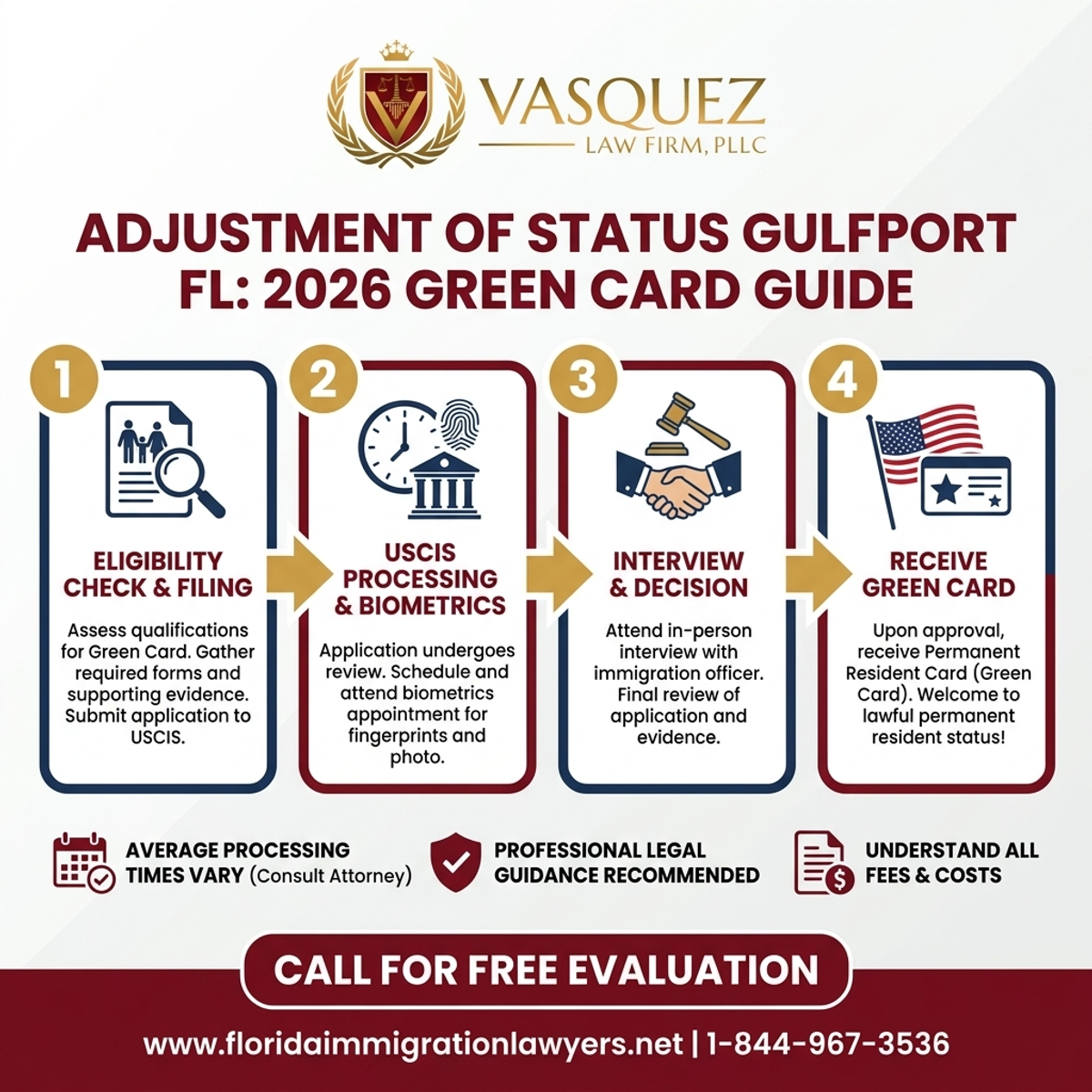
Step-by-Step Process — Adjustment of Status Gulfport FL: 2026 Green Card Guide
- Form I-485: Application to Register Permanent Residence or Adjust Status.
- Form I-130 (or I-140) Approval Notice: Copy of the approval notice for your underlying immigrant petition. If filing concurrently (e.g., immediate relatives), include the I-130 petition itself.
- Two Passport-Style Photographs: Must meet USCIS specifications.
- Copy of Government-Issued Photo Identification: Such as your passport, driver's license, or state ID.
- Copy of Birth Certificate: With certified English translation if not in English.
- Copy of Passport Pages: Including biographical page, visa stamp, and entry stamp.
- Copy of Form I-94: Arrival/Departure Record, proving lawful entry.
- Form I-864: Affidavit of Support (for family-based petitions), along with the petitioner's tax returns and evidence of income/assets.
- Form I-693: Report of Medical Examination and Vaccination Record, completed by a USCIS-approved civil surgeon. This must be unsealed if you are submitting it directly.
- Certified Police and Court Records: If you have any arrests, charges, or convictions, even if expunged.
- Marriage Certificate and Evidence of Bona Fide Marriage: If applying as a spouse of a U.S. citizen or LPR (e.g., joint bank accounts, leases, photos, affidavits from friends/family).
- Proof of Continuous Lawful Presence: If applicable, documentation showing maintenance of status prior to filing.
- Form I-765 (Optional): Application for Employment Authorization (EAD).
- Form I-131 (Optional): Application for Travel Document (Advance Parole).
- Form I-601/I-601A (if applicable): Application for Waiver of Grounds of Inadmissibility.
Always review the most current instructions for Form I-485 on the USCIS website to ensure you have the latest requirements. Organizing these documents meticulously is key. A Florida immigration lawyer can help you compile a complete and accurate packet, avoiding common pitfalls.
How Long Does Adjustment of Status Take in Florida in 2026? (Timeline & Processing)
The processing time for adjustment of status can vary significantly, depending on several factors including the basis of your application, the USCIS service center processing your case, and the workload of the local field office (such as Tampa for Gulfport residents). As of mid-2026, applicants should prepare for a process that can range from several months to over two years.
While there is no fixed timeline, understanding the typical stages and their durations can help set realistic expectations for your adjustment of status application in Florida. USCIS regularly updates its processing times online, which are crucial to monitor.
| Stage | Typical Timeframe (As of 2026) | Notes |
|---|---|---|
| I-130 / I-140 Petition Processing | 6-24 months | Varies greatly by petition type, preference category, and USCIS service center. Immediate relatives may file I-130 concurrently with I-485. |
| Visa Availability (if applicable) | Variable, can be years | Only for preference categories. Check the monthly Visa Bulletin for current priority dates. Immediate relatives do not have a waiting period for visa availability. |
| I-485 Filing to Biometrics Appointment | 4-8 weeks | Once USCIS accepts your I-485, a notice for biometrics is typically mailed out within this period. |
| Biometrics to EAD/Advance Parole (I-765/I-131) | 3-12 months | Processing times for work permits and travel documents can vary, but often arrive before the final I-485 decision. |
| Biometrics to Interview Scheduling | 6-18 months | This stage is highly dependent on the workload of the USCIS field office (e.g., Tampa). Some cases may be approved without an interview. |
| Interview to Final Decision | 1-6 months | Some cases are decided on the spot, while others require further review. RFEs or additional evidence requests can extend this phase. |
| Total Process (from I-130/I-140 filing) | 1-3+ years | This is a broad estimate. Complex cases, backlogs, or issues with documentation can significantly prolong the process. |
It is important to regularly check the USCIS processing times tool for the most up-to-date information relevant to your specific forms and field office. While waiting, it's crucial to respond promptly to any USCIS requests and notify them of any address changes. Delays can often be attributed to incomplete applications or the need for additional evidence, underscoring the importance of meticulous preparation.
What Are the Costs Associated with Filing Form I-485? (Fee Breakdown)
The financial aspect of applying for adjustment of status is an important consideration for many applicants in Florida. The total cost can vary based on the specific forms required, the need for medical examinations, and whether legal assistance is retained. As of 2026, USCIS fees are subject to change, so always verify the latest amounts directly on their website.
Understanding the various fees involved is crucial for budgeting and planning your adjustment of status application. These costs include government filing fees, medical examination charges, and potentially attorney fees for professional guidance.
| Item | Typical Fee (As of 2026) | Notes |
|---|---|---|
| Form I-485 Filing Fee | Varies (refer to USCIS site) | Includes the biometrics services fee. Fees are subject to change, so always check the latest USCIS fee schedule. |
| Form I-130 Petition Fee (if applicable) | Varies (refer to USCIS site) | Required for family-sponsored immigrant petitions. |
| Form I-140 Petition Fee (if applicable) | Varies (refer to USCIS site) | Required for employment-based immigrant petitions. |
| Form I-765 (EAD) / Form I-131 (Advance Parole) | Often no additional fee if filed concurrently with I-485 | If filed separately or after I-485, separate fees may apply. Always verify. |
| Medical Examination Fee (Form I-693) | Varies ($200 - $500+) | Paid directly to the USCIS-approved civil surgeon. This fee is not paid to USCIS. |
| Attorney Fees | Varies ($3,000 - $10,000+) | Professional legal fees depend on the complexity of the case, the attorney's experience, and the scope of services. This is a significant investment but often invaluable. |
| Translation Services | Varies ($20 - $50+ per page) | If any supporting documents are not in English, certified translations are required. |
| Postage/Courier Fees | Varies ($5 - $50+) | Costs for mailing applications, especially for certified mail or express services. |
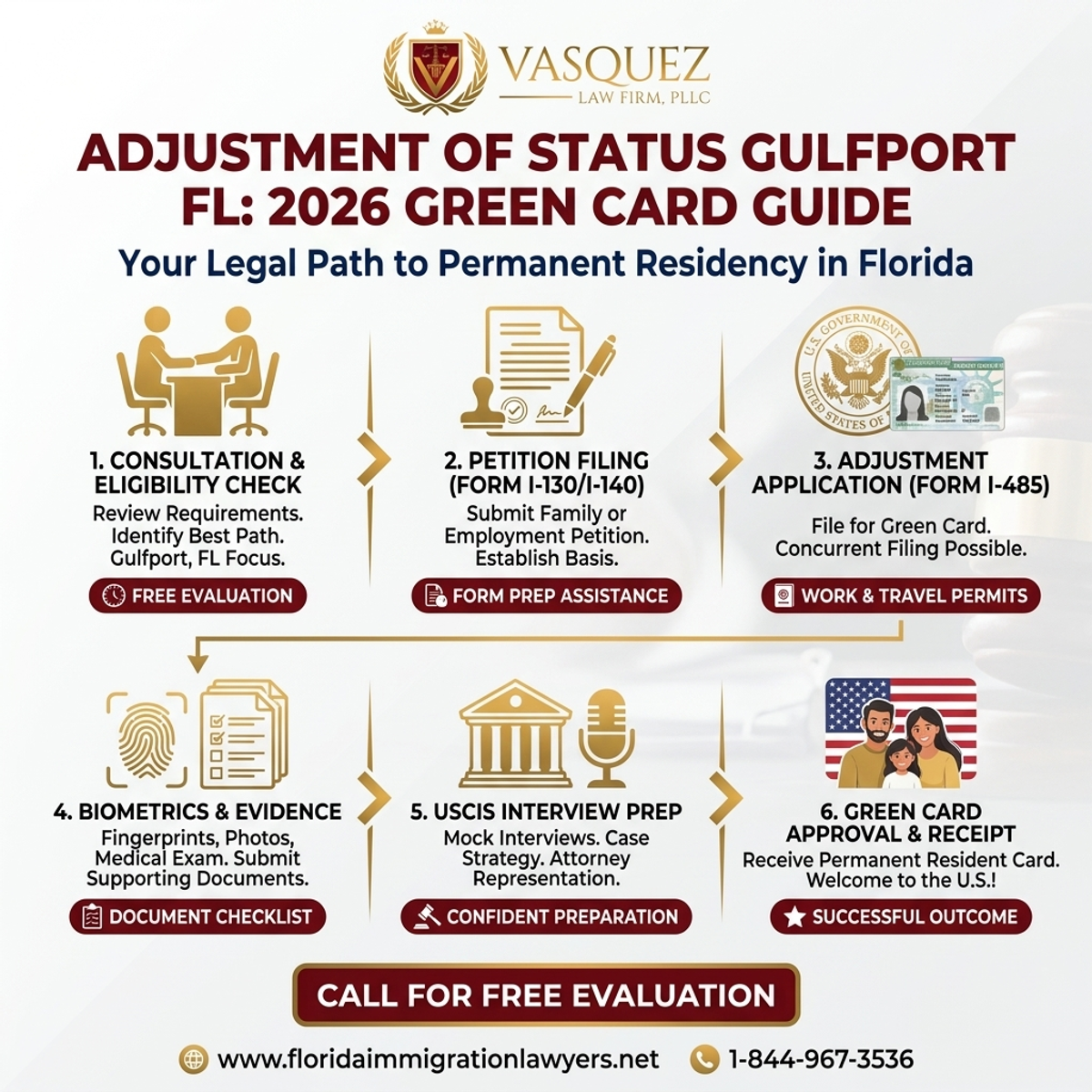
Key Statistics — Adjustment of Status Gulfport FL: 2026 Green Card Guide
It's crucial to budget for all potential expenses and review the USCIS website for the most current fee information before submitting your application. Fee waivers may be available for certain low-income applicants, but eligibility is strict. An experienced immigration lawyer can help you understand all applicable fees and determine if you qualify for any waivers, providing a clear financial picture for your adjustment of status journey in Florida.
Addressing Complexities: Waivers, Inadmissibility, and Asylum-Based AoS
While the path to adjustment of status appears straightforward for many, numerous complexities can arise, particularly involving grounds of inadmissibility. These are legal reasons why a foreign national may be barred from entering the U.S. or adjusting their status. Common grounds include unlawful presence, certain criminal convictions, misrepresentation, or previous immigration violations. For individuals in Gulfport or anywhere in Florida facing such issues, a waiver of inadmissibility (such as Form I-601, Application for Waiver of Grounds of Inadmissibility, or Form I-601A, Application for Provisional Unlawful Presence Waiver) may be necessary. These waivers are often difficult to obtain, requiring proof of extreme hardship to a qualifying U.S. citizen or LPR relative, and underscore the critical need for legal expertise. The process for obtaining a waiver is distinct from the adjustment of status application itself and adds another layer of complexity and time to the overall immigration journey. Understanding the specific legal citations, such as INA Section 212, which lists grounds of inadmissibility, is essential.
Furthermore, asylum-based adjustment of status presents its own unique set of considerations. Individuals granted asylum or refugee status in the U.S. are generally eligible to apply for a green card one year after their grant date. This falls under INA Section 209. The application process for asylum-based adjustment, while still utilizing Form I-485, requires specific documentation related to the asylum grant and proof of continuous physical presence in the U.S. since the grant. There is also a strict one-year filing deadline for asylum applicants to adjust status, unless certain exceptions apply. Any criminal history, even minor offenses, can jeopardize an asylum-based adjustment application, making it imperative to consult with an attorney who is well-versed in both asylum and adjustment of status law. Florida Immigration Lawyers has extensive experience in these nuanced areas, providing comprehensive support to ensure all requirements are met and potential hurdles are addressed proactively.
Life in Florida While Your Adjustment of Status is Pending
Waiting for your adjustment of status application to be processed can be a lengthy period, often spanning many months or even years, as seen in the processing times for the Tampa Field Office. During this time, it's crucial to understand your rights and limitations, especially concerning work and travel. If you filed Form I-765 (Application for Employment Authorization) concurrently with your I-485, you will typically receive an Employment Authorization Document (EAD), also known as a work permit. This document allows you to legally work in the U.S. while your green card application is pending, providing financial stability and peace of mind for you and your family in Gulfport or elsewhere in Florida.
Similarly, if you wish to travel outside the U.S. while your I-485 is pending, you must obtain an Advance Parole document by filing Form I-131 (Application for Travel Document). Traveling internationally without Advance Parole can be detrimental to your adjustment of status application, potentially leading to its automatic abandonment upon your departure, particularly if you are not in certain non-immigrant statuses like H-1B or L-1. It is vital to consult with an immigration attorney before making any international travel plans during this sensitive period. Additionally, maintaining lawful status, even if your previous visa has expired, is important. Always ensure USCIS has your current mailing address; Form AR-11, Alien's Change of Address Card, or updating your address online is mandatory within 10 days of moving, especially in a dynamic state like Florida where people frequently relocate between cities like Tampa, Orlando, and Miami. Staying informed and compliant with these regulations is essential for a smooth adjustment of status process.
Do not navigate this complex process alone. The stakes are too high to risk common mistakes or misunderstandings of immigration law. Contact Florida Immigration Lawyers today at 1-844-YO-PELEO for a free consultation. Our experienced team is ready to provide the guidance and representation you need to achieve your immigration goals in Florida.
Common Mistakes to Avoid During Adjustment of Status
The adjustment of status process is fraught with potential pitfalls that can lead to significant delays, Requests for Evidence (RFEs), or even denial. Avoiding these common mistakes is crucial for a successful outcome:
- Submitting Incomplete or Incorrect Forms: Even minor errors or missing signatures on Form I-485 or supporting documents can cause your application to be rejected or returned, wasting valuable time. Always double-check all fields and instructions.
- Failing to Disclose All Relevant Information: Hiding a past criminal record, prior immigration violations, or other potentially adverse information can be considered misrepresentation, leading to a permanent bar from the U.S. Honesty is paramount.
- Missing Deadlines: Failing to respond to RFEs, interview notices, or other USCIS communications by the specified deadline can result in the abandonment or denial of your application.
- Traveling Internationally Without Advance Parole: If you are applying for adjustment of status and leave the U.S. without an approved Advance Parole document (Form I-131), your I-485 application may be considered abandoned upon your departure, unless you are in certain non-immigrant categories (H-1B, L-1).
- Not Attending Biometrics or Interview: Missing scheduled appointments without proper rescheduling can lead to your application being denied. Always respond promptly to USCIS notices.
- Submitting an Expired or Unsealed Medical Exam (Form I-693): The medical exam must be current at the time USCIS reviews your application, and if submitted by you, it must be in a sealed envelope from the civil surgeon. An outdated or opened exam will result in an RFE.
- Failing to Update Your Address with USCIS: Moving within Florida or out of state without notifying USCIS using Form AR-11 or online can result in missed notices and critical communications, leading to severe delays or even denial.
- Ignoring Request for Evidence (RFE) or Notice of Intent to Deny (NOID): These are serious communications from USCIS requiring a timely and comprehensive response. Failing to address them adequately will likely lead to denial.
- Assuming Eligibility Without Legal Review: Complex immigration histories, overstays, or specific circumstances may make you ineligible for adjustment of status, even if you meet basic criteria. A lawyer can identify potential issues.
- Providing False or Misleading Information: Any attempt to deceive USCIS through fraudulent documents or false statements can lead to severe penalties, including a permanent bar from the U.S.
- Inadequate Proof of Relationship or Bona Fide Marriage: For family-based adjustments, especially spousal petitions, insufficient evidence of a genuine relationship is a common reason for RFEs or denials.
When to Call a Lawyer for Your Adjustment of Status in Florida
While some adjustment of status cases might seem straightforward, the complexities of immigration law mean that legal representation is almost always beneficial. For residents of Gulfport, Tampa, and across Florida, having an experienced immigration attorney from Florida Immigration Lawyers by your side can make a significant difference in the outcome of your case. You should strongly consider contacting a lawyer in the following scenarios:
- Complex Immigration History: If you have ever overstayed a visa, entered the U.S. without inspection, had a previous visa denial, or been in removal proceedings, your case is complex and requires expert review.
- Criminal Record: Even minor arrests or convictions can have severe immigration consequences, potentially leading to inadmissibility. An attorney can assess your eligibility for waivers or other remedies.
- Grounds of Inadmissibility: If you believe you might be inadmissible for any reason (e.g., health-related, security-related, public charge concerns), a lawyer can determine if a waiver is available and help prepare a strong application.
- Previous Denials or RFEs: If your previous immigration applications have been denied or you've received a Request for Evidence (RFE) or Notice of Intent to Deny (NOID), an attorney can help you understand the issues and formulate an effective response.
- Asylum or Refugee Status: Adjusting status based on asylum or refugee status has specific timelines and requirements that an attorney can help you navigate.
- Unusual Family Circumstances: Cases involving stepchildren, adopted children, or complex marital histories often benefit from legal guidance to ensure all relationships are properly documented.
- Fear of Interview: If you are anxious about the USCIS interview or have difficulty understanding complex legal questions, an attorney can prepare you and, in most cases, attend the interview with you.
- Language Barriers: While USCIS provides interpreters, having your own legal counsel who can explain the process in your native language (e.g., Spanish) can be invaluable.
- Facing Deportation: If you are currently in removal proceedings, adjusting status may be a defense strategy, but it requires immediate and skilled legal intervention.
Florida Immigration Lawyers understands the nuances of adjustment of status and can provide tailored advice for your unique situation. Our team is committed to protecting your rights and guiding you through every step of the process.
About Florida Immigration Lawyers
Florida Immigration Lawyers is an immigration law firm dedicated to serving individuals and families across the entire state of Florida, including Gulfport, Tampa, Orlando, Miami, and beyond. With a deep understanding of U.S. immigration laws and a passion for helping clients achieve their American dream, our experienced attorneys provide comprehensive legal services tailored to your unique needs.
Our firm focuses on a wide range of immigration matters, including adjustment of status, family-based petitions, employment visas, asylum applications, deportation defense, and naturalization. We pride ourselves on our client-focused approach, offering personalized attention, clear communication, and strategic advocacy to secure the strongest possible outcomes.
Choosing Florida Immigration Lawyers means partnering with a team that values integrity, experience, and compassion. We are available 24/7 to answer your questions and offer free consultations to discuss your case. Let us put our knowledge and dedication to work for you. Visit our attorneys page to learn more about our team, or contact us directly to schedule your consultation.
Sources and References
- U.S. Citizenship and Immigration Services (USCIS)
- Executive Office for Immigration Review (EOIR)
- U.S. Department of State (Visa Bulletin)
- 8 U.S.C. Chapter 12 - Immigration and Nationality Act (INA)
- INA Section 209 - Adjustment of Status of Refugees
- INA Section 212 - General Classes of Aliens Ineligible to Receive Visas and Inadmissible to United States
- INA Section 245 - Adjustment of Status of Nonimmigrant to That of Person Admitted for Permanent Residence
- 8 CFR Part 245 - Adjustment of Status to That of Person Admitted for Permanent Residence
Related services: immigration practice areas.
This article provides general legal information and is not intended as legal advice. Every case is unique, and outcomes depend on specific facts and circumstances. Contact an attorney for advice about your particular situation.
Your journey to a green card in Florida is a significant step towards building a lasting future. Don't leave your future to chance. Let the experienced legal team at Florida Immigration Lawyers guide you through every stage of the adjustment of status process. We are committed to providing you with the dedicated representation you deserve. Call us now for a free consultation at 1-844-YO-PELEO. Se Habla Español - Estamos aqui para ayudarle.
Do Not Navigate This Process Alone
Our experienced immigration attorneys are ready to fight for you. Get a free, confidential case review today.
Se Habla Español
Or leave your details and we’ll call you:
Free Evaluation in 24 Hours
Or talk to us right now

AI voice assistant — available 24/7
FreeFrequently Asked Questions

William J. Vásquez
Founding Attorney · Vasquez Law Firm
U.S. Air Force veteran and immigration attorney with years of hands-on U.S. immigration experience. J.D., NCCU School of Law. AILA member. Admitted to the 4th, 5th, and 11th Circuit Courts.
Available 24/7 - Free Evaluations
Reviewed for legal accuracy by William J. Vásquez
Licensed in North Carolina; U.S. immigration is federal practice.
Related Legal Services
Our Florida immigration attorneys can help you with experienced immigration attorneys, asylum protection and citizenship and naturalization. Call today at 1-844-YO-PELEO for a free case review.
Related Links
Related Topics
Free Legal Case Review
Discuss your case with our experienced attorneys. We're available 24/7.
Se Habla Español - Estamos aquí para ayudarle.
Related Articles
Immigration Lawyer Orlando Free Consultation in Florida
For individuals and families in Orlando, Florida, navigating the complexities of U.S. immigration law requires expert guidance. An immigration lawyer in Orlando offers crucial support for everything from visa applications and green card processes to naturalization and deportation defense. This comprehensive guide details what a free consultation covers, providing a step-by-step overview of immigration pathways, essential document checklists, and expected timelines in 2026. We also highlight common mistakes to avoid, discuss the critical role of legal counsel in deportation and asylum cases, and explain why choosing a local Orlando immigration attorney is beneficial. Florida Immigration Lawyers is dedicated to serving the diverse community of Orlando with compassionate, effective legal solutions, ensuring you receive personalized advice and robust representation for a successful immigration journey.
EAD Advance Parole Combo Card in Florida 2026
For individuals with a pending Form I-485, Application to Register Permanent Residence or Adjust Status, the EAD Advance Parole Combo Card is an essential document. This single card combines the authorization to work legally in the U.S. (Employment Authorization Document - EAD) with permission to travel internationally and re-enter without abandoning your green card application (Advance Parole). This guide from Florida Immigration Lawyers provides a comprehensive overview for applicants in Florida in 2026, covering eligibility, the step-by-step application process, required documents, expected processing times, and associated costs. We also highlight common mistakes to avoid and when to seek legal counsel to ensure a smooth and successful immigration journey. Understanding this vital card is key to maintaining stability while awaiting your permanent residency approval.
Vasquez Law Firm: U Visa Certification for Florida Crime
For crime victims in Florida, understanding U visa certification is crucial for obtaining legal protection and status. This comprehensive guide, updated for 2026, explains the U visa process, from securing the vital I-918 Supplement B from Florida law enforcement agencies to filing your petition with USCIS. Learn about eligibility criteria, the specific documents required, and what to expect regarding processing timelines, including the Bona Fide Determination (BFD) and the annual visa cap. We also cover potential costs, fee waivers, and common pitfalls to avoid. If you are a crime victim in Orlando or anywhere in Florida, knowing your rights and the steps to take is essential. Discover how expert legal assistance can navigate the challenges, ensuring your application is complete and compelling. Florida Immigration Lawyers are dedicated to providing compassionate, knowledgeable support for your U visa journey.
Applying for Citizenship with Father's Family Petition
Applying for U.S. citizenship after a father's family petition requires navigating a multi-stage immigration process. This journey typically begins with the approved Form I-130, which establishes the family relationship, leading to lawful permanent residency (a green card). After a statutory period of 3 to 5 years as a green card holder, individuals become eligible to apply for naturalization, the final step to U.S. citizenship. This comprehensive guide from Florida Immigration Lawyers details the eligibility requirements, step-by-step application procedures, associated costs, and common pitfalls to avoid for those pursuing citizenship in Florida in 2026. Understanding the nuances of continuous residence, physical presence, and good moral character is crucial. Our firm provides expert legal assistance for family-based immigration and naturalization cases throughout Florida, ensuring your application is meticulously prepared and effectively presented. Secure your future with experienced legal guidance.