Applying for Citizenship with Father's Family Petition
Applying for U.S. citizenship after a father's family petition requires navigating a multi-stage immigration process. This journey typically begins with the approved Form I-130, which establishes the family relationship, leading to lawful permanent residency (a green card). After a statutory period of 3 to 5 years as a green card holder, individuals become eligible to apply for naturalization, the final step to U.S. citizenship. This comprehensive guide from Florida Immigration Lawyers details the eligibility requirements, step-by-step application procedures, associated costs, and common pitfalls to avoid for those pursuing citizenship in Florida in 2026. Understanding the nuances of continuous residence, physical presence, and good moral character is crucial. Our firm provides expert legal assistance for family-based immigration and naturalization cases throughout Florida, ensuring your application is meticulously prepared and effectively presented. Secure your future with experienced legal guidance.
Applying for U.S. citizenship through a father's family petition involves a multi-stage process, starting with the father filing Form I-130, Petition for Alien Relative. This establishes the family relationship, leading to a green card (lawful permanent residency), which is a prerequisite for naturalization. The timeline varies significantly based on the petitioner's status (U.S. Citizen or Lawful Permanent Resident) and the beneficiary's age and marital status, typically taking several years to obtain permanent residency, followed by a waiting period of 3-5 years before being eligible to apply for citizenship. Consulting an experienced immigration lawyer in Orlando is crucial to navigate the complexities and ensure all requirements are met.
- Form I-130 is the foundational step for family-based immigration.
- Eligibility for a green card is determined by the family relationship and visa availability.
- Naturalization typically requires 3-5 years as a lawful permanent resident.
- The process involves multiple forms, fees, and interviews with USCIS.
- Legal guidance is essential to avoid delays and potential pitfalls.
Applying for Citizenship with Father's Family Petition in Florida
For many individuals in Florida, the dream of U.S. citizenship is deeply intertwined with family. If you've decided to apply for citizenship, and your journey began with your father's family petition, you're on a path that many immigrants navigate. This process, while incredibly rewarding, involves intricate legal steps, strict eligibility criteria, and varying timelines that can feel overwhelming without proper guidance. Understanding each stage, from the initial family petition to the final naturalization oath, is key to a successful outcome.
Whether your father is a U.S. citizen or a lawful permanent resident, his petition laid the groundwork for your immigration journey. Now, as you consider the final step towards becoming a U.S. citizen, it's essential to understand how your specific immigration history influences your eligibility and what further requirements you must meet. This comprehensive guide from Florida Immigration Lawyers will walk you through the entire process, highlight critical considerations, and provide insights specific to those living in Orlando and across the Sunshine State. We understand the significance of family unity and the pursuit of citizenship.
The journey from a family petition to U.S. citizenship is a testament to perseverance and commitment. Our goal is to demystify this path, offering clear, actionable information to help you make informed decisions. We'll cover everything from the initial I-130 petition's role in your current status to the specific requirements for naturalization. Navigating these complex immigration laws requires precision and expertise. Don't leave your future to chance. Call Florida Immigration Lawyers at 1-844-YO-PELEO for a free case review and let our experienced team guide you towards achieving your American dream.
What is a Family Petition (Form I-130) and How Does it Relate to Citizenship?
A family petition, specifically Form I-130, Petition for Alien Relative, is the foundational document in most family-based immigration cases. It is filed by a U.S. citizen or lawful permanent resident (LPR) to establish a qualifying relationship with an eligible foreign national relative who wishes to immigrate to the United States. This form is the first, crucial step towards obtaining a green card, which is a prerequisite for eventually applying for U.S. citizenship through naturalization.
The I-130 petition itself does not grant immigration benefits but serves to prove the legitimate family connection. Once approved by USCIS, it allows the foreign national to proceed with either adjustment of status (if already in the U.S. and eligible) or consular processing abroad. For those whose fathers filed an I-130, this approval validated their family relationship, enabling them to eventually become lawful permanent residents. This green card status is the direct link to citizenship, as naturalization applicants must first demonstrate a period of continuous residence as an LPR. Understanding the specifics of the I-130 petition's approval date and priority date is vital, especially for those in preference categories, as it impacts when a visa number becomes available. The legal basis for these categories is found in the Immigration and Nationality Act (INA), specifically sections like INA 201 and INA 203, which outline immediate relatives and family preference categories, respectively.
How Do I Apply for a Family-Based Green Card Through My Father's Petition?
Applying for a family-based green card through your father's petition involves several distinct stages after the initial I-130 approval. The specific path depends on whether you are currently in the United States or abroad, and if a visa number is immediately available. Generally, this process culminates in either adjusting your status within the U.S. or undergoing consular processing at a U.S. embassy or consulate in your home country. Eligibility for adjustment of status requires lawful entry and maintenance of status, among other factors.
As of 2026, the process typically follows these steps, though individual circumstances can introduce variations. The key is to meticulously follow all instructions from USCIS and the Department of State to avoid delays. For beneficiaries residing in Florida, the adjustment of status process would involve the USCIS Tampa or Miami Field Offices, depending on your residence, and possibly the Orlando Application Support Center for biometrics. Consular processing is handled by the National Visa Center (NVC) before being forwarded to the relevant embassy or consulate abroad. Ensuring all documents are correctly translated and certified is paramount.
Step-by-Step Guide to Obtaining a Green Card:
- Form I-130 Filing and Approval: Your father, as the petitioner, filed Form I-130 with USCIS to establish the family relationship. Once approved, this serves as the foundation for your green card application. The approval notice confirms your eligibility based on the family tie.
- Visa Availability: If you are in a family preference category (e.g., adult child of a U.S. citizen, or child of an LPR), you must wait for a visa number to become available according to the Visa Bulletin, published monthly by the Department of State. Immediate relatives (spouse, minor child, parent of U.S. citizen) do not have to wait for visa availability.
- Adjustment of Status (Form I-485) or Consular Processing:
- Adjustment of Status: If you are in the U.S., entered lawfully, and a visa is available (if applicable), you can file Form I-485, Application to Register Permanent Residence or Adjust Status, concurrently with or after your I-130 approval. This allows you to obtain your green card without leaving the U.S.
- Consular Processing: If you are outside the U.S. or ineligible for adjustment of status, your approved I-130 will be sent to the National Visa Center (NVC). The NVC will then guide you through submitting required documents and fees before scheduling an interview at a U.S. embassy or consulate in your home country.
- Biometrics Appointment: For both adjustment of status and consular processing, you will attend a biometrics appointment (fingerprints, photos, signature) at a local Application Support Center (ASC), such as the one in Orlando, Florida.
- Interview: You will typically undergo an interview with a USCIS officer (for adjustment of status) or a consular officer (for consular processing) to verify the information in your application and determine your admissibility to the U.S.
- Green Card Issuance: Upon successful completion of all steps and approval of your application, your green card will be mailed to you, granting you lawful permanent resident status.
Document Checklist for Green Card Application:
- Approved Form I-130 Petition
- Form I-485 (if adjusting status) or DS-260 (for consular processing)
- Birth Certificate
- Passport and travel documents
- Medical Examination Report (Form I-693)
- Affidavit of Support (Form I-864) from petitioner
- Proof of your father's U.S. Citizenship or LPR status
- Marriage certificates (if applicable)
- Police clearance certificates (for consular processing)
- Photographs
- Proof of lawful entry (for adjustment of status)
What are the Eligibility Requirements for U.S. Citizenship (Naturalization) in Florida?
To become a U.S. citizen through naturalization in 2026, you must meet several stringent eligibility requirements set forth by the Immigration and Nationality Act (INA). The most common path requires you to be a lawful permanent resident (green card holder) for at least five years, demonstrating continuous residence and physical presence in the United States during that time. There are exceptions, such as a three-year residency requirement for those married to a U.S. citizen, but for those whose journey began with a father's family petition, the five-year rule often applies.
Beyond the residency period, applicants must be at least 18 years old at the time of filing, demonstrate good moral character, and show an attachment to the principles of the U.S. Constitution. You must also be able to read, write, and speak basic English, and have a fundamental understanding of U.S. history and government (civics). Exceptions to the English and civics requirements exist for older applicants and those with certain medical conditions. For Florida residents, naturalization interviews are conducted at USCIS field offices, such as those in Orlando, Tampa, or Miami. The oath of allegiance ceremonies are often held locally, sometimes even in federal courthouses across Central Florida. USCIS Policy Manual provides detailed guidance on these requirements, specifically Part D, Chapter 2 for general eligibility. The legal framework for naturalization is primarily found in INA 316 (8 U.S.C. 1427) for general requirements.
Key Naturalization Requirements:
- Age: Be at least 18 years old at the time of filing Form N-400.
- Lawful Permanent Resident Status: Hold a valid green card for at least 5 years (or 3 years if married to a U.S. citizen and meet other criteria).
- Continuous Residence: Have continuously resided in the U.S. for at least 5 years (or 3 years) immediately preceding the filing date of Form N-400. Absences from the U.S. for more than 6 months but less than 1 year may break continuous residence unless proven otherwise. Absences of 1 year or more automatically break continuous residence.
- Physical Presence: Be physically present in the U.S. for at least half of the required continuous residence period (e.g., 30 months out of 5 years, or 18 months out of 3 years).
- Residence in State/USCIS District: Reside for at least 3 months immediately preceding the filing of Form N-400 in the state or USCIS district where you apply. For those in Orlando, this means living in the Central Florida USCIS jurisdiction.
- Good Moral Character: Demonstrate good moral character for the statutory period (5 or 3 years). This means having no serious criminal offenses and abiding by U.S. laws.
- English Language Proficiency: Be able to read, write, and speak basic English.
- Civics Knowledge: Demonstrate knowledge and understanding of U.S. history and government.
- Attachment to the U.S. Constitution: Take an Oath of Allegiance to the U.S. and its Constitution.
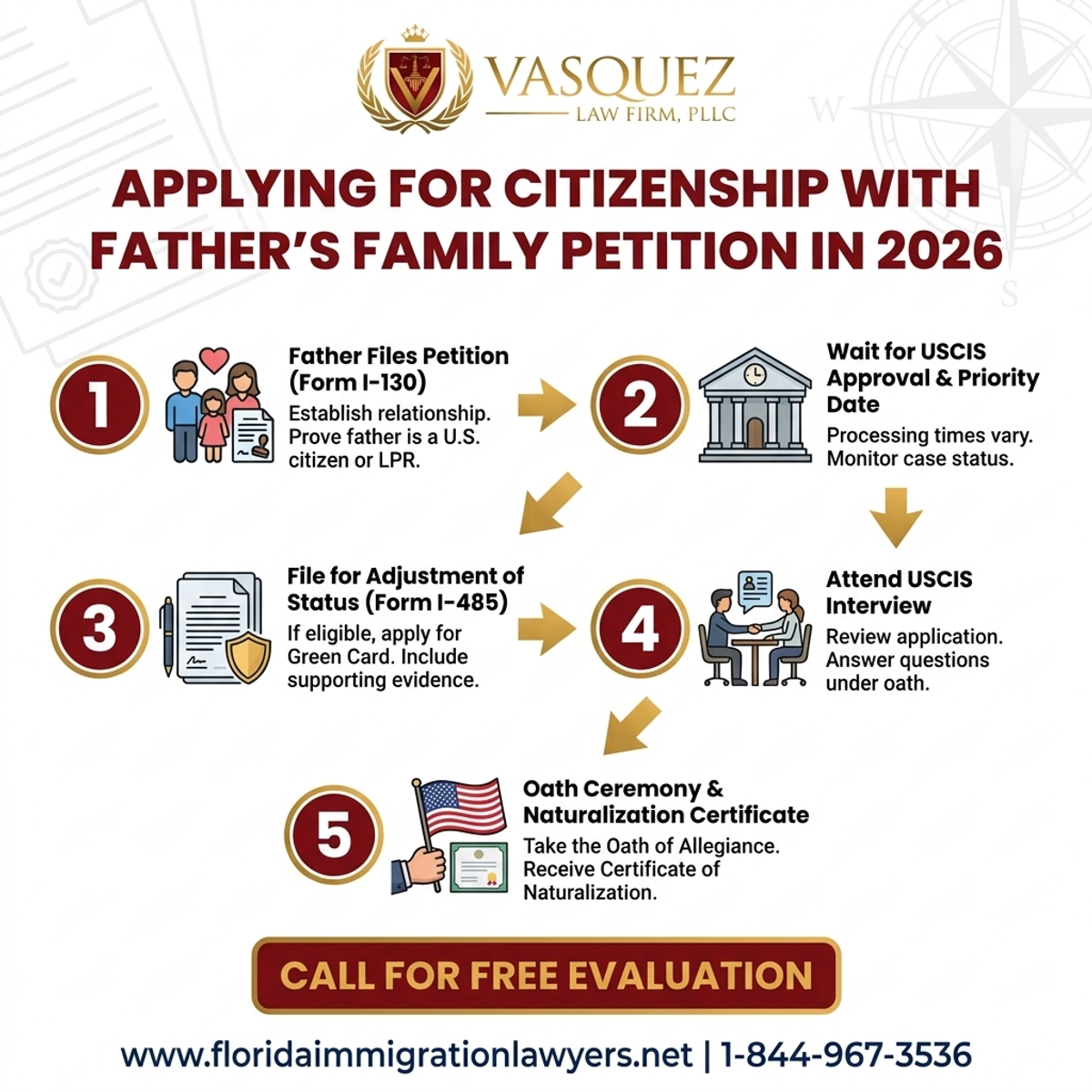
Step-by-Step Process — Applying for Citizenship with Father's Family Petition in 2026
Timeline and Processing Expectations for 2026:
The processing times for family petitions and naturalization applications can vary significantly based on the specific USCIS service center, field office workload, and the complexity of your case. As of 2026, applicants should anticipate the following general timeframes:
| Stage | Typical Timeframe | Notes |
|---|---|---|
| I-130 Petition (Immediate Relative) | 6-12 months | For U.S. Citizen filing for spouse, parent, or unmarried child under 21. |
| I-130 Petition (Preference Categories) | 12-24+ months | For U.S. Citizen filing for adult children/siblings, or LPR filing for spouses/children. Followed by visa wait times. |
| Adjustment of Status (I-485) | 10-24 months | After I-130 approval and visa availability. Includes biometrics and interview. |
| Consular Processing | 12-36+ months | After I-130 approval and visa availability. NVC processing, interview abroad. |
| Naturalization (N-400) | 8-18 months | After meeting 3 or 5 year LPR residency. Includes biometrics, interview, and oath ceremony. |
What Are the Costs Associated with a Family Petition and Naturalization in 2026?
The costs involved in a family petition and naturalization process in 2026 encompass various government filing fees, medical examination costs, and potentially legal fees. It is important to note that USCIS fees are subject to change, and applicants should always refer to the official USCIS website for the most current fee schedule before filing. These fees are non-refundable, regardless of the outcome of your application, making it crucial to ensure your application is complete and accurate.
Beyond the direct government fees, applicants should budget for additional expenses such as medical examinations by a USCIS-approved civil surgeon (mandatory for I-485), document translation services, and legal representation. While legal fees vary, investing in an experienced immigration lawyer in Orlando can help avoid costly mistakes, delays, and potential denials, ultimately saving you time and money in the long run. Florida Immigration Lawyers offers transparent fee structures and free initial consultations to discuss your specific case and associated costs. Remember that fee waivers may be available for certain low-income applicants, but eligibility criteria are strict and must be carefully reviewed.
| Item | Typical Fee (as of 2026) | Notes |
|---|---|---|
| Form I-130, Petition for Alien Relative | $525 | Filed by the U.S. citizen or LPR petitioner. |
| Form I-485, Application to Adjust Status | $1,225 (includes biometrics) | Filed by the beneficiary in the U.S. to get a green card. |
| Biometrics Services Fee | Included in I-485 fee; $85 if standalone | Required for identity verification and background checks. |
| Form N-400, Application for Naturalization | $725 (includes biometrics) | Filed by the green card holder to become a U.S. citizen. |
| Medical Examination (Form I-693) | $200-$500 | Cost varies by civil surgeon; required for I-485. |
| Attorney Fees | Varies by case complexity | Highly recommended for expert guidance and representation. |
Navigating Challenges in Family Petition and Citizenship Cases in Orlando
Immigration processes, especially those involving family petitions and naturalization, are rarely straightforward, and applicants in Florida often face unique challenges. One common hurdle is the sheer volume of applications processed by the USCIS field offices in Florida, such as those serving Orlando, Tampa, and Miami, which can lead to longer than average processing times. Delays can be frustrating and impact an applicant's ability to travel or work. Furthermore, the complexities of demonstrating continuous residence and good moral character, particularly if there have been any minor legal infractions or extended absences from the U.S., require careful documentation and explanation.
Specific to Florida, issues like changes in residency within the state or interactions with local law enforcement (even for minor incidents) can sometimes complicate the good moral character assessment for naturalization. Moreover, understanding the nuances of how past immigration applications or entries might affect current eligibility requires expert analysis. For instance, if an individual initially entered the U.S. without inspection, their path to a green card via adjustment of status might be barred, even with an approved I-130, necessitating a waiver or consular processing. The Executive Office for Immigration Review (EOIR) oversees immigration courts, and any prior interaction with them can significantly impact future applications. An experienced immigration lawyer in Orlando can help you anticipate and address these challenges proactively, ensuring your application presents the strongest possible case.
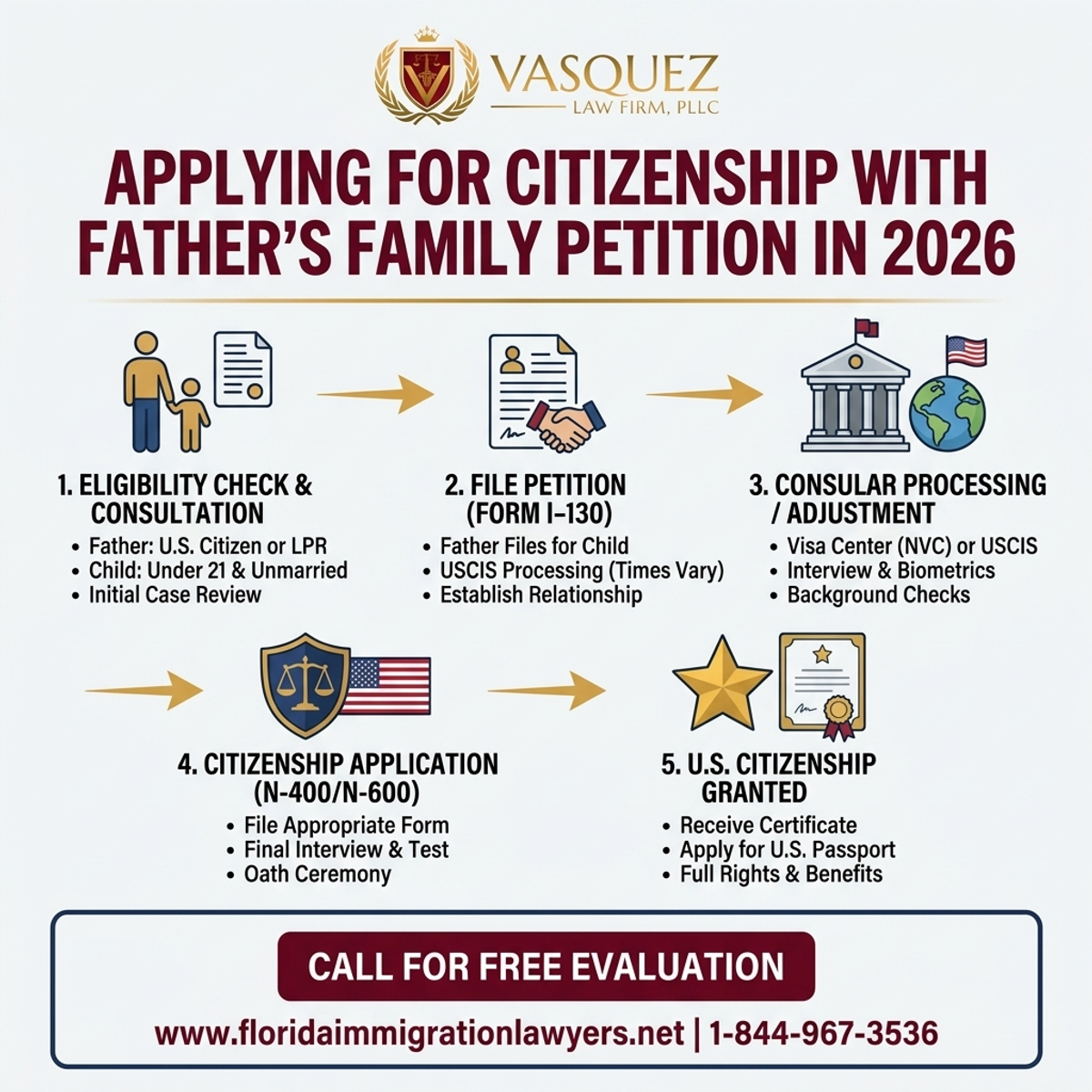
Key Statistics — Applying for Citizenship with Father's Family Petition in 2026
Do not navigate this complex and critical process alone. The stakes are too high to risk errors or misunderstandings. Contact Florida Immigration Lawyers today to ensure your family petition and citizenship application are handled with the expertise and care they deserve. Our team is ready to provide the dedicated legal support you need.
Common Mistakes to Avoid in Family Petition and Citizenship Applications
- Incomplete or Inaccurate Forms: Submitting forms with missing information or errors is a leading cause of delays, Requests for Evidence (RFEs), or even outright denials. Every field must be completed accurately and truthfully.
- Failure to Disclose All Information: Omitting details, especially concerning criminal history (even minor offenses), prior immigration applications, or marital history, can be considered misrepresentation and lead to severe consequences, including permanent bars.
- Missing Deadlines: Failing to respond to RFEs or appointment notices by the specified deadline can result in the denial of your application without further review.
- Insufficient Supporting Documentation: Not providing all required evidence, such as birth certificates, marriage licenses, financial documents, or proof of continuous residence, will halt the process.
- Not Updating Address with USCIS: Moving without notifying USCIS using Form AR-11 can cause you to miss crucial notices, interviews, or RFEs, leading to application abandonment.
- Lack of Good Moral Character: Engaging in activities that demonstrate a lack of good moral character during the statutory period for naturalization (e.g., certain criminal convictions, habitual drunkenness, false testimony) can result in denial.
- Incorrectly Calculating Physical Presence/Continuous Residence: Misunderstanding how absences from the U.S. affect your eligibility for naturalization can lead to filing too early and subsequent denial.
- Failing the English or Civics Test: Not adequately preparing for the naturalization tests can result in a failed interview, though applicants usually get a second chance.
- Ignoring Public Charge Rule Changes: For green card applicants, misunderstanding the current public charge rule (INA 212(a)(4)) and not providing sufficient financial documentation can lead to denial.
- Not Seeking Legal Advice: Attempting to navigate complex immigration laws without the guidance of an experienced attorney often leads to avoidable mistakes and prolonged processing times.
When to Call a Florida Immigration Lawyer
The journey from a father's family petition to U.S. citizenship is filled with legal intricacies that can be challenging to manage independently. You should strongly consider contacting a Florida immigration lawyer if you encounter any of the following scenarios: you have a criminal record, even a minor one; you have previously been denied an immigration benefit; you have spent significant time outside the U.S. during your green card period; you have received a Request for Evidence (RFE) or a Notice of Intent to Deny (NOID) from USCIS; or if your case involves any complexities such as prior deportations, multiple entries, or issues with your initial family petition.
Furthermore, if you are unsure about your eligibility for naturalization, need assistance compiling a comprehensive document checklist, or require representation at a USCIS interview, an attorney is invaluable. Florida Immigration Lawyers specializes in family-based immigration and naturalization cases, offering personalized guidance to clients throughout Orlando and the entire state. Our attorneys can help you understand the specific requirements under 8 CFR (Code of Federal Regulations) and other relevant statutes, prepare a robust application, and represent your interests effectively. Don't risk your future citizenship status. Our team is here to provide clarity and strategic support every step of the way.
About Florida Immigration Lawyers
Florida Immigration Lawyers is a leading immigration law firm dedicated to serving individuals and families across the entire state of Florida. With a deep understanding of U.S. immigration law and a commitment to our clients, we provide compassionate and effective legal representation for a wide range of immigration matters. Our experienced attorneys specialize in family-based immigration, naturalization, asylum, deportation defense, and business immigration, ensuring that you receive comprehensive support no matter your situation.
We pride ourselves on our client-focused approach, offering personalized strategies tailored to your unique circumstances. Our team understands the profound impact immigration decisions have on your life and your family's future, which is why we offer dedicated, bilingual services (English and Spanish) to ensure clear communication and understanding. We are available 24/7 and offer free case reviews to help you understand your options and take the first step towards your immigration goals. From our office in Central Florida, we are ready to assist you. Trust Florida Immigration Lawyers to be your advocates. Visit our contact page or call us at 1-844-YO-PELEO to schedule your free consultation today.
Sources and References
- U.S. Citizenship and Immigration Services (USCIS)
- U.S. Department of State
- Executive Office for Immigration Review (EOIR)
- 8 U.S.C. Chapter 12 - Immigration and Nationality Act (INA)
- INA Section 201 - Immigrants: worldwide level of family-sponsored immigrants
- INA Section 203 - Preference Categories
- INA Section 316 (8 U.S.C. 1427) - General Requirements for Naturalization
- 8 CFR Part 316 - General Requirements for Naturalization
- USCIS Policy Manual - Volume 12, Part D, Chapter 2 - General Naturalization Requirements
Related services: family petition process, family-based green cards, fiancé visa (K-1), marriage-based immigration.
This article provides general legal information and is not intended as legal advice. Every case is unique, and outcomes depend on specific facts and circumstances. Contact an attorney for advice about your particular situation. Immigration laws are subject to change, and specific fee amounts should always be verified on the official USCIS website.
Your path to U.S. citizenship is a significant milestone, and having a knowledgeable legal partner can make all the difference. Florida Immigration Lawyers is committed to helping you navigate every step of this journey with confidence and peace of mind. Our dedicated team is here to provide exceptional legal representation and support for your family petition and naturalization process. Don't delay your American dream. Contact us today for a free case review.
Call Florida Immigration Lawyers at 1-844-YO-PELEO. Se Habla Espanol - Estamos aqui para ayudarle.
If you need legal assistance, learn more about our family immigration practice, or call us at 1-844-967-3536 for a free case review.
Do Not Navigate This Process Alone
Our experienced immigration attorneys are ready to fight for you. Get a free, confidential case review today.
Se Habla Español
Or leave your details and we’ll call you:
Free Evaluation in 24 Hours
Or talk to us right now

AI voice assistant — available 24/7
FreeFrequently Asked Questions

William J. Vásquez
Founding Attorney · Vasquez Law Firm
U.S. Air Force veteran and immigration attorney with years of hands-on U.S. immigration experience. J.D., NCCU School of Law. AILA member. Admitted to the 4th, 5th, and 11th Circuit Courts.
Available 24/7 - Free Evaluations
Reviewed for legal accuracy by William J. Vásquez
Licensed in North Carolina; U.S. immigration is federal practice.
Related Legal Services
Our Florida immigration attorneys can help you with citizenship and naturalization, immigration practice areas and free immigration consultation. Call today at 1-844-YO-PELEO for a free case review.
Related Links
Related Topics
Free Legal Case Review
Discuss your case with our experienced attorneys. We're available 24/7.
Se Habla Español - Estamos aquí para ayudarle.
Related Articles
Immigration Lawyer Orlando Free Consultation in Florida
For individuals and families in Orlando, Florida, navigating the complexities of U.S. immigration law requires expert guidance. An immigration lawyer in Orlando offers crucial support for everything from visa applications and green card processes to naturalization and deportation defense. This comprehensive guide details what a free consultation covers, providing a step-by-step overview of immigration pathways, essential document checklists, and expected timelines in 2026. We also highlight common mistakes to avoid, discuss the critical role of legal counsel in deportation and asylum cases, and explain why choosing a local Orlando immigration attorney is beneficial. Florida Immigration Lawyers is dedicated to serving the diverse community of Orlando with compassionate, effective legal solutions, ensuring you receive personalized advice and robust representation for a successful immigration journey.
EAD Advance Parole Combo Card in Florida 2026
For individuals with a pending Form I-485, Application to Register Permanent Residence or Adjust Status, the EAD Advance Parole Combo Card is an essential document. This single card combines the authorization to work legally in the U.S. (Employment Authorization Document - EAD) with permission to travel internationally and re-enter without abandoning your green card application (Advance Parole). This guide from Florida Immigration Lawyers provides a comprehensive overview for applicants in Florida in 2026, covering eligibility, the step-by-step application process, required documents, expected processing times, and associated costs. We also highlight common mistakes to avoid and when to seek legal counsel to ensure a smooth and successful immigration journey. Understanding this vital card is key to maintaining stability while awaiting your permanent residency approval.
Immigration Lawyer Consultation Services in Florida 2026
Embarking on an immigration journey in Florida requires clear guidance through complex laws. An immigration lawyer consultation is your first essential step, offering a personalized assessment of your unique situation and outlining viable pathways such as family-based visas, employment opportunities, or asylum claims. This critical meeting helps identify potential challenges, understand necessary documentation, and clarifies timelines and costs involved. For anyone in Florida seeking to navigate the U.S. immigration system, a consultation provides the foundational knowledge to make informed decisions and proceed with confidence. Florida Immigration Lawyers is ready to provide expert assistance, ensuring your path forward is strategically planned and legally sound.
Immigration Appeal BIA Process in Florida 2026
Learn about the immigration appeal process with the Board of Immigration Appeals in Florida. Understand the steps, necessary documentation, and timelines involved. Discover when to seek legal help to ensure a successful appeal.