Vasquez Law Firm: U Visa Certification for Florida Crime
For crime victims in Florida, understanding U visa certification is crucial for obtaining legal protection and status. This comprehensive guide, updated for 2026, explains the U visa process, from securing the vital I-918 Supplement B from Florida law enforcement agencies to filing your petition with USCIS. Learn about eligibility criteria, the specific documents required, and what to expect regarding processing timelines, including the Bona Fide Determination (BFD) and the annual visa cap. We also cover potential costs, fee waivers, and common pitfalls to avoid. If you are a crime victim in Orlando or anywhere in Florida, knowing your rights and the steps to take is essential. Discover how expert legal assistance can navigate the challenges, ensuring your application is complete and compelling. Florida Immigration Lawyers are dedicated to providing compassionate, knowledgeable support for your U visa journey.
U visa certification is a critical step for crime victims in Florida seeking humanitarian immigration relief. It involves obtaining a signed Form I-918, Supplement B, from a qualifying law enforcement agency or prosecutor's office, confirming the victim's helpfulness in the investigation or prosecution of specific criminal activities. This certification, required for the U visa petition, provides a pathway to legal status and protection for those who have suffered substantial physical or mental abuse. Navigating this process, especially with diverse law enforcement agencies across Florida, often requires expert legal guidance to ensure compliance and maximize the chances of approval.
- Eligibility: Victims of qualifying crimes who suffered substantial harm and cooperate with law enforcement.
- Law Enforcement Role: Agencies sign Form I-918, Supplement B, attesting to the victim's helpfulness.
- Application Process: Requires detailed documentation, a personal statement, and the certified Supplement B.
- Processing Time: Can be lengthy, with a waitlist due to annual caps, but often leads to work authorization.
- Legal Help: Essential for navigating complexities, fee waivers, and agency interactions in Florida.
Navigating the aftermath of a crime is a traumatic experience, made even more challenging for immigrants who may fear deportation or lack understanding of their legal rights. If you or a loved one has been a victim of a serious crime in Florida, you might be eligible for a U visa, a crucial form of humanitarian relief designed to protect and provide legal status to those who cooperate with law enforcement. This visa not only offers a path to safety but also acknowledges the invaluable role victims play in upholding justice within our communities.
Understanding the intricacies of U visa certification, particularly the vital interaction with Florida law enforcement agencies, is paramount. This comprehensive guide, updated for 2026, will demystify the process, from establishing eligibility and gathering necessary documentation to understanding timelines and avoiding common pitfalls. We will delve into the specific requirements for obtaining the critical Form I-918, Supplement B, and how a seasoned immigration attorney can make a significant difference in your journey. At Florida Immigration Lawyers, we are dedicated to helping crime victims in Orlando and across Florida secure their future. Call Florida Immigration Lawyers at 1-844-YO-PELEO for a free case review and let us help you understand your options.
What is a U Visa and Who Qualifies in Florida?
The U visa offers nonimmigrant status to victims of certain crimes who have suffered substantial harm and cooperate with law enforcement. In Florida, eligibility requires being a victim of a qualifying criminal activity, suffering substantial physical or mental abuse, possessing information about the crime, and being helpful to law enforcement in investigation or prosecution as of 2026. This protective status, established under Section 101(a)(15)(U) of the Immigration and Nationality Act (INA), provides a temporary pathway for victims to remain in the U.S. legally, offering protection from deportation and potentially leading to permanent residency.
To qualify for a U visa, an individual must meet several strict criteria. Firstly, you must be a victim of a qualifying criminal activity, which includes a specific list of crimes such as domestic violence, sexual assault, trafficking, felonious assault, murder, torture, blackmail, obstruction of justice, and more, as outlined in 8 U.S.C. § 1101(a)(15)(U) and 8 CFR § 214.14. Secondly, you must have suffered substantial physical or mental abuse as a result of the criminal activity. This harm must be significant, and evidence typically includes medical records, psychological evaluations, or affidavits.
Thirdly, you must possess information concerning the criminal activity and have been, are being, or are likely to be helpful to a federal, state, or local law enforcement agency, prosecutor, judge, or other government official investigating or prosecuting the crime. In Florida, this cooperation can involve working with local police departments like the Orlando Police Department, sheriff's offices such as the Orange County Sheriff's Office, the State Attorney's Office for the Ninth Judicial Circuit, or even federal agencies like ICE. Your helpfulness is the cornerstone of the U visa petition, distinguishing it from other immigration pathways. Lastly, the criminal activity must have occurred in the U.S. or violated U.S. law. Understanding these complex criteria is the first step, and an experienced attorney can help you assess your eligibility based on your specific situation in Florida.
How Do I Obtain a U Visa Certification (I-918 Supplement B) in Florida?
Obtaining a U Visa certification in Florida involves requesting a signed Form I-918, Supplement B, from a qualifying law enforcement agency or prosecutor's office. This document attests to your helpfulness in the investigation or prosecution of a qualifying crime. As of 2026, agencies typically have their own procedures, requiring detailed information about your cooperation and often a formal request from the victim or their legal representative.
The process of securing Form I-918, Supplement B, is often the most challenging aspect of a U visa application. Different law enforcement agencies in Florida—from municipal police departments to county sheriff's offices and state attorney's offices—may have varying protocols and timelines for reviewing and signing these certifications. It is crucial to approach this stage with meticulous preparation and persistence. Your request must clearly demonstrate your status as a victim, the nature of the crime, and the extent of your cooperation, which could include providing testimony, identifying perpetrators, or assisting in evidence collection. Without a signed certification, your U visa petition cannot proceed.
Here is a step-by-step guide to obtaining your U visa certification:
- Identify the Relevant Law Enforcement Agency: Determine which agency investigated the crime. This could be a local police department (e.g., Orlando Police Department), a county sheriff's office (e.g., Seminole County Sheriff's Office), the State Attorney's Office, or even federal agencies like the FBI or ICE.
- Gather Documentation of Cooperation: Collect all evidence demonstrating your victim status and cooperation, such as police reports, court documents, witness statements, communications with investigators, and any records of your assistance in the case.
- Prepare a Detailed Request Letter: Draft a formal letter explaining your case, the qualifying crime, the harm you suffered, and precisely how you have been helpful to the agency. Include copies of all supporting documents.
- Submit Form I-918, Supplement B, to the Agency: Present the unsigned Form I-918, Supplement B, along with your request letter and supporting documents, to the appropriate contact person within the law enforcement agency. Some agencies have specific forms or online portals for these requests.
- Follow Up Diligently: Agencies may take several weeks or months to review your request. Regular, polite follow-ups are often necessary. An attorney can help manage these communications and ensure your request doesn't get overlooked.
- Receive the Signed Certification: Once the agency reviews your case and confirms your helpfulness, they will sign and return Form I-918, Supplement B. This is a crucial document for your full U visa application to USCIS.
What Documents Are Needed for a U Visa Application (Form I-918)?
A complete U visa application, Form I-918, requires several documents including a personal statement detailing the crime and harm, evidence of the qualifying criminal activity, proof of substantial physical or mental abuse, and most crucially, the certified Form I-918, Supplement B from law enforcement. Additional identity and background documents are also necessary to establish your eligibility and admissibility to the United States.
The success of your U visa petition hinges on the thoroughness and accuracy of your documentation. USCIS requires a comprehensive package that clearly establishes each eligibility criterion. Beyond the certified Supplement B, your personal narrative is incredibly important. This statement should articulate the events of the crime, the abuse you endured, and the assistance you provided to law enforcement. It allows USCIS to understand the human impact of the crime and your critical role in seeking justice. Collecting medical records, police reports, and other official documents can be daunting, but each piece of evidence strengthens your case.
Here is a comprehensive document checklist for your U visa application:
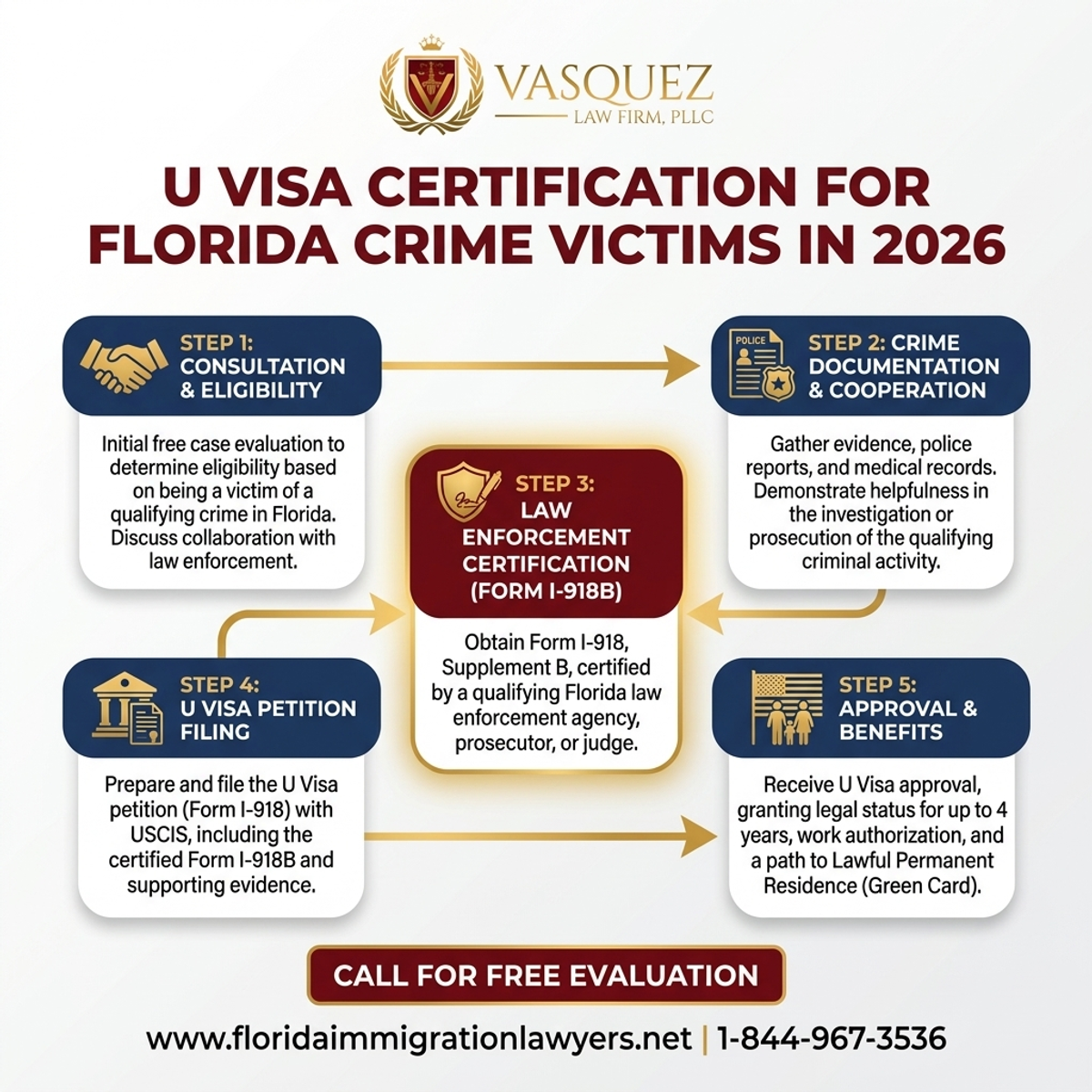
Step-by-Step Process — Vasquez Law Firm: U Visa Certification for Florida Crime Victims in 2026
- Form I-918, Petition for U Nonimmigrant Status: The primary application form submitted to USCIS.
- Form I-918, Supplement A, Petition for Qualifying Family Member of U-1 Recipient: If applicable, for eligible family members seeking derivative U visa benefits.
- Form I-918, Supplement B, U Nonimmigrant Status Certification: The signed certification from the law enforcement agency.
- Personal Statement from the Victim: A detailed narrative explaining the crime, the harm suffered, and your helpfulness.
- Evidence of Qualifying Criminal Activity: Police reports, court documents, news articles, affidavits from witnesses, or other official records of the crime.
- Evidence of Substantial Physical or Mental Abuse: Medical records, psychological evaluations, therapist notes, or affidavits from professionals or credible witnesses.
- Proof of Identity and Nationality: Copies of your passport, birth certificate, national identity card, or other official government-issued identification.
- Form I-192, Application for Advance Permission to Enter as Nonimmigrant: Required if you have any grounds of inadmissibility (e.g., certain criminal history, prior immigration violations).
- Biometrics: You will be scheduled for a biometrics appointment (fingerprinting and photograph) after filing.
- Document Translations: Any documents not in English must be accompanied by a certified English translation.
How Long Does U Visa Processing Take in 2026?
As of 2026, U visa processing times are lengthy due to high demand and annual caps. Initial processing to receive a Bona Fide Determination (BFD) can take several years, often leading to work authorization. Final U visa approval, after being placed on a waitlist, typically takes many more years before nonimmigrant status is granted, reflecting the significant volume of applications and the 10,000 annual limit.
The U visa process is notoriously long, and applicants must be prepared for extended waits. USCIS receives far more U visa petitions than the 10,000 annual cap allows. This disparity creates a substantial backlog, leading to the establishment of a waitlist. However, USCIS has implemented a Bona Fide Determination (BFD) process to provide some relief during the long wait. If USCIS determines that your petition is bona fide (meaning it appears to be legitimate and meets all initial eligibility requirements), you may be granted deferred action and receive a work permit (Employment Authorization Document, EAD), allowing you to live and work in the U.S. legally while awaiting final adjudication. This BFD process can provide immense relief to victims in Florida who need stability and protection.
Here is a typical timeline for U visa processing as of 2026:
| Stage | Typical Timeframe | Notes |
|---|---|---|
| Request for I-918 Supp B | 1-12 months | Varies significantly by law enforcement agency in Florida; diligent follow-up is critical. |
| USCIS Receipt Notice (I-797C) | 1-3 months | Confirms USCIS has received your completed Form I-918 petition. |
| Biometrics Appointment | 3-6 months | Scheduled at an Application Support Center (ASC), such as the one in Orlando, for fingerprinting and photo. |
| Bona Fide Determination (BFD) | 4-6 years | USCIS reviews for initial eligibility; if positive, grants work permit (EAD) and deferred action. |
| Waitlist Placement | Indefinite | Once BFD is granted, applicants are placed on a waitlist due to the 10,000 annual U visa cap. |
| Final U Visa Approval | 8-10+ years | After reaching the front of the waitlist, USCIS conducts a full review for U nonimmigrant status. |
It's important to remember that these are approximate times, and individual cases can vary. The Executive Office for Immigration Review (EOIR), which oversees immigration courts, may also be involved if you are in removal proceedings, and a U visa can offer crucial protection in such situations. Patience and consistent legal support are key throughout this extended process.
What Are the Costs Associated with a U Visa Application?
The primary costs for a U visa application include USCIS filing fees for Form I-918 and Form I-192 (if required), which are subject to change. However, as of 2026, many victims applying for a U visa are exempt from these fees or can apply for a fee waiver, significantly reducing out-of-pocket expenses. Legal representation fees are separate and depend on the complexity of the case and the attorney's experience.
While the prospect of legal fees can be a concern for many victims, it's important to know that USCIS recognizes the vulnerable position of U visa applicants. For Form I-918 and Form I-192, applicants can often request a fee waiver by submitting Form I-912, Request for Fee Waiver. This waiver is typically granted if the applicant's household income is at or below 150% of the Federal Poverty Guidelines, they receive a means-tested benefit, or they are experiencing financial hardship. Successfully obtaining a fee waiver can alleviate a significant financial burden, making the application process more accessible for crime victims in Florida. However, other costs like medical exams, if needed for eventual adjustment of status, and attorney fees, will still apply.
Here's an overview of potential costs for a U visa application:
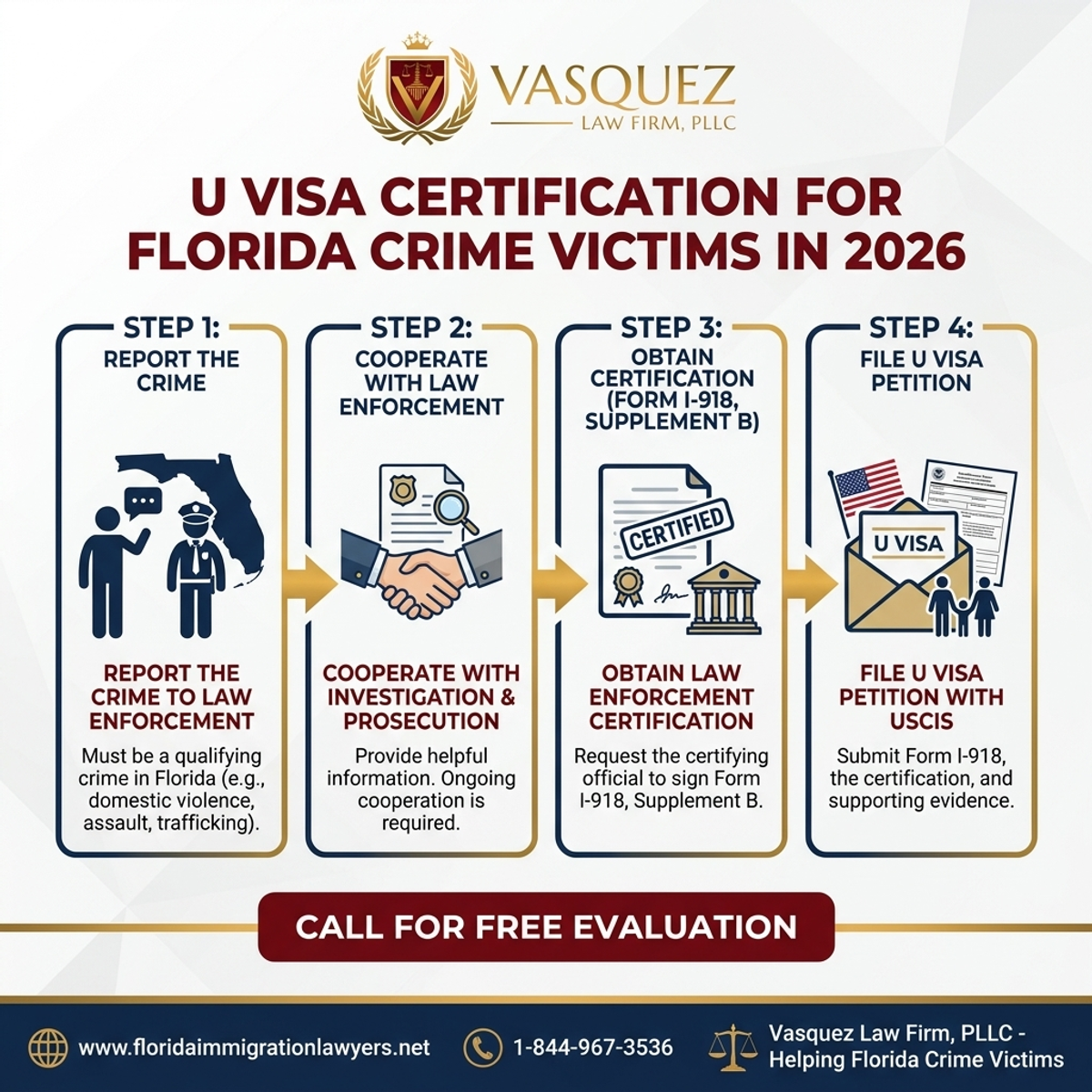
Key Statistics — Vasquez Law Firm: U Visa Certification for Florida Crime Victims in 2026
| Item | Typical Fee (Approx. 2026) | Notes |
|---|---|---|
| Form I-918 Petition | Waivable | Often exempt for U visa applicants due to victim status; Form I-912 can be filed. |
| Form I-192 Waiver (if applicable) | Waivable | Required if inadmissible; often exempt for U visa applicants. |
| Biometrics Fee | Waivable | Included in I-918 fee, often exempt for U visa. |
| Medical Examination (if needed) | $200-$500 | Required for adjustment of status to green card later; must be performed by a USCIS-approved civil surgeon. |
| Attorney Fees | Varies widely | Depends on complexity of case, attorney's experience, and services provided. Free consultations are often available with our attorneys. |
| Document Translation Fees | Varies | If documents are not in English, certified translations are required. |
While some fees can be waived, investing in experienced legal counsel can be invaluable. A knowledgeable immigration attorney can help you navigate the fee waiver process, ensure your application is complete and accurate, and advocate on your behalf with both law enforcement agencies and USCIS, ultimately saving you time and preventing costly errors.
Common Mistakes to Avoid in U Visa Certification and Application
The U visa process is complex, and even minor errors can lead to significant delays or outright denials. Avoiding these common mistakes is crucial for a successful application, especially when dealing with various law enforcement agencies in Florida and the stringent requirements of USCIS.
- Failing to Report the Crime Promptly: Delay in reporting a crime can raise questions about the legitimacy of the victim's claim or their helpfulness to law enforcement, weakening the case for U visa certification.
- Not Cooperating Fully with Law Enforcement: The core of the U visa is helpfulness. Any perceived lack of cooperation, or withdrawal of cooperation, can result in a denial of the I-918 Supplement B certification.
- Submitting an Incomplete I-918 Supplement B Request to Law Enforcement: Agencies are busy. A request lacking clear details, supporting documents, or a proper explanation of helpfulness is likely to be delayed or rejected, requiring further follow-up.
- Misunderstanding "Qualifying Criminal Activity" or "Substantial Harm": Not all crimes qualify for a U visa, and the harm suffered must meet the "substantial abuse" threshold. Misinterpreting these definitions can lead to a futile application.
- Missing Deadlines or Failing to Respond to USCIS Requests: USCIS communication, such as Requests for Evidence (RFEs), must be addressed promptly and thoroughly. Failure to do so can result in application denial.
- Not Disclosing All Immigration History or Inadmissibility Grounds: Attempting to hide past immigration violations or criminal history can lead to a finding of misrepresentation, resulting in a permanent bar from the U.S.
- Attempting to Apply Without Legal Counsel: The nuances of U visa law, particularly regarding waivers of inadmissibility and dealing with law enforcement, are best handled by an experienced immigration attorney.
- Leaving Florida or the U.S. Without Proper Authorization: Departing the country, especially while an application is pending, can be seen as abandonment of the petition or create inadmissibility issues upon return.
- Providing Inconsistent Statements: Any discrepancies between statements given to law enforcement, USCIS, or in personal affidavits can severely undermine credibility and lead to denial.
- Neglecting Derivative Family Members: Forgetting to include eligible family members on Form I-918, Supplement A, or failing to meet their specific eligibility criteria, can prevent them from obtaining U nonimmigrant status.
When to Call a Lawyer for Your U Visa Case in Florida
Navigating the U visa process, especially when dealing with law enforcement agencies across Florida and the complexities of immigration law, is rarely straightforward. While it's always advisable to consult an attorney, certain situations make legal representation absolutely essential. If you encounter any of the following scenarios, it's a clear sign that you need to seek expert legal counsel immediately.
You should call a lawyer if law enforcement is unresponsive or denies your certification request for Form I-918, Supplement B. An attorney can effectively communicate with agencies, understand the reasons for denial, and strategize on how to overcome obstacles. If you have a complex criminal history, prior immigration violations, or other inadmissibility issues, a lawyer is crucial to help you prepare and file the necessary waivers (Form I-192) and argue for your eligibility. Furthermore, if you are currently in removal proceedings before an immigration court, a U visa can offer a powerful defense, but it requires skilled legal advocacy to coordinate with the court and USCIS.
Other red flags include fearing retaliation from perpetrators or others, which can impact your ability to cooperate safely. An attorney can help you understand protective measures and ensure your safety is prioritized. If you are unsure whether your crime qualifies, if the harm you suffered meets the "substantial abuse" criteria, or if you need assistance gathering extensive documentation, legal guidance is invaluable. The experienced team at Florida Immigration Lawyers is here to help. Our attorneys, based in Orlando and serving all of Florida, specialize in U visa cases, asylum, family immigration, and more. We offer comprehensive support to ensure your application is complete, accurate, and compelling. Don't face this journey alone; schedule a free consultation today.
About Florida Immigration Lawyers
Florida Immigration Lawyers is a leading immigration law firm dedicated to serving individuals and families across the entire state of Florida. With a deep understanding of the intricacies of U.S. immigration law, our compassionate and experienced attorneys are committed to protecting the rights and securing the futures of immigrants. We pride ourselves on providing personalized, client-focused legal services, guiding you through every step of your immigration journey with integrity and professionalism.
Our firm specializes in a broad range of immigration matters, including U visas for crime victims, asylum, citizenship, family-based petitions, business immigration, and deportation defense. We understand the unique challenges faced by immigrant communities in Central Florida and beyond, and our bilingual team is equipped to provide clear, effective communication. We are available 24/7 to address your urgent needs and offer free case reviews to help you understand your legal options without financial obligation. Choose Florida Immigration Lawyers for dedicated advocacy and peace of mind.
Sources and References
- U.S. Citizenship and Immigration Services (USCIS)
- Executive Office for Immigration Review (EOIR)
- U.S. Department of State
- 8 U.S.C. § 1101(a)(15)(U) - Immigration and Nationality Act (INA) Section for U Nonimmigrant Status
- 8 CFR § 214.14 - Regulations Governing U Nonimmigrant Status
- USCIS Policy Manual, Volume 3, Part B, Chapter 5 - U Nonimmigrant Status
Related services: asylum application process, refugee status and resettlement, withholding of removal, humanitarian protection programs.
This article provides general legal information and is not intended as legal advice. Every case is unique, and outcomes depend on specific facts and circumstances. Contact an attorney for advice about your particular situation.
Your safety and legal future are paramount. If you are a crime victim in Florida seeking a U visa, do not hesitate to seek expert legal guidance. The complexities of law enforcement certification and USCIS requirements demand the attention of skilled professionals. Contact Florida Immigration Lawyers today at 1-844-YO-PELEO for a free, confidential case review. Se Habla Español - Estamos aquí para ayudarle.
Do Not Navigate This Process Alone
Our experienced immigration attorneys are ready to fight for you. Get a free, confidential case review today.
Se Habla Español
Or leave your details and we’ll call you:
Free Evaluation in 24 Hours
Or talk to us right now
AI voice assistant — available 24/7
FreeFrequently Asked Questions

William J. Vásquez
Founding Attorney · Vasquez Law Firm
U.S. Air Force veteran and immigration attorney with years of hands-on U.S. immigration experience. J.D., NCCU School of Law. AILA member. Admitted to the 4th, 5th, and 11th Circuit Courts.
Available 24/7 - Free Evaluations
Reviewed for legal accuracy by William J. Vásquez
Licensed in North Carolina; U.S. immigration is federal practice.
Related Legal Services
Our Florida immigration attorneys can help you with immigration lawyer cost in Florida, experienced immigration attorneys and asylum protection. Call today at 1-844-YO-PELEO for a free case review.
Related Links
Related Topics
Free Legal Case Review
Discuss your case with our experienced attorneys. We're available 24/7.
Se Habla Español - Estamos aquí para ayudarle.
Related Articles
Immigration Lawyer Orlando Free Consultation in Florida
For individuals and families in Orlando, Florida, navigating the complexities of U.S. immigration law requires expert guidance. An immigration lawyer in Orlando offers crucial support for everything from visa applications and green card processes to naturalization and deportation defense. This comprehensive guide details what a free consultation covers, providing a step-by-step overview of immigration pathways, essential document checklists, and expected timelines in 2026. We also highlight common mistakes to avoid, discuss the critical role of legal counsel in deportation and asylum cases, and explain why choosing a local Orlando immigration attorney is beneficial. Florida Immigration Lawyers is dedicated to serving the diverse community of Orlando with compassionate, effective legal solutions, ensuring you receive personalized advice and robust representation for a successful immigration journey.
EAD Advance Parole Combo Card in Florida 2026
For individuals with a pending Form I-485, Application to Register Permanent Residence or Adjust Status, the EAD Advance Parole Combo Card is an essential document. This single card combines the authorization to work legally in the U.S. (Employment Authorization Document - EAD) with permission to travel internationally and re-enter without abandoning your green card application (Advance Parole). This guide from Florida Immigration Lawyers provides a comprehensive overview for applicants in Florida in 2026, covering eligibility, the step-by-step application process, required documents, expected processing times, and associated costs. We also highlight common mistakes to avoid and when to seek legal counsel to ensure a smooth and successful immigration journey. Understanding this vital card is key to maintaining stability while awaiting your permanent residency approval.
Applying for Citizenship with Father's Family Petition
Applying for U.S. citizenship after a father's family petition requires navigating a multi-stage immigration process. This journey typically begins with the approved Form I-130, which establishes the family relationship, leading to lawful permanent residency (a green card). After a statutory period of 3 to 5 years as a green card holder, individuals become eligible to apply for naturalization, the final step to U.S. citizenship. This comprehensive guide from Florida Immigration Lawyers details the eligibility requirements, step-by-step application procedures, associated costs, and common pitfalls to avoid for those pursuing citizenship in Florida in 2026. Understanding the nuances of continuous residence, physical presence, and good moral character is crucial. Our firm provides expert legal assistance for family-based immigration and naturalization cases throughout Florida, ensuring your application is meticulously prepared and effectively presented. Secure your future with experienced legal guidance.
Immigration Lawyer Consultation Services in Florida 2026
Embarking on an immigration journey in Florida requires clear guidance through complex laws. An immigration lawyer consultation is your first essential step, offering a personalized assessment of your unique situation and outlining viable pathways such as family-based visas, employment opportunities, or asylum claims. This critical meeting helps identify potential challenges, understand necessary documentation, and clarifies timelines and costs involved. For anyone in Florida seeking to navigate the U.S. immigration system, a consultation provides the foundational knowledge to make informed decisions and proceed with confidence. Florida Immigration Lawyers is ready to provide expert assistance, ensuring your path forward is strategically planned and legally sound.