Removal Conditional Green Card Process in Florida 2026
For individuals with a two-year conditional green card obtained through marriage, the process of removing conditions is a critical next step. This involves filing Form I-751, Petition to Remove Conditions on Residence, within a strict 90-day window before expiration. This guide, relevant for 2026, details the required documentation, filing timelines, potential costs, and crucial waivers for special circumstances like divorce or abuse. It also highlights common mistakes to avoid and emphasizes the importance of demonstrating a bona fide marriage to USCIS. For residents across Florida, from Gainesville to Miami, understanding these requirements is vital to transitioning to permanent residency. Seeking legal guidance from Florida Immigration Lawyers can significantly enhance your chances of a successful outcome, providing peace of mind throughout this complex immigration process.
Removing the conditions on your green card in Florida, often referred to as the removal conditional green card process, is a critical step for individuals who initially received a two-year conditional permanent resident status based on marriage. This process primarily involves filing Form I-751, Petition to Remove Conditions on Residence, with USCIS within the 90-day window before your conditional green card expires. It requires demonstrating that your marriage was entered into in good faith and not solely for immigration benefits. Successfully navigating this complex process, especially if your marriage has ended, often benefits from experienced legal guidance to ensure all requirements are met and potential issues are addressed proactively.
- File Form I-751 within 90 days before your conditional green card expires.
- Provide extensive evidence of a bona fide marriage.
- Understand joint filing requirements or eligibility for waivers.
- Be prepared for potential interviews at a local USCIS office in Florida.
- Seek legal assistance for complex cases or waiver applications.
Receiving a conditional green card in Florida marks a significant milestone in your immigration journey, offering temporary permanent residency. However, the journey doesn't end there. For many, the next crucial step is the removal conditional green card process, which transforms your two-year conditional status into a permanent, 10-year green card. This step is vital for individuals who obtained their green card through marriage and whose marriage was less than two years old at the time of their green card approval. Failing to properly remove these conditions can lead to severe immigration consequences, including the loss of your legal status and potential deportation.
Navigating the complexities of U.S. immigration law can be challenging, particularly when dealing with specific requirements like the I-751 petition. From gathering the right evidence to understanding filing deadlines and potential waivers, each step demands careful attention to detail. This comprehensive guide will walk you through the entire process of removing conditions on your green card in Florida as of 2026, offering insights into what to expect, common pitfalls to avoid, and when professional legal assistance from a Florida immigration lawyer is indispensable. Our goal is to empower you with the knowledge needed to successfully transition from conditional to permanent resident status. If you have questions or need personalized guidance, do not hesitate to call Florida Immigration Lawyers at 1-844-YO-PELEO for a free consultation.
What is a Conditional Green Card and Why is it Issued?
A conditional green card is a type of permanent resident card issued to individuals who obtain their green card through marriage to a U.S. citizen or lawful permanent resident, and whose marriage was less than two years old on the day they were granted permanent residency. This status is temporary, lasting for two years, and is established under Section 216 of the Immigration and Nationality Act (INA).
The U.S. government implemented the conditional residency program primarily to deter marriage fraud. USCIS uses this two-year period to re-evaluate the legitimacy of the marriage. It provides an opportunity for the couple to demonstrate, through ongoing evidence, that their marriage is genuine and was not entered into solely for immigration benefits. For residents in Florida, this means that even if you've settled into life in Gainesville or Miami, the conditional nature of your status requires a subsequent application to become a permanent resident.
Unlike a standard 10-year green card, which grants permanent residency without further review, the conditional green card comes with an expiration date and a mandatory requirement to file Form I-751 to remove the conditions. If the conditions are not removed within the specified timeframe, the conditional resident status automatically terminates, potentially leading to deportation proceedings. This distinction is crucial for all conditional residents in Florida to understand, as it directly impacts their long-term ability to live and work in the United States.
How Do I Remove Conditions on My Green Card in Florida?
To remove conditions on your green card in Florida, you must file Form I-751, Petition to Remove Conditions on Residence, with U.S. Citizenship and Immigration Services (USCIS). This petition must be filed within the 90-day period immediately preceding the expiration date on your two-year conditional green card.
The primary purpose of Form I-751 is to demonstrate to USCIS that your marriage was and continues to be bona fide, meaning it was entered into in good faith and not to circumvent immigration laws. Typically, you and your petitioning spouse file the I-751 jointly. However, there are provisions for filing a waiver if your circumstances have changed, such as in cases of divorce, abuse, or the death of your spouse. For Florida residents, filing involves sending your completed petition and supporting documentation to the designated USCIS Lockbox facility, which will depend on your specific mailing address. A successful filing leads to an extension of your status, allowing you to continue living and working in the U.S. while your petition is being processed. Seeking guidance from a Florida family immigration lawyer can be invaluable.
What Documents Do I Need for the I-751 Petition? (Document Checklist)
For the I-751 petition, you need to provide extensive evidence proving your marriage is bona fide. The more compelling and varied the evidence, the stronger your case for the removal conditional green card.
As of 2026, USCIS expects a comprehensive package of documents that collectively demonstrate the marital relationship is genuine and ongoing. This includes evidence of cohabitation, commingled finances, joint responsibilities, and shared social life. While no single document guarantees approval, a robust collection of evidence from different categories is highly recommended. Organize your documents clearly and label them appropriately to assist the USCIS officer reviewing your petition. Submitting certified translations for any non-English documents is also a mandatory requirement.
- Form I-751, Petition to Remove Conditions on Residence: Completed and signed by both spouses (or by the conditional resident if filing a waiver).
- Copy of your Conditional Green Card: Both front and back.
- Copy of your Marriage Certificate.
- Birth Certificates of Children: If you have children born during the marriage.
- Joint Financial Documents:
- Joint bank account statements (savings, checking).
- Joint federal and state income tax returns for the past two years.
- Joint credit card statements.
- Joint utility bills (electricity, water, gas, internet).
- Joint leases, mortgages, or property deeds showing co-ownership.
- Evidence of Cohabitation:
- Leases or mortgages showing joint residency.
- Utility bills addressed to both spouses at the same address.
- Driver's licenses or state IDs showing the same address.
Step-by-Step Process — Removal Conditional Green Card Process in Florida 2026
- Insurance Policies: Joint health, life, auto, or home insurance policies naming each other as beneficiaries.
- Affidavits from Third Parties: Statements from friends, family members, or employers attesting to the bona fide nature of your marriage. These should be notarized and include the affiant's contact information.
- Photographs: A selection of photos of the couple together over time, including with family and friends, at significant events, and on vacations. Date and identify individuals in the photos.
- Other Evidence:
- Travel itineraries and tickets for trips taken together.
- Joint membership cards (e.g., gym, clubs).
- Correspondence addressed to both spouses.
- Evidence of gifts exchanged.
- Any other relevant documentation demonstrating a shared life.
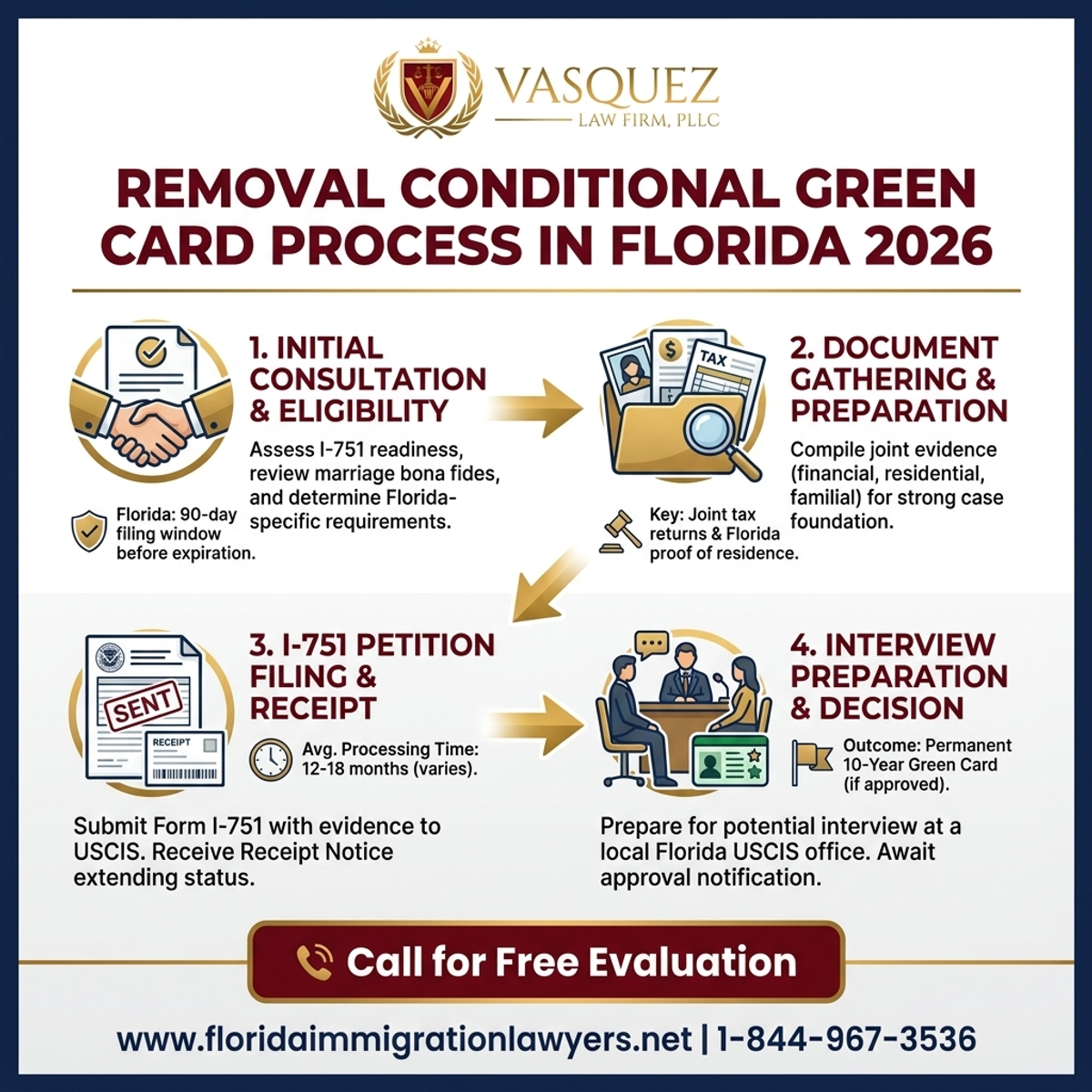
What is the I-751 Filing and Processing Timeline in 2026?
As of 2026, the I-751 filing and processing timeline typically ranges from 12 to 24 months, though some cases may take longer depending on the USCIS service center and the complexity of the application. The process begins with timely submission of your petition.
After filing, USCIS will issue a receipt notice, Form I-797C, Notice of Action, which typically extends your conditional resident status for 24-48 months. This receipt notice is crucial for proving your continued lawful status for employment, travel, and other purposes. Following this, you will receive a notice for a biometrics appointment at an Application Support Center (ASC) in Florida, such as those near Orlando or Tampa. While many I-751 petitions are approved without an interview, USCIS may schedule one if they require additional information or have concerns about the marriage's authenticity. The final decision will be mailed to you. You can check the current processing times for Form I-751 on the USCIS website.
| Stage | Typical Timeframe (as of 2026) | Notes |
|---|---|---|
| File I-751 Petition | Within 90 days before green card expiration | Crucial deadline; missing it can lead to termination of status. |
| Receipt Notice (I-797C) | 2-4 weeks after filing | Extends conditional resident status for 24-48 months, allowing continued work and travel. |
| Biometrics Appointment | 4-8 weeks after receipt notice | Fingerprints and photos taken at a local USCIS Application Support Center. |
| Request for Evidence (RFE) (if applicable) | Varies, typically 6-12 months after filing | USCIS requests additional documentation or clarification. Timely response is critical. |
| Interview (if required) | 12-24 months after filing | Not all cases require an interview; more common for waiver petitions or if concerns arise. |
| Decision on I-751 | 18-30 months after filing | Approval results in a 10-year permanent green card; denial can lead to Notice to Appear (NTA). |
Understanding I-751 Waivers and Special Circumstances
While most conditional residents file Form I-751 jointly with their U.S. citizen or lawful permanent resident spouse, circumstances can arise where a joint filing is not possible or advisable. In such cases, the conditional resident may be eligible to apply for a waiver of the joint filing requirement. Understanding these waivers is crucial for individuals in Florida facing challenging situations.
As of 2026, USCIS recognizes several grounds for I-751 waivers. These include the death of the petitioning spouse, which allows the surviving spouse to file the petition alone. Another common waiver is for those whose marriage ended in divorce or annulment, provided the conditional resident can demonstrate that the marriage was entered into in good faith. This 'good faith marriage' waiver is often utilized in Florida by individuals who genuinely married but whose relationship unfortunately did not last. Furthermore, waivers are available for conditional residents who have been subjected to battery or extreme cruelty by their U.S. citizen or permanent resident spouse, or whose removal would result in extreme hardship. These provisions are designed to protect vulnerable individuals and ensure they are not penalized for circumstances beyond their control. Seeking legal counsel is highly recommended when considering a waiver, as these cases often involve complex legal arguments and substantial evidence. An experienced immigration attorney can help you navigate these sensitive situations and prepare a strong waiver application.
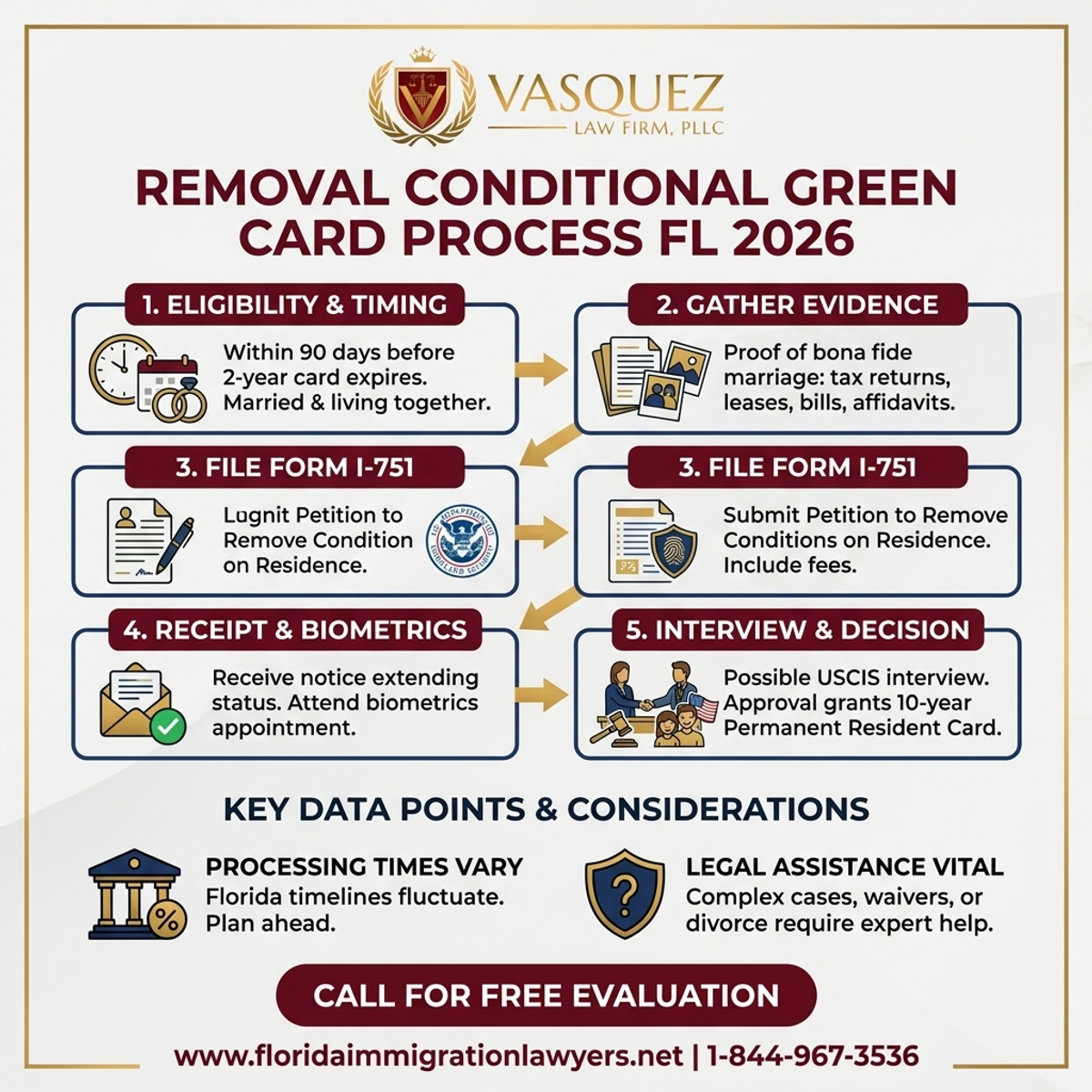
Key Statistics — Removal Conditional Green Card Process in Florida 2026
Costs Associated with Conditional Green Card Removal in Florida
The costs associated with the removal conditional green card process primarily involve USCIS filing fees and, potentially, legal fees for attorney representation. As of 2026, USCIS fees are subject to change, so it is always essential to verify the most current amounts directly on the official USCIS website before filing.
The filing fee for Form I-751 is a mandatory cost for all applicants. Additionally, a separate biometrics services fee is required for each individual included in the petition who needs to provide fingerprints and photographs. Beyond these government fees, applicants in Florida may incur costs for obtaining necessary supporting documents, such as certified copies of birth certificates or marriage licenses, and professional translation services for any documents not in English. Legal fees can vary significantly based on the complexity of your case, whether you are filing jointly or seeking a waiver, and the level of service provided by your chosen immigration lawyer. While some individuals choose to file independently, the investment in legal counsel can be invaluable for ensuring accuracy, completeness, and a higher likelihood of success, especially for complex or challenging cases. USCIS offers information on fee waivers for those who meet specific financial hardship criteria; however, applying for a fee waiver adds another layer of complexity to the process. For the most up-to-date fee information, always refer to the USCIS Filing Fees page.
| Item | Typical Fee (as of 2026) | Notes |
|---|---|---|
| USCIS Form I-751 Filing Fee | Varies (check USCIS website) | Required for the petition itself; non-refundable. |
| Biometrics Services Fee | Varies (check USCIS website) | Per applicant required to provide biometrics (fingerprints, photos, signature). |
| Attorney Fees | Highly variable (e.g., $2,000 - $8,000+) | Depends on case complexity (joint vs. waiver), attorney experience, and services rendered. |
| Document Translation Fees | Varies (e.g., $20 - $50 per page) | For any documents not in English, requiring certified translation. |
| Postage/Shipping Fees | Varies (e.g., $10 - $50) | For sending your application package to USCIS via certified mail or courier. |
Do not navigate this process alone. The stakes are high, and even minor errors can lead to significant delays or denial. Contact Florida Immigration Lawyers today for assistance with your conditional green card removal process. Our experienced team is ready to help you every step of the way.
Common Mistakes to Avoid During Conditional Green Card Removal
The process of removing conditions on your green card is meticulous, and even small errors can lead to significant delays or even denial. Being aware of common pitfalls can help you avoid them.
- Missing the 90-Day Filing Window: This is perhaps the most critical mistake. Form I-751 must be filed within the 90 days immediately before your conditional green card expires. Filing too early or too late can result in your status terminating automatically.
- Submitting Insufficient Evidence: USCIS requires robust proof of a bona fide marriage. Relying on only a few documents, or submitting weak evidence, can lead to a Request for Evidence (RFE) or denial.
- Failing to Update Your Address with USCIS: If you move, you must inform USCIS within 10 days using Form AR-11. Missing notices due to an outdated address can result in missed appointments or critical deadlines.
- Ignoring a Request for Evidence (RFE): If USCIS sends an RFE, it means they need more information. Failing to respond comprehensively and on time will almost certainly lead to a denial.
- Traveling Internationally Without Proper Documentation: After filing I-751, your conditional green card is extended by the receipt notice. Traveling without this notice, or with an expired card and no notice, can cause issues upon re-entry.
- Not Disclosing All Relevant Information: Attempting to hide a criminal history, previous marriages, or other pertinent facts can be considered misrepresentation and lead to severe penalties, including deportation.
- Filing the Wrong Form or Incomplete Information: Using an outdated version of Form I-751 or failing to fill out all required sections correctly can cause your petition to be rejected.
- Assuming an Interview is Not Required: While many I-751 cases are approved without an interview, USCIS can schedule one at any time. Not being prepared for an interview can jeopardize your case.
- Poor Organization of Supporting Documents: Submitting a disorganized pile of documents makes it difficult for USCIS to review your case efficiently, potentially leading to RFEs or delays.
- Not Seeking Legal Advice for Complex Cases: If your marriage has ended, you have a criminal record, or you're filing a waiver, navigating the process without legal help significantly increases the risk of denial.
- Submitting Expired or Incorrect Fees: USCIS filing fees change periodically. Always verify the current fee amounts on the USCIS website to avoid your petition being rejected.
- Lack of Timely Response to USCIS Communications: Whether it's an RFE, an interview notice, or other correspondence, prompt and accurate responses are vital to keep your case moving forward.
When to Call a Florida Immigration Lawyer for Conditional Green Card Removal
While some individuals may feel confident filing Form I-751 on their own, there are many scenarios where the expertise of a Florida immigration lawyer is not just helpful, but crucial. The stakes are incredibly high, as the failure to properly remove conditions can lead to the termination of your lawful status and potential deportation.
You should strongly consider contacting Florida Immigration Lawyers if your marriage has ended in divorce or annulment, and you need to file a waiver. This is a complex area of law, and proving a bona fide marriage under these circumstances requires careful preparation and presentation of evidence. Similarly, if you have been a victim of abuse or extreme cruelty by your U.S. citizen spouse, an attorney can help you navigate the sensitive waiver process while protecting your safety. Other red flags include a criminal record, a previous denial of an immigration benefit, or if USCIS has sent you a Request for Evidence (RFE) or a Notice of Intent to Deny (NOID). Our attorneys at Florida Immigration Lawyers are experienced in handling all aspects of the removal conditional green card process, including representing clients at interviews and responding to complex USCIS inquiries. We serve clients across Florida, including Orlando, ensuring you have strong legal advocacy.
About Florida Immigration Lawyers
Florida Immigration Lawyers is an immigration law firm dedicated to serving individuals and families across the entire state of Florida. With a deep understanding of U.S. immigration laws and a compassionate approach, our experienced attorneys are committed to providing exceptional legal representation. We focus on a wide range of immigration matters, including family-based petitions, employment visas, asylum claims, citizenship applications, and deportation defense.
Our firm prides itself on offering personalized service, ensuring that each client receives the attention and strategic advice their unique case demands. We understand the challenges and anxieties that come with immigration processes, and we strive to make the journey as smooth and stress-free as possible. Available 24/7 for your convenience, we offer free consultations to discuss your options and develop a clear path forward. Whether you are in Gainesville, Jacksonville, Orlando, Tampa, or Miami, Florida Immigration Lawyers is here to be your trusted legal partner. Call us today at 1-844-YO-PELEO to speak with an attorney.
Sources and References
- U.S. Citizenship and Immigration Services (USCIS)
- USCIS Form I-751, Petition to Remove Conditions on Residence
- USCIS Filing Fees
- Executive Office for Immigration Review (EOIR)
- 8 U.S.C. § 1186a - Conditional permanent resident status for certain alien spouses and sons and daughters
- 8 CFR Part 216 - Conditional Basis of Lawful Permanent Residence Status
- USCIS Policy Manual, Volume 6 - Immigrants, Part G - Spouses, Children, and Parents of U.S. Citizens and Lawful Permanent Residents, Chapter 2 - Conditional Permanent Resident Status
Related services: family petition process, family-based green cards, fiancé visa (K-1), marriage-based immigration.
This article provides general legal information and is not intended as legal advice. Every case is unique, and outcomes depend on specific facts and circumstances. Contact an attorney for advice about your particular situation.
Don't jeopardize your future in the United States. Ensure your removal conditional green card process is handled correctly and efficiently. Contact Florida Immigration Lawyers today at 1-844-YO-PELEO for a free consultation. Se Habla Español - Estamos aqui para ayudarle.
Do Not Navigate This Process Alone
Our experienced immigration attorneys are ready to fight for you. Get a free, confidential case review today.
Se Habla Español
Or leave your details and we’ll call you:
Free Evaluation in 24 Hours
Or talk to us right now

AI voice assistant — available 24/7
FreeFrequently Asked Questions

William J. Vásquez
Founding Attorney · Vasquez Law Firm
U.S. Air Force veteran and immigration attorney with years of hands-on U.S. immigration experience. J.D., NCCU School of Law. AILA member. Admitted to the 4th, 5th, and 11th Circuit Courts.
Available 24/7 - Free Evaluations
Reviewed for legal accuracy by William J. Vásquez
Licensed in North Carolina; U.S. immigration is federal practice.
Related Legal Services
Our Florida immigration attorneys can help you with citizenship and naturalization, immigration practice areas and free immigration consultation. Call today at 1-844-YO-PELEO for a free case review.
Related Links
Related Topics
Free Legal Case Review
Discuss your case with our experienced attorneys. We're available 24/7.
Se Habla Español - Estamos aquí para ayudarle.
Related Articles
EB-5 Investor Green Card in Florida: A 2026 Guide
Explore how to obtain an EB-5 investor green card in Florida. Learn about the investment requirements, processes, and benefits of participating in this program. Discover how Florida's economic landscape can be an ideal setting for your investment. Contact Florida Immigration Lawyers for a free case review.
Certificate of Eligibility for Expungement in Florida 2026
For non-U.S. citizens in Florida, understanding how a state expungement impacts immigration status is critical. A certificate of eligibility for expungement in Florida allows a criminal record to be sealed or expunged under state law. However, federal immigration agencies often disregard such state-level relief, still considering the original criminal offense as a conviction for immigration purposes. This can have severe implications for visa applications, green card eligibility, naturalization, and even lead to deportation. This guide clarifies the Florida expungement process, its limited effect on federal immigration law, and key steps to protect your status in 2026. Learn about common mistakes, required documents, timelines, and when to seek expert legal counsel from Florida Immigration Lawyers to navigate these complex issues effectively.
Immigration Lawyer Orlando Free Consultation in Florida
For individuals and families in Orlando, Florida, navigating the complexities of U.S. immigration law requires expert guidance. An immigration lawyer in Orlando offers crucial support for everything from visa applications and green card processes to naturalization and deportation defense. This comprehensive guide details what a free consultation covers, providing a step-by-step overview of immigration pathways, essential document checklists, and expected timelines in 2026. We also highlight common mistakes to avoid, discuss the critical role of legal counsel in deportation and asylum cases, and explain why choosing a local Orlando immigration attorney is beneficial. Florida Immigration Lawyers is dedicated to serving the diverse community of Orlando with compassionate, effective legal solutions, ensuring you receive personalized advice and robust representation for a successful immigration journey.
Fiance Visa in Miami: Your 2026 Florida K-1 Guide
For U.S. citizens in Florida, including Miami and Orlando, who wish to bring their foreign fiance(e) to the U.S. for marriage, the K-1 fiance visa is the primary immigration pathway. This comprehensive guide details the K-1 visa process for 2026, covering eligibility requirements for both the petitioner and beneficiary, the necessary documentation, expected timelines, and associated costs. We break down the stages from filing Form I-129F with USCIS to consular processing and the subsequent Adjustment of Status after marriage. Learn about common mistakes to avoid and understand when to seek professional legal assistance. Florida Immigration Lawyers offers expert guidance to help you navigate this complex journey, ensuring a smooth and successful application. Call us for a free case review.