TN Visa for USMCA Professionals: Florida Guide 2026
For Canadian and Mexican professionals seeking temporary employment in Florida's thriving sectors, the TN visa offers a unique and efficient pathway. Established under NAFTA and continued by USMCA, this nonimmigrant visa allows qualified individuals to work in specific professional occupations in the U.S. This comprehensive guide details eligibility criteria, including nationality, a pre-arranged job offer, and necessary educational qualifications, as well as the application processes for both Canadian and Mexican citizens. It covers essential documentation, provides tables for typical processing times and costs in 2026, and offers crucial advice on maintaining and extending your TN status. Learn about common mistakes to avoid and understand when legal assistance from Florida Immigration Lawyers can be invaluable for navigating the complexities of U.S. immigration law. We serve all of Florida, offering free case reviews and dedicated support.

The TN visa allows Canadian and Mexican citizens to work in the United States in pre-arranged professional occupations. Established under the North American Free Trade Agreement (NAFTA) and continued by the United States-Mexico-Canada Agreement (USMCA), this nonimmigrant visa is an excellent option for professionals seeking temporary employment in Florida. Eligibility depends on the applicant's nationality, the profession aligning with the USMCA list, and having the necessary educational qualifications or licenses. The process typically involves applying at a U.S. port of entry or through a USCIS petition, offering a streamlined path for qualified individuals to contribute to Florida's diverse economy.
- Eligibility: Canadian or Mexican citizen, pre-arranged professional occupation, required qualifications.
- Benefits: Faster processing, no numerical cap (unlike H-1B), renewable indefinitely.
- Application: Port of entry for Canadians; USCIS petition or consulate for Mexicans.
- Location: Ideal for professionals seeking opportunities in Florida's growing sectors.
- Assistance: Florida Immigration Lawyers can guide you through the complex TN visa application.
Florida's vibrant economy, with its booming tech, healthcare, tourism, and aerospace industries, continuously attracts top talent from across North America. For many Canadian and Mexican professionals, the path to temporary employment in the Sunshine State is paved by the TN visa, a unique nonimmigrant work visa category. Originally established under the North American Free Trade Agreement (NAFTA) and seamlessly continued under its successor, the United States-Mexico-Canada Agreement (USMCA), the TN visa offers a streamlined route for eligible professionals to work in the U.S.
Navigating the complexities of U.S. immigration law can be challenging, especially with evolving regulations and specific requirements. This comprehensive guide will illuminate the TN visa process for USMCA professionals, focusing on eligibility criteria, application procedures, required documentation, and what to expect in terms of timelines and costs in 2026. Whether you are a Canadian engineer looking to work in Orlando's simulation industry or a Mexican accountant aiming for opportunities in Miami, understanding the nuances of the TN visa is crucial for a successful application. Florida Immigration Lawyers are here to provide the guidance you need. Call us today at 1-844-YO-PELEO for a free case review.
What is a TN Visa for USMCA Professionals in Florida?
The TN (Trade NAFTA) visa is a special nonimmigrant classification that permits qualified Canadian and Mexican citizens to engage in business activities at a professional level in the United States. It was created to facilitate the temporary entry of business persons under the terms of NAFTA, which has since been superseded by the USMCA. As of 2026, the provisions for the TN visa remain largely consistent under the USMCA, enabling professionals to fill critical roles in various U.S. industries, including those experiencing rapid growth in Florida.
Unlike some other work visas, the TN visa does not have an annual numerical cap, making it an attractive option for many. It is granted for an initial period of up to three years and can be renewed indefinitely, as long as the applicant maintains nonimmigrant intent – meaning they intend to return to their home country upon the completion of their authorized stay. This flexibility makes it particularly suitable for professionals seeking short-term or project-based employment in Florida's dynamic job market. For example, a Canadian IT consultant could secure a TN visa to work on a specific project for a tech firm in Central Florida, contributing their expertise without the complexities of other visa categories.
The legal framework for the TN visa is primarily found in Section 214(e) of the Immigration and Nationality Act (INA) and further detailed in 8 CFR 214.6. This framework specifies the eligible professions, educational requirements, and the application procedures. Understanding these foundational elements is the first step toward a successful TN visa application. Florida's strategic location and robust economy make it a prime destination for professionals leveraging the TN visa to advance their careers. From healthcare professionals in Tampa to financial analysts in Jacksonville, the opportunities are vast and varied. Ensuring your profession aligns with the USMCA list and that you meet the educational criteria is paramount.
Who is Eligible for a TN Professional Visa in 2026?
To be eligible for a TN professional visa in 2026, you must be a citizen of Canada or Mexico, possess the necessary qualifications for one of the designated professional occupations under the USMCA, and have a pre-arranged offer of employment from a U.S. employer. This visa category is specifically designed for individuals who will be working in a professional capacity, requiring a bachelor's degree or licensure in a specific field.
The USMCA agreement outlines a specific list of eligible professions. This list is exhaustive, and your occupation must fall squarely within one of these categories. Examples include accountants, engineers, lawyers, teachers, scientific technicians, economists, management consultants, and various medical professionals such as registered nurses and physical therapists. For many of these professions, a bachelor's degree is the minimum requirement. However, some, like management consultants, may also qualify with extensive professional experience. For instance, a Canadian architect with a relevant degree seeking to work on a new development project in Orlando would typically meet the professional occupation criteria.
Beyond your nationality and profession, you must also demonstrate that you possess the required educational credentials or licenses. This typically means holding a baccalaureate degree or a licensura (for Mexican citizens) in a field directly related to the intended professional activity. In some cases, a state or provincial license may also be required if the profession demands it in the U.S. For example, a registered nurse must be licensed in the state of Florida to practice. Furthermore, you must have a legitimate offer of employment from a U.S. employer, and your work must be temporary in nature, consistent with the nonimmigrant intent requirement. This means you should not have the ultimate intention of permanently residing in the U.S. when applying for the TN visa.
How Do I Apply for a TN Visa as a USMCA Professional?
The application process for a TN visa differs slightly depending on whether you are a Canadian or Mexican citizen. Canadian citizens generally have a more streamlined process, often applying directly at a U.S. port of entry, while Mexican citizens typically apply through a U.S. consulate or embassy after their employer files a petition.
Application Process for Canadian Citizens:
- Secure a Job Offer: Obtain a job offer from a U.S. employer in one of the USMCA-designated professional occupations.
- Gather Documentation: Compile all necessary documents, including proof of Canadian citizenship, original educational degrees/transcripts, professional licenses, and a detailed letter from your prospective U.S. employer.
- Apply at a Port of Entry (POE): Present your application package to a U.S. Customs and Border Protection (CBP) officer at a U.S. port of entry or a pre-flight inspection station. The CBP officer will review your documents and conduct an interview to determine your eligibility. If approved, your TN status will be granted immediately, and you can enter the U.S.
- Pay Fee: Be prepared to pay the required application fee at the port of entry. As of 2026, this fee is typically around $50.
- Alternatively, File Form I-129: Your U.S. employer can also file Form I-129, Petition for a Nonimmigrant Worker, with USCIS on your behalf. This is often done if the applicant is already in the U.S. and seeking to change status or extend their TN status without leaving the country.
Application Process for Mexican Citizens:
- Secure a Job Offer: Similar to Canadians, you must have a job offer from a U.S. employer in a USMCA-designated professional occupation.
- Employer Files Form I-129: Your prospective U.S. employer must file Form I-129, Petition for a Nonimmigrant Worker, with USCIS on your behalf. This petition must include all supporting documentation proving your eligibility, such as your educational credentials and the employer's letter.
- USCIS Processing: USCIS will process the I-129 petition. If approved, USCIS will send an approval notice (Form I-797). Premium processing is available for an additional fee to expedite this step.
- Consular Interview: Once the I-129 is approved, you will need to schedule an interview at a U.S. embassy or consulate in Mexico. You will present your approval notice, passport, visa application forms (DS-160), and supporting documents.
- Visa Issuance: If the consular officer approves your application, a TN visa will be stamped in your passport, allowing you to travel to a U.S. port of entry and seek admission.
- Pay Fees: Be prepared to pay the DS-160 application fee and any other applicable visa issuance fees.
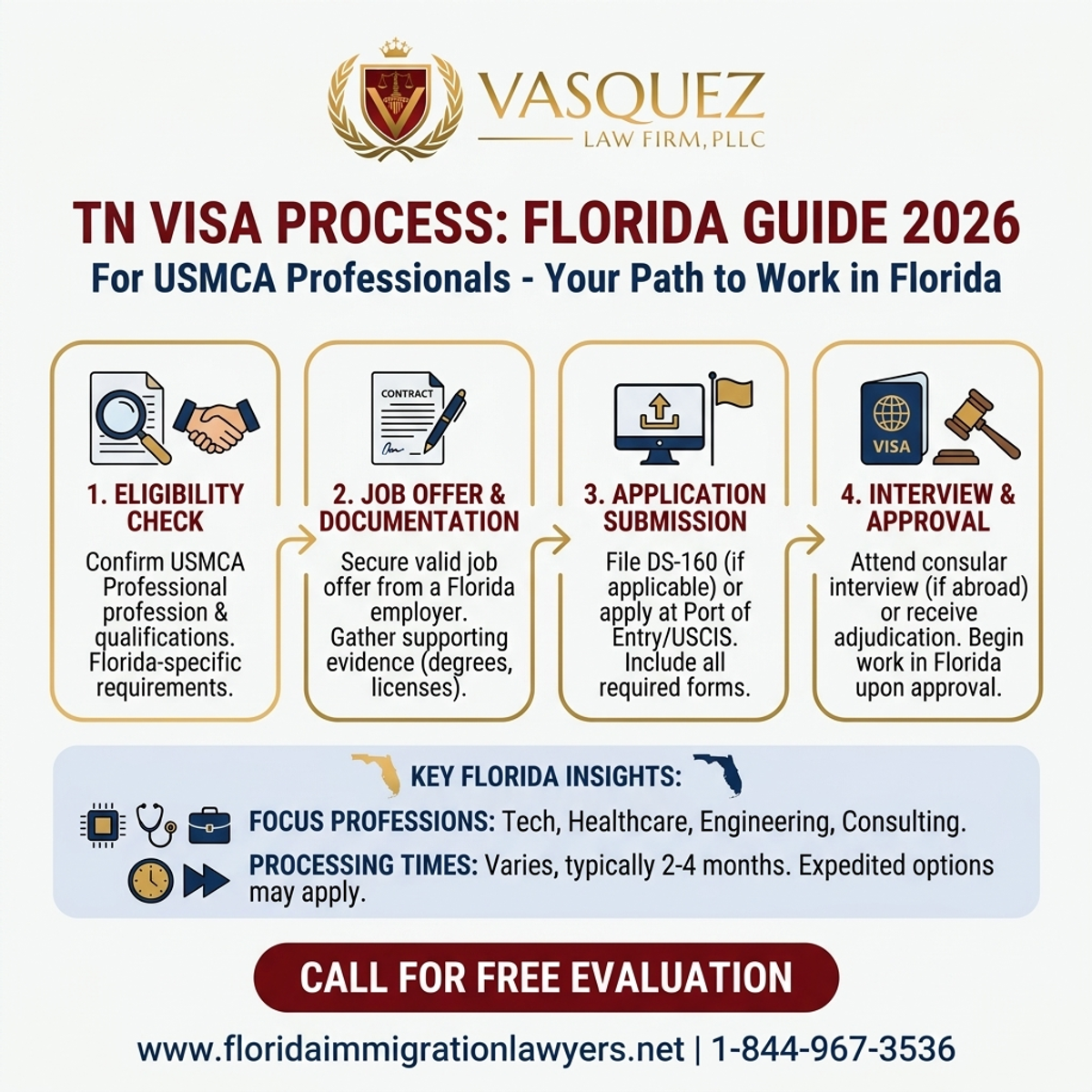
Step-by-Step Process — TN Visa for USMCA Professionals: Florida Guide 2026
It is crucial to meticulously prepare all documentation and ensure strict adherence to the application guidelines. Any discrepancies or missing information can lead to delays or even denial. For those residing in Florida and seeking to extend or change status, the USCIS processing centers handle the I-129 petitions. For example, individuals in Central Florida would typically submit their petitions to the USCIS service center with jurisdiction over their case, which is often the Vermont Service Center or California Service Center, depending on the type of filing.
What Documents Are Required for a TN Visa Application?
A complete and accurate set of documents is critical for a successful TN visa application. Regardless of whether you are applying at a port of entry or through a consulate, ensure you have all original documents and copies ready. Missing or incorrect documentation is a leading cause of delays and denials.
TN Visa Document Checklist:
- Proof of Canadian or Mexican Citizenship: Valid passport (for both), or birth certificate with photo identification (for Canadians).
- Letter from U.S. Employer: A detailed letter from your prospective U.S. employer confirming the job offer. This letter must:
- State the professional capacity in which you will be employed.
- Describe the job duties.
- Specify the anticipated length of stay (up to three years).
- Outline the educational qualifications or licenses required for the position.
- State the salary or remuneration.
- Confirm the nonimmigrant intent, i.e., the temporary nature of the employment.
- Educational Credentials: Original or certified copies of academic degrees (e.g., Bachelor's, Licenciatura) and official transcripts. If your degree is from a non-U.S. institution, an educational equivalency evaluation may be required.
- Professional Licenses: Any required professional licenses to practice your occupation in Florida (e.g., nursing license, engineering license).
- Resumé/Curriculum Vitae (CV): A detailed document outlining your professional experience and qualifications.
- Evidence of Prior Experience: Letters from previous employers, if experience is used to qualify for certain professions (e.g., management consultant).
- Application Forms: For Mexican citizens, the DS-160 Online Nonimmigrant Visa Application confirmation page. For those filing Form I-129, the approved I-797 notice.
- Photographs: Passport-style photographs meeting U.S. visa requirements (for Mexican citizens).
- Proof of Nonimmigrant Intent: While not explicitly required for Canadians at the border, it's advisable to carry documents demonstrating ties to your home country (e.g., property deeds, bank statements, family ties) if questioned.
For individuals seeking employment in Florida, it's particularly important to ensure that any state-specific licensing requirements are met. For example, a doctor or nurse from Canada or Mexico must ensure their qualifications are recognized and that they obtain the necessary Florida state licenses before commencing employment. This often involves additional steps with state regulatory boards, which our firm can help you understand.
What Are the TN Visa Processing Times and Costs in 2026?
The processing times and costs for a TN visa in 2026 can vary significantly based on your nationality and the application method chosen. Understanding these factors is crucial for planning your move to Florida and commencing your professional work.
Typical TN Visa Processing Times (as of 2026):
| Stage | Typical Timeframe | Notes |
|---|---|---|
| Canadian Citizen at Port of Entry | Immediate (same day) | Assuming all documentation is complete and eligibility is clear. |
| USCIS Form I-129 Processing (Mexican Citizen or Canadian already in U.S.) | 3 to 6 months | Varies by USCIS service center workload. Check USCIS processing times for current estimates. |
| USCIS Form I-129 Premium Processing | 15 calendar days | Available for an additional fee, guarantees a response within 15 days. |
| Consular Interview Scheduling (Mexican Citizen) | Weeks to months | Depends on embassy/consulate availability in Mexico. |
| Visa Issuance (Mexican Citizen) | Days to weeks after interview | After a successful interview, the visa is usually stamped quickly. |
Typical TN Visa Cost Factors and Fee Breakdown (as of 2026):
| Item | Typical Fee | Notes |
|---|---|---|
| Canadian Citizen Port of Entry Application Fee | Approximately $50 USD | Paid to CBP at the border. |
| USCIS Form I-129 Filing Fee | Varies (Check USCIS website) | Paid by the employer. Subject to change. |
| USCIS Form I-907 Premium Processing Fee | Varies (Check USCIS website) | Optional fee for expedited processing. Paid by the employer. Subject to change. |
| DS-160 Nonimmigrant Visa Application Fee (Mexican Citizen) | Varies (Check Department of State website) | Paid to the U.S. Department of State before the consular interview. Subject to change. |
| Attorney Fees | Varies widely | For legal assistance with preparing the petition and supporting documents. |
| Educational Credential Evaluation (if needed) | $100 - $300 | Required if your foreign degree needs U.S. equivalency. |
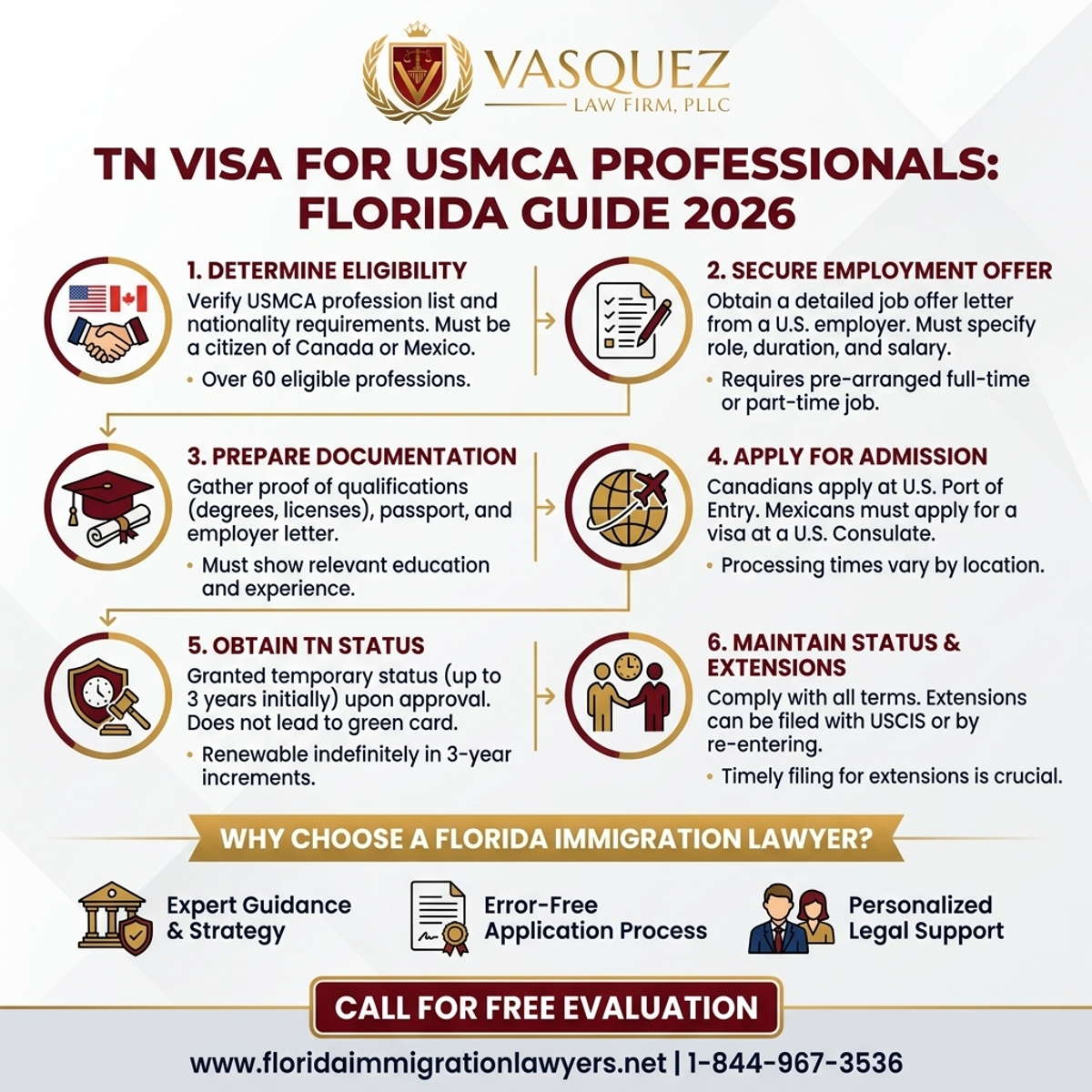
Key Statistics — TN Visa for USMCA Professionals: Florida Guide 2026
It is important to note that all government fees are subject to change. Always refer to the official USCIS and Department of State websites for the most current fee schedules. While the TN visa generally offers a cost-effective route compared to some other work visas, legal fees for assistance can be a significant component of the overall expense. Investing in legal counsel ensures accuracy and efficiency in the complex immigration process.
Do not navigate this process alone. Contact Florida Immigration Lawyers today for comprehensive support and guidance throughout your TN visa application. Call us at 1-844-YO-PELEO.
Maintaining and Extending Your TN Professional Status in Florida
Once you have successfully obtained your TN visa and are working in Florida, it's crucial to understand the requirements for maintaining your status and the process for extending it if your employment continues. The TN visa is granted for a specific period, typically up to three years, and it is imperative to adhere to its terms to avoid complications.
Maintaining your TN status primarily involves continuing to work for the employer specified in your application, in the professional capacity for which the visa was granted. If you change employers or your job duties significantly change, you may need to file a new TN application or an amended I-129 petition. For instance, if a Canadian engineer initially approved for a TN visa with a firm in Tampa decides to take a new engineering position with a company in Jacksonville, they would typically need to apply for a new TN visa. Similarly, if your job title remains the same but your responsibilities drastically shift to a non-professional role, your status could be jeopardized.
Extending your TN status is a common practice for professionals whose temporary assignments in Florida last longer than the initial three-year period. You can apply for an extension in two primary ways: either by departing the U.S. and reapplying at a port of entry (for Canadians) or a U.S. consulate (for Mexicans), or by having your employer file Form I-129 with USCIS on your behalf while you remain in the U.S. The I-129 extension process is similar to the initial petition, requiring updated employment letters and evidence of continued eligibility. There is no limit to the number of times a TN visa can be extended, provided that the nonimmigrant intent is maintained and all eligibility criteria are continuously met. This makes the TN visa a highly flexible option for long-term temporary assignments in Florida's thriving sectors.
Common Mistakes to Avoid with Your TN Visa Application
Applying for a TN visa involves strict requirements, and even minor errors can lead to significant delays or outright denial. Being aware of common pitfalls can help you navigate the process more smoothly and increase your chances of success.
- Misrepresenting Professional Qualification: Attempting to fit a non-listed occupation into an eligible category, or not genuinely possessing the required degree/experience. This is a common issue, as CBP and consular officers are trained to scrutinize job descriptions and qualifications carefully.
- Lack of Nonimmigrant Intent: Failing to convince the officer that your stay in the U.S. is temporary. While not as stringent as some other visas, expressing an intent to permanently reside in the U.S. can lead to denial.
- Incomplete or Incorrect Documentation: Missing essential documents, providing expired copies, or submitting uncertified translations. Forgetting a key document, such as an original degree or a detailed employer letter, can cause immediate rejection.
- Employer Letter Deficiencies: The employer letter is critical. If it lacks specific job duties, states an incorrect professional category, or doesn't clearly indicate the temporary nature of employment, it can be problematic.
- Applying for an Ineligible Profession: Your job must precisely match one of the professions on the USMCA list. Creative interpretations often lead to denial. For example, a general manager typically won't qualify, but a management consultant might, provided specific duties are outlined.
- Ignoring State-Specific Licensing: For professions like nursing or engineering, failing to obtain or demonstrate progress towards obtaining a Florida state license before applying can be a major hurdle.
- Not Preparing for the Interview (Mexican Citizens/Canadians at POE): Underestimating the importance of articulating your professional role, intent, and qualifications clearly and confidently during the interview.
- Overstaying or Violating Status: Remaining in the U.S. beyond your authorized period or working outside the scope of your TN visa can lead to severe immigration consequences, including future bars to entry.
When to Call a Lawyer for Your TN Visa in Florida
While the TN visa process can appear straightforward for some, particularly Canadian citizens applying at a port of entry, complexities often arise that warrant the expertise of an experienced immigration attorney. Florida Immigration Lawyers are dedicated to helping professionals navigate these challenges, ensuring a smooth and successful application process.
You should consider contacting our firm if you encounter any of the following scenarios: your profession is not explicitly listed in the USMCA appendix but you believe it's equivalent; you have a complex educational background or rely on professional experience for qualification; you have a prior immigration violation or criminal record; your previous TN application was denied; or your employer needs guidance on drafting a compliant support letter. Our attorneys can provide a thorough assessment of your eligibility and help you gather robust evidence to support your claim. We understand the specific requirements of U.S. Customs and Border Protection (CBP) officers and USCIS adjudicators, helping you anticipate potential issues.
Furthermore, if you are a Mexican citizen, the I-129 petition and consular interview process can be intricate. Our legal team can prepare and file the petition on your employer's behalf, ensuring all documentation is accurate and complete, and help you prepare for your consular interview. For Canadian citizens, while port-of-entry applications are common, having an attorney review your documents beforehand can prevent unexpected denials. If you plan to change employers or extend your TN status while in Florida, legal advice is invaluable to ensure continuous compliance with immigration laws. Do not take unnecessary risks with your career. Let Florida Immigration Lawyers provide the peace of mind and professional representation you deserve.
About Florida Immigration Lawyers
Florida Immigration Lawyers is an immigration law firm dedicated to serving individuals and businesses across the entire state of Florida. With a deep understanding of U.S. immigration law and a commitment to our clients, we provide comprehensive legal services for a wide range of immigration matters, including nonimmigrant visas like the TN visa, family-based petitions, business immigration solutions, and defense against deportation. Our experienced attorneys are passionate about helping clients achieve their American dreams, whether they are seeking to work, live, or become citizens in the U.S.
We pride ourselves on offering personalized attention, strategic advice, and aggressive advocacy for every case. Our team is available 24/7 to answer your questions and provide support. We offer free case reviews to help you understand your options and the best path forward without any initial financial commitment. Located in Central Florida, our firm is equipped to assist clients throughout Orlando and all other regions of the state, providing bilingual services (English and Spanish) to ensure clear communication and understanding. Choose Florida Immigration Lawyers for dedicated, compassionate, and effective legal representation. Schedule a free consultation today or call us at 1-844-YO-PELEO.
Sources and References
- U.S. Citizenship and Immigration Services (USCIS)
- Executive Office for Immigration Review (EOIR)
- U.S. Department of State
- Immigration and Nationality Act (INA) Section 214(e) - Admission of Nonimmigrants
- 8 U.S. Code § 1184(e) - Admission of Nonimmigrants (TN Visa)
- 8 Code of Federal Regulations (CFR) 214.6 - Canadian and Mexican Citizens Engaged in Professional Activities
- United States-Mexico-Canada Agreement (USMCA) - Chapter 16 (Temporary Entry for Business Persons)
Related services: immigration practice areas, family immigration services, citizenship and naturalization.
This article provides general legal information and is not intended as legal advice. Every case is unique, and outcomes depend on specific facts and circumstances. Contact an attorney for advice about your particular situation.
Ready to pursue your professional opportunities in Florida with a TN visa? Don't leave your future to chance. Contact Florida Immigration Lawyers today for a free case review and let our experienced team guide you every step of the way. Call us now at 1-844-YO-PELEO. Se Habla Español - Estamos aqui para ayudarle.
If you need legal assistance, learn more about speak with an immigration lawyer, or call us at 1-844-YO-PELEO for a free case review.
Do Not Navigate This Process Alone
Our experienced immigration attorneys are ready to fight for you. Get a free, confidential case review today.
Se Habla Español
Or leave your details and we’ll call you:
Free Evaluation in 24 Hours
Or talk to us right now

AI voice assistant — available 24/7
FreeFrequently Asked Questions

William J. Vásquez
Founding Attorney · Vasquez Law Firm
U.S. Air Force veteran and immigration attorney with years of hands-on U.S. immigration experience. J.D., NCCU School of Law. AILA member. Admitted to the 4th, 5th, and 11th Circuit Courts.
Available 24/7 - Free Evaluations
Reviewed for legal accuracy by William J. Vásquez
Licensed in North Carolina; U.S. immigration is federal practice.
Related Legal Services
Our Florida immigration attorneys can help you with business immigration, deportation defense and family immigration services. Call today at 1-844-YO-PELEO for a free case review.
Related Links
Related Topics
Free Legal Case Review
Discuss your case with our experienced attorneys. We're available 24/7.
Se Habla Español - Estamos aquí para ayudarle.
Related Articles
Immigration Lawyer Orlando Free Consultation in Florida
For individuals and families in Orlando, Florida, navigating the complexities of U.S. immigration law requires expert guidance. An immigration lawyer in Orlando offers crucial support for everything from visa applications and green card processes to naturalization and deportation defense. This comprehensive guide details what a free consultation covers, providing a step-by-step overview of immigration pathways, essential document checklists, and expected timelines in 2026. We also highlight common mistakes to avoid, discuss the critical role of legal counsel in deportation and asylum cases, and explain why choosing a local Orlando immigration attorney is beneficial. Florida Immigration Lawyers is dedicated to serving the diverse community of Orlando with compassionate, effective legal solutions, ensuring you receive personalized advice and robust representation for a successful immigration journey.
Fiance Visa in Miami: 2026 Process Guide for Florida
For U.S. citizens in Florida, bringing a foreign fiancé(e) to the U.S. requires navigating the K-1 Fiance Visa process. This guide details the 2026 requirements, step-by-step application, essential documents, and expected timelines. Learn about filing Form I-129F with USCIS, consular interviews, and the crucial Adjustment of Status after marriage. We cover typical fees, common mistakes to avoid, and when to seek legal assistance. Florida Immigration Lawyers offers expert guidance for couples in Miami, Orlando, and across Florida, ensuring a smooth path to uniting with your loved one. Get a free case review today.
Immigration Lawyer Services in Orlando, Florida
Explore immigration consultation services in Orlando, Florida, with a qualified immigration lawyer. Learn what to expect and understand your options for family and business immigration needs.
Fraud Prevention and Detection Fee: What to Know in Florida
Explore the fraud prevention and detection fee essential for immigration processes in Florida. Discover how it impacts applications like the I-601 waiver and learn key steps to navigate this requirement effectively.