F-1 Reinstatement Process for Florida Students | VLF Florida
Learn about the F-1 reinstatement process for students in Coral Springs, Florida, including steps, timelines, and common mistakes to avoid. Contact Florida Immigration Lawyers for professional assistance.

F-1 Reinstatement Process for Florida Students | VLF Florida
Maintaining valid F-1 student status is crucial for international students pursuing their education in the United States. However, unforeseen circumstances can sometimes lead to an F-1 student falling 'out of status.' When this happens, it can be a stressful and confusing time, potentially jeopardizing your academic future and your ability to remain in the U.S. legally. Fortunately, for many students in Florida, the F-1 reinstatement process offers a pathway to regain valid status. Understanding this complex process is the first step towards resolving your situation.
At VLF Florida, we understand the anxieties that come with immigration challenges. Our experienced immigration attorneys are dedicated to guiding F-1 students through the reinstatement application, ensuring all requirements are met and your case is presented effectively. If you're an F-1 student in Florida who has fallen out of status, don't delay – understanding your options and acting quickly is paramount.
Understanding F-1 Status and Maintaining It
An F-1 visa allows international students to pursue a full course of study at an SEVP-approved school in the United States. To maintain this nonimmigrant student status, you must adhere to specific regulations set by U.S. Citizenship and Immigration Services (USCIS) and your designated school official (DSO). Key requirements include:
- Full-Time Enrollment: You must be enrolled full-time in a program of study, as defined by your school.
- Valid I-20: Your Form I-20, Certificate of Eligibility for Nonimmigrant Student Status, must be current and valid.
- Timely Program Completion: You must complete your program by the date indicated on your I-20, or apply for an extension before it expires.
- No Unauthorized Employment: You cannot work off-campus without explicit authorization from USCIS or your DSO.
- Reporting Changes: You must report any changes in your name, address, or academic program to your DSO.
Failure to meet any of these conditions can result in you falling 'out of status,' which means you are no longer legally present in the U.S. under your F-1 visa.
What Puts an F-1 Student 'Out of Status'?
There are several common reasons why an F-1 student might find themselves out of status, often unintentionally:
- Dropping Below Full-Time Enrollment: Unless authorized by your DSO for specific reasons (e.g., medical leave, final semester), reducing your course load below full-time is a direct violation.
- Unauthorized Employment: Working without proper authorization, whether on-campus beyond limits or off-campus without OPT or CPT approval, is a serious violation.
- Expiration of I-20: Allowing your I-20 to expire without applying for an extension or changing your status can lead to being out of status.
- Program Completion: Failing to depart the U.S. or apply for Optional Practical Training (OPT) within 60 days of completing your program.
- Transfer Issues: Not completing a school transfer correctly or within the required timeframe.
- Administrative Errors: Sometimes, errors by the student or even the school can inadvertently lead to status violations.
Once you realize you are out of status, it's crucial to seek legal advice immediately to understand your options, including the F-1 reinstatement process.
The F-1 Reinstatement Process: A Step-by-Step Guide
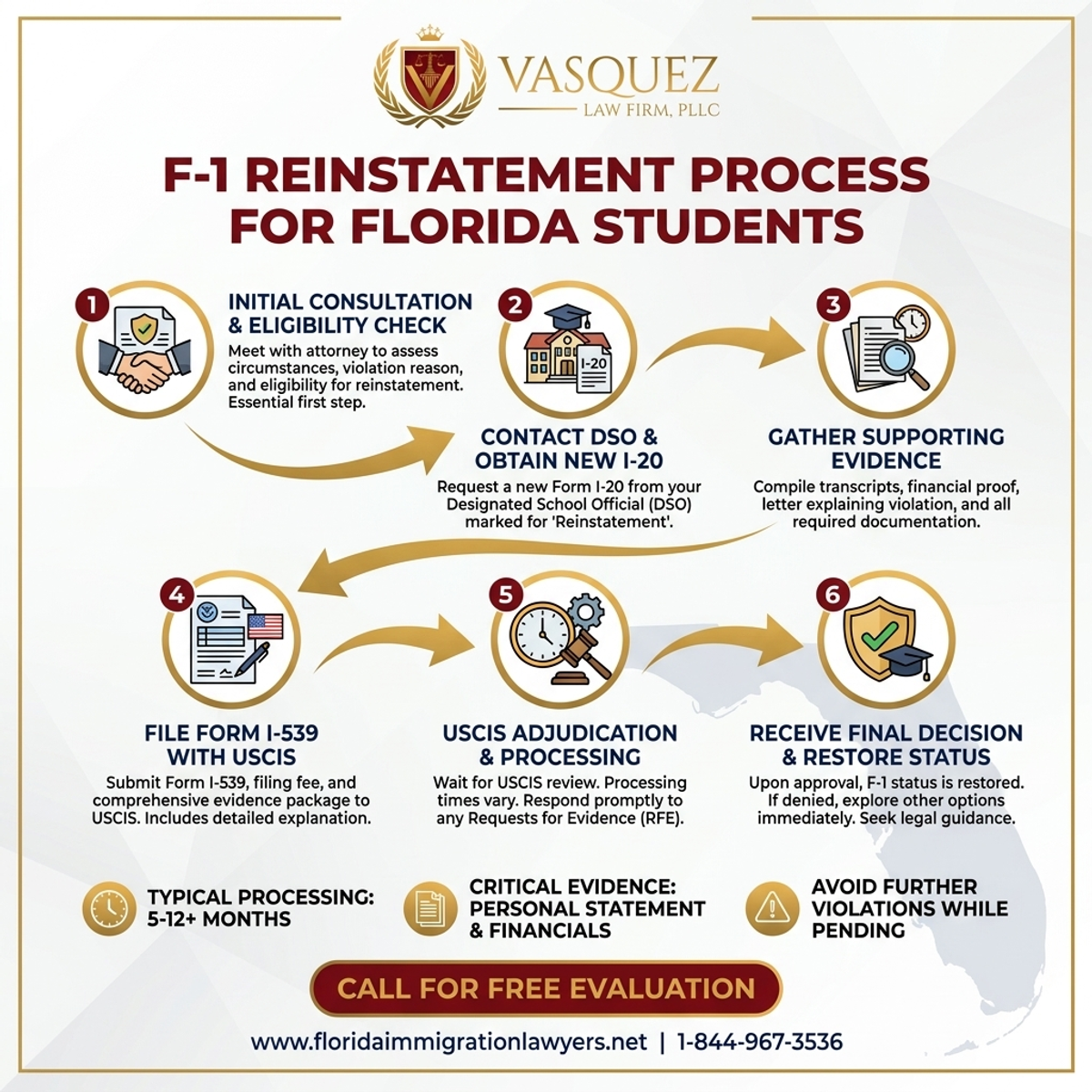
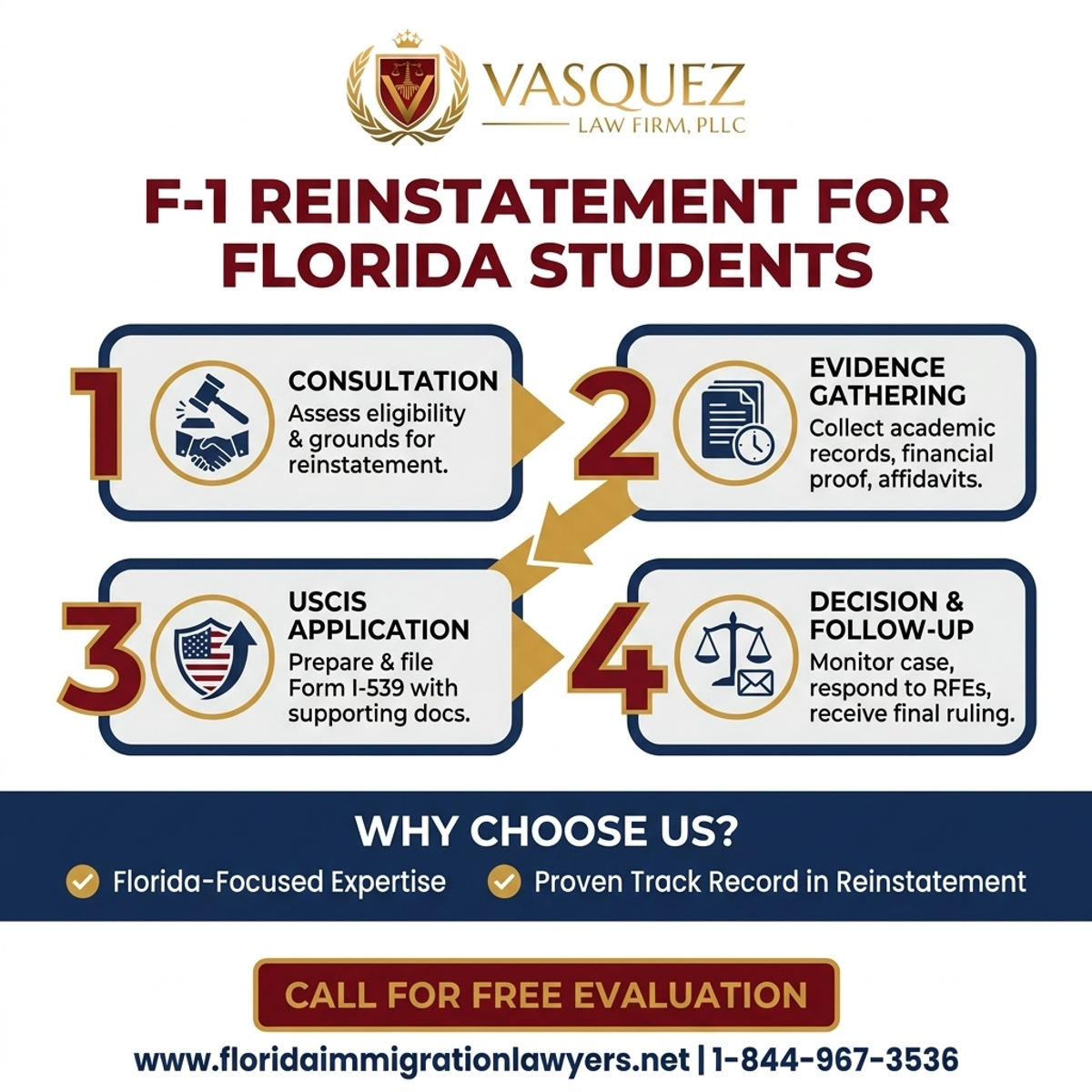
The F-1 reinstatement process is a formal application to USCIS requesting that your nonimmigrant status be restored. It is not an automatic right and requires careful preparation. Here’s a general overview of the steps involved:
1. Determine Eligibility for Reinstatement
Before applying, you must meet specific criteria. You generally qualify for F-1 reinstatement if:
- You have not been out of status for more than five months at the time of filing your Form I-539. If you have been out of status for longer, you must demonstrate exceptional circumstances.
- You have not engaged in unauthorized employment.
- You are not deportable for any reason other than your status violation.
- You are currently pursuing, or intend to pursue, a full course of study at an SEVP-approved school.
- The violation of status resulted from circumstances beyond your control (e.g., a serious illness or accident, unexpected loss of funding, natural disaster) or from an administrative error by your DSO.
- You have not had a record of repeated willful violations of immigration regulations.
It's important to note that even if you meet these criteria, USCIS has the final discretion to approve or deny your application. Consulting with experienced attorneys can help you assess your eligibility accurately.
2. Obtain a New I-20 from Your DSO
If your DSO supports your reinstatement application, they will issue you a new Form I-20 with a notation indicating that it is for 'reinstatement.' This new I-20 will reflect your current program dates and financial information. This document is critical for your application.
Step-by-Step Process — F-1 Reinstatement Process for Florida Students | VLF Florida
3. Gather Required Documents
A comprehensive application package is essential. You will typically need:
- Form I-539: Application to Extend/Change Nonimmigrant Status.
- Filing Fee: The current USCIS filing fee for Form I-539.
- New I-20: The Form I-20 issued by your DSO for reinstatement.
- Original I-20s: All previous Forms I-20.
- I-94 Record: Your most recent admission record (printed from CBP website).
- Financial Documentation: Proof of sufficient funds to cover your tuition and living expenses for your program (e.g., bank statements, scholarship letters).
- Academic Transcripts: Official transcripts from all U.S. schools attended.
- Personal Statement/Letter of Explanation: A detailed letter explaining how you fell out of status, why it was beyond your control, and why you deserve reinstatement. This is a critical component.
- Supporting Evidence: Any documents that corroborate your personal statement (e.g., medical records, letters from doctors, bank statements showing financial hardship, letters from your DSO).
- Passport and Visa Copy: Copies of your passport biographical page and F-1 visa stamp.
4. Prepare and File Your Application
Carefully complete Form I-539 and assemble your entire application package. It is crucial that all forms are filled out accurately and completely, and all supporting documents are included. Any missing information or errors can lead to delays or a denial. Once prepared, mail the application to the appropriate USCIS service center.
5. USCIS Processing and Biometrics
After filing, you will receive a receipt notice from USCIS. You may also receive an appointment notice for biometrics (fingerprints and photos). Processing times for F-1 reinstatement applications can vary significantly, often taking several months. During this time, you are generally permitted to remain in the U.S. while your application is pending, but you cannot resume your F-1 benefits (like working on campus) until your reinstatement is approved.
Common Challenges and Pitfalls in F-1 Reinstatement
While the F-1 reinstatement process offers a lifeline, it's fraught with potential challenges that can lead to denial if not handled carefully. One of the most common pitfalls is **missing the five-month deadline**. If you have been out of status for more than five months, you must provide compelling evidence of 'exceptional circumstances' that prevented you from filing earlier. This is a high bar and requires robust documentation and a persuasive explanation. Simply forgetting or being unaware of the rules is rarely considered an exceptional circumstance.
Another significant hurdle is **unauthorized employment**. Any engagement in work without proper authorization, even for a short period, can render you ineligible for reinstatement. USCIS takes this violation very seriously, as it goes against the core purpose of the F-1 visa. Students often mistakenly believe that 'under the table' work won't be discovered, but USCIS has various methods for detecting such activities, and honesty is always the best policy when preparing your application.
Furthermore, **insufficient evidence of circumstances beyond your control** is a frequent reason for denial. Your personal statement must be detailed, credible, and strongly supported by documentary evidence. Vague explanations or a lack of supporting documents (e.g., medical records for illness, police reports for theft, detailed financial statements for unforeseen economic hardship) will weaken your case considerably. USCIS wants to see that the violation was truly an unavoidable event, not a result of negligence or willful disregard for immigration laws.
Finally, **incorrectly filling out forms or submitting an incomplete application** can cause significant delays or outright denial. The Form I-539 and its accompanying supplements require precise information. Errors in dates, addresses, or responses can raise red flags. Moreover, failing to include all required supporting documents, such as all previous I-20s, complete financial proof, or a clear copy of your I-94, will result in a Request for Evidence (RFE) or a denial. Navigating these complexities is where the expertise of an immigration lawyer becomes invaluable, as they can help ensure your application is meticulously prepared and presents the strongest possible case for approval.
What Happens After Reinstatement is Approved?
If your F-1 reinstatement application is approved, USCIS will send you an approval notice, and your new I-20 will become valid. This means your F-1 status is restored, and you can continue your studies and enjoy all the benefits associated with your student visa, such as eligibility for on-campus employment (if applicable) and future OPT. It is crucial to maintain your status diligently going forward to avoid future complications.
Key Statistics — F-1 Reinstatement Process for Florida Students | VLF Florida
What Happens if Reinstatement is Denied?
A denial of your F-1 reinstatement application can have serious consequences. If denied, you are considered out of status and must depart the U.S. immediately to avoid accruing unlawful presence. Accruing unlawful presence can lead to future bars to re-entry into the U.S. Depending on your specific circumstances, other limited options might be available:
- Depart and Reapply: You may need to leave the U.S. and apply for a new F-1 visa at a U.S. consulate abroad. This option carries risks, as the consulate will review your previous status violation.
- Seek Other Immigration Relief: In very specific situations, you might be eligible for other forms of immigration relief. For example, if you fear returning to your home country, you might explore options like asylum. However, these are complex and often require immediate legal intervention.
- Deportation Defense: If you accrue significant unlawful presence or are encountered by immigration enforcement, you could be placed in removal (deportation) proceedings. In such cases, immediate deportation defense is critical.
It is imperative to consult with an immigration attorney immediately upon receiving a denial to understand your limited options and the potential ramifications.
Why Legal Counsel is Crucial for F-1 Reinstatement
The F-1 reinstatement process is intricate and unforgiving. A single mistake or omission can lead to delays or outright denial, potentially ending your academic journey in the U.S. and creating long-term immigration challenges. An experienced immigration attorney can provide invaluable assistance by:
- Assessing Eligibility: Determining if you meet the strict criteria for reinstatement and advising on the best course of action.
- Preparing a Strong Case: Helping you gather all necessary documentation and crafting a compelling personal statement that clearly explains your circumstances and justifies your request for reinstatement.
- Avoiding Pitfalls: Identifying potential issues in your application and addressing them proactively.
- Communicating with USCIS: Responding to Requests for Evidence (RFEs) and tracking your application status.
- Exploring Alternatives: If reinstatement isn't viable, advising on other potential immigration pathways or strategies.
Don't navigate this complex process alone. The stakes are too high. At VLF Florida, our dedicated team of immigration lawyers has a proven track record of assisting F-1 students in Florida with their reinstatement applications. We are committed to providing personalized and effective legal representation to help you secure your academic future.
Contact VLF Florida Today for a Free Consultation
If you are an F-1 student in Florida facing the challenge of being out of status, time is of the essence. The sooner you act, the better your chances of a successful outcome. Let our knowledgeable immigration attorneys guide you through every step of the F-1 reinstatement process.
Call VLF Florida today for a free, confidential consultation. We are here to help you understand your options and work towards restoring your F-1 status. Contact us now at (844) 967-3536.
Sources and References
- U.S. Citizenship and Immigration Services (USCIS)
- Executive Office for Immigration Review (EOIR)
- U.S. Department of State - Bureau of Consular Affairs
- Immigration and Nationality Act (INA), 8 U.S.C. Chapter 12
Do Not Navigate This Process Alone
Our experienced immigration attorneys are ready to fight for you. Get a free, confidential consultation today.
Se Habla Español
Frequently Asked Questions
Florida Immigration Lawyers
Immigration Attorney | Founder, Vasquez Law Firm
U.S. Air Force veteran and immigration attorney with thousands of cases resolved. J.D., NCCU School of Law. AILA member. Admitted to the 4th, 5th, and 11th Circuit Courts.
Available 24/7 - Free Evaluations
Related Legal Services
Our Florida immigration attorneys can help you with asylum protection, deportation defense and citizenship and naturalization. Call today at 1-844-967-3536 for a free consultation.
Related Links
Related Topics
Free Legal Consultation
Discuss your case with our experienced attorneys. We're available 24/7.
Se Habla Español - Estamos aquí para ayudarle.
Related Articles
VAWA Self-Petition Florida: Abused Spouses Immigration Guide
For abused spouses in Florida, the VAWA self-petition offers a critical pathway to legal immigration status without the abuser's cooperation. This comprehensive guide details the eligibility requirements, the step-by-step process of filing Form I-360, essential documentation, and expected timelines. Learn how to gather evidence, draft a compelling personal statement, and understand the costs and potential fee waivers. We also highlight common mistakes to avoid and explain when seeking legal counsel from Florida Immigration Lawyers is invaluable. This process is designed to empower survivors to achieve safety, independence, and a secure future, free from the fear of deportation.
Immigration Bond Hearing Florida: Get Released from ICE Detention
Facing an immigration bond hearing in Florida can be daunting, especially for families in Kissimmee, Orlando, and Miami. This comprehensive guide demystifies the process, explaining what an immigration bond hearing entails, who is eligible, and the crucial steps to take. We detail the essential documents required, outline timelines and cost factors, and highlight common mistakes to avoid. Discover why experienced legal representation from Florida Immigration Lawyers is vital to navigate this complex system and secure release from ICE detention. Understand your rights and learn how to present a strong case for bond.
Understanding the Child Status Protection Act in Florida
The Child Status Protection Act helps families in Florida prevent their children from aging out of immigration eligibility. Learn how it works and what steps to take if you're in Miami or elsewhere in Florida.
Dual Citizenship Guide for Florida Residents | VLF Florida
Explore the essentials of obtaining dual citizenship in Florida. Learn the benefits, challenges, and steps involved. Contact Florida Immigration Lawyers for expert guidance.