VAWA Self-Petition Florida: Abused Spouses Immigration Guide
For abused spouses in Florida, the VAWA self-petition offers a critical pathway to legal immigration status without the abuser's cooperation. This comprehensive guide details the eligibility requirements, the step-by-step process of filing Form I-360, essential documentation, and expected timelines. Learn how to gather evidence, draft a compelling personal statement, and understand the costs and potential fee waivers. We also highlight common mistakes to avoid and explain when seeking legal counsel from Florida Immigration Lawyers is invaluable. This process is designed to empower survivors to achieve safety, independence, and a secure future, free from the fear of deportation.

The VAWA self-petition (Violence Against Women Act) offers a pathway to legal immigration status for certain abused spouses, children, and parents of U.S. citizens or Lawful Permanent Residents (LPRs). This crucial protection allows eligible individuals in Florida to apply for a green card without the abuser's knowledge or cooperation, providing a lifeline for those escaping domestic violence. Filing Form I-360, Petition for Amerasian, Widow(er), or Special Immigrant, is the first step, requiring comprehensive evidence of the qualifying relationship, abuse, cohabitation, and good moral character. It is designed to empower survivors to seek safety and independence.
- VAWA allows abused spouses, children, and parents to self-petition for immigration relief.
- You do not need the abuser's cooperation to file a VAWA self-petition.
- Eligibility requires proving a qualifying relationship, abuse, cohabitation, and good moral character.
- The process involves filing Form I-360 with USCIS, leading to potential green card eligibility.
- Seeking legal counsel from Florida Immigration Lawyers is highly recommended for this complex process.
Navigating the complexities of immigration law can be daunting, especially when compounded by the trauma of domestic abuse. For many individuals in Florida, the fear of deportation can trap them in dangerous situations, making it seem impossible to escape a violent relationship. However, a vital legal pathway exists to protect survivors and help them achieve independence: the VAWA self-petition. This provision of the Violence Against Women Act offers a confidential and empowering route to legal status, ensuring that abuse victims do not have to rely on their abuser's cooperation to secure their future in the United States.
If you are an abused spouse, child, or parent of a U.S. citizen or lawful permanent resident in Florida, understanding your rights and options under VAWA is crucial. This comprehensive guide will walk you through the eligibility requirements, the step-by-step application process, necessary documentation, expected timelines, and common pitfalls to avoid. Our goal is to provide clear, actionable information to help you or a loved one in Coral Springs, Miami, Orlando, or anywhere in Florida, take the brave step towards safety and stability. The journey may seem overwhelming, but you do not have to face it alone. Call Florida Immigration Lawyers at 1-844-967-3536 for a free consultation to discuss your specific situation and learn how we can help you pursue a VAWA self-petition.
Understanding VAWA Self-Petition for Abused Spouses in Florida
The Violence Against Women Act (VAWA) was enacted to protect victims of domestic violence, regardless of their immigration status, by providing a path to lawful permanent residency. The VAWA self-petition allows eligible individuals to file an immigration petition on their own behalf, without the abusive U.S. citizen or Lawful Permanent Resident (LPR) spouse, parent, or child sponsoring them. This is a critical distinction from traditional family-based petitions, where the abuser's cooperation would be required, often placing victims in further jeopardy. For abused spouses in Florida, this offers a beacon of hope and a chance to escape violence without fear of deportation.
Under VAWA, a self-petitioner can apply for an immigrant visa (green card) based on the abuse they have suffered. This protection is designed to prevent abusers from using immigration status as a tool for control and coercion. The process begins with filing Form I-360, Petition for Amerasian, Widow(er), or Special Immigrant, directly with U.S. Citizenship and Immigration Services (USCIS). Upon approval of the I-360, the self-petitioner may then apply for adjustment of status to become a lawful permanent resident, or, if outside the U.S., apply for an immigrant visa through consular processing. This pathway is a testament to the U.S. government's commitment to protecting vulnerable individuals and fostering family unity, even in the face of domestic strife. Understanding these provisions is the first step towards securing your future and safety in Florida.
What Constitutes Abuse Under VAWA?
Abuse under VAWA is broadly defined and extends beyond physical violence. It includes a pattern of behavior that causes fear, intimidation, or harm. While physical abuse is clearly recognized, USCIS also considers extreme cruelty, which encompasses psychological, emotional, sexual, and financial abuse. This can include threats, intimidation, isolation, control over finances, verbal degradation, sexual assault, and emotional manipulation. For individuals living in Florida, documenting these forms of abuse can be challenging but is crucial for a successful VAWA petition. Evidence such as police reports, medical records, therapist notes, affidavits from friends or family, and even personal journals can all contribute to proving extreme cruelty. The law acknowledges that domestic violence manifests in many forms, all of which can be devastating to a survivor's well-being and ability to live freely.
Eligibility Requirements for a VAWA Self-Petition in Florida
To successfully file a VAWA self-petition as an abused spouse in Florida, you must meet several stringent eligibility criteria. These requirements ensure that the protections are extended to genuinely vulnerable individuals while maintaining the integrity of the immigration system. Each criterion demands specific evidence, making thorough preparation essential. Understanding these requirements is the bedrock of a strong VAWA case, and legal guidance can be invaluable in demonstrating your eligibility to USCIS, which processes these petitions at the Vermont Service Center.
- Qualifying Relationship: You must be the spouse of a U.S. citizen or Lawful Permanent Resident (LPR). This also applies to individuals who believed they were legally married but the marriage was not valid solely due to the abuser's bigamy. Additionally, if your abusive spouse lost their U.S. citizenship or LPR status due to a domestic violence-related incident, or if you divorced the abuser within two years prior to filing, you might still be eligible. This provision is vital for victims in Florida who might have delayed seeking help due to fear or manipulation.
- Abuse or Extreme Cruelty: You must have been subjected to battery or extreme cruelty by your U.S. citizen or LPR spouse. As discussed, this includes physical, psychological, emotional, sexual, and financial abuse. Detailed evidence, such as police reports from local Florida law enforcement agencies, medical records from Florida hospitals, psychological evaluations, and affidavits from witnesses, is critical to substantiate these claims. The abuse must have occurred during the marriage.
- Lived with the Abuser: You must have resided with the abuser at some point during your marriage. This does not mean you need to be living together at the time of filing, especially if you have fled the abusive environment. USCIS understands that victims often separate from their abusers for safety reasons. Evidence of cohabitation can include joint leases, utility bills, mail addressed to both parties at the same address, or sworn statements from individuals who observed you living together in Florida.
- Good Faith Marriage: You must demonstrate that you entered the marriage in good faith, meaning you genuinely intended to establish a life together, not solely to obtain an immigration benefit. This is a common hurdle in many immigration cases, but for VAWA self-petitioners, it's particularly important. Evidence can include photographs of your wedding and life together, joint bank accounts, shared property, and testimony from friends and family who knew you as a couple.
- Good Moral Character: You must establish that you are a person of good moral character. This generally means you have not committed certain crimes or engaged in other actions that would disqualify you. USCIS reviews your criminal history, if any, and other aspects of your background. Minor infractions may be excusable, but serious criminal offenses could jeopardize your petition. For Floridians, this involves providing police clearances and a detailed personal statement.
It is important to note that VAWA protections extend to children of abused spouses and abused parents of U.S. citizens as well. If you are in Florida and believe you meet these criteria, gathering comprehensive evidence is your next crucial step. The specific legal framework for VAWA self-petitions is found in the Immigration and Nationality Act (INA) Section 204(a)(1)(A)(iii), which outlines the eligibility for self-petitioning spouses.
Step-by-Step Guide to Filing Your I-360 VAWA Petition in Florida
Filing a VAWA self-petition is a multi-stage process that requires meticulous attention to detail and a thorough understanding of immigration law. While the journey may seem complex, breaking it down into manageable steps can help clarify what is needed. This guide is designed to help abused spouses in Florida navigate the process of filing Form I-360, but remember that legal assistance can significantly improve your chances of success.
- Gather Comprehensive Evidence: This is arguably the most critical step. You need to collect all possible documentation to prove your eligibility. This includes evidence of your qualifying relationship (marriage certificate, joint documents), proof of your abuser's U.S. citizen or LPR status (birth certificate, green card copy), evidence of cohabitation (leases, utility bills), and most importantly, extensive evidence of the abuse. This can range from police reports filed with local Florida departments, medical records from emergency room visits or therapy sessions, affidavits from witnesses (friends, family, neighbors, clergy), photos of injuries or property damage, text messages, emails, journals, and even financial records showing control.
- Complete Form I-360, Petition for Amerasian, Widow(er), or Special Immigrant: This is the primary form for your VAWA self-petition. Fill it out accurately and completely. Do not leave any sections blank; if a question does not apply, write "N/A." Ensure all information is consistent with your supporting documents. This form collects biographical information about you and your abuser, details about your marriage, and your basis for self-petitioning.
- Draft a Detailed Personal Statement: Your personal statement is your opportunity to tell your story in your own words. This narrative should describe the nature of your relationship, the abuse you suffered, and how it impacted your life. Be as specific as possible, including dates, locations (e.g., Coral Springs, Miami, Orlando), and descriptions of incidents. This statement is incredibly powerful and helps USCIS understand the full scope of your experience. It should be written empathetically and clearly, outlining the extreme cruelty you endured.
- Compile Supporting Documents and Evidence: Organize all your gathered evidence clearly. Create a table of contents and label each piece of evidence. This makes it easier for the USCIS officer to review your petition. Include copies of all identity documents (birth certificate, passport), marriage certificate, divorce decrees (if applicable), and any documentation related to your good moral character, such as police clearances.
- File Your Petition with USCIS Vermont Service Center: All VAWA self-petitions are filed with the USCIS Vermont Service Center. Mail your completed Form I-360, your personal statement, and all supporting evidence to the address specified on the USCIS website for I-360 filings. Remember, there are no filing fees for the I-360 VAWA self-petition.
- Receive Prima Facie Determination: After filing, USCIS will review your petition for initial eligibility. If it appears that you meet the basic requirements, you will receive a Prima Facie determination notice. This is not a final approval but indicates that your petition is strong enough to warrant further consideration. This determination can provide access to certain public benefits in Florida while your petition is pending.
- Attend Biometrics Appointment: USCIS will send you an appointment notice to visit an Application Support Center (ASC) for biometrics (fingerprints and photos). These are used for background checks and identity verification. For Florida residents, this might be at an ASC in Miami, Orlando, Tampa, or another location depending on your residence.
- Respond to Requests for Evidence (RFE): USCIS may send an RFE if they need additional information or clarification. It is crucial to respond promptly and thoroughly with all requested documents. Failure to do so can lead to a denial of your petition.
- Decision on I-360 Petition: Once USCIS has reviewed all evidence, they will issue a decision. If approved, you will receive an I-360 approval notice. This establishes your eligibility as a VAWA self-petitioner and allows you to proceed to the next stage of seeking a green card.
- Adjustment of Status or Consular Processing: If you are physically present in the U.S. and an immigrant visa is immediately available (which is generally the case for approved VAWA self-petitioners), you can file Form I-485, Application to Register Permanent Residence or Adjust Status. If you are outside the U.S., you will pursue consular processing through a U.S. embassy or consulate abroad. For those adjusting status in Florida, an interview at a local USCIS field office (like Miami, Orlando, or Tampa) may be required.
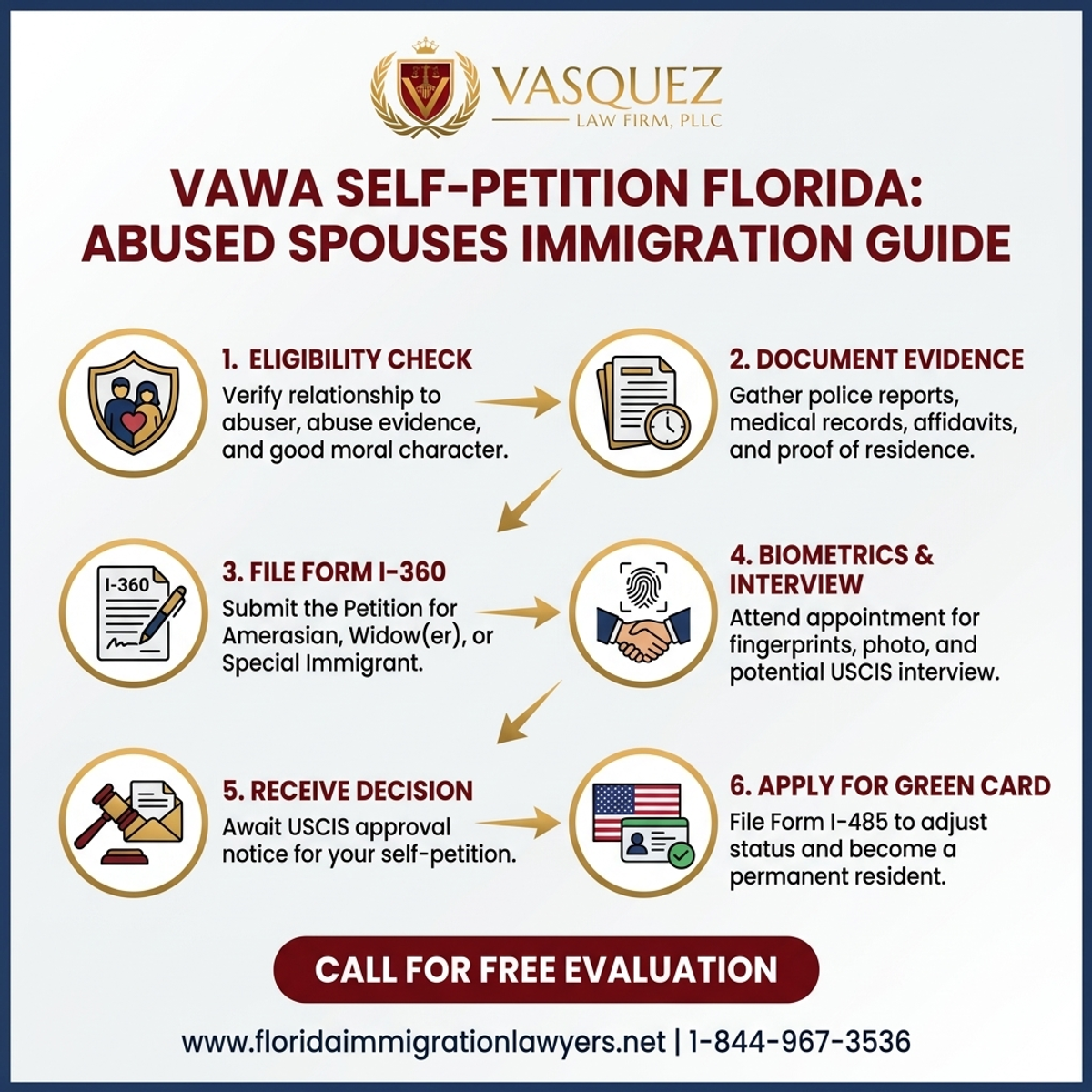
Step-by-Step Process — VAWA Self-Petition Florida: Abused Spouses Immigration Guide
Essential Documents for Your VAWA Self-Petition Checklist
Preparing a complete and well-organized set of documents is paramount for a successful VAWA self-petition. Missing or insufficient evidence is a leading cause of delays or denials. Use this comprehensive checklist to ensure you have everything necessary to present a strong case to USCIS. Remember to submit copies, not originals, unless specifically requested.
- Proof of Identity:
- Copy of your birth certificate.
- Copy of your passport biographical page.
- Copy of your national identity card (if applicable).
- Copy of any previous U.S. visas or I-94 arrival/departure record.
- Proof of Relationship to Abuser:
- Copy of your marriage certificate.
- Evidence of good faith marriage (e.g., wedding photos, joint bank statements, joint utility bills, shared property deeds, children's birth certificates naming both parents, affidavits from friends/family).
- If divorced, copy of the final divorce decree (must be within two years of filing).
- If abuser died, copy of death certificate (must be within two years of filing).
- Proof of Abuser's U.S. Citizen or LPR Status:
- Copy of abuser's U.S. birth certificate, U.S. passport, or Certificate of Naturalization.
- Copy of abuser's Green Card (Form I-551).
- If abuser lost status due to abuse, evidence of such loss.
- Proof of Cohabitation:
- Joint leases or mortgages.
- Utility bills addressed to both at the same address.
- Mail addressed to both at the same address.
- Affidavits from witnesses (friends, family, landlords) confirming you lived together.
- Evidence of Abuse or Extreme Cruelty:
- Detailed personal statement describing the abuse (critical).
- Police reports from Florida law enforcement agencies (e.g., Coral Springs Police Department, Broward County Sheriff's Office).
- Medical records, hospital reports, or therapist notes documenting injuries or psychological distress.
- Photographs of physical injuries, property damage, or abusive living conditions.
- Affidavits or sworn statements from witnesses who observed the abuse or its effects.
- Emails, text messages, voicemails, or social media posts from the abuser demonstrating control, threats, or abuse.
- Evidence of financial abuse (e.g., restricted access to funds, forced debt, control over employment).
- Court orders related to domestic violence (e.g., restraining orders, protection orders).
- Documentation from shelters, support groups, or social workers in Florida.
- Proof of Good Moral Character:
- Police clearances from all places you have lived since age 16 (including Florida).
- Court disposition records for any arrests or convictions (even if expunged).
- Affidavits from reputable members of the community attesting to your character.
- Other Supporting Documents:
- Any previous immigration applications or petitions you have filed.
- Certified translations for any documents not in English.
Timeline and Processing Expectations for VAWA Cases in Florida
Understanding the timeline for a VAWA self-petition can help manage expectations, though it's important to remember that processing times can vary significantly based on USCIS workload, case complexity, and current policies. For individuals in Florida, the process generally involves several stages, each with its own waiting period. USCIS posts average processing times on its website, specifically for the Vermont Service Center, which handles all I-360 VAWA petitions.
Initial I-360 Processing:
After you file your Form I-360 with the Vermont Service Center, you will typically receive a receipt notice (Form I-797C) within 2-4 weeks. Following this, USCIS aims to issue a Prima Facie determination within approximately 1-2 months. This initial determination is a positive sign, indicating that your petition appears to be well-founded and allows you to potentially access certain public benefits. The full processing time for the I-360 petition itself can range from 12 to 24 months, or even longer in some cases. During this period, USCIS will conduct background checks, review your evidence, and may issue a Request for Evidence (RFE) if more information is needed. Responding to an RFE can add several months to the overall timeline.
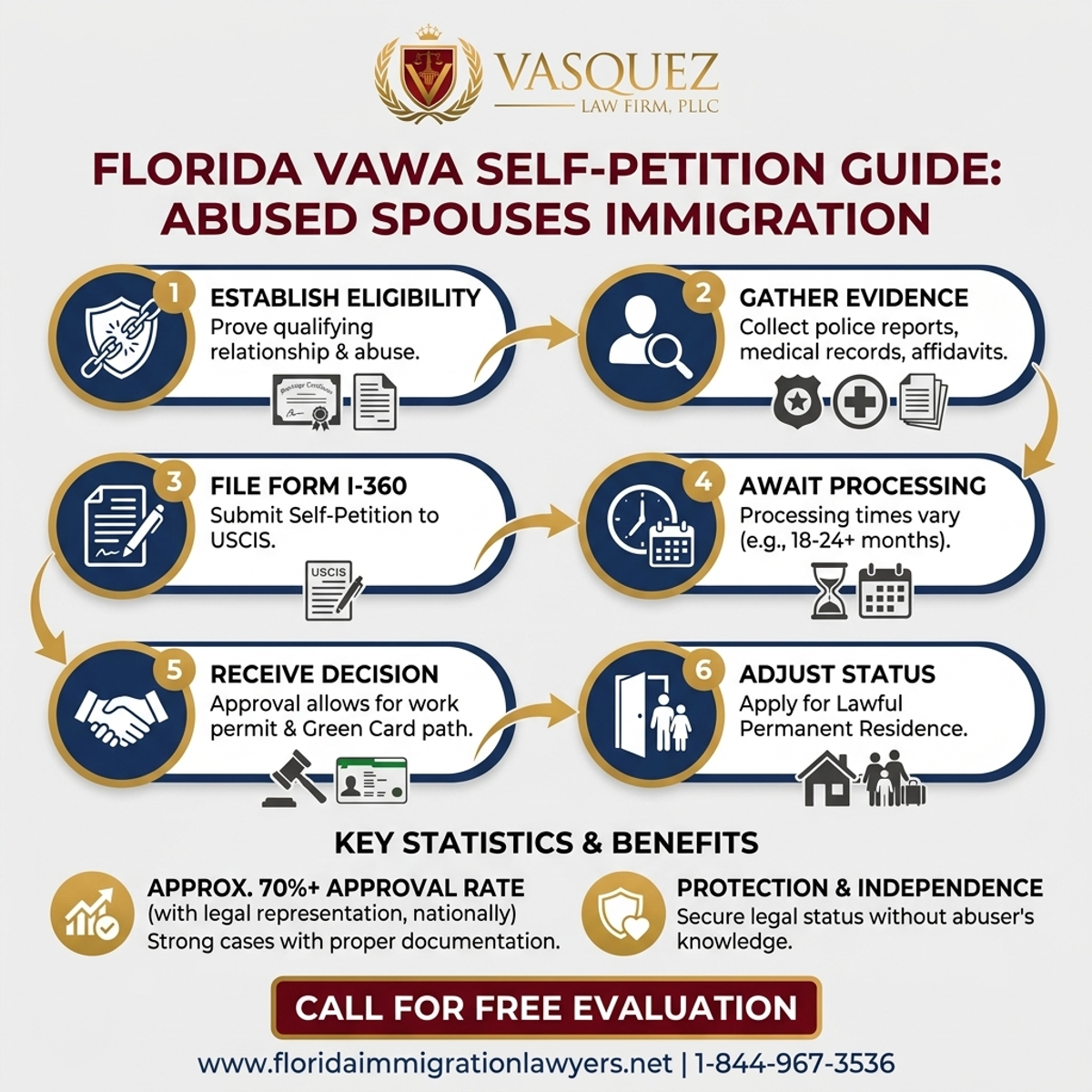
Key Statistics — VAWA Self-Petition Florida: Abused Spouses Immigration Guide
Adjustment of Status (I-485) Processing:
Once your I-360 petition is approved, if you are eligible and an immigrant visa is available (which is usually the case for VAWA self-petitioners), you can then file Form I-485, Application to Register Permanent Residence or Adjust Status. Along with your I-485, you can concurrently file for an Employment Authorization Document (EAD, Form I-765) and an Advance Parole travel document (Form I-131). The EAD typically takes 6-12 months to be processed, allowing you to work legally while your green card application is pending. The I-485 processing itself can take an additional 6-18 months or more. For Florida residents, this stage might involve an interview at a local USCIS field office, such as those in Miami, Orlando, or Tampa. These interviews are generally less common for VAWA adjustment of status cases but can occur, especially if there are complexities in the case or if your good moral character needs further assessment. The entire process, from filing I-360 to receiving a green card, can easily span 2 to 4 years. Patience and consistent follow-up are key, and having legal representation can help keep your case on track.
Cost Factors and Fee Waivers for VAWA Petitions
Understanding the financial aspects of filing a VAWA self-petition is important for abused spouses in Florida. One of the significant advantages of the VAWA program, designed to alleviate barriers for victims, is that the primary petition, Form I-360, does not require a filing fee. This is a crucial relief for individuals who may have limited financial resources due to the abuse they have experienced, including financial control by the abuser.
While the I-360 itself is free, there are other potential costs associated with the overall immigration process. These typically include:
- Attorney Fees: The most substantial cost for many self-petitioners will be legal representation. While not mandatory, hiring an experienced immigration attorney from Florida Immigration Lawyers can dramatically increase the likelihood of a successful outcome due to the complexity of the law and the need for compelling evidence. Fees vary based on the attorney's experience and the complexity of your case.
- Translation Costs: If any of your supporting documents are not in English, you will need to provide certified translations. These costs can add up, depending on the volume of documents requiring translation.
- Medical Examination Fees: When you file for Adjustment of Status (Form I-485) after your I-360 is approved, you will need to undergo a medical examination by a USCIS-approved civil surgeon. The fees for this examination are set by the individual doctors and can range from a few hundred dollars to more, depending on required vaccinations and tests.
- Biometrics Fees: Although the I-360 does not have a fee, biometrics fees may be applicable when filing Form I-485, Application to Register Permanent Residence or Adjust Status.
- Adjustment of Status (I-485) Filing Fee: While the I-360 is free, the subsequent Form I-485 does have a filing fee. However, VAWA self-petitioners are often eligible for a fee waiver for the I-485 and associated applications like the Employment Authorization Document (I-765) and Advance Parole (I-131). To apply for a fee waiver, you must submit Form I-912, Request for Fee Waiver, along with evidence of your inability to pay, such as proof of receiving means-tested public benefits, household income below 150% of the federal poverty guidelines, or financial hardship.
It is essential to discuss all potential costs and fee waiver eligibility with your attorney. Florida Immigration Lawyers can help you understand these financial aspects and prepare the necessary forms to request fee waivers, ensuring that financial constraints do not prevent you from seeking safety and legal status.
Life After VAWA Approval: Path to a Green Card and Beyond
Receiving an approval for your VAWA self-petition (Form I-360) is a monumental step, marking the end of one challenging chapter and the beginning of a new one. This approval signifies that USCIS has recognized your eligibility as an abused spouse and has granted you a significant measure of protection. However, it is important to understand that an I-360 approval is not yet a green card; rather, it is the crucial gateway to obtaining lawful permanent residency. For individuals in Florida, this means transitioning from a state of vulnerability to one of increasing stability and independence.
Once your I-360 is approved, the next step depends on whether you are currently in the United States or abroad. Most VAWA self-petitioners are already in the U.S. and will proceed with filing Form I-485, Application to Register Permanent Residence or Adjust Status. This application allows you to adjust your status to a lawful permanent resident without having to leave the country. Concurrently with your I-485, you can also apply for an Employment Authorization Document (EAD) and an Advance Parole travel document. The EAD will grant you permission to work legally in the U.S., providing much-needed financial independence. Advance Parole allows you to travel internationally and re-enter the U.S. without abandoning your adjustment of status application. For Floridians, securing an EAD can be life-changing, opening doors to better employment opportunities in cities like Coral Springs, Fort Lauderdale, and Miami.
After filing your I-485, USCIS will conduct further background checks and may schedule an interview at a local field office in Florida, such as the ones in Miami, Orlando, or Tampa, though interviews are often waived for VAWA cases. Upon approval of your I-485, you will receive your green card, officially becoming a Lawful Permanent Resident. This status grants you the right to live and work permanently in the United States, providing a sense of security and freedom from the fear of deportation. After holding a green card for five years (or three years if you remain married to a U.S. citizen, though this is less common for VAWA self-petitioners), you may then be eligible to apply for U.S. citizenship through naturalization. This final step completes your immigration journey, cementing your place in the United States and offering full civic participation. This entire process is designed to offer a comprehensive path to safety and stability for survivors of domestic violence.
Common Mistakes to Avoid in Your VAWA Self-Petition
Filing a VAWA self-petition is a complex legal process where even small errors can lead to significant delays or a denial. Abused spouses in Florida should be aware of these common mistakes to avoid jeopardizing their case:
- Insufficient Evidence of Abuse: This is perhaps the most frequent reason for denials. Many petitioners provide only a brief statement without corroborating evidence. USCIS requires comprehensive proof of abuse or extreme cruelty. Failing to include police reports, medical records, therapist notes, affidavits from witnesses, or detailed personal accounts can weaken your case significantly. Consequences: Delays, Requests for Evidence (RFEs), or outright denial, forcing you to re-file or appeal.
- Lack of Proof of Good Faith Marriage: USCIS scrutinizes whether the marriage was entered into for genuine reasons or solely for immigration benefits. If you do not provide enough evidence of shared life, such as joint bank accounts, leases, photos, and affidavits, your petition may be denied. Consequences: Denial based on suspicion of marriage fraud, making future immigration attempts more difficult.
- Inconsistent or Vague Personal Statement: Your personal statement is your voice, but if it lacks specific details, dates, and consistent recounting of events, it can raise doubts. Vague statements about the abuse or the relationship can be perceived as lacking credibility. Consequences: USCIS may doubt the veracity of your claims, leading to an RFE or denial.
- Missing Deadlines or Incorrect Filing: Immigration processes have strict timelines. Failing to respond to an RFE by the deadline, or sending your I-360 to the wrong USCIS service center (it must go to the Vermont Service Center), can cause significant issues. Consequences: Automatic denial for missed deadlines, or substantial delays if filed incorrectly.
- Not Disclosing All Relevant Information: Attempting to hide past arrests, immigration violations, or other potentially negative information can be detrimental. USCIS conducts thorough background checks, and discovering undisclosed information can lead to accusations of misrepresentation. Consequences: Denial, and potentially a finding of misrepresentation which can bar future immigration benefits.
- Failing to Prove Abuser's Status: You must provide clear evidence that your abuser was a U.S. citizen or Lawful Permanent Resident at the time of the abuse. Without this, you do not meet a fundamental eligibility requirement. Consequences: Denial due to failure to meet statutory eligibility.
- Attempting to Self-File Without Legal Counsel: While technically possible, the complexity of VAWA petitions, the emotional toll of recounting abuse, and the need for legal strategy make self-filing risky. An attorney can help identify all necessary evidence, draft a compelling statement, and navigate legal nuances. Consequences: Higher likelihood of errors, delays, and denial, often due to lack of understanding of legal standards for evidence.
- Inadequate Proof of Cohabitation: You must demonstrate that you lived with the abuser. While not necessarily at the time of filing, evidence like joint leases, utility bills, or affidavits from witnesses are necessary. Consequences: Denial for failing to meet a key statutory requirement.
When to Call a Lawyer for Your VAWA Self-Petition in Florida
While the information in this guide provides a solid foundation, the decision to pursue a VAWA self-petition is deeply personal and legally intricate. The emotional burden of reliving abuse while navigating complex legal requirements can be overwhelming. This is precisely why having an experienced immigration attorney from Florida Immigration Lawyers by your side is not just beneficial, but often critical for success, especially for abused spouses in Florida.
You should consider contacting an attorney immediately if any of the following scenarios apply to you:
- You Have Limited Evidence of Abuse: If you lack police reports, medical records, or other official documentation, an attorney can help you strategize how to gather alternative evidence, such as affidavits, therapist notes, or expert psychological evaluations, to build a compelling case.
- Your Abuser Has Criminal History or You Do: Any criminal history, yours or your abuser's, can complicate the case. An attorney can assess the impact, advise on waivers if available, and ensure proper disclosure to USCIS.
- You Have Prior Immigration Violations: If you have overstayed a visa, entered without inspection, or have a deportation order, an attorney can determine if VAWA provides a pathway to waive these issues and protect you from removal.
- Your Marriage Was Short-Lived or Ended Recently: If you divorced your abuser or they died within the two years preceding your filing, specific rules apply. An attorney can ensure you meet the strict deadlines and provide the correct evidence.
- You Are Unsure About Any Eligibility Requirement: If you are questioning whether you meet any of the VAWA criteria, such as good faith marriage, cohabitation, or good moral character, a legal expert can provide clarity and guidance.
- You Received a Request for Evidence (RFE) or Notice of Intent to Deny (NOID): These notices indicate that USCIS has concerns about your petition. Responding effectively requires legal expertise to address the specific issues raised by USCIS.
- The Emotional Toll is Too Great: Recounting abuse can be traumatizing. An attorney can handle the legal heavy lifting, allowing you to focus on your healing and safety.
Florida Immigration Lawyers has extensive experience helping survivors of domestic violence in Coral Springs, Miami, Orlando, Tampa, and across Florida secure their immigration status through VAWA. We understand the sensitivity required for these cases and provide compassionate, strategic legal representation. We are committed to protecting your rights and helping you achieve safety and independence.
About Florida Immigration Lawyers
Florida Immigration Lawyers is a leading law firm dedicated to providing comprehensive and compassionate legal services to immigrants across the entire state of Florida. With a deep understanding of the unique challenges faced by immigrant communities, especially those in vulnerable situations, our firm stands as a beacon of hope and advocacy. We specialize in a wide range of immigration matters, including family-based petitions, deportation defense, asylum claims, citizenship applications, and critical relief programs like the VAWA self-petition. Our team of experienced attorneys is committed to delivering personalized attention, strategic guidance, and unwavering support to each client.
We pride ourselves on our client-centered approach, recognizing that every case has a unique story and requires tailored solutions. Our attorneys are not just legal professionals; they are empathetic advocates who understand the profound impact immigration issues have on individuals and families. We offer services in both English and Spanish, ensuring that language is never a barrier to receiving high-quality legal representation. Whether you are in Coral Springs, navigating the complexities of a VAWA petition, or facing deportation elsewhere in Florida, Florida Immigration Lawyers is here to help. We offer free consultations and are available 24/7 to address your urgent needs. Our mission is to empower you to achieve your immigration goals and build a secure future in the United States.
Sources and References
- U.S. Citizenship and Immigration Services (USCIS) - Violence Against Women Act (VAWA)
- USCIS - Form I-360, Petition for Amerasian, Widow(er), or Special Immigrant
- Executive Office for Immigration Review (EOIR)
- Immigration and Nationality Act (INA) Section 204(a)(1)(A)(iii) - Self-Petitioning Spouses of U.S. Citizens or Lawful Permanent Residents.
- 8 U.S.C. § 1154 - Procedure for granting immigrant status.
- 8 CFR § 204.2(c) - Petitions for spouses, children, or parents of U.S. citizens or lawful permanent residents.
- USCIS Policy Manual, Volume 6, Part G, Chapter 2 - VAWA Based Self-Petitions.
Related services: family petition process, family-based green cards, fiancé visa (K-1), marriage-based immigration.
This article provides general legal information and is not intended as legal advice. Every case is unique, and outcomes depend on specific facts and circumstances. Contact an attorney for advice about your particular situation. Immigration laws are subject to change, and it is crucial to consult with a qualified legal professional for the most current and accurate guidance.
Your journey towards safety and legal status in the United States is a testament to your strength and resilience. The VAWA self-petition offers a powerful pathway, but navigating its complexities requires expert guidance. Do not let fear or confusion prevent you from taking this vital step. Contact Florida Immigration Lawyers today for a free, confidential consultation at 1-844-967-3536. Se Habla Español - Estamos aquí para ayudarle.
If you need legal assistance, learn more about our family immigration practice, or call us at 1-844-967-3536 for a free consultation.
Do Not Navigate This Process Alone
Our experienced immigration attorneys are ready to fight for you. Get a free, confidential consultation today.
Se Habla Español
Or leave your details and we’ll call you:
Free Evaluation in 24 Hours
Or talk to us right now

AI voice assistant — available 24/7
FreeFrequently Asked Questions

William J. Vásquez
Founding Attorney · Vasquez Law Firm
U.S. Air Force veteran and immigration attorney with years of hands-on U.S. immigration experience. J.D., NCCU School of Law. AILA member. Admitted to the 4th, 5th, and 11th Circuit Courts.
Available 24/7 - Free Evaluations
Reviewed for legal accuracy by William J. Vásquez
Licensed in North Carolina; U.S. immigration is federal practice.
Related Legal Services
Our Florida immigration attorneys can help you with deportation defense, citizenship and naturalization and family immigration services. Call today at 1-844-967-3536 for a free consultation.
Related Links
Related Topics
Free Legal Consultation
Discuss your case with our experienced attorneys. We're available 24/7.
Se Habla Español - Estamos aquí para ayudarle.
Related Articles
Stem OPT Immigration Lawyer: 2026 Florida Guide
For F-1 students in Florida, the STEM OPT extension offers a vital 24-month work authorization after their initial OPT. This guide, updated for 2026, covers eligibility, the step-by-step application process, required documents, and critical timelines. Graduates from Florida universities in STEM fields must navigate strict USCIS regulations, including the E-Verify employer requirement. Learn how to avoid common mistakes and when to seek professional legal assistance from a dedicated stem OPT immigration lawyer to ensure a successful application and continued career growth in the U.S. Florida Immigration Lawyers offers expert guidance for students across the state.
Dual Citizenship Lawyer: Navigating Delays in Florida
Facing citizenship delays in Florida can be challenging, but understanding the process and knowing your options is key. Learn how a dual citizenship lawyer can assist you in navigating N-400 processing and USCIS backlogs in Hialeah.
"ina § 208(a)(2)" One-Year Filing Deadline: Florida Asylum
Discover the importance of the "ina § 208(a)(2)" one-year filing deadline for asylum seekers in Florida. Learn about the steps, documents needed, and common mistakes to avoid in your asylum application process.
DV-2027 Registration Period: Your Green Card Lottery Guide
The DV-2027 Diversity Visa (DV) lottery offers a unique pathway to permanent residency for individuals from countries with historically low immigration rates to the U.S. Expected to open in Fall 2025, the registration period requires strict adherence to eligibility criteria, including country of birth and specific education or work experience. This guide from Florida Immigration Lawyers covers the step-by-step application process, essential documents, critical timelines, and associated costs. We highlight common mistakes to avoid and explain when legal counsel is indispensable, especially for residents in Florida. Understanding the nuances of the green card lottery is vital for a successful application. Contact us for expert guidance on your DV-2027 journey.