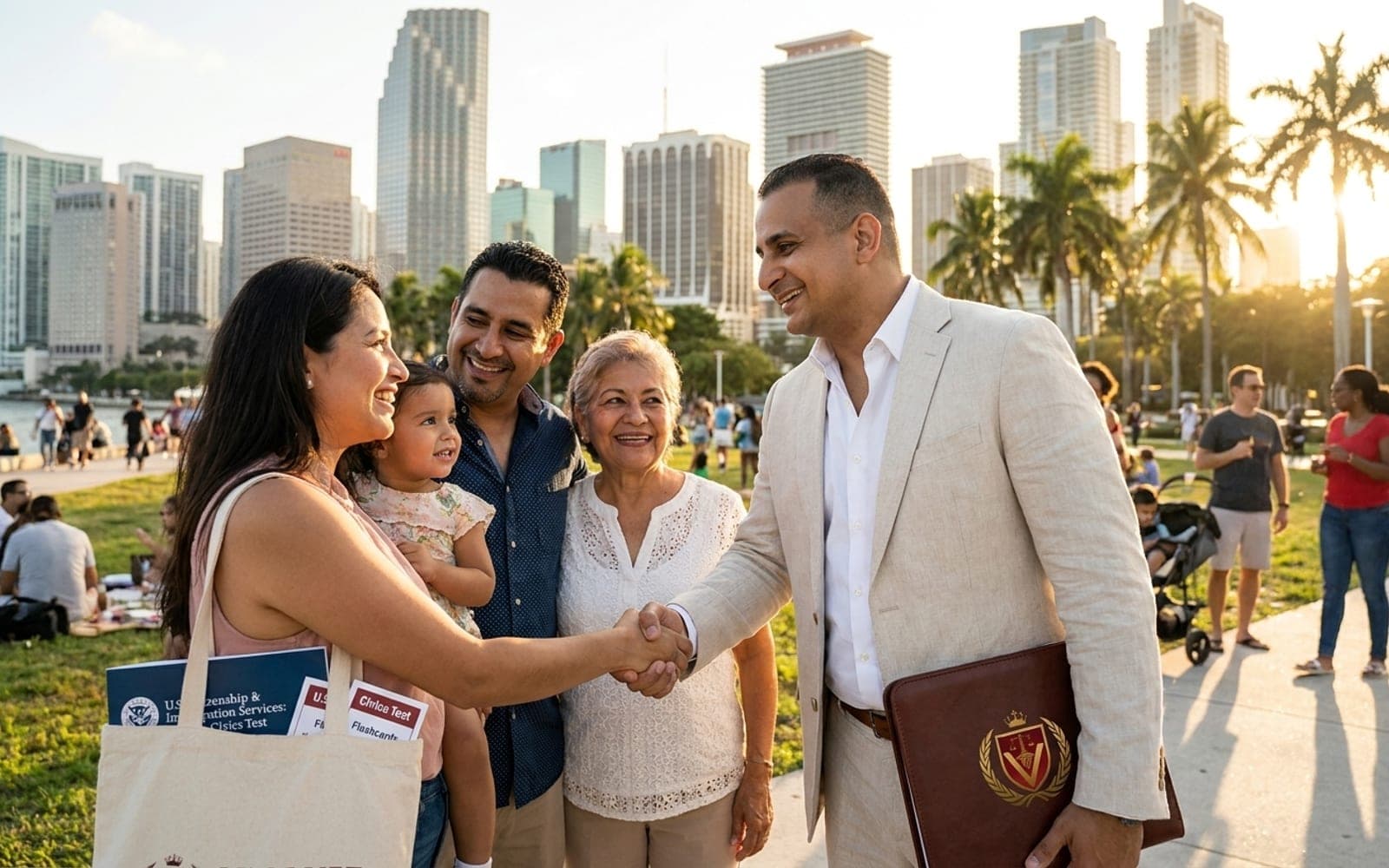
Broward County residents bring different questions: permanent residents ready to naturalize, teenagers who may qualify for Special Immigrant Juvenile Status, Cuban families on parole, and people with immigration court dates. Most permanent residents can file Form N-400 after five years, or three if married to and living with a U.S. citizen, with continuous residence, physical presence, good moral character and passing English and civics tests. Much of a lawyer's effort comes before filing, checking trips, old arrests, taxes and prior green card answers. We serve Broward by video, phone and Orlando meetings.
- Naturalization generally follows five years as a resident, or three if married to a citizen.
- Lawyers check trips abroad, old arrests, taxes and earlier green card answers.
- Other Broward matters include SIJS, Cuban parole and immigration court cases.
- TPS and parole programs change often, so confirm current rules.
Introduction
Broward County residents come to us with very different questions: a permanent resident in Hollywood ready to naturalize, a teenager in Lauderhill who may qualify for Special Immigrant Juvenile Status, a Cuban family in Pompano Beach on parole, or someone with an upcoming hearing in immigration court. This guide groups the most common Broward matters by type, explains how each works in general terms, and lists what to prepare. To discuss your situation, call 1-844-YO-PELEO or contact us.
Vasquez Law Firm handles immigration law only, from one office in Orlando. We have no office in Broward County, and we serve Broward clients by video, by phone, and in person at the Orlando office, in English and Spanish.
This article is general information, not legal advice. Programs such as TPS and parole change frequently, and every case turns on its own facts, so a lawyer should confirm the current rules before you file.
Immigration Help for Broward Residents: Naturalization in Hollywood, Pompano Beach, Tamarac, and Lauderhill
Most permanent residents can apply for citizenship on Form N-400 after five years as a green card holder, or after three years if they have been married to and living with a U.S. citizen for that period. Applicants also need continuous residence, enough physical presence, good moral character, and a passing result on the English and civics tests unless an age-and-residence or medical exception applies.
A citizenship lawyer spends most of the effort before filing: checking trips abroad, reviewing old arrests or traffic matters that led to court, confirming taxes were filed, and comparing your answers with your earlier green card file. We hear from clients across the county, from Hollywood to Pompano Beach and from Tamarac to Lauderhill, and the questions are the same because the N-400 covers your full history. The interview takes place at the USCIS field office that serves your county, as your notice directs. Learn more on our naturalization services page.
How We Work With Broward Clients
Immigration law is federal, and applications, court cases, and consular matters are decided by federal agencies, so a lawyer does not need to be in your city to represent you. Most of the work consists of reviewing documents, preparing evidence, and explaining options, which we do by phone and video. Our only office is at 1111 E Amelia Street in Orlando.
- You contact us and describe your situation, by phone or through the contact page.
- We schedule a consultation by video or phone, or in Orlando if you prefer to come in.
- You share your notices, passport, green card, court records, and any other documents through a secure method we explain.
- We review the history, explain the options and risks, and identify the next deadline.
- If you hire the firm, we sign a written agreement and begin preparing filings or court documents.
- We keep you informed through filing, any interview or hearing, and the decision.
For court cases, we represent clients in immigration courts around the state, in person or by video as the court allows, and your hearing notice controls where you must appear.
Preparing for the naturalization interview
At the interview an officer places you under oath, reviews your application, and tests your English and civics knowledge unless an exception applies. USCIS publishes study materials, and you should use the current version. If you are asked about something that surprises you, such as an old arrest or a trip you forgot, answer truthfully. A lawyer can go through your answers and your passport dates with you beforehand so there are fewer surprises, and may attend with you if you choose.
Good moral character and continuous residence cause many of the questions. A dismissed or sealed case can still matter, a long absence can interrupt residence, and unpaid taxes or child support can raise concerns. Bring the final court records, tax records, and travel dates to your first meeting.
TPS Renewals for Broward Residents
Temporary Protected Status gives nationals of designated countries permission to stay and work while the designation lasts. The government announces extensions, re-registration periods, and any terminations in the Federal Register, and those decisions change over time. Missing a re-registration window can cause loss of status and work authorization.
A lawyer files Form I-821 for re-registration and, when needed, Form I-765 for the work permit, and checks whether the client has any other path, such as a family petition, that could lead to a green card. TPS is temporary and does not by itself give permanent status, so planning for the next step is worth discussing early.
Special Immigrant Juvenile Status for Young People
Special Immigrant Juvenile Status (SIJS) protects children under 21 who cannot reunify with one or both parents because of abuse, neglect, abandonment, or a similar basis under state law. The case has two stages. First, a Florida state court with jurisdiction over the child makes specific findings, including that returning to the home country would not serve the child's interests. Then the child files Form I-360 with USCIS, and later applies for a green card when a visa is available.
Timing matters because the child must remain under 21 and the state court generally must act while it still has jurisdiction. A lawyer coordinates the immigration filing with the family court case so the findings match what USCIS requires. A family court lawyer handles the state court case, and the immigration lawyer works with that attorney to make sure the order covers what is needed.
Document Checklist for a Broward Immigration Consultation
- Green card, passport, I-94 record, and every USCIS or court notice.
- Court dispositions for any arrest, even if it was dismissed.
- For SIJS: any family court orders and school or medical records.
- For parole: your parole document and entry record.
- For TPS: your approval notices, work permit, and registration receipts.
- A list of trips outside the United States with dates.
- Tax returns and proof of residence and employment.
- Marriage, birth, and divorce certificates for the people involved in the case.
Bring what you have. A lawyer can help you identify missing records and plan how to obtain them.
Timeline and Processing Expectations
Processing times vary by application, by office, and over time. USCIS and the immigration courts publish current information, so check those sources rather than relying on a figure from another person. Court schedules depend on the docket, and hearings can be reset, so keep your notices and check the court's case status system.
Some matters have fixed dates that you cannot miss, such as a TPS re-registration window, a hearing, or an age limit for SIJS. The table below shows the general stages.
| Stage | What happens | Who acts |
|---|
| Case review | Status, dates, and goals are reviewed | You and your lawyer |
| Preparation | Forms and evidence are gathered and checked | You and your lawyer |
| Filing | Application, petition, or court filing is submitted | Your lawyer and you |
| Interview or hearing | USCIS interview, state court finding, or immigration hearing | The agency or the court |
| Decision | Approval, denial, or relief granted or denied | USCIS or the judge |
Planning across more than one status
Many Broward families have members in different situations: a parent who is a citizen, a spouse on TPS, a child who entered on parole, and a relative with a court date. A step taken for one person can affect another, such as a travel decision that jeopardizes TPS or a filing that raises questions about an earlier entry. A lawyer should look at the whole family's situation before any application is filed, and should explain which options are open to each person and in what order.
Cuban Parole and Humanitarian Parole
Broward has a large Cuban community, and parole questions come up often. Under the Cuban Adjustment Act, a Cuban national who was inspected and admitted or paroled into the United States and has been physically present for at least one year may apply for permanent residence. Many people who entered on parole later use this law.
The Cuban Family Reunification Parole program and other parole programs created by policy have been paused, changed, or ended at different times, so current availability should be checked before any filing. A lawyer will also review the exact entry documents, because the type of parole and the I-94 record can affect eligibility to adjust.
Humanitarian parole, filed on Form I-131, is a separate request to let someone enter or remain temporarily for urgent humanitarian reasons or significant public benefit. A lawyer builds the evidence, such as medical records or proof of a family emergency. Parole is discretionary and is not a green card.
Asylum for Lauderhill and Broward Residents
Asylum is available to people who suffered persecution or fear it because of race, religion, nationality, political opinion, or membership in a particular social group. Form I-589 generally must be filed within one year of the last arrival, with narrow exceptions. Expect to spend real time on a written declaration and supporting evidence, because the applicant's credibility and the country conditions are central to the decision.
A lawyer will also consider withholding of removal and protection under the Convention Against Torture, which have different standards and can apply when asylum does not.
Waivers of Inadmissibility
Many family-based green card cases stall because of a ground of inadmissibility: unlawful presence, a prior misrepresentation, or certain criminal history. Some can be forgiven through a waiver, such as Form I-601 or the provisional unlawful presence waiver on Form I-601A, which usually requires showing extreme hardship to a U.S. citizen or permanent resident spouse or parent. A lawyer gathers medical, financial, family, and country evidence to document that hardship. See our waivers page for more.
Deportation Defense and Immigration Court
If you received a Notice to Appear, your case is before an immigration judge. The notice and later hearing notices name the court, which for Broward residents is generally one of the South Florida immigration courts. A lawyer reviews the charges, decides whether to contest them, and identifies any relief, such as cancellation of removal, adjustment of status, asylum, or voluntary departure.
People with a hearing date approaching should not miss it, since failing to appear can lead to an order of removal in your absence. Our office is in Orlando, but immigration law is federal, and we represent clients in courts around the state. See our deportation defense page for more detail.
Cost Factors and Fee Breakdown
The cost of a matter depends on the type of case and its stage, as the table below shows.
| Item | Amount | Notes |
|---|
| N-400 naturalization fee | Check USCIS for the current fee | USCIS lists any reduced-fee options on its website |
| TPS and work permit fees | Check USCIS for the current fee | Fee rules differ by form and category |
| SIJS, parole, and waiver forms | Check USCIS for the current fee | Depends on the form and the applicant |
| Immigration court fees | Check the court or agency for current fees | Depends on the application filed in court |
| Attorney fees | Varies by case | Depends on the stage and complexity |
Fees and form editions change, so check the current schedule before you pay. An incorrect fee or an old form can cause a rejection and delay.
Ask any lawyer to explain in writing what the engagement covers and which costs are separate. Be cautious about any lawyer who guarantees an outcome.
Keep your records in one place. Save every receipt notice, approval, and court paper, and keep a list of the dates of each application and each trip abroad. These records help your lawyer answer agency questions and help you later when you apply for a green card or citizenship. Update your address with USCIS and the immigration court whenever you move, since notices go to the address on file and a missed notice can have serious consequences.
Common Mistakes to Avoid
- Missing a TPS re-registration window or an immigration court hearing.
- Filing for citizenship without reviewing trips abroad, old arrests, and taxes.
- Waiting too long on a SIJS case, when the child's age and the state court's jurisdiction are limited.
- Assuming a parole program is still open without checking current availability.
- Filing a waiver without strong evidence of hardship to a qualifying relative.
- Relying on a notary or consultant who is not a licensed attorney.
If you are not sure which of these topics applies to you, that is a good reason to ask. A short consultation can sort out which status you hold, which applications are realistic, and what deadlines are coming, so that you can decide your next step with accurate information rather than rumors from friends or social media.
When to Call a Lawyer
Call a lawyer when you receive a Notice to Appear, when a TPS or parole deadline is approaching, before you file for citizenship with any arrest or long absence in your history, and when a child may need SIJS before turning 21. To schedule a consultation by video, phone, or in person in Orlando, call 1-844-YO-PELEO.
About Vasquez Law Firm
Vasquez Law Firm practices immigration law only. Our only office is at 1111 E Amelia Street in Orlando, and we serve clients across Florida, including Broward County, by phone and secure video, with in-person meetings in Orlando. William J. Vásquez is the founding attorney, and consultations are available in English and Spanish. Call 1-844-YO-PELEO or contact us.
Sources and References
Related services: naturalization and citizenship lawyers, immigration lawyers in Florida
Other ways people search for this
People look for this help under different names. Related searches include immigration lawyer for tps; family deportation attorney; citizenship lawyer pompano; citizenship lawyer tamarac; naturalization lawyer in lauderhill; tps renewal lawyer broward; lauderhill special immigrant juvenile status lawyer; cuban family parole lawyer broward; humanitarian parole attorney broward; cuban parole lawyer pompano; asylum lawyer in lauderhill; inadmissibility waiver attorney broward; deportation lawyer broward; broward immigration court attorney; deportation attorney broward fl; deportation attorney near me broward.
This article is general information, not legal advice. Every case is different; speak with an immigration lawyer about your situation.