Citizenship Test Florida: Your Guide to Naturalization Success
Achieving U.S. citizenship through naturalization is a life-changing milestone for many Florida residents. This comprehensive guide details the citizenship test, including its English and civics components, and provides a step-by-step walkthrough of the N-400 application process. Learn about eligibility, required documents, processing timelines, and associated costs. We also highlight common mistakes to avoid and explain when seeking legal counsel can be invaluable, especially for those in Gainesville and surrounding areas. Florida Immigration Lawyers offers expert guidance to help you prepare for your naturalization interview and civics test, ensuring you navigate this crucial journey with confidence and achieve your dream of becoming a U.S. citizen.
Preparing for the citizenship test in Florida is a crucial step toward achieving U.S. naturalization. This test includes English proficiency (reading, writing, speaking) and a civics examination covering U.S. history and government. Successfully passing requires diligent study of the 100 civics questions and practice with English language skills. Many applicants in areas like Gainesville utilize resources from USCIS and seek legal guidance to navigate the Form N-400 application process and interview effectively. Understanding the requirements and potential challenges is key to a smooth journey.
- The citizenship test has English and civics test components.
- Diligent preparation for the 100 civics questions is essential.
- The Form N-400 is the primary application for naturalization.
- Seeking legal guidance can significantly improve your chances of success.
- Florida applicants process through various USCIS field offices.
The dream of becoming a U.S. citizen is a powerful motivator for many individuals and families across Florida. It represents not just a change in status, but access to new opportunities, rights, and a deeper sense of belonging. However, the path to naturalization, particularly passing the citizenship test, can seem daunting without proper guidance. From understanding the complex eligibility requirements to mastering the civics and English portions of the exam, each step demands careful attention and preparation.
This comprehensive guide is designed to demystify the citizenship test and the entire naturalization process for residents of Florida, including those in Gainesville and surrounding communities. We will break down the essential components, provide actionable advice, and highlight common pitfalls to avoid. Our goal is to equip you with the knowledge and confidence needed to successfully navigate this significant journey. Call Florida Immigration Lawyers at 1-844-YO-PELEO for a free consultation and take the first step towards your American dream.
Understanding the U.S. Naturalization Process in Florida
Naturalization is the process by which a foreign citizen or national becomes a U.S. citizen. It is governed primarily by the Immigration and Nationality Act (INA), specifically 8 U.S.C. § 1427. This pathway to citizenship offers numerous benefits, including the right to vote, hold certain federal jobs, and travel with a U.S. passport. In Florida, a state with a large and diverse immigrant population, thousands of individuals pursue naturalization each year, contributing significantly to its vibrant communities.
To be eligible for naturalization, applicants must generally meet several key requirements. These include being at least 18 years old, holding lawful permanent resident (Green Card) status for a specific period (typically five years, or three years if married to a U.S. citizen), demonstrating continuous residence and physical presence in the U.S., and possessing good moral character. Crucially, applicants must also demonstrate an ability to read, write, and speak basic English, and have a fundamental understanding of U.S. history and government, which is assessed during the citizenship test.
The journey begins with filing Form N-400, Application for Naturalization, with U.S. Citizenship and Immigration Services (USCIS). For residents of Gainesville and North Florida, applications are typically processed through the USCIS field office in Jacksonville or Orlando, depending on jurisdiction. These offices handle interviews and oath ceremonies for applicants in their respective service areas. Understanding these local processing nuances is an important part of a successful application. Florida Immigration Lawyers can help you determine your eligibility and prepare your application effectively.
Mastering the Citizenship Test: English and Civics Components
The citizenship test is a pivotal part of the naturalization interview. It comprises two main parts: an English test and a civics test. Both are designed to ensure that prospective citizens have the foundational knowledge and communication skills necessary for civic engagement in the United States. Preparing adequately for both components is critical for success, especially for individuals in Florida who are eager to embrace their new status.
The English Proficiency Test
During the naturalization interview, a USCIS officer will assess your ability to read, write, and speak English. The speaking portion is evaluated throughout the interview as you answer questions about your N-400 application. For the reading test, you will be asked to read one out of three sentences correctly. These sentences are typically simple, often related to U.S. history or civics. For the writing test, you will be asked to write one out of three sentences correctly, dictated by the USCIS officer. Practicing these skills using official USCIS study materials is highly recommended. You can find comprehensive resources on the USCIS website.
The Civics Test
The civics test assesses your knowledge of U.S. history and government. USCIS provides a list of 100 civics questions and answers. During your interview, the USCIS officer will ask you up to 10 questions from this list. You must answer at least 6 correctly to pass this portion of the test. The questions cover various topics, including American government (principles of democracy, branches of government, rights and responsibilities), American history (colonial period, independence, 19th and 20th centuries), and integrated civics (geography, symbols, holidays). Thoroughly studying all 100 questions is crucial. Many Floridians find study groups or online resources helpful for memorization and understanding the context of these questions.
Your Step-by-Step Guide to Naturalization in Gainesville, Florida
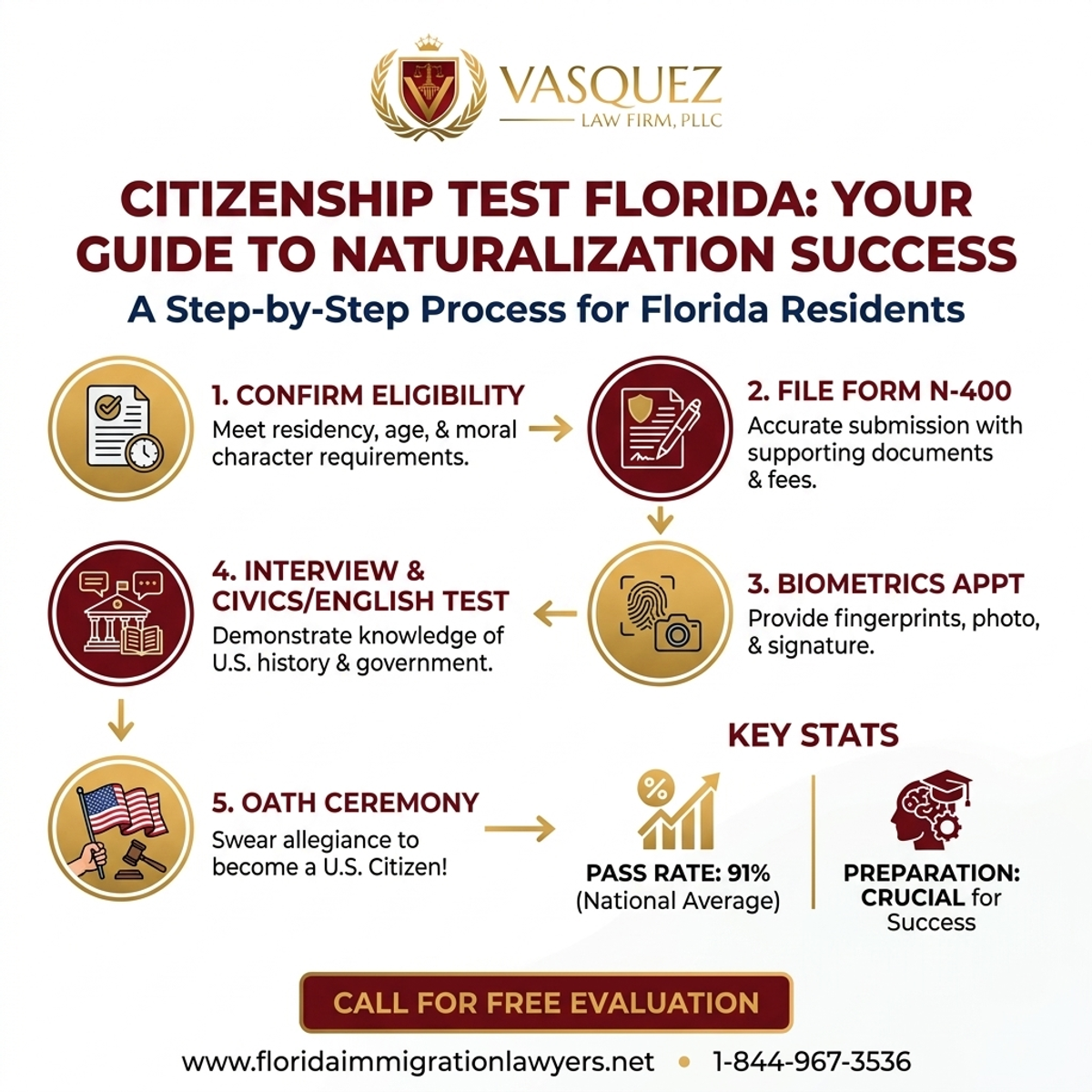
Navigating the naturalization process can feel overwhelming, but breaking it down into manageable steps can help. For residents of Gainesville, Florida, understanding each stage is key to a successful outcome. Here is a detailed, step-by-step guide to help you through the journey:
-
Determine Your Eligibility: Before applying, ensure you meet all naturalization requirements, including age, continuous residency, physical presence, good moral character, and English/civics knowledge. Consult with an immigration attorney to confirm your eligibility, especially if you have any complex issues or have been outside the U.S. for extended periods.
-
Prepare Form N-400, Application for Naturalization: This is the primary application form. It requires detailed personal information, residency history, travel records, marital history, and a good moral character assessment. Answer all questions accurately and completely. Any discrepancies or omissions can cause delays or even denial. For Gainesville residents, ensuring all details align with your local records is important.
-
Gather Supporting Documents: Collect all necessary documents to support your N-400 application. This typically includes your Green Card, state identification, marriage certificates, divorce decrees, tax returns, travel records, and any court or arrest records. Organize these documents meticulously to avoid issues during your interview.
-
Submit Your Application and Fees: File your completed Form N-400, along with all supporting documents and the required filing fee, to USCIS. You can pay by money order, personal check, cashier's check, or credit card using Form G-1450. Fee waivers are available for eligible applicants (Form I-912). Always keep a copy of your entire submission for your records.
-
Attend Your Biometrics Appointment: After filing, USCIS will send you an appointment notice for biometrics (fingerprints, photograph, and signature). This appointment is usually held at an Application Support Center (ASC) near Gainesville, such as in Orlando or Jacksonville. This data is used for background checks and identity verification. Do not miss this appointment.
Step-by-Step Process — Citizenship Test Florida: Your Guide to Naturalization Success
-
Prepare for and Attend Your Naturalization Interview: This is a critical stage. A USCIS officer will review your N-400 application, test your English proficiency (reading, writing, speaking), and administer the civics test. Be prepared to answer questions about your application truthfully and thoroughly. For Gainesville applicants, your interview will likely be scheduled at the Jacksonville or Orlando USCIS field office. Thorough preparation for the citizenship test is paramount.
-
Receive a Decision: After your interview, the USCIS officer will inform you of a decision. You may receive an immediate approval, a continuance (if more information or a retest is needed), or a denial. If approved, you will receive a notice for your Oath of Allegiance ceremony.
-
Attend the Oath of Allegiance Ceremony: This is the final step where you take an oath to the United States and receive your Certificate of Naturalization. This ceremony officially makes you a U.S. citizen. You can then apply for a U.S. passport and register to vote. Many ceremonies are held at USCIS field offices or federal courthouses across Florida.
Essential Documents Checklist for Your N-400 Application
A well-organized application package is crucial for a smooth naturalization process. Missing or incorrect documents can lead to delays, requests for evidence, or even denial. Before submitting your Form N-400, ensure you have gathered all necessary supporting documentation. This comprehensive checklist will help you prepare your application effectively, whether you are in Gainesville or elsewhere in Florida.
- Copy of your Green Card (Form I-551): Both front and back.
- Copies of all passports: Current and expired, especially showing entries and exits for travel outside the U.S.
- Two passport-style photos: Meeting USCIS specifications.
- State Identification: Copy of your driver's license or state ID.
- Marriage Certificate: If applying based on marriage to a U.S. citizen.
- Divorce Decrees or Annulment Records: For all prior marriages of you and your current spouse (if applicable).
- Birth Certificates of Spouse and Children: If applicable.
- Proof of Termination of Prior Marriages: If applicable.
- Federal Income Tax Returns: For the last five (or three) years, depending on your eligibility category.
- Proof of Selective Service Registration: For male applicants between ages 18 and 26.
- Court Disposition Records: For any arrests, citations, or criminal charges, even if dismissed or expunged. This is critical for good moral character assessment.
- Child Support or Alimony Orders and Proof of Payments: If applicable.
- Travel Records: Detailed list of all trips outside the U.S. since becoming a permanent resident, including dates of departure and return.
- Documentation for any medical disability exceptions: If requesting an exemption from the English or civics requirements (Form N-648).
- Fee Waiver Application (Form I-912): If you are eligible for and requesting a fee waiver.
It is always advisable to keep original documents safe and only submit copies unless USCIS specifically requests an original. An immigration attorney can help you compile and organize these documents, ensuring your application is complete and accurate. You can learn more about general immigration processes on our immigration practice area page.
Timeline and Processing Expectations for Florida Naturalization
The timeline for naturalization can vary significantly depending on several factors, including the USCIS field office processing your application, the completeness of your submission, and current agency backlogs. For applicants in Florida, processing times are generally competitive but can fluctuate. Understanding these expectations can help manage your journey to becoming a U.S. citizen.
Typical Processing Stages and Durations
After filing Form N-400, you can expect the following general timeline, though individual experiences may differ:
- Receipt Notice: Within 1-3 weeks after filing, you will receive Form I-797C, Notice of Action, confirming receipt of your application.
- Biometrics Appointment: Typically scheduled 3-5 weeks after the receipt notice. This appointment is quick, usually lasting less than 30 minutes.
- Interview Scheduling: This is often the longest wait, ranging from 6-12 months, or sometimes longer, depending on the specific USCIS field office workload. For Gainesville residents, this means waiting for an interview notice from the Jacksonville or Orlando field office.
- Naturalization Interview: The interview itself lasts about 20-30 minutes, covering your application and the citizenship test (English and civics).
- Decision and Oath Ceremony: If approved, you might receive an immediate decision or a decision notice within a few weeks. The Oath of Allegiance ceremony is usually scheduled 2-6 weeks after approval, but it can be on the same day for some offices.
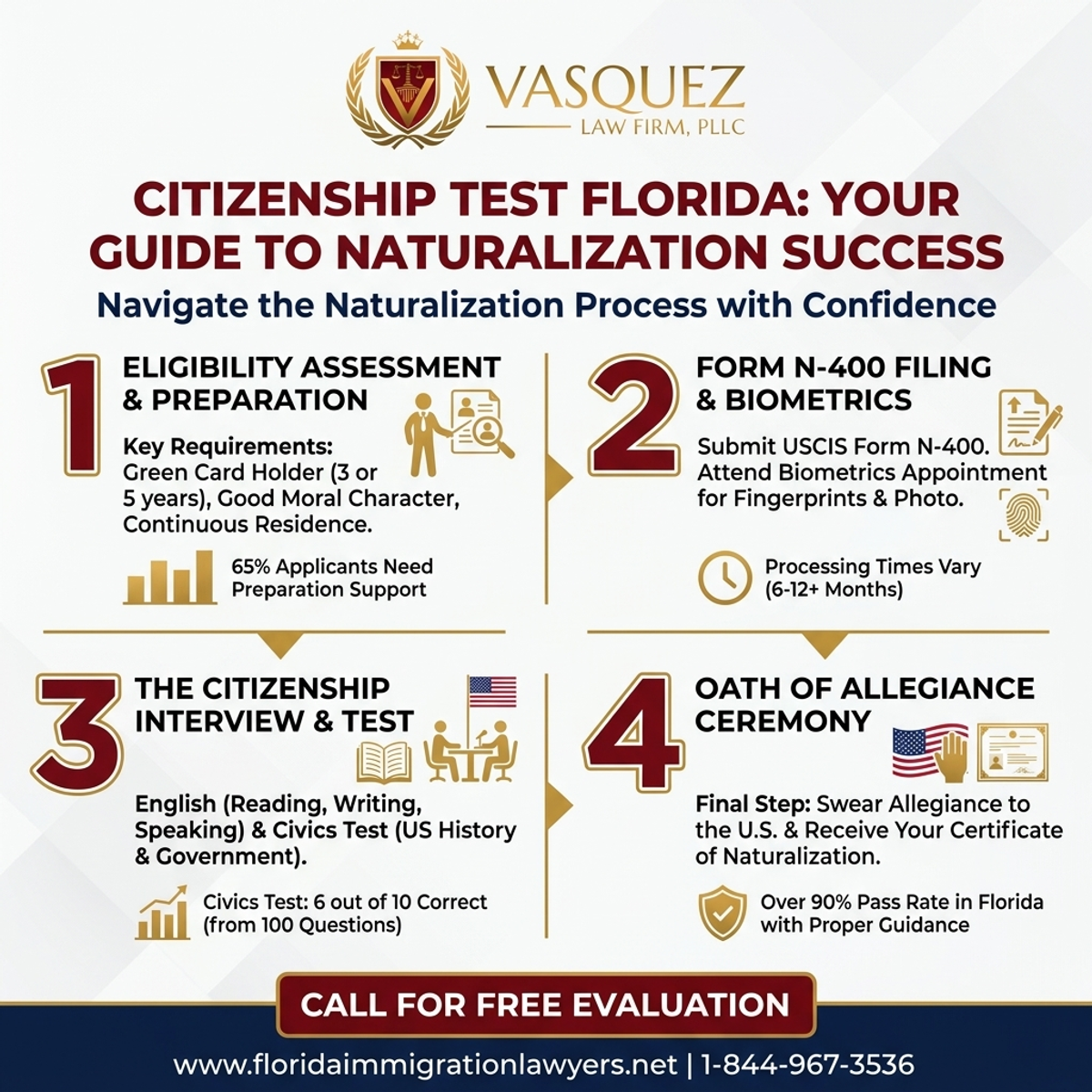
Key Statistics — Citizenship Test Florida: Your Guide to Naturalization Success
USCIS provides a helpful online tool to check processing times for different forms and field offices. It is crucial to monitor these times and be prepared for potential delays. Factors such as criminal history, extensive travel, or complex good moral character issues can significantly prolong the processing time as USCIS conducts more extensive background checks. Maintaining an accurate address with USCIS is also vital to receive all correspondence in a timely manner.
Cost Factors and Fee Breakdown for Naturalization
Pursuing U.S. citizenship involves various costs that applicants should be aware of. These fees are set by USCIS and are subject to change. While we cannot provide specific dollar amounts here, understanding the categories of expenses will help you budget for your naturalization journey in Florida.
Primary USCIS Fees
- Form N-400 Application Fee: This is the main fee for filing the Application for Naturalization.
- Biometrics Services Fee: This fee covers the cost of fingerprinting and background checks. In some cases, this fee may be combined with the N-400 application fee.
It is important to check the most current fee schedule on the USCIS website or consult with an attorney, as fees can be updated periodically. USCIS offers fee waivers (Form I-912, Request for Fee Waiver) for eligible applicants who can demonstrate an inability to pay. Eligibility for a fee waiver is typically based on household income below 150% of the Federal Poverty Guidelines, receipt of a means-tested benefit, or financial hardship.
Other Potential Costs
- Legal Fees: Hiring an experienced immigration attorney, like those at Florida Immigration Lawyers, can be a significant investment but often proves invaluable. Legal fees cover assistance with application preparation, document review, interview preparation, and representation in complex cases. This investment can prevent costly mistakes and delays.
- Document Translation Fees: If any of your supporting documents are not in English, you will need certified translations, which incur additional costs.
- Travel Expenses: Applicants from Gainesville may incur travel costs to attend biometrics appointments and interviews at USCIS field offices in Jacksonville or Orlando.
- Passport Application Fees: Once naturalized, you will need to apply for a U.S. passport, which has its own separate fee.
Planning for these expenses is an essential part of preparing for naturalization. Do not let financial concerns deter you; explore all options, including fee waivers and payment plans with your legal counsel. For assistance with your application and understanding all costs involved, please visit our citizenship practice area page.
Do not navigate this process alone. Contact Florida Immigration Lawyers today to ensure your application is complete and correctly filed, giving you the best chance for success. We are experienced in handling all aspects of the naturalization process for clients throughout Florida.
Common Mistakes to Avoid During Your Naturalization Journey
The path to U.S. citizenship is filled with specific requirements and potential pitfalls. Avoiding common mistakes can save you time, money, and emotional stress. Be vigilant and thorough throughout your naturalization process, especially when preparing for the citizenship test.
-
Incomplete or Inaccurate Form N-400: Failing to answer all questions truthfully and completely, or making errors, can lead to delays, Requests for Evidence (RFEs), or even denial. USCIS takes all information seriously. Ensure every section is filled out meticulously.
-
Failing the Citizenship Test (English or Civics): Insufficient preparation for the English reading, writing, and speaking tests, or not studying all 100 civics questions, is a common reason for continuances. You get one retest, but failure again means denial.
-
Issues with Good Moral Character: Undisclosed criminal history, tax evasion, false claims of U.S. citizenship, or other serious offenses can lead to denial. Even minor infractions must be disclosed and properly documented. This is a critical aspect of eligibility under 8 CFR Part 316.10.
-
Not Maintaining Continuous Residence: Extended trips outside the U.S. (generally six months or more) can break your continuous residence requirement, resetting your eligibility clock. Be precise with travel dates and consult an attorney if you have long absences.
-
Missing or Unorganized Supporting Documents: Submitting an application without all required supporting evidence, or with poorly organized documents, will trigger RFEs and significant delays. Always keep originals and submit clear copies.
-
Lying or Providing False Information During the Interview: Any misrepresentation or false statement, even minor, can be considered fraud and lead to a permanent bar from naturalization. Always be honest and truthful with the USCIS officer.
-
Not Updating Your Address with USCIS: Moving without notifying USCIS using Form AR-11 can result in missed notices, appointment letters, or decisions, potentially leading to abandonment of your application. This is particularly important for applicants in Florida who might move between cities like Gainesville, Orlando, or Jacksonville.
-
Failing to Register for Selective Service: Male applicants who resided in the U.S. between ages 18 and 26 must register for Selective Service. Failure to do so can prevent naturalization unless an exemption applies. This is a mandatory requirement for good moral character.
-
Not Understanding the Oath of Allegiance: While typically the final step, some applicants do not fully grasp the commitment of the oath. Understand what you are swearing to, as it signifies full allegiance to the U.S.
-
Not Seeking Legal Counsel for Complex Cases: Attempting to navigate naturalization alone with a criminal record, past immigration violations, or medical waivers can be detrimental. An attorney can identify potential issues and build a strong case.
When to Call a Lawyer for Your Citizenship Test and Naturalization
While the naturalization process is designed to be accessible, certain situations warrant the expertise of an experienced immigration attorney. Florida Immigration Lawyers are here to provide the guidance you need, ensuring your journey to citizenship is as smooth as possible. Do not hesitate to seek professional help if you encounter any of the following scenarios:
- Complex Eligibility Issues: If you have questions about your continuous residence, physical presence, or good moral character, especially due to extensive travel, arrests, or past immigration violations, an attorney can assess your eligibility and advise on potential waivers or strategies.
- Criminal History: Even minor arrests or convictions can significantly impact your naturalization application. An attorney can analyze your criminal record, gather necessary court dispositions, and prepare a strong argument for good moral character. This is crucial for navigating the requirements of INA § 101(f) and § 316(a).
- Previous Application Denials: If your prior naturalization application was denied, an attorney can review the reasons for denial, help you address the underlying issues, and guide you through the reapplication process.
- Medical Disability Waivers: If you require an exemption from the English or civics requirements due to a physical or developmental disability or mental impairment (Form N-648), an attorney can help you properly document and submit this complex waiver.
- Language Barriers: While the citizenship test includes an English component, if you struggle with English or feel more comfortable communicating in your native language during legal consultations, our bilingual attorneys can provide clear and effective assistance.
- Fear or Anxiety About the Interview: The naturalization interview can be stressful. An attorney can prepare you thoroughly, conduct mock interviews, and even accompany you to the interview to provide support and address any legal issues that may arise.
- Changing Circumstances: Life events such as divorce, marriage, or moving to a new city like Gainesville, Orlando, or Miami during the application process can complicate your case. An attorney can help you update USCIS and ensure your application remains accurate.
Our attorneys at Florida Immigration Lawyers have extensive experience with the naturalization process and understand the specific challenges faced by applicants in Florida. We are dedicated to providing personalized, compassionate, and effective legal representation. For assistance with your naturalization journey or any other immigration matter, including deportation defense or asylum cases, contact us today.
About Florida Immigration Lawyers
Florida Immigration Lawyers is a leading law firm dedicated to providing exceptional legal representation to immigrants across the entire state of Florida. Our team of highly skilled and compassionate attorneys understands the complexities and emotional weight of immigration law. We are committed to helping individuals and families achieve their American dreams, whether through naturalization, family petitions, or defense against deportation. Our deep knowledge of U.S. immigration laws, including the INA and 8 CFR, combined with a personalized approach, sets us apart.
We offer a comprehensive range of immigration services, including assistance with the naturalization process, visa applications, green cards, asylum claims, and business immigration solutions. Our firm is proud to serve clients in Orlando and all other Florida communities. We believe that everyone deserves access to quality legal advice, which is why we offer free consultations and are available 24/7 to address your urgent needs. Our attorneys are fluent in English and Spanish, ensuring clear communication and culturally sensitive support for all our clients. Visit our attorneys page to learn more about our team.
Sources and References
- U.S. Citizenship and Immigration Services (USCIS)
- Executive Office for Immigration Review (EOIR)
- U.S. Department of State (Travel.State.Gov)
- 8 U.S.C. Chapter 12 - Immigration and Nationality Act (INA)
- 8 U.S.C. § 1427 - Requirements for Naturalization
- 8 CFR Part 312 - English Literacy and Knowledge of History and Government of the United States
- 8 CFR Part 316.10 - Good Moral Character
Related services: citizenship test preparation, dual citizenship guidance, family-based immigration.
This article provides general legal information and is not intended as legal advice. Every case is unique, and outcomes depend on specific facts and circumstances. Contact an attorney for advice about your particular situation.
Are you ready to take the final step towards U.S. citizenship? Do not leave your future to chance. The complexities of the citizenship test and naturalization process require careful attention and expert guidance. Contact Florida Immigration Lawyers at 1-844-YO-PELEO for a free consultation. Se Habla Español - Estamos aqui para ayudarle.
Do Not Navigate This Process Alone
Our experienced immigration attorneys are ready to fight for you. Get a free, confidential case review today.
Se Habla Español
Or leave your details and we’ll call you:
Free Evaluation in 24 Hours
Or talk to us right now

AI voice assistant — available 24/7
FreeFrequently Asked Questions

William J. Vásquez
Founding Attorney · Vasquez Law Firm
U.S. Air Force veteran and immigration attorney with years of hands-on U.S. immigration experience. J.D., NCCU School of Law. AILA member. Admitted to the 4th, 5th, and 11th Circuit Courts.
Available 24/7 - Free Evaluations
Reviewed for legal accuracy by William J. Vásquez
Licensed in North Carolina; U.S. immigration is federal practice.
Related Legal Services
Our Florida immigration attorneys can help you with business immigration, deportation defense and family immigration services. Call today at 1-844-YO-PELEO for a free case review.
Related Links
Related Topics
Free Legal Case Review
Discuss your case with our experienced attorneys. We're available 24/7.
Se Habla Español - Estamos aquí para ayudarle.
Related Articles
Immigration Lawyer Orlando Free Consultation in Florida
For individuals and families in Orlando, Florida, navigating the complexities of U.S. immigration law requires expert guidance. An immigration lawyer in Orlando offers crucial support for everything from visa applications and green card processes to naturalization and deportation defense. This comprehensive guide details what a free consultation covers, providing a step-by-step overview of immigration pathways, essential document checklists, and expected timelines in 2026. We also highlight common mistakes to avoid, discuss the critical role of legal counsel in deportation and asylum cases, and explain why choosing a local Orlando immigration attorney is beneficial. Florida Immigration Lawyers is dedicated to serving the diverse community of Orlando with compassionate, effective legal solutions, ensuring you receive personalized advice and robust representation for a successful immigration journey.
USCIS Oath Ceremony Florida 2026: Schedule & Key Dates
For immigrants in Florida, understanding the USCIS oath ceremony schedule for 2026 is crucial for the final step of naturalization. This comprehensive guide from Florida Immigration Lawyers explores how these schedules are determined, the factors influencing processing times, and what to expect throughout the naturalization journey. We delve into eligibility requirements, a step-by-step application guide, and a detailed look at the documents needed for your oath ceremony. With varying wait times across Florida's USCIS field offices, staying informed is key. We also highlight common mistakes to avoid and explain when seeking legal counsel can be invaluable to ensure a smooth and successful transition to U.S. citizenship. Gain insights into timelines, costs, and the support available from our expert team.
BIA Remand Order: What It Means for Your Florida Appeal 2026
A BIA remand order is a directive from the Board of Immigration Appeals (BIA) to send an immigration case back to an Immigration Judge (IJ) for further proceedings. This pivotal decision means your appeal is not over; instead, the case will be re-opened in Immigration Court to address specific legal errors or consider new evidence, as outlined by the BIA. For individuals in Florida, understanding the nuances of a remand is crucial for achieving a favorable immigration outcome. This comprehensive guide from Florida Immigration Lawyers explains what a BIA remand order is, why it occurs, and the critical steps you must take afterward. We detail the appeal process in Florida, outline essential documents, provide a timeline for remanded cases in 2026, and break down associated costs. Learn about common mistakes to avoid and when it is absolutely vital to seek expert legal counsel to protect your rights and future. Our firm offers dedicated, bilingual support across Florida, providing free case reviews to help you navigate this complex legal journey with confidence.
Student Visa Attorney Florida: Your 2026 Guide to Study
Dreaming of studying in Florida? The student visa process can be challenging, but with the right guidance, your academic future in the Sunshine State is achievable. This comprehensive guide, updated for 2026, details the F-1 visa application steps, essential documents, financial requirements, and work limitations for international students. Learn about the crucial role a student visa attorney in Florida plays in navigating complex immigration laws, ensuring your application is meticulously prepared, and helping you avoid common pitfalls. From obtaining your I-20 to successfully clearing your consular interview, understanding each stage is vital. Discover when to seek legal counsel, especially for complex cases, previous denials, or maintaining your student status. Florida Immigration Lawyers are here to provide expert immigration help, offering free case reviews and dedicated support across Florida. Secure your educational journey with professional legal assistance.