Understanding the Child Status Protection Act in Florida
Worried about your child aging out of their immigration status in Florida? Discover how the Child Status Protection Act (CSPA) can help safeguard their future. Call Florida Immigration Lawyers at 1-844-967-3536 for expert guidance.

Introduction
Are you concerned about your child aging out of their immigration status in Florida? The Child Status Protection Act (CSPA) is designed to help children under certain immigration petitions retain their eligibility even after turning 21. In this article, we will cover how the CSPA works, eligibility criteria, and provide guidance to families in Kissimmee and throughout Florida. Call Florida Immigration Lawyers at 1-844-967-3536 for a free consultation to protect your child's future.
The journey to permanent residency in the U.S. is often long and complex, and for many families, the greatest fear is that their children might "age out" before their visa becomes available. This can lead to heartbreaking separations and the loss of a child's opportunity to join their family in America. The CSPA acts as a critical safeguard, offering a lifeline to ensure that children who meet specific criteria can preserve their eligibility despite processing delays.
Understanding the nuances of CSPA is paramount for immigrant families in Florida, a state with a vibrant and diverse immigrant community. Whether you're in Kissimmee, Miami, Orlando, or anywhere else in the Sunshine State, the principles of CSPA apply, and navigating them correctly can mean the difference between family unity and prolonged separation. This article aims to demystify CSPA, providing clear, actionable insights to help you protect your child's immigration future. Don't hesitate to reach out to Florida Immigration Lawyers at 1-844-967-3536 for expert guidance tailored to your unique situation.
What is the Child Status Protection Act?
The Child Status Protection Act (CSPA) was enacted to address "aging out," where a child loses eligibility for certain immigration benefits upon turning 21. As of 2026, CSPA provides a method to calculate an applicant's age to qualify as a 'child' under immigration laws. This calculation can help maintain eligibility for those classified as derivative beneficiaries.
CSPA applies to various immigrant categories, such as family-based, employment-based, and diversity visa cases. The key is understanding how the law calculates age for immigration purposes, potentially preserving benefits otherwise lost due to aging out.
Before CSPA, many children who were derivative beneficiaries of immigrant petitions would lose their eligibility for a green card if they turned 21 during the often lengthy processing times. This "aging out" phenomenon caused immense distress and separated families, as a child over 21 would typically need a new, separate petition, often with much longer waiting lists. CSPA was enacted in 2002 to mitigate this harsh consequence, providing a mechanism to "freeze" a child's age for immigration purposes.
The Act specifically applies to various categories of immigrant visas, including immediate relatives (though less common for aging out as no visa backlog), family-preference categories (F1, F2A, F2B, F3, F4), employment-based petitions (e.g., E1, E2, E3), and diversity visa lottery winners. Each category has slightly different rules for how CSPA is applied, making a detailed understanding crucial. For instance, children of U.S. citizens (immediate relatives) generally do not "age out" in the same way as those in preference categories, but CSPA still offers protection in specific scenarios, such as when a parent naturalizes.
The core principle of CSPA is to ensure that children are not penalized for administrative delays in the immigration system. It seeks to uphold the intent of Congress to keep families together, allowing eligible children to immigrate alongside or shortly after their parents. By providing a specific formula to calculate a child's age, CSPA offers a vital pathway for countless families to achieve their dream of living together permanently in the United States.
How Does CSPA Age Calculation Work?
CSPA age calculation involves subtracting the number of days the petition was pending from the child's age at visa availability. This age freeze ensures that children who turn 21 during the process retain their eligibility. For example, if a petition was pending for 180 days, these days are subtracted from the child's age when the visa becomes available.
- Determine the child's age when the visa becomes available.
- Subtract the number of days the petition was pending.
- If the resulting age is under 21, the child remains eligible.
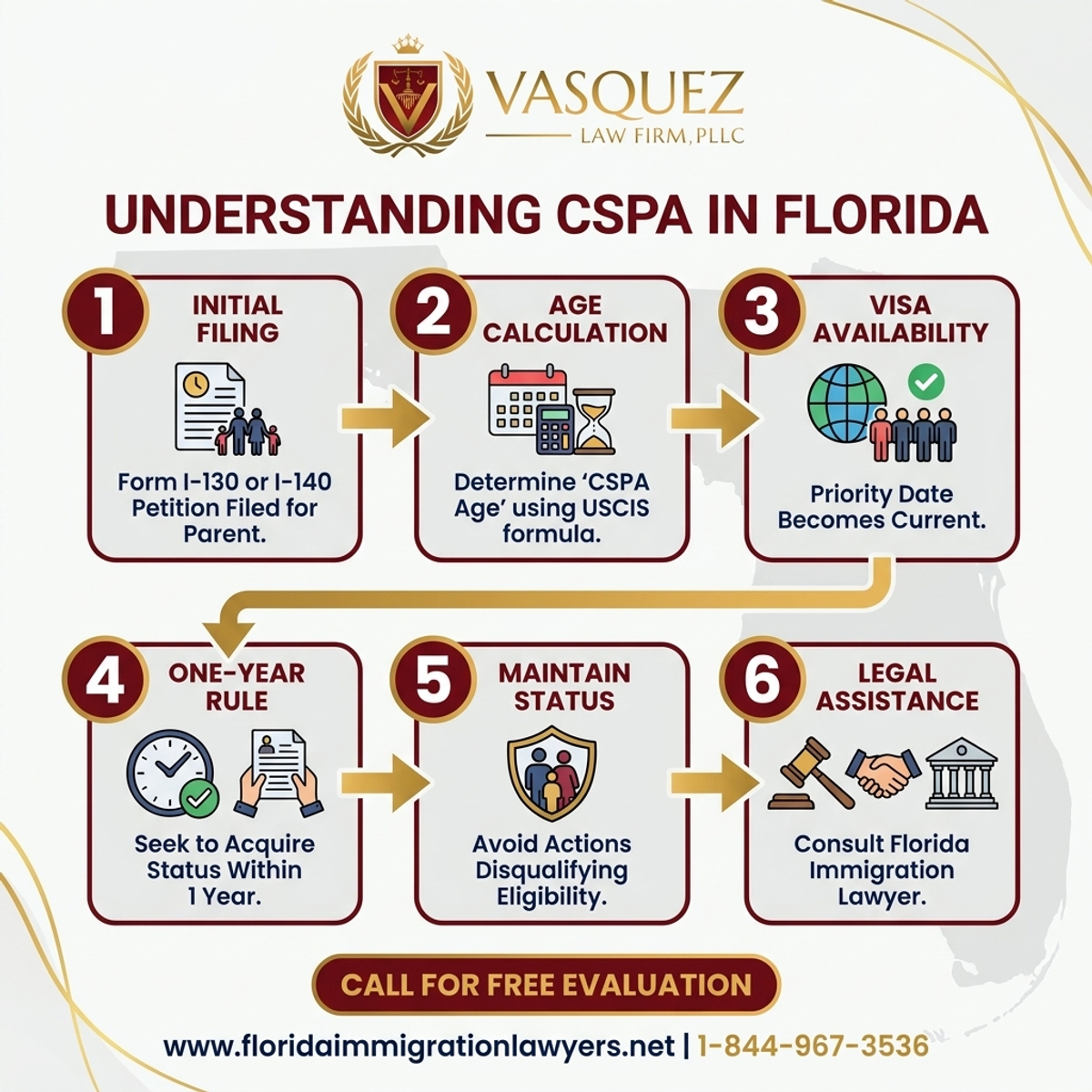
Step-by-Step Process — Understanding the Child Status Protection Act in Florida
Understanding these steps is crucial, especially for families in vibrant Florida communities like Kissimmee with diverse immigrant populations.
The magic of CSPA lies in its age calculation formula, which essentially "subtracts" the time an immigrant petition was pending from the child's actual age when their visa number becomes available. This adjusted age, if under 21, allows the child to retain their "child" status. For example, imagine a child is 20 years and 6 months old when their parent's F2A petition (for spouses and children of LPRs) becomes current according to the Visa Bulletin. If the original petition (Form I-130) was filed and pending for 1 year (365 days), the CSPA age calculation would be 20 years and 6 months minus 1 year, resulting in a CSPA age of 19 years and 6 months. Since this is under 21, the child is protected.
A critical component of this calculation is the "visa availability" date. This is determined by the U.S. Department of State's monthly Visa Bulletin, which indicates when immigrant visas become available for different preference categories and countries of chargeability. It's not just when the petition is approved, but when a visa number is actually available for the child's category. Furthermore, to benefit from CSPA, the child must "seek to acquire" permanent residence within one year of the visa becoming available. This typically means filing Form I-485 (Application to Register Permanent Residence or Adjust Status) if they are in the U.S., or submitting the DS-260 (Immigrant Visa Application) if they are abroad, within that one-year window.
This "sought to acquire" requirement is a common pitfall. Many families, unaware of this strict deadline, miss the one-year window and lose CSPA protection, even if their CSPA age calculation was favorable. This highlights the importance of closely monitoring the Visa Bulletin and acting swiftly once a visa number becomes available. Consulting with experienced professionals like Florida Immigration Lawyers can help you track these dates and ensure all necessary actions are taken promptly to protect your child's eligibility.
What Documents Are Required for CSPA Claims?
To apply CSPA protections, you must gather and submit several documents. Ensuring completeness is vital for a successful CSPA claim. The typical documents include:
- Original birth certificate of the child.
- Copy of the approved immigrant petition (I-130, I-140, etc.).
- Proof of visa availability (notice from the National Visa Center).
- Form I-485, Application to Register Permanent Residence or Adjust Status, if applicable.
Having these documents ready can significantly streamline the process with USCIS.
Beyond the primary documents listed, supporting evidence is often crucial. For instance, if the petitioning parent naturalized, proof of their U.S. citizenship (e.g., naturalization certificate) will be needed. If the child's name has changed, or if there are any discrepancies in birth records, official court orders or affidavits may be required. Every document submitted should be accurate, legible, and, if not in English, accompanied by a certified English translation.
The birth certificate is paramount as it establishes the child's legal age and relationship to the petitioner. The approved immigrant petition (I-130, I-140, etc.) demonstrates the basis for the immigration benefit and the petition's filing date, which is essential for the CSPA age calculation. The notice from the National Visa Center (NVC) or the USCIS receipt notice for I-485 serves as proof of visa availability and the date the child "sought to acquire" their visa.
Organizing these documents meticulously and ensuring their accuracy can prevent significant delays or requests for evidence (RFEs) from USCIS. A missing or incorrect document can halt the entire process, jeopardizing your child's CSPA protection. Florida Immigration Lawyers can assist you in compiling a comprehensive and accurate application package, ensuring all required documentation is properly prepared and submitted.
Timeline for CSPA Applications and Processing
| Stage | Typical Timeframe | Notes |
|---|---|---|
| Petition Filing | 6-12 months | Varies by USCIS workload. |
| Visa Availability | Varies | Depends on visa bulletin dates. |
| CSPA Age Calculation | Immediate | Done as visa becomes available. |
| I-485 Processing | 8-14 months | After visa availability. |
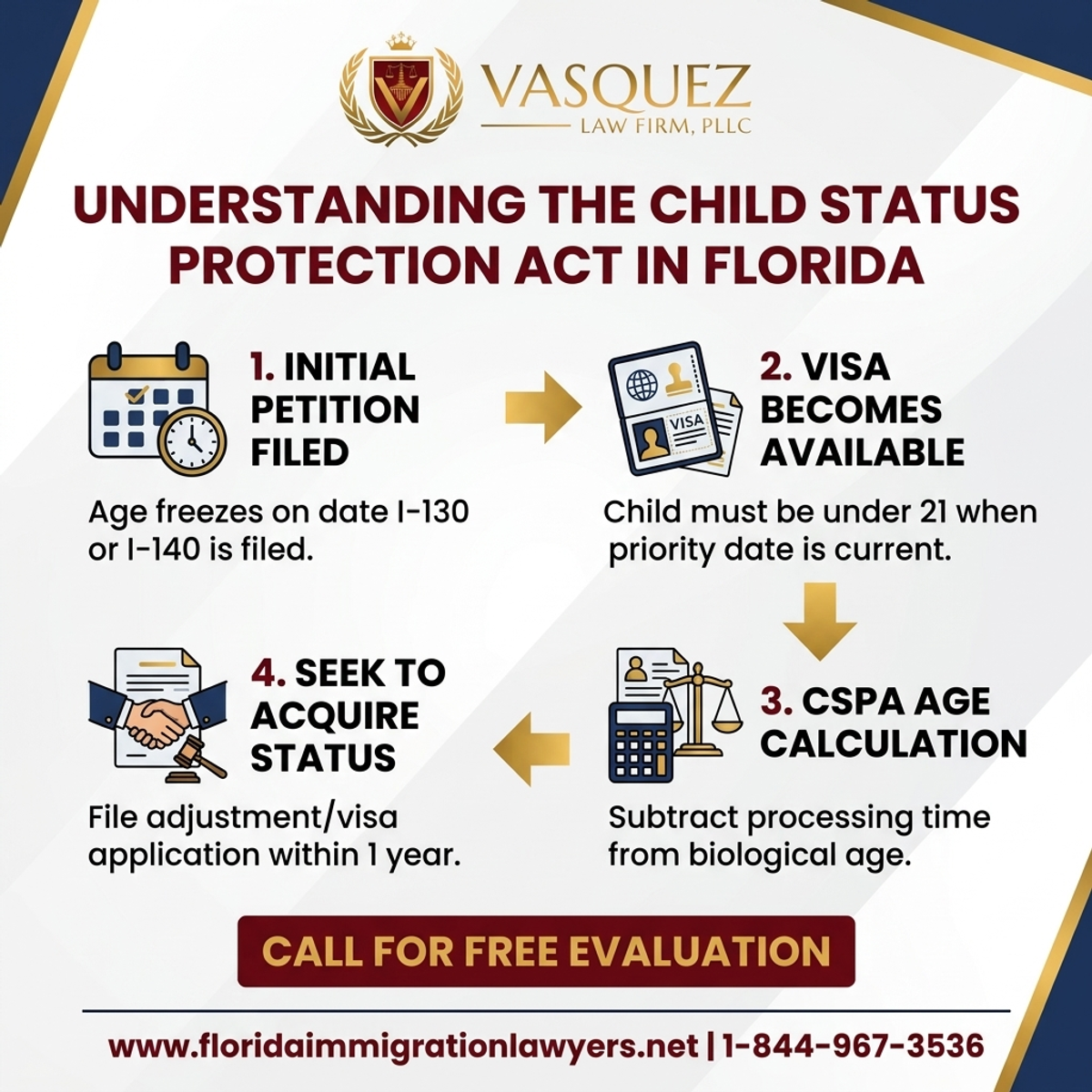
Key Statistics — Understanding the Child Status Protection Act in Florida
Processing times can vary, so timely action is recommended.
The "Typical Timeframe" provided in the table offers a general idea, but actual processing times can fluctuate wildly due to various factors. These include the specific visa category, the country of origin, current USCIS and NVC workloads, and legislative changes. For example, some family-based petitions, especially those for siblings or married children of U.S. citizens (F4, F3), can have waiting periods stretching over a decade, making CSPA absolutely critical for derivative beneficiaries.
The most unpredictable element is "Visa Availability," which is governed by the Visa Bulletin. This bulletin can show retrogression (visa numbers becoming unavailable again) or slow movement, directly impacting when a child's CSPA age is "locked in" and when they must "seek to acquire" their visa. Monitoring the Visa Bulletin monthly is not just recommended; it's essential for families relying on CSPA.
Due to these varying timelines, proactive engagement with your immigration attorney is vital. They can help you understand the current trends, estimate potential wait times, and advise on when to prepare for the next steps, such as filing the I-485 or submitting the DS-260. Missing critical deadlines because of a misunderstanding of the timeline can lead to irreversible consequences, making professional legal guidance from Florida Immigration Lawyers invaluable.
What Are the Costs Involved in CSPA Filings?
| Item | Typical Fee | Notes |
|---|---|---|
| Form I-130 | Varies | For family-based petitions. |
| Form I-485 | Varies | For adjustment of status. |
| Legal Fees | Varies | Consult with an attorney. |
Costs can differ based on the specific circumstances and legal representation needed.
Beyond the government filing fees for forms like I-130 and I-485, which are subject to change by USCIS, families should budget for several other potential expenses. These can include fees for biometrics appointments, mandatory medical examinations conducted by USCIS-approved civil surgeons, and costs for obtaining original documents or certified translations of foreign documents. These ancillary costs can add up, so it's wise to plan for them in advance.
Legal fees for professional immigration services are a significant but often worthwhile investment. These fees cover the expertise of an attorney in navigating complex immigration laws, preparing and reviewing all documentation, communicating with USCIS or the NVC on your behalf, and representing you in interviews if necessary. The exact cost can vary depending on the complexity of your case, the attorney's experience, and the scope of services required.
While it might be tempting to handle the process independently to save money, the potential for costly mistakes, delays, or even denials due to inexperience can far outweigh the savings. Many law firms, including Florida Immigration Lawyers, offer transparent fee structures and payment plans to make legal assistance accessible. Discussing your financial situation during your free consultation can help you understand the potential costs and explore options for managing them, ensuring your child's CSPA claim is handled correctly without undue financial burden.
Do not navigate this process alone. Contact Florida Immigration Lawyers today.
Common Mistakes to Avoid
- Not understanding the CSPA age calculation method, leading to misinterpretation of eligibility.
- Failing to file the necessary forms within the required timeframes, resulting in lost benefits.
- Overlooking the need for accurate documentation, which can delay or deny applications.
- Assuming that eligibility is automatic without the proper CSPA age calculation.
- Ignoring updates to immigration laws that might affect CSPA provisions.
- Not consulting with an experienced immigration attorney, risking improper application handling.
- Misinterpreting visa bulletin updates that affect visa availability and age calculation.
- Submitting incomplete or incorrect forms, leading to application rejection.
- Failure to monitor USCIS communications for updates on application status.
- Not considering the impact of family relocation on jurisdiction and processing times.
Frequently Asked Questions (FAQs) About CSPA
What is the "sought to acquire" requirement for CSPA?
To benefit from CSPA, your child must "seek to acquire" permanent residence within one year of a visa becoming available. This typically means filing Form I-485 (Adjustment of Status) if in the U.S., or submitting Form DS-260 (Immigrant Visa Application) if applying from abroad. Missing this crucial one-year deadline, even if your child's CSPA age calculation is favorable, will result in the loss of CSPA protection. Timely action is paramount.
Does CSPA apply if my parent naturalizes?
Yes, CSPA can apply. If a Lawful Permanent Resident (LPR) parent naturalizes while their child's F2A (unmarried child of LPR) petition is pending, the petition automatically converts to an F1 (unmarried child of U.S. citizen) petition. CSPA can still protect the child's age, often by allowing them to retain the earlier F2A priority date, which can be more favorable. Consulting Florida Immigration Lawyers is essential to understand the specific implications for your case.
Can CSPA protect my child if I am an employment-based immigrant?
Absolutely. CSPA applies to derivative beneficiaries of employment-based immigrant petitions (e.g., I-140). The calculation method is similar: the time the I-140 petition was pending is subtracted from the child's age when the visa becomes available. This protection ensures that children of skilled workers, professionals, and other employment-based immigrants can remain eligible for a green card despite processing delays.
What happens if my child's CSPA age is exactly 21?
If the CSPA age calculation results in your child being exactly 21, they are generally considered to have "aged out" and will not be protected by CSPA. The CSPA requires the calculated age to be under 21. This emphasizes the precision required in the calculation and the importance of professional assistance to ensure every day of eligibility is accounted for.
Is there an appeal process if my CSPA claim is denied?
Yes, if your CSPA claim is denied, you may have options to appeal or file a motion to reconsider/reopen with USCIS or the Board of Immigration Appeals (BIA), depending on the stage of denial. The specific process and likelihood of success depend heavily on the reasons for denial. It is crucial to immediately seek legal counsel from Florida Immigration Lawyers to evaluate your options and prepare a strong appeal.
When to Call a Lawyer
Engaging an immigration lawyer can make a significant difference in navigating CSPA complexities. If you face uncertain visa availability, complex age calculations, or any application errors, legal expertise is crucial. Florida Immigration Lawyers can assist with these challenges, ensuring your child's rights are protected. Remember, timely legal advice can prevent potential pitfalls in your immigration journey.
While the CSPA aims to simplify things, its application can be incredibly nuanced. For example, if a petitioning parent naturalizes while their child's petition is pending, the child's category might change, which can affect the CSPA calculation. Similarly, if there are any past immigration violations, criminal records, or complex family situations (e.g., adoptions, stepchildren), a lawyer's expertise is not just helpful but often essential to ensure eligibility and avoid potential pitfalls.
An experienced immigration attorney from Florida Immigration Lawyers can provide invaluable assistance by accurately calculating your child's CSPA age, identifying potential issues before they arise, and ensuring all deadlines, especially the crucial one-year "sought to acquire" requirement, are met. They can also represent you in communications with USCIS or the National Visa Center, respond to Requests for Evidence (RFEs), and prepare you for any interviews.
Don't wait until you receive a denial or a Request for Evidence to seek legal help. Proactive engagement with a lawyer from the outset can save you time, stress, and money in the long run. Even if you think your case is straightforward, a quick consultation can provide peace of mind and confirm that you are on the right track. Call Florida Immigration Lawyers at 1-844-967-3536 today for a free consultation to discuss your child's CSPA eligibility and secure their future.
About Florida Immigration Lawyers
Florida Immigration Lawyers is your trusted partner for all immigration needs in Florida. We specialize in family immigration, asylum, deportation defense, and more. Our experienced team is committed to providing personalized legal solutions. Call us at 1-844-967-3536 or visit our website for a free consultation. We are available 24/7 to serve you.
Sources and References
- U.S. Citizenship and Immigration Services (USCIS)
- Executive Office for Immigration Review (EOIR)
- 8 U.S.C. Chapter 12 - Immigration and Nationality Act
Related services: immigration practice areas, family immigration services, citizenship and naturalization.
This article provides general legal information and is not intended as legal advice. Every case is unique, and outcomes depend on specific facts and circumstances. Contact an attorney for advice about your particular situation.
Do not wait. Contact Florida Immigration Lawyers at 1-844-967-3536 for a free consultation today. Se Habla Espanol - Estamos aqui para ayudarle.
If you need legal assistance, learn more about how our immigration attorneys can help, or call us at 1-844-967-3536 for a free consultation.
Do Not Navigate This Process Alone
Our experienced immigration attorneys are ready to fight for you. Get a free, confidential consultation today.
Se Habla Español
Frequently Asked Questions
Harold Estrada-Rodriguez
Florida Immigration Attorney · FL Bar No. 1041171
Florida Bar attorney handling Florida-jurisdiction immigration matters. Bilingual representation, free consultations.
Available 24/7 - Free Evaluations
Related Legal Services
Our Florida immigration attorneys can help you with immigration practice areas, free immigration consultation and experienced immigration attorneys. Call today at 1-844-967-3536 for a free consultation.
Related Links
Related Topics
Free Legal Consultation
Discuss your case with our experienced attorneys. We're available 24/7.
Se Habla Español - Estamos aquí para ayudarle.
Related Articles
Protect Yourself from Immigration Scams in Florida
Immigration scams are a serious issue in Florida, particularly in areas like Hollywood. Learn how to identify and avoid scams such as notario fraud. Stay informed and seek legal help when necessary. Call Florida Immigration Lawyers for a free consultation.
H-4 EAD Spouse Work Permit Rules in Florida | VLF Florida
Discover how the H-4 EAD can empower spouses of H-1B visa holders in Florida to work legally. Our detailed guide covers eligibility, application process, and common pitfalls. Call Florida Immigration Lawyers for personalized assistance.
U Visa Immigration Relief for Crime Victims in Florida
U Visa provides a crucial pathway to legal status for crime victims in Florida. Learn about eligibility, application steps, and common pitfalls to avoid. Contact Florida Immigration Lawyers for expert guidance and a free consultation.
Immigration Bond Hearing Florida: Your 2026 Guide | VLF Florida
Navigating an immigration bond hearing in Florida requires a clear understanding of the process, eligibility, and legal requirements. This 2026 guide from Florida Immigration Lawyers provides essential information on securing release from ICE detention, including details on bond hearings, required documents, typical timelines, and associated costs. Learn about the factors immigration judges consider, common mistakes to avoid, and when it's critical to enlist expert legal counsel. With Florida-specific insights and practical advice, this resource aims to empower individuals and families facing immigration detention across the state, from West Palm Beach to Miami. Secure a free consultation with our experienced attorneys for dedicated support.