H-4 EAD Spouse Work Permit Rules in Florida
Discover how the H-4 EAD can empower spouses of H-1B visa holders in Florida to work legally. Our detailed guide covers eligibility, application process, and common pitfalls. Call Florida Immigration Lawyers for personalized assistance.
H-4 EAD Spouse Work Permit Rules in Florida | VLF Florida
For many highly skilled professionals working in the United States on H-1B visas, the prospect of their spouses gaining work authorization is a significant relief and a crucial step towards building a stable life. The H-4 EAD (Employment Authorization Document) allows eligible H-4 dependent spouses of H-1B visa holders to work legally in the U.S. This provision has been particularly impactful for families seeking to establish roots and contribute to the economy in states like Florida, which has seen a growing influx of H-1B professionals.
Navigating the intricacies of U.S. immigration law, especially concerning work permits, can be challenging. This comprehensive guide from VLF Florida aims to clarify the H-4 EAD spouse work permit rules specifically for those residing in or considering a move to Florida. We'll delve into eligibility, the application process, key benefits, potential challenges, and how our experienced immigration attorneys can provide invaluable assistance.
Understanding the H-4 EAD: A Pathway to Work Authorization in Florida
The H-4 EAD is a work permit granted to certain H-4 nonimmigrants, who are typically the spouses and minor children of H-1B visa holders. Before 2015, H-4 dependents were generally not permitted to work in the U.S., leading to significant financial and career challenges for many families. Recognizing the need to retain skilled talent and support H-1B families, the U.S. Citizenship and Immigration Services (USCIS) introduced this rule change, allowing eligible H-4 spouses to apply for an EAD.
This authorization is particularly vital in Florida, a state known for its diverse economy, including burgeoning tech, healthcare, and aerospace industries. With an H-4 EAD, spouses can pursue career opportunities, contribute to household income, and achieve greater financial independence, thereby enhancing the overall quality of life for H-1B families in the Sunshine State. It alleviates the burden on the H-1B principal and allows for a more equitable partnership within the family unit, fostering greater integration into American society and the local Florida community.
Eligibility Requirements for H-4 EAD in Florida
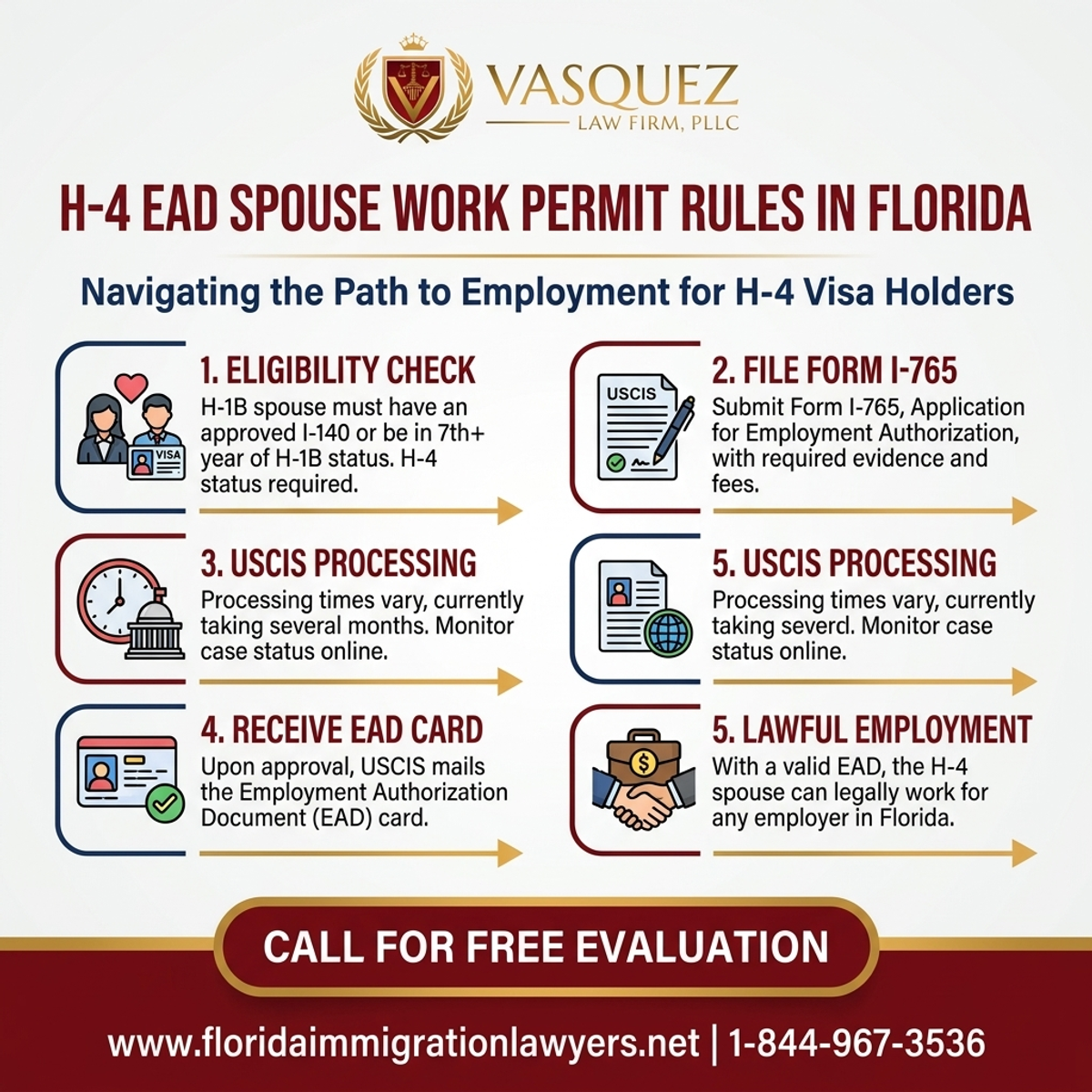
Not all H-4 spouses are eligible for an EAD. The eligibility criteria are specific and tied directly to the H-1B principal's status. To qualify for an H-4 EAD, the H-4 applicant must meet one of the following conditions:
-
Primary H-1B Status: The principal H-1B nonimmigrant must be in valid H-1B status. This is the foundational requirement, as the H-4 EAD is entirely dependent on the H-1B spouse's status. If the H-1B principal loses their status, the H-4 EAD may also become invalid.
-
Approved Form I-140: The H-1B principal must be the beneficiary of an approved Form I-140, Immigrant Petition for Alien Worker. This signifies that the H-1B principal is on the path to obtaining lawful permanent residency (a Green Card). The I-140 approval demonstrates a long-term intent to remain in the U.S., which underpins the rationale for granting work authorization to their spouse.
-
H-1B Extension under AC21: The H-1B principal has been granted H-1B status under sections 106(a) and (b) of the American Competitiveness in the Twenty-first Century Act of 2000 (AC21), as amended. This typically applies when the H-1B principal has reached the six-year maximum limit for H-1B status but is eligible for extensions beyond this limit due to a pending PERM Labor Certification application or an approved I-140 petition. These extensions are granted in one-year increments until a decision is made on their Green Card application.
-
Valid H-4 Nonimmigrant Status: The applicant must hold valid H-4 nonimmigrant status at the time of filing the EAD application. This means they must have been admitted to the U.S. as an H-4 dependent or have successfully changed their status to H-4. Maintaining continuous lawful status is paramount throughout the application process.
It's crucial to understand that meeting these criteria is non-negotiable. Any discrepancies or failures to meet these conditions can lead to delays or denial of the H-4 EAD application. Consulting with a knowledgeable immigration attorney can help ensure all eligibility requirements are accurately assessed and met before filing.
The H-4 EAD Application Process: A Step-by-Step Guide
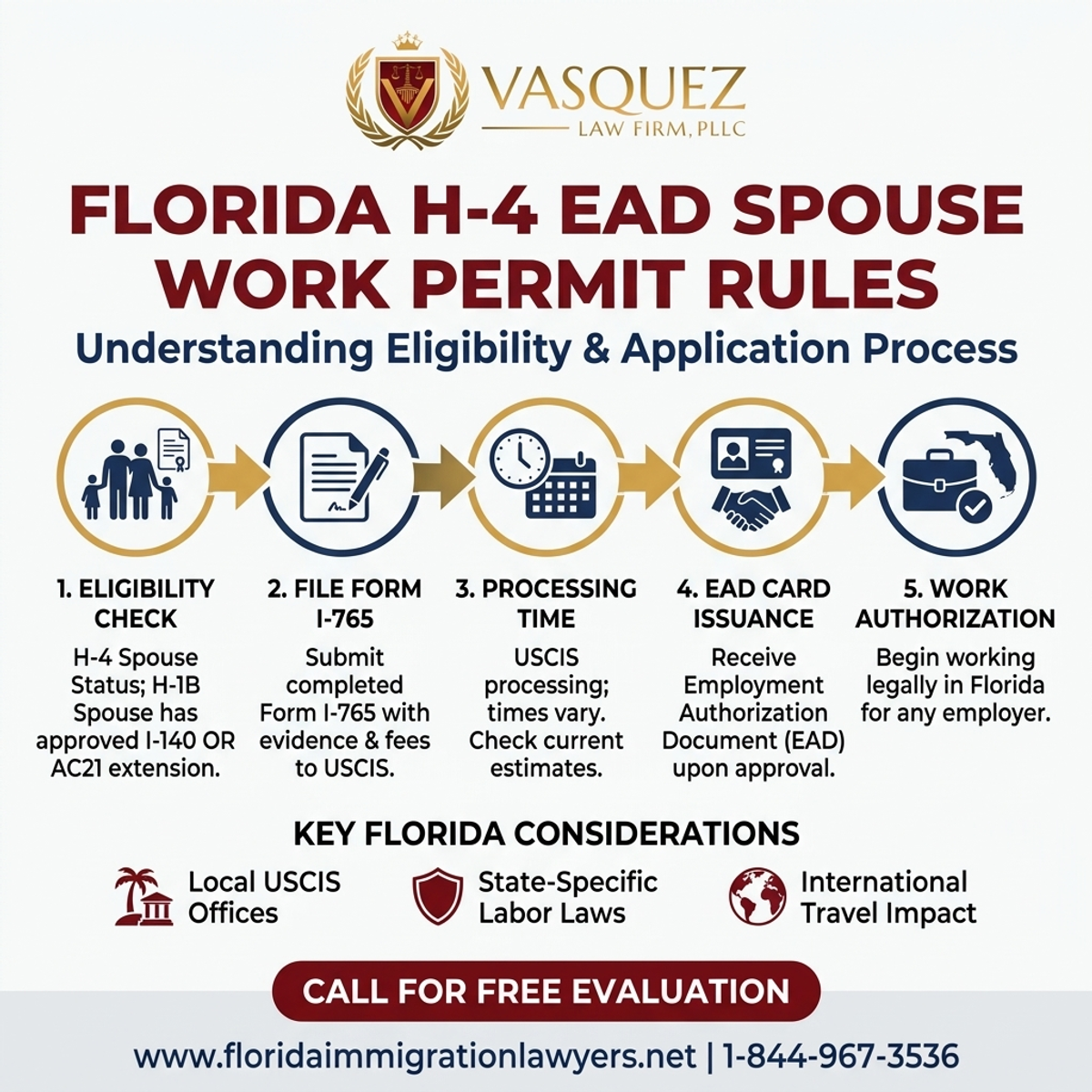
Applying for an H-4 EAD involves several steps and requires meticulous attention to detail. Here’s a general overview of the process:
-
Gather Required Documents: Before completing any forms, collect all necessary supporting documentation. This typically includes:
- Form I-765, Application for Employment Authorization.
- Copy of the H-4 applicant's most recent Form I-94, Arrival/Departure Record.
- Copy of the H-4 applicant's H-4 visa stamp (if applicable).
- Copy of the H-4 applicant's passport (biographic page).
- Copy of the marriage certificate to the H-1B principal.
- Copies of the H-1B principal's Form I-797 approval notices for H-1B status.
- Copy of the H-1B principal's approved Form I-140 (if applicable).
- Two passport-style photographs of the H-4 applicant.
- Proof of relationship to the H-1B principal (e.g., birth certificate for children, marriage certificate for spouse).
-
Complete Form I-765: Fill out Form I-765 accurately and completely. Pay close attention to all sections, especially Part 2, Item 27, where you must enter the eligibility category (c)(26) for H-4 EAD. Any errors or omissions can cause significant delays.
-
Prepare Supporting Evidence: Organize all collected documents. USCIS prefers copies, so do not send original documents unless specifically requested. Ensure all copies are clear and legible.
-
File the Application: Mail the completed Form I-765, all supporting documents, and the applicable filing fee to the correct USCIS lockbox facility. The filing fee for Form I-765 can change, so always check the USCIS website for the most current fee. If you are filing concurrently with an H-4 extension of stay (Form I-539), you can send both applications together.
Step-by-Step Process — H-4 EAD Spouse Work Permit Rules in Florida | VLF Florida
-
Biometrics Appointment: After USCIS receives your application, you will typically receive a receipt notice. Subsequently, you may receive an appointment notice for biometrics (fingerprints and photographs) at an Application Support Center (ASC). It is mandatory to attend this appointment.
-
Processing Times: H-4 EAD processing times can vary significantly based on the USCIS service center and current caseloads. You can check the approximate processing times on the USCIS website. It's advisable to apply well in advance of any current EAD expiration.
-
Receiving the EAD Card: Once your application is approved, USCIS will mail you the Employment Authorization Document (EAD card). This card is proof of your authorization to work in the U.S. and will specify its validity period.
Benefits of Holding an H-4 EAD in Florida
The H-4 EAD offers a multitude of benefits that significantly improve the lives of H-1B families in Florida:
-
Work Flexibility: Unlike many other work visas, the H-4 EAD is not tied to a specific employer. This means the H-4 spouse can work for any employer, in any occupation, full-time or part-time, as long as it is legal. This flexibility is invaluable for career growth and job satisfaction.
-
Career Advancement: Spouses are no longer forced to put their careers on hold. They can pursue their professional goals, gain valuable U.S. work experience, and advance in their chosen fields, contributing their skills to Florida's economy.
-
Financial Independence: The ability to earn an income provides financial stability and independence for the H-4 spouse and contributes significantly to the household income. This can alleviate financial pressure on the H-1B principal and allow for greater financial planning, such as saving for a home in Florida or investing in education.
-
Entrepreneurship Opportunities: For those with an entrepreneurial spirit, the H-4 EAD allows spouses to start their own businesses or engage in self-employment, fostering innovation and job creation within Florida.
-
Peace of Mind: The most profound benefit is often the peace of mind it brings to H-1B families. Knowing that both spouses can pursue their professional aspirations and contribute to the family's well-being reduces stress and fosters a more balanced and fulfilling life in the U.S.
Navigating the H-4 EAD Landscape: Common Challenges and Solutions
While the H-4 EAD offers significant advantages, applicants and their families may encounter various challenges during the process and while maintaining their status. Understanding these potential hurdles and knowing how to address them is crucial for a smooth experience.
-
Processing Delays: USCIS processing times for H-4 EAD applications can be unpredictable and lengthy, sometimes extending beyond several months. These delays can cause anxiety, especially if an existing EAD is expiring or a job offer is pending. While premium processing is not available for H-4 EADs, staying informed about current processing times on the USCIS website and filing well in advance (up to 180 days before expiration) can mitigate some stress. If the H-1B principal's I-140 is approved, their H-1B extension might benefit from premium processing, which can indirectly speed up the H-4 approval if filed concurrently.
-
Requests for Evidence (RFEs): USCIS may issue an RFE if they require additional information or clarification on your application. Common reasons for RFEs include missing documents (e.g., marriage certificate, I-140 approval notice), unclear evidence, or inconsistencies in the application. Responding to an RFE accurately and promptly is vital. An experienced immigration attorney can help you understand the RFE, gather the necessary evidence, and prepare a comprehensive response to avoid further delays or potential denial.
-
Maintaining Status: The validity of the H-4 EAD is directly tied to the H-1B principal's status. If the H-1B principal's status is revoked, denied, or expires without an extension, the H-4 EAD may also become invalid. It is imperative for the H-1B principal to maintain their lawful status at all times. Regular communication with the H-1B employer and legal counsel is essential to ensure continuous compliance.
-
Travel Considerations: H-4 EAD holders can travel internationally. However, the EAD itself does not grant re-entry into the U.S. You must have a valid H-4 visa stamp (unless visa-exempt) and valid H-4 status to re-enter. Unlike some other categories, H-4 EAD does not come with advance parole. Ensure your H-4 visa and I-94 are valid upon return.
Key Statistics — H-4 EAD Spouse Work Permit Rules in Florida | VLF Florida
-
What if the H-1B Spouse Changes Jobs? If the H-1B principal changes employers, their new employer must file a new H-1B petition. While the H-4 EAD remains valid as long as the H-1B principal maintains valid H-1B status, it's crucial to ensure the H-1B transfer is approved and that the underlying I-140 or AC21 eligibility remains intact. Any lapse in the H-1B principal's status can jeopardize the H-4 EAD.
Seeking legal counsel early can significantly help in navigating these complexities, ensuring all requirements are met and potential issues are proactively addressed. An attorney can provide guidance on filing strategies, RFE responses, and maintaining continuous lawful status for both the H-1B principal and the H-4 spouse.
Renewing Your H-4 EAD: Ensuring Continued Work Authorization
The H-4 EAD is not permanent and typically aligns with the H-1B principal's period of stay. To ensure continuous work authorization, H-4 EAD holders must apply for a renewal before their current EAD expires. It is highly recommended to file for renewal approximately 180 days before the expiration date.
The renewal process is largely similar to the initial application, requiring a new Form I-765, updated supporting documents, and the applicable filing fee. A significant benefit for timely filed renewals is the automatic extension rule. If you file your H-4 EAD renewal application before your current EAD expires, and your H-4 status remains valid, your work authorization is automatically extended for up to 540 days (as of recent USCIS policy changes) while your renewal application is pending. This provides crucial continuity of employment during processing delays.
Transitioning Beyond H-4 EAD: Pathways to Permanent Residency
While the H-4 EAD provides invaluable work authorization, it is a temporary status linked to the H-1B principal's nonimmigrant visa. It does not directly lead to permanent residency (a Green Card) for the H-4 spouse. The path to a Green Card for an H-4 dependent typically follows the H-1B principal's journey. If the H-1B principal is sponsored for permanent residency through an employment-based category (e.g., EB-2 or EB-3), the H-4 spouse and children can be included in that application as derivatives. The H-4 EAD serves as a crucial bridge, allowing the spouse to work legally while the family awaits their Green Card approval, which can often take many years due to visa bulletin backlogs.
The Role of an Experienced Immigration Attorney in Florida
Navigating the complex landscape of U.S. immigration law, particularly regarding H-4 EADs, can be daunting. The rules are intricate, and even minor errors can lead to significant delays or denials. This is where the expertise of an experienced immigration attorney becomes invaluable.
An attorney can provide comprehensive guidance, from assessing eligibility and preparing meticulous applications to responding to Requests for Evidence (RFEs) and addressing any unforeseen challenges. They ensure all documentation is accurate, complete, and submitted correctly, minimizing the risk of errors that could jeopardize your work authorization. For families in Florida, having local counsel familiar with the nuances of state-specific considerations and USCIS service center practices can be a distinct advantage.
VLF Florida's experience in immigration law extends beyond H-4 EADs. Our firm offers comprehensive legal support for various immigration matters, including asylum claims and robust deportation defense, ensuring that our clients receive holistic and dedicated representation across their immigration journey. We are committed to helping individuals and families achieve their American dreams.
Why Choose VLF Florida for Your H-4 EAD Needs?
At VLF Florida, we understand the profound impact that an H-4 EAD can have on an H-1B family's life. Our team of dedicated and experienced attorneys is committed to providing personalized, compassionate, and effective legal representation for all your immigration needs.
We pride ourselves on:
- In-depth Knowledge: Our attorneys possess extensive knowledge of U.S. immigration law, including the latest updates and policies regarding H-4 EADs.
- Personalized Approach: We treat each client's case with the individual attention it deserves, understanding that every family's situation is unique.
- Transparent Communication: We keep you informed at every step of the process, ensuring you understand your options and the progress of your application.
- Experience: Our firm has a strong history of successfully assisting H-1B families in securing their H-4 EADs and navigating other complex immigration challenges.
Let us be your trusted partner in securing your work authorization and building a stable future in Florida.
Frequently Asked Questions (FAQs)
- What is an H-4 EAD?
An H-4 EAD is an Employment Authorization Document that allows certain H-4 dependent spouses of H-1B visa holders to work legally in the United States.
- Who is eligible for an H-4 EAD?
Eligibility generally requires that the H-1B spouse has an approved I-140 petition or has been granted certain extensions under AC21.
- How long does it take to get an H-4 EAD approved?
Processing times vary by service center and caseload; applicants should check uscis.gov for current estimated processing times.
- Can I work immediately after filing my H-4 EAD application?
No, an applicant must wait for approval and receipt of the physical EAD card before beginning employment.
- What documents do I need to apply for an H-4 EAD?
Applicants generally need Form I-765, proof of H-4 status, and evidence of the qualifying H-1B spouse petition.
- Does the H-4 EAD expire with my spouse H-1B status?
Yes, the H-4 EAD is generally tied to the validity of the underlying H-4 status, which depends on the H-1B spouse status.
- Can I renew my H-4 EAD?
Yes, renewal applications can be filed before the current EAD expires, though timing depends on current USCIS processing guidance.
- Do I need an attorney to file an H-4 EAD application?
An attorney is not required, but the eligibility rules can be technical, and legal guidance can help avoid processing delays.
Conclusion
The H-4 EAD spouse work permit represents a significant opportunity for H-1B families in Florida to achieve greater financial stability and career fulfillment. While the process can be complex, understanding the eligibility requirements, application steps, and potential challenges is key to a successful outcome. Don't navigate the complexities alone. Contact VLF Florida today for a free consultation and let our experienced immigration attorneys guide you through every step of your H-4 EAD application, helping you build a thriving future in Florida.
Sources and References
- U.S. Citizenship and Immigration Services (USCIS)
- Executive Office for Immigration Review (EOIR)
- U.S. Department of State - Bureau of Consular Affairs
- Immigration and Nationality Act (INA), 8 U.S.C. Chapter 12
Do Not Navigate This Process Alone
Our experienced immigration attorneys are ready to fight for you. Get a free, confidential case review today.
Se Habla Español
Or leave your details and we’ll call you:
Free Evaluation in 24 Hours
Or talk to us right now

AI voice assistant — available 24/7
FreeFrequently Asked Questions

William J. Vásquez
Founding Attorney · Vasquez Law Firm
U.S. Air Force veteran and immigration attorney with years of hands-on U.S. immigration experience. J.D., NCCU School of Law. AILA member. Admitted to the 4th, 5th, and 11th Circuit Courts.
Available 24/7 - Free Evaluations
Reviewed for legal accuracy by William J. Vásquez
Licensed in North Carolina; U.S. immigration is federal practice.
Related Legal Services
Our Florida immigration attorneys can help you with deportation defense, family immigration services and immigration lawyer cost in Florida. Call today at 1-844-YO-PELEO for a free case review.
Related Links
Related Topics
Free Legal Case Review
Discuss your case with our experienced attorneys. We're available 24/7.
Se Habla Español - Estamos aquí para ayudarle.
Related Articles
Immigration Lawyer Orlando Free Consultation in Florida
For individuals and families in Orlando, Florida, navigating the complexities of U.S. immigration law requires expert guidance. An immigration lawyer in Orlando offers crucial support for everything from visa applications and green card processes to naturalization and deportation defense. This comprehensive guide details what a free consultation covers, providing a step-by-step overview of immigration pathways, essential document checklists, and expected timelines in 2026. We also highlight common mistakes to avoid, discuss the critical role of legal counsel in deportation and asylum cases, and explain why choosing a local Orlando immigration attorney is beneficial. Florida Immigration Lawyers is dedicated to serving the diverse community of Orlando with compassionate, effective legal solutions, ensuring you receive personalized advice and robust representation for a successful immigration journey.
EAD Advance Parole Combo Card in Florida 2026
For individuals with a pending Form I-485, Application to Register Permanent Residence or Adjust Status, the EAD Advance Parole Combo Card is an essential document. This single card combines the authorization to work legally in the U.S. (Employment Authorization Document - EAD) with permission to travel internationally and re-enter without abandoning your green card application (Advance Parole). This guide from Florida Immigration Lawyers provides a comprehensive overview for applicants in Florida in 2026, covering eligibility, the step-by-step application process, required documents, expected processing times, and associated costs. We also highlight common mistakes to avoid and when to seek legal counsel to ensure a smooth and successful immigration journey. Understanding this vital card is key to maintaining stability while awaiting your permanent residency approval.
EAD Advance Parole Combo Card in Florida: What You Need
An EAD advance parole combo card allows individuals with pending adjustment applications to both work and travel abroad without jeopardizing their green card application. Learn how to apply in Florida, what documents you need, and common mistakes to avoid.
Dual Citizenship Lawyer in Florida: What You Need to Know
For Florida residents, the concept of dual citizenship, or holding two passports, offers a compelling blend of opportunities and challenges. While the U.S. generally permits dual nationality, the path to achieving this status requires a meticulous understanding of both U.S. immigration laws and the citizenship policies of your country of origin. This guide explores the definition of dual citizenship, the detailed step-by-step process for U.S. naturalization, and the significant benefits and potential pitfalls involved. We cover essential documentation, typical timelines, and cost considerations for 2026, providing crucial insights for anyone in Orlando, Miami, or across Florida considering this important legal step. Learn about common mistakes to avoid and understand when to seek professional legal counsel to navigate this complex process successfully. Florida Immigration Lawyers is here to provide expert, bilingual support for your dual citizenship journey.