Voluntary Departure vs Deportation in Florida
Understanding voluntary departure vs deportation is crucial for immigrants in Florida. Learn the differences, processes, and common mistakes to avoid. Contact Florida Immigration Lawyers for a free consultation.

Voluntary Departure vs. Deportation in Florida: Understanding Your Options
Navigating the complexities of U.S. immigration law can be daunting, especially when facing potential removal from the country. For individuals in Florida, understanding the critical differences between voluntary departure and deportation is paramount. While both outcomes involve leaving the United States, their implications for your future immigration prospects are vastly different. This comprehensive guide will break down each process, explore the eligibility requirements, consequences, and underscore the importance of expert legal counsel to protect your rights and future.
Understanding Voluntary Departure: A Strategic Exit
Voluntary departure is a discretionary form of relief that allows eligible non-citizens to leave the United States at their own expense and avoid a formal order of deportation. This option can be granted by an immigration judge or, in some cases, by U.S. Citizenship and Immigration Services (USCIS) or Immigration and Customs Enforcement (ICE). It represents a significant opportunity for individuals to mitigate the severe long-term consequences associated with a deportation order.
Eligibility Criteria for Voluntary Departure
To be granted voluntary departure, an individual must meet specific criteria, which can vary depending on whether it's requested before or during removal proceedings. Generally, requirements include:
- Physical Presence: Demonstrating physical presence in the U.S. for at least one year prior to the issuance of the Notice to Appear (NTA).
- Good Moral Character: Proving that you are a person of good moral character for the five years preceding your application. This often means having no serious criminal convictions.
- No Aggravated Felonies: Individuals with certain aggravated felony convictions are typically ineligible.
- Financial Ability: Showing that you have the financial means to purchase your own ticket and depart the U.S.
- Willingness to Depart: Expressing a clear intent to leave the country voluntarily and on time.
- Not an Arriving Alien: If seeking voluntary departure at the conclusion of removal proceedings, you must not have been admitted or paroled into the U.S. as an arriving alien.
The Application Process and Advantages
Requesting voluntary departure can happen at different stages. It might be granted by an ICE officer before an NTA is issued, or by an immigration judge during or at the conclusion of deportation defense proceedings. If granted, the individual is typically given a specific timeframe (usually 60 to 120 days) to leave the country. The primary advantage of voluntary departure is avoiding the statutory bars to re-entry that come with a deportation order. A deportation order can impose a 5, 10, or even 20-year bar, or in some cases, a permanent bar, preventing future legal re-entry into the U.S. Voluntary departure, conversely, generally avoids these harsh penalties, preserving the possibility of returning to the U.S. legally in the future, often after a shorter waiting period or without a formal bar.
Consequences of Failing to Depart Voluntarily
It is crucial to adhere strictly to the terms of voluntary departure. Failure to leave the U.S. within the specified timeframe will automatically convert the voluntary departure order into a final order of deportation. This also incurs a civil penalty and a 10-year bar to re-entry, making future immigration to the U.S. exceedingly difficult. This highlights the importance of understanding all aspects of your case and complying with immigration orders.
Understanding Deportation (Removal): The Harsh Reality
Deportation, officially known as removal, is the forced expulsion of a non-citizen from the United States by the government. Unlike voluntary departure, a deportation order carries severe and long-lasting consequences, significantly impacting an individual's ability to return to the U.S. or adjust their immigration status in the future.
Common Grounds for Deportation
The U.S. government can initiate deportation proceedings against non-citizens for a wide range of reasons. Some of the most common grounds include:
- Criminal Offenses: Convictions for certain crimes, particularly aggravated felonies, crimes involving moral turpitude, or drug offenses, are frequent grounds for deportation.
- Visa Violations: Overstaying a visa, violating the terms of a visa (e.g., working without authorization on a tourist visa), or entering the U.S. without inspection.
- Fraud or Misrepresentation: Providing false information or misrepresenting facts to obtain a visa or other immigration benefit.
- National Security Concerns: Engaging in activities deemed a threat to national security.
- Public Charge: Becoming a public charge within five years of entry, though this ground has become more complex and less frequently applied in recent years.
The Deportation Process
The deportation process typically begins when ICE issues a Notice to Appear (NTA), which formally charges a non-citizen with being removable from the U.S. The individual then appears before an immigration judge in immigration court. These proceedings can be lengthy and complex, involving multiple hearings where evidence is presented, witnesses may testify, and legal arguments are made. Throughout this process, the individual has the right to legal representation, though not at government expense. An experienced immigration attorney is crucial for navigating these proceedings, presenting defenses, and exploring any available forms of relief from removal.
Severe Consequences of a Deportation Order
A final order of deportation has profound and often devastating consequences:
- Bars to Re-entry: As mentioned, a deportation order typically results in a 5, 10, or 20-year bar from re-entering the U.S., with some offenses leading to permanent bars. This means you cannot legally return to the U.S. for that period, even with a valid visa or waiver.
- Family Separation: Deportation often leads to the painful separation of families, as U.S. citizen or lawful permanent resident family members may be left behind.
- Difficulty with Future Immigration: Even after the bar expires, obtaining a visa or other immigration benefit can be significantly more challenging, often requiring complex waivers.
- No Pathway to Citizenship: A deportation order effectively ends any immediate path to U.S. citizenship.
Key Differences Between Voluntary Departure and Deportation
The distinction between voluntary departure and deportation is not merely semantic; it fundamentally alters an individual's future relationship with U.S. immigration law. Here's a summary of the critical differences:
- Legal Record: Voluntary departure avoids a formal deportation order on your immigration record, which is a significant advantage. Deportation creates a permanent record of removal.
- Bars to Re-entry: Voluntary departure generally avoids the statutory bars to re-entry (5, 10, 20-year, or permanent) that are automatically triggered by a deportation order.
- Future Immigration Prospects: With voluntary departure, future attempts to return to the U.S. or adjust status are less complicated. After deportation, future immigration is severely hampered and often requires difficult waivers.
- Control and Dignity: Voluntary departure offers a degree of control over the departure process and preserves dignity, allowing an individual to leave on their own terms. Deportation is a forced removal by the government.
- Civil Penalties: Failure to comply with voluntary departure terms can lead to civil penalties and a 10-year bar. A deportation order itself carries severe penalties.
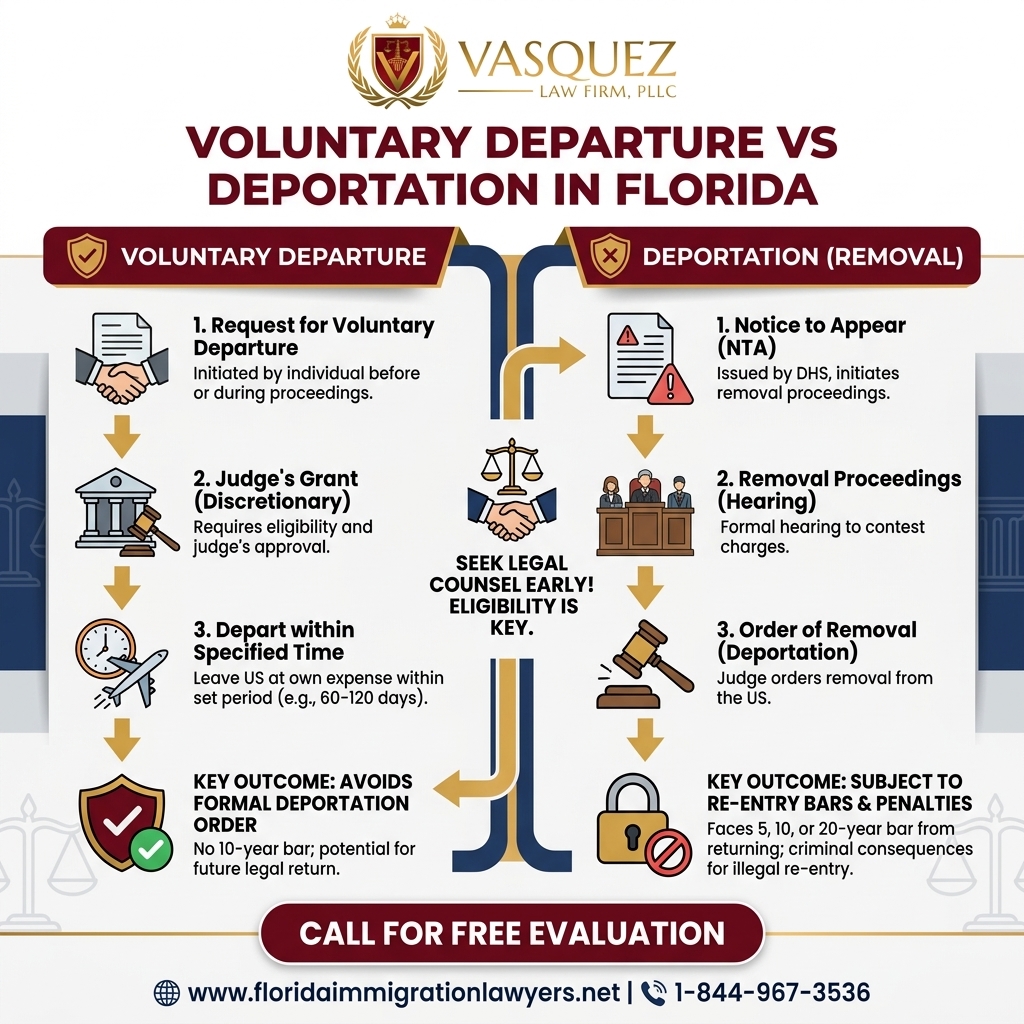
Understanding these differences is crucial for anyone facing removal proceedings in Florida, as the choice or outcome can shape their entire future.
Exploring Relief from Removal and Asylum Options
While facing deportation can feel overwhelming, it's important to know that various forms of relief may be available to prevent removal. These legal avenues can offer a pathway to remain in the U.S. or provide protection to those fleeing persecution. Understanding these options is a critical component of a robust deportation defense strategy.
Asylum and Withholding of Removal
One of the most significant forms of relief is asylum. Individuals who have suffered persecution or have a well-founded fear of persecution in their home country based on race, religion, nationality, political opinion, or membership in a particular social group may be eligible for asylum. If granted, asylum allows the individual to remain in the U.S., eventually apply for lawful permanent residency, and potentially bring certain family members. A related form of relief, Withholding of Removal, offers protection from deportation to a specific country where an individual's life or freedom would be threatened, though it does not provide a direct path to permanent residency.
Cancellation of Removal
Another vital form of relief is Cancellation of Removal. There are two main types: for certain lawful permanent residents and for certain non-permanent residents. For non-permanent residents, eligibility typically requires continuous physical presence in the U.S. for at least 10 years, good moral character, and demonstrating that removal would cause exceptional and extremely unusual hardship to a U.S. citizen or lawful permanent resident spouse, parent, or child. This is a highly discretionary form of relief, and the burden of proof is substantial.
Adjustment of Status and Waivers
In some cases, individuals in removal proceedings may be eligible to adjust their status to a lawful permanent resident if they have an immediate relative petition (e.g., from a U.S. citizen spouse) and meet other eligibility requirements. Additionally, various waivers may be available to overcome certain grounds of inadmissibility or deportability. These waivers are complex and often require demonstrating extreme hardship or other specific criteria. Each of these relief options has strict eligibility requirements and a complex application process, making expert legal guidance indispensable.
The Critical Role of an Immigration Attorney in Florida
Whether you are considering voluntary departure or fighting a deportation order, the stakes are incredibly high. The U.S. immigration system is notoriously complex, with laws and regulations that frequently change. Attempting to navigate this landscape without experienced legal counsel can lead to critical errors, missed deadlines, and ultimately, an unfavorable outcome.
Navigating Complex Laws and Procedures
An experienced immigration attorney understands the intricate details of immigration law and can assess your unique situation to determine the best course of action. They can identify all potential forms of relief, explain the eligibility requirements, and guide you through the application or defense process. This includes understanding the nuances of Florida-specific immigration courts and procedures.
Developing a Strong Defense Strategy
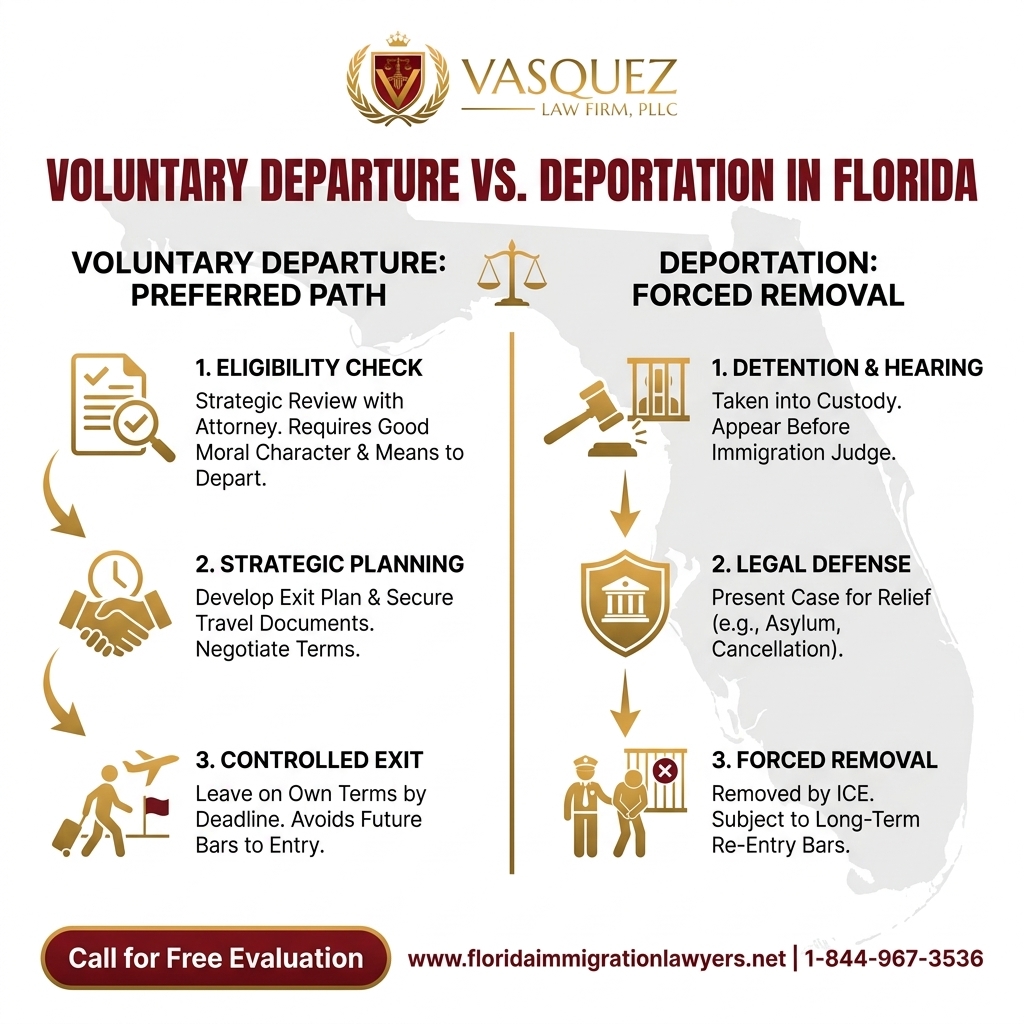
For those facing deportation, an attorney is essential for building a robust deportation defense. This involves gathering necessary evidence, preparing compelling arguments, filing appropriate motions, and representing you effectively in court. They can challenge the government's allegations, present evidence of your eligibility for relief, and advocate for your right to remain in the U.S.
Court Representation and Appeals
Your attorney will represent you during all immigration court hearings, ensuring your rights are protected and that you receive a fair hearing. If an unfavorable decision is rendered, they can advise you on the possibility of an appeal to the Board of Immigration Appeals (BIA) or even the federal courts. The expertise of a skilled legal team, like the attorneys at VLF Florida, can make all the difference in the outcome of your case.
Frequently Asked Questions (FAQs)
Here are answers to some common questions about voluntary departure and deportation:
1. Can I request voluntary departure if I have a criminal record?
It depends on the nature and severity of your criminal record. Certain aggravated felonies or crimes involving moral turpitude may make you ineligible for voluntary departure. An attorney can assess your specific situation.
2. How long does the voluntary departure process take?
The timeline can vary. If granted by ICE, it can be relatively quick. If requested in court, it depends on the court's schedule and the complexity of your case. Once granted, you typically have 60-120 days to depart.
3. What happens if I miss my voluntary departure deadline?
Missing the deadline automatically converts your voluntary departure order into a final order of deportation, incurs a civil penalty, and results in a 10-year bar to re-entry.
4. Can I appeal a deportation order?
Yes, you generally have the right to appeal an immigration judge's decision to the Board of Immigration Appeals (BIA). Further appeals to federal circuit courts are also possible in some cases.
5. Is legal representation mandatory for deportation proceedings?
While not legally mandatory, legal representation is highly recommended. The complexities of immigration law make it extremely difficult for individuals to represent themselves effectively.
6. How can I find out if I have a deportation order against me?
You can check your immigration status through the Executive Office for Immigration Review (EOIR) automated case information system or by consulting with an immigration attorney who can help you obtain your immigration records.
7. Can I apply for a visa to return to the U.S. after being deported?
After a deportation order, you are subject to a statutory bar to re-entry (e.g., 5, 10, 20 years, or permanent). You would need to wait until the bar expires and then potentially apply for a waiver before you could be eligible for a new visa.
8. What is the difference between an NTA and a deportation order?
A Notice to Appear (NTA) is the document that initiates deportation proceedings, informing you of the charges against you. A deportation order is the final decision by an immigration judge or higher court to remove you from the U.S.
Secure Your Future with Expert Legal Guidance
The choice between voluntary departure and fighting a deportation order is one of the most critical decisions an undocumented individual or non-citizen in Florida can make. The long-term implications for your ability to live, work, and reunite with family in the U.S. are immense. Do not face these challenges alone. At VLF Florida, our dedicated immigration team is committed to providing compassionate and effective legal representation. We will meticulously review your case, explain your options, and fight tirelessly to protect your rights and secure the best possible outcome for your future. Contact us today for a confidential consultation and take the first step towards a clearer path forward. Call (844) 967-3536 for Florida immigration legal help.
Sources and References
- U.S. Citizenship and Immigration Services (USCIS)
- Executive Office for Immigration Review (EOIR)
- U.S. Department of State - Bureau of Consular Affairs
- Immigration and Nationality Act (INA), 8 U.S.C. Chapter 12
Do Not Navigate This Process Alone
Our experienced immigration attorneys are ready to fight for you. Get a free, confidential consultation today.
Se Habla Español
Or leave your details and we’ll call you:
Free Evaluation in 24 Hours
Or talk to us right now

AI voice assistant — available 24/7
FreeFrequently Asked Questions

William J. Vásquez
Founding Attorney · Vasquez Law Firm
U.S. Air Force veteran and immigration attorney with years of hands-on U.S. immigration experience. J.D., NCCU School of Law. AILA member. Admitted to the 4th, 5th, and 11th Circuit Courts.
Available 24/7 - Free Evaluations
Reviewed for legal accuracy by William J. Vásquez
Licensed in North Carolina; U.S. immigration is federal practice.
Related Legal Services
Our Florida immigration attorneys can help you with citizenship and naturalization, family immigration services and immigration practice areas. Call today at 1-844-967-3536 for a free consultation.
Related Links
Related Topics
Free Legal Consultation
Discuss your case with our experienced attorneys. We're available 24/7.
Se Habla Español - Estamos aquí para ayudarle.
Related Articles
How to Choose an Immigration Lawyer in Florida 2026
Selecting the right immigration lawyer in Florida is a critical decision that can profoundly impact your future. With complex regulations and varying case types, finding an attorney who specializes in your specific needs, possesses a strong reputation, and communicates transparently is paramount. This guide from Florida Immigration Lawyers provides actionable steps, from verifying credentials with the Florida Bar and understanding fee structures to recognizing common pitfalls like 'notario' scams. Learn how to effectively vet potential legal counsel, prepare necessary documents, and set realistic expectations for your immigration journey in 2026. Empower yourself to make an informed choice and secure expert legal representation for your family, business, or defense immigration needs in Orlando and across Florida.
VAWA Immigration Lawyer: Your 2026 Guide in Florida
For individuals in Florida experiencing domestic abuse from a U.S. citizen or lawful permanent resident, VAWA (Violence Against Women Act) immigration relief offers a confidential pathway to a green card. This article, updated for 2026, provides a comprehensive guide to understanding VAWA self-petitioning, including eligibility criteria, the step-by-step application process, essential documentation, and expected timelines. Learn about the crucial role of a VAWA immigration lawyer in navigating complex requirements, ensuring confidentiality, and protecting your rights throughout the process. We cover common mistakes to avoid and highlight when to seek expert legal counsel to secure your safety and immigration status in Florida. Florida Immigration Lawyers offers free case reviews and compassionate support.
U Visa Certification in Florida: Law Enforcement Guide 2026
For non-citizen crime victims in Florida, the U visa offers a vital path to protection and legal status. This comprehensive guide details the crucial process of obtaining U visa certification from law enforcement, a mandatory step for victims who have suffered substantial abuse and are willing to assist in criminal investigations. Learn about eligibility criteria, the role of agencies like the Orlando Police Department, the step-by-step application process, and expected timelines for 2026. We also cover cost factors and common pitfalls to avoid. Florida Immigration Lawyers provides expert assistance for victims across Florida, ensuring they can navigate these complex legal challenges with confidence and compassion. Discover how our dedicated team can help you pursue justice and secure your future.
Family Petitions for Citizenship Through Father's Family
For individuals in Florida seeking U.S. citizenship through their father's family, understanding the legal pathways is crucial. This comprehensive guide from Florida Immigration Lawyers explains the process, from filing a family petition (Form I-130) to naturalization. We cover derivative and acquired citizenship, step-by-step procedures, required documents, and typical timelines as of 2026. Learn about the cost factors, common mistakes to avoid, and when to seek professional legal assistance from an immigration lawyer in Orlando or anywhere in Florida. Our firm provides expert guidance for complex cases involving paternity, criminal records, or USCIS appeals, ensuring your application for citizenship through a father's family is meticulously prepared. Contact Florida Immigration Lawyers for a free case review.