SIJS: Special Immigrant Juvenile Status in Florida
Special Immigrant Juvenile Status (SIJS) offers a path to lawful residency for minors who have been abused, neglected, or abandoned. Learn about eligibility, the application process, and how Florida Immigration Lawyers can assist you.

SIJS: Special Immigrant Juvenile Status in Florida
For children who have suffered abuse, neglect, or abandonment, the path to safety and stability can be incredibly challenging. In the United States, a crucial form of relief exists for these vulnerable minors: Special Immigrant Juvenile Status (SIJS). In Florida, navigating the complexities of SIJS requires a deep understanding of both state juvenile law and federal immigration law. This comprehensive guide will help you understand what SIJS is, who is eligible, the application process, and how it can provide a pathway to a green card and a secure future for deserving children.
If you or a child you know may be eligible for SIJS, it is vital to seek legal guidance. Contact us today for a free consultation to discuss your specific situation and explore the best legal strategies.
Understanding Special Immigrant Juvenile Status (SIJS)
Special Immigrant Juvenile Status (SIJS) is an immigration classification available to certain undocumented children who have been abused, neglected, or abandoned by one or both parents. It provides a pathway for these children to obtain lawful permanent residency (a Green Card) in the United States, offering them protection and a chance at a stable life away from the harm they experienced. The core purpose of SIJS is to protect vulnerable children by allowing them to remain in the U.S. and eventually adjust their status, rather than face potential deportation back to dangerous situations.
SIJS is specifically designed for minors who cannot be reunited with one or both parents due to abuse, neglect, or abandonment, and for whom it has been determined that returning to their home country is not in their best interest. This status acknowledges the unique vulnerabilities of these children and provides a humanitarian solution within the U.S. immigration system. It's a critical tool for ensuring the safety and well-being of children who have endured severe trauma and instability.
Eligibility Criteria for SIJS in Florida
To qualify for SIJS in Florida, a child must meet several stringent criteria, which involve both state juvenile court findings and federal immigration requirements. Understanding these requirements is the first step in determining eligibility:
1. Age Requirement
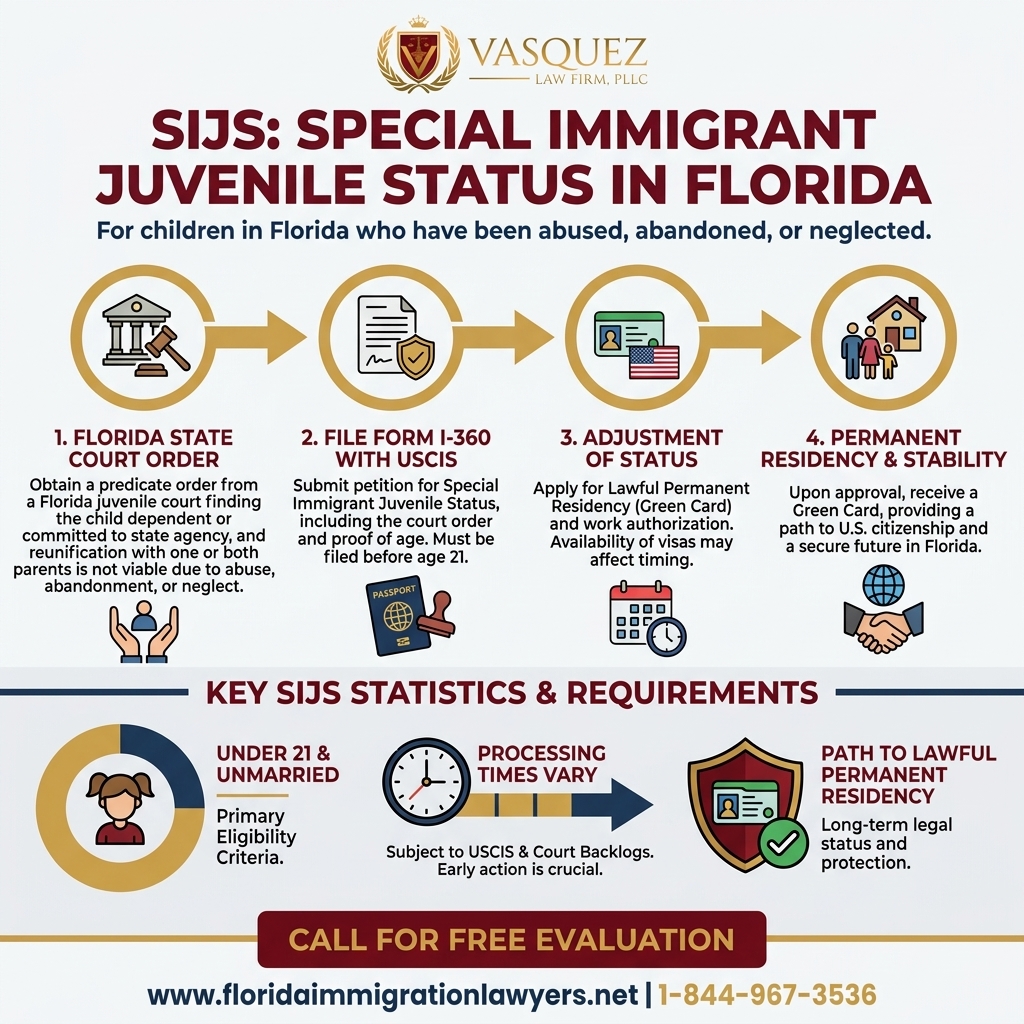
The applicant must be under 21 years old at the time the Form I-360, Petition for Amerasian, Widow(er), or Special Immigrant, is filed with U.S. Citizenship and Immigration Services (USCIS). It is crucial to file before the child's 21st birthday, as this is a strict deadline. In some cases, depending on state law and the specific court order, a child might need to be under 18 at the time of the initial juvenile court order, but the federal age limit for filing the I-360 is 21.
2. Unmarried Status
The applicant must be unmarried at the time of filing the I-360 petition and must remain unmarried until they obtain lawful permanent residency. Marriage at any point during the process will disqualify the applicant from SIJS.
3. Dependency or Custody Order from a State Juvenile Court
A state juvenile court in Florida must have issued an order finding that the child is dependent on the court, or that legal custody has been committed to a state agency or an individual appointed by the court. This order is the cornerstone of an SIJS petition. It signifies that the state court has taken jurisdiction over the child's welfare due to the inability of their parents to provide adequate care and protection. This can stem from proceedings such as dependency, guardianship, or dissolution of marriage cases where specific findings are made.
4. Finding of Abuse, Neglect, or Abandonment
The juvenile court order must also include a finding that reunification with one or both parents is not viable due to abuse, neglect, or abandonment. This is a critical legal determination. The court must explicitly state that it is not in the child's best interest to be returned to the care of the abusive, neglectful, or abandoning parent(s). This finding is paramount as it directly addresses the humanitarian grounds for SIJS. Examples of abuse can range from physical or sexual abuse to severe emotional harm, while neglect often involves a parent's failure to provide basic necessities like food, shelter, or medical care. Abandonment refers to a parent's desertion of the child without providing for their support or care.
5. USCIS Consent to the Juvenile Court's Jurisdiction
In cases where the child is in the custody of a federal agency (e.g., detained by immigration authorities), USCIS must provide consent for the juvenile court to make the necessary findings for SIJS eligibility. This ensures cooperation between federal and state authorities in protecting the child's best interests. This is often relevant for unaccompanied minors who cross the border and are placed in federal shelters.
The Two-Step Application Process
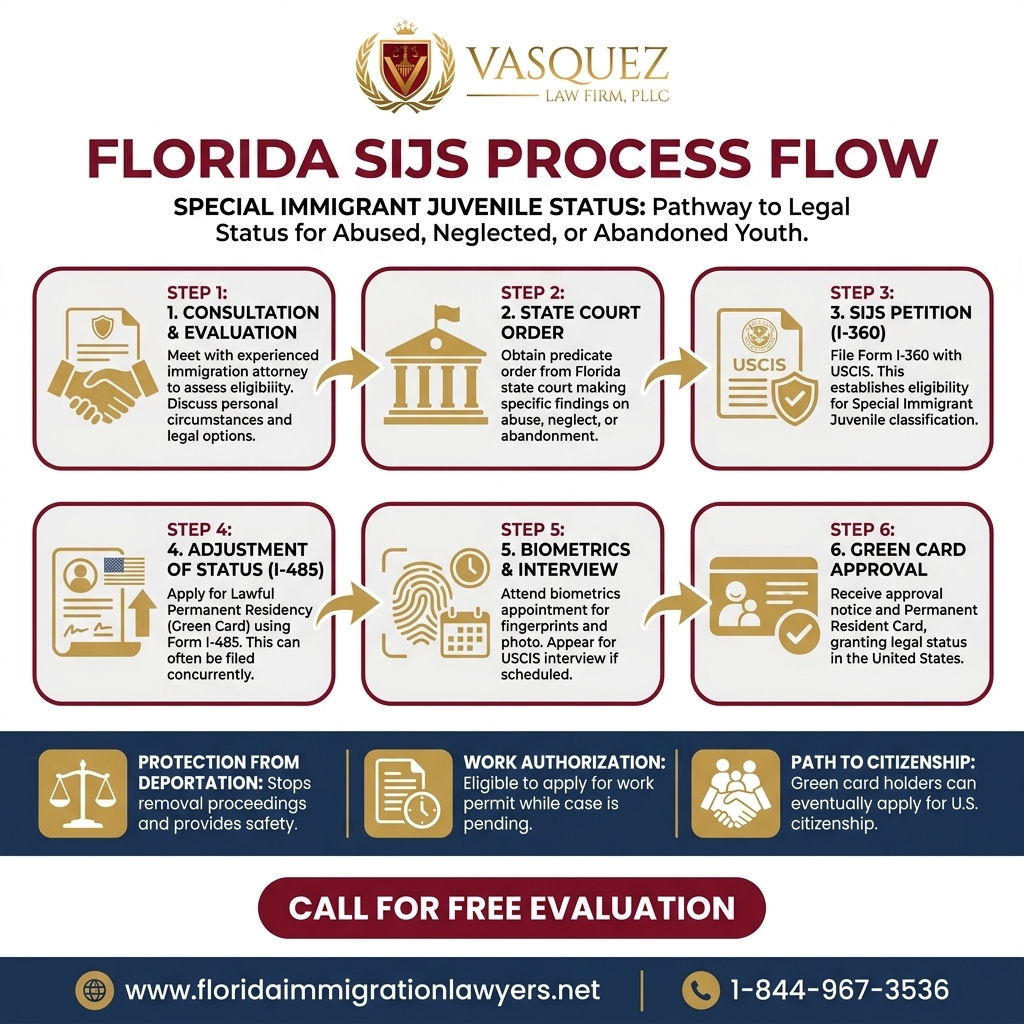
The SIJS application process is unique because it involves both state and federal legal systems. It typically consists of two main steps:
Step 1: Obtaining a Juvenile Court Order (State Court)
The first and often most challenging step is to obtain a specific order from a Florida state juvenile court. This order must contain all the necessary findings for SIJS eligibility. This usually involves initiating a dependency, guardianship, or custody proceeding in a Florida state court. The child, through a guardian or attorney, must present evidence to the court demonstrating the abuse, neglect, or abandonment they have suffered. The court will then make explicit findings that:
- The child is dependent on the court or committed to the custody of a state agency or an individual appointed by the court.
- Reunification with one or both parents is not viable due to abuse, neglect, or abandonment.
- It is not in the child's best interest to be returned to their country of origin or last habitual residence of the parent(s).
The role of the juvenile court judge is to act in the child's best interest, making determinations based on the evidence presented regarding the child's safety, welfare, and future. This process can be lengthy and requires careful legal strategy to ensure all required findings are included in the final order.
Step 2: Applying to USCIS (Federal Government)
Once the favorable juvenile court order is obtained, the second step involves filing a petition with U.S. Citizenship and Immigration Services (USCIS). This typically includes:
- Form I-360, Petition for Amerasian, Widow(er), or Special Immigrant: This is the primary petition for SIJS. It must be filed with the certified juvenile court order and all supporting documentation, including evidence of the child's age, identity, and the circumstances of abuse, neglect, or abandonment. A well-prepared I-360 package is crucial for a smooth process.
- Concurrent Filing with Form I-485, Application to Register Permanent Residence or Adjust Status: In many cases, if an immigrant visa is immediately available, the child can concurrently file Form I-485 to adjust their status to a lawful permanent resident. This allows the child to apply for a Green Card at the same time as the SIJS petition.
- Interview Process: After filing, USCIS may schedule an interview with the child and their legal guardian or attorney. During the interview, an immigration officer will review the application and ask questions to verify the information provided and ensure eligibility.
It's important to note that while the juvenile court makes findings about the child's welfare, USCIS ultimately determines whether the child meets the federal definition of a Special Immigrant Juvenile and is eligible for a Green Card.
Life After SIJS: The Path to a Green Card and Beyond
Obtaining SIJS is a monumental step, but it is often just the beginning of a journey towards full legal status and a stable future in the United States. The ultimate goal for most SIJS recipients is to adjust their status to that of a lawful permanent resident, commonly known as getting a Green Card.
Adjustment of Status (Form I-485)
As mentioned, many SIJS applicants can file Form I-485, Application to Register Permanent Residence or Adjust Status, concurrently with their I-360 petition. This is possible if an immigrant visa is immediately available in the SIJS category. Unlike some other visa categories, SIJS applicants are exempt from certain grounds of inadmissibility, making the path to a Green Card more accessible for these vulnerable children. The I-485 process involves submitting additional forms, medical examinations, and potentially an interview with USCIS. Once approved, the child receives their Green Card, granting them permanent residency in the U.S.
Waiting for Visa Availability
In some instances, particularly for applicants from certain countries, there might be a backlog in the SIJS visa category, meaning a visa number is not immediately available. In such cases, the I-360 petition may be approved, but the I-485 application will be held in abeyance until a visa number becomes available. During this waiting period, the child is often eligible for deferred action and work authorization, providing a crucial layer of protection and the ability to legally work and live in the U.S. while awaiting their Green Card.
Benefits of a Green Card
A Green Card provides numerous benefits to SIJS recipients, fundamentally transforming their lives. It offers protection from deportation, allowing them to live without fear of removal. Green Card holders can legally work in the U.S., pursue higher education at in-state tuition rates in many states, and travel internationally with fewer restrictions. This stability is vital for children who have experienced significant trauma, enabling them to build a new life, pursue their dreams, and integrate fully into their communities.
Path to Citizenship
After holding a Green Card for five years (or three years if certain conditions are met, such as marriage to a U.S. citizen, though this is less common for SIJS recipients), SIJS beneficiaries can apply for U.S. citizenship through the naturalization process. This final step offers the highest level of security and all the rights and responsibilities of a U.S. citizen, completing their journey from vulnerability to full integration into American society.
Protecting Vulnerable Children: Why SIJS Matters
SIJS is more than just an immigration pathway; it is a critical safeguard for children who have endured unimaginable hardship. It offers a chance for safety, stability, and a future free from abuse and neglect. By providing a legal avenue for these children to remain in the U.S., SIJS allows them to access education, healthcare, and social services that are essential for their development and well-being. It helps break cycles of violence and poverty, giving children the opportunity to heal and thrive in a supportive environment. For many, SIJS represents their only hope for a secure and dignified life.
The Intersection of SIJS with Other Immigration Reliefs and Challenges
While SIJS offers a powerful form of relief, it's essential to understand how it interacts with other immigration options and potential challenges.
SIJS vs. Asylum
Sometimes, a child who qualifies for SIJS might also have a claim for asylum. It's crucial to understand the distinctions. Asylum is granted to individuals who have a well-founded fear of persecution in their home country based on race, religion, nationality, political opinion, or membership in a particular social group. SIJS, on the other hand, focuses on abuse, neglect, or abandonment by parents and the inability to reunite with them. While both provide protection, the legal grounds and evidence required differ significantly. An experienced immigration attorney can help determine which path, or if both, are appropriate for a child's unique circumstances, often advising SIJS as a more direct route for qualifying minors due to its specific protections.
SIJS and Removal Proceedings
Many children who are eligible for SIJS are already in removal (deportation) proceedings. In such cases, obtaining a SIJS classification can be a powerful defense against deportation. Once the I-360 petition is approved, the child can then apply for adjustment of status, which typically terminates the removal proceedings. This interplay highlights the critical role SIJS plays in protecting vulnerable children from being sent back to dangerous situations. The ability to stop removal proceedings is one of the most significant benefits of SIJS for children who are already facing deportation.
Common Challenges and Denials
Despite its humanitarian purpose, SIJS cases can face challenges. Common issues include difficulties in obtaining the necessary state court order with all the required findings, problems gathering sufficient evidence of abuse/neglect/abandonment, or age-out issues if the petition is not filed before the child's 21st birthday. Additionally, complex family situations, such as a parent's attempts to regain custody, can complicate the process. USCIS may also deny petitions if they find that the juvenile court order was obtained primarily to gain immigration benefits rather than for the child's best interest, although this is rare when proper legal procedures are followed.
Why Choose an Experienced Florida Immigration Attorney for Your SIJS Case?
Navigating the SIJS process is incredibly complex, involving distinct state and federal legal systems, strict deadlines, and sensitive personal circumstances. An experienced immigration attorney specializing in SIJS cases in Florida can provide invaluable assistance by:
- Navigating Complex Laws: Our attorneys possess a deep understanding of both Florida's juvenile dependency laws and federal immigration regulations, ensuring all requirements are met.
- Gathering and Presenting Evidence: We help compile the necessary documentation and evidence of abuse, neglect, or abandonment, which is crucial for both the state court and USCIS petitions.
- Representation in Court: We represent clients in state juvenile court proceedings to secure the essential SIJS findings, and then guide them through the USCIS application and interview process.
- Protecting Your Rights: We advocate fiercely for the child's best interests, ensuring their rights are protected throughout the entire legal journey.
- Preventing Costly Mistakes: Errors in the application can lead to significant delays or even denial. Our expertise minimizes these risks.
Contact Us Today for a Free Consultation
If you believe a child in your care or a child you know may be eligible for Special Immigrant Juvenile Status in Florida, do not delay. The process is time-sensitive, and the stakes are incredibly high. Our dedicated legal team is committed to helping vulnerable children find safety and stability through SIJS. We offer compassionate and knowledgeable legal representation tailored to each child's unique situation.
Call us today for a free, confidential consultation to discuss your case. Let us help you navigate this complex legal journey and secure a brighter future for a deserving child. Your initial consultation is free — call (844) 967-3536.
Sources and References
- U.S. Citizenship and Immigration Services (USCIS)
- Executive Office for Immigration Review (EOIR)
- U.S. Department of State - Bureau of Consular Affairs
- Immigration and Nationality Act (INA), 8 U.S.C. Chapter 12
Do Not Navigate This Process Alone
Our experienced immigration attorneys are ready to fight for you. Get a free, confidential consultation today.
Se Habla Español
Frequently Asked Questions

William J. Vásquez
Founding Attorney · Vasquez Law Firm
U.S. Air Force veteran and immigration attorney with thousands of cases resolved. J.D., NCCU School of Law. AILA member. Admitted to the 4th, 5th, and 11th Circuit Courts.
Available 24/7 - Free Evaluations
Related Legal Services
Our Florida immigration attorneys can help you with experienced immigration attorneys, business immigration and asylum protection. Call today at 1-844-967-3536 for a free consultation.
Related Links
Related Topics
Free Legal Consultation
Discuss your case with our experienced attorneys. We're available 24/7.
Se Habla Español - Estamos aquí para ayudarle.
Related Articles
Immigration Bond Hearing Florida: Your 2026 Guide | VLF Florida
Navigating an immigration bond hearing in Florida requires a clear understanding of the process, eligibility, and legal requirements. This 2026 guide from Florida Immigration Lawyers provides essential information on securing release from ICE detention, including details on bond hearings, required documents, typical timelines, and associated costs. Learn about the factors immigration judges consider, common mistakes to avoid, and when it's critical to enlist expert legal counsel. With Florida-specific insights and practical advice, this resource aims to empower individuals and families facing immigration detention across the state, from West Palm Beach to Miami. Secure a free consultation with our experienced attorneys for dedicated support.
J-1 Waiver for Physicians in Florida: A 2026 Guide
Navigating the J-1 waiver process in Florida can be challenging for foreign physicians. Learn how the Conrad 30 program facilitates placements in underserved areas like Homestead, ensuring a successful application. Call Florida Immigration Lawyers today for expert guidance.
Naturalization Process Florida Timeline 2026 Guide
The naturalization process in Florida, culminating in U.S. citizenship, involves several key stages including eligibility assessment, filing Form N-400, biometrics, an interview, and the Oath of Allegiance. As of 2026, the typical timeline for this process in Florida ranges from 18 to 24 months, though individual experiences can vary. This guide from Florida Immigration Lawyers provides a comprehensive overview, covering requirements, step-by-step procedures, potential costs, and common pitfalls. We emphasize the importance of understanding Florida-specific nuances and the benefits of legal counsel to navigate this complex journey effectively. Contact us for a free consultation.
H-2B Visa for Florida Hospitality Seasonal Workers
Explore the H-2B visa process for seasonal workers in Florida's hospitality industry. Learn about costs, timelines, and common mistakes. Contact Florida Immigration Lawyers for expert assistance.