RFE Florida Response: Guide to USCIS Request for Evidence
Receiving a Request for Evidence (RFE) from USCIS in Florida can be alarming, but it's a chance to strengthen your immigration case. This guide from Florida Immigration Lawyers explains what an RFE is, common reasons you might receive one in Coral Springs or elsewhere in Florida, and a detailed step-by-step process for responding effectively. Learn about essential documents, crucial timelines, and common mistakes to avoid. We emphasize the importance of legal counsel to interpret complex requests and ensure a comprehensive, timely submission. Protect your immigration journey by understanding your RFE and responding strategically. Contact us for a free consultation today.

A Request for Evidence (RFE) from USCIS is a formal letter asking for more information or documentation to support your immigration application or petition. Receiving an RFE does not mean your case is denied; instead, it indicates that USCIS needs additional details to make a decision. A timely and thorough response is crucial to avoid delays or potential denial. In Florida, understanding the specific requirements and providing comprehensive evidence is key. Seeking guidance from an experienced immigration attorney can significantly improve your chances of a successful outcome, ensuring all requested documents are properly prepared and submitted.
- An RFE means USCIS needs more information, not necessarily a denial.
- Respond promptly and thoroughly within the given deadline.
- Carefully review the RFE to understand exactly what is requested.
- Gather all necessary documents, ensuring accuracy and completeness.
- Consult a Florida immigration lawyer for expert assistance with your RFE response.
Receiving a Request for Evidence (RFE) from U.S. Citizenship and Immigration Services (USCIS) can be a daunting experience. You have diligently prepared your immigration application, perhaps for a family visa, employment green card, or adjustment of status in Coral Springs or elsewhere in Florida, only to receive a letter asking for more information. This moment can bring anxiety and confusion, making you wonder if your dreams of living and working in the U.S. are in jeopardy. However, an RFE is a common part of the immigration process, not an immediate sign of denial. It is a critical opportunity to provide the missing pieces and strengthen your case.
At Florida Immigration Lawyers, we understand the complexities and emotional toll that an RFE can bring. Our mission is to guide individuals and families throughout Florida, including areas like Miami, Orlando, and Tampa, through every step of their immigration journey. This comprehensive guide will demystify the RFE process, explain common reasons for receiving one, provide a detailed step-by-step response strategy, and highlight the crucial role legal representation plays. We will cover essential documents, timelines, and common mistakes to avoid, empowering you to navigate this challenge effectively. Do not let an RFE overwhelm you; with the right strategy and legal support, you can successfully respond and move forward with your immigration goals. Call Florida Immigration Lawyers at 1-844-967-3536 for a free consultation and let us help you craft a robust RFE response.
Understanding a Request for Evidence (RFE) from USCIS
A Request for Evidence (RFE) is a formal written notice issued by USCIS when they determine that the initial evidence submitted with an immigration application or petition is insufficient. This insufficiency can stem from various factors, such as missing documents, inconsistencies in information, or a failure to establish eligibility for the requested benefit. USCIS relies on comprehensive documentation to make informed decisions, and an RFE signifies that they require additional clarity or proof to continue processing your case. It is a standard procedure outlined in 8 CFR 103.2(b)(8) and is part of their due diligence.
The purpose of an RFE is not to deny your application outright but to give you a chance to provide the necessary information. It is a critical juncture where your ability to present a clear, compelling, and complete response directly impacts your case's outcome. Ignoring an RFE or submitting an incomplete response will almost certainly lead to a denial, potentially resulting in significant delays, loss of filing fees, and even the initiation of deportation proceedings in some circumstances. Therefore, understanding the gravity of an RFE and responding strategically is paramount for any applicant in Florida.
USCIS officers review thousands of applications daily, and their scrutiny ensures the integrity of the U.S. immigration system. An RFE ensures that applicants meet all statutory and regulatory requirements under the Immigration and Nationality Act (INA), such as INA Sections 204 (for family-based petitions) or 212 (regarding admissibility). The specific nature of an RFE varies widely depending on the type of application, the facts of your case, and the particular officer reviewing it. It might ask for proof of relationship, financial eligibility, educational qualifications, or employment history. Regardless of the specifics, it demands your immediate and careful attention.
Common Reasons for an RFE in Florida Immigration Cases
Immigration cases in Florida, whether filed from Coral Springs, Miami, Orlando, or Jacksonville, often encounter similar challenges that lead to RFEs. Understanding these common triggers can help you prepare proactively or respond effectively. One of the most frequent reasons is insufficient initial evidence. This includes missing documents like birth certificates, marriage licenses, financial statements, or police clearance certificates that were required but not submitted with the original application.
Another common cause for an RFE involves inconsistencies or discrepancies in the submitted information. For example, if dates on different forms or supporting documents do not match, or if there are conflicting statements about your marital status or employment history. USCIS officers are trained to spot these anomalies and will request clarification. This is particularly crucial for applications like family-based petitions, where proof of a bona fide relationship is paramount. In Florida, with its diverse population, ensuring consistent personal data across all documents is vital.
Questions regarding eligibility criteria also frequently result in RFEs. For instance, in an employment-based petition, USCIS might question the beneficiary's qualifications for the specific job or the employer's ability to pay the proffered wage. For adjustment of status cases, RFEs often relate to maintaining lawful status, proving entry into the U.S., or addressing potential public charge concerns, especially in light of evolving policy interpretations. Even for asylum cases, RFEs can be issued if the narrative or supporting evidence lacks credibility or sufficient detail.
Finally, issues with translations or affidavits can also lead to RFEs. If foreign language documents are not accompanied by certified English translations or if affidavits lack proper notarization or sufficient detail from credible witnesses, USCIS will likely request corrections or additional proof. Given Florida's large immigrant population, many applicants submit documents from various countries, making proper translation and certification a frequent point of scrutiny. Addressing these issues promptly and accurately is essential for a successful RFE response.
Step-by-Step Guide to Responding to a USCIS RFE
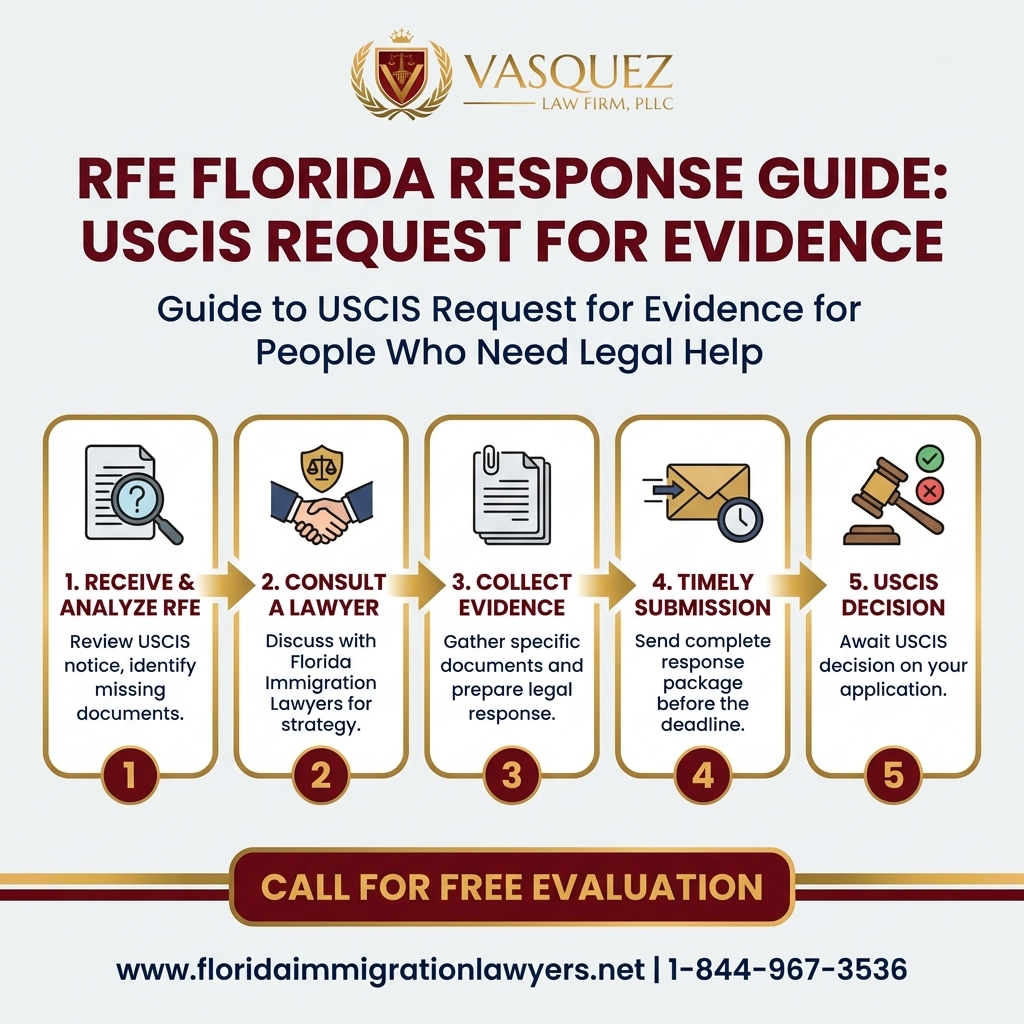
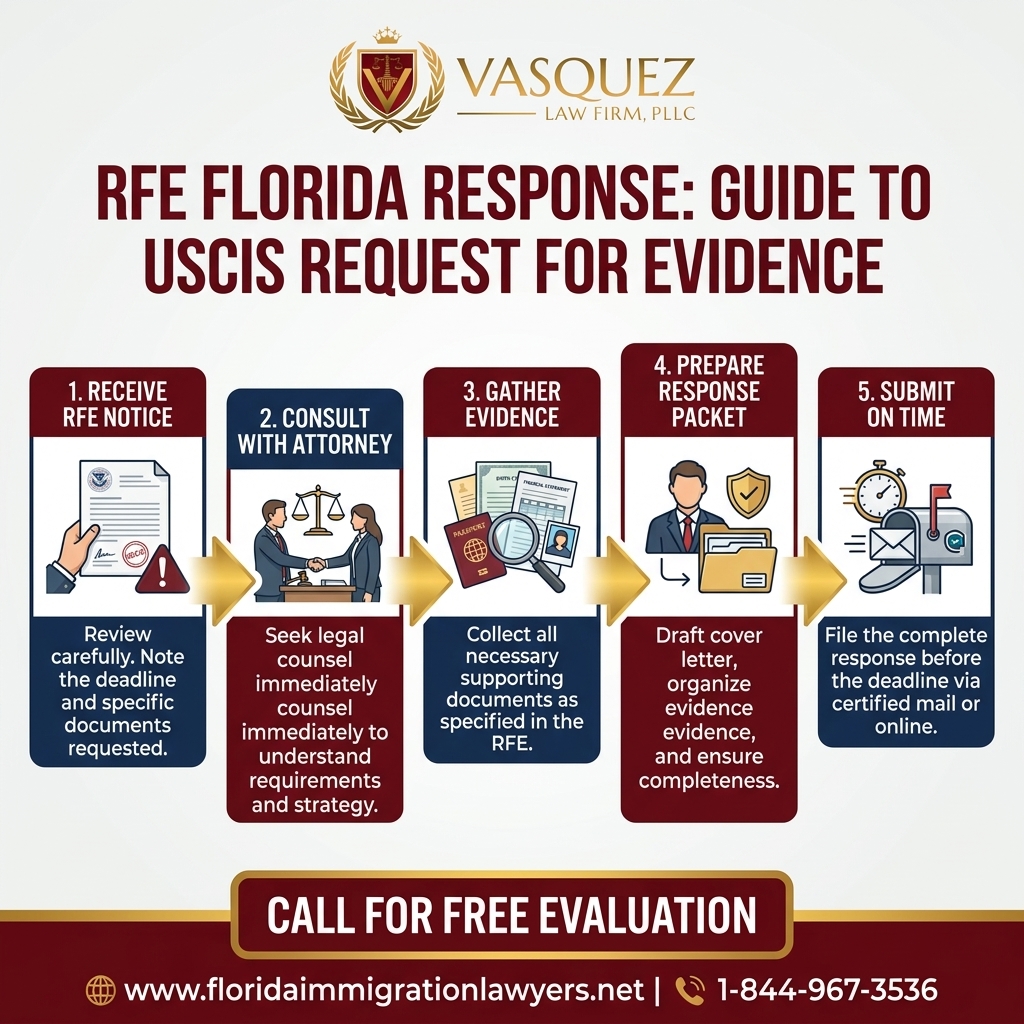
Responding to a USCIS Request for Evidence requires a systematic and meticulous approach. Haphazardly gathering documents can lead to further delays or even denial. Follow these steps carefully to ensure a robust and timely RFE response:
-
Read the RFE Carefully and Completely: The very first step is to thoroughly review the entire RFE document. Do not skim it. Understand precisely what USCIS is asking for. Highlight or make notes of every single item requested. Sometimes, an RFE might seem straightforward but contains subtle requests that, if overlooked, could jeopardize your case. Pay close attention to the specific section of law or regulation cited by USCIS, as this provides context for their request.
-
Identify the Specific Evidence Requested: Break down the RFE into individual requests. Create a checklist based on the RFE letter. For each item, identify what kind of document or information is needed. Is it a birth certificate, a tax transcript, an employment verification letter, or an affidavit? Knowing exactly what is required will prevent you from submitting irrelevant documents and help you stay organized.
-
Gather All Necessary Documents: Begin collecting all the identified documents immediately. If you need to obtain new documents, such as updated police records, certified translations, or letters from employers, start this process without delay. Some documents can take weeks or months to acquire, especially if they are from overseas. Ensure all documents are original or certified copies as requested, and if in a foreign language, they must be accompanied by a certified English translation.
-
Consult with an Immigration Attorney: This is arguably the most crucial step. An experienced Florida immigration attorney, like those at Florida Immigration Lawyers, can help you interpret complex RFE requests, identify the best evidence to submit, and ensure your response is legally sound and comprehensive. They can also help draft affidavits, prepare cover letters, and organize your submission in a professional manner. This is especially important for complex RFEs or if your case has specific challenges.
-
Prepare a Detailed Cover Letter: A well-structured cover letter is vital. It should list every item you are submitting in response to the RFE, referencing the specific USCIS request number and the RFE's original item number. This helps the USCIS officer easily match your evidence to their requests. The cover letter should also reiterate your case information (receipt number, applicant name) and the type of application. An attorney can draft a persuasive and clear cover letter for you.
-
Organize and Assemble Your Response: Arrange your documents in the order they were requested in the RFE, or as listed in your cover letter. Use tabs or dividers to separate different types of evidence. Make sure all pages are legible and securely fastened. It is highly recommended to make a complete copy of your entire RFE response package for your records before mailing it. This safeguard ensures you have proof of what was sent.
-
Submit Your Response by the Deadline: The RFE letter will specify a deadline, typically 60 to 87 days from the date of issuance. You MUST submit your response before this deadline. USCIS considers the response received on the date it is physically delivered to their office, not the postmark date. Send your response via certified mail with a return receipt or a courier service that provides tracking. Ensure the response is sent to the correct USCIS address specified in the RFE, which may vary depending on the type of application or processing center. Timely submission is non-negotiable for your case's progression. For more information on USCIS processes, visit the official USCIS website.
Essential Document Checklist for Your RFE Response
The documents requested in an RFE are highly specific to your case, but certain categories frequently appear. Having a clear understanding of potential requirements can help you prepare. Always refer to your specific RFE letter for the exact list. Here is a general checklist of common documents USCIS may request:
- Proof of Identity and Nationality:
- Certified copy of birth certificate.
- Passport biographic page and visa stamps.
- National identity card.
- Proof of Relationship (for family-based petitions):
- Marriage certificate (for spouse petitions).
- Birth certificates for children (showing parentage).
- Divorce decrees or death certificates for previous marriages.
- Photographs, joint bank statements, utility bills, leases, insurance policies, and affidavits from friends/family attesting to the bona fide nature of the relationship.
- Travel itineraries and hotel bookings showing shared experiences.
- Financial Documentation (for affidavit of support or employment cases):
- IRS tax transcripts (Form W-2, 1099, 1040) for the last three years.
- Employer letters verifying employment and salary.
- Pay stubs.
- Bank statements.
- Proof of assets (property deeds, investment accounts).
- Educational and Professional Credentials (for employment-based petitions):
- Diplomas, degrees, and academic transcripts.
- Professional licenses or certifications.
- Letters of experience from previous employers.
- Foreign degree evaluations.
- Proof of Lawful Entry and Status Maintenance (for adjustment of status):
- Form I-94 arrival/departure record.
- Copies of all previous visas and immigration documents.
- Evidence of maintaining nonimmigrant status (e.g., school transcripts for F-1 students, pay stubs for H-1B workers).
- Medical Examination Records:
- Form I-693, Report of Medical Examination and Vaccination Record, if not previously submitted or if expired.
- Police Clearances/Criminal Records:
- If requested due to past arrests or convictions, certified court dispositions and police clearance certificates.
- Certified English Translations:
- For any document not originally in English, accompanied by a translator's certification.
Navigating RFE Timelines and Processing Expectations
Understanding the timeline associated with an RFE is crucial for managing expectations and planning your next steps. Once USCIS issues an RFE, it will specify a response deadline, which is typically between 60 and 87 days from the date the RFE was issued. This deadline is strict and non-negotiable. Failing to submit a complete response within this timeframe will result in the denial of your application or petition. It is important to note that the clock starts ticking from the date on the RFE letter, not the date you receive it.
After you submit your RFE response, the processing time for your application will restart. USCIS does not provide an exact timeframe for how long it will take to adjudicate a case after an RFE response. However, they generally aim to process responses as efficiently as possible. You can monitor your case status online using the receipt number provided on your original application and the RFE letter. While some cases might be decided within a few weeks, others could take several months, depending on the complexity of the case, the specific USCIS service center or field office (such as those in Miami or Orlando), and the current caseload.
It is important to remain patient during this period. Avoid making multiple inquiries too soon after submission, as this can sometimes slow down the process. If you have not received a decision after a reasonable period (e.g., 60-90 days), or if the online status has not updated, your attorney can help you determine the appropriate next steps, such as initiating a service request. The overall processing time for your application will ultimately be extended by the RFE period and the subsequent review. For instance, an adjustment of status application that typically takes 12-18 months could be delayed by an additional 3-6 months or more due to an RFE.
Cost Factors and Professional Fees for an RFE in Florida
Responding to an RFE can incur various costs beyond the initial USCIS filing fees. These expenses typically fall into several categories, and understanding them helps in financial planning. The most significant cost for many applicants will be attorney fees. While you can technically respond to an RFE on your own, the complexity of immigration law and the specific demands of an RFE often warrant professional legal assistance. An experienced immigration lawyer in Florida will charge fees based on the complexity of the RFE, the amount of evidence needed, and the time required to prepare a robust response. These fees can range from a few hundred to several thousand dollars, depending on the case.
Beyond legal fees, applicants should anticipate costs related to document retrieval and preparation. This might include fees for obtaining certified copies of birth certificates, marriage licenses, court records, or police reports from government agencies. If any of your supporting documents are in a foreign language, you will need to pay for certified English translations. These translation services are typically charged per page or per word and can add up, especially for extensive documentation. Ensuring these translations are accurate and meet USCIS standards is critical to avoid further RFEs.
Other potential costs include postage and courier services for submitting your response. While regular mail is an option, using certified mail with a return receipt or a private courier service (like FedEx or UPS) is highly recommended for tracking purposes and proof of delivery. These services come with additional fees but provide peace of mind. Moreover, if your RFE requires an updated medical examination (Form I-693), you will need to pay the civil surgeon's fees, which can be several hundred dollars.
While these costs can seem substantial, viewing them as an investment in the success of your immigration case is important. A poorly prepared or incomplete RFE response can lead to denial, requiring you to refile your entire application, pay new filing fees, and endure even longer delays. Engaging an attorney from Florida Immigration Lawyers can help you navigate these costs efficiently, ensuring that your investment leads to the best possible outcome. For example, a denied business immigration petition due to an RFE can cost a company significant time and money, making legal counsel a wise expenditure.
Common Mistakes to Avoid When Responding to an RFE
-
Ignoring the Deadline: This is perhaps the most critical mistake. USCIS RFEs come with a strict deadline, usually 60-87 days. Missing this deadline will almost certainly lead to an automatic denial of your application, requiring you to start the entire process over and pay new fees. Always mark your calendar and aim to submit well in advance.
-
Failing to Understand the RFE: Many applicants skim the RFE letter and fail to grasp the specific requests. Submitting generic documents or evidence that doesn't directly address USCIS's concerns is a waste of time and can lead to denial. Read every sentence carefully and understand the underlying legal reason for each request.
-
Submitting Incomplete or Irrelevant Evidence: Only send what is requested and ensure it is complete. Sending too much irrelevant information can overwhelm the officer and obscure the necessary evidence. Conversely, sending only part of what was asked is equally detrimental. Each piece of evidence must directly support the specific point USCIS is questioning.
-
Sending Original Documents (Unless Specifically Requested): USCIS generally prefers copies of supporting documents. Sending irreplaceable originals can lead to their loss and significant problems if you need them for other purposes. Only send originals if the RFE explicitly states to do so.
-
Providing Untranslated Foreign Language Documents: Any document not in English must be accompanied by a complete and certified English translation. Failing to do so will result in the document not being considered and can lead to another RFE or denial. The translation must include a certification from the translator.
-
Failing to Address All Points in the RFE: Even if you believe one request is less important, you must address every single point raised in the RFE. USCIS will deny your application if even one crucial piece of requested evidence is missing or inadequately addressed.
-
Submitting Fraudulent or Misleading Information: Never attempt to submit false documents or provide misleading information. This can lead to severe consequences, including permanent bars to immigration, criminal charges, and civil penalties. Integrity is paramount in all immigration matters.
-
Not Keeping a Copy of Your Response: Always make a complete copy of your entire RFE response package, including the cover letter and all submitted evidence, before mailing it. This serves as your proof of submission and reference if questions arise later.
-
Sending to the Wrong Address: The RFE letter will specify the correct USCIS address to send your response. This might be different from the original filing address. Always double-check and use the exact address provided to ensure timely delivery.
-
Assuming Your Case is Denied: Receiving an RFE can be stressful, but it's not a denial. Many cases are ultimately approved after a well-prepared RFE response. Maintain a positive outlook and focus on providing a thorough reply.
When to Call a Florida Immigration Lawyer for Your RFE
While some straightforward RFEs might be manageable for diligent applicants, many situations demand the expertise of a seasoned immigration attorney. You should strongly consider contacting Florida Immigration Lawyers if you encounter any of the following scenarios:
- Complex Legal Issues: If the RFE refers to specific sections of immigration law (like INA 212(a) regarding inadmissibility or 8 CFR 204.2 for marriage petitions) that you do not understand, an attorney can interpret these legal requirements and guide you on how to provide appropriate evidence.
- Public Charge Concerns: RFEs related to the public charge rule (INA 212(a)(4)) are highly complex and can have serious implications. An attorney can help structure your financial evidence and arguments to overcome these concerns.
- Fraud Allegations or Misrepresentation: If the RFE hints at fraud, misrepresentation, or questions the bona fides of your relationship or employment, immediate legal counsel is essential. These are grave allegations that can lead to permanent bars from the U.S.
- Past Immigration Violations or Criminal History: Any RFE that touches upon previous overstays, unlawful entries, or a criminal record requires an attorney's review to assess potential waivers or defenses.
- Difficulty Obtaining Requested Documents: If you are struggling to obtain specific documents, especially from foreign countries, an attorney can advise on alternative evidence, such as affidavits or secondary evidence, and help you navigate bureaucratic hurdles.
- Short Deadlines or Overwhelm: If the RFE has a very short deadline, or if you feel overwhelmed by the volume and complexity of the requested information, an attorney can streamline the process and ensure a timely, complete response.
- Previous Denials or Complex Case History: If you have a history of immigration denials or a particularly complicated case, an RFE is a critical moment where expert intervention can make all the difference.
At Florida Immigration Lawyers, we specialize in providing comprehensive RFE response services for clients throughout Florida, including Coral Springs, Fort Lauderdale, and West Palm Beach. Our attorneys are adept at analyzing RFEs, strategizing the best approach, gathering compelling evidence, and preparing robust legal arguments. We work to protect your rights and help you achieve your immigration goals. Do not take chances with your future; contact us for a free consultation to discuss your specific RFE.
About Florida Immigration Lawyers
Florida Immigration Lawyers is a leading immigration law firm dedicated to serving individuals, families, and businesses across the entire state of Florida. With a deep understanding of U.S. immigration laws and policies, our experienced attorneys provide compassionate, effective, and results-driven legal representation. We are committed to helping our clients navigate the often-complex and challenging immigration system with confidence and peace of mind.
Our firm offers a comprehensive range of immigration services, including family-based visas, employment-based visas, asylum, deportation defense, naturalization and citizenship, and responses to RFEs and Notices of Intent to Deny (NOIDs). We pride ourselves on our client-focused approach, ensuring that each case receives personalized attention and a tailored strategy. Whether you are in Coral Springs, Miami, Orlando, or any other Florida city, our team is accessible and ready to assist you.
Choosing Florida Immigration Lawyers means partnering with a team that genuinely cares about your future. We are available 24/7 to address your urgent concerns and offer free consultations to help you understand your options without financial commitment. Our bilingual staff ensures clear communication, making the legal process more accessible for all. Let us be your trusted advocates in your immigration journey. Visit us at https://www.floridaimmigrationlawyers.net or call 1-844-967-3536 today.
Sources and References
- U.S. Citizenship and Immigration Services (USCIS)
- Executive Office for Immigration Review (EOIR)
- U.S. Department of State (travel.state.gov)
- 8 U.S.C. Chapter 12 - Immigration and Nationality Act (INA)
- 8 CFR 103.2(b)(8) - Requests for evidence, and denials.
- INA Section 204 - Procedure for granting status.
- INA Section 212 - General classes of aliens ineligible for visas and admission; waivers.
Related services: immigration practice areas, experienced immigration attorneys, free immigration consultation.
This article provides general legal information and is not intended as legal advice. Every case is unique, and outcomes depend on specific facts and circumstances. Contact an attorney for advice about your particular situation.
Do not let a Request for Evidence derail your immigration dreams. Take proactive steps and secure expert legal representation. For personalized assistance with your RFE response in Florida, contact our dedicated team at Florida Immigration Lawyers for a free consultation. Call us now at 1-844-967-3536. Se Habla Espanol - Estamos aqui para ayudarle.
If you need legal assistance, learn more about learn about our immigration practice, or call us at 1-844-967-3536 for a free consultation.
Do Not Navigate This Process Alone
Our experienced immigration attorneys are ready to fight for you. Get a free, confidential consultation today.
Se Habla Español
Frequently Asked Questions

William J. Vásquez
Founding Attorney · Vasquez Law Firm
U.S. Air Force veteran and immigration attorney with thousands of cases resolved. J.D., NCCU School of Law. AILA member. Admitted to the 4th, 5th, and 11th Circuit Courts.
Available 24/7 - Free Evaluations
Related Legal Services
Our Florida immigration attorneys can help you with business immigration, asylum protection and deportation defense. Call today at 1-844-967-3536 for a free consultation.
Related Links
Related Topics
Free Legal Consultation
Discuss your case with our experienced attorneys. We're available 24/7.
Se Habla Español - Estamos aquí para ayudarle.
Related Articles
J-1 Waiver for Physicians in Florida: A 2026 Guide
Navigating the J-1 waiver process in Florida can be challenging for foreign physicians. Learn how the Conrad 30 program facilitates placements in underserved areas like Homestead, ensuring a successful application. Call Florida Immigration Lawyers today for expert guidance.
Naturalization Process Florida Timeline 2026 Guide
The naturalization process in Florida, culminating in U.S. citizenship, involves several key stages including eligibility assessment, filing Form N-400, biometrics, an interview, and the Oath of Allegiance. As of 2026, the typical timeline for this process in Florida ranges from 18 to 24 months, though individual experiences can vary. This guide from Florida Immigration Lawyers provides a comprehensive overview, covering requirements, step-by-step procedures, potential costs, and common pitfalls. We emphasize the importance of understanding Florida-specific nuances and the benefits of legal counsel to navigate this complex journey effectively. Contact us for a free consultation.
H-2B Visa for Florida Hospitality Seasonal Workers
Explore the H-2B visa process for seasonal workers in Florida's hospitality industry. Learn about costs, timelines, and common mistakes. Contact Florida Immigration Lawyers for expert assistance.
Military Naturalization Expedited at Florida Bases
Explore expedited military naturalization for service members stationed in Florida, including MacDill Air Force Base. Learn about eligibility, application steps, and how Florida Immigration Lawyers can assist you.
