Visa Bulletin 2026 Predictions: Florida Priority Dates
The Visa Bulletin for 2026 will significantly impact immigrants in Florida, including those in Homestead, determining eligibility for green cards based on priority dates. While precise 2026 predictions are complex due to fluctuating demand and administrative backlogs, prolonged wait times are expected for oversubscribed categories like F2B and F4, especially for applicants from high-demand countries. Understanding the factors influencing the bulletin, such as per-country limits and USCIS processing times, is crucial. This guide provides a step-by-step overview of the immigrant visa process, essential document checklists, and insights into projected timelines. Avoiding common mistakes and seeking expert legal counsel from Florida Immigration Lawyers are vital steps to navigate this intricate journey successfully. Contact us for a free consultation to discuss your specific immigration needs.

The Visa Bulletin for 2026 will continue to be a critical guide for immigrants in Florida, particularly those in Homestead, seeking permanent residency. It dictates when immigrant visa applicants can move forward with their cases based on their priority dates and specific visa categories. While precise 2026 predictions are challenging due to fluctuating demand and administrative processing times, applicants should anticipate continued long wait times for oversubscribed categories like F2B and F4, especially for individuals from high-demand countries. Monitoring the monthly bulletin from the U.S. Department of State and consulting with an experienced immigration attorney are essential steps for navigating these complexities.
- Priority Date Significance: Your place in line for a visa.
- Category and Country Limits: Major factors influencing wait times.
- Anticipate Long Waits: Especially for family-sponsored visas from high-demand nations.
- Stay Informed: Regularly check the official Visa Bulletin.
- Legal Guidance: Essential for understanding complex predictions and navigating the process.
Are you an immigrant in Florida, perhaps from Homestead or a surrounding community, eagerly awaiting your turn for a green card? The journey to permanent residency often feels like a waiting game, and the Visa Bulletin is the official scoreboard that determines when your number is called. Understanding its intricate workings and what 2026 predictions might mean for your case is crucial, yet often overwhelming. For many families and individuals across the Sunshine State, tracking their priority dates and anticipating future wait times is a source of immense anxiety and hope.
This comprehensive guide from Florida Immigration Lawyers aims to demystify the 2026 Visa Bulletin for Florida residents. We will explore the factors that influence these critical dates, provide a step-by-step overview of the immigrant visa process, detail essential documents, and offer insights into projected timelines. Our goal is to equip you with the knowledge needed to navigate this complex system effectively, helping you understand what to expect as you plan your future in the U.S. Do not navigate these crucial immigration matters alone. Call Florida Immigration Lawyers at 1-844-967-3536 for a free consultation and personalized guidance tailored to your unique situation.
Understanding the Visa Bulletin and Its Impact on Florida Immigrants
The Visa Bulletin is a monthly publication by the U.S. Department of State that provides crucial information for individuals applying for immigrant visas. It lists the "priority dates" that are currently eligible for final action or for filing applications. For many immigrants in Florida, from the bustling cities to the agricultural heartland of Homestead, this bulletin is the gateway to understanding when their dream of permanent residency might become a reality. It directly impacts when you can submit your application for adjustment of status within the U.S. or attend your immigrant visa interview at a U.S. embassy or consulate abroad.
At its core, the Visa Bulletin manages the statutory limits on immigrant visas set by Congress under the Immigration and Nationality Act (INA). Specifically, INA §201 and §203 establish worldwide numerical limitations for family-sponsored and employment-based immigrant visas. These limitations mean that not everyone who qualifies for a visa can receive one immediately. Instead, a queue is formed based on the "priority date," which is typically the date USCIS receives your initial petition (e.g., Form I-130 for family-sponsored visas or Form I-140 for employment-based visas). When your priority date becomes "current" according to the Visa Bulletin, it signals that a visa number is available for you.
The bulletin categorizes visas into various preference categories, such as F1 (unmarried adult sons and daughters of U.S. citizens), F2A (spouses and minor children of lawful permanent residents), F2B (unmarried adult sons and daughters of lawful permanent residents), F3 (married sons and daughters of U.S. citizens), and F4 (brothers and sisters of U.S. citizens). Each category has a specific annual allocation. Furthermore, INA §202 imposes per-country limits, meaning no single country can receive more than 7% of the total available visas in a given year. This often leads to significantly longer wait times for applicants from high-demand countries like Mexico, the Philippines, India, and China, which have large immigrant populations throughout Florida, including in diverse communities like Homestead. This interplay of preference categories and country caps creates the complex movements seen in the monthly bulletin.
Key Factors Influencing Visa Bulletin Predictions for 2026 in Florida
Predicting the exact movements of the Visa Bulletin for 2026 is inherently challenging due to the dynamic nature of immigration. However, several key factors consistently influence these projections, and understanding them is vital for Florida residents tracking their priority dates. These factors help explain why some categories move quickly while others experience years, or even decades, of backlogs. For families in Homestead and across Florida, anticipating these trends can help manage expectations and plan effectively for their future.
Visa Demand and Supply Dynamics
The fundamental principle behind the Visa Bulletin is the balance between the demand for immigrant visas and the limited supply. Florida has a large and diverse immigrant population, leading to high demand across various visa categories. For example, family-sponsored categories, particularly F2B and F4, see immense demand from countries with large diaspora communities in South Florida. When demand far outstrips the available annual visa numbers, priority dates retrogress or move very slowly. Conversely, if demand lessens or more visas become available due to carryover from underutilized categories, dates can advance more rapidly. The USCIS workload and efficiency in processing petitions also play a direct role, as administrative backlogs can slow down the entire system, even if visa numbers are technically available.
Per-Country Limits and Geographic Concentration
As mandated by INA §202, no single country can receive more than 7% of the total annual visas. This statutory limit profoundly impacts applicants from populous nations with high rates of emigration to the U.S. In Florida, this particularly affects applicants born in Mexico, the Philippines, India, and China. Even if a worldwide category is current, a specific country may have a substantial backlog due to this cap. For instance, an F4 applicant from Mexico living in Homestead might face a significantly longer wait than an F4 applicant from a country with lower demand, even if their priority dates are similar. This creates a complex patchwork of availability that makes generalized predictions difficult without considering the applicant's country of birth.
Government Processing Times and Policy Shifts
The efficiency and backlog status of government agencies, primarily USCIS and the National Visa Center (NVC), directly affect how quickly cases can be processed once a priority date becomes current. Recent news regarding DACA renewal delays, for example, illustrates how administrative challenges and policy shifts within USCIS can create ripple effects across the entire immigration system. These delays can slow down the adjudication of underlying petitions (like I-130s), which in turn impacts when cases are forwarded to the NVC and subsequently when visa numbers are requested. Any policy changes regarding visa allocation or processing priorities, whether through executive action or legislative amendments, could also significantly alter the 2026 landscape. For instance, a policy emphasizing certain employment-based categories could shift resources and indirectly affect family-based visa availability. These factors, combined with the inherent unpredictability of human migration patterns, make precise long-term forecasts for the Visa Bulletin extremely difficult, underscoring the need for ongoing vigilance and expert legal advice.
Navigating the Immigrant Visa Process: A Step-by-Step Guide for Florida Residents
The immigrant visa process, while seemingly daunting, can be broken down into several manageable steps. For Florida residents, especially those in areas like Homestead, understanding this sequence is crucial for successfully tracking your case and preparing for the future. Each stage requires careful attention to detail and timely action. Missing a step or submitting incorrect information can lead to significant delays, pushing back your priority date and extending your wait times. Our firm, Florida Immigration Lawyers, regularly assists clients through each of these vital stages, ensuring a smoother journey.
-
Step 1: Filing the Immigrant Petition (I-130 or I-140)
The process typically begins when a U.S. citizen or lawful permanent resident (LPR) relative files Form I-130, Petition for Alien Relative, on behalf of their family member. For employment-based visas, an employer generally files Form I-140, Immigrant Petition for Alien Worker. This initial petition establishes your priority date – the date USCIS officially receives your application. Filing accurately and with comprehensive supporting documentation is paramount. Any errors or omissions at this stage can lead to Requests for Evidence (RFEs) and unnecessary delays in obtaining an approved petition. This initial step is the foundation upon which your entire immigration case rests.
-
Step 2: USCIS Petition Adjudication and Approval
After filing, USCIS reviews the petition. Processing times vary widely depending on the type of petition and the specific service center. You can check estimated processing times on the USCIS website. Once approved, USCIS sends the approved petition to the National Visa Center (NVC). It is critical to keep your address updated with USCIS to ensure you receive all correspondence. An approved petition is a major milestone, but it does not mean a visa is immediately available.
-
Step 3: National Visa Center (NVC) Processing
Upon receiving the approved petition, the NVC will contact the beneficiary and petitioner to begin collecting required documents and fees. This includes the Affidavit of Support (Form I-864) and various civil documents like birth certificates, marriage certificates, and police clearances. You will also complete the Immigrant Visa Application (Form DS-260). The NVC acts as a central hub, ensuring all necessary paperwork is gathered before a visa interview can be scheduled. Timely submission of all requested documents to the NVC is essential to prevent your case from being delayed or even terminated.
-
Step 4: Monitoring the Visa Bulletin for Priority Date to Become Current
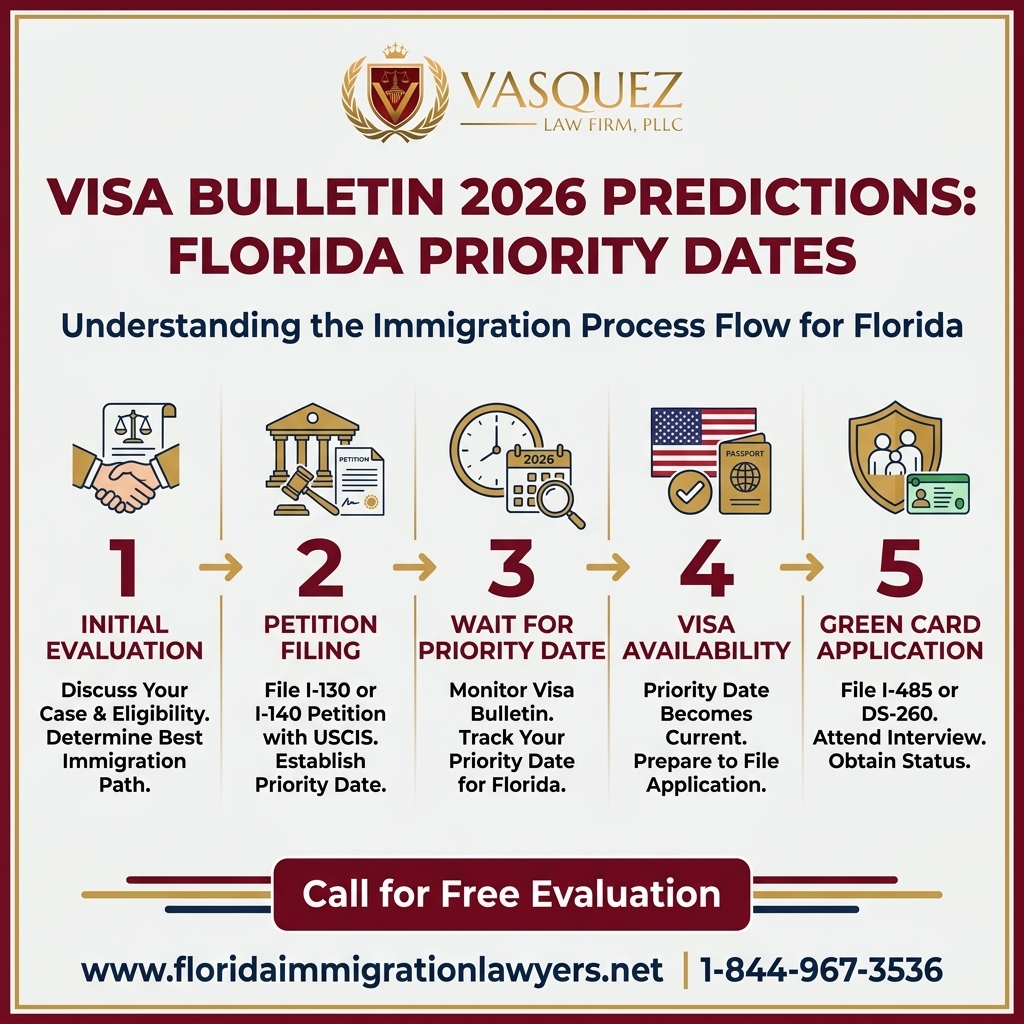
While your case is at the NVC, you must diligently monitor the monthly Visa Bulletin published by the U.S. Department of State. Your priority date must be "current" in the "Final Action Dates" chart for your specific visa category and country of chargeability before an interview can be scheduled. If your priority date is not current, your case will remain at the NVC until a visa number becomes available. This is often the longest part of the wait for many applicants, especially those in oversubscribed categories like F2B or F4. For residents in Florida, this period of waiting requires patience and ongoing awareness.
-
Step 5: Interview Scheduling and Medical Examination
Once your priority date becomes current, the NVC will schedule your immigrant visa interview at the appropriate U.S. embassy or consulate abroad (for consular processing) or notify you to apply for adjustment of status with USCIS (for those already in the U.S. and eligible). Before the interview, you must undergo a medical examination with an authorized panel physician. The interview is the final step where a consular officer or USCIS officer determines your eligibility for the immigrant visa or green card. Thorough preparation for this interview, often with legal counsel, is highly recommended to ensure a smooth process. For those adjusting status in Florida, your interview will typically be at the USCIS Miami Field Office or another local office, depending on your residency.
-
Step 6: Visa Issuance or Green Card Approval
If your interview is successful, the consular officer will issue your immigrant visa, which allows you to enter the U.S. as a lawful permanent resident. Upon entry, you will typically receive your physical green card in the mail. For those adjusting status within the U.S., USCIS will mail your green card directly to you. This final step marks the culmination of your journey through the immigrant visa process, granting you permanent residency in the United States. Congratulations are in order, but remember that maintaining your green card status also has ongoing responsibilities under U.S. immigration law, as outlined in 8 CFR Part 264.
Essential Document Checklist for Immigrant Visa Applicants in Florida
Gathering the correct documentation is a critical, yet often underestimated, part of the immigrant visa process. For Florida residents, particularly those preparing for consular processing abroad or adjustment of status at the Miami USCIS Field Office, meticulous organization can prevent significant delays. An incomplete submission is one of the most common reasons for Requests for Evidence (RFEs) or even denials, prolonging your wait times and impacting your priority dates. This checklist outlines the essential documents typically required, but remember that your specific case may necessitate additional paperwork. Always consult your NVC or USCIS instructions carefully.
- Approved Immigrant Petition (Form I-130 or I-140): The notice of approval from USCIS for your initial petition. This is the foundation of your case.
- Immigrant Visa Application (Form DS-260) Confirmation Page: Completed online at the NVC website.
- Passport: A valid passport for each applicant, valid for at least six months beyond your intended date of entry into the U.S.
- Birth Certificates: Original or certified copies for all applicants, and for the petitioner (if applicable).
- Marriage Certificates: Original or certified copies, if married, and divorce/death certificates for any prior marriages.
- Police Certificates: From your country of nationality and any country where you have lived for six months or more since age 16.
- Court and Prison Records: If you have ever been arrested or convicted of a crime, regardless of outcome.
- Military Records: If you served in the military of any country.
- Photocopies of All Documents: It is always wise to keep a complete set of photocopies for your records.
- Photographs: U.S. visa-style photographs for each applicant.
- Affidavit of Support (Form I-864) and Supporting Financial Documents: Filed by the petitioner (and any joint sponsor), including recent tax returns, W-2s, and employment verification. This demonstrates that the immigrant will not become a public charge.
- Medical Examination Results: Completed by an authorized panel physician. This must be done shortly before your interview.
- Proof of Relationship: Depending on your visa category, this could include photos, joint bank accounts, lease agreements, or other evidence confirming the bona fide nature of your relationship.
- Proof of Petitioner's U.S. Status: U.S. birth certificate, naturalization certificate, or U.S. passport.
Organizing these documents thoroughly and accurately before your interview or adjustment of status filing is vital. Florida Immigration Lawyers can help you compile this crucial evidence, ensuring nothing is overlooked and that your submission meets all regulatory requirements under 8 CFR Part 204.
Projected Timelines and Processing Expectations for 2026
Understanding the projected timelines for immigrant visas in 2026 is critical for Florida residents, especially given the historical backlogs and current administrative challenges. While it is impossible to provide exact dates for when your priority date will become current, we can offer general expectations based on current trends and the factors influencing the Visa Bulletin. These timelines can vary significantly based on your visa category, country of origin, and whether you are pursuing adjustment of status in Florida or consular processing abroad. The recent news regarding DACA renewal delays, for example, underscores how administrative backlogs at USCIS can impact overall processing efficiency, potentially extending wait times across various immigration processes.
General Wait Times by Visa Category
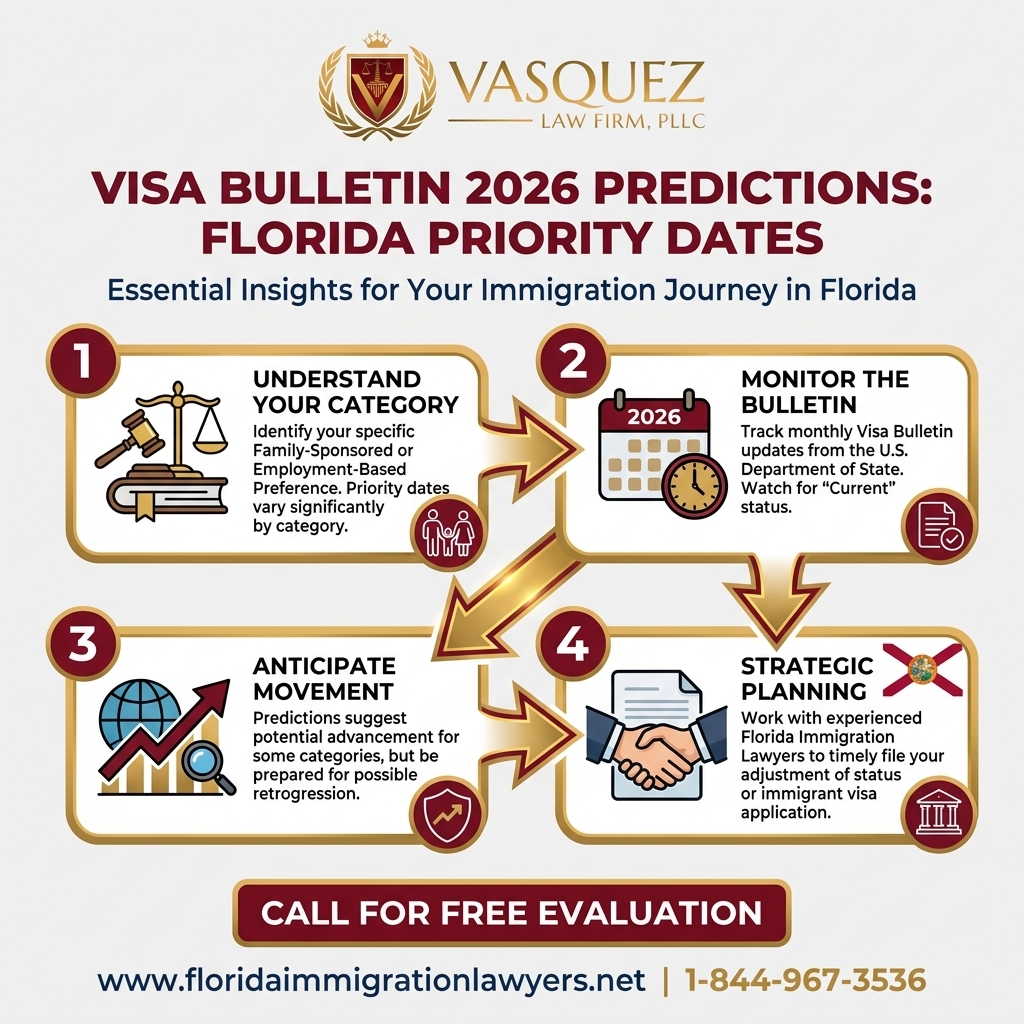
For family-sponsored categories, wait times are generally longest for those with statutory limitations and high demand. For instance, F4 (brothers and sisters of U.S. citizens) applicants from countries like Mexico or the Philippines often face waits of 15 years or more. F2B (unmarried adult sons and daughters of lawful permanent residents) applicants also experience substantial delays, often exceeding 7-10 years for many nationalities. In contrast, F2A (spouses and minor children of lawful permanent residents) typically has shorter wait times, often becoming current within a few years or even less, though this can fluctuate. Employment-based categories also vary, with EB-1 and EB-2 (for certain highly skilled individuals) often being current or having shorter waits, while EB-3 and EB-5 can have significant backlogs, particularly for Indian and Chinese nationals. These are broad estimates, and monthly fluctuations in the Visa Bulletin can lead to unexpected advancements or retrogressions.
Impact of Backlogs and Policy on 2026 Timelines
The overall efficiency of USCIS and the National Visa Center (NVC) processing significantly impacts how quickly cases move. Current backlogs, exacerbated by limited resources and increased demand, mean that even after your priority date becomes current, there can still be substantial delays in interview scheduling or final adjudication. For applicants in Florida, this could mean longer waits at the Miami USCIS Field Office for adjustment of status interviews or extended periods for NVC to process documents. Policy changes, such as those impacting DACA, can shift governmental resources and attention, indirectly affecting other visa categories. While the federal government has blocked some immigration courthouse arrests (as per recent news), the underlying administrative processes continue to face challenges. Therefore, for 2026, it is reasonable to anticipate that established backlogs will persist, and wait times for oversubscribed categories will remain lengthy. Staying informed through the official Visa Bulletin and consulting with an immigration attorney are crucial for managing these expectations and strategizing your immigration journey.
Adjustment of Status vs. Consular Processing
The choice between adjusting status within the U.S. (if eligible) and consular processing abroad can also affect your timeline. Adjustment of status cases are handled by USCIS field offices (like the one serving Homestead, Florida, in Miami), while consular processing involves a U.S. embassy or consulate in your home country. While both depend on the Visa Bulletin, the specific processing times and backlogs at USCIS field offices versus individual consulates can differ. For instance, the Miami Immigration Court, which serves the Homestead area, handles deportation defense cases, highlighting the complex judicial and administrative landscape immigrants navigate in Florida. It is essential to consult with an attorney to determine the most strategic and efficient path for your particular circumstances, especially when considering the implications of 8 CFR Part 245 regarding adjustment of status eligibility.
Do not navigate this complex process alone. Contact Florida Immigration Lawyers today for expert guidance on your visa bulletin concerns and to understand your potential 2026 predictions. Call us at 1-844-967-3536 for a free consultation.
Cost Factors and Fee Breakdown for Immigrant Visa Applications
Navigating the immigrant visa process in Florida involves not only complex legal procedures but also a series of fees that can add up significantly. Understanding these cost factors upfront is essential for budgeting and planning your immigration journey, especially when considering the long wait times that can precede final approval. While specific fee amounts are subject to change and should always be verified on the official USCIS website, we can outline the general categories of expenses you should anticipate. Florida Immigration Lawyers are transparent about potential costs and can help you understand the financial implications for your specific case, whether you are in Homestead or elsewhere in the state.
Government Filing Fees
The primary costs are the filing fees charged by USCIS and the Department of State. These include:
- Petition for Alien Relative (Form I-130) Fee: This is paid by the petitioner to USCIS to initiate the family-sponsored immigration process.
- Immigrant Petition for Alien Worker (Form I-140) Fee: Paid by the employer for employment-based immigration.
- National Visa Center (NVC) Processing Fees: If your case goes through consular processing, you will pay an Immigrant Visa Application Processing Fee and an Affidavit of Support Processing Fee to the NVC.
- USCIS Immigrant Fee: Paid to USCIS after your visa is issued abroad and before you enter the U.S. as a permanent resident. This fee covers the cost of producing your physical Green Card.
- Application for Adjustment of Status (Form I-485) Fee: If you are adjusting status within the U.S., this fee covers the green card application, and often includes fees for employment authorization (Form I-765) and advance parole (Form I-131) if filed concurrently.
These fees are non-refundable, regardless of the outcome of your application. It is crucial to use the correct fee amounts and payment methods to avoid rejection of your application.
Ancillary Costs
Beyond government filing fees, you will encounter several other necessary expenses:
- Medical Examination Fees: All immigrant visa applicants must undergo a medical examination by an authorized panel physician. The cost varies by physician and location in Florida (e.g., Homestead), but it is a mandatory expense.
- Translation Fees: If any of your supporting documents are not in English, they must be translated by a certified translator. This applies to birth certificates, marriage certificates, police records, and any other foreign-language documents.
- Document Procurement Fees: Costs associated with obtaining original or certified copies of birth certificates, marriage certificates, police clearances, etc., from your home country or U.S. states.
- Travel Expenses: For consular processing, you will incur travel costs for your interview at a U.S. embassy or consulate abroad. For adjustment of status, you might have travel costs to attend an interview at a USCIS field office in Florida.
Legal Representation Fees
While not mandatory, retaining an experienced immigration attorney is a significant investment that can save you time, stress, and potential errors. Attorney fees cover: assistance with petition preparation, document review, RFE responses, interview preparation, and strategic advice on navigating complex issues like the Visa Bulletin and potential waivers. For Florida Immigration Lawyers, our fees reflect the depth of our expertise and our commitment to guiding you through every step, ensuring your application is as strong as possible. We offer free consultations to discuss your case and provide a clear understanding of our fee structure. Contact us at 1-844-967-3536 to discuss your specific needs and how we can assist you in your immigration journey, adhering to the legal principles outlined in 8 U.S.C. §1362 regarding legal counsel.
Common Mistakes to Avoid in the Immigrant Visa Process
Navigating the immigrant visa process can be fraught with potential pitfalls, especially when dealing with the complexities of the Visa Bulletin and ever-changing immigration policies. For Florida residents, making even a seemingly minor error can lead to significant delays, Requests for Evidence (RFEs), or even denial of your application, extending your wait times and affecting your priority dates. Avoiding these common mistakes is crucial for a smooth and efficient immigration journey.
-
Failing to Monitor the Visa Bulletin Regularly: Many applicants assume they will be notified when their priority date is current. However, it is your responsibility to check the monthly bulletin. Missing an advancement can cause you to miss crucial deadlines for submitting documents to the NVC or filing for adjustment of status. Always consult the official U.S. Department of State Visa Bulletin.
-
Submitting Incomplete or Inaccurate Forms: Even minor errors or missing information on forms like I-130, DS-260, or I-485 can lead to rejection or RFEs, adding months or even years to your processing time. Double-check every field and ensure all required supporting documents are attached. This is a common issue that Florida Immigration Lawyers frequently help clients rectify.
-
Not Updating Your Address with USCIS and NVC: If you move within Florida, or even just within Homestead, and fail to update your address, you could miss critical notices, RFEs, or interview appointments. This can lead to your case being delayed, or in some instances, administratively closed. Always file a change of address promptly.
-
Providing Insufficient Evidence of Relationship or Financial Support: For family-based petitions, robust evidence of a bona fide relationship and the petitioner's financial ability to support the applicant (via Form I-864) is essential. Weak evidence can lead to suspicion, RFEs, or denials. Gather comprehensive documentation like joint bank statements, photos, and affidavits from third parties.
-
Missing NVC Deadlines for Document Submission: Once your case moves to the NVC, there are strict deadlines for submitting all civil documents and the Affidavit of Support. Failure to meet these deadlines can result in your case being administratively closed, requiring you to restart the process and potentially lose your priority date.
-
Not Preparing Adequately for the Interview: Whether it's a consular interview abroad or an adjustment of status interview at the Miami USCIS Field Office, thorough preparation is key. Review your application, understand the questions you might be asked, and bring all original documents. Inadequate preparation can lead to a denial or further delays.
-
Failing to Disclose All Relevant Information: Attempting to conceal past arrests, previous immigration violations, or other potentially adverse information can lead to severe consequences, including findings of misrepresentation, permanent bars from the U.S., and even criminal charges. Honesty and transparency are paramount, even if the information seems problematic. An attorney can help you determine what needs to be disclosed and if waivers are available.
-
Ignoring Legal Advice or Attempting to Self-Represent in Complex Cases: While some straightforward cases might be managed independently, complex situations (e.g., criminal history, previous denials, specific waivers needed, or intricate family structures) almost always benefit from legal counsel. Attempting to navigate these complexities without an attorney can lead to critical errors and adverse outcomes, especially with the ever-changing landscape of immigration law, as seen in 8 U.S.C. Chapter 12.
When to Call a Lawyer: Expert Guidance for Your Immigration Journey
The immigrant visa process is incredibly intricate, with numerous forms, deadlines, and legal nuances that can be overwhelming for even the most detail-oriented individual. While this guide provides general information, your specific situation is unique. There are many scenarios where the expertise of an experienced immigration attorney becomes not just helpful, but absolutely essential for Florida residents navigating their path to permanent residency. Florida Immigration Lawyers are here to provide the dedicated support you need, whether you are in Homestead, Miami, or any other part of the state.
You should strongly consider contacting an attorney if you encounter any of the following situations:
- Complex Family Relationships or Sponsorship Issues: If your family structure is unusual, if there are questions about the validity of a marriage, or if the petitioner has financial challenges meeting the Affidavit of Support requirements, an attorney can offer strategic solutions.
- Previous Denials or Immigration Violations: If you have had a prior visa application denied, been issued a Notice to Appear in immigration court (such as the Miami Immigration Court), or have any history of overstaying a visa or unlawful presence, legal counsel is critical. These issues can trigger bars to admissibility that require waivers, a highly complex area of law.
- Criminal History: Even minor arrests or convictions can have significant immigration consequences. An attorney can assess your criminal record, determine if it impacts your eligibility, and advise on potential waivers or defense strategies.
- Difficulty Interpreting the Visa Bulletin: If you are unsure how to read the Visa Bulletin, how your priority date applies, or if you need to understand the implications of a retrogressing date, an attorney can provide clarity and help you plan.
- Receiving a Request for Evidence (RFE) or Notice of Intent to Deny (NOID): These notices from USCIS or NVC indicate that there are deficiencies in your application. Responding correctly and comprehensively is crucial, and an attorney can help you gather the necessary evidence and craft a strong response.
- Uncertainty About Adjustment of Status vs. Consular Processing: Deciding whether to adjust status in the U.S. or go through consular processing abroad involves different eligibility criteria and risks. An attorney can help you determine the safest and most efficient path.
- Seeking Asylum or Deportation Defense: If your situation involves asylum claims or you are facing deportation proceedings, specialized legal representation is absolutely vital. Our firm offers robust deportation defense and asylum services.
Florida Immigration Lawyers possess in-depth knowledge of U.S. immigration law, including the intricacies of the INA and 8 CFR. We can help you understand visa bulletin predictions 2026, prepare meticulous applications, respond to challenges, and represent you in interviews or court if necessary. Do not risk your future by navigating these complex waters alone. Contact us today for a free consultation and let us put our expertise to work for you. Our attorneys are dedicated to protecting your rights and helping you achieve your immigration goals.
About Florida Immigration Lawyers
Florida Immigration Lawyers is a leading immigration law firm dedicated to serving individuals and families across the entire state of Florida. With a deep understanding of the complexities of U.S. immigration law and a compassionate approach, we provide comprehensive legal services designed to help our clients achieve their American dreams. Our commitment to excellence, personalized attention, and unwavering advocacy sets us apart.
We specialize in a broad range of immigration matters, including family-sponsored visas, employment-based visas, adjustment of status, consular processing, naturalization and citizenship, asylum, and deportation defense. Whether you are seeking to reunite with family, pursue career opportunities, or find safety in the U.S., our experienced attorneys are equipped to guide you through every step of the process. We understand the unique challenges faced by immigrants in Florida, from Homestead to Jacksonville, and we are dedicated to providing clear, effective legal strategies.
Choosing Florida Immigration Lawyers means partnering with a team that genuinely cares about your outcome. We pride ourselves on offering accessible, high-quality legal representation. We are available 24/7 to address your urgent concerns and offer free consultations to discuss your case without obligation. Our bilingual team ensures that language is never a barrier to receiving expert legal advice. Let us be your trusted advocates in navigating the complexities of immigration law. Visit our website at https://www.floridaimmigrationlawyers.net or call us directly at 1-844-967-3536 to learn how we can assist you.
Sources and References
- U.S. Citizenship and Immigration Services (USCIS)
- U.S. Department of State - Visa Bulletin
- Executive Office for Immigration Review (EOIR)
- 8 U.S.C. Chapter 12 - Immigration and Nationality Act (INA §201, §202, §203)
- 8 CFR Part 204 - Petitions, Classifications, and Priority Dates
- 8 CFR Part 245 - Adjustment of Status to that of Person Admitted for Permanent Residence
- 8 CFR Part 264 - Documentary Requirements: Immigrants and Nonimmigrants; Waivers; Admissions of Certain Inadmissible Aliens; Parole
Related services: immigration practice areas, family immigration services, citizenship and naturalization, business immigration.
This article provides general legal information and is not intended as legal advice. Every case is unique, and outcomes depend on specific facts and circumstances. Contact an attorney for advice about your particular situation.
Don't leave your immigration future to chance. Get the clarity and support you deserve. Contact Florida Immigration Lawyers today for a free consultation to discuss your visa bulletin predictions 2026 Florida concerns. Call us now at 1-844-967-3536. Se Habla Español - Estamos aquí para ayudarle.
Do Not Navigate This Process Alone
Our experienced immigration attorneys are ready to fight for you. Get a free, confidential consultation today.
Se Habla Español
Frequently Asked Questions

William J. Vásquez
Founding Attorney · Vasquez Law Firm
U.S. Air Force veteran and immigration attorney with thousands of cases resolved. J.D., NCCU School of Law. AILA member. Admitted to the 4th, 5th, and 11th Circuit Courts.
Available 24/7 - Free Evaluations
Related Legal Services
Our Florida immigration attorneys can help you with free immigration consultation, experienced immigration attorneys and business immigration. Call today at 1-844-967-3536 for a free consultation.
Related Links
Related Topics
Free Legal Consultation
Discuss your case with our experienced attorneys. We're available 24/7.
Se Habla Español - Estamos aquí para ayudarle.
Related Articles
J-1 Waiver for Physicians in Florida: A 2026 Guide
Navigating the J-1 waiver process in Florida can be challenging for foreign physicians. Learn how the Conrad 30 program facilitates placements in underserved areas like Homestead, ensuring a successful application. Call Florida Immigration Lawyers today for expert guidance.
Naturalization Process Florida Timeline 2026 Guide
The naturalization process in Florida, culminating in U.S. citizenship, involves several key stages including eligibility assessment, filing Form N-400, biometrics, an interview, and the Oath of Allegiance. As of 2026, the typical timeline for this process in Florida ranges from 18 to 24 months, though individual experiences can vary. This guide from Florida Immigration Lawyers provides a comprehensive overview, covering requirements, step-by-step procedures, potential costs, and common pitfalls. We emphasize the importance of understanding Florida-specific nuances and the benefits of legal counsel to navigate this complex journey effectively. Contact us for a free consultation.
H-2B Visa for Florida Hospitality Seasonal Workers
Explore the H-2B visa process for seasonal workers in Florida's hospitality industry. Learn about costs, timelines, and common mistakes. Contact Florida Immigration Lawyers for expert assistance.
Military Naturalization Expedited at Florida Bases
Explore expedited military naturalization for service members stationed in Florida, including MacDill Air Force Base. Learn about eligibility, application steps, and how Florida Immigration Lawyers can assist you.