Family Petition Immigration Lawyer Miami: Your Path to Unity
Navigating the U.S. family petition process can be overwhelming for families in Florida, including Miami and Pembroke Pines. This comprehensive guide details how U.S. citizens and lawful permanent residents can sponsor eligible relatives for a green card, starting with Form I-130. We cover eligibility, a step-by-step filing guide, essential document checklists, and insights into current processing timelines for 2026. Learn about the associated costs, common mistakes to avoid, and crucial scenarios where an experienced family petition immigration lawyer in Miami can provide invaluable assistance. Florida Immigration Lawyers offers expert guidance to ensure a smooth and successful path to family reunification.

A family petition immigration lawyer in Miami helps U.S. citizens and lawful permanent residents sponsor eligible family members for a green card. This complex process typically begins with filing Form I-130, Petition for Alien Relative, with USCIS. The lawyer assists in preparing documentation, navigating preference categories, responding to Requests for Evidence (RFEs), and representing clients through consular processing or adjustment of status. Their expertise is crucial for ensuring compliance with immigration laws, avoiding common pitfalls, and streamlining the path to family reunification in Florida and beyond.
- Initial step involves filing Form I-130 to establish a qualifying family relationship.
- Eligibility depends on the petitioner's status and the family member's relationship.
- The process can involve USCIS, the National Visa Center, and U.S. Consulates.
- Legal representation is vital for complex cases, RFE responses, and interview preparation.
- Timelines vary significantly based on the family preference category and country of origin.
Bringing your loved ones to the United States is a deeply personal and often challenging journey. For many families in Florida, particularly those in vibrant communities like Miami and Pembroke Pines, the dream of reunification hinges on successfully navigating the intricate U.S. immigration system. Understanding the various pathways, particularly the family petition process, is the first critical step. This process, while offering hope, is fraught with complex legal requirements, extensive documentation, and varying timelines that can feel overwhelming without expert guidance. That is precisely where a dedicated family petition immigration lawyer in Miami becomes an indispensable ally.
This comprehensive guide from Florida Immigration Lawyers aims to demystify the family petition process. We will explore everything from eligibility criteria and the step-by-step filing of Form I-130 to crucial document checklists, expected timelines, and associated costs. Our goal is to equip you with the knowledge needed to pursue your family’s immigration goals effectively. We understand the stakes involved and are committed to helping you understand each phase of this journey. If you are ready to take the first step towards reuniting your family, do not hesitate to call Florida Immigration Lawyers at 1-844-967-3536 for a free consultation. Our experienced team serves families throughout Florida, including Miami-Dade, Broward, and Palm Beach counties, providing personalized and compassionate legal support.
Understanding the Family Petition Process in Florida
The family petition process is the cornerstone of family-based immigration to the United States. It allows U.S. citizens and lawful permanent residents (LPRs) to sponsor certain eligible family members for a green card, granting them permanent residency. This process is governed primarily by the Immigration and Nationality Act (INA), specifically sections like INA § 201 and INA § 203 (codified at 8 U.S.C. §§ 1151 and 1153), which define who can be sponsored and under what preference category. For families living in or moving to Florida, navigating these federal regulations requires a nuanced understanding, especially given the state's diverse population and specific USCIS field office operations.
The journey typically begins with the U.S. citizen or LPR filing Form I-130, Petition for Alien Relative, with U.S. Citizenship and Immigration Services (USCIS). This form establishes the qualifying relationship between the petitioner and the beneficiary. It is more than just a piece of paper; it is the legal foundation upon which the entire immigration case is built. Errors or omissions at this initial stage can lead to significant delays or even denials, underscoring the importance of meticulous preparation. A skilled family petition immigration lawyer in Miami can help ensure this foundational step is executed flawlessly, setting the stage for a successful outcome.
Immediate Relatives vs. Family Preference Categories
The U.S. immigration system categorizes family relationships into two main groups, each with different processing speeds:
- Immediate Relatives: This category includes spouses of U.S. citizens, unmarried children under 21 of U.S. citizens, and parents of U.S. citizens (if the citizen is 21 or older). There are no numerical limitations for immediate relative visas, meaning they do not have to wait for a visa number to become available once the I-130 is approved. This typically results in a faster path to a green card.
- Family Preference Categories: These categories are subject to annual numerical limits, leading to potential waiting periods. They include adult children (married and unmarried) of U.S. citizens, siblings of U.S. citizens, and spouses and unmarried children of lawful permanent residents. The wait times can range from a few years to over two decades, depending on the category and the beneficiary's country of origin.
Understanding which category your family member falls into is crucial for setting realistic expectations about the timeline. Your immigration attorney can provide insight into the current visa bulletin trends and how they may impact your specific case.
Who Can File a Family Petition?
Only U.S. citizens and lawful permanent residents are eligible to file family petitions. The type of relationships they can sponsor varies:
- U.S. Citizens can petition for: Spouses, unmarried children under 21, unmarried adult children, married adult children, and siblings (if the citizen is 21 or older), and parents (if the citizen is 21 or older).
- Lawful Permanent Residents (Green Card Holders) can petition for: Spouses and unmarried children of any age. LPRs cannot petition for parents, married children, or siblings.
These eligibility rules are strict and require clear evidence of the claimed relationship. For Florida residents, especially in diverse areas like Miami-Dade, verifying these relationships often involves navigating international documents and legal standards, where an experienced lawyer can be invaluable.
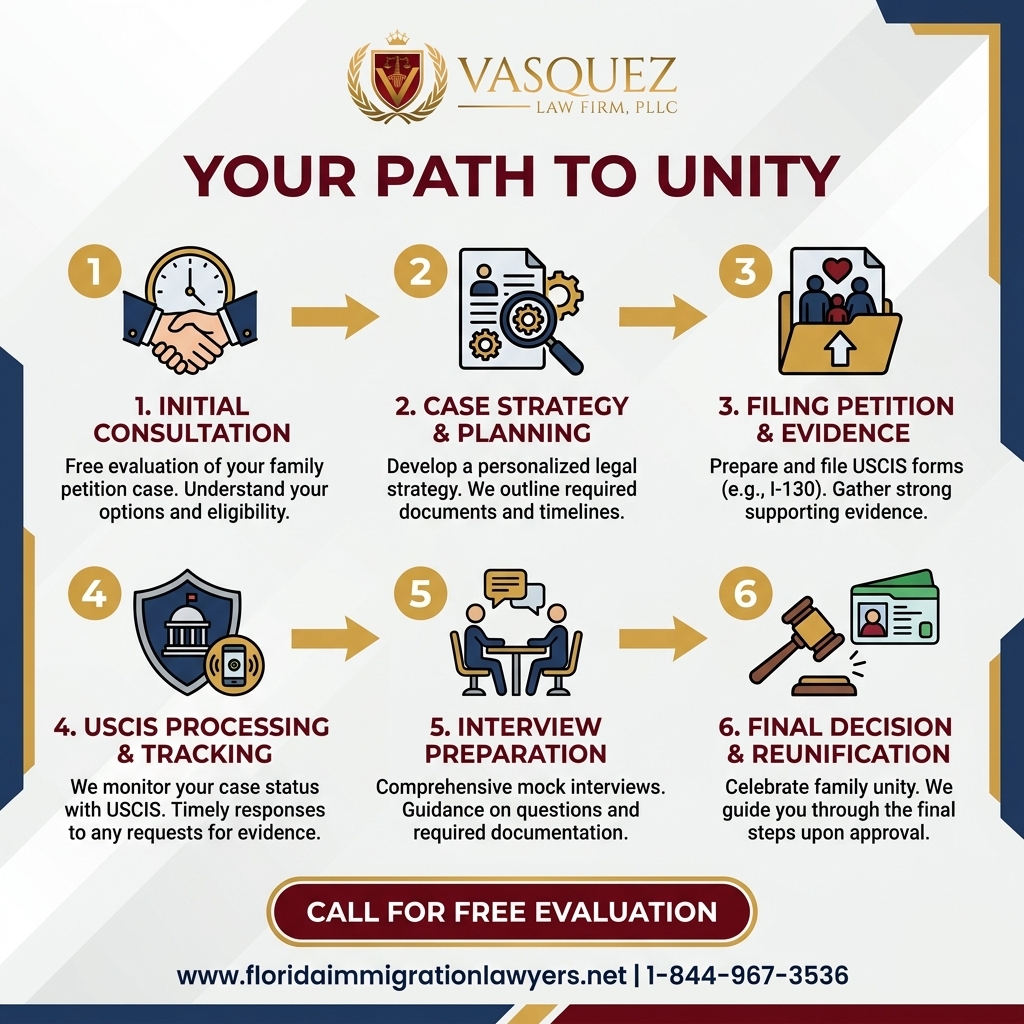
Step-by-Step Guide to Filing Your I-130 Petition
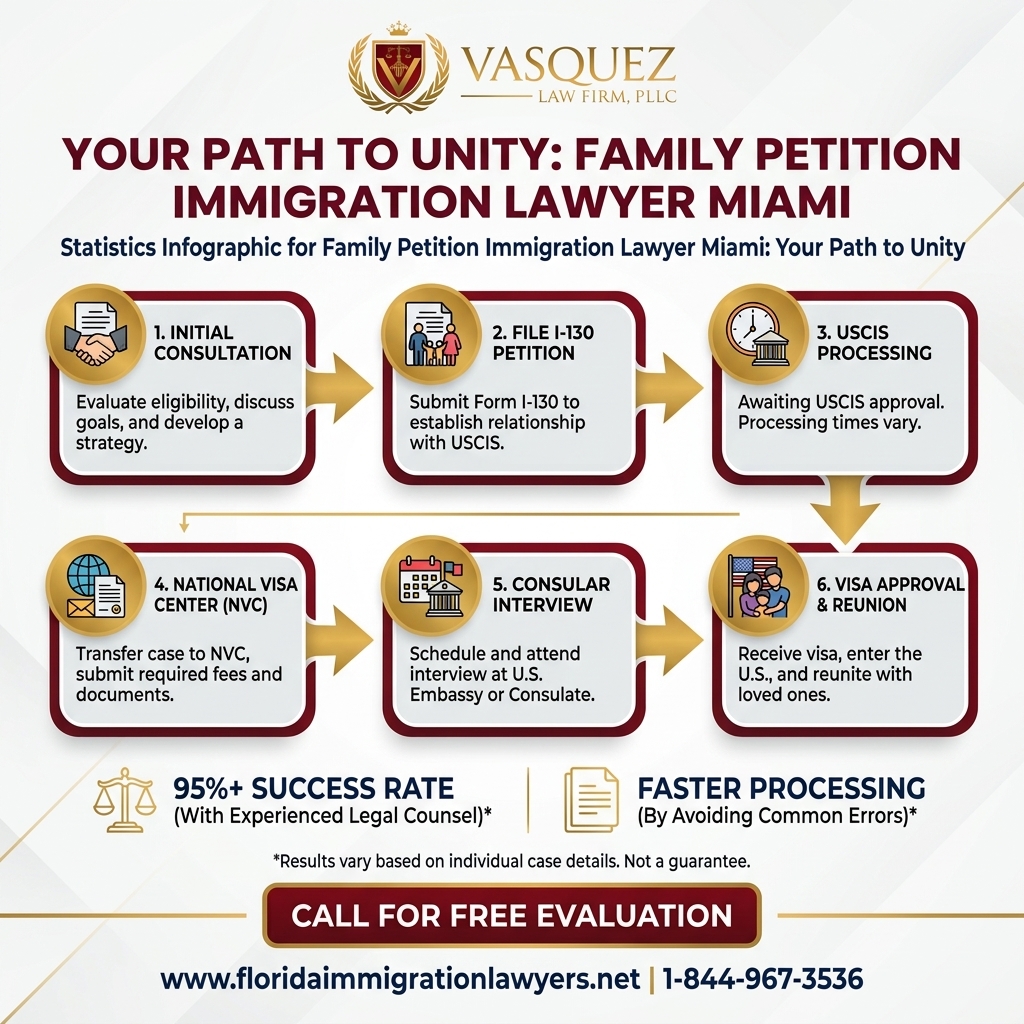
Filing Form I-130, Petition for Alien Relative, is the foundational step in most family-based immigration cases. This form establishes the legal relationship between the U.S. citizen or lawful permanent resident petitioner and the foreign national beneficiary. The process demands precision and a thorough understanding of USCIS requirements. Any misstep can lead to delays, requests for evidence (RFEs), or even denial, prolonging family separation. This guide outlines the typical steps involved, providing a roadmap for families in Pembroke Pines and across Florida.
-
Determine Eligibility and Gather Initial Information: Before filing, confirm that you (the petitioner) are a U.S. citizen or LPR and that your family member (the beneficiary) falls into an eligible category. Collect basic information for both parties, including full names, dates of birth, addresses, and immigration history. This preliminary check helps identify potential issues early on.
-
Complete Form I-130, Petition for Alien Relative: Accurately fill out Form I-130. This form requires detailed information about both the petitioner and the beneficiary, the nature of their relationship, and their immigration history. Pay close attention to every question, ensuring consistency with supporting documents. An error here can significantly impact your case.
-
Assemble Supporting Documentation: This is a critical phase. You must provide compelling evidence to prove the claimed family relationship. For spouses, this includes marriage certificates, joint bank accounts, photos, and affidavits. For parent-child relationships, birth certificates are primary. All documents not in English must be accompanied by a certified English translation. We will delve into a detailed document checklist shortly.
-
Pay Filing Fees: Submit the required filing fee for Form I-130 to USCIS. Fee amounts are subject to change, so always check the official USCIS website for the most current information. Do not send cash. Ensure your payment method is acceptable to avoid rejection of your petition.
-
Mail the Petition Package to USCIS: Send the completed Form I-130, all supporting documents, and the filing fee to the correct USCIS lockbox facility. The specific mailing address depends on where you live and the type of petition. Using certified mail with a return receipt is highly recommended to track delivery.
-
Receive Receipt Notice and Await I-130 Approval: Once USCIS receives your petition, they will send a Form I-797C, Notice of Action, acknowledging receipt. This notice will include your case receipt number, which you can use to track your case status online. USCIS will then review the petition and evidence. If approved, you will receive an I-797, Approval Notice.
-
National Visa Center (NVC) Processing or Adjustment of Status:
- Consular Processing (for beneficiaries outside the U.S.): If the I-130 is approved and the beneficiary is abroad, the case moves to the National Visa Center (NVC). The NVC collects additional documents and fees, including the Affidavit of Support (Form I-864), and schedules an interview at a U.S. Embassy or Consulate in the beneficiary's home country.
- Adjustment of Status (for beneficiaries in the U.S.): If the beneficiary is already in the U.S. and eligible to adjust their status (e.g., entered legally and remains in status, or is an immediate relative of a U.S. citizen), they can file Form I-485, Application to Register Permanent Residence or Adjust Status, concurrently with or after the I-130 approval. This typically involves a USCIS interview at a local field office, such as the one in Miami or Orlando.
-
Interview and Final Decision: Both consular processing and adjustment of status generally involve an interview. For consular processing, the interview takes place at a U.S. embassy or consulate. For adjustment of status, it occurs at a USCIS field office. During the interview, an officer will review the application, supporting documents, and ask questions to confirm eligibility and the validity of the relationship. A favorable interview leads to visa issuance or green card approval.
Essential Document Checklist for a Successful Family Petition
The success of your family petition hinges significantly on providing a comprehensive and accurate set of supporting documents. USCIS requires robust evidence to prove the bona fide nature of the family relationship. Missing or incorrect documents are a leading cause of delays and Requests for Evidence (RFEs). For residents in Florida navigating this process, especially in areas with diverse international backgrounds like Miami and Fort Lauderdale, gathering these documents can be particularly challenging. Here is a general checklist, but remember that specific cases may require additional evidence.
General Documents for All Petitions:
- Form I-130, Petition for Alien Relative: Completed and signed by the petitioner.
- Proof of Petitioner's U.S. Citizenship or LPR Status: U.S. birth certificate, naturalization certificate, unexpired U.S. passport, or green card (Form I-551).
- Proof of Bona Fide Relationship: This varies significantly by relationship type.
Specific Documents Based on Relationship:
- For Spouses (U.S. Citizen or LPR Petitioning for Spouse):
- Marriage certificate.
- Proof of termination of any prior marriages for both petitioner and beneficiary (divorce decrees, death certificates).
- Evidence of a bona fide marriage (joint bank accounts, utility bills, leases, mortgages, insurance policies, photos together, affidavits from friends/family).
- Birth certificates for any children born of the marriage.
- For Children (U.S. Citizen or LPR Petitioning for Child):
- Child's birth certificate showing the names of both parents.
- Petitioner's birth certificate (if the petitioner is the parent).
- Marriage certificate of parents (if applicable).
- Proof of legitimation (if child was born out of wedlock and petitioner is the father).
- For Parents (U.S. Citizen Petitioning for Parent):
- Petitioner's birth certificate showing the names of both parents.
- Parents' marriage certificate (if applicable).
- Proof of termination of any prior marriages for parents (divorce decrees, death certificates).
- For Siblings (U.S. Citizen Petitioning for Sibling):
- Petitioner's birth certificate.
- Beneficiary's birth certificate.
- Parents' marriage certificate (if applicable) to prove common parentage.
- Proof of name changes (if any).
Additional Important Considerations:
- Translations: All documents not in English must be accompanied by a complete and certified English translation. The translator must certify that they are competent to translate and that the translation is accurate.
- Copies vs. Originals: Generally, USCIS prefers copies of documents, but be prepared to present originals at an interview. Always keep a complete copy of everything you submit.
- Affidavit of Support (Form I-864): Later in the process, the petitioner must submit Form I-864, promising to financially support the beneficiary. This requires tax returns, employment letters, and other financial documentation.
Organizing these documents can be daunting. A seasoned immigration lawyer in Miami can help you compile a robust application package, ensuring all necessary evidence is included and properly presented to avoid delays.
Navigating Timelines and Processing Expectations in 2026
One of the most common questions families have when embarking on the family petition journey concerns processing times. The truth is, there is no single answer, as timelines can vary significantly based on several factors, including the type of family relationship, the beneficiary's country of origin, and the current workload of USCIS and the National Visa Center (NVC). While 2026 brings new hopes, historical trends and current backlogs mean that patience is a virtue in family-based immigration.
For immediate relatives (spouses, unmarried children under 21, and parents of U.S. citizens), the process is generally faster because there are no annual visa quotas. After the Form I-130 is approved by USCIS, the beneficiary can typically proceed directly to adjustment of status (if in the U.S.) or consular processing (if abroad). The I-130 approval itself can take anywhere from 6 to 18 months, sometimes longer, depending on the service center. Following approval, the adjustment of status or consular processing phase can add another 6 to 18 months. This means immediate relatives might see their cases finalized within 1.5 to 3 years from the initial filing.
For family preference categories, the situation is more complex due to numerical limitations set by Congress. Once USCIS approves the I-130 petition, the beneficiary must wait for a visa number to become available based on their priority date (the date USCIS received the I-130). The Visa Bulletin, published monthly by the U.S. Department of State, provides current waiting times. These waits can be extensive:
- First Preference (F1): Unmarried adult children of U.S. citizens – often 7-10 years.
- Second Preference (F2A): Spouses and unmarried children (under 21) of LPRs – typically 2-5 years.
- Second Preference (F2B): Unmarried adult children of LPRs – often 8-12 years.
- Third Preference (F3): Married adult children of U.S. citizens – often 12-15 years.
- Fourth Preference (F4): Siblings of U.S. citizens – often 15-20+ years.
These timelines are estimates and can fluctuate. For individuals in Florida, processing may occur at USCIS service centers such as the Nebraska Service Center or Texas Service Center, depending on the filing address. Interviews for adjustment of status often take place at local field offices, with Miami, Orlando, and Tampa being key locations. A family petition immigration lawyer in Miami can help you track your case, interpret the Visa Bulletin, and advise on any changes in processing trends that might affect your family's journey.
Cost Factors and Fee Breakdown for Family Petitions
Understanding the financial aspects of filing a family petition is crucial for proper planning. The costs associated with family-based immigration are not limited to just government filing fees; they can also include legal fees, medical examination costs, and other administrative expenses. It is important to remember that government filing fees are subject to change, so always consult the official USCIS website for the most current fee schedule before submitting any payments. Florida Immigration Lawyers can help you understand the full scope of potential expenses involved in your specific case.
Government Filing Fees:
The primary government fees you will encounter typically include:
- Form I-130, Petition for Alien Relative: This is the initial filing fee to establish the family relationship.
- Form I-485, Application to Register Permanent Residence or Adjust Status (if applicable): If the beneficiary is adjusting status within the U.S., this fee covers their application for a green card. This fee often includes biometric services.
- Biometrics Services Fee: For fingerprinting and background checks, typically included in the I-485 fee, but sometimes a separate fee for consular processing cases or other forms.
- Affidavit of Support (Form I-864): There is no separate filing fee for the I-864 form itself when filed with USCIS, but there may be fees associated with the National Visa Center (NVC) processing.
- Immigrant Visa Application Processing Fee (DS-260) (if applicable): For beneficiaries pursuing consular processing abroad, this fee is paid to the Department of State (DOS).
- USCIS Immigrant Fee: A fee paid to USCIS after an immigrant visa is issued by a U.S. Embassy or Consulate, before the green card is produced.
These fees are non-refundable, regardless of the outcome of your petition. It is essential to ensure all forms are correctly filled out and all supporting documents are included to avoid losing these fees due to a rejected application.
Additional Potential Costs:
- Medical Examination Fees: All immigrant visa applicants and adjustment of status applicants must undergo a medical examination by a USCIS-approved civil surgeon (for I-485) or a panel physician (for consular processing). These fees vary by physician and location, and are typically not covered by insurance.
- Translation Costs: If any of your supporting documents are not in English, you will need to pay for certified translations.
- Document Procurement Costs: Obtaining official copies of birth certificates, marriage certificates, divorce decrees, or police records can incur fees from government agencies in the U.S. or abroad.
- Travel Expenses: For interviews, biometrics appointments, or consular processing abroad, travel costs can add up, especially for families in Florida who may need to travel to Miami, Orlando, or even internationally.
Legal Fees for a Family Petition Immigration Lawyer in Miami:
While not mandatory, retaining an experienced immigration attorney is a significant investment that can save you time, stress, and potential costly errors. Legal fees for a family petition can vary based on the complexity of the case, the specific services required, and the attorney's experience. A reputable family petition immigration lawyer in Miami will typically offer a clear fee structure, often on a flat-fee basis for specific services, providing transparency and predictability. This investment ensures your case is handled professionally, increasing the likelihood of a positive outcome. Many firms, including Florida Immigration Lawyers, offer free initial consultations to discuss your case and provide a fee estimate.
Why a Family Petition Immigration Lawyer in Miami is Crucial
The U.S. immigration system is notoriously complex, with laws and regulations that can change, and interpretations that vary. While it is theoretically possible to file a family petition independently, the reality for most families in Florida, particularly in a bustling hub like Miami, is that legal representation is not just beneficial, but often crucial for success. A dedicated family petition immigration lawyer in Miami brings invaluable expertise, local knowledge, and strategic insight to your case, significantly improving your chances of a smooth and successful outcome.
One of the primary reasons to hire an attorney is to ensure accuracy and completeness. Immigration forms are lengthy and often confusing, and a single error or omission can lead to delays, requests for evidence (RFEs), or even denial. For example, failing to provide sufficient evidence of a bona fide marriage or overlooking a critical detail in a criminal history can have severe consequences. An experienced lawyer understands the nuances of each form, helps you gather the correct supporting documents, and meticulously prepares your application package, reducing the risk of costly mistakes. This attention to detail is paramount for families across Florida, from Pembroke Pines to Key West.
Furthermore, an immigration lawyer can provide strategic advice tailored to your unique circumstances. Every family's situation is different, with varying immigration histories, relationship dynamics, and potential challenges. An attorney can assess your eligibility, identify potential red flags (such as prior immigration violations or criminal issues), and advise on the best course of action. They can also explain the implications of different visa categories, help you understand the Visa Bulletin, and prepare you for interviews with USCIS or consular officers. This proactive approach can help mitigate risks and prepare you for any contingencies that may arise.
Dealing with government agencies like USCIS and the National Visa Center (NVC) can be intimidating. An attorney acts as your advocate, communicating with these agencies on your behalf, responding to RFEs efficiently, and representing you at interviews. They can interpret complex legal jargon, explain your rights, and ensure that your case is processed fairly. For families in Miami-Dade, having a local lawyer who understands the operations of the Miami USCIS Field Office and the specific challenges faced by the local immigrant community can be a distinct advantage. They are also adept at citing relevant legal authority, such as specific sections of the 8 CFR (Code of Federal Regulations), to support your petition.
Finally, the emotional toll of the immigration process cannot be overstated. The uncertainty, the waiting, and the fear of separation can be incredibly stressful. By entrusting your case to a professional, you gain peace of mind, knowing that your family's future is in capable hands. A lawyer allows you to focus on your family while they handle the legal complexities. Florida Immigration Lawyers are committed to providing compassionate and effective representation, helping countless families across Florida achieve their dream of reunification.
Common Mistakes to Avoid in Your Family Petition
The family petition process is intricate, and even minor missteps can lead to significant delays or denials. Being aware of these common pitfalls can help you avoid them and streamline your path to family reunification.
-
Incomplete or Incorrect Forms: Failing to fill out Form I-130 or other required forms accurately and completely is a very common mistake. Even a small error can lead to a rejection or Request for Evidence (RFE), prolonging the process. Always double-check every field and ensure all required signatures are present.
-
Insufficient Supporting Documentation: Not providing enough evidence to prove the bona fide nature of your relationship is a major pitfall. USCIS requires robust proof, especially for spousal petitions. Generic documents are often not enough; you need a variety of evidence demonstrating a shared life and genuine relationship.
-
Failure to Translate Documents: Any document not in English must be accompanied by a complete and certified English translation. Submitting untranslated documents will lead to rejection or RFE. Ensure the translator provides their certification of competence and accuracy.
-
Missing Deadlines or Ignoring RFEs: USCIS and the NVC set strict deadlines for submitting documents or responding to Requests for Evidence. Missing these deadlines can result in the denial of your petition. Always respond promptly and thoroughly to any requests from immigration authorities.
-
Not Disclosing All Relevant Information: Attempting to conceal information, such as prior marriages, criminal history, or previous immigration violations, is a severe mistake. This can lead to accusations of misrepresentation, permanent bars from the U.S., or even criminal charges. Transparency is always the best policy, even if the information seems problematic.
-
Submitting Outdated Fee Amounts: USCIS fees change periodically. Submitting an incorrect fee amount will result in your petition being rejected. Always verify the current fees on the official USCIS website before sending your application.
-
Lack of Financial Support Documentation (I-864): The Affidavit of Support (Form I-864) is crucial. Petitioners must demonstrate they can financially support the beneficiary. Failure to meet income requirements or provide sufficient evidence (tax returns, employment letters) can halt the process. In some cases, a joint sponsor may be needed.
-
Improper Communication with Immigration Authorities: Engaging with USCIS or consular officers without proper preparation or understanding of immigration law can be detrimental. Inconsistent statements during interviews or unclear written communications can create doubt about your case. A lawyer can guide you through these interactions.
When to Call a Family Petition Immigration Lawyer in Miami
While some straightforward immigration cases might seem manageable on your own, the complexities of the U.S. immigration system often warrant professional legal assistance. For anyone considering a family petition, especially in a dynamic region like Miami or Pembroke Pines, knowing when to seek help from an experienced family petition immigration lawyer in Miami can be the difference between success and prolonged frustration. Here are specific scenarios where contacting Florida Immigration Lawyers is highly recommended:
- Complex Family Relationships: If your family structure is not straightforward (e.g., step-children, adopted children, previous marriages, or relationships established abroad with differing legal standards), an attorney can help establish the validity of the relationship under U.S. immigration law.
- Criminal History or Prior Immigration Violations: If either the petitioner or the beneficiary has any criminal record, past deportations, overstays, or other immigration infractions, these issues can lead to inadmissibility. An attorney can assess these issues, determine if waivers are available, and prepare a strong defense.
- Previous Denials or RFEs: If your previous family petition was denied, or you have received a Request for Evidence (RFE) that you do not fully understand, an attorney can review your case history, identify the underlying problems, and help you submit a corrected or stronger application.
- Concerns About Financial Sponsorship: If the petitioner does not meet the income requirements for the Affidavit of Support (Form I-864), an attorney can advise on finding a joint sponsor or explore other options to ensure financial eligibility.
- Changes in Circumstances: Life events such as marriage, divorce, birth of a child, or a change in immigration status can impact an ongoing petition. An attorney can help you navigate these changes and ensure your petition remains compliant.
- Need for Consular Processing Expertise: If your family member is abroad and will undergo consular processing, an attorney can guide them through the NVC stage, prepare them for the embassy interview, and address any country-specific challenges.
- Language Barriers or Cultural Differences: For many families, language barriers or unfamiliarity with U.S. legal and administrative processes can be a significant hurdle. A bilingual attorney can bridge this gap, ensuring clear communication and accurate representation.
Florida Immigration Lawyers offers comprehensive services for family-based immigration. From initial consultation and petition filing to RFE responses and interview preparation, our team provides dedicated support. We serve clients across Florida, including Miami-Dade, Broward, Palm Beach, and Collier counties, ensuring that your family’s journey toward reunification is handled with expertise and compassion.
About Florida Immigration Lawyers
Florida Immigration Lawyers is a leading immigration law firm dedicated to serving individuals and families throughout the Sunshine State. With a deep understanding of U.S. immigration law and a strong commitment to our clients, we provide expert legal guidance across a wide range of immigration matters. Our team of experienced attorneys is passionate about helping people achieve their American dreams, whether that involves family reunification, protection through asylum, or securing a green card or citizenship. We pride ourselves on offering personalized, compassionate, and effective legal solutions tailored to each client's unique circumstances.
We understand that navigating the complexities of immigration law can be daunting and emotionally taxing. That is why we strive to make the process as clear and stress-free as possible for our clients. From our offices, we extend our services to all corners of Florida, including major metropolitan areas like Miami, Orlando, Tampa, and Jacksonville, as well as smaller communities such as Pembroke Pines, Fort Lauderdale, and West Palm Beach. Our firm is equipped to handle cases involving family immigration, asylum, deportation defense, citizenship, and business immigration. We are particularly adept at handling family immigration matters, guiding petitioners through every step of the I-130 process and beyond.
At Florida Immigration Lawyers, we believe in accessible legal representation. We offer free consultations to discuss your case and provide an honest assessment of your options. Our dedicated team is available 24/7 to answer your questions and provide support when you need it most. We are a bilingual firm, and Se Habla Español, ensuring that language is never a barrier to receiving quality legal advice. When you choose Florida Immigration Lawyers, you choose a partner committed to your success and dedicated to reuniting your family. Our attorneys are ready to advocate for you.
Sources and References
- U.S. Citizenship and Immigration Services (USCIS)
- U.S. Department of State - Visa Bulletin
- Executive Office for Immigration Review (EOIR)
- 8 U.S.C. Chapter 12 - Immigration and Nationality Act (INA)
- 8 U.S.C. § 1151 - Worldwide level of immigration
- 8 U.S.C. § 1153 - Allocation of immigrant visas
- 8 CFR Part 204 - Petitions, Applications, and Other Forms
- USCIS Policy Manual
Related services: family-based green cards, fiancé visa (K-1), marriage-based immigration.
This article provides general legal information and is not intended as legal advice. Every case is unique, and outcomes depend on specific facts and circumstances. Immigration laws are subject to change. Contact an attorney for advice about your particular situation. Florida Immigration Lawyers does not guarantee case outcomes or specific results.
Reuniting with your family is a profound goal, and the journey through U.S. immigration can be complex. Do not face it alone. The experienced and compassionate team at Florida Immigration Lawyers is here to provide the expert legal guidance you need every step of the way. We serve families across Florida, offering dedicated support for family petitions and all immigration matters. Take the first step towards a brighter future for your loved ones.
Call Florida Immigration Lawyers today for a free consultation at 1-844-967-3536. Se Habla Español - Estamos aqui para ayudarle.
Do Not Navigate This Process Alone
Our experienced immigration attorneys are ready to fight for you. Get a free, confidential consultation today.
Se Habla Español
Frequently Asked Questions

William J. Vásquez
Founding Attorney · Vasquez Law Firm
U.S. Air Force veteran and immigration attorney with thousands of cases resolved. J.D., NCCU School of Law. AILA member. Admitted to the 4th, 5th, and 11th Circuit Courts.
Available 24/7 - Free Evaluations
Related Legal Services
Our Florida immigration attorneys can help you with immigration practice areas, free immigration consultation and experienced immigration attorneys. Call today at 1-844-967-3536 for a free consultation.
Related Links
Related Topics
Free Legal Consultation
Discuss your case with our experienced attorneys. We're available 24/7.
Se Habla Español - Estamos aquí para ayudarle.
Related Articles
J-1 Waiver for Physicians in Florida: A 2026 Guide
Navigating the J-1 waiver process in Florida can be challenging for foreign physicians. Learn how the Conrad 30 program facilitates placements in underserved areas like Homestead, ensuring a successful application. Call Florida Immigration Lawyers today for expert guidance.
Naturalization Process Florida Timeline 2026 Guide
The naturalization process in Florida, culminating in U.S. citizenship, involves several key stages including eligibility assessment, filing Form N-400, biometrics, an interview, and the Oath of Allegiance. As of 2026, the typical timeline for this process in Florida ranges from 18 to 24 months, though individual experiences can vary. This guide from Florida Immigration Lawyers provides a comprehensive overview, covering requirements, step-by-step procedures, potential costs, and common pitfalls. We emphasize the importance of understanding Florida-specific nuances and the benefits of legal counsel to navigate this complex journey effectively. Contact us for a free consultation.
H-2B Visa for Florida Hospitality Seasonal Workers
Explore the H-2B visa process for seasonal workers in Florida's hospitality industry. Learn about costs, timelines, and common mistakes. Contact Florida Immigration Lawyers for expert assistance.
Military Naturalization Expedited at Florida Bases
Explore expedited military naturalization for service members stationed in Florida, including MacDill Air Force Base. Learn about eligibility, application steps, and how Florida Immigration Lawyers can assist you.