K-3 Visa Timeline Florida: Spousal Immigration Guide
The K-3 visa allows foreign spouses of U.S. citizens to enter the United States while their permanent residency petition (Form I-130) is pending. This guide provides a detailed look at the K-3 visa timeline in Florida, covering the step-by-step application process, essential documentation, potential costs, and the subsequent adjustment of status. Learn how to navigate USCIS and consular processing, understand common pitfalls, and discover when professional legal assistance is crucial. Florida Immigration Lawyers offers expert guidance for families across the state, including Naples, helping to reunite loved ones efficiently and effectively.

The K-3 visa serves as a nonimmigrant option for foreign spouses of U.S. citizens awaiting the approval of their immigrant visa petition (Form I-130). Its primary purpose is to allow spouses to enter the U.S. and reside with their citizen partner while the longer permanent residency process unfolds. In Florida, the K-3 visa timeline can vary significantly, typically ranging from 12 to 24 months or more from the initial I-130 filing to K-3 visa approval and subsequent adjustment of status. This temporary visa aims to shorten family separation, enabling spouses to pursue their green card from within the United States.
- K-3 visa is for spouses of U.S. citizens awaiting I-130 approval.
- Processing involves USCIS and State Department, taking 1-2 years or more.
- Allows spouse to enter the U.S. and apply for adjustment of status.
- Requires a valid I-130 petition to be filed first.
- Not a direct path to a green card, but a bridge to it.
K-3 Visa Timeline Florida: Spousal Immigration Guide
Connecting with your loved one across international borders can be a complex journey, especially when navigating U.S. immigration laws. For U.S. citizens in Florida who have married a foreign national, the desire to bring their spouse to the United States quickly is often paramount. While the traditional immigrant visa (CR1/IR1) process can be lengthy, the K-3 visa offers a potential pathway to reunite sooner.
This comprehensive guide from Florida Immigration Lawyers will walk you through the intricacies of the K-3 visa timeline in Florida. We will cover the application process, required documentation, potential costs, and what to expect at each stage, tailored to those residing in areas like Naples and across our beautiful state. Understanding this process is critical for a smooth and successful outcome.
The K-3 visa can be a beacon of hope for many families, but it requires meticulous attention to detail and a thorough understanding of immigration regulations. Do not navigate this complex process alone. For personalized guidance and to ensure every step is handled correctly, call Florida Immigration Lawyers at 1-844-967-3536 for a free consultation today. We are here to help you reunite with your spouse.
Understanding the K-3 Visa: A Bridge to Permanent Residency in Florida
The K-3 nonimmigrant visa was specifically created to reduce the lengthy separation periods often experienced by U.S. citizens and their foreign spouses during the immigrant visa process. Enacted under the Legal Immigration Family Equity (LIFE) Act, this visa allows a foreign spouse to enter the United States while their Form I-130, Petition for Alien Relative, is still pending with U.S. Citizenship and Immigration Services (USCIS). This means you can be together in Florida sooner rather than waiting abroad for full immigrant visa processing.
It is important to understand that the K-3 visa itself is a nonimmigrant visa, not a direct green card. Its primary function is to serve as a bridge, allowing the spouse to enter the U.S. and then apply for adjustment of status to become a lawful permanent resident (LPR) from within Florida. This process is governed by specific provisions of the Immigration and Nationality Act (INA), specifically INA Section 101(a)(15)(K). Without the K-3, spouses would typically have to wait for their I-130 to be approved and then undergo consular processing abroad, which can take significantly longer.
For U.S. citizens living in Florida, whether in bustling cities like Miami or the serene communities around Naples, the K-3 visa offers a practical solution to family separation. While it adds an additional layer of application, the benefit of being together during the adjustment of status phase often outweighs the procedural complexities. Our firm assists many families in Florida to utilize this pathway effectively.
The K-3 Visa Timeline Florida: Step-by-Step Processing Guide
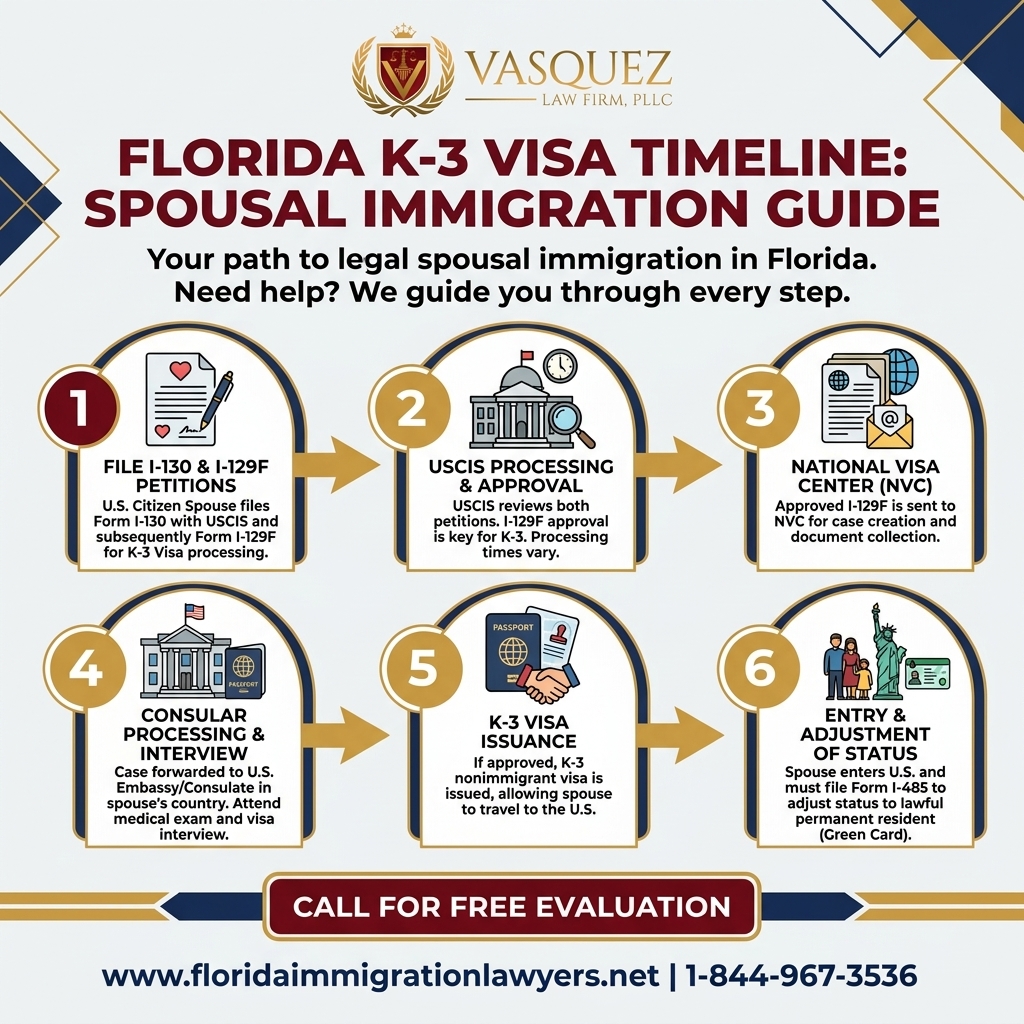
Navigating the K-3 visa process involves several stages, each with its own requirements and waiting periods. The overall K-3 visa timeline Florida residents experience can vary widely based on USCIS caseloads, consular efficiency, and the completeness of your application. Here is a general step-by-step guide:
-
Step 1: File Form I-130, Petition for Alien Relative
The U.S. citizen spouse must first file Form I-130 with USCIS. This petition establishes the bona fide marital relationship between you and your foreign spouse. It is a foundational step for any family-based immigration process. USCIS processing times for I-130 can vary significantly, often taking 10-18 months, sometimes more. This initial approval is crucial for the subsequent K-3 application.
-
Step 2: File Form I-129F, Petition for Nonimmigrant Spouse
Once the I-130 has been filed (and you have received a receipt notice), you can then file Form I-129F, Petition for Nonimmigrant Spouse, also with USCIS. This is the specific petition for the K-3 visa. It is critical that the I-130 is already filed, as the K-3 is contingent upon it. This petition demonstrates your intent to bring your spouse to the U.S. as a nonimmigrant while the I-130 is pending.
-
Step 3: USCIS Processing of Form I-129F
After filing, USCIS will process the I-129F petition. Processing times for I-129F can range from 7-12 months, or potentially longer. If approved, USCIS sends the petition to the National Visa Center (NVC). The NVC then forwards the approved petition to the U.S. Embassy or Consulate in your spouse's home country where the visa interview will take place. You can monitor general processing times on the USCIS website.
-
Step 4: National Visa Center (NVC) and Consular Processing
Upon receiving the approved I-129F from USCIS, the NVC will assign a case number and send instructions to the foreign spouse. This stage involves collecting required documents and paying applicable fees. The NVC then schedules an interview at the appropriate U.S. Embassy or Consulate. The consular processing stage can add several weeks to a few months to the overall timeline, depending on the embassy's workload.
-
Step 5: Consular Interview and K-3 Visa Approval
The foreign spouse attends an interview at the U.S. Embassy or Consulate. During the interview, a consular officer will review the application, verify the marriage's authenticity, and ensure the spouse is admissible to the U.S. If approved, the K-3 visa is stamped in the spouse's passport. This critical step determines whether the spouse can travel to Florida.
-
Step 6: Entry to the U.S. and Adjustment of Status (AOS)
With the K-3 visa, the foreign spouse can enter the United States. Upon arrival in Florida, the K-3 visa holder is eligible to file Form I-485, Application to Register Permanent Residence or Adjust Status. This application is filed with USCIS and is the final step to obtaining a green card. The adjustment of status process in Florida includes a biometrics appointment, and potentially an interview at a local USCIS field office, such as those in Miami, Orlando, or Tampa, or the Fort Myers office that serves the Naples area. This phase can take an additional 12-24 months.
Essential Documents for Your K-3 Spouse Visa Application
A well-prepared application package is crucial for avoiding delays in your K-3 visa timeline in Florida. Gathering all necessary documents accurately and completely is paramount. Missing or incorrect documentation can lead to Requests for Evidence (RFEs) or even denials, significantly prolonging the process. Here is a comprehensive checklist of documents typically required:
- For the U.S. Citizen Petitioner:
- Proof of U.S. citizenship (e.g., U.S. birth certificate, passport, naturalization certificate).
- Certified copy of marriage certificate.
- Proof of termination of any prior marriages for both spouses (e.g., divorce decrees, death certificates).
- Photographs of the petitioner and beneficiary.
- Form I-130, Petition for Alien Relative, and all supporting documents.
- Form I-129F, Petition for Nonimmigrant Spouse, and all supporting documents.
- Form I-864, Affidavit of Support, demonstrating financial capability to support the spouse.
- Tax returns, W-2s, and employment verification letters.
- Proof of bona fide marriage (e.g., joint bank accounts, property deeds, leases, utility bills, insurance policies, photos together, affidavits from friends/family).
- Police clearances from all countries resided in for more than six months since age 16.
- For the Foreign Spouse (Beneficiary):
- Valid passport (valid for at least six months beyond the intended period of stay).
- Birth certificate.
- Certified copy of marriage certificate.
- Police clearances from all countries resided in for more than six months since age 16.
- Medical examination results from an authorized panel physician.
- Vaccination records.
- Two U.S. passport style photographs.
- Form DS-160, Online Nonimmigrant Visa Application confirmation page.
- Any relevant court and criminal records, if applicable.
- Military records, if applicable.
It is advisable to keep copies of everything submitted and to organize your documents meticulously. Our Florida Immigration Lawyers team can help you compile and review your documentation to ensure compliance.
Navigating K-3 Visa Costs and Fees in 2026
The K-3 visa process involves various fees that applicants must consider, spanning different stages of the application. These costs are subject to change by government agencies, so it is always best to check the official websites for the most current fee schedules. While we cannot provide exact figures due to their fluctuating nature, here is a breakdown of the typical cost factors involved in the K-3 visa timeline for Florida residents:
- USCIS Filing Fees:
- Form I-130, Petition for Alien Relative: This is the initial petition fee.
- Form I-129F, Petition for Nonimmigrant Spouse: This fee is specifically for the K-3 visa petition.
- Form I-485, Application to Register Permanent Residence or Adjust Status: Filed once the spouse is in the U.S. and includes biometrics fees.
- Form I-765, Application for Employment Authorization (optional, if filed separately).
- Form I-131, Application for Travel Document (optional, if filed separately).
- National Visa Center (NVC) and Consular Processing Fees:
- Visa application processing fee (for the K-3 visa itself).
- Affidavit of Support processing fee (for Form I-864).
- Other Potential Costs:
- Medical Examination: Required for the foreign spouse, conducted by an authorized panel physician abroad. Costs vary by country and clinic.
- Vaccinations: Required as part of the medical exam.
- Translation Services: If any documents are not in English, certified translations will be needed.
- Document Acquisition: Costs for obtaining birth certificates, marriage certificates, police clearances, etc.
- Travel Expenses: For the foreign spouse to attend the interview and travel to Florida.
- Attorney Fees: Legal representation is a significant investment that can help ensure a smooth process and avoid costly mistakes.
Budgeting for these expenses is an essential part of planning your K-3 visa journey. While the fees can accumulate, the investment allows for family reunification. For detailed fee information, always refer to USCIS Fee Schedule and the Department of State's Schedule of Fees for Consular Services. Remember, these fees are typically non-refundable, regardless of the application outcome. Careful preparation can help prevent unnecessary re-filings.
What Happens After K-3 Visa Approval in Florida? Adjustment of Status
Once your foreign spouse receives their K-3 visa and successfully enters the United States, usually through a Florida airport such as Miami International or Orlando International, the journey continues toward permanent residency. The K-3 visa is a nonimmigrant visa, meaning it is temporary. The ultimate goal is to obtain a green card through the process known as Adjustment of Status (AOS).
Upon arrival in Florida, the K-3 visa holder should promptly file Form I-485, Application to Register Permanent Residence or Adjust Status, with USCIS. This application converts their nonimmigrant status to lawful permanent resident status. It is crucial to file this application before the K-3 visa expires, typically within two years of issuance. Along with Form I-485, applicants often concurrently file Form I-765 for Employment Authorization Document (EAD) and Form I-131 for Advance Parole (travel document). This allows the spouse to work and travel internationally while their green card application is pending.
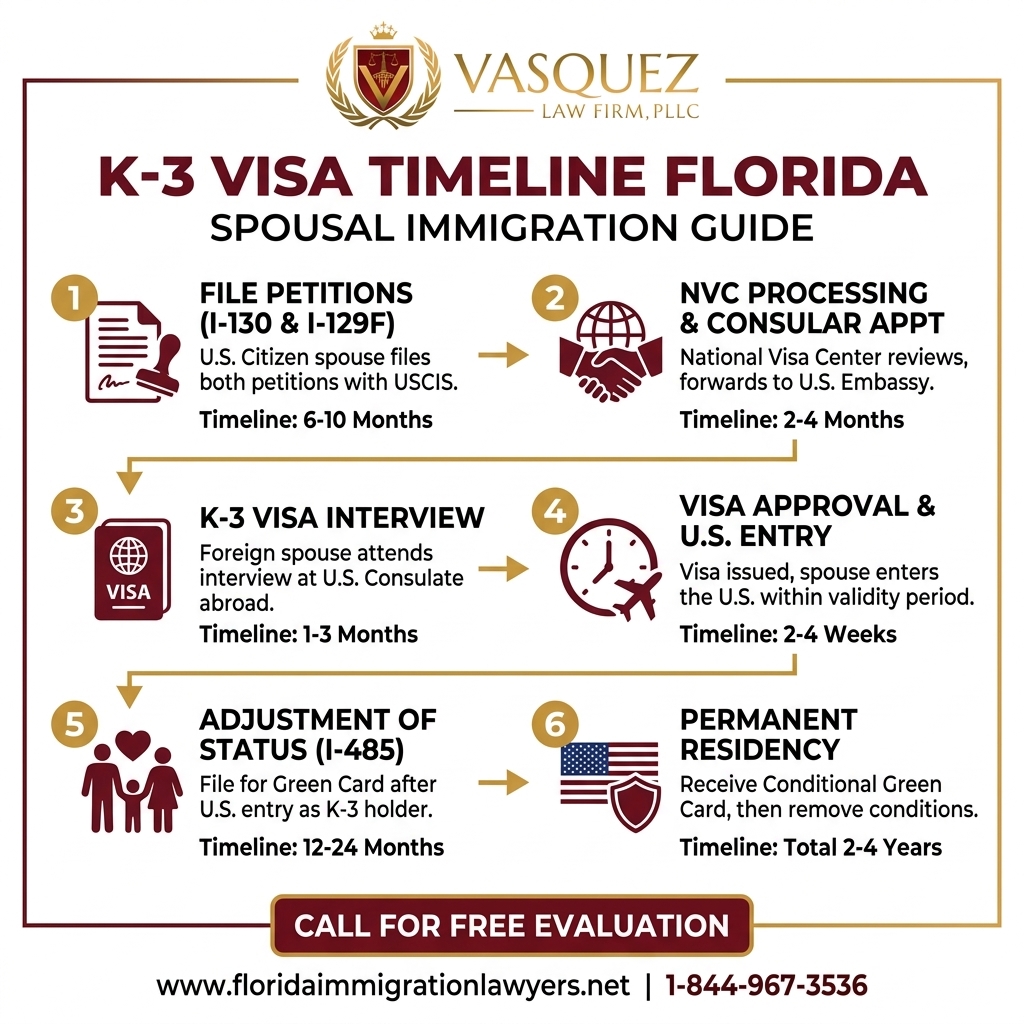
The Adjustment of Status process in Florida typically involves a biometrics appointment, where fingerprints and photographs are taken. Subsequently, USCIS may schedule an interview at a local field office. For residents of Naples and Southwest Florida, this could be the Fort Myers Field Office. During this interview, a USCIS officer will review the application and verify the authenticity of the marriage and the applicant's eligibility for permanent residency. If approved, the spouse will receive a conditional green card, valid for two years, if the marriage is less than two years old at the time of approval. Within 90 days before the conditional green card expires, Form I-751, Petition to Remove Conditions on Residence, must be filed to obtain a permanent, 10-year green card.
Addressing Challenges and Potential Denials in the K-3 Visa Process
Even with thorough preparation, challenges can arise during the K-3 visa timeline in Florida. Understanding potential hurdles and how to address them is vital for a successful outcome. Common issues include Requests for Evidence (RFEs), notices of intent to deny, or outright denials. An RFE means USCIS requires more information or documentation to make a decision. Responding completely and promptly to an RFE is critical. Failure to do so often leads to a denial.
Denials can occur for various reasons, such as insufficient evidence of a bona fide marriage, inadmissibility issues (e.g., criminal history, prior immigration violations, health-related grounds), or errors in the application. If a K-3 petition is denied, it is essential to understand the reason for the denial. Depending on the grounds, you may have options to appeal the decision to the Board of Immigration Appeals (BIA) or file a new petition. However, appeals are complex and often require experienced legal counsel.
In some cases, the I-130 petition may be approved before or concurrently with the I-129F petition. When this happens, the K-3 visa becomes largely unnecessary because the spouse can proceed directly to consular processing for an immigrant visa (CR1/IR1). USCIS will typically administratively close the I-129F petition if the I-130 is approved first. While this means the K-3 path is no longer available, it usually indicates that the quicker immigrant visa route has opened up, which is generally a more direct path to a green card. Florida Immigration Lawyers can help you navigate these scenarios and advise on the best course of action.
Do not navigate this process alone. Contact Florida Immigration Lawyers today for expert guidance and support through every step of your K-3 visa journey. We offer free consultations to assess your unique situation.
Common Mistakes to Avoid in Your K-3 Visa Application
The K-3 visa process is detailed, and even minor errors can lead to significant delays or denials. Being aware of common pitfalls can help you avoid them, ensuring a smoother journey for your spouse to join you in Florida.
-
Filing Form I-129F Before Form I-130: The K-3 visa is contingent on an underlying I-130 petition. Filing the I-129F first will result in rejection or denial, wasting time and fees. Always ensure your I-130 is filed and receipted before submitting the I-129F.
-
Incomplete or Inaccurate Forms: Failing to answer all questions or providing inconsistent information on forms I-130, I-129F, or DS-160 can trigger RFEs or denials. Double-check all entries for accuracy and completeness.
-
Insufficient Evidence of Bona Fide Marriage: USCIS and consular officers scrutinize marriages for authenticity. Lack of compelling evidence (joint accounts, photos, shared responsibilities, communication records) can lead to suspicion and denial. Be thorough and provide diverse proof.
-
Missing Deadlines or Ignoring RFEs: Immigration processes are time-sensitive. Failing to respond to an RFE within the specified timeframe, or missing appointments, will almost certainly result in a denial or administrative closure of your case.
-
Not Disclosing All Information: Withholding information about prior marriages, criminal history, or immigration violations, even if minor, can be considered misrepresentation and lead to permanent bars from the U.S. Always be truthful and provide all requested details.
-
Inadequate Financial Sponsorship: The U.S. citizen petitioner must demonstrate the financial ability to support their spouse using Form I-864, Affidavit of Support. If income or assets are insufficient, a joint sponsor may be needed. Failure to meet poverty guidelines can lead to inadmissibility.
-
Errors in Medical Examinations: The foreign spouse must undergo a medical exam by an USCIS-approved panel physician. Errors in the exam, missing required vaccinations, or failure to disclose medical conditions can cause delays or inadmissibility findings.
-
Lack of Preparation for Consular Interview: The interview is a critical stage. Not understanding your application, providing inconsistent answers, or failing to present required documents can lead to denial. Practice answering questions and organize your documents meticulously.
-
Assuming K-3 is a Green Card: The K-3 is a nonimmigrant visa. Failure to file Form I-485 for Adjustment of Status after entering the U.S. will result in the spouse eventually losing their legal status. Understand that AOS is a mandatory next step.
-
Not Seeking Legal Counsel for Complex Cases: While some cases are straightforward, situations involving prior immigration issues, criminal records, or previous denials greatly benefit from legal expertise. Attempting to manage complex cases alone often leads to costly mistakes.
When to Call a Florida Immigration Lawyer
While this guide provides a comprehensive overview, the K-3 visa timeline in Florida can present unique challenges that are best handled by experienced legal professionals. Knowing when to seek legal assistance can save you time, stress, and potential heartbreak.
You should consider contacting Florida Immigration Lawyers if you encounter any of the following situations:
- Complex Marital History: If either spouse has been previously married multiple times, or if there are questions about the legal termination of prior marriages, an attorney can help ensure all documentation is correct.
- Criminal History or Prior Immigration Violations: Any criminal record for either spouse, or past immigration issues such as overstays or deportations, can trigger inadmissibility. An attorney can assess your eligibility and explore potential waivers.
- Previous Denials: If an I-130 or K-3 petition has been previously denied, understanding the reasons and strategizing for a new application or appeal is crucial.
- Issues with Bona Fide Marriage Evidence: If you have limited joint documents or a significant age/cultural gap, an attorney can help you gather and present compelling evidence to prove your marriage is legitimate.
- Financial Sponsorship Concerns: If the U.S. citizen's income is borderline or insufficient for the Affidavit of Support, an attorney can advise on joint sponsors or alternative solutions.
- Confusing RFEs or Notices of Intent to Deny: Responding effectively to these requires legal expertise to address USCIS concerns adequately.
- Desire for Expedited Processing: While true expediting is rare, an attorney can identify if your case qualifies for any special consideration.
- General Uncertainty and Stress: The immigration process is emotionally taxing. Having an attorney like those at Florida Immigration Lawyers can provide peace of mind and ensure every step is handled professionally.
Our firm specializes in family immigration and can guide you through every stage, from initial petition filings to adjustment of status interviews in Florida. We serve clients across the state, including those in Naples and surrounding communities, providing dedicated and compassionate representation.
About Florida Immigration Lawyers
Florida Immigration Lawyers is a leading law firm dedicated to providing exceptional legal representation to individuals and families throughout Florida. With a deep understanding of the complexities of U.S. immigration law, our experienced attorneys are committed to helping clients achieve their immigration goals. We pride ourselves on offering personalized, compassionate, and effective legal solutions.
Our firm handles a wide range of immigration matters, including K-3 visas, asylum, citizenship, deportation defense, and various family and business immigration cases. We understand the unique challenges faced by immigrants and their families in Florida, from Naples to Jacksonville, and are dedicated to making the legal process as smooth as possible. Our team of skilled attorneys is available 24/7 to answer your questions and provide support.
When you choose Florida Immigration Lawyers, you gain a partner who will advocate tirelessly on your behalf. We offer free consultations to discuss your case and provide clear, actionable advice. Let us put our expertise to work for you. Visit floridaimmigrationlawyers.net or call us at 1-844-967-3536.
Sources and References
- U.S. Citizenship and Immigration Services (USCIS)
- Executive Office for Immigration Review (EOIR)
- U.S. Department of State - Bureau of Consular Affairs
- 8 U.S.C. Chapter 12 - Immigration and Nationality Act (INA), particularly INA Section 101(a)(15)(K)
- 8 CFR (Code of Federal Regulations) - General provisions relating to immigration
- USCIS Policy Manual - Adjudicator's Field Manual
Related services: family petition process, family-based green cards, fiancé visa (K-1), marriage-based immigration.
This article provides general legal information and is not intended as legal advice. Every case is unique, and outcomes depend on specific facts and circumstances. Contact an attorney for advice about your particular situation. Immigration laws are subject to change.
Embarking on the K-3 visa journey for your spouse in Florida requires diligence and a clear understanding of the process. While challenging, the reward of family reunification is immeasurable. Do not let the complexities deter you from pursuing your goal.
For expert legal assistance tailored to your specific needs, contact Florida Immigration Lawyers today for a free consultation at 1-844-967-3536. Se Habla Español - Estamos aquí para ayudarle.
Do Not Navigate This Process Alone
Our experienced immigration attorneys are ready to fight for you. Get a free, confidential consultation today.
Se Habla Español
Frequently Asked Questions

William J. Vásquez
Founding Attorney · Vasquez Law Firm
U.S. Air Force veteran and immigration attorney with thousands of cases resolved. J.D., NCCU School of Law. AILA member. Admitted to the 4th, 5th, and 11th Circuit Courts.
Available 24/7 - Free Evaluations
Related Legal Services
Our Florida immigration attorneys can help you with immigration practice areas, free immigration consultation and experienced immigration attorneys. Call today at 1-844-967-3536 for a free consultation.
Related Links
Related Topics
Free Legal Consultation
Discuss your case with our experienced attorneys. We're available 24/7.
Se Habla Español - Estamos aquí para ayudarle.
Related Articles
J-1 Waiver for Physicians in Florida: A 2026 Guide
Navigating the J-1 waiver process in Florida can be challenging for foreign physicians. Learn how the Conrad 30 program facilitates placements in underserved areas like Homestead, ensuring a successful application. Call Florida Immigration Lawyers today for expert guidance.
Naturalization Process Florida Timeline 2026 Guide
The naturalization process in Florida, culminating in U.S. citizenship, involves several key stages including eligibility assessment, filing Form N-400, biometrics, an interview, and the Oath of Allegiance. As of 2026, the typical timeline for this process in Florida ranges from 18 to 24 months, though individual experiences can vary. This guide from Florida Immigration Lawyers provides a comprehensive overview, covering requirements, step-by-step procedures, potential costs, and common pitfalls. We emphasize the importance of understanding Florida-specific nuances and the benefits of legal counsel to navigate this complex journey effectively. Contact us for a free consultation.
H-2B Visa for Florida Hospitality Seasonal Workers
Explore the H-2B visa process for seasonal workers in Florida's hospitality industry. Learn about costs, timelines, and common mistakes. Contact Florida Immigration Lawyers for expert assistance.
Military Naturalization Expedited at Florida Bases
Explore expedited military naturalization for service members stationed in Florida, including MacDill Air Force Base. Learn about eligibility, application steps, and how Florida Immigration Lawyers can assist you.