VAWA Immigration Relief Florida: Protecting Abuse Victims
For non-citizen victims of domestic violence by a U.S. citizen or LPR spouse, parent, or adult child in Florida, VAWA (Violence Against Women Act) offers a critical pathway to legal status. This self-petitioning process allows individuals to apply for a green card confidentially, without the abuser's involvement. Eligibility requires proving the qualifying relationship, documented abuse, and good moral character. The journey involves filing Form I-360 with USCIS, followed by an application for adjustment of status. Florida Immigration Lawyers provides expert legal guidance, from evidence gathering to navigating interviews, ensuring victims in Naples and across Florida can achieve safety and independence. Our firm understands the unique challenges faced by immigrants and offers compassionate support through every step.

VAWA (Violence Against Women Act) immigration relief offers a crucial pathway to legal status for non-citizen victims of domestic violence, extreme cruelty, or abuse by a U.S. citizen or Lawful Permanent Resident spouse, parent, or adult child. In Florida, this self-petitioning process allows victims to apply for a green card without the abuser's knowledge or cooperation, providing safety and independence. Eligibility hinges on proving the qualifying relationship, the abuse, and good moral character. The process involves filing Form I-360, Petition for Amerasian, Widow(er), or Special Immigrant, with USCIS. Seeking experienced legal counsel from Florida Immigration Lawyers is vital to navigate the complex requirements and gather compelling evidence for a successful outcome.
- VAWA provides a pathway to legal status for abused non-citizens.
- Victims can self-petition without the abuser's involvement.
- Eligibility requires a qualifying relationship, documented abuse, and good moral character.
- The primary step is filing Form I-360 with U.S. Citizenship and Immigration Services (USCIS).
- Expert legal guidance is essential for navigating the complex VAWA application process in Florida.
Navigating the complex U.S. immigration system can be daunting, especially when compounded by the trauma of domestic violence or extreme cruelty. For non-citizen victims in Florida, the Violence Against Women Act (VAWA) offers a beacon of hope – a confidential and independent pathway to legal residency and safety. This vital legislation allows individuals who have been abused by a U.S. citizen or Lawful Permanent Resident (LPR) spouse, parent, or adult child to "self-petition" for immigration benefits without the abuser's knowledge or consent. Understanding VAWA immigration relief in Florida is the first step towards rebuilding your life free from fear.
At Florida Immigration Lawyers, we understand the courage it takes to seek help. Our dedicated team is committed to providing compassionate and effective legal representation to victims of abuse across Florida, from the bustling streets of Miami to the quiet communities of Naples and the Panhandle. We are here to guide you through every stage of the VAWA process, ensuring your rights are protected and your voice is heard. If you or a loved one is seeking safety and legal status through VAWA, do not hesitate to reach out. Call Florida Immigration Lawyers at 1-844-967-3536 for a free, confidential consultation today. Your journey to independence starts here.
What is VAWA Immigration Relief and Who is Eligible in Florida?
VAWA immigration relief, codified primarily under the Immigration and Nationality Act (INA) Section 204(a), allows certain non-citizens to file an immigration petition on their own behalf, without the cooperation or knowledge of an abusive U.S. citizen or Lawful Permanent Resident (LPR) spouse, parent, or adult child. This provision was enacted to protect victims who might otherwise be trapped in abusive relationships due to their immigration status dependence on their abuser. In Florida, as in other states, the goal is to provide a path to safety and legal stability for vulnerable individuals.
Eligibility for VAWA self-petitioning in Florida is specific and requires meeting several criteria. You may be eligible if you are a:
- Battered Spouse: You are married to a U.S. citizen or LPR, or were previously married to one and the marriage ended within the last two years due to death or divorce related to the abuse. You must have been subjected to battery or extreme cruelty during the marriage, and you entered into the marriage in good faith, not solely for immigration purposes. You must also have resided with the abuser and be a person of good moral character.
- Battered Child: You are an unmarried child under 21 (or under 25 in certain circumstances) who has been battered or subjected to extreme cruelty by a U.S. citizen or LPR parent. You must have resided with the abuser and be of good moral character.
- Battered Parent: You are a parent of an adult U.S. citizen son or daughter (21 years or older) who has subjected you to battery or extreme cruelty. You must have resided with the abuser and be of good moral character.
The abuse does not have to be physical; it can also include psychological, emotional, financial, or sexual abuse. The key is demonstrating a pattern of extreme cruelty. For those in Florida, understanding these specific requirements and gathering the necessary evidence is paramount. Our firm can help you assess your eligibility and build a strong case, whether you are in Naples, Orlando, or any other part of the Sunshine State, ensuring that the legal framework is applied to your unique situation with sensitivity and expertise.
How Does the VAWA Self-Petition Process Work in Florida?
The VAWA self-petition process in Florida involves a series of critical steps, beginning with the meticulous preparation and submission of Form I-360, Petition for Amerasian, Widow(er), or Special Immigrant, to USCIS. This initial filing is the cornerstone of your VAWA case, establishing your eligibility and laying the groundwork for potential future immigration benefits. After successful submission, USCIS will review your petition, often issuing a Notice of Prima Facie Case, which can provide interim benefits.
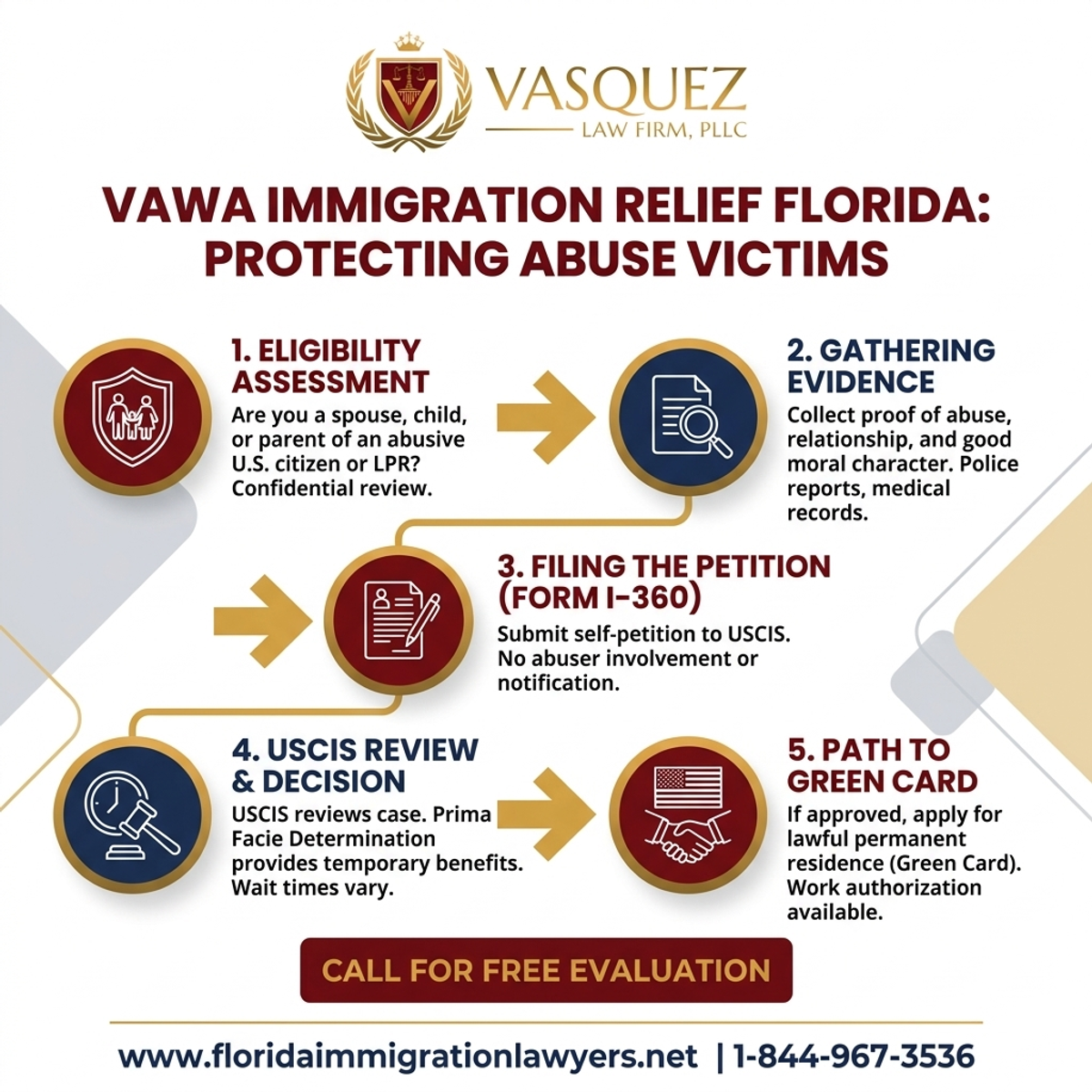
The process is designed to be confidential and protect the applicant's safety. Here's a step-by-step guide to how it generally unfolds:
- Consultation and Eligibility Assessment: The first crucial step is to consult with an experienced immigration attorney. During this phase, your lawyer will review your personal circumstances, the nature of the abuse, and your relationship with the abuser to determine if you meet the specific VAWA eligibility criteria. This is particularly important in Florida, where diverse populations may face unique challenges.
- Gathering Evidence: You will work with your attorney to collect all necessary documentation. This includes proof of your relationship with the abuser (marriage certificates, birth certificates), evidence of abuse (police reports, medical records, affidavits, psychological evaluations, photos, texts, emails), proof of your good moral character (criminal background checks, affidavits from credible sources), and evidence of your residence with the abuser.
- Filing Form I-360: Your attorney will prepare and file Form I-360, Petition for Amerasian, Widow(er), or Special Immigrant, along with all supporting evidence, to the USCIS Vermont Service Center, which processes all VAWA petitions. Unlike many other immigration petitions, there is no filing fee for Form I-360 for VAWA self-petitioners.
- Prima Facie Determination: Upon receipt, USCIS will review your petition. If the evidence submitted appears to meet the VAWA requirements, USCIS may issue a Notice of Prima Facie Case. This notice indicates that your petition is likely to be approved and can provide eligibility for certain public benefits in Florida while your case is pending.
- Request for Evidence (RFE) or Interview (Rare): USCIS may issue an RFE if they require additional information or clarification. It is rare for VAWA self-petitioners to be called for an interview, but it can happen in certain complex cases. Your attorney will help you respond to any RFEs promptly and thoroughly.
- I-360 Approval: If your petition is approved, you will receive an Approval Notice for Form I-360. This establishes your eligibility for VAWA and allows you to proceed to the next stage of seeking lawful permanent residency.
- Adjustment of Status (Form I-485): Once your I-360 is approved and an immigrant visa number is immediately available (which is usually the case for VAWA self-petitioners, as they are considered immediate relatives), you can file Form I-485, Application to Register Permanent Residence or Adjust Status. This is the application for your green card. You can often file Form I-765 (Application for Employment Authorization) concurrently with your I-485 to obtain a work permit while your green card application is pending.
- Green Card Interview: Most applicants for adjustment of status in Florida will be required to attend an interview at a local USCIS field office (e.g., Miami, Orlando, Tampa). Your attorney can accompany you to this interview, helping you prepare and providing support.
- Green Card Approval: If your I-485 is approved, you will be granted lawful permanent resident status and receive your green card.
This detailed process, especially the evidence gathering and response to USCIS, necessitates expert legal guidance. Florida Immigration Lawyers are well-versed in the specifics of VAWA cases and the nuances of USCIS processing, providing essential support to victims throughout the state.
What Documentation is Required for a VAWA Petition in 2026?
A successful VAWA petition hinges on submitting comprehensive and compelling evidence that demonstrates your eligibility under the law. As of 2026, the evidentiary requirements remain rigorous, focusing on establishing the qualifying relationship, the abuse experienced, and your good moral character. Gathering and organizing these documents can be overwhelming, which is why legal assistance is invaluable.
Here is a detailed checklist of the types of documents typically required for a VAWA self-petition:
- Proof of Relationship:
- Marriage certificate (for spouses).
- Birth certificates for you and your abuser (for child or parent petitions).
- Divorce decrees from any previous marriages for both you and the abuser.
- Evidence of a bona fide marriage (e.g., joint bank accounts, property deeds, leases, utility bills, insurance policies, photos of the couple together, affidavits from friends/family attesting to the relationship).
- Proof of Abuse or Extreme Cruelty:
- Detailed affidavit (personal statement) from you describing the abuse, its frequency, and its impact. This is often the most critical piece of evidence.
- Police reports, arrest records, or court documents related to domestic violence incidents, protective orders, or criminal charges against the abuser.
- Medical records, hospital reports, or psychological evaluations detailing injuries, mental health conditions, or therapy related to the abuse.
- Affidavits from witnesses (friends, family, neighbors, clergy, social workers) who have direct knowledge of the abuse or observed its effects.
- Photos of injuries, damaged property, or living conditions caused by the abuse.
- Correspondence (emails, text messages, voicemails) from the abuser demonstrating control, threats, or abuse.
- Evidence of financial control or abuse (e.g., bank statements, eviction notices, debt incurred by abuser in your name).
- Reports from shelters, counseling services, or domestic violence support organizations in Florida (e.g., from Naples, Fort Myers, or across the state).
- Proof of Residence with Abuser:
- Leases, utility bills, property deeds, or other documents showing you and the abuser lived together.
- Affidavits from witnesses confirming cohabitation.
Step-by-Step Process — VAWA Immigration Relief Florida: Protecting Abuse Victims
- Proof of Good Moral Character:
- Your personal affidavit outlining your character.
- Affidavits from reputable individuals (employers, religious leaders, community members) attesting to your good moral character.
- Criminal background checks (if applicable).
- Proof of Abuser's Status:
- Copy of abuser's U.S. birth certificate, passport, or naturalization certificate (for U.S. citizens).
- Copy of abuser's green card (Form I-551) (for Lawful Permanent Residents).
It is important to provide as much evidence as possible, even if you feel some documents are not conclusive on their own. The collective weight of evidence is what builds a strong VAWA case. Our attorneys specialize in helping clients in Florida gather and present this crucial documentation effectively.
What are the Typical Timelines for VAWA Cases in Florida?
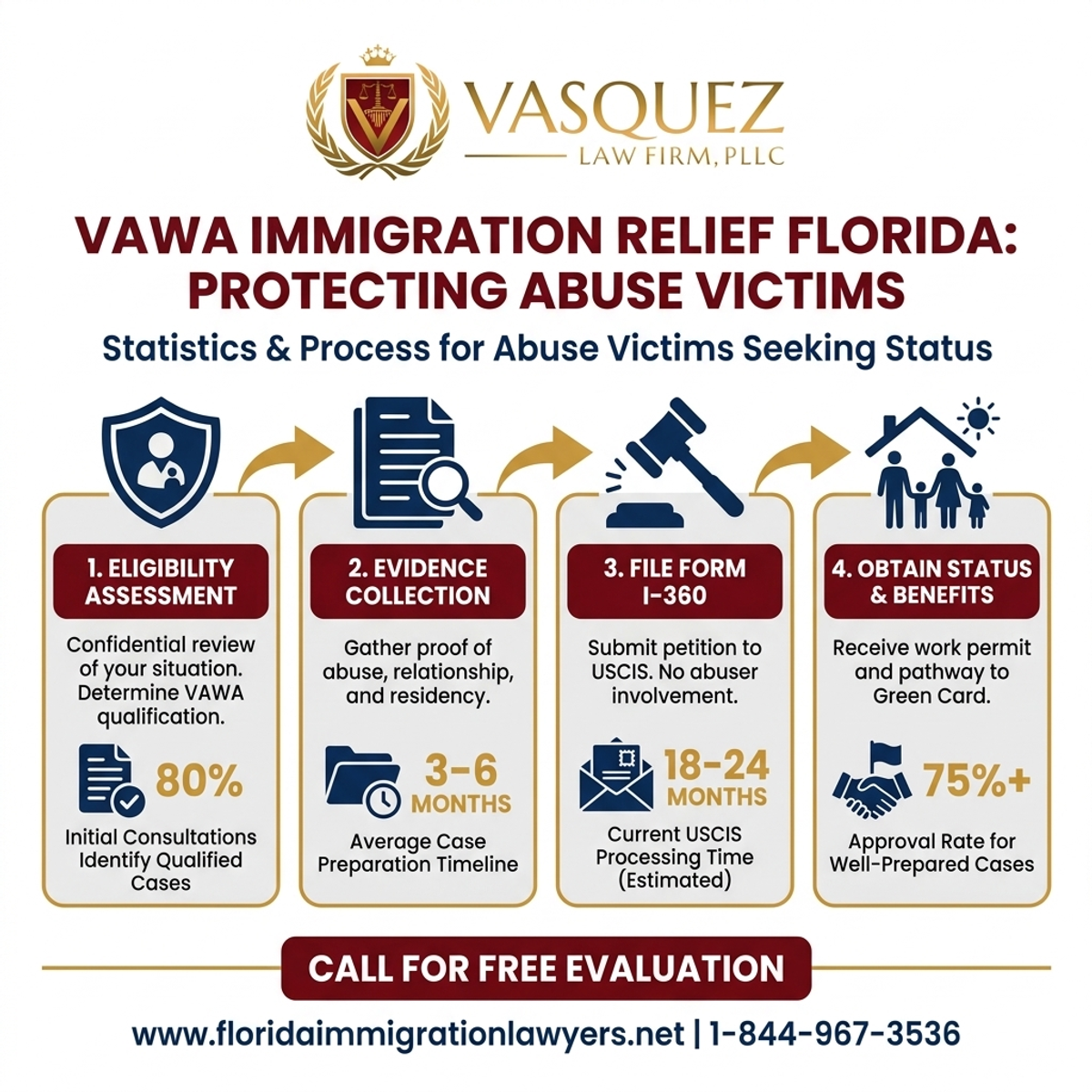
The processing times for VAWA cases can vary significantly depending on USCIS caseloads and the complexity of individual petitions. As of 2026, applicants in Florida should anticipate a multi-stage process, with the initial I-360 petition taking several months to over a year for a decision. Following I-360 approval, the subsequent adjustment of status (green card) application adds further processing time. While specific guarantees cannot be made, understanding the typical stages and their durations can help manage expectations.
Below is a general overview of the typical timelines for VAWA cases:
| Stage | Typical Timeframe (As of 2026) | Notes |
|---|---|---|
| I-360 Petition Filing & Receipt | 1-2 weeks | USCIS sends a receipt notice (Form I-797C) after receiving your petition. |
| Prima Facie Determination | Within 1-6 months | If evidence is strong, USCIS may issue a Notice of Prima Facie Case, allowing access to some public benefits. |
| I-360 Petition Processing & Decision | 12-24 months (or longer) | This is the longest stage. USCIS reviews evidence, may issue an RFE. Processing times are subject to change; check USCIS processing times page for current estimates. |
| I-360 Approval | Immediate upon decision | You receive an I-797 Approval Notice. An immigrant visa number is usually immediately available for VAWA self-petitioners. |
| Adjustment of Status (I-485) Filing | Can be filed concurrently or after I-360 approval | If filed concurrently, I-485 will be adjudicated after I-360 approval. |
| Work Authorization (I-765) & Travel Document (I-131) | 3-12 months (if filed concurrently with I-485) | These applications can provide temporary relief while the I-485 is pending. |
| I-485 Interview (Florida USCIS Office) | 6-18 months after I-485 filing | Interview at a local Florida USCIS field office (e.g., Miami, Orlando, Tampa). |
| Green Card Decision | 1-6 months after interview | Final decision on your lawful permanent residency application. |
It's important to note that these are estimates. Individual circumstances, such as the completeness of your application, responses to RFEs, and the specific USCIS service center's workload, can affect actual processing times. An experienced Florida immigration lawyer can help you prepare a thorough application to minimize delays and keep you informed about the most current processing trends impacting cases in Naples and throughout Florida.
Understanding the Costs and Fees Associated with VAWA in Florida.
One of the significant advantages of VAWA immigration relief is the waiver of certain government filing fees, making the process more accessible for abuse victims. While the primary VAWA petition (Form I-360) has no government filing fee, there are other potential costs associated with the overall process that applicants in Florida should be aware of. These can include legal fees, medical examination costs, and fees for subsequent applications like adjustment of status.
Here is a breakdown of typical costs and fees for a VAWA case:
| Item | Typical Fee (As of 2026) | Notes |
|---|---|---|
| Form I-360 (VAWA Self-Petition) | $0 | No USCIS filing fee for VAWA self-petitioners. |
| Form I-485 (Adjustment of Status) | Variable (check USCIS website) | Required to get your green card after I-360 approval. Fee waivers may be available for low-income applicants. |
| Form I-765 (Employment Authorization Document - EAD) | Variable (check USCIS website) | Often filed concurrently with I-485. Fee may be included with I-485 filing or waived. |
| Form I-131 (Advance Parole/Travel Document) | Variable (check USCIS website) | Often filed concurrently with I-485. Fee may be included with I-485 filing or waived. |
| Biometrics Services Fee | Included with I-485 fee (or waived) | Required for fingerprinting and background checks. |
| Immigrant Medical Examination | $200-$500+ | Conducted by a USCIS-approved civil surgeon. Costs vary by provider and location in Florida. This is a mandatory out-of-pocket expense. |
| Legal Fees | Varies by complexity and attorney | This is a significant cost but an invaluable investment for navigating the complex legal process. Florida Immigration Lawyers offers free initial consultations. |
| Document Translation Fees | Varies by document volume | If any supporting documents are not in English, certified translations are required. |
| Postage/Courier Fees | Minimal | For sending applications and evidence to USCIS. |
Key Statistics — VAWA Immigration Relief Florida: Protecting Abuse Victims
While the I-360 itself is free, the subsequent steps towards obtaining a green card do involve costs. However, USCIS provides fee waiver options for many forms, including the I-485, for individuals who can demonstrate an inability to pay. An experienced immigration attorney in Florida can help you understand all potential costs, assess your eligibility for fee waivers, and ensure you are prepared for the financial aspects of your VAWA journey. Our firm is dedicated to making legal representation accessible to those who need it most.
Beyond the I-360: Adjusting Status and Further Relief Options
Approval of the VAWA I-360 petition is a monumental achievement, but it is typically not the final step in securing permanent legal status. The I-360 approval establishes your eligibility as a VAWA self-petitioner and opens the door to applying for a green card through a process called Adjustment of Status. This crucial next phase is where many VAWA beneficiaries consolidate their path to lawful permanent residency, establishing stability and independence in Florida.
Once your I-360 is approved, you are generally considered an immediate relative for visa availability purposes, meaning you do not typically have to wait for a visa number to become available. This allows you to promptly file Form I-485, Application to Register Permanent Residence or Adjust Status. Filing the I-485 requires careful attention to detail, including submitting additional documents such as medical examination results from a USCIS-approved civil surgeon in Florida, proof of continuous presence in the U.S., and updated background information. Concurrently with your I-485, you can also apply for an Employment Authorization Document (EAD) using Form I-765, which allows you to work legally while your green card application is pending, and an Advance Parole document using Form I-131, which permits you to travel outside the U.S. and return without abandoning your application.
It's important to differentiate VAWA relief from other forms of protection for victims, such as U Visas or T Visas. While all aim to protect vulnerable non-citizens, VAWA is specifically for victims of domestic violence by U.S. citizens or LPRs in a family relationship, leading directly to a green card pathway. U Visas are for victims of serious crimes (including domestic violence) who have suffered substantial mental or physical abuse and are helpful to law enforcement. T Visas are for victims of human trafficking. An attorney can help determine which relief option is most appropriate for your specific circumstances if you are a victim in Florida. Furthermore, if you are currently in deportation proceedings, an approved VAWA I-360 can allow you to request termination or administrative closure of those proceedings, or to apply for adjustment of status before an Immigration Judge.
The journey from I-360 approval to green card can still be complex, often involving an interview at a local USCIS field office in Florida (e.g., Miami, Jacksonville, Tampa, Orlando). Having experienced legal representation from Florida Immigration Lawyers ensures that you are thoroughly prepared for this interview, understand all questions, and can present your case effectively to immigration officials. Our goal is to help you achieve the security of lawful permanent residency and move forward with your life.
Protecting Your Future: The Importance of Confidentiality in VAWA Cases
One of the most critical aspects of VAWA immigration relief, especially for those in vulnerable situations in Florida, is the robust confidentiality protection afforded to applicants. Congress recognized that abusers often exploit their victims' immigration status and fear of exposure to control them. To counteract this, VAWA includes specific provisions, such as INA Section 204(a)(1)(J), that safeguard the privacy and safety of self-petitioners.
Under these confidentiality provisions, USCIS is prohibited from disclosing information about a VAWA self-petitioner or their family members to the abuser without the self-petitioner's express written consent. This means that when you file your VAWA petition, USCIS will not notify your abuser that you have applied. This protection extends to information collected by the Department of Homeland Security (DHS) and other government agencies involved in immigration matters. The goal is to ensure that victims can seek help without fear of retaliation or further abuse by having their immigration application revealed to their abuser. This is particularly vital in a state like Florida, with its diverse and sometimes transient population, where victims may feel isolated or particularly vulnerable.
Maintaining confidentiality is not just a legal safeguard; it is a practical measure for your safety and well-being. When working with an attorney at Florida Immigration Lawyers, we prioritize your safety plan and ensure that all communications and documents are handled with the utmost discretion. We understand that abusers may try to track or manipulate their victims, and we take every precaution to protect your information. This includes advising you on safe communication methods, secure mailing addresses, and how to interact with authorities without compromising your safety or your case.
Beyond the legal protections, there are numerous resources in Florida that can provide additional support and safety planning. Domestic violence shelters, counseling services, and advocacy groups throughout the state, including those serving communities in Naples, Fort Myers, and Sarasota, offer safe havens and crucial assistance. While your VAWA application moves forward, these resources can provide immediate relief and support. Our firm works closely with local organizations to ensure our clients have access to a comprehensive network of support, empowering them to break free from abusive cycles and build a new, secure future. The confidentiality provisions of VAWA are a powerful tool in this process, ensuring that your pursuit of legal status does not put you at further risk.
Common Mistakes to Avoid in VAWA Immigration Cases
Navigating a VAWA petition requires precision and a thorough understanding of immigration law. Many applicants, especially those under duress, can inadvertently make mistakes that jeopardize their case. Avoiding these common pitfalls is crucial for a successful outcome in Florida.
- Insufficient or Inconsistent Evidence: Failing to provide enough compelling evidence of both the qualifying relationship and the abuse is a common pitfall. Vague descriptions or lack of corroborating documents can weaken your case significantly. Ensure your affidavit is detailed and supported by medical records, police reports, and witness statements.
- Missing Deadlines: Immigration processes are strict about deadlines. Missing a filing deadline, especially for the I-360 petition (if the marriage ended), or failing to respond to a Request for Evidence (RFE) in time, can lead to denial.
- Misrepresenting Facts: Any misrepresentation, intentional or unintentional, about your relationship, the abuse, or your background can have severe consequences, including a denial and potential accusations of fraud. Always be truthful and transparent.
- Not Proving Good Moral Character: VAWA requires applicants to demonstrate good moral character. Past criminal convictions, even minor ones, can be an issue. Failing to address these or providing insufficient evidence of rehabilitation can lead to denial.
- Not Filing a Fee Waiver for I-485: While the I-360 has no fee, the I-485 does. Many VAWA applicants are eligible for fee waivers due to financial hardship. Failing to apply for one when eligible can create an unnecessary financial burden or delay.
- Returning to the Abuser: While understandable in some situations, returning to live with the abuser after filing a VAWA petition can complicate your case and raise questions about the ongoing nature of the abuse or the bona fide nature of your self-petition.
- Lack of Confidentiality: Discussing your VAWA petition with the abuser or allowing them access to your immigration documents can compromise your safety and the integrity of your case. Maintain strict confidentiality.
- Failing to Disclose All Prior Immigration History: Any prior visa applications, entries, exits, or interactions with immigration authorities must be fully disclosed. Omissions can be seen as misrepresentation.
- Not Seeking Legal Counsel: Attempting to navigate the complex VAWA process without an experienced immigration attorney is perhaps the biggest mistake. A lawyer can help gather evidence, draft compelling affidavits, respond to RFEs, and represent you throughout the process, significantly increasing your chances of success.
When to Call a Lawyer for VAWA Immigration Relief in Florida
The decision to seek VAWA immigration relief is often made during a period of intense vulnerability and fear. While the law is designed to empower victims, the legal process itself is intricate and fraught with potential complexities. Knowing when to call an experienced immigration lawyer in Florida is not just advisable; it can be absolutely critical to the success of your case and your safety.
You should consider contacting Florida Immigration Lawyers immediately if any of the following scenarios apply to you:
- You are currently experiencing abuse: If you are in an abusive relationship with a U.S. citizen or LPR spouse, parent, or adult child, an attorney can help you understand your rights, create a safety plan, and initiate the VAWA process confidentially.
- You are in deportation or removal proceedings: If you have been placed in removal proceedings, a VAWA petition can offer a powerful defense or a pathway to adjustment of status before an Immigration Judge at an EOIR Immigration Court in Florida (e.g., Miami, Orlando).
- Your abuser has a criminal history or is uncooperative: If your abuser has a history of violence or is actively trying to obstruct your immigration efforts, legal counsel is essential to navigate these challenges and protect your interests.
- You have prior immigration violations or criminal history: Any past immigration issues (e.g., overstays, unlawful entries) or minor criminal offenses can complicate your VAWA case. An attorney can assess the impact and help mitigate potential negative consequences.
- You have limited evidence of abuse: If you lack official documents like police reports or medical records, an attorney can guide you on how to gather alternative evidence, such as detailed affidavits, psychological evaluations, or witness statements, to build a strong case.
- You are confused by the forms or legal requirements: The VAWA application involves numerous complex forms and specific legal criteria. An attorney ensures all paperwork is correctly filled out and all requirements are met.
- You received a Request for Evidence (RFE) or Notice of Intent to Deny (NOID): These notices from USCIS indicate that your application is incomplete or has issues. A lawyer can help you formulate a comprehensive and timely response to address USCIS concerns.
- You need to apply for a work permit or travel document: While your VAWA case is pending, an attorney can assist you in applying for ancillary benefits like an Employment Authorization Document (EAD) or Advance Parole.
Florida Immigration Lawyers has extensive experience in handling VAWA cases across the state, from Naples to Tallahassee. We provide confidential, empathetic, and aggressive representation to ensure victims of abuse can secure their immigration future safely and effectively. We understand the unique challenges faced by immigrants in Florida and are here to offer the support and expertise you need.
About Florida Immigration Lawyers
Florida Immigration Lawyers is a leading immigration law firm dedicated to serving individuals and families throughout the state of Florida. With a deep understanding of U.S. immigration law and a compassionate approach, our experienced attorneys provide comprehensive legal services to clients facing a wide range of immigration challenges. From complex VAWA petitions and asylum claims to family-based visas, deportation defense, and naturalization, we are committed to achieving favorable outcomes for our clients.
Our firm prides itself on offering personalized attention, strategic advocacy, and transparent communication. We recognize that every immigration case is unique and often deeply personal, which is why we take the time to listen, understand your story, and craft a tailored legal strategy. We are available 24/7 to address urgent needs and offer free, confidential consultations to help you understand your options without financial obligation. Serving all of Florida, including Naples, Miami, Orlando, and Tampa, we are your trusted partners in navigating the complexities of immigration law. When your future depends on expert legal guidance, choose Florida Immigration Lawyers. Call us today at 1-844-967-3536 or visit www.floridaimmigrationlawyers.net.
Sources and References
- U.S. Citizenship and Immigration Services (USCIS)
- Executive Office for Immigration Review (EOIR)
- U.S. Department of State (travel.state.gov)
- Immigration and Nationality Act (INA) Section 204(a)(1) - Self-Petitioning for Battered Spouses, Children, and Parents
- 8 U.S.C. § 1154(a)(1) - Procedure for granting immigrant status; petition for benefits
- 8 CFR § 204.2(c) - Petitions for spouses, children, or parents of U.S. citizens or lawful permanent residents
Related services: immigration practice areas, family immigration services, citizenship and naturalization.
This article provides general legal information and is not intended as legal advice. Every case is unique, and outcomes depend on specific facts and circumstances. Contact an attorney for advice about your particular situation. Immigration law is subject to change.
Don't let fear or uncertainty prevent you from seeking the safety and legal status you deserve. The compassionate and experienced attorneys at Florida Immigration Lawyers are ready to stand by your side, offering expert guidance and unwavering support throughout your VAWA immigration journey. Take control of your future and secure your independence. Contact us for a free, confidential consultation today by calling 1-844-967-3536. Se Habla Espanol - Estamos aqui para ayudarle.
If you need legal assistance, learn more about speak with an immigration lawyer, or call us at 1-844-967-3536 for a free consultation.
Do Not Navigate This Process Alone
Our experienced immigration attorneys are ready to fight for you. Get a free, confidential consultation today.
Se Habla Español
Frequently Asked Questions
Harold Estrada-Rodriguez
Florida Immigration Attorney · FL Bar No. 1041171
Florida Bar attorney handling Florida-jurisdiction immigration matters. Bilingual representation, free consultations.
Available 24/7 - Free Evaluations
Related Legal Services
Our Florida immigration attorneys can help you with immigration practice areas, free immigration consultation and experienced immigration attorneys. Call today at 1-844-967-3536 for a free consultation.
Related Links
Related Topics
Free Legal Consultation
Discuss your case with our experienced attorneys. We're available 24/7.
Se Habla Español - Estamos aquí para ayudarle.
Related Articles
Understanding the Child Status Protection Act in Florida
The Child Status Protection Act (CSPA) is crucial for families in Florida to ensure children remain eligible for immigration benefits. Learn how CSPA protects against aging out and get expert advice from Florida Immigration Lawyers.
Immigration Services Naples Collier County Florida
Discover comprehensive immigration services in Naples, Collier County, Florida. This detailed guide covers family visas, employment immigration, green card applications, naturalization, and crucial deportation defense strategies. Learn about typical processing times as of 2026, associated costs, and essential documents. We also highlight common mistakes to avoid and when it's critical to consult an experienced Florida immigration lawyer. Florida Immigration Lawyers offers free consultations and dedicated support for all your immigration needs in Southwest Florida, ensuring you navigate the complex legal landscape with confidence.
Immigration Lawyer in Tampa Bay Area | VLF Florida
If you're planning to move to the Tampa Bay area, understanding the immigration process is crucial. Learn how an experienced immigration lawyer can assist you and ensure your journey is as smooth as possible. Call 1-844-967-3536 for a free consultation.
Immigration Attorney Gainesville: North Florida Legal Help
Navigating U.S. immigration law can be incredibly complex, especially in a dynamic region like North Florida. From Alachua County to the broader Gainesville area, individuals and families require experienced legal guidance for visas, green cards, citizenship, and deportation defense. Florida Immigration Lawyers offers comprehensive assistance, providing clarity and support through every step of your immigration journey. We understand the unique challenges faced by immigrants in Florida and are dedicated to protecting your rights and achieving your immigration goals. Our firm serves all of Florida, including Gainesville and St. Petersburg.
