Understanding the Child Status Protection Act in Florida
The Child Status Protection Act (CSPA) is crucial for families in Florida to ensure children remain eligible for immigration benefits. Learn how CSPA protects against aging out and get expert advice from Florida Immigration Lawyers.

The Child Status Protection Act (CSPA) helps protect immigrant children's eligibility for visas when they are at risk of "aging out" as derivative beneficiaries. This law is crucial for families in Florida seeking to secure their children's immigration status. Key takeaways include:
- CSPA freezes a child's age under certain conditions.
- Applies to children in various visa categories.
- Helps maintain family unity during immigration processes.
Introduction
Imagine your family has waited years for a visa, only to realize your child may "age out" and lose eligibility. This scenario is a harsh reality for many families in Florida. As of 2026, the Child Status Protection Act (CSPA) serves to prevent these situations by protecting the immigration status of children. This article covers how CSPA works, eligibility criteria, and the steps to take advantage of these protections. Call Florida Immigration Lawyers at 1-844-967-3536 for a free consultation.
The journey through immigration can be long and fraught with anxiety, especially when the future of your children hangs in the balance. For many families, the prospect of a child turning 21 during the often-protracted visa processing period is a source of immense stress, potentially leading to devastating family separation. CSPA offers a critical safeguard, ensuring that administrative delays do not unfairly penalize innocent children.
Understanding the nuances of CSPA is not just a legal exercise; it's about preserving family unity and securing a brighter future. This complex piece of legislation can be a beacon of hope, but navigating its requirements demands precision and expert insight. Florida Immigration Lawyers are here to guide you through every step, ensuring your family benefits from these vital protections.
What is the Child Status Protection Act (CSPA)?
The Child Status Protection Act (CSPA) freezes the age of children who are derivative beneficiaries of immigration petitions, helping them maintain visa eligibility. This law is critical when delays in processing put children at risk of "aging out" when they turn 21.
Enacted in 2002, CSPA addresses the complex issue of children aging out of eligibility due to prolonged visa processing times. It applies to various visa categories, including family-sponsored, employment-based, and diversity immigrant visas. By "freezing" a child's age, CSPA ensures that they remain eligible for their visa despite reaching their 21st birthday during processing.
Before CSPA, a child turning 21 during the visa queue would automatically lose their eligibility as a "child" and often had to start an entirely new, separate petition as an adult. This often meant years, sometimes even decades, of additional waiting and separation from their family. CSPA was a direct response to these heartbreaking scenarios, recognizing that children should not be penalized for government processing backlogs beyond their control.
The law's intent is to preserve the original relationship status between the child and the principal applicant, treating them as if they never aged past 21 for immigration purposes. This protection extends across a broad spectrum of visa types, making it a cornerstone of family-based immigration and crucial for many employment-based and diversity visa applicants who include their children in their petitions.
How Does the CSPA Calculate Age for Immigration Purposes?
Under CSPA, a child's age is calculated by subtracting the time the visa petition was pending from their actual age at visa availability. This calculation helps determine if the child qualifies as under 21 for immigration purposes.
The formula is straightforward: Age at visa availability minus pending time of petition equals CSPA age. For example, if a petition was pending for two years and the child turns 21 during this time, their CSPA age would be considered 19, keeping them eligible as a "child" under immigration law.
To illustrate further, consider a scenario where a U.S. citizen parent files an F2B petition for their unmarried son. The petition is pending for 5 years. When the visa finally becomes available, the son is 23 years and 6 months old. His CSPA age would be 23 years, 6 months (age at visa availability) minus 5 years (petition pending time), resulting in a CSPA age of 18 years, 6 months. This calculation makes him eligible as a "child" under CSPA, preventing him from aging out.
It's critical to understand that "visa availability" is determined by the U.S. Department of State's monthly Visa Bulletin. Your "priority date" must be current for your specific visa category and country of chargeability. The date your visa becomes available is the key reference point for the CSPA age calculation, not the date the petition was filed or approved. Missing this crucial detail can lead to incorrect eligibility assumptions.
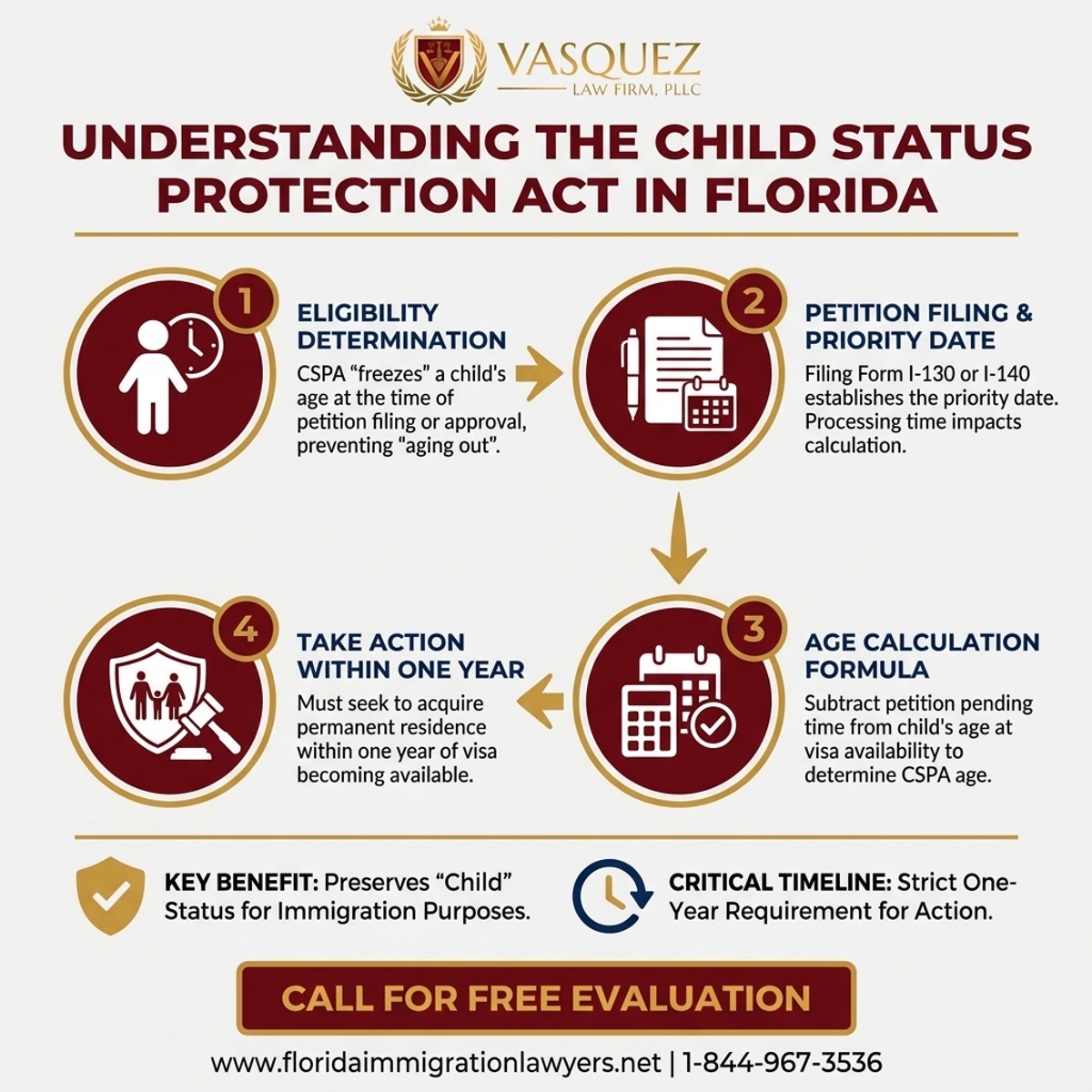
Step-by-Step Process — Understanding the Child Status Protection Act in Florida
Who Qualifies for CSPA Protections?
To qualify under CSPA, children must be listed as derivative beneficiaries on their parent's visa petition. They must also apply for adjustment of status or an immigrant visa within one year of their visa becoming available.
CSPA applies to several categories, including family-sponsored preference visas, employment-based preference visas, and certain humanitarian programs. It's essential that eligible children and their families act promptly to file necessary applications once their visa becomes available to benefit from CSPA protections.
Specifically, CSPA is most commonly applied to children in the following categories: Family-Sponsored Preference Categories such as F1 (unmarried sons and daughters of U.S. citizens), F2A (spouses and children of Lawful Permanent Residents), F2B (unmarried sons and daughters of Lawful Permanent Residents), F3 (married sons and daughters of U.S. citizens), and F4 (brothers and sisters of U.S. citizens). It also extends to children of principal applicants in Employment-Based Preference Categories (EB-1, EB-2, EB-3, EB-4, EB-5) and those under the Diversity Visa Program. Immediate relatives (spouses, minor children, and parents of U.S. citizens) do not typically need CSPA, as their visas are not numerically limited, and thus they do not face the same "aging out" risk.
A critical component for qualification is the "one-year rule." Once the visa becomes available (i.e., your priority date is current according to the Visa Bulletin), the child must "seek to acquire permanent residence" within one year. This means filing either Form I-485 (Application to Register Permanent Residence or Adjust Status) if in the U.S., or Form DS-260 (Immigrant Visa Application) through consular processing abroad. Failing to meet this one-year deadline is a common pitfall that can lead to the loss of CSPA protection, even if the age calculation was favorable.
Practical Tip: Families should proactively monitor the Visa Bulletin and begin preparing all necessary documentation well in advance of their priority date becoming current. Consulting with Florida Immigration Lawyers can help you stay ahead of deadlines and ensure all eligibility criteria are met precisely, maximizing your child's chances of benefiting from CSPA.
Step-by-Step Guide to Using CSPA
- Determine if your child is listed as a derivative beneficiary.
- Calculate the child's CSPA age using official guidelines.
- File for adjustment of status or an immigrant visa within one year of availability.
- Consult with an immigration attorney to ensure all documentation is accurate and complete.
- Monitor the status of applications and maintain communication with USCIS.
1. Determine if your child is listed as a derivative beneficiary.
This is the foundational step. Check the original Form I-130 (Petition for Alien Relative) or Form I-140 (Immigrant Petition for Alien Worker) to confirm your child was included. A derivative beneficiary is a family member (spouse or unmarried child under 21) who can immigrate with the principal applicant based on the same petition.
2. Calculate the child's CSPA age using official guidelines.
Accurately applying the CSPA formula is crucial. This involves identifying the child's age on the date the visa became available and subtracting the number of days the petition was pending. Utilizing online CSPA calculators or, more reliably, consulting with an attorney from Florida Immigration Lawyers can prevent errors.
3. File for adjustment of status or an immigrant visa within one year of availability.
This is perhaps the most critical deadline. Once your priority date is current, you have a strict one-year window to file the appropriate application (I-485 for adjustment in the U.S. or DS-260 for consular processing abroad). Missing this deadline almost invariably results in losing CSPA protection.
4. Consult with an immigration attorney to ensure all documentation is accurate and complete.
Immigration law is intricate, and even minor errors can lead to significant delays or denials. An experienced immigration attorney, like those at Florida Immigration Lawyers, can help gather, review, and organize all necessary documents, ensuring your application is robust and compliant with all CSPA requirements.
5. Monitor the status of applications and maintain communication with USCIS.
After filing, regularly check the status of your application online using the receipt number. Be prepared to respond promptly and thoroughly to any Requests for Evidence (RFEs) or interview notices from USCIS. Keeping your contact information updated with USCIS is also essential to avoid missing critical correspondence.
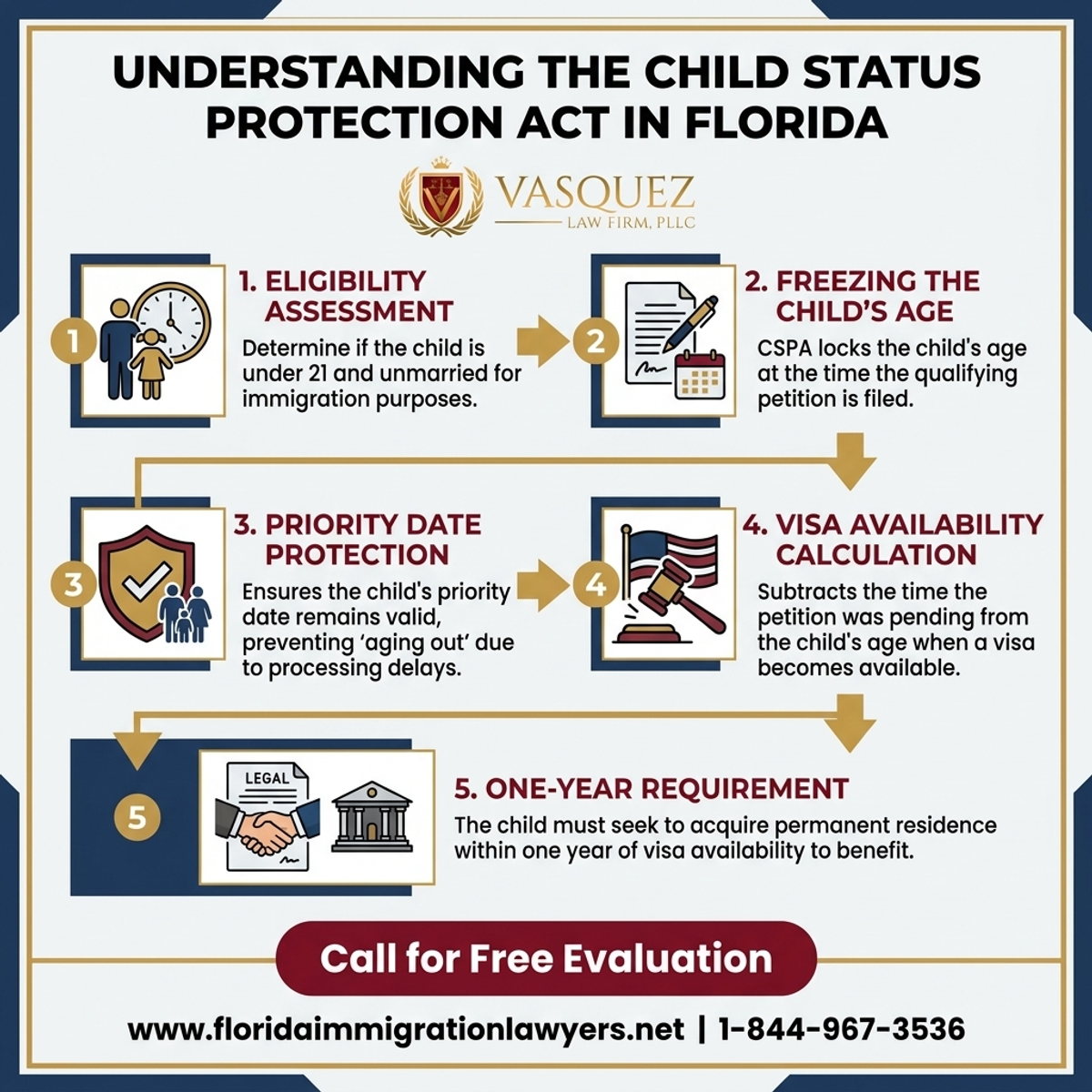
Key Statistics — Understanding the Child Status Protection Act in Florida
Document Checklist for CSPA Applications
A robust and complete application package is key to avoiding unnecessary delays and ensuring a smooth process. Beyond the standard forms, the supporting documentation is what proves eligibility and identity.
- Copy of the original visa petition (Form I-130 or I-140)
- Proof of relationship to the primary beneficiary
- Birth certificate of the child
- Passport-sized photos
- Filing fee payments
- Proof of visa availability notification
In addition to these core documents, you may need certified translations for any documents not in English, police clearance certificates, medical examination results, and affidavits of support. Each case is unique, and the specific requirements can vary. Consulting with Florida Immigration Lawyers can help you compile a comprehensive checklist tailored to your situation, ensuring no critical piece of evidence is overlooked.
Timeline and Processing Expectations
Immigration processing times are notoriously variable, influenced by factors such as the specific visa category, the applicant's country of origin, the volume of applications, and current USCIS and Department of State policies. While CSPA protects a child's age, it does not inherently speed up the processing of the underlying petition or application.
| Stage | Typical Timeframe | Notes |
|---|---|---|
| Petition Filing | 6-12 months | Varies by case and category |
| Visa Availability | Varies | Check visa bulletin regularly |
| Adjustment of Status | 8-14 months | Dependent on USCIS processing times |
It is crucial for families to manage their expectations and understand that these timeframes are estimates. Backlogs, especially for certain high-demand categories or countries, can extend waiting periods significantly. Consistent monitoring of the Visa Bulletin and prompt responses to any USCIS communications are essential to keep your case moving forward. Do not navigate this process alone. Contact Florida Immigration Lawyers today.
Common Mistakes to Avoid
- Not applying for adjustment within one year of visa availability, risking loss of CSPA protection.
- Misunderstanding CSPA age calculations, leading to incorrect eligibility assumptions.
- Failing to provide complete documentation, causing delays or denials.
- Not consulting an attorney, resulting in missed opportunities for protection.
- Overlooking changes in visa bulletin, affecting eligibility timing.
- Ignoring USCIS correspondence, leading to missed deadlines.
- Assuming all children automatically qualify under CSPA without verifying eligibility.
Not Applying for Adjustment Within One Year
This is arguably the most critical and common error. Even if your child's CSPA age calculation is favorable, failing to file the Adjustment of Status (Form I-485) or Immigrant Visa Application (Form DS-260) within one year of the visa becoming available will almost certainly lead to the loss of CSPA protection. This deadline is strictly enforced, and there are very few exceptions. It's imperative to be proactive and prepare your application well in advance.
Misunderstanding CSPA Age Calculations
The CSPA age calculation can be complex, especially when dealing with petitions that convert from one category to another or when the priority date retrogresses. Errors in calculating the child's CSPA age can lead to false hopes or, conversely, to missing out on a legitimate opportunity for protection. Always double-check your calculations, and if in doubt, seek professional advice from Florida Immigration Lawyers.
Failing to Provide Complete Documentation
An incomplete application package is a guaranteed way to invite delays, Requests for Evidence (RFEs), or even outright denial. Each missing document or piece of information adds time to the process and can jeopardize your child's eligibility. Thoroughness and accuracy are paramount; a detailed review by an experienced attorney can prevent these costly mistakes.
When to Call a Lawyer
Immigration processes can be complex and stressful, especially when children's futures are at stake. Contact an attorney if you encounter issues with CSPA eligibility, need help with documentation, or face delays. Florida Immigration Lawyers offer expert guidance to navigate these challenges effectively.
You should consider calling Florida Immigration Lawyers immediately if your child is approaching their 21st birthday, your visa priority date is nearing currency, or you have received any communication from USCIS or the National Visa Center (NVC) that you don't fully understand. Proactive legal counsel can identify potential issues before they become insurmountable problems.
Furthermore, if your case involves complex family situations, previous immigration issues, or if you simply want peace of mind that every detail is handled correctly, an attorney's expertise is invaluable. The team at Florida Immigration Lawyers specializes in CSPA cases, ensuring your family's journey to permanent residency is as smooth and successful as possible.
About Florida Immigration Lawyers
Florida Immigration Lawyers is dedicated to serving families across Florida, including Kissimmee. Our experienced attorneys specialize in all areas of immigration law, providing personalized and effective solutions. Contact us 24/7 at 1-844-967-3536 or visit our website for a free consultation.
Our firm understands the profound impact immigration issues have on families. We pride ourselves on our compassionate yet rigorous approach, particularly in cases involving the Child Status Protection Act. We have a proven track record of helping families successfully navigate the complexities of CSPA, ensuring children are not left behind due to bureaucratic delays. Our commitment is to keep families together and achieve their American dream.
With a deep understanding of federal immigration laws and their application in Florida, our team is equipped to handle even the most challenging CSPA scenarios. We offer comprehensive support, from initial eligibility assessment and age calculation to filing all necessary petitions and representing clients through every stage of the process. We are available 24/7 because we know that immigration concerns don't adhere to a 9-to-5 schedule. Se Habla Español.
Frequently Asked Questions About CSPA
Sources and References
- U.S. Citizenship and Immigration Services (USCIS)
- Executive Office for Immigration Review (EOIR)
- 8 U.S.C. Chapter 12 - Immigration and Nationality Act
Related services: immigration practice areas, family immigration services, citizenship and naturalization, deportation defense.
This article provides general legal information and is not intended as legal advice. Every case is unique, and outcomes depend on specific facts and circumstances. Contact an attorney for advice about your particular situation.
Final CTA
Secure your family's future by understanding the Child Status Protection Act. Contact Florida Immigration Lawyers at 1-844-967-3536 for expert assistance. Se Habla Español - Estamos aquí para ayudarle.
If you need legal assistance, learn more about immigration case consultation, or call us at 1-844-967-3536 for a free consultation.
Do Not Navigate This Process Alone
Our experienced immigration attorneys are ready to fight for you. Get a free, confidential consultation today.
Se Habla Español
Frequently Asked Questions
Harold Estrada-Rodriguez
Florida Immigration Attorney · FL Bar No. 1041171
Florida Bar attorney handling Florida-jurisdiction immigration matters. Bilingual representation, free consultations.
Available 24/7 - Free Evaluations
Related Legal Services
Our Florida immigration attorneys can help you with family immigration services, immigration practice areas and free immigration consultation. Call today at 1-844-967-3536 for a free consultation.
Related Links
Related Topics
Free Legal Consultation
Discuss your case with our experienced attorneys. We're available 24/7.
Se Habla Español - Estamos aquí para ayudarle.
Related Articles
Immigration Scams Protection Florida: Don't Be a Victim
Immigration scams, particularly notario fraud, pose a significant threat to immigrants in Florida. These schemes exploit vulnerabilities, promising false hope and leading to severe financial and legal repercussions. This comprehensive guide from Florida Immigration Lawyers provides crucial insights into identifying common scams, understanding the red flags, and taking proactive steps for protection. Learn how to report fraud to authorities like USCIS and The Florida Bar, and understand the difference between legitimate legal services and fraudulent offers. With Florida-specific advice and detailed steps, we empower you to safeguard your immigration journey. Contact us for a free consultation and expert legal assistance.
VAWA Immigration Relief Florida: Protecting Abuse Victims
For non-citizen victims of domestic violence by a U.S. citizen or LPR spouse, parent, or adult child in Florida, VAWA (Violence Against Women Act) offers a critical pathway to legal status. This self-petitioning process allows individuals to apply for a green card confidentially, without the abuser's involvement. Eligibility requires proving the qualifying relationship, documented abuse, and good moral character. The journey involves filing Form I-360 with USCIS, followed by an application for adjustment of status. Florida Immigration Lawyers provides expert legal guidance, from evidence gathering to navigating interviews, ensuring victims in Naples and across Florida can achieve safety and independence. Our firm understands the unique challenges faced by immigrants and offers compassionate support through every step.
Immigration Services Naples Collier County Florida
Discover comprehensive immigration services in Naples, Collier County, Florida. This detailed guide covers family visas, employment immigration, green card applications, naturalization, and crucial deportation defense strategies. Learn about typical processing times as of 2026, associated costs, and essential documents. We also highlight common mistakes to avoid and when it's critical to consult an experienced Florida immigration lawyer. Florida Immigration Lawyers offers free consultations and dedicated support for all your immigration needs in Southwest Florida, ensuring you navigate the complex legal landscape with confidence.
Immigration Lawyer in Tampa Bay Area | VLF Florida
If you're planning to move to the Tampa Bay area, understanding the immigration process is crucial. Learn how an experienced immigration lawyer can assist you and ensure your journey is as smooth as possible. Call 1-844-967-3536 for a free consultation.