Immigration Services Naples Collier County Florida
Discover comprehensive immigration services in Naples, Collier County, Florida. This detailed guide covers family visas, employment immigration, green card applications, naturalization, and crucial deportation defense strategies. Learn about typical processing times as of 2026, associated costs, and essential documents. We also highlight common mistakes to avoid and when it's critical to consult an experienced Florida immigration lawyer. Florida Immigration Lawyers offers free consultations and dedicated support for all your immigration needs in Southwest Florida, ensuring you navigate the complex legal landscape with confidence.

Navigating immigration services in Naples, Collier County, Florida, requires a deep understanding of complex federal laws and local procedures. For residents of Southwest Florida, access to experienced legal counsel is crucial for family-based petitions, employment visas, naturalization, and deportation defense. A knowledgeable immigration lawyer can help you prepare accurate applications, respond to USCIS requests, and represent you in court, significantly increasing your chances of a positive outcome. Given the evolving immigration landscape, professional guidance ensures compliance and protects your rights throughout the process.
- Comprehensive Support: Assistance with family visas, employment visas, asylum, and citizenship applications.
- Local Expertise: Guidance tailored to the specific needs and challenges of immigrants in Naples and Collier County.
- Deportation Defense: Robust legal representation in immigration court proceedings.
- Timely Updates: Stay informed about policy changes and processing times affecting your case.
Immigrating to the United States, or simply navigating its complex immigration system, can be one of the most challenging journeys an individual or family undertakes. For those living in Naples, Collier County, Florida, understanding the myriad of rules, regulations, and legal pathways is essential. Whether you are seeking to reunite with family, pursue employment opportunities, escape persecution, or become a U.S. citizen, the process is filled with potential pitfalls and intricate requirements. Without proper guidance, even minor errors can lead to significant delays or denials.
At Florida Immigration Lawyers, we recognize the unique needs of the diverse community in Southwest Florida. Our dedicated team is committed to providing comprehensive legal support, ensuring that your immigration journey is as smooth and successful as possible. This article will serve as your essential guide to the various immigration services in Naples, Collier County, Florida, covering everything from common application types to processing timelines and critical mistakes to avoid. We will also highlight when professional legal assistance becomes indispensable. Do not face these challenges alone; our experienced Florida immigration lawyers are here to help. Call Florida Immigration Lawyers at 1-844-967-3536 for a free consultation today.
What Immigration Services Are Available in Naples, Collier County, Florida?
In Naples, Collier County, Florida, a wide array of immigration services is available to address the diverse needs of its immigrant population. These services span various categories, including family-based immigration, employment visas, humanitarian relief such as asylum, and the path to U.S. citizenship. Each service is governed by specific laws and regulations, requiring meticulous preparation and adherence to strict guidelines set forth by agencies like USCIS (U.S. Citizenship and Immigration Services).
For individuals and families in Southwest Florida, understanding which service applies to their unique situation is the first crucial step. Family-based immigration, for example, allows U.S. citizens and lawful permanent residents to petition for eligible relatives to immigrate to the United States. This often involves filing Form I-130, Petition for Alien Relative, followed by adjustment of status (Form I-485) if the beneficiary is already in the U.S., or consular processing if they are abroad. Employment-based immigration, on the other hand, provides pathways for foreign nationals to come to the U.S. for work, often requiring sponsorship from a U.S. employer and involving various visa categories like H-1B, L-1, or EB-1 through EB-5. Asylum and refugee status offer protection to individuals fleeing persecution in their home countries, a process that can be particularly sensitive and complex, requiring detailed documentation and compelling testimony. Lastly, naturalization is the process by which eligible lawful permanent residents can become U.S. citizens, typically after meeting residency requirements and passing civics and English tests. Our firm offers comprehensive immigration services to guide you through these intricate processes, ensuring all requirements are met.
Navigating the Green Card Process in Southwest Florida: A Step-by-Step Guide
Obtaining a Green Card, or Lawful Permanent Resident status, is a pivotal step for many immigrants seeking to live and work permanently in the United States. The process, while complex, is achievable with careful planning and adherence to regulations. For residents of Southwest Florida, including Naples and Collier County, the general steps remain consistent with national guidelines, though local USCIS field offices (such as the one in Miami) will handle interviews and specific regional processing.
The journey to a Green Card typically begins with an eligible U.S. citizen or lawful permanent resident filing a petition on behalf of the immigrant. This could be a family member (Form I-130, Petition for Alien Relative) or an employer (Form I-140, Immigrant Petition for Alien Worker). Once the petition is approved and a visa becomes available, the immigrant can either apply for adjustment of status if they are already in the U.S. (Form I-485, Application to Register Permanent Residence or Adjust Status) or go through consular processing at a U.S. embassy or consulate abroad. The adjustment of status process often involves biometrics appointments, medical examinations, and an interview at a USCIS field office. Consular processing similarly includes a medical exam and an interview at a U.S. consulate. After a successful interview, the Green Card is issued. Our firm specializes in family immigration, offering expert guidance at every stage.
Green Card Application Steps
- File the Immigrant Petition: The U.S. citizen, LPR petitioner, or employer files the appropriate form (e.g., I-130 for family, I-140 for employment) with USCIS. This establishes the relationship or employment basis.
- Wait for Petition Approval: USCIS reviews the petition. Approval means the underlying basis for immigration is recognized. For some categories, there's a waiting period for a visa number to become available based on the Visa Bulletin.
- File for Adjustment of Status or Consular Processing: If in the U.S. with a valid non-immigrant visa and an immediately available visa, file Form I-485. If abroad, or if a visa isn't immediately available, prepare for consular processing through the National Visa Center (NVC).
- Attend Biometrics Appointment: USCIS schedules an appointment to collect fingerprints, photos, and a signature for background checks.
- Complete Medical Examination: A designated civil surgeon performs a medical examination to ensure health requirements are met. The results are sealed and submitted to USCIS or the consulate.
- Attend Interview: Most applicants attend an interview with a USCIS officer (for adjustment of status) or a consular officer (for consular processing). Be prepared to answer questions about your application and eligibility.
- Receive Decision: If approved, you will receive a notice and your Green Card will be mailed. If denied, the notice will explain the reasons, and you may have options to appeal or refile.
Document Checklist for Green Card Applications
- Valid passport and birth certificate(s)
- Marriage certificate (if applicable) and divorce decrees (if applicable)
- Financial documents (e.g., Form I-864 Affidavit of Support, tax returns, employment letters)
- Medical examination report from a USCIS-approved civil surgeon
- Police clearance certificates from all countries lived in for more than 6 months since age 16
- Photographs meeting USCIS specifications
- Proof of relationship (e.g., photos, joint bank accounts, birth certificates of children)
- Any relevant prior immigration documents (e.g., I-94 arrival record, previous visa stamps)
- Certified translations for any non-English documents
How Long Do Immigration Applications Take in 2026? Timelines and Expectations
The processing times for immigration applications can vary significantly based on the type of application, the specific USCIS service center or field office involved, and current backlogs. As of 2026, applicants in Naples, Collier County, Florida, should anticipate that timelines can range from several months to several years. Factors such as the complexity of the case, the completeness of the application, and the volume of submissions to USCIS all play a critical role in determining how long a decision will take. It is always wise to consult the official USCIS website for the most current processing times, as these are subject to change without prior notice.
For instance, family-based petitions (Form I-130) often have different processing times depending on the relationship category. Immediate relatives of U.S. citizens (spouses, unmarried children under 21, parents) generally have shorter waiting periods once the I-130 is approved, as visa numbers are immediately available. Other family preference categories, however, can involve waiting periods of many years due to annual visa limits. Employment-based petitions also vary, with some categories (e.g., EB-1 for extraordinary ability) having relatively quick processing, while others (e.g., EB-3 for skilled workers) can experience significant backlogs. Naturalization applications (Form N-400) typically involve a period of several months for processing, an interview, and an oath ceremony. Given these variables, proper planning and managing expectations are key. For the most up-to-date information, regularly check the USCIS processing times page.
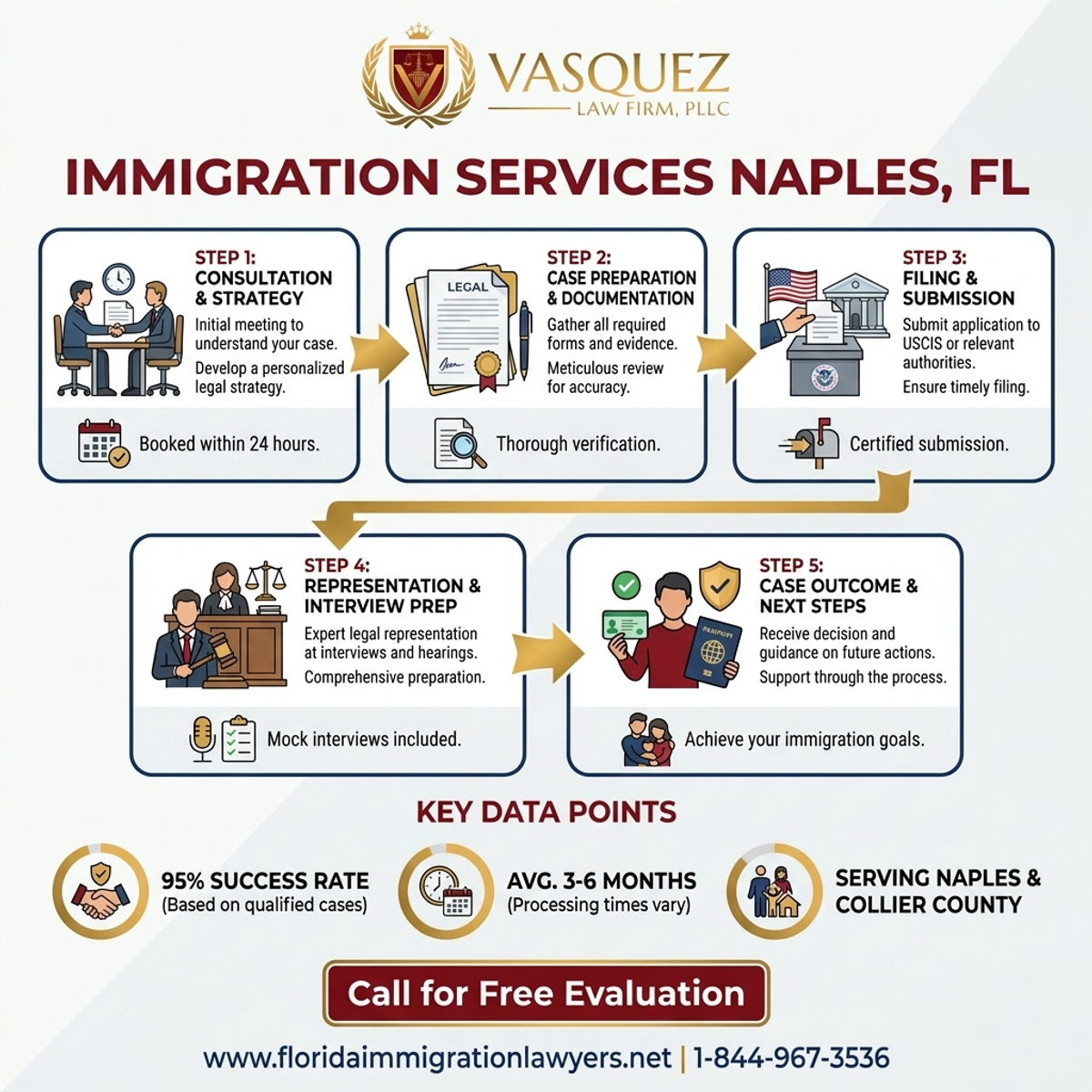
Step-by-Step Process — Immigration Services Naples Collier County Florida
Typical Immigration Processing Timeframes (As of 2026)
| Stage | Typical Timeframe | Notes |
|---|---|---|
| Form I-130 (Family Petition) | 6-24 months | Varies by relationship and service center. Immediate relatives often faster. |
| Form I-485 (Adjustment of Status) | 10-36 months | Depends on underlying petition, field office (e.g., Miami), and case complexity. |
| Form I-765 (Employment Authorization) | 3-12 months | Often filed concurrently with I-485. Premium processing available for some categories. |
| Form N-400 (Naturalization) | 8-18 months | Includes interview, civics test, and oath ceremony. Field office processing times vary. |
| Asylum Interview | 6-60+ months | Non-detained affirmative asylum interviews can have long waits due to backlogs. |
Understanding Deportation Defense and Asylum Claims in Florida
For immigrants in Florida, particularly in areas like Naples and Collier County, understanding deportation defense and asylum claims is critically important. The state of Florida, with its significant immigrant population, sees a substantial number of individuals facing removal proceedings. When an individual is placed in deportation (removal) proceedings, they receive a Notice to Appear (NTA) and must appear before an Immigration Judge at an Executive Office for Immigration Review (EOIR) court, such as those in Miami or Orlando. These proceedings are complex, adversarial, and can result in a lawful permanent resident or other non-citizen being ordered to leave the U.S. Effective deportation defense involves identifying all possible forms of relief from removal, such as cancellation of removal, adjustment of status, waivers, or asylum.
Asylum claims are a specific type of relief available to individuals who fear persecution in their home country based on race, religion, nationality, membership in a particular social group, or political opinion. In Florida, asylum seekers can file an affirmative asylum application with USCIS if they are not in removal proceedings, or an defensive asylum application if they are already before an Immigration Judge. The process is rigorous, requiring extensive documentation and credible testimony to establish a well-founded fear of persecution. Given the recent policy changes affecting undocumented immigrants and asylum seekers, it is more important than ever to have skilled legal representation. Our dedicated deportation defense attorneys and asylum lawyers in Florida are adept at navigating these challenging cases, providing robust advocacy to protect your rights and help you seek refuge. This includes understanding provisions under the Immigration and Nationality Act (INA), such as INA § 208 for asylum and INA § 240 for removal proceedings. You can find more information about immigration courts at the Executive Office for Immigration Review (EOIR) website.
What Are the Costs Associated with Immigration Cases in Naples, Florida?
Understanding the financial aspects of immigration cases is a crucial part of the planning process for residents in Naples, Florida. The total cost of an immigration case is typically a combination of government filing fees, attorney fees, and other miscellaneous expenses such as medical examination fees, translation costs, and document acquisition fees. It is important to note that government filing fees are set by USCIS and the Department of State and are subject to change. As of 2026, these fees vary significantly depending on the type of application or petition being filed. For example, a Green Card application (Form I-485) will have a different fee than a naturalization application (Form N-400) or an employment authorization document (Form I-765). These fees are generally non-refundable, regardless of the outcome of the case.
Attorney fees, on the other hand, cover the legal services provided by your immigration lawyer. These fees reflect the complexity of your case, the time and effort required, and the attorney's experience. While some firms may charge hourly rates, many immigration cases are handled on a flat-fee basis, providing transparency and predictability for clients. It is always recommended to discuss fee structures upfront during your initial consultation. Additional costs might include fees for obtaining specific documents from your home country, biometric services, or travel expenses for interviews. While the upfront costs can seem daunting, investing in experienced legal counsel can prevent costly mistakes and delays in the long run. We encourage you to visit the Department of State website for current visa service fees.
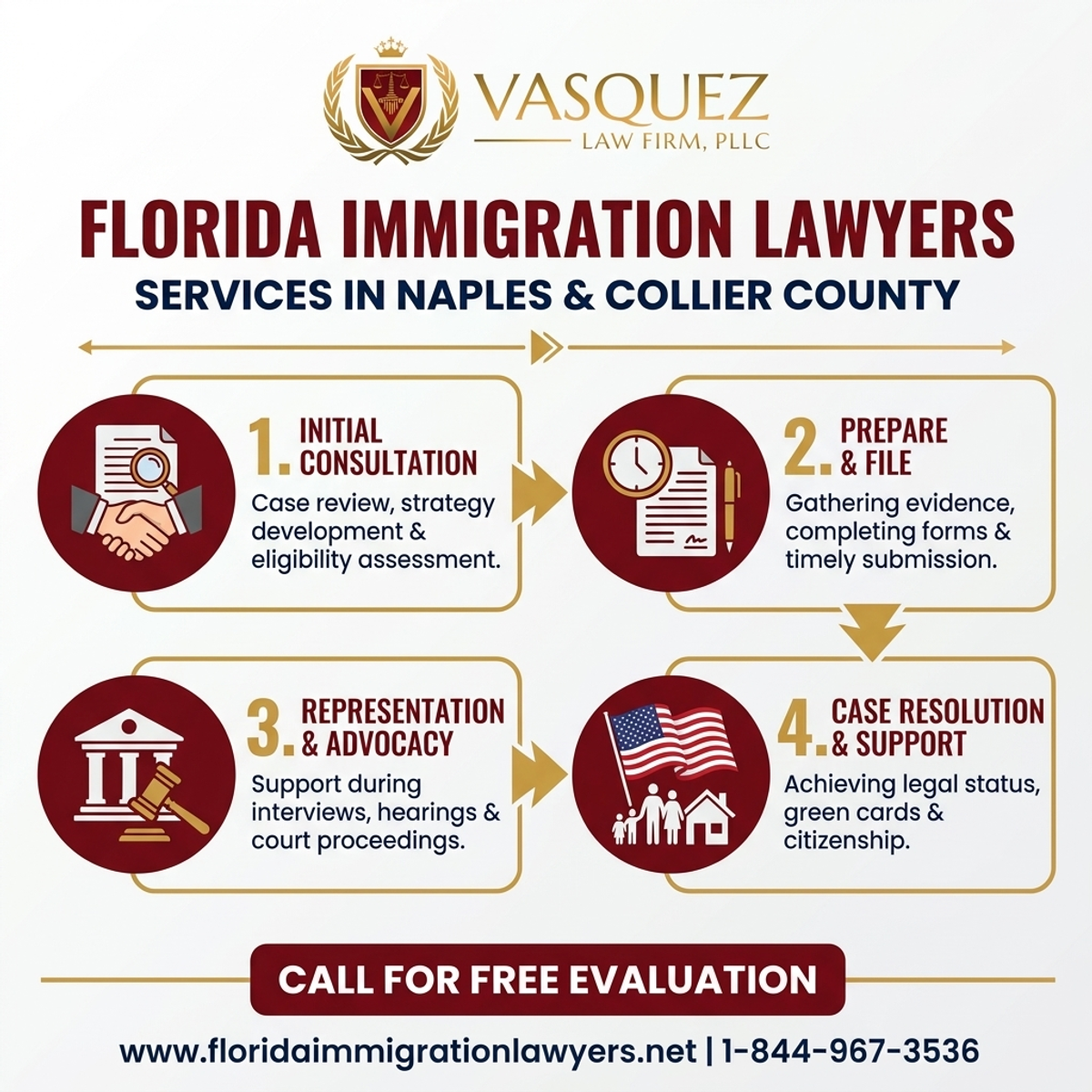
Key Statistics — Immigration Services Naples Collier County Florida
Typical Immigration Case Cost Factors (As of 2026)
| Item | Typical Fee | Notes |
|---|---|---|
| USCIS Filing Fees | Varies by form ($0 - $1,760+) | Non-refundable. Examples: I-130, I-485, N-400, I-765. Subject to change. |
| Attorney Fees | Varies by case ($1,500 - $10,000+) | Flat fees common for specific applications (e.g., Green Card, Naturalization). Hourly for complex cases. |
| Medical Examination | $200 - $500 | Required for adjustment of status and consular processing. Performed by USCIS-approved civil surgeon. |
| Translation Services | $20 - $50 per page | Required for any non-English documents. Must be certified translations. |
| Biometrics Fee | Included in filing fees (or separate for some forms) | For fingerprinting and background checks. |
| Document Acquisition | Varies | Costs for obtaining birth certificates, marriage licenses, police records from home country. |
Achieving U.S. Citizenship: The Naturalization Process for Florida Residents
For many lawful permanent residents (Green Card holders) in Naples, Collier County, Florida, the ultimate goal is to become a U.S. citizen through the naturalization process. This significant step grants full civic rights, including the right to vote, hold certain federal jobs, and travel with a U.S. passport. The naturalization process, while straightforward for most eligible applicants, requires careful attention to detail and a thorough understanding of eligibility requirements. Generally, applicants must be at least 18 years old, have been a lawful permanent resident for at least five years (or three years if married to a U.S. citizen), demonstrate continuous residence and physical presence in the U.S., possess good moral character, and show an attachment to the principles of the U.S. Constitution.
The journey to citizenship begins with filing Form N-400, Application for Naturalization, with USCIS. After submitting the application, applicants will attend a biometrics appointment for fingerprinting. The next crucial step is the naturalization interview, typically held at a USCIS field office, such as the one in Miami. During this interview, a USCIS officer will review your application, ask questions about your eligibility, and administer English and civics tests. The English test assesses your ability to read, write, and speak basic English, while the civics test covers U.S. history and government. If approved, the final step is attending an Oath of Allegiance Ceremony, where you officially become a U.S. citizen. Our firm provides expert guidance for the entire citizenship process, ensuring you are well-prepared for each stage. For specific legal requirements, refer to 8 U.S.C. § 1427, which outlines the general requirements for naturalization.
Common Mistakes to Avoid in Your Immigration Journey
Navigating the U.S. immigration system can be fraught with challenges, and even minor errors can lead to significant delays, denials, or even dire consequences. Being aware of common mistakes can help you avoid unnecessary complications.
- Submitting Incomplete or Inaccurate Applications: Failing to provide all required information or submitting forms with errors is a leading cause of delays and Requests for Evidence (RFEs). This can lengthen processing times significantly.
- Missing Deadlines: USCIS and immigration courts have strict deadlines for filing petitions, responding to RFEs, or appearing in court. Missing a deadline can result in denial, loss of status, or even an order of removal.
- Providing False Information: Any misrepresentation or fraudulent statement on an immigration application can lead to a permanent bar from receiving immigration benefits and may result in criminal charges. Honesty is paramount.
- Not Disclosing Criminal History: Even minor arrests or convictions, including those expunged, must be disclosed. Failure to do so can be considered misrepresentation and have severe immigration consequences, including deportation.
- Failing to Update Your Address with USCIS: If you move, you are legally required to notify USCIS within 10 days using Form AR-11. Failure to do so can result in missed notices, court dates, and potentially adverse decisions.
- Attending Interviews Unprepared: Going to an interview without reviewing your application, understanding the questions, or having all necessary documents can lead to confusion, suspicion, and denial.
- Traveling Internationally Without Advance Parole: If you have a pending adjustment of status application, leaving the U.S. without an approved Advance Parole document can be considered abandonment of your application, making it impossible to re-enter.
- Ignoring Requests for Evidence (RFEs) or Notices of Intent to Deny (NOIDs): These are critical communications from USCIS. Failing to respond adequately and on time will almost certainly lead to a denial of your application.
- Trying to Handle Complex Cases Alone: Cases involving criminal history, previous deportations, complex waivers, or asylum claims are highly intricate. Attempting to manage them without legal counsel often leads to unfavorable outcomes.
- Not Understanding English for Naturalization: While exceptions exist, most naturalization applicants must demonstrate an ability to read, write, and speak basic English. Failure to prepare for this can lead to delays.
When to Call a Florida Immigration Lawyer in Naples, Collier County
While some immigration processes may seem straightforward, the reality is that U.S. immigration law is incredibly complex and constantly changing. Even a seemingly simple application can encounter unexpected hurdles. Knowing when to seek professional legal assistance from a Florida immigration lawyer is crucial for ensuring a smooth and successful outcome, especially for residents of Naples and Collier County. You should seriously consider contacting an attorney if your case involves any complexities such as a prior criminal history, previous immigration violations, or a history of deportation. These factors can significantly complicate your application and often require specialized waivers or defense strategies.
Furthermore, if you receive a Request for Evidence (RFE) or a Notice of Intent to Deny (NOID) from USCIS, it is a strong indicator that your application is in jeopardy and immediate legal intervention is needed. Individuals facing removal (deportation) proceedings in immigration court absolutely require experienced legal representation to protect their rights and explore all possible avenues for relief. Asylum claims, which often involve sensitive personal testimonies and intricate legal arguments, also benefit immensely from an attorney's guidance. If you have questions about which visa category is right for you, encounter language barriers, or simply desire peace of mind that your application is handled correctly, a free consultation with Florida Immigration Lawyers can provide clarity and strategic direction. Our team is well-versed in immigration law and dedicated to serving the diverse needs of the immigrant community in Naples and throughout Florida.
About Florida Immigration Lawyers
Florida Immigration Lawyers is a leading immigration law firm dedicated to serving individuals and families across the entire state of Florida, including Naples and Collier County. Our firm understands the profound impact immigration matters have on people's lives, and we are committed to providing compassionate, effective, and results-oriented legal representation. Our team of experienced attorneys specializes in a comprehensive range of immigration services, from family-based visas and employment-based immigration to complex deportation defense and naturalization processes. We pride ourselves on offering personalized attention, strategic advice, and unwavering advocacy for each client.
Choosing Florida Immigration Lawyers means partnering with a firm that prioritizes your success and peace of mind. We offer free consultations to discuss your unique situation and provide an honest assessment of your options. Our bilingual staff is available 24/7 to answer your questions and provide support, ensuring that language is never a barrier to accessing quality legal counsel. We leverage our deep knowledge of immigration law and our commitment to client service to navigate the complexities of the U.S. immigration system on your behalf. Whether you are seeking to obtain a Green Card, defend against deportation, or achieve U.S. citizenship, we are here to guide you every step of the way. Contact us today at 1-844-967-3536 or visit our contact page to schedule your free consultation.
Sources and References
- U.S. Citizenship and Immigration Services (USCIS)
- Executive Office for Immigration Review (EOIR)
- U.S. Department of State
- 8 U.S.C. Chapter 12 - Immigration and Nationality Act (INA)
- INA § 208 - Asylum
- INA § 240 - Removal Proceedings
- 8 U.S.C. § 1427 - Requirements for Naturalization
- Code of Federal Regulations (CFR) - Title 8, Aliens and Nationality
Related services: immigration waivers, humanitarian protection programs, DACA renewal and applications, temporary protected status (TPS).
This article provides general legal information and is not intended as legal advice. Every case is unique, and outcomes depend on specific facts and circumstances. Contact an attorney for advice about your particular situation. Immigration laws are subject to frequent changes, and this information may not reflect the most current legal developments.
Your immigration journey in Naples, Collier County, Florida, is a significant undertaking that deserves the highest level of professional legal support. At Florida Immigration Lawyers, we are dedicated to protecting your rights, advocating for your interests, and guiding you through every step of the process. From initial consultations to final approvals, our experienced team is here to provide clarity, confidence, and competent representation. Do not let the complexities of immigration law overwhelm you. Take the first step towards a brighter future by contacting us for a free consultation today. Call Florida Immigration Lawyers at 1-844-967-3536. Se Habla Espanol - Estamos aqui para ayudarle.
Do Not Navigate This Process Alone
Our experienced immigration attorneys are ready to fight for you. Get a free, confidential consultation today.
Se Habla Español
Frequently Asked Questions
Harold Estrada-Rodriguez
Florida Immigration Attorney · FL Bar No. 1041171
Florida Bar attorney handling Florida-jurisdiction immigration matters. Bilingual representation, free consultations.
Available 24/7 - Free Evaluations
Related Legal Services
Our Florida immigration attorneys can help you with deportation defense, citizenship and naturalization and family immigration services. Call today at 1-844-967-3536 for a free consultation.
Related Links
Related Topics
Free Legal Consultation
Discuss your case with our experienced attorneys. We're available 24/7.
Se Habla Español - Estamos aquí para ayudarle.
Related Articles
Immigration Lawyer in Tampa Bay Area | VLF Florida
If you're planning to move to the Tampa Bay area, understanding the immigration process is crucial. Learn how an experienced immigration lawyer can assist you and ensure your journey is as smooth as possible. Call 1-844-967-3536 for a free consultation.
Immigration Attorney Gainesville: North Florida Legal Help
Navigating U.S. immigration law can be incredibly complex, especially in a dynamic region like North Florida. From Alachua County to the broader Gainesville area, individuals and families require experienced legal guidance for visas, green cards, citizenship, and deportation defense. Florida Immigration Lawyers offers comprehensive assistance, providing clarity and support through every step of your immigration journey. We understand the unique challenges faced by immigrants in Florida and are dedicated to protecting your rights and achieving your immigration goals. Our firm serves all of Florida, including Gainesville and St. Petersburg.
Immigration Court Proceedings Florida: Your Guide in 2026
Understanding immigration court proceedings in Florida is vital for anyone facing removal. This comprehensive guide for 2026 covers the stages of removal proceedings, essential documentation, expected timelines, and associated costs. Learn about common mistakes to avoid and when to seek legal counsel to protect your rights and explore options for relief from removal. With busy courts in Miami, Orlando, and Bradenton, expert legal representation is crucial. Florida Immigration Lawyers offers dedicated support for complex immigration court cases, helping clients navigate the Executive Office for Immigration Review (EOIR) system with confidence. Contact us for a free consultation.
Refugee Resettlement Florida: Your 2026 Guide | VLF Florida
For those seeking safety, understanding refugee status and the resettlement process in Florida is crucial. Our 2026 guide covers eligibility, the step-by-step journey from arrival to permanent residency in communities like Hollywood, and the vital support services available. Refugees face unique challenges, but federal protections and comprehensive programs exist to help them integrate successfully. Learn about the benefits, legal pathways, and common pitfalls to avoid. Florida Immigration Lawyers provides expert guidance, ensuring you navigate this complex process with confidence and care. Contact us for a free consultation to secure your future.