Refugee Resettlement Florida: Your 2026 Guide
For those seeking safety, understanding refugee status and the resettlement process in Florida is crucial. Our 2026 guide covers eligibility, the step-by-step journey from arrival to permanent residency in communities like Hollywood, and the vital support services available. Refugees face unique challenges, but federal protections and comprehensive programs exist to help them integrate successfully. Learn about the benefits, legal pathways, and common pitfalls to avoid. Florida Immigration Lawyers provides guidance, ensuring you navigate this complex process with confidence and care. Contact us for a free consultation to secure your future.
Refugee status in Florida for 2026 offers protection to individuals who have fled their home country due to persecution and cannot return. Once granted, refugees are eligible for a comprehensive resettlement program designed to help them integrate into U.S. society, particularly in areas like Hollywood, Florida. This includes initial housing, financial aid, medical care, employment assistance, and language training. The process culminates in the opportunity to apply for lawful permanent residency after one year. Understanding the legal framework and accessing available resources is crucial for a successful transition.
- Refugee status is granted to individuals with a well-founded fear of persecution.
- Resettlement agencies in Florida provide critical support for integration.
- Refugees can apply for a Green Card after one year of residence in the U.S.
- Legal assistance is vital for navigating the complex immigration process.
Imagine fleeing your home, leaving everything behind, driven by a well-founded fear for your safety or life. This is the reality for countless individuals seeking refugee status, and for many, Florida represents a beacon of hope for a new beginning. As of 2026, the process of obtaining refugee status and navigating resettlement in Florida, including vibrant communities like Hollywood, can seem overwhelming. However, understanding the journey and the robust support systems in place is the first step towards rebuilding your life in safety and dignity.
This comprehensive guide from Florida Immigration Lawyers will walk you through the intricacies of refugee status, the resettlement process, available benefits, and the pathway to permanent residency in Florida. We aim to provide clarity and empower you with the knowledge needed to successfully navigate this critical transition. If you or a loved one are seeking to understand your options, do not hesitate to call Florida Immigration Lawyers at 1-844-YO-PELEO for a free consultation. We are here to help you every step of the way.
What is Refugee Status in Florida and Who Qualifies?
Refugee status is a legal protection granted to individuals who have fled their home country and cannot return due to a well-founded fear of persecution based on race, religion, nationality, membership in a particular social group, or political opinion. This status is determined by the U.S. government, often through referrals from the United Nations High Commissioner for Refugees (UNHCR) or by direct application from within the U.S. for asylum seekers. The definition of a refugee is enshrined in U.S. law under the Immigration and Nationality Act (INA) Section 101(a)(42), which aligns with international conventions.
To qualify for refugee status, an individual must generally be outside their country of nationality or habitual residence and unable or unwilling to return due to persecution. Unlike asylum seekers, who apply for protection from within the United States or at a port of entry, refugees are typically processed overseas. The U.S. Citizenship and Immigration Services (USCIS) plays a central role in adjudicating refugee applications, ensuring that all criteria are met. In Florida, refugees often arrive through specific government programs, bringing diverse backgrounds and experiences to communities across the state, including the Hollywood area, which has a history of welcoming new arrivals. Understanding these foundational definitions is crucial for anyone considering this path.
The distinction between a refugee and an asylum seeker, while subtle, is important. Both seek protection from persecution, but their application locations differ significantly. Refugees undergo a rigorous screening and interview process while still in a foreign country, often in refugee camps or processing centers. Once approved, they are then resettled in the United States. Asylum seekers, however, must be physically present in the U.S. or at a port of entry to apply. This difference impacts the initial steps and the agencies involved in their journey. For those in Florida, whether arriving as a refugee or seeking asylum, the goal remains the same: finding safety and building a new life free from fear. Our firm can provide dedicated assistance for both asylum and refugee cases.
How Does Refugee Resettlement Work in Florida in 2026?
As of 2026, refugee resettlement in Florida involves a coordinated effort between federal agencies, state programs, and local non-profit organizations. The process begins with the refugee's arrival in the United States, typically facilitated by the U.S. Department of State in partnership with nine national resettlement agencies. These agencies then work with their local affiliates in Florida to provide essential services, ensuring a smooth transition into American society. This comprehensive support system aims to help refugees achieve self-sufficiency as quickly as possible.
The resettlement journey is structured and supportive:
- Arrival and Initial Processing: Upon arrival at a U.S. airport, refugees are met by representatives from a local resettlement agency. They receive immediate assistance with transportation to their new home, which is often pre-arranged by the agency in cities like Hollywood, Florida, or other welcoming communities. This initial phase focuses on ensuring basic needs are met after a long and often arduous journey.
- Placement and Initial Support: Within the first 30-90 days, resettlement agencies provide crucial services, including temporary housing, food, clothing, and an initial cash allowance. They also assist with enrolling children in school, applying for Social Security cards, and accessing initial medical screenings. The goal is to stabilize the family unit and address immediate needs.
- Cultural Orientation: Refugees participate in orientation sessions to learn about American culture, laws, responsibilities, and available community resources. These sessions are vital for bridging cultural gaps and empowering refugees to navigate their new environment effectively.
- Employment Assistance: A primary focus of resettlement is economic self-sufficiency. Agencies offer job readiness training, resume building, interview preparation, and job placement services. They connect refugees with local employers in Florida, helping them secure their first jobs and contribute to the local economy.
- English Language Training (ESL): Language is often a significant barrier. Resettlement programs provide access to English as a Second Language (ESL) classes, which are essential for communication, employment, and integration into American society. Many community colleges and non-profits in Florida offer these vital courses.
- Pathway to Permanent Residency: After one year of continuous physical presence in the U.S. in refugee status, refugees are eligible to apply for lawful permanent resident status (a Green Card). This is a critical step towards long-term stability and eventually, U.S. citizenship.
The timeline for various stages of the refugee resettlement process in Florida can vary, but generally follows these expectations:
| Stage | Typical Timeframe | Notes |
|---|---|---|
| Initial Arrival & Setup | 1-3 months | Includes housing, initial financial aid, medical screening, school enrollment. |
| Cultural Orientation | Ongoing for 3-6 months | Classes and community engagement to understand U.S. life. |
| Employment Search & Placement | 3-12 months | Agencies assist with job training and finding initial employment. |
| English Language Learning | Ongoing, 6+ months | Access to ESL classes for improved communication and job prospects. |
| Adjustment of Status (Green Card Application) | After 1 year of U.S. residence | Refugees become eligible to apply for lawful permanent residency. |
| Green Card Processing | 6-18 months (as of 2026) | Varies based on USCIS workload and specific case complexities. |
What Benefits and Support Services are Available for Refugees in Florida?
Refugees in Florida are eligible for a range of essential benefits and support services designed to facilitate their integration and promote self-sufficiency. These programs, funded federally but administered by state and local agencies, address immediate needs and provide pathways to long-term stability. Accessing these services is crucial for refugees as they adapt to their new lives in communities across Florida, including those residing in Hollywood and surrounding Broward County areas.
The Florida Department of Children and Families (DCF) oversees many of these programs, working in conjunction with resettlement agencies. Key benefits include:
- Financial Assistance: Refugees may qualify for the Refugee Cash Assistance (RCA) program for up to eight months, or Temporary Assistance for Needy Families (TANF) if they meet specific criteria. These programs provide crucial financial support during the initial period of adjustment while individuals seek employment.
- Medical Assistance: The Refugee Medical Assistance (RMA) program offers health insurance for up to eight months for refugees who do not qualify for Medicaid. This ensures access to necessary medical care, including physical examinations, immunizations, and treatment for acute conditions. Mental health services are also a critical component, helping refugees cope with trauma and the stresses of displacement.
- Employment Services: Resettlement agencies provide comprehensive employment support, including job counseling, vocational training, resume preparation, and job placement assistance. The goal is to help refugees find sustainable employment quickly, contributing to their independence and the local economy. Many programs focus on skill-matching to available jobs in Florida's diverse industries.
- Education: Children of refugees are immediately eligible to enroll in public schools. Adults have access to English as a Second Language (ESL) classes, often offered by local community colleges, adult education centers, and non-profit organizations. These educational opportunities are fundamental for integration and future success.
- Social Services: Beyond the initial support, refugees can access various social services, including cultural orientation, legal assistance referrals, community integration programs, and support groups. These services help refugees navigate the complexities of their new environment and build supportive networks within their communities.
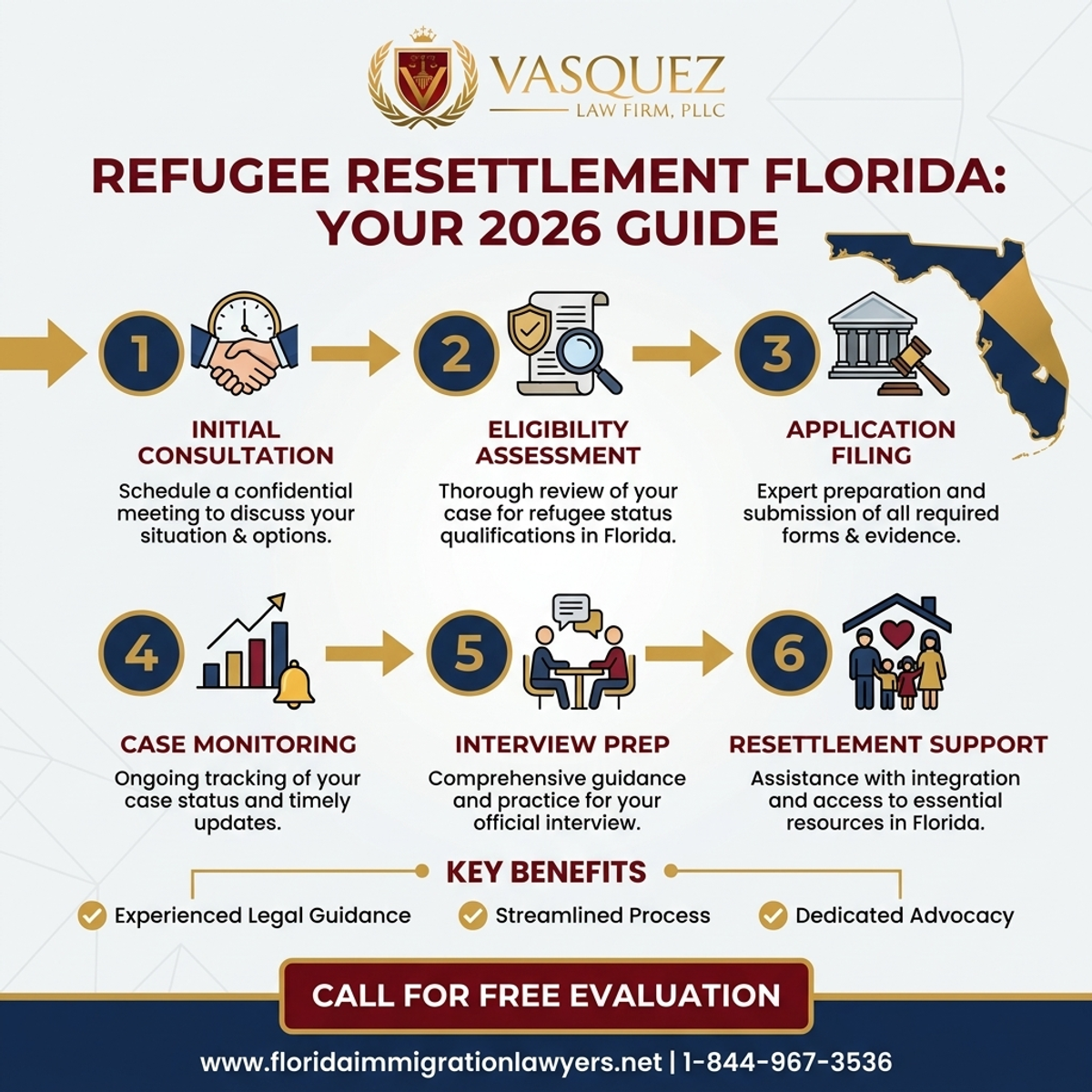
Step-by-Step Process — Refugee Resettlement Florida: Your 2026 Guide
In Florida, a strong network of local non-profits and community organizations, particularly in areas with large refugee populations like South Florida, complements the efforts of national resettlement agencies. These local groups often provide specialized services, such as mentorship programs, cultural events, and advocacy, tailoring support to the unique needs of different refugee communities. For instance, organizations in Hollywood or Miami-Dade may offer specific language support or culturally sensitive counseling services. Accessing these resources requires active engagement and often involves working closely with your assigned resettlement agency.
Navigating the Legal Pathway to Permanent Residency for Refugees
One of the most significant milestones for a refugee in the United States is the opportunity to adjust their status to that of a lawful permanent resident, commonly known as obtaining a Green Card. This crucial step provides long-term stability and opens the door to eventual U.S. citizenship. As of 2026, refugees are eligible to apply for adjustment of status after one year of continuous physical presence in the U.S. in refugee status. The process involves filing Form I-485, Application to Register Permanent Residence or Adjust Status, with USCIS.
The eligibility criteria for adjustment of status for refugees are generally straightforward but require careful attention to detail:
- You must have been admitted to the U.S. as a refugee.
- You must have been physically present in the U.S. for at least one year since your admission as a refugee.
- You must continue to meet the definition of a refugee or be a qualifying derivative spouse or child.
- You must be admissible to the United States for permanent residence, or eligible for a waiver of inadmissibility.
The application process involves gathering extensive documentation. Here is a general checklist of documents commonly required for Form I-485 for refugees:
- Form I-485, Application to Register Permanent Residence or Adjust Status
- Two passport-style photographs
- Copy of government-issued photo identification (e.g., passport, driver's license)
- Copy of your birth certificate
- Copy of your refugee admission stamp (Form I-94, Arrival/Departure Record)
- Form I-693, Report of Medical Examination and Vaccination Record (completed by a USCIS-approved civil surgeon)
- Certified English translations of any foreign language documents
- Form I-765, Application for Employment Authorization (optional, if you need an EAD while I-485 is pending)
- Form I-131, Application for Travel Document (optional, if you need to travel abroad while I-485 is pending)
- Police clearances from any country you have lived in for 6 months or more since age 16 (if requested by USCIS)
- Evidence of continuous physical presence in the U.S. for one year (though USCIS often has this information)
Understanding the potential costs involved in the adjustment of status process is also important. While refugees are exempt from the I-485 filing fee, there are other fees that may apply:
| Item | Typical Fee (as of 2026) | Notes |
|---|---|---|
| Form I-485 Filing Fee | $0 | Refugees are exempt from this fee. |
| Biometrics Fee | $85 | Required for fingerprinting and background checks. |
| Form I-693 Medical Exam | Varies ($200-$500+) | Cost charged by civil surgeon; not a USCIS fee. |
| Form I-765 (EAD) Filing Fee | $0 (if filed with I-485) | Refugees are generally exempt from this fee when applying for adjustment of status. |
| Form I-131 (Travel Document) Filing Fee | $0 (if filed with I-485) | Refugees are generally exempt from this fee when applying for adjustment of status. |
| Attorney Fees | Varies | Costs for legal representation, highly recommended for complex cases. |
Note: USCIS fees are subject to change. Always check the official USCIS website for the most current fee schedule.
After filing Form I-485, applicants will typically receive a receipt notice, followed by an appointment for biometrics. USCIS may also schedule an interview to review the application and verify information. If approved, you will receive your Green Card, officially granting you lawful permanent resident status. This entire process can take several months to over a year, so patience and careful preparation are key. Consulting with an experienced immigration attorney in Florida, particularly for those in Hollywood or other South Florida locales, can significantly streamline this process and prevent costly errors. Our team can help you with your citizenship journey.
Challenges and Legal Protections for Refugees in Florida
While refugee status offers vital protection, the journey to full integration in Florida can present various challenges. Refugees often face language barriers, cultural shock, difficulties in finding employment commensurate with their skills, and the psychological impact of past trauma. These hurdles can be particularly pronounced in bustling urban centers like Hollywood, where the pace of life and diverse cultural landscape require significant adaptation. Despite these challenges, refugees in Florida are afforded robust legal protections under U.S. and international law, ensuring their rights and facilitating their path to a new life.
Common challenges include:
- Language Barriers: Learning English is fundamental for employment, education, and daily life. While ESL classes are available, the process takes time and dedication.
- Cultural Adaptation: Adjusting to new social norms, legal systems, and daily routines can be disorienting and stressful.
- Employment: Despite professional skills, refugees may struggle to find jobs due to lack of U.S. work experience, unrecognized foreign credentials, or language proficiency issues.
- Housing: Finding affordable and safe housing, particularly in competitive markets like South Florida, can be a significant challenge after initial resettlement support ends.
- Mental Health: Many refugees have experienced severe trauma, and accessing appropriate mental health services is crucial for their well-being and integration.
Regarding legal protections, refugees are granted specific rights upon their admission to the U.S. These include the right to work, access to public benefits, and protection from deportation. Once granted refugee status, individuals cannot be returned to a country where they face persecution. This principle, known as non-refoulement, is a cornerstone of international refugee law, as detailed by organizations like the State Department.
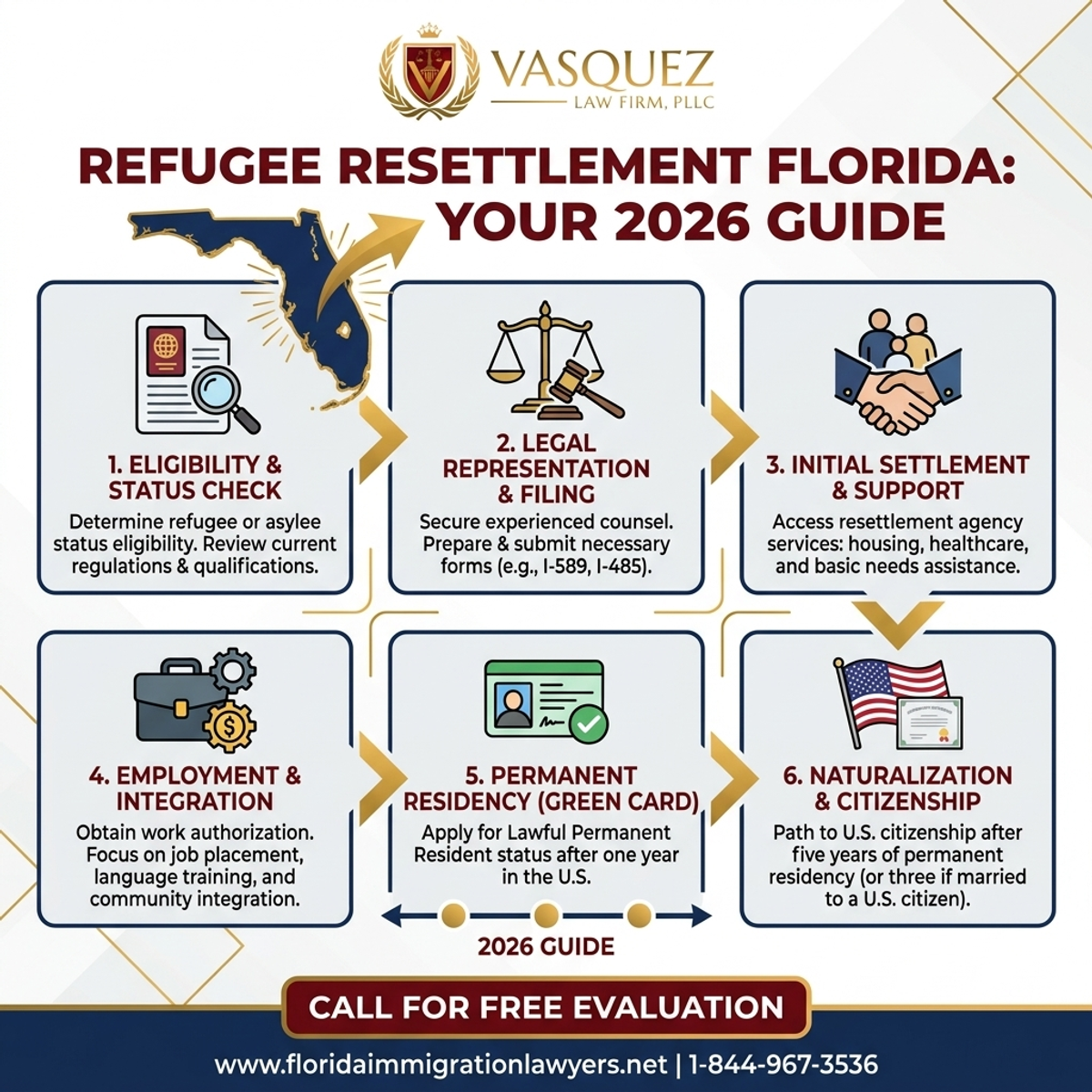
Key Statistics — Refugee Resettlement Florida: Your 2026 Guide
It is important to note that while some recent state policies in Florida have generated concerns for certain immigrant communities, particularly those without documented status, refugees benefit from federal protection and a clear pathway to legal residency. These federal protections supersede state-level restrictions in many critical areas, ensuring that refugees can access the necessary support for their integration. However, staying informed about evolving legal landscapes is always wise. Legal counsel can provide invaluable guidance, ensuring refugees understand their rights and are not subject to discrimination or unlawful treatment. For complex situations, particularly those involving family reunification or potential deportation defense, seeking legal advice is paramount.
Do not navigate this process alone. The complexities of refugee resettlement and the legal pathway to permanent residency require meticulous attention to detail and a deep understanding of immigration law. Contact Florida Immigration Lawyers today for guidance and unwavering support throughout your journey.
Common Mistakes to Avoid in Refugee Resettlement and Adjustment of Status
Navigating the refugee resettlement process and subsequently applying for a Green Card can be complex. Even minor errors can lead to significant delays or even denial. Here are some common mistakes refugees should actively avoid:
- Missing Deadlines for Form I-485: Refugees are eligible to apply for adjustment of status one year after admission. Failing to file Form I-485 within a reasonable timeframe after becoming eligible can complicate matters, although there is generally no strict deadline for refugees. However, delaying means delaying your permanent residency and potential citizenship.
- Providing Inconsistent Information: Any discrepancies between information provided during your refugee interview and your Green Card application can raise red flags with USCIS. Always be truthful and consistent in all your immigration forms and interviews.
- Failing to Disclose All Arrests or Detentions: Even minor encounters with law enforcement, either in the U.S. or abroad, must be disclosed. Hiding such information, even if charges were dropped or you were never convicted, can be considered misrepresentation and lead to severe consequences.
- Traveling Internationally Without Proper Documents: Once you are a refugee in the U.S., traveling outside the country without an appropriate travel document (such as a Refugee Travel Document, Form I-571) can jeopardize your refugee status and ability to return to the U.S.
- Ignoring Resettlement Agency Guidance: Resettlement agencies provide crucial initial support and guidance. Disregarding their advice on housing, employment, or cultural orientation can make integration more difficult and prolong your path to self-sufficiency.
- Failing to Maintain Updated Contact Information with USCIS: If you move, you must inform USCIS of your new address within 10 days using Form AR-11, Alien's Change of Address Card. Missing important notices from USCIS due to an outdated address can result in application delays or denials.
- Not Seeking Legal Counsel for Complex Cases: While the basic adjustment process for refugees is fee-exempt, cases involving criminal history, previous immigration violations, or complex family situations can be challenging. Attempting to handle these without professional legal advice often leads to negative outcomes.
- Misunderstanding Benefits Eligibility: Some refugees mistakenly believe they are entitled to certain benefits indefinitely or fail to understand the time limits on programs like RCA. This can lead to financial instability if not managed properly.
- Falling Victim to Notary Fraud: Unfortunately, some individuals falsely claim to be immigration experts (notarios) but are not licensed attorneys. Always seek advice from a qualified immigration attorney to avoid scams and ensure your case is handled legally and ethically.
When to Call a Lawyer for Refugee Status and Resettlement in Florida
While refugee resettlement agencies provide invaluable support, there are specific situations where the expertise of an experienced immigration attorney, like those at Florida Immigration Lawyers, becomes absolutely essential. Navigating the complex U.S. immigration system, especially for those who have experienced trauma, can be daunting. Our legal team is here to offer clarity, protection, and advocacy for refugees throughout Florida, including Hollywood and surrounding communities.
You should consider contacting an immigration lawyer if:
- You have a criminal history: Even minor offenses can make you inadmissible for permanent residency. An attorney can assess the impact of any past convictions and explore potential waivers.
- Your refugee status is being challenged or revoked: If USCIS or other authorities question your eligibility or threaten to revoke your status, immediate legal intervention is critical.
- You are experiencing significant delays or denials: Unexplained processing delays or a denial of your adjustment of status application warrant a thorough review by a legal professional.
- You need to file for family members: Sponsoring family members to join you in the U.S. involves separate complex processes, such as filing Form I-730, Refugee/Asylee Relative Petition, which an attorney can expertly manage.
- You have complex medical conditions: While refugees are generally exempt from certain inadmissibility grounds, complex medical or public health issues might require legal guidance.
- You are facing an interview with USCIS: An attorney can prepare you for your interview, explain potential questions, and even accompany you to ensure your rights are protected.
- You are considering travel outside the U.S.: Understanding the implications of international travel on your refugee status and Green Card application is crucial. An attorney can advise on obtaining the correct travel documents.
- You are unsure about any part of the adjustment of status application: The Form I-485 and its supporting documents are extensive. An attorney can ensure everything is correctly filed, preventing errors that could lead to delays or denials.
Florida Immigration Lawyers has extensive experience assisting refugees with their legal needs. We understand the unique challenges you face and are committed to providing compassionate, effective representation. Do not hesitate to reach out for a free consultation to discuss your specific situation.
About Florida Immigration Lawyers
Florida Immigration Lawyers is an immigration law firm dedicated to serving individuals and families across the entire state of Florida. With a deep understanding of U.S. immigration law and a compassionate approach, we provide legal guidance for a wide range of immigration matters, including refugee status, asylum claims, family-based petitions, deportation defense, and naturalization. Our firm is committed to protecting the rights and interests of immigrants, helping them achieve their dreams of a secure future in the United States.
We pride ourselves on our personalized service, ensuring that every client receives the attention and tailored strategy their unique case demands. Our experienced attorneys are proficient in both English and Spanish, making legal assistance accessible to Florida's diverse communities. Whether you are seeking refuge, navigating the Green Card process, or facing complex legal challenges, Florida Immigration Lawyers is your trusted partner. We offer free consultations, are available 24/7, and are ready to stand by your side. Call us today at 1-844-YO-PELEO or visit floridaimmigrationlawyers.net to learn more.
Sources and References
- U.S. Citizenship and Immigration Services (USCIS)
- Executive Office for Immigration Review (EOIR)
- U.S. Department of State - Bureau of Population, Refugees, and Migration
- Immigration and Nationality Act (INA) Section 101(a)(42) - 8 U.S.C. § 1101(a)(42)
- 8 Code of Federal Regulations (CFR) Part 207 - Refugee Status
- 8 Code of Federal Regulations (CFR) Part 209 - Adjustment of Status of Refugees and Asylees
- UNHCR - The 1951 Refugee Convention and its 1967 Protocol
Related services: asylum application process, withholding of removal, humanitarian protection programs.
This article provides general legal information and is not intended as legal advice. Every case is unique, and outcomes depend on specific facts and circumstances. Contact an attorney for advice about your particular situation.
Your journey to safety and stability in Florida is important. Let Florida Immigration Lawyers be your guide through the complexities of refugee status and resettlement. We are dedicated to providing compassionate, effective legal representation. Reach out for a free consultation today at 1-844-YO-PELEO. Se Habla Español - Estamos aquí para ayudarle.
Do Not Navigate This Process Alone
Our experienced immigration attorneys are ready to fight for you. Get a free, confidential case review today.
Se Habla Español
Or leave your details and we’ll call you:
Free Evaluation in 24 Hours
Or talk to us right now

AI voice assistant — available 24/7
FreeFrequently Asked Questions

William J. Vásquez
Founding Attorney · Vasquez Law Firm
U.S. Air Force veteran and immigration attorney with years of hands-on U.S. immigration experience. J.D., NCCU School of Law. AILA member. Admitted to the 4th, 5th, and 11th Circuit Courts.
Available 24/7 - Free Evaluations
Reviewed for legal accuracy by William J. Vásquez
Licensed in North Carolina; U.S. immigration is federal practice.
Related Legal Services
Our Florida immigration attorneys can help you with experienced immigration attorneys, asylum protection and citizenship and naturalization. Call today at 1-844-YO-PELEO for a free case review.
Related Links
Related Topics
Free Legal Case Review
Discuss your case with our experienced attorneys. We're available 24/7.
Se Habla Español - Estamos aquí para ayudarle.
Related Articles
DUI Immigration Consequences in Florida 2026
A DUI conviction in Florida can have severe immigration consequences, potentially leading to inadmissibility, deportation, or denial of immigration benefits. For non-citizens, a DUI is not just a traffic offense but a serious criminal matter that federal immigration law scrutinizes closely. Factors like multiple offenses, injury, or property damage can escalate a simple DUI to a Crime Involving Moral Turpitude (CIMT) or even an aggravated felony, triggering mandatory detention and removal proceedings. Understanding the specific nature of your Florida conviction and its interpretation under the Immigration and Nationality Act (INA) is crucial. This article outlines how DUIs impact immigration status, the grounds for inadmissibility and deportation, a step-by-step guide to navigating the process, essential documentation, and expected timelines for 2026. We also highlight common mistakes to avoid and when to seek legal counsel from an experienced immigration attorney. Florida Immigration Lawyers offers comprehensive support for individuals facing these challenging situations, providing expert guidance through complex legal landscapes.
Dual Citizenship Lawyer in Florida: What You Need to Know
For Florida residents, the concept of dual citizenship, or holding two passports, offers a compelling blend of opportunities and challenges. While the U.S. generally permits dual nationality, the path to achieving this status requires a meticulous understanding of both U.S. immigration laws and the citizenship policies of your country of origin. This guide explores the definition of dual citizenship, the detailed step-by-step process for U.S. naturalization, and the significant benefits and potential pitfalls involved. We cover essential documentation, typical timelines, and cost considerations for 2026, providing crucial insights for anyone in Orlando, Miami, or across Florida considering this important legal step. Learn about common mistakes to avoid and understand when to seek professional legal counsel to navigate this complex process successfully. Florida Immigration Lawyers is here to provide expert, bilingual support for your dual citizenship journey.
EAD Advance Parole Combo Card in Florida 2026
For individuals with a pending Form I-485, Application to Register Permanent Residence or Adjust Status, the EAD Advance Parole Combo Card is an essential document. This single card combines the authorization to work legally in the U.S. (Employment Authorization Document - EAD) with permission to travel internationally and re-enter without abandoning your green card application (Advance Parole). This guide from Florida Immigration Lawyers provides a comprehensive overview for applicants in Florida in 2026, covering eligibility, the step-by-step application process, required documents, expected processing times, and associated costs. We also highlight common mistakes to avoid and when to seek legal counsel to ensure a smooth and successful immigration journey. Understanding this vital card is key to maintaining stability while awaiting your permanent residency approval.
EAD Advance Parole Combo Card in Florida: What You Need
An EAD advance parole combo card allows individuals with pending adjustment applications to both work and travel abroad without jeopardizing their green card application. Learn how to apply in Florida, what documents you need, and common mistakes to avoid.