Immigration Court Proceedings Florida: Your Guide in 2026
Understanding immigration court proceedings in Florida is vital for anyone facing removal. This comprehensive guide for 2026 covers the stages of removal proceedings, essential documentation, expected timelines, and associated costs. Learn about common mistakes to avoid and when to seek legal counsel to protect your rights and explore options for relief from removal. With busy courts in Miami, Orlando, and Bradenton, legal representation is crucial. Florida Immigration Lawyers offers dedicated support for complex immigration court cases, helping clients navigate the Executive Office for Immigration Review (EOIR) system with confidence. Contact us for a free consultation.
Immigration court proceedings in Florida involve complex legal processes managed by the Executive Office for Immigration Review (EOIR), which oversees immigration courts in locations like Miami, Orlando, and Bradenton. These proceedings, often called removal proceedings, determine whether a non-citizen can remain in the U.S. or will be deported. As of 2026, navigating these courts requires a deep understanding of immigration law, specific defenses against removal, and timely document submission. Legal representation from experienced Florida immigration lawyers is crucial to protect your rights and explore all available relief.
- Immigration courts in Florida are part of the EOIR system.
- Proceedings determine admissibility or deportability for non-citizens.
- Several types of relief from removal may be available.
- Legal representation significantly impacts case outcomes.
- Florida courts face backlogs, making timely action vital.
Facing immigration court proceedings in Florida can be one of the most stressful and daunting experiences of your life. Whether you've received a Notice to Appear (NTA) or are challenging a previous immigration decision, the path through the U.S. immigration court system is fraught with complexities, strict deadlines, and profound consequences. In Florida, with its diverse immigrant population and busy immigration courts in cities like Miami, Orlando, and Bradenton, understanding your rights and the procedures is paramount. This comprehensive guide, updated for 2026, will walk you through the intricacies of immigration court in the Sunshine State, offering clarity and actionable advice. We at Florida Immigration Lawyers understand the immense pressure you're under and are here to provide the dedicated legal support you need. Call us today at 1-844-YO-PELEO for a free, confidential consultation to discuss your specific situation.
Overview of Immigration Court Proceedings in Florida
Immigration court proceedings fall under the jurisdiction of the Executive Office for Immigration Review (EOIR), an agency within the U.S. Department of Justice. In Florida, there are several key immigration courts, including the busy Miami Immigration Court, the Orlando Immigration Court, and the Bradenton Immigration Court. These courts handle a wide array of cases, primarily focusing on removal proceedings, which are formal hearings to determine if a non-citizen should be ordered deported from the United States. These proceedings can be initiated for various reasons, such as visa overstays, criminal convictions, or violations of immigration law. The process is adversarial, meaning there is a government attorney (ICE counsel) seeking your removal and you, the respondent, have the right to present your case and seek relief from removal. Understanding the specific court you're assigned to, whether it's in Miami, Orlando, or Bradenton, is the first step in preparing your defense. Each court may have its own nuances, though they all follow federal immigration laws and regulations. The stakes are incredibly high, as an unfavorable decision can lead to deportation and separation from family. Therefore, a strategic and informed approach is essential from the outset.
What are the key stages of removal proceedings in Florida?
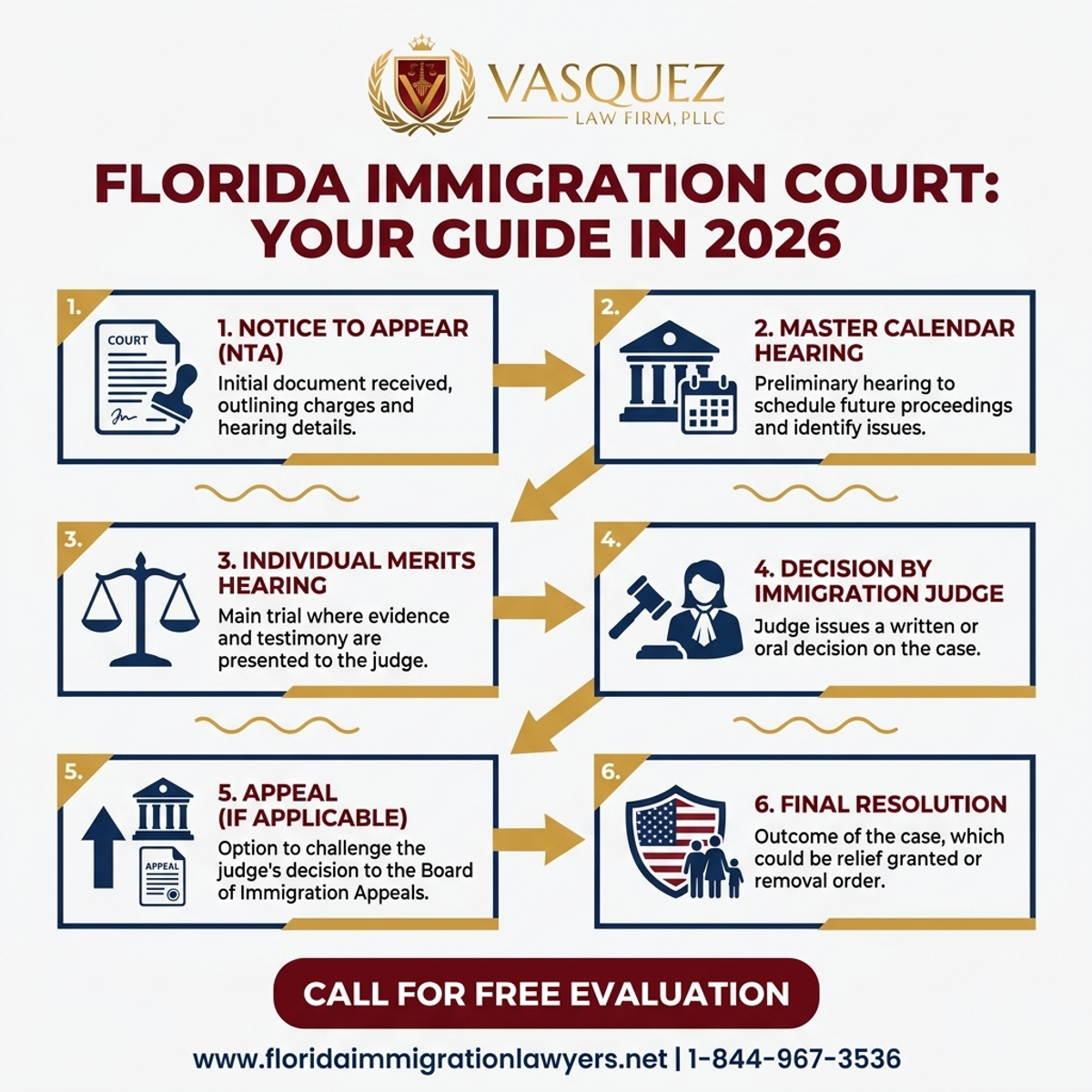
Removal proceedings in Florida, governed by Section 240 of the Immigration and Nationality Act (INA), typically follow a structured multi-stage process, beginning with the issuance of a Notice to Appear (NTA). This document formally charges a non-citizen with being deportable or inadmissible and initiates their case before an Immigration Judge. The stages are designed to ensure due process while allowing the government to enforce immigration laws. Each step requires careful attention to detail and adherence to strict deadlines, making legal counsel invaluable throughout the process.
-
Notice to Appear (NTA) & Initial Filing: The process begins when the Department of Homeland Security (DHS) issues an NTA, which lists the allegations against you and the charges of deportability or inadmissibility. This document is filed with the immigration court, officially starting your case. You will receive a copy of the NTA, which includes the date and time of your first hearing, known as the Master Calendar Hearing.
-
Master Calendar Hearing (MCH): This is your initial appearance before an Immigration Judge (IJ). During the MCH, the IJ will confirm your identity, ensure you understand the charges in the NTA, and ask you to admit or deny those charges. You will also be asked to state what forms of relief from removal, if any, you intend to pursue. It's crucial to have legal representation at this stage to properly respond to the charges and identify potential defenses. The IJ will then set deadlines for filing applications for relief and schedule individual hearings.
-
Filing Applications for Relief: If you are eligible for a form of relief, such as asylum, cancellation of removal, adjustment of status, or another waiver, you must file the appropriate application with the court by the deadline set by the IJ. This often involves extensive documentation and detailed affidavits. For example, asylum claims require filing Form I-589, Application for Asylum and for Withholding of Removal, within one year of your last arrival in the U.S., unless an exception applies. These applications are central to your defense against deportation.
-
Individual Hearing (Merits Hearing): This is the substantive hearing where you present your case for relief from removal. You will testify, present evidence, and may call witnesses. The government attorney will also present their case and cross-examine you and your witnesses. The Immigration Judge will review all evidence and testimony. This hearing is often lengthy and requires thorough preparation. For those seeking asylum, this is where you detail your fear of persecution.
-
Decision by the Immigration Judge: After the individual hearing, the IJ will issue a decision, either orally in court or in writing at a later date. The judge will determine whether you are removable as charged and whether you qualify for any relief from removal you sought. If relief is granted, your case may be terminated or adjusted. If relief is denied and you are ordered removed, you have the right to appeal.
-
Appeals Process: If either you or the government are dissatisfied with the IJ's decision, you can appeal to the Board of Immigration Appeals (BIA) within 30 days. The BIA reviews the IJ's decision for legal errors. Further appeals can be made to a U.S. Circuit Court of Appeals, and in rare cases, to the U.S. Supreme Court. This appellate process can add significant time to your case, but it provides a critical avenue for correcting errors.
What documents are required for immigration court in 2026?
For immigration court proceedings in 2026, the specific documents required depend heavily on the type of relief you are seeking, but generally include identity documents, proof of entry, and extensive supporting evidence for your claims. Failure to provide necessary documentation can lead to delays or denial of your case, making a comprehensive checklist and meticulous organization essential. An experienced attorney can help you compile the correct paperwork to present a strong case.
Essential Document Checklist for Immigration Court
Preparing for immigration court in Florida requires meticulous documentation. The types of documents you'll need vary based on your specific case and the relief you are seeking. However, a core set of documents is almost always necessary. This list is not exhaustive, and your attorney will provide a tailored list based on your unique circumstances. It's vital to provide both originals and copies, and ensure all foreign language documents are accompanied by certified English translations.
- Identity and Biographic Documents:
- Passport, birth certificate, national identity card.
- Any U.S. immigration documents (I-94, visa, EAD, green card).
- Marriage certificates, birth certificates of children, divorce decrees (if applicable).
- Proof of U.S. residence (utility bills, lease agreements, property deeds).
- Proof of Entry and Presence:
- I-94 arrival/departure record.
- Travel history records.
- School records, employment records, tax returns showing continuous presence.
- Evidence for Relief Applications:
- Asylum: Detailed declaration of persecution, country condition reports, medical records, police reports, witness affidavits.
- Cancellation of Removal: Proof of continuous physical presence (tax returns, employment records, school records), proof of good moral character (police clearances, letters of recommendation), evidence of exceptional and extremely unusual hardship to qualifying relatives (medical records, psychological evaluations, financial statements).
- Adjustment of Status: Proof of qualifying relationship (marriage certificate, birth certificate), financial sponsorship documents (I-864 Affidavit of Support), medical examination results, criminal background checks.
- Waivers (e.g., I-601, I-212): Evidence of hardship, good moral character, rehabilitation, and statutory eligibility.
Step-by-Step Process — Immigration Court Proceedings Florida: Your Guide in 2026
- Financial Documents:
- Tax returns (past 5 years).
- Employment letters and pay stubs.
- Bank statements, property ownership documents.
- Character and Community Ties:
- Letters of recommendation from employers, community leaders, family members.
- Proof of community involvement, volunteer work.
- Police clearance certificates from all places of residence.
It is crucial to remember that the burden of proof often lies with the respondent to demonstrate eligibility for relief. Therefore, gathering comprehensive, credible, and well-organized documentation is a cornerstone of a successful defense in immigration court. Working with a skilled attorney ensures no critical documents are overlooked and that your evidence is presented effectively. You can find more information on required forms and processes on the official USCIS website and EOIR website.
How long do immigration court cases take in Florida as of 2026?
As of 2026, the duration of immigration court cases in Florida can vary significantly, typically ranging from 1 to 5 years, or even longer for complex cases or those involving appeals. Factors such as court backlogs, the complexity of the legal issues, the availability of an Immigration Judge, and the specific type of relief sought all contribute to the overall timeline. The Executive Office for Immigration Review (EOIR) continues to face a substantial caseload, impacting processing times across all Florida immigration courts. This prolonged waiting period underscores the importance of consistent legal representation and meticulous case management.
Immigration Court Case Timeline Expectations (As of 2026)
Understanding the typical timeline for immigration court proceedings in Florida is essential for planning and managing expectations. Keep in mind that these are general estimates, and individual cases may proceed faster or slower based on specific circumstances.
| Stage | Typical Timeframe | Notes |
|---|---|---|
| Issuance of NTA to First MCH | 3 months - 2 years | Highly dependent on court backlog and DHS priorities. Detained cases are expedited. |
| Master Calendar Hearings | 3-12 months | Multiple MCHs may be scheduled to address charges, discuss relief, and set deadlines. |
| Filing Applications for Relief | Deadlines set by IJ (e.g., 90-180 days after MCH) | Strict deadlines. Extensions are rare and require good cause. |
| Individual Hearing (Merits) | 6 months - 3 years after MCH | Longest waiting period due to court dockets. Can be several hours to multiple days. |
| IJ Decision | Immediately after hearing or up to 6 months later | Oral decisions are common; written decisions may take longer. |
| Appeal to BIA | 1-3 years | Filed within 30 days of IJ decision. BIA reviews legal arguments and record. |
| Appeal to Circuit Court | 1-3 years | Only for legal errors, not factual findings. Requires a higher level of review. |
The total duration can be significantly affected by factors such as the complexity of the case, the need for continuances, the availability of witnesses or evidence, and the overall volume of cases in Florida's immigration courts, particularly in busy locations like Miami. For individuals in detention, cases are generally expedited, but even these can take several months. Proactive case management and timely responses to court requests are vital to avoid unnecessary delays.
Understanding Costs and Fees for Immigration Court Cases
The financial aspects of immigration court proceedings in Florida can be a significant concern for respondents. Costs generally fall into two main categories: government filing fees and legal fees for attorney representation. Government filing fees are set by USCIS or EOIR and apply to specific applications for relief, such as asylum (though no fee for initial asylum application), adjustment of status, or waivers. These fees are subject to change, so it's always best to check the latest fee schedule on the official government websites. Legal fees, on the other hand, cover the extensive work performed by your attorney, including case preparation, legal research, court appearances, and communication with government agencies. While legal fees represent an investment, the value of experienced representation in potentially life-altering removal proceedings cannot be overstated. Many firms, including Florida Immigration Lawyers, offer flexible payment plans to make legal assistance more accessible. It's important to have a clear understanding of all potential costs upfront.
Typical Costs Associated with Immigration Court Cases (As of 2026)
Below is a general overview of potential costs. Please note that these figures are estimates and can change. Always consult with your attorney for precise figures and check official government sources for the most current filing fees.
| Item | Typical Fee | Notes |
|---|---|---|
| Application for Asylum (Form I-589) | $0 | No filing fee for the initial asylum application. |
| Application for Adjustment of Status (Form I-485) | Variable (often $1,225) | Plus biometrics fee. Check USCIS website for current fee. May be filed in court. |
| Application for Waiver of Grounds of Inadmissibility (Form I-601) | Variable (often $930) | Required for certain inadmissibility issues. Check USCIS website for current fee. |
| Motion to Reopen/Reconsider | Variable (often $89) | Filed with the Immigration Court or BIA to ask for a new review. |
| Appeal to Board of Immigration Appeals (Form EOIR-26) | Variable (often $110) | Fee to appeal an IJ's decision. Fee waivers may be available. |
| Legal Fees (Attorney Representation) | Highly Variable ($5,000 - $15,000+) | Depends on complexity of case, number of hearings, and type of relief sought. Flat fees or hourly rates. |
| Translation Services | Variable ($25-$75 per page) | Required for all non-English documents. |
| Expert Witness Fees | Variable ($500 - $5,000+) | For psychologists, country condition experts, etc., if needed for your case. |
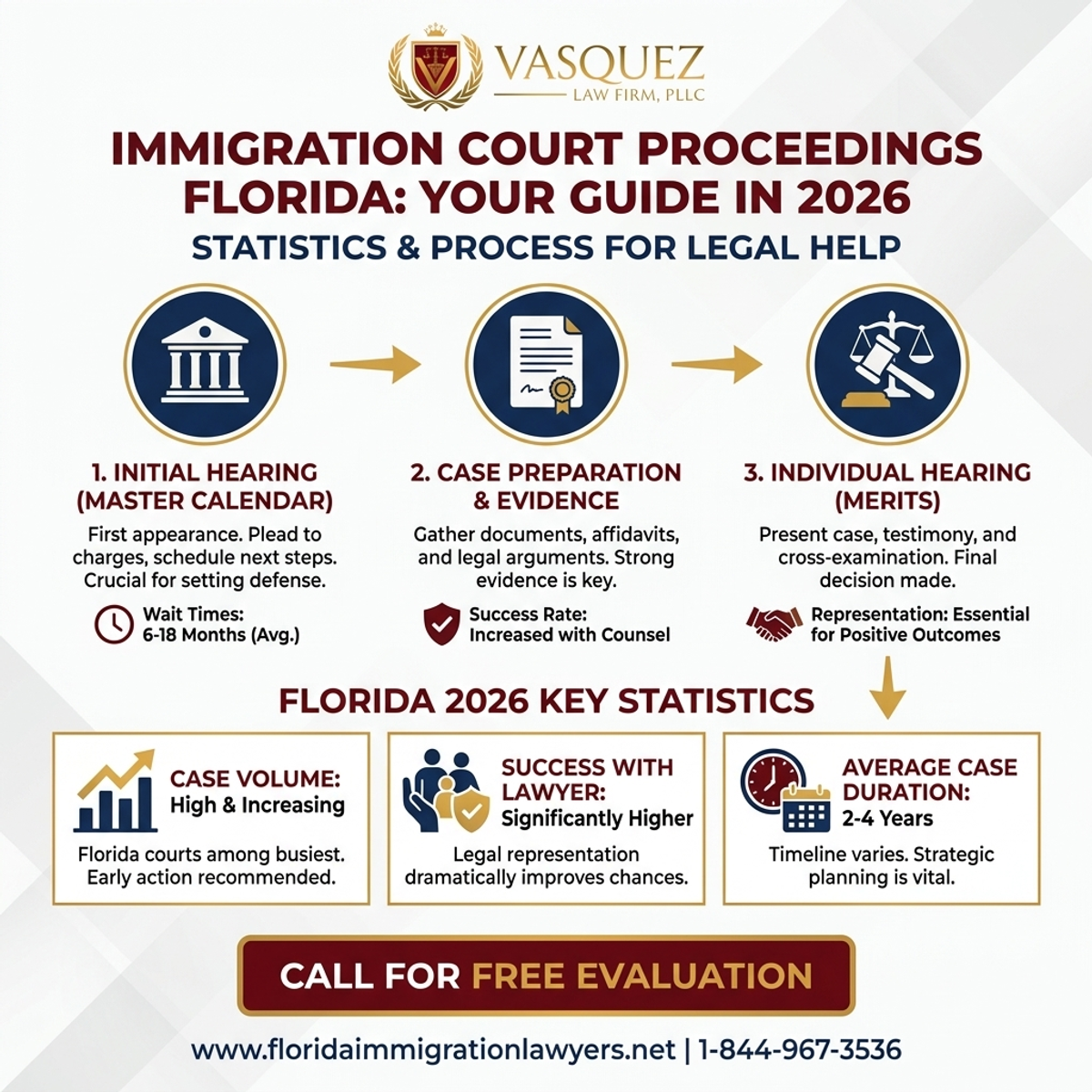
Key Statistics — Immigration Court Proceedings Florida: Your Guide in 2026
Many individuals facing removal proceedings may be eligible for fee waivers for certain government applications if they can demonstrate financial hardship. It is crucial to discuss your financial situation with your attorney to explore all available options for managing costs. Investing in quality legal representation can often prevent costly mistakes and improve the likelihood of a positive outcome, ultimately saving you money and stress in the long run. We encourage you to schedule a free consultation with Florida Immigration Lawyers to understand the specific costs associated with your case.
Defenses and Relief from Removal in Florida Immigration Court
When facing removal proceedings in Florida, understanding the available defenses and forms of relief is paramount. An experienced immigration attorney can assess your eligibility for various options that may allow you to remain in the United States. These forms of relief are statutory and regulatory, meaning they are defined by the Immigration and Nationality Act (INA) and its corresponding regulations (8 CFR). The most common forms of relief include asylum and withholding of removal (INA 208), cancellation of removal (INA 240A), and adjustment of status (INA 245). Each form of relief has specific eligibility criteria that must be met, and the burden of proof typically lies with the respondent to demonstrate that they qualify. For example, a successful asylum claim requires demonstrating a well-founded fear of persecution on account of race, religion, nationality, political opinion, or membership in a particular social group. Similarly, cancellation of removal for non-permanent residents requires demonstrating 10 years of continuous physical presence, good moral character, and exceptional and extremely unusual hardship to a qualifying U.S. citizen or lawful permanent resident spouse, parent, or child. Other forms of relief may include waivers of inadmissibility, voluntary departure, or prosecutorial discretion. The specific facts of your case, your immigration history, and any criminal record will significantly influence which defenses are viable. Florida Immigration Lawyers are adept at identifying and pursuing all possible avenues of relief for our clients.
Common Mistakes to Avoid in Immigration Court Proceedings
Navigating immigration court proceedings in Florida is complex, and even minor errors can have significant consequences. Avoiding these common mistakes can greatly improve your chances of a favorable outcome.
-
Missing Court Hearings: Failing to appear for a Master Calendar Hearing or Individual Hearing can result in an in absentia removal order, meaning you are ordered deported without your presence. This is one of the most serious mistakes, and challenging such an order is extremely difficult.
-
Not Filing Applications on Time: Immigration courts have strict deadlines for filing applications for relief, such as asylum (often a one-year deadline from entry) or cancellation of removal. Missing these deadlines can lead to outright denial of your ability to apply for crucial relief.
-
Lying or Misrepresenting Facts: Any false statements or fraudulent documents submitted to the court or USCIS can severely damage your credibility and lead to permanent bars from immigration benefits. Always be truthful and transparent.
-
Not Understanding the Charges: Many respondents fail to fully understand the allegations in their Notice to Appear (NTA). Incorrectly admitting to charges or failing to challenge them can weaken your entire defense. An attorney ensures you understand and respond appropriately.
-
Inadequate Documentation: Presenting insufficient or poorly organized evidence to support your claims for relief is a common pitfall. Comprehensive and credible documentation is vital for asylum, cancellation, and other applications.
-
Lack of Legal Representation: Attempting to represent yourself in immigration court is highly risky. Immigration law is incredibly complex, and a non-citizen without an attorney is significantly less likely to win their case compared to those with legal counsel.
-
Failing to Disclose Criminal History: Attempting to conceal past arrests or convictions, even minor ones, can be disastrous. Immigration judges and government attorneys have access to criminal records, and non-disclosure can lead to severe penalties, including bars to relief.
-
Not Updating Contact Information: Moving without notifying the immigration court (EOIR) of your new address can lead to you missing crucial notices, including hearing dates, which can result in an in absentia removal order.
-
Not Preparing for Testimony: Your testimony is a critical part of your case. Failing to prepare adequately for direct examination and cross-examination can undermine your credibility and weaken your claims. Your attorney will help you prepare thoroughly.
-
Ignoring an Appeal Deadline: If an Immigration Judge denies your case, you typically have 30 days to file an appeal with the Board of Immigration Appeals (BIA). Missing this deadline means you forfeit your right to challenge the decision, making the removal order final.
When to Call a Lawyer for Immigration Court Proceedings
Given the high stakes and intricate nature of immigration court proceedings in Florida, knowing when to seek legal counsel is critical. The short answer is: as soon as possible. Ideally, you should contact an immigration attorney immediately upon receiving any notice from immigration authorities, such as a Notice to Appear (NTA), or if you are detained by ICE. An experienced attorney can assess your situation, explain the charges against you, and help you understand your options for relief from removal. They will ensure all documents are filed correctly and on time, represent you in court, and advocate tirelessly on your behalf. Specific scenarios that absolutely warrant contacting a lawyer include being placed in removal proceedings, facing detention, having a criminal record, seeking asylum, or needing to appeal an unfavorable decision. Even if your case seems straightforward, the nuances of immigration law are vast, and a misstep can have irreversible consequences. Florida Immigration Lawyers are available 24/7 to provide immediate assistance and strategic guidance, protecting your rights from the very beginning of your case. Don't wait until it's too late; proactive legal engagement is your best defense.
About Florida Immigration Lawyers
Florida Immigration Lawyers is a leading law firm dedicated to providing comprehensive and compassionate legal representation to immigrants across the entire state of Florida. With offices strategically located to serve communities from Tampa to Miami, our team of highly skilled attorneys focuses on all aspects of immigration law, including complex immigration court proceedings in Florida, deportation defense, asylum claims, family-based immigration, and citizenship applications. We understand that each client's journey is unique and often challenging, which is why we approach every case with personalized attention and unwavering commitment. Our firm is proud to offer bilingual services, ensuring that all clients receive clear and effective communication. We are available 24/7 for free consultations, ready to provide immediate support and strategic advice. When your future in the U.S. is at stake, trust Florida Immigration Lawyers to be your steadfast advocate. Call us at 1-844-YO-PELEO or visit our website to learn how we can help you navigate the immigration system successfully.
Sources and References
- U.S. Citizenship and Immigration Services (USCIS)
- Executive Office for Immigration Review (EOIR)
- 8 U.S.C. Chapter 12 - Immigration and Nationality Act (INA)
- INA Section 240 - Removal Proceedings
- INA Section 208 - Asylum
- INA Section 240A - Cancellation of Removal
- 8 CFR (Code of Federal Regulations) - Immigration Regulations
Related services: immigration waivers, humanitarian protection programs, DACA renewal and applications, temporary protected status (TPS).
This article provides general legal information and is not intended as legal advice. Every case is unique, and outcomes depend on specific facts and circumstances. Contact an attorney for advice about your particular situation. Immigration laws are subject to frequent change.
Navigating immigration court proceedings in Florida requires expertise, diligence, and a robust legal strategy. Don't face this critical juncture alone. Florida Immigration Lawyers is here to offer the professional guidance and zealous representation you deserve. We are committed to protecting your rights and fighting for your future. Take the first step towards a positive outcome by scheduling your free consultation today. Call us at 1-844-YO-PELEO. Se Habla Español - Estamos aquí para ayudarle.
If you need legal assistance, learn more about learn about deportation defense options, or call us at 1-844-YO-PELEO for a free consultation.
Do Not Navigate This Process Alone
Our experienced immigration attorneys are ready to fight for you. Get a free, confidential case review today.
Se Habla Español
Or leave your details and we’ll call you:
Free Evaluation in 24 Hours
Or talk to us right now

AI voice assistant — available 24/7
FreeFrequently Asked Questions

William J. Vásquez
Founding Attorney · Vasquez Law Firm
U.S. Air Force veteran and immigration attorney with years of hands-on U.S. immigration experience. J.D., NCCU School of Law. AILA member. Admitted to the 4th, 5th, and 11th Circuit Courts.
Available 24/7 - Free Evaluations
Reviewed for legal accuracy by William J. Vásquez
Licensed in North Carolina; U.S. immigration is federal practice.
Related Legal Services
Our Florida immigration attorneys can help you with free immigration consultation, business immigration and deportation defense. Call today at 1-844-YO-PELEO for a free case review.
Related Links
Related Topics
Free Legal Case Review
Discuss your case with our experienced attorneys. We're available 24/7.
Se Habla Español - Estamos aquí para ayudarle.
Related Articles
DUI Immigration Consequences in Florida 2026
A DUI conviction in Florida can have severe immigration consequences, potentially leading to inadmissibility, deportation, or denial of immigration benefits. For non-citizens, a DUI is not just a traffic offense but a serious criminal matter that federal immigration law scrutinizes closely. Factors like multiple offenses, injury, or property damage can escalate a simple DUI to a Crime Involving Moral Turpitude (CIMT) or even an aggravated felony, triggering mandatory detention and removal proceedings. Understanding the specific nature of your Florida conviction and its interpretation under the Immigration and Nationality Act (INA) is crucial. This article outlines how DUIs impact immigration status, the grounds for inadmissibility and deportation, a step-by-step guide to navigating the process, essential documentation, and expected timelines for 2026. We also highlight common mistakes to avoid and when to seek legal counsel from an experienced immigration attorney. Florida Immigration Lawyers offers comprehensive support for individuals facing these challenging situations, providing expert guidance through complex legal landscapes.
Dual Citizenship Lawyer in Florida: What You Need to Know
For Florida residents, the concept of dual citizenship, or holding two passports, offers a compelling blend of opportunities and challenges. While the U.S. generally permits dual nationality, the path to achieving this status requires a meticulous understanding of both U.S. immigration laws and the citizenship policies of your country of origin. This guide explores the definition of dual citizenship, the detailed step-by-step process for U.S. naturalization, and the significant benefits and potential pitfalls involved. We cover essential documentation, typical timelines, and cost considerations for 2026, providing crucial insights for anyone in Orlando, Miami, or across Florida considering this important legal step. Learn about common mistakes to avoid and understand when to seek professional legal counsel to navigate this complex process successfully. Florida Immigration Lawyers is here to provide expert, bilingual support for your dual citizenship journey.
EAD Advance Parole Combo Card in Florida 2026
For individuals with a pending Form I-485, Application to Register Permanent Residence or Adjust Status, the EAD Advance Parole Combo Card is an essential document. This single card combines the authorization to work legally in the U.S. (Employment Authorization Document - EAD) with permission to travel internationally and re-enter without abandoning your green card application (Advance Parole). This guide from Florida Immigration Lawyers provides a comprehensive overview for applicants in Florida in 2026, covering eligibility, the step-by-step application process, required documents, expected processing times, and associated costs. We also highlight common mistakes to avoid and when to seek legal counsel to ensure a smooth and successful immigration journey. Understanding this vital card is key to maintaining stability while awaiting your permanent residency approval.
EAD Advance Parole Combo Card in Florida: What You Need
An EAD advance parole combo card allows individuals with pending adjustment applications to both work and travel abroad without jeopardizing their green card application. Learn how to apply in Florida, what documents you need, and common mistakes to avoid.