Unlawful Presence Waiver Florida: A 2026 Guide
Navigating the I-601A Provisional Unlawful Presence Waiver in Florida is a critical step for many seeking lawful permanent residency. This comprehensive guide for 2026 explains who is eligible, the detailed application process, required documentation, and what to expect regarding timelines and costs. We delve into the crucial concept of 'extreme hardship' and highlight common mistakes to avoid. Whether you're in Jacksonville, Miami, or anywhere in Florida, understanding this waiver is essential. Florida Immigration Lawyers provides legal assistance to help you overcome inadmissibility due to unlawful presence and reunite your family.
An unlawful presence waiver in Florida, specifically the I-601A Provisional Unlawful Presence Waiver, allows certain individuals who are inadmissible to the U.S. solely due to unlawful presence to seek a waiver before departing the country for their immigrant visa interview. This critical process, managed by USCIS, helps qualifying individuals avoid a lengthy separation from family. To be eligible in 2026, applicants must generally be immediate relatives of U.S. citizens or lawful permanent residents, demonstrate extreme hardship to a qualifying relative, and meet other specific criteria. Seeking legal counsel from a Florida immigration lawyer is highly recommended to navigate this complex process effectively.
- The I-601A waiver addresses inadmissibility due to unlawful presence.
- It allows waiver processing in the U.S. before the consular interview abroad.
- Applicants must prove extreme hardship to a U.S. citizen or LPR spouse or parent.
- Eligibility is generally limited to immediate relatives of U.S. citizens or LPRs.
- Consulting an attorney is crucial for a successful application in Florida.
For many individuals living in Florida, the dream of obtaining lawful permanent residency is often complicated by a period of unlawful presence in the United States. This can trigger a significant bar to re-entry, making it impossible to adjust status or return after an overseas visa interview. Fortunately, the I-601A Provisional Unlawful Presence Waiver offers a pathway to overcome this challenge, allowing eligible applicants to seek a waiver from within the U.S. before attending their immigrant visa interview abroad. Navigating this intricate process, especially from areas like Jacksonville, requires a deep understanding of immigration law and meticulous preparation.
At Florida Immigration Lawyers, we understand the anxieties and uncertainties that come with immigration challenges. Our dedicated team is committed to guiding you through every step of the I-601A waiver application, ensuring your case is presented effectively and comprehensively. If you believe you or a loved one may benefit from an unlawful presence waiver in Florida, do not hesitate to seek legal assistance. Call Florida Immigration Lawyers at 1-844-YO-PELEO for a free consultation today and let us help you pursue your path to legal residency.
What is an Unlawful Presence Waiver (I-601A) in Florida?
An I-601A Provisional Unlawful Presence Waiver, often simply called an unlawful presence waiver, is a crucial immigration tool designed for individuals who are inadmissible to the United States solely because they accrued more than 180 days of unlawful presence. This waiver allows them to seek forgiveness for their unlawful presence before they leave the U.S. to attend their immigrant visa interview at a U.S. consulate or embassy abroad. As of 2026, the I-601A waiver significantly reduces the time U.S. citizen and lawful permanent resident (LPR) relatives are separated from their loved ones, providing a more streamlined path to family reunification.
The concept of unlawful presence is defined under Section 212(a)(9)(B) of the Immigration and Nationality Act (INA). This section outlines that individuals who have been unlawfully present in the U.S. for more than 180 days but less than one year, and who then depart, are barred from re-entry for three years. If their unlawful presence exceeds one year, the bar extends to ten years. The I-601A waiver directly addresses these 3-year and 10-year bars. Without this waiver, individuals would have to leave the U.S. and then apply for a traditional I-601 waiver abroad, facing an unknown period of separation from their families while the waiver is processed. The provisional waiver offers a significant advantage by allowing much of the processing to occur while the applicant remains in Florida with their family.
It is important to understand that the I-601A waiver only covers inadmissibility due to unlawful presence. It does not waive other grounds of inadmissibility, such as certain criminal convictions, misrepresentations, or prior deportation orders. For example, if an applicant in Jacksonville has a criminal record that makes them inadmissible, they may need to seek a separate waiver for that ground of inadmissibility, often requiring an I-601 Application for Waiver of Grounds of Inadmissibility. Our firm helps clients in Florida, including those near the USCIS field office in Jacksonville, understand all potential inadmissibility issues and determine the most appropriate legal strategy for their unique circumstances.
Who is Eligible for the I-601A Provisional Waiver in 2026?
As of 2026, eligibility for the I-601A Provisional Unlawful Presence Waiver is specific and stringent. Applicants must meet several key criteria to be considered. Generally, you must be physically present in the United States at the time of filing your Form I-601A, be at least 17 years old, and be the beneficiary of an approved Form I-130, Petition for Alien Relative, or Form I-360, Petition for Amerasian, Widow(er), or Special Immigrant, that classifies you as an immediate relative of a U.S. citizen or lawful permanent resident (LPR).
Furthermore, you must demonstrate to USCIS that refusal of your admission to the U.S. would result in extreme hardship to your U.S. citizen or LPR spouse or parent. This is a critical component of the application, requiring compelling evidence of severe impact. You must also be seeking an immigrant visa through a U.S. Embassy or Consulate abroad, and your departure from the U.S. for the immigrant visa interview must be the only remaining hurdle to your admissibility, meaning you are not subject to any other grounds of inadmissibility beyond unlawful presence. For instance, if you are living in Miami or Orlando and have a U.S. citizen spouse, you might be eligible, provided you meet all other criteria. Our attorneys regularly assist clients across Florida, from Tampa to Gainesville, in assessing their eligibility for this crucial waiver.
In addition to these primary requirements, there are certain exclusions. You are generally not eligible if you are in removal proceedings, unless those proceedings have been administratively closed and not recalendared, or if you have a final order of removal or deportation. Individuals who have previously been granted an I-212 permission to reapply after deportation or removal may also face complexities. It is also important to have a qualifying relative who is a U.S. citizen or LPR. The qualifying relative cannot be a U.S. citizen or LPR child. Understanding these nuances is vital, and a detailed assessment by an experienced immigration lawyer in Florida is essential to determine if the I-601A waiver is the right path for you.
How Do I Apply for an I-601A Provisional Waiver in Florida?
Applying for an I-601A Provisional Unlawful Presence Waiver in Florida involves several precise steps, beginning with securing an approved immigrant visa petition and culminating in a consular interview abroad. The process is designed to be completed in the U.S. for the waiver portion, minimizing the time a family is separated. As of 2026, meticulous preparation and adherence to USCIS guidelines are paramount for a successful outcome.
Step-by-Step Application Process
- Approved Immigrant Visa Petition: The first step is to have an approved Form I-130, Petition for Alien Relative, filed by a U.S. citizen or LPR spouse or parent. This establishes your eligibility as an immediate relative.
- Pay Immigrant Visa Processing Fee: Once the I-130 is approved, the National Visa Center (NVC) will contact you to pay the immigrant visa processing fee and submit required civil documents.
- File Form I-601A: After the NVC confirms receipt of your fees and documents, you can file Form I-601A, Application for Provisional Unlawful Presence Waiver, with USCIS. You must be physically present in the U.S. when you file.
- Attend Biometrics Appointment: USCIS will send you an appointment notice for biometrics collection (fingerprints, photograph, signature) at an Application Support Center (ASC) in Florida, such as the one in Jacksonville or Orlando.
- Await USCIS Decision: USCIS will review your application and the evidence of extreme hardship. This can take several months. If approved, you will receive an approval notice.
- Attend Consular Interview Abroad: With an approved I-601A waiver, you will attend your immigrant visa interview at the U.S. Embassy or Consulate in your home country. The approval of the waiver does not guarantee visa issuance, as the consular officer will review all aspects of your case.
- Re-enter the U.S. as a Lawful Permanent Resident: If the consular officer approves your immigrant visa, you will be able to re-enter the U.S. as a lawful permanent resident, often receiving your green card shortly thereafter.
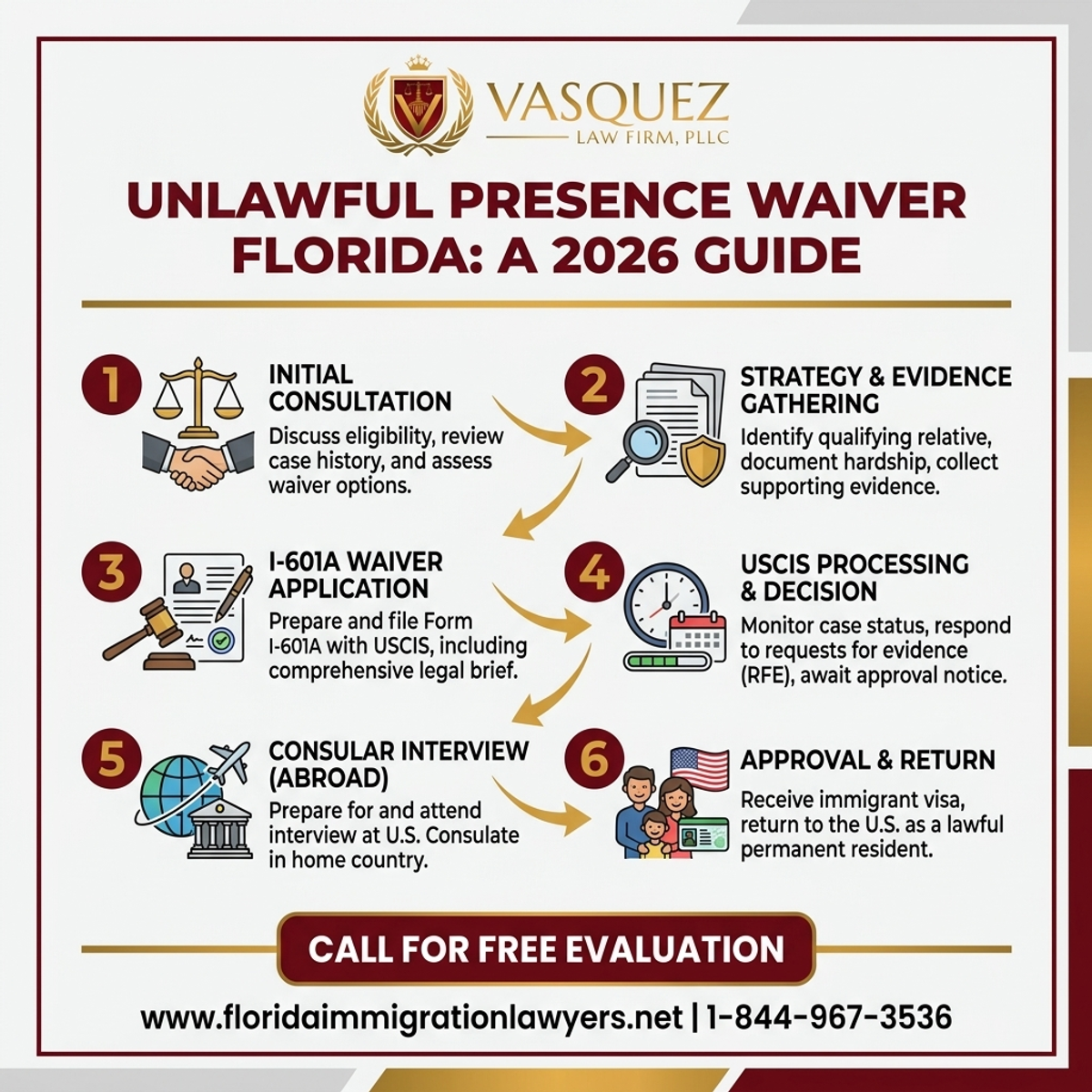
Step-by-Step Process — Unlawful Presence Waiver Florida: A 2026 Guide
Each stage requires careful attention to detail. For instance, gathering all necessary civil documents for the NVC stage, such as birth certificates, marriage certificates, and police records, is crucial. Moreover, the extreme hardship evidence for the I-601A must be robust and compelling, clearly demonstrating the severe and unusual impact on your qualifying relative. Our Florida Immigration Lawyers team can assist you in preparing all necessary forms and compiling a strong evidentiary package.
What Documents Do I Need for an Unlawful Presence Waiver Application?
A successful unlawful presence waiver application hinges on a meticulously prepared collection of documents. Beyond the standard USCIS forms, applicants must provide substantial evidence to support their claim of extreme hardship to a qualifying U.S. citizen or lawful permanent resident spouse or parent. As of 2026, USCIS requires comprehensive documentation to make a favorable decision.
Comprehensive Document Checklist
- Form I-601A: The completed and signed Application for Provisional Unlawful Presence Waiver.
- Proof of Approved Immigrant Visa Petition: Copy of Form I-797, Approval Notice, for the Form I-130 or I-360 petition.
- Proof of Immigrant Visa Processing Fee Payment: Copy of the receipt for the immigrant visa application processing fee paid to the Department of State.
- Proof of Identity and Nationality: Copy of your passport biographic page, birth certificate, and any other national identity documents.
- Evidence of U.S. Citizen or LPR Qualifying Relative: Copy of the qualifying relative's U.S. birth certificate, U.S. passport, Certificate of Naturalization, or Green Card (Form I-551).
- Proof of Relationship: Marriage certificate for a spouse, birth certificate for a parent-child relationship.
- Proof of Physical Presence in the U.S.: Records showing you were physically present in the U.S. on December 21, 2012, if applicable, or general proof of continuous presence.
- Extreme Hardship Documentation: This is the most critical component. It includes, but is not limited to:
- Medical records, doctor's letters, and therapy reports detailing any serious health conditions of the qualifying relative that require your care or support.
- Financial records (tax returns, pay stubs, bank statements, debt statements) demonstrating the qualifying relative's financial dependence on you or severe financial hardship if you depart.
- Psychological evaluations or letters from mental health professionals detailing the emotional and psychological impact of your absence on the qualifying relative.
- Evidence of significant educational disruption for the qualifying relative if they were to relocate or if you were absent.
- Proof of community ties and social integration for the qualifying relative, showing disruption to their life in Florida if you are removed.
- Country conditions reports for your home country that would impact the qualifying relative if they were to join you.
- Police Clearances: If required by the NVC or consular post for your immigrant visa.
- Passport-style Photographs: As per USCIS specifications.
Collecting these documents, especially the evidence for extreme hardship, can be overwhelming. An experienced Florida immigration attorney can help you identify and organize the most compelling evidence to support your I-601A application, ensuring no critical piece of information is overlooked.
How Long Does the I-601A Provisional Waiver Process Take in 2026?
The processing time for an I-601A Provisional Unlawful Presence Waiver can vary significantly based on USCIS caseloads and individual case complexities. As of 2026, applicants in Florida should anticipate a multi-stage process, with each stage having its own typical timeframe. While USCIS aims for efficiency, patience is key, and preparing for potential delays is advisable.
I-601A Processing Timelines and Expectations
| Stage | Typical Timeframe (As of 2026) | Notes |
|---|---|---|
| Form I-130 Petition Approval | 10-18 months | This initial petition must be approved before filing I-601A. |
| NVC Processing (after I-130 approval) | 2-6 months | Payment of fees, submission of civil documents. |
| Form I-601A Processing by USCIS | 12-24 months | This is the main waiver processing time after filing I-601A. Check USCIS website for current processing times for the Potomac Service Center. |
| Biometrics Appointment | 3-8 weeks after filing I-601A | Scheduled at a local Application Support Center (ASC) in Florida. |
| Consular Interview Scheduling | 1-4 months after I-601A approval | Depends on the specific U.S. Embassy or Consulate abroad. |
| Immigrant Visa Issuance | Days to weeks after interview | Upon approval at the consular interview. |
It's crucial to regularly check the USCIS processing times website for the most up-to-date information, as these estimates can fluctuate. For applicants in Florida, the entire journey from filing the initial I-130 to receiving the green card can realistically take anywhere from 2 to 4 years. Factors influencing these timelines include the complexity of your extreme hardship case, the volume of applications at USCIS and the National Visa Center, and the efficiency of the specific U.S. Embassy or Consulate handling your interview.
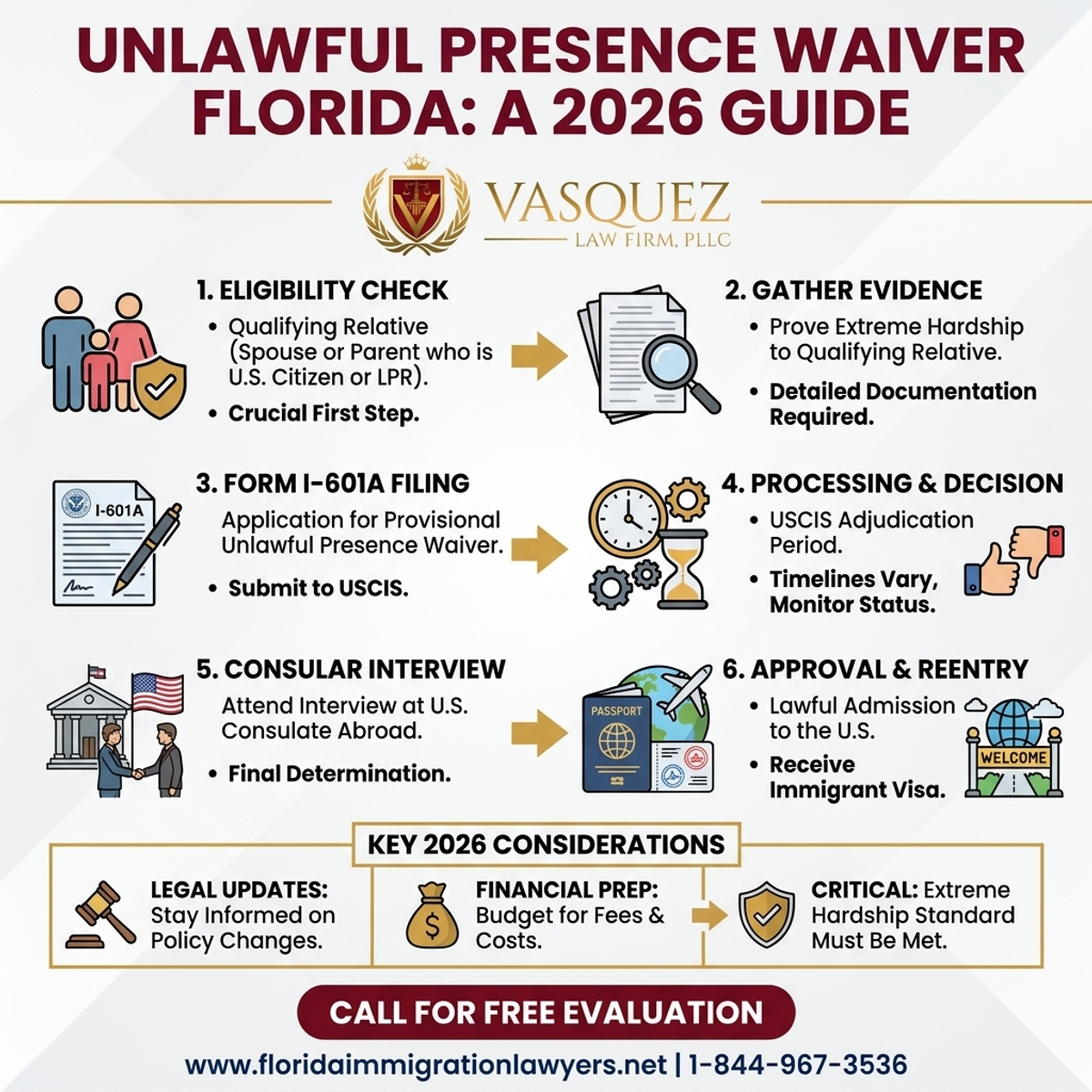
Key Statistics — Unlawful Presence Waiver Florida: A 2026 Guide
Delays can occur if USCIS issues a Request for Evidence (RFE), requiring additional documentation to support your claim. Responding promptly and thoroughly to an RFE is critical to avoid further delays or even a denial. Our attorneys at Florida Immigration Lawyers help clients in Orlando and across the state prepare comprehensive applications that minimize the likelihood of RFEs and streamline the process as much as possible.
What are the Costs Associated with the I-601A Waiver Application?
The financial aspect of applying for an unlawful presence waiver is an important consideration for many families in Florida. As of 2026, there are several fees associated with the I-601A Provisional Unlawful Presence Waiver process, including government filing fees and potential legal service fees. It is important to note that government fees are subject to change, and applicants should always verify the most current amounts on the official USCIS website.
Estimated I-601A Application Fees
| Item | Typical Fee (As of 2026) | Notes |
|---|---|---|
| Form I-130, Petition for Alien Relative | Varies (Check USCIS website) | This is the initial petition filed by the U.S. citizen or LPR relative. |
| Form I-601A, Application for Provisional Unlawful Presence Waiver | Varies (Check USCIS website) | The primary fee for the waiver application itself. |
| Biometrics Services Fee | Varies (Check USCIS website) | Included with the I-601A filing fee in many cases. |
| Immigrant Visa Application Processing Fee (DS-260) | Varies (Check Department of State website) | Paid to the National Visa Center for consular processing. |
| Medical Examination Fee | Varies (Paid to designated physician) | Required before the consular interview. Costs depend on location and provider. |
| Immigrant Fee (USCIS Immigrant Visa Fee) | Varies (Check USCIS website) | Paid to USCIS after visa approval, before receiving the Green Card. |
| Attorney Legal Fees | Varies significantly based on case complexity and firm | Covers legal counsel, preparation of forms, evidence compilation, and representation. |
While government fees are non-negotiable, investing in experienced legal counsel can be invaluable. An immigration attorney helps ensure your application is complete, accurate, and includes all necessary evidence to demonstrate extreme hardship, significantly increasing your chances of approval. This can prevent costly delays, Requests for Evidence (RFEs), or even denials that would require refiling and additional fees. For families in Florida, from Pensacola to Fort Lauderdale, understanding these financial commitments upfront is crucial for planning.
It is important to budget not only for the government filing fees but also for potential costs such as translation services for foreign documents, obtaining certified copies of records, and travel expenses for biometrics appointments and the consular interview abroad. Our team at Florida Immigration Lawyers offers transparent fee structures and can discuss the expected costs during your free consultation, helping you prepare financially for this important journey.
Understanding "Extreme Hardship" for I-601A Waivers
The concept of "extreme hardship" is the cornerstone of any successful I-601A Provisional Unlawful Presence Waiver application. USCIS does not have a precise regulatory definition for extreme hardship, making it a highly subjective and often challenging element to prove. It requires applicants to demonstrate that the U.S. citizen or lawful permanent resident (LPR) qualifying relative (spouse or parent) would suffer a degree of hardship that is significantly greater than the normal difficulties associated with family separation or relocation.
As of 2026, USCIS adjudicators consider a variety of factors in a holistic review, weighing all relevant evidence. These factors can include, but are not limited to, the qualifying relative's health (physical and mental), financial situation, educational opportunities, personal ties, family responsibilities, and country conditions in the applicant's home country if the qualifying relative were to relocate there. For example, if a U.S. citizen spouse in Jacksonville relies on the applicant for care due to a severe medical condition, or if their business would collapse without the applicant's involvement, this could constitute extreme hardship. The focus is always on the suffering of the qualifying U.S. citizen or LPR relative, not on the applicant's own hardship.
To successfully demonstrate extreme hardship, applicants must provide compelling and well-documented evidence. This often includes medical records, psychological evaluations (especially from Florida-licensed therapists), financial statements, tax returns, property deeds, letters from employers, educators, and community leaders, and evidence of the qualifying relative's deep ties to their community in Florida. For instance, if a U.S. citizen parent of the applicant has specific care needs due to age or disability, and the applicant is their sole caregiver in Orlando, documentation from doctors and social workers would be crucial. The burden of proof is high, and generalized claims of hardship are rarely sufficient. USCIS looks for specific, quantifiable, and verifiable evidence that illustrates how the qualifying relative's life would be severely and unusually impacted by the applicant's absence or their relocation abroad.
In various BIA (Board of Immigration Appeals) decisions, such as Matter of Cervantes-Gonzalez and Matter of L-O-G-, the standard for extreme hardship has been elaborated, emphasizing the need for evidence beyond typical emotional and financial difficulties. For families in Florida, leveraging local resources and support systems, and thoroughly documenting the impact of potential separation, is vital. An experienced immigration lawyer can help identify the strongest arguments and gather the most persuasive evidence to meet USCIS's rigorous standards for extreme hardship.
Do not navigate this complex process alone. Contact Florida Immigration Lawyers today.
Common Mistakes to Avoid with the I-601A Provisional Waiver
The I-601A Provisional Unlawful Presence Waiver is a complex legal process where even minor errors can lead to significant delays or outright denial. Being aware of common pitfalls can greatly improve your chances of success. Here are some critical mistakes to avoid:
- Failing to Prove Extreme Hardship: This is the most common reason for denial. Applicants often submit insufficient evidence or fail to articulate how their qualifying relative (U.S. citizen or LPR spouse or parent) would suffer extreme hardship, not just ordinary difficulty. Consequences: Denial, requiring a new filing and extended separation.
- Incomplete or Inaccurate Forms: Submitting forms with missing information, incorrect dates, or contradictory answers. USCIS is strict about administrative completeness. Consequences: Request for Evidence (RFE) or denial, wasting time and money.
- Not Disclosing All Grounds of Inadmissibility: The I-601A only waives unlawful presence. Failing to disclose other inadmissibility issues (e.g., certain criminal convictions, misrepresentation, prior deportation orders) will lead to denial at the consular interview. Consequences: Visa denial at the interview, potentially triggering an even longer bar.
- Filing with an Existing Order of Removal/Deportation: If you have a final order of removal, you are generally not eligible for the I-601A unless your proceedings have been administratively closed and not recalendared. Consequences: Automatic denial, potentially alerting ICE to your presence.
- Traveling Outside the U.S. Before I-601A Approval: If you depart the U.S. before your I-601A is approved, your application will be considered abandoned. Consequences: Application termination, requiring you to restart the process from abroad.
- Misunderstanding the Qualifying Relative Rule: The extreme hardship must be to a U.S. citizen or LPR spouse or parent, not a child. While a child's suffering can be part of the parent's hardship, the child cannot be the sole qualifying relative. Consequences: Denial due to lack of a proper qualifying relative.
- Ignoring Local Immigration Court Jurisdiction: For those in removal proceedings in Florida, understanding the status of your case (e.g., at the Miami or Orlando immigration court) is crucial before filing. Consequences: Filing incorrectly can lead to denial or complications with your court case.
- Failing to Consult an Experienced Immigration Lawyer: Attempting to navigate the I-601A process without legal guidance often leads to critical errors due to the complex nature of the regulations and evidence required. Consequences: Increased risk of denial, missed opportunities, and prolonged separation from family.
When to Call a Lawyer for Your Unlawful Presence Waiver
While some immigration processes can be straightforward, the I-601A Provisional Unlawful Presence Waiver is undeniably one of the most complex. The stakes are incredibly high, as a denial can mean years of separation from your family. Knowing when to seek legal assistance is crucial for a successful outcome. If you are in Florida and considering an unlawful presence waiver, engaging an experienced immigration lawyer from Florida Immigration Lawyers is highly advisable, especially in the following scenarios:
- Complex Hardship Cases: If your qualifying relative's extreme hardship is not immediately obvious, involves intricate medical conditions, severe financial distress, or psychological trauma, an attorney can help articulate and document these complexities effectively.
- Prior Immigration Violations: If you have any previous immigration violations beyond simple unlawful presence, such as prior deportation orders, misrepresentations to immigration officials, or criminal history, your case will be significantly more complicated and likely require specialized legal strategies.
- Difficulty Gathering Evidence: Compiling the extensive documentation required for extreme hardship can be overwhelming. An attorney can guide you on what evidence is most persuasive and help you obtain it.
- Requests for Evidence (RFEs) or Notices of Intent to Deny (NOIDs): If USCIS issues an RFE or NOID, it means they need more information or are leaning towards denial. Responding effectively requires legal expertise to address their concerns comprehensively.
- Uncertainty About Eligibility: If you are unsure whether you meet all the strict eligibility criteria for the I-601A waiver, a lawyer can assess your specific situation and advise on the best course of action.
- Fear of Consular Interview: Even with an approved waiver, the consular interview can be daunting. An attorney can prepare you for potential questions and issues that might arise, especially if your interview is at a consulate with a reputation for strict adjudication.
At Florida Immigration Lawyers, we have extensive experience with I-601A waivers, serving clients throughout Florida, including Jacksonville, Miami, and Orlando. We understand the nuances of proving extreme hardship and navigating the intricate USCIS and Department of State requirements. Our team can provide strategic advice, meticulous document preparation, and compassionate support, significantly increasing your chances of a favorable outcome. Do not risk your future or your family's unity by going it alone.
About Florida Immigration Lawyers
Florida Immigration Lawyers is an immigration law firm dedicated to serving individuals and families across the entire state of Florida. With a deep understanding of U.S. immigration laws and the unique challenges faced by immigrants in our state, we provide comprehensive legal services designed to achieve favorable outcomes for our clients. Our firm is committed to delivering personalized, compassionate, and effective legal representation.
We focus on a wide range of immigration matters, including family-based immigration, deportation defense, asylum claims, citizenship and naturalization, and various waivers of inadmissibility like the I-601A Provisional Unlawful Presence Waiver. Our attorneys, including those listed on our attorneys page, are highly skilled and experienced, staying abreast of the latest developments in immigration policy and law, which is particularly relevant given recent changes and surges in enforcement in Florida. We pride ourselves on our client-focused approach, ensuring that every individual receives the attention and advocacy they deserve.
Choosing Florida Immigration Lawyers means partnering with a team that genuinely cares about your future. We offer free consultations to discuss your case and are available 24/7 to address your urgent legal needs. Our bilingual staff ensures that language is never a barrier to quality legal representation. Let us be your trusted advocates in navigating the complexities of immigration law. Visit our website at www.floridaimmigrationlawyers.net or call us today at 1-844-YO-PELEO.
Sources and References
- U.S. Citizenship and Immigration Services (USCIS) - Form I-601A, Application for Provisional Unlawful Presence Waiver
- Executive Office for Immigration Review (EOIR)
- U.S. Department of State - Bureau of Consular Affairs
- 8 U.S.C. § 1182(a)(9)(B) - Immigration and Nationality Act (INA) Section 212(a)(9)(B) regarding unlawful presence.
- 8 CFR § 212.7(e) - Code of Federal Regulations pertaining to Provisional Unlawful Presence Waivers.
- Matter of Cervantes-Gonzalez, 22 I&N Dec. 560 (BIA 1999) - Board of Immigration Appeals decision on extreme hardship.
- Matter of L-O-G-, 21 I&N Dec. 413 (BIA 1996) - Board of Immigration Appeals decision on extreme hardship.
Related services: immigration practice areas, family immigration services, business immigration, free immigration consultation.
This article provides general legal information and is not intended as legal advice. Every case is unique, and outcomes depend on specific facts and circumstances. Contact an attorney for advice about your particular situation.
The journey to lawful permanent residency can be challenging, but with the right legal guidance, a successful outcome is within reach. If you are facing issues related to unlawful presence and believe an I-601A waiver is your path forward in Florida, our experienced immigration attorneys are here to help. We offer comprehensive support, from assessing your eligibility to preparing your entire application package. Don't let the complexities of immigration law stand in the way of your future. Contact Florida Immigration Lawyers today for a free consultation. Call us at 1-844-YO-PELEO. Se Habla Espanol - Estamos aqui para ayudarle.
Do Not Navigate This Process Alone
Our experienced immigration attorneys are ready to fight for you. Get a free, confidential case review today.
Se Habla Español
Or leave your details and we’ll call you:
Free Evaluation in 24 Hours
Or talk to us right now

AI voice assistant — available 24/7
FreeFrequently Asked Questions

William J. Vásquez
Founding Attorney · Vasquez Law Firm
U.S. Air Force veteran and immigration attorney with years of hands-on U.S. immigration experience. J.D., NCCU School of Law. AILA member. Admitted to the 4th, 5th, and 11th Circuit Courts.
Available 24/7 - Free Evaluations
Reviewed for legal accuracy by William J. Vásquez
Licensed in North Carolina; U.S. immigration is federal practice.
Related Legal Services
Our Florida immigration attorneys can help you with experienced immigration attorneys, asylum protection and citizenship and naturalization. Call today at 1-844-YO-PELEO for a free case review.
Related Links
Related Topics
Free Legal Case Review
Discuss your case with our experienced attorneys. We're available 24/7.
Se Habla Español - Estamos aquí para ayudarle.
Related Articles
Certificate of Eligibility for Expungement in Florida 2026
For non-U.S. citizens in Florida, understanding how a state expungement impacts immigration status is critical. A certificate of eligibility for expungement in Florida allows a criminal record to be sealed or expunged under state law. However, federal immigration agencies often disregard such state-level relief, still considering the original criminal offense as a conviction for immigration purposes. This can have severe implications for visa applications, green card eligibility, naturalization, and even lead to deportation. This guide clarifies the Florida expungement process, its limited effect on federal immigration law, and key steps to protect your status in 2026. Learn about common mistakes, required documents, timelines, and when to seek expert legal counsel from Florida Immigration Lawyers to navigate these complex issues effectively.
Immigration Lawyer Orlando Free Consultation in Florida
For individuals and families in Orlando, Florida, navigating the complexities of U.S. immigration law requires expert guidance. An immigration lawyer in Orlando offers crucial support for everything from visa applications and green card processes to naturalization and deportation defense. This comprehensive guide details what a free consultation covers, providing a step-by-step overview of immigration pathways, essential document checklists, and expected timelines in 2026. We also highlight common mistakes to avoid, discuss the critical role of legal counsel in deportation and asylum cases, and explain why choosing a local Orlando immigration attorney is beneficial. Florida Immigration Lawyers is dedicated to serving the diverse community of Orlando with compassionate, effective legal solutions, ensuring you receive personalized advice and robust representation for a successful immigration journey.
Naturalization Ceremony Locations and Schedule 2026 Florida
For those in Florida aspiring to U.S. citizenship, understanding the naturalization process, including ceremony locations and schedules for 2026, is essential. This guide from Florida Immigration Lawyers details the N-400 application, eligibility requirements, and typical timelines. We cover the step-by-step journey, from initial filing and biometrics to the naturalization interview and the final Oath of Allegiance ceremony held across Florida's USCIS field offices, including Orlando, Miami, Tampa, and Jacksonville. Learn about critical documents, potential costs, and common mistakes to avoid. Our firm emphasizes the importance of accurate applications and offers expert legal assistance for complex cases, ensuring a smoother path to becoming a U.S. citizen. Get a free case review today.
Green Card Renewal Process in Florida: 2026 Guide
Renewing your green card in Florida is a vital process for maintaining your lawful permanent resident status. This comprehensive 2026 guide from Florida Immigration Lawyers breaks down the Form I-90 application, covering eligibility, step-by-step instructions, necessary documents, typical costs, and current processing timelines. We explain who needs to renew, what to expect at your biometrics appointment, and Florida-specific considerations for permanent residents. Learn how to avoid common mistakes that can delay your application and understand when professional legal assistance is crucial. Our expert attorneys are here to provide free case reviews and guide you through every stage, ensuring a smooth and secure renewal of your permanent resident card.