Orlando NIW Attorney: Navigating the National Interest
Explore how the National Interest Waiver (NIW) can benefit professionals in Orlando, Florida. Learn about the application process, documentation required, and why consulting with Florida Immigration Lawyers can enhance your chances of success.
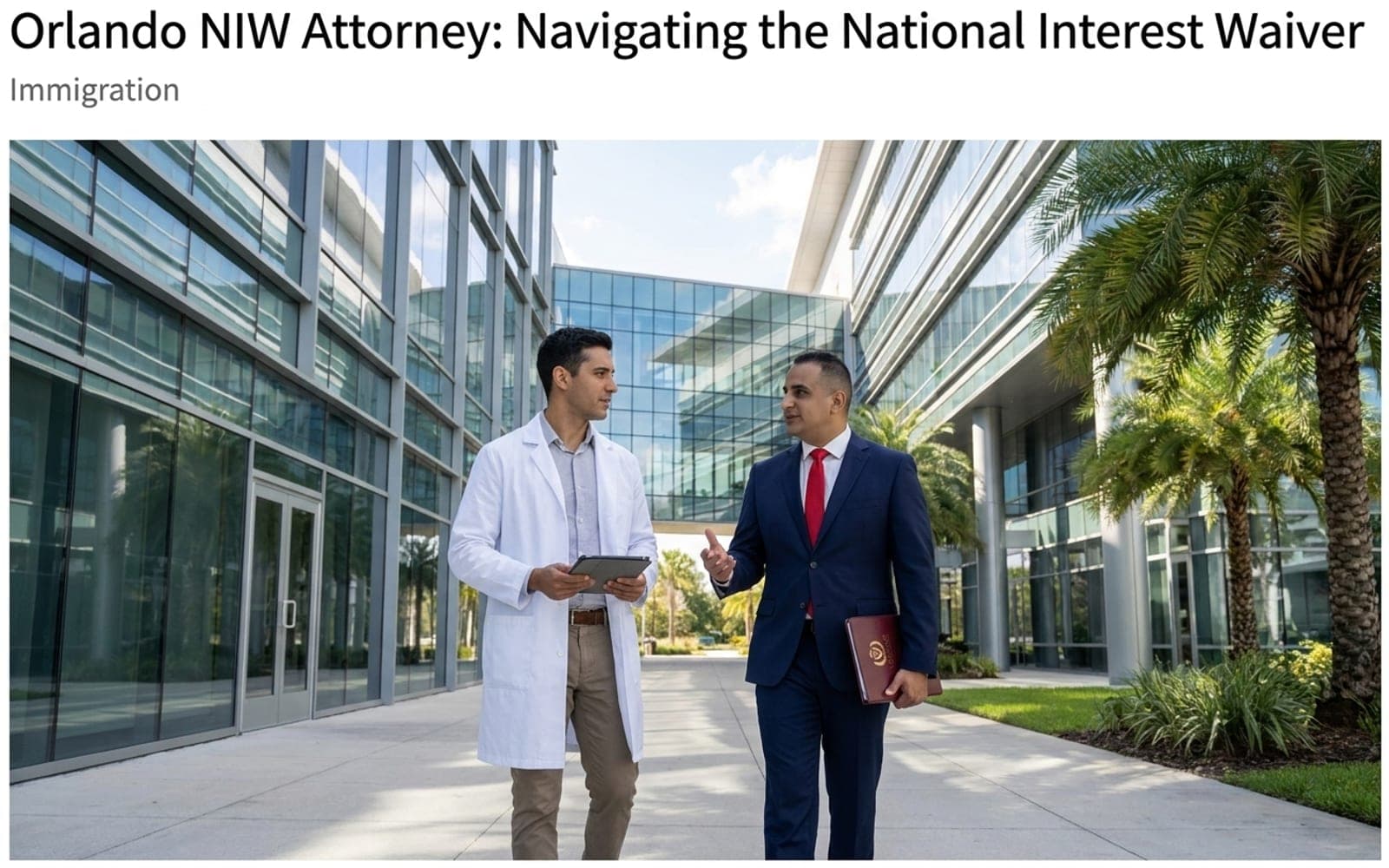
- NIW is a self-petitioning process under the EB-2 visa category.
- Florida professionals, especially in Orlando, can benefit from this waiver.
- Demonstrating significant impact on national interests is crucial.
- Legal guidance can enhance the chances of approval.
Introduction: Orlando NIW Attorney
For many skilled professionals in Orlando, navigating the complexities of immigration law can be daunting. The National Interest Waiver (NIW) offers a pathway for those whose work benefits the U.S. economy, education, health, or culture significantly. In this article, we'll explore how the NIW works, particularly for those in Florida. Call Florida Immigration Lawyers at 1-844-YO-PELEO for a free case review.
The NIW stands as a beacon for innovators, researchers, entrepreneurs, and other highly qualified individuals who can demonstrate that their contributions are not just personally beneficial, but are critical to the broader national interests of the United States. It's a testament to the U.S.'s commitment to attracting global talent that drives progress and competitiveness on an international scale, ensuring the nation remains at the forefront of global innovation.
Specifically for professionals residing in Florida, and especially in thriving hubs like Orlando, the NIW presents a unique opportunity. Florida's diverse economy, with its burgeoning tech industry, world-class research institutions, advanced healthcare sector, and significant agricultural and aerospace industries, provides fertile ground for individuals whose work can make a substantial impact. Understanding the nuances of this waiver is key to unlocking a permanent residency pathway without the usual employer sponsorship hurdles, offering a direct route to contributing your expertise to the American landscape.
What is the National Interest Waiver (NIW)?
The National Interest Waiver is part of the EB-2 visa category, allowing foreign nationals to self-petition for a green card without a job offer or labor certification if they can demonstrate their work is in the national interest. This waiver is particularly beneficial for professionals in fields such as science, business, and health.
As of 2026, the NIW remains a viable option for those in Orlando and Central Florida, offering a streamlined process for those whose expertise can significantly benefit the U.S.
The EB-2 visa category generally requires a job offer and a PERM labor certification, which is a lengthy process designed to protect U.S. workers by proving that no qualified U.S. workers are available for the position. The NIW, however, waives this requirement, acknowledging that certain individuals' contributions are so vital to the nation that requiring a labor certification would be detrimental to the national interest. This makes it an exceptionally attractive option for those who may not have a direct employer sponsor or whose work transcends a specific job description, providing greater autonomy in their immigration journey.
To qualify for the EB-2 category itself, applicants must possess an advanced degree (Master's or higher, or a Bachelor's degree plus five years of progressive experience) or demonstrate exceptional ability in the sciences, arts, or business. The NIW then builds upon this foundation, requiring an additional layer of proof that their specific endeavor holds substantial merit and national importance, and that they are uniquely positioned to advance it. This dual requirement ensures that only highly qualified individuals whose work truly serves the national good are granted this waiver, distinguishing them from other EB-2 applicants.
How to Qualify for an NIW in Florida?
Qualifying for an NIW involves meeting specific criteria that demonstrate your work’s significant importance to the U.S. economy or cultural landscape. Applicants must prove their endeavor has substantial merit and national importance, they are well-positioned to advance the proposed endeavor, and that it benefits the U.S. to waive the labor certification requirements.
Florida professionals should focus on highlighting how their work contributes to areas such as economic development, healthcare advancements, or educational improvements.
These three prongs, established in the landmark 2016 Administrative Appeals Office (AAO) decision, Matter of Dhanasar, form the backbone of any successful NIW petition. The "substantial merit and national importance" prong requires demonstrating that the proposed endeavor has broad implications beyond the applicant's immediate field, affecting the U.S. economy, health, education, or other critical areas. For instance, a scientist developing sustainable energy solutions in Florida would directly contribute to national environmental goals and economic independence, showcasing a clear national impact.
The second prong, "well-positioned to advance the proposed endeavor," assesses the applicant's skills, experience, track record, and business plan. USCIS looks for evidence that the individual has a reasonable chance of success. This could include a history of successful projects, patents, publications, strong recommendations from leading experts, or a robust business plan for an entrepreneurial venture. An Orlando-based engineer with a history of innovative software development, for example, would be well-positioned to launch a tech startup that creates jobs and new technologies for the U.S. market.
Finally, the "beneficial to the U.S. to waive the labor certification requirements" prong requires a showing that the national interest would be adversely affected if the petitioner were required to go through the standard labor certification process. This often involves arguing that the urgency, uniqueness, or critical nature of the work makes the delay and burden of labor certification counterproductive to the national good. An experienced immigration attorney at Florida Immigration Lawyers can help you articulate these complex arguments effectively, ensuring your petition stands the best chance of approval by clearly demonstrating the necessity of the waiver.
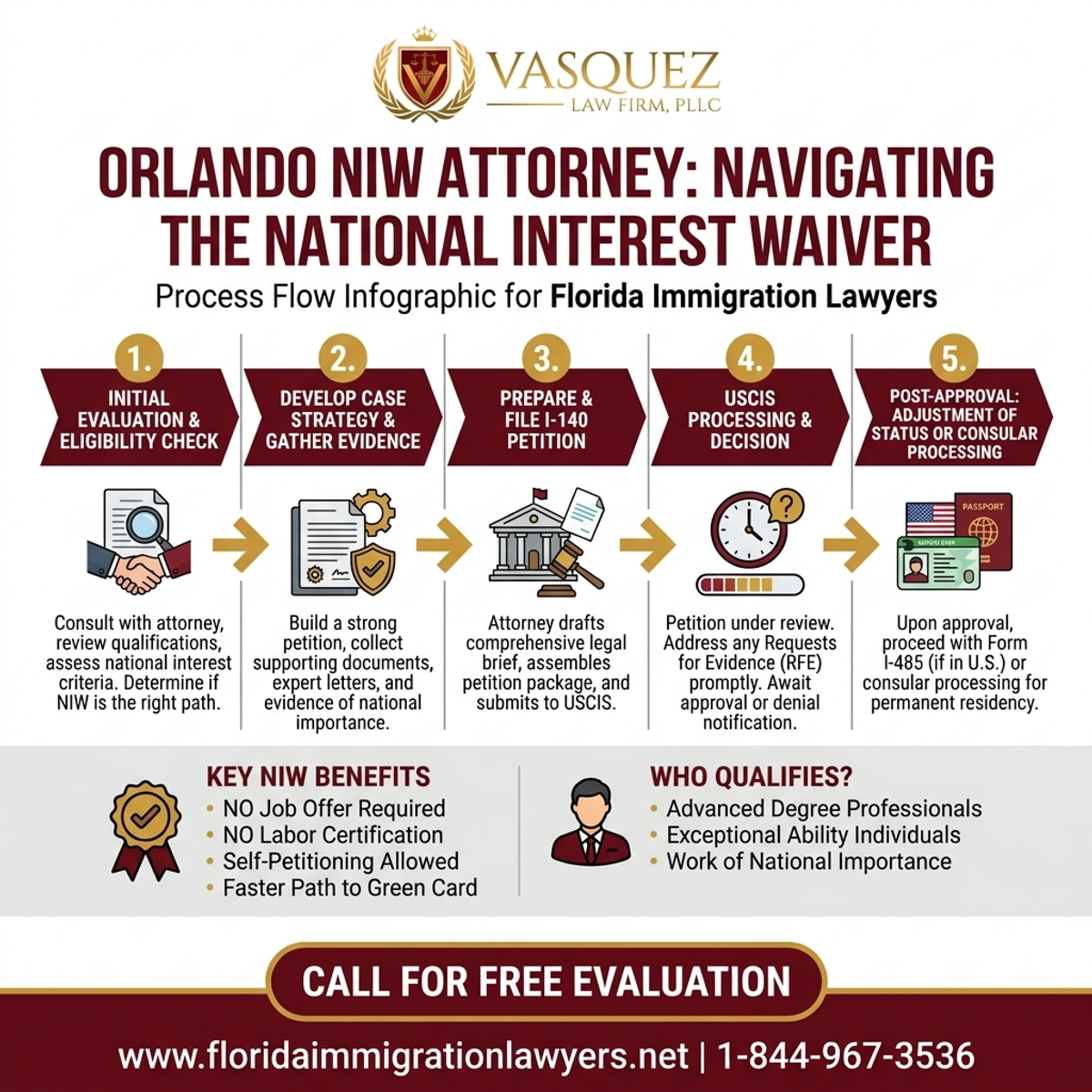
Step-by-Step Process — Orlando NIW Attorney: Navigating the National Interest Waiver
Steps to Apply for a National Interest Waiver
Embarking on the NIW application journey requires meticulous preparation and a clear understanding of each phase. While the process can seem complex, breaking it down into manageable steps, ideally with the guidance of an experienced attorney, can significantly ease the burden and increase your chances of success. Each stage is critical and demands careful attention to detail.
- Prepare your application by gathering evidence of your qualifications and the national interest impact of your work. This crucial initial phase involves compiling a comprehensive portfolio that robustly supports each of the Dhanasar prongs. It's not just about listing achievements, but demonstrating their broader significance and your unique position to contribute to the U.S. national interest.
- Submit Form I-140, Petition for Alien Worker, to USCIS. This form is the formal request for your NIW, accompanied by all your carefully prepared supporting documentation. Accuracy and completeness are paramount to avoid delays or Requests for Evidence (RFEs), which can prolong the process significantly.
- Provide supporting documentation, including letters of recommendation and evidence of your work’s impact. These letters, ideally from independent experts in your field, should specifically address your qualifications and the national importance of your endeavor. Evidence of impact can range from citations of your work to media coverage or contracts demonstrating demand for your skills.
- Await USCIS decision, which typically takes several months. During this period, USCIS may issue an RFE if they require additional information or clarification. A well-prepared initial petition can often prevent this, but responding effectively and promptly to an RFE is critical for a favorable outcome.
- If approved, proceed with adjustment of status or consular processing for a green card. Adjustment of status is for applicants already in the U.S. and eligible to adjust their status without leaving, while consular processing involves attending an interview at a U.S. embassy or consulate abroad. Your location and visa availability will determine the appropriate path.
Each step demands careful attention to detail and a strategic approach. Engaging with Florida Immigration Lawyers can provide you with the support needed to navigate these stages efficiently and confidently, from initial evidence gathering to the final green card application, ensuring a smooth and successful process.
Document Checklist for NIW Applications
A robust NIW petition hinges on compelling and well-organized evidence. The following documents are essential, but remember that the specific evidence required will vary based on your unique professional background and the nature of your proposed endeavor. Always aim to provide overwhelming evidence that clearly demonstrates your qualifications and the national importance of your work to USCIS.
- Detailed resume or CV: This should highlight your educational background, professional experience, publications, presentations, awards, and any other relevant accomplishments that underscore your expertise and influence in your field.
- Evidence of achievements and publications: Include copies of scholarly articles, patents, citations, media mentions, awards, grants, or other recognition of your expertise and impact. Quantifiable data, such as citation counts, can significantly strengthen your case.
- Letters of recommendation from experts in your field: These should ideally come from independent experts, not just colleagues or subordinates, and specifically attest to your unique abilities and the national importance of your work, addressing the Dhanasar criteria directly and with specific examples.
- Proof of the national interest impact of your work: This is perhaps the most critical component. It could include market analyses, letters from government agencies, contracts, evidence of economic impact (job creation, revenue), or testimonials from organizations benefiting from your work, all demonstrating a broad, national benefit.
- Completed Form I-140: Ensure this form is accurately filled out and signed, serving as the official petition to USCIS. Any discrepancies or omissions can lead to delays or requests for additional information.
Compiling this evidence can be a complex and time-consuming task. Florida Immigration Lawyers are adept at helping clients identify, organize, and present the strongest possible evidence to support their NIW petitions, ensuring no critical detail is overlooked and that your application is as persuasive as possible.
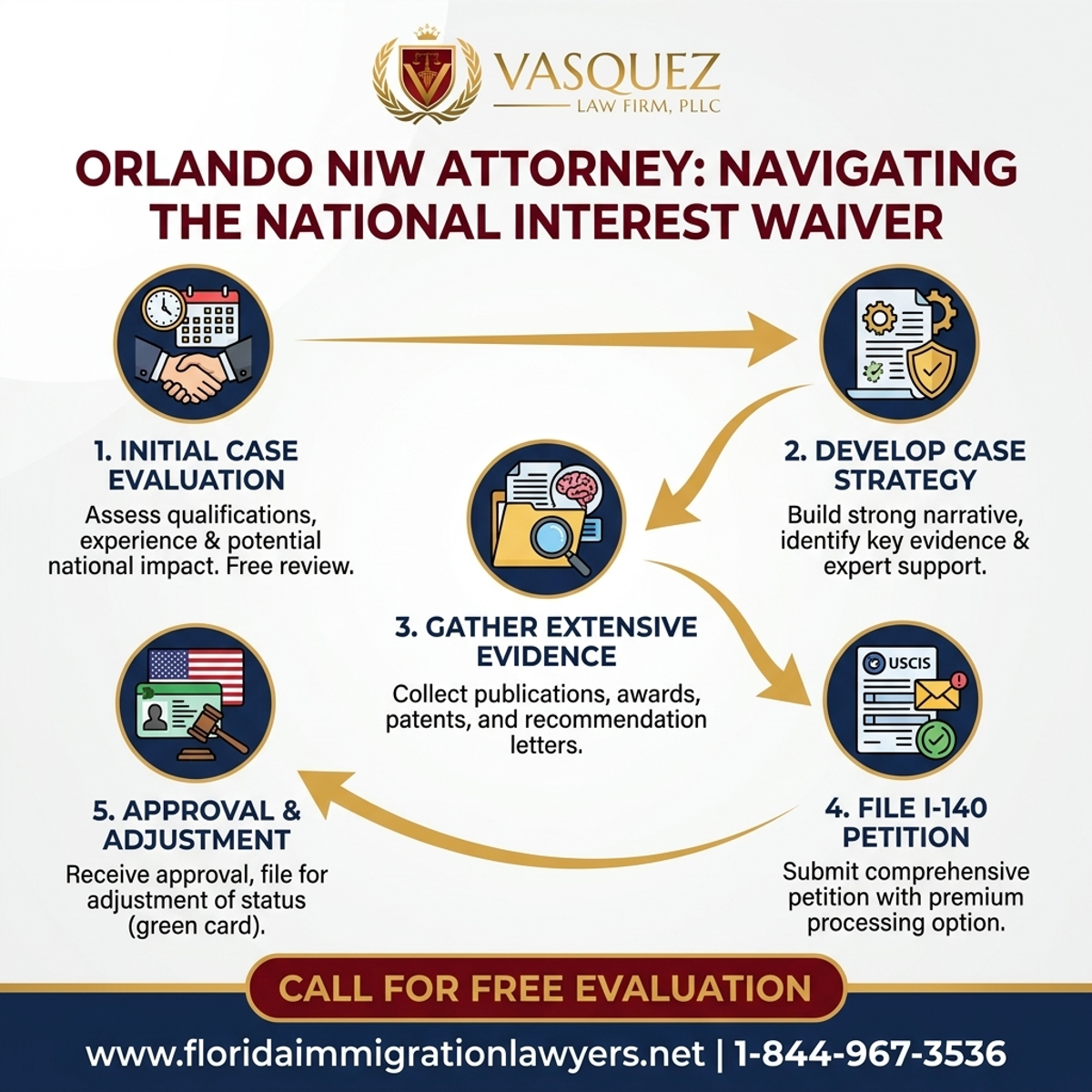
Key Statistics — Orlando NIW Attorney: Navigating the National Interest Waiver
Timeline and Processing Expectations: Orlando NIW Attorney
Understanding the potential timeline for your National Interest Waiver application is crucial for planning your future. While USCIS processing times can vary significantly based on caseload, policy changes, and individual case complexity, having a general expectation can help manage the process and set realistic goals.
| Stage | Typical Timeframe | Notes |
|---|---|---|
| Preparation of Application | 1-2 months | Gathering documents and evidence |
| USCIS Processing | 6-9 months | Varies based on case complexity |
| Adjustment of Status | 6-12 months | After NIW approval |
It's important to note that the "USCIS Processing" timeframe refers specifically to the I-140 petition. While NIW petitions are eligible for Premium Processing, allowing for a 15-day processing guarantee for an additional fee, this only expedites the I-140 decision. The subsequent adjustment of status (Form I-485) or consular processing will follow its own timeline, which can also fluctuate. Factors such as your country of birth's visa bulletin priority dates, the specific USCIS service center, and whether you receive a Request for Evidence (RFE) can all impact the overall duration. Consulting with Florida Immigration Lawyers can provide you with the most current and personalized timeline estimates for your NIW case, helping you plan ahead effectively.
Do not navigate this process alone. Contact Florida Immigration Lawyers today.
Common Mistakes to Avoid: Orlando NIW Attorney
The NIW application process is highly scrutinized, and even minor errors or omissions can lead to significant delays or outright denial. Being aware of common pitfalls can help you prepare a stronger, more successful petition. Avoid these mistakes to streamline your path to a green card and maximize your chances of approval.
- Underestimating the importance of evidence: Insufficient documentation can lead to denial. Many applicants fail to provide enough qualitative and quantitative evidence to support their claims. It's not enough to state you are an expert; you must prove it with citations, awards, patents, and independent testimonials that clearly demonstrate your impact.
- Lack of clear national interest argument: The application must clearly show how the work benefits the U.S. This is where many self-petitioners struggle, failing to connect their specific work to broader national goals as defined by the Dhanasar criteria. Focus on the widespread impact, not just personal or local benefits, to make a compelling case.
- Improperly structured recommendation letters: Letters should be specific and relevant to the field. Generic letters or those from non-experts carry little weight. They must detail your unique contributions, their national importance, and why you are well-positioned to continue this work, ideally from independent experts who can objectively assess your value.
- Ignoring updates in immigration policy: Policies change, and staying informed is crucial. Immigration law is dynamic. What was acceptable last year might not be this year. Relying on outdated information can jeopardize your application, making it essential to consult with current legal experts.
- Focusing solely on personal achievements: Emphasize the national importance of the work. While your achievements are the foundation, the NIW requires demonstrating how these achievements translate into significant benefits for the U.S. as a whole, showcasing a broader impact beyond individual success.
- Inadequate legal assistance: Professional help can significantly increase approval chances. Attempting to navigate the complex NIW requirements without experienced legal counsel often results in missed opportunities to present a compelling case or errors in filing, which can be costly in terms of time and resources.
- Submitting incomplete applications: Ensure all forms and documents are thoroughly completed. Even a missing signature or an unchecked box can lead to an RFE or denial, causing unnecessary delays and potentially requiring you to restart parts of the application process.
By proactively addressing these common mistakes, you can significantly strengthen your NIW petition. Florida Immigration Lawyers possess the experience to review your application thoroughly, identify potential weaknesses, and ensure every aspect of your submission meets USCIS standards, maximizing your chances of a favorable outcome and a smoother immigration process.
Frequently Asked Questions (FAQs) about the NIW
Q1: Can I apply for an NIW if I don't have an advanced degree?
A1: Yes, while an advanced degree is the most common path for EB-2, you can also qualify with "exceptional ability" in the sciences, arts, or business. This requires demonstrating a degree of expertise significantly above that ordinarily encountered, often evidenced by specific criteria like academic records, significant awards, high salary, professional association memberships, or recognition for achievements in your field. An attorney can help assess if your unique background meets this rigorous standard.
Q2: What kind of "national importance" does USCIS look for?
A2: USCIS broadly defines national importance to include endeavors that have significant potential to benefit the U.S. economy, healthcare, education, environment, or culture. This could involve developing new technologies, creating jobs, conducting critical research, improving public health outcomes, or addressing pressing national challenges like climate change or food security. The impact must extend beyond your local community and resonate on a national scale.
Q3: Do I need a job offer to apply for an NIW?
A3: No, one of the most significant advantages of the National Interest Waiver is that it allows you to self-petition without a job offer or employer sponsorship. This flexibility is particularly beneficial for entrepreneurs, independent researchers, or professionals whose work might not fit a traditional employment model. However, you must still demonstrate that your proposed endeavor is ongoing and that you are well-positioned to continue advancing it in the U.S.
Q4: How important are recommendation letters for an NIW petition?
A4: Recommendation letters are critically important for an NIW petition, serving as independent corroboration of your expertise and the national importance of your work. They should come from recognized experts in your field who can speak to your unique contributions, your qualifications, and how your endeavor benefits the U.S. Generic letters are insufficient; strong letters provide specific examples and clearly link your work to the Dhanasar criteria. Florida Immigration Lawyers can guide you on securing the most impactful letters.
When to Call a Lawyer: Orlando NIW Attorney
Legal assistance is crucial if you're unsure about meeting the NIW criteria or if your case involves complex issues. An immigration attorney can help craft a compelling argument for your petition and ensure all documents meet the necessary standards. Florida Immigration Lawyers offer experienced guidance to professionals in Orlando seeking an NIW.
You should consider engaging an attorney from the very beginning of your NIW journey. This is especially true if your professional background is unconventional, if you have a limited publication record but significant industry impact, or if you're an entrepreneur whose work is still in its early stages. An attorney can help you strategize the best approach to present your case, identify the most impactful evidence, and frame your endeavor within the strict Dhanasar framework, significantly strengthening your petition.
Furthermore, if you receive a Request for Evidence (RFE) from USCIS, professional legal guidance becomes indispensable. RFEs often indicate that USCIS requires more information or clarification on specific aspects of your petition. Responding effectively to an RFE can be the difference between approval and denial. An experienced lawyer understands what USCIS is looking for and can help you gather and present the necessary supplementary evidence and arguments to address their concerns comprehensively. Don't hesitate to call 1-844-YO-PELEO for assistance.
About Florida Immigration Lawyers: Orlando NIW Attorney
Florida Immigration Lawyers is dedicated to assisting clients across Central Florida with immigration matters. Our experienced team offers personalized legal services, ensuring that every client receives the attention and experience they deserve. Available 24/7, we provide free case reviews and bilingual support. Schedule a free consultation today.
Sources and References: Orlando NIW Attorney
- U.S. Citizenship and Immigration Services (USCIS)
- Executive Office for Immigration Review (EOIR)
- 8 U.S.C. Chapter 12 - Immigration and Nationality Act
Related services: family petition process, family-based green cards, fiancé visa (K-1), marriage-based immigration.
This article provides general legal information and is not intended as legal advice. Every case is unique, and outcomes depend on specific facts and circumstances. Contact an attorney for advice about your particular situation.
For comprehensive assistance with your NIW application, contact Florida Immigration Lawyers at 1-844-YO-PELEO. Se Habla Español - Estamos aquí para ayudarle.
If you need legal assistance, learn more about learn about family-based immigration, or call us at 1-844-967-3536 for a free case review.
Do Not Navigate This Process Alone
Our experienced immigration attorneys are ready to fight for you. Get a free, confidential case review today.
Se Habla Español
Or leave your details and we’ll call you:
Free Evaluation in 24 Hours
Or talk to us right now
AI voice assistant — available 24/7
FreeFrequently Asked Questions

William J. Vásquez
Founding Attorney · Vasquez Law Firm
U.S. Air Force veteran and immigration attorney with years of hands-on U.S. immigration experience. J.D., NCCU School of Law. AILA member. Admitted to the 4th, 5th, and 11th Circuit Courts.
Available 24/7 - Free Evaluations
Reviewed for legal accuracy by William J. Vásquez
Licensed in North Carolina; U.S. immigration is federal practice.
Related Legal Services
Our Florida immigration attorneys can help you with citizenship and naturalization, immigration practice areas and free immigration consultation. Call today at 1-844-YO-PELEO for a free case review.
Related Links
Related Topics
Free Legal Case Review
Discuss your case with our experienced attorneys. We're available 24/7.
Se Habla Español - Estamos aquí para ayudarle.
Related Articles
Certificate of Eligibility for Expungement in Florida 2026
For non-U.S. citizens in Florida, understanding how a state expungement impacts immigration status is critical. A certificate of eligibility for expungement in Florida allows a criminal record to be sealed or expunged under state law. However, federal immigration agencies often disregard such state-level relief, still considering the original criminal offense as a conviction for immigration purposes. This can have severe implications for visa applications, green card eligibility, naturalization, and even lead to deportation. This guide clarifies the Florida expungement process, its limited effect on federal immigration law, and key steps to protect your status in 2026. Learn about common mistakes, required documents, timelines, and when to seek expert legal counsel from Florida Immigration Lawyers to navigate these complex issues effectively.
Immigration Lawyer Orlando Free Consultation in Florida
For individuals and families in Orlando, Florida, navigating the complexities of U.S. immigration law requires expert guidance. An immigration lawyer in Orlando offers crucial support for everything from visa applications and green card processes to naturalization and deportation defense. This comprehensive guide details what a free consultation covers, providing a step-by-step overview of immigration pathways, essential document checklists, and expected timelines in 2026. We also highlight common mistakes to avoid, discuss the critical role of legal counsel in deportation and asylum cases, and explain why choosing a local Orlando immigration attorney is beneficial. Florida Immigration Lawyers is dedicated to serving the diverse community of Orlando with compassionate, effective legal solutions, ensuring you receive personalized advice and robust representation for a successful immigration journey.
Naturalization Ceremony Locations and Schedule 2026 Florida
For those in Florida aspiring to U.S. citizenship, understanding the naturalization process, including ceremony locations and schedules for 2026, is essential. This guide from Florida Immigration Lawyers details the N-400 application, eligibility requirements, and typical timelines. We cover the step-by-step journey, from initial filing and biometrics to the naturalization interview and the final Oath of Allegiance ceremony held across Florida's USCIS field offices, including Orlando, Miami, Tampa, and Jacksonville. Learn about critical documents, potential costs, and common mistakes to avoid. Our firm emphasizes the importance of accurate applications and offers expert legal assistance for complex cases, ensuring a smoother path to becoming a U.S. citizen. Get a free case review today.
Green Card Renewal Process in Florida: 2026 Guide
Renewing your green card in Florida is a vital process for maintaining your lawful permanent resident status. This comprehensive 2026 guide from Florida Immigration Lawyers breaks down the Form I-90 application, covering eligibility, step-by-step instructions, necessary documents, typical costs, and current processing timelines. We explain who needs to renew, what to expect at your biometrics appointment, and Florida-specific considerations for permanent residents. Learn how to avoid common mistakes that can delay your application and understand when professional legal assistance is crucial. Our expert attorneys are here to provide free case reviews and guide you through every stage, ensuring a smooth and secure renewal of your permanent resident card.