Annual Asylum Fee: No Cost for I-589 in Florida 2026
For those seeking asylum in Florida, a critical question often arises: Is there an annual asylum fee for Form I-589 applications? The straightforward answer for 2026 is no, U.S. Citizenship and Immigration Services (USCIS) does not charge a fee to file this humanitarian application. This policy ensures that financial barriers do not prevent individuals from seeking protection from persecution. However, while the application itself is free, applicants should be prepared for associated costs such as legal representation, document translation, and travel expenses for appointments. This comprehensive guide from Florida Immigration Lawyers details the asylum application process in Florida, outlining eligibility requirements, step-by-step procedures, necessary documentation, and typical processing timelines. We also address common mistakes to avoid and highlight when it is crucial to seek legal counsel to strengthen your case and protect your rights. Understanding these nuances is essential for a successful asylum claim.
Is there an annual asylum fee for Form I-589 applications in 2026? No, U.S. Citizenship and Immigration Services (USCIS) does not charge a fee to file Form I-589, Application for Asylum and for Withholding of Removal. This policy remains consistent for 2026, ensuring that individuals seeking humanitarian protection are not financially burdened by the initial application. While the application itself is free, applicants should be aware of other potential costs, such as legal representation, document translation, and travel expenses for interviews or hearings. Understanding the entire process is crucial for those seeking asylum in Florida.
- Form I-589 itself has no filing fee.
- Other costs like legal fees, translations, and travel may apply.
- Asylum seekers must demonstrate a well-founded fear of persecution.
- Timely filing, generally within one year of arrival, is critical.
- Consulting an attorney is highly recommended for complex cases.
Navigating the asylum application process in the United States can be one of the most challenging and critical journeys an individual or family can undertake. For those seeking safety and protection from persecution, understanding every step, especially the financial aspects, is paramount. In Florida, a state with a significant immigrant population and a complex legal landscape, the process can feel particularly daunting. This comprehensive guide from Florida Immigration Lawyers aims to demystify the asylum application, clarify the question of an annual asylum fee, and provide actionable insights for individuals seeking protection in 2026.
You may be fleeing unimaginable circumstances, and the thought of complex legal procedures and unexpected costs can add to an already stressful situation. Our goal is to empower you with accurate information, helping you understand your rights and the path forward. From clarifying fee structures to outlining the necessary documentation and timelines, we cover the essential elements of applying for asylum in Florida. Do not navigate this complex process alone. Call Florida Immigration Lawyers at 1-844-YO-PELEO for a free case review and guidance tailored to your unique situation.
Is there an annual asylum fee for Form I-589 applications in 2026?
No, as of 2026, there is absolutely no filing fee required by U.S. Citizenship and Immigration Services (USCIS) for Form I-589, Application for Asylum and for Withholding of Removal. This policy is a fundamental aspect of U.S. humanitarian law, ensuring that individuals seeking protection are not prevented from applying due to financial constraints. The United States maintains that the right to seek asylum should be accessible to all who qualify, irrespective of their economic status. This means you do not need to worry about an annual asylum fee or any initial cost directly associated with submitting your asylum application to USCIS.
This fee waiver applies universally to all asylum applicants, whether they are filing affirmatively with USCIS or defensively in immigration court. The absence of a filing fee for Form I-589 is explicitly stated in the Immigration and Nationality Act (INA) and relevant regulations, reflecting a commitment to international and domestic protections for refugees. However, it is crucial to distinguish between the primary application fee and other potential costs that may arise throughout the asylum process. While the I-589 itself is free, applicants should be prepared for indirect expenses, which we will detail in a later section. Understanding this distinction is vital for accurate financial planning.
What is Asylum and Who Qualifies in Florida?
Asylum is a form of protection granted to foreign nationals who are already in the United States or are seeking admission at a port of entry and demonstrate a well-founded fear of persecution in their home country. This fear must be based on one of five protected grounds: race, religion, nationality, membership in a particular social group, or political opinion. The legal framework for asylum is enshrined in Section 208 of the Immigration and Nationality Act (INA), which aligns with international refugee law.
To qualify for asylum in Florida, an applicant must prove that they have suffered past persecution or have a legitimate fear of future persecution if they return to their home country. The persecution must be at the hands of the government, or by a group that the government is unable or unwilling to control. This is a high legal standard, requiring compelling evidence and a coherent narrative. For example, individuals fleeing gang violence in Central America might argue membership in a particular social group if they can demonstrate that the government is complicit or ineffective in protecting them. The recent news regarding Salvadoran immigrants bracing for loss of Temporary Protected Status (TPS) highlights the ongoing need for other forms of protection, such as asylum, for those who cannot safely return home.
Florida, particularly Central Florida around Orlando, sees a diverse range of asylum seekers from countries experiencing political instability, human rights abuses, and violence. Many come from Venezuela, Cuba, Haiti, Nicaragua, and various African and Middle Eastern nations. The specific circumstances of persecution vary widely, from political dissidents fearing imprisonment to religious minorities facing systematic discrimination or individuals targeted for their LGBTQ+ identity. Proving a well-founded fear requires more than just a general fear of violence; it demands specific evidence linking the fear to one of the five protected grounds. Our attorneys at Florida Immigration Lawyers are adept at helping clients gather and present this crucial evidence, strengthening their asylum claims.
The Asylum Application Process in Florida: A Step-by-Step Guide
The asylum process can be complex, involving multiple stages and interactions with government agencies. For those in Florida, understanding these steps is crucial. Here's a detailed guide:
-
Prepare and File Form I-589: This is the initial and most critical step. You must complete and submit Form I-589, Application for Asylum and for Withholding of Removal, to USCIS. It is essential to be thorough and accurate, providing detailed information about your identity, family, travel history, and, most importantly, the basis for your fear of persecution. All supporting documentation, such as affidavits, country condition reports, and evidence of persecution, should be included. Generally, you must file Form I-589 within one year of your last arrival in the United States, although there are limited exceptions to this one-year filing deadline.
-
Biometrics Appointment: After filing Form I-589, you will receive a notice for a biometrics appointment at a local Application Support Center (ASC). For applicants in Central Florida, this might be in Orlando or a nearby city. At this appointment, USCIS will collect your fingerprints, photograph, and signature. These are used for background and security checks. Missing this appointment can delay your application significantly or even lead to its denial.
-
Asylum Interview: Following successful background checks, you will be scheduled for an asylum interview with an asylum officer. In Florida, interviews typically take place at the USCIS Miami Asylum Office, which serves the entire state. The interview is your opportunity to explain your case in detail, providing your testimony about why you fear persecution. You have the right to bring an attorney and an interpreter (if needed) to this interview. The asylum officer will ask questions about your Form I-589, your personal history, and the conditions in your home country. Be prepared to answer thoroughly and honestly.
-
Decision and Referral to Immigration Court: After the interview, the asylum officer will make a decision. If your case is approved, you will be granted asylum. If it is denied, and you are not in lawful immigration status, your case will typically be referred to an immigration judge at an Executive Office for Immigration Review (EOIR) court. In Florida, this could be the Orlando Immigration Court or the Miami Immigration Court. If you are already in removal proceedings, the asylum officer will not have the authority to grant asylum, and your case will remain with the immigration judge.
Step-by-Step Process — Annual Asylum Fee: No Cost for I-589 in Florida 2026
-
Immigration Court Proceedings (if referred): If your case is referred to immigration court, you will have a series of hearings before an immigration judge. This process is more formal and adversarial than the asylum interview. You will have the opportunity to present your case, call witnesses, and submit additional evidence. The government attorney will also present their case. The judge will then issue a decision. If asylum is denied by the immigration judge, you may have the option to appeal the decision to the Board of Immigration Appeals (BIA).
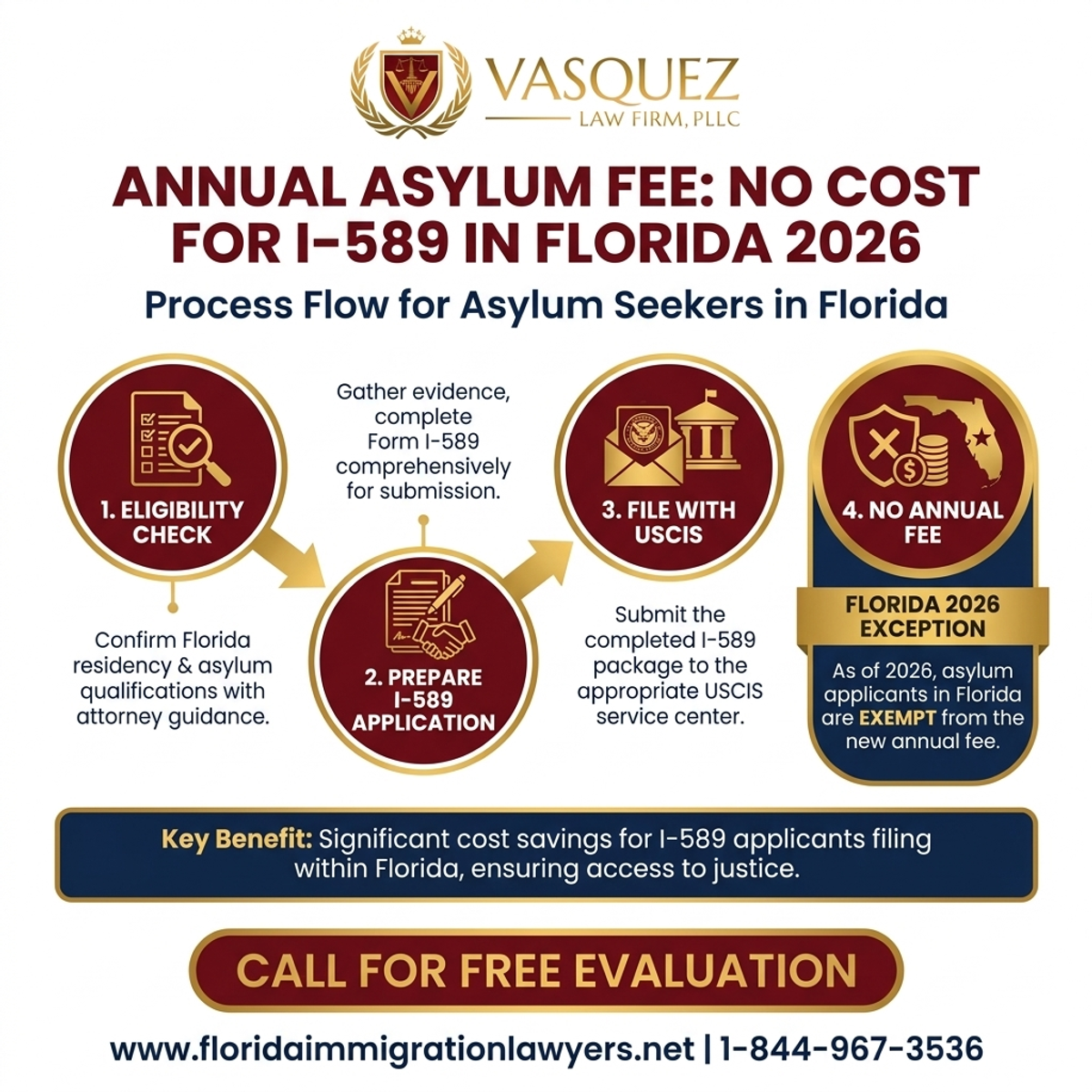
Each stage requires careful preparation and adherence to deadlines. The complexity only underscores the importance of legal counsel throughout the entire process.
Required Documents for Your Florida Asylum Petition
A strong asylum application relies heavily on comprehensive and credible documentation. Gathering these documents can be time-consuming, but it is essential for proving your well-founded fear of persecution. Here is a checklist of commonly required documents for an asylum petition in Florida:
- Form I-589: Completed and signed, with all questions answered accurately.
- Identification Documents: Copies of your passport, birth certificate, national ID card, and any U.S. immigration documents (e.g., I-94 arrival/departure record, visa).
- Proof of Relationship: If including family members in your application, provide marriage certificates, birth certificates for children, and any other relevant documents.
- Personal Statement/Affidavit: A detailed, chronological narrative describing your experiences of persecution or your fear of future persecution, explaining how it relates to one of the five protected grounds. This is often the most critical piece of evidence.
- Supporting Affidavits: Statements from witnesses who can corroborate your story, such as family members, friends, or colleagues, even if they are still in your home country.
- Country Conditions Evidence: Reports from human rights organizations (e.g., Amnesty International, Human Rights Watch), U.S. Department of State, United Nations, reputable news sources, or academic institutions detailing the general conditions and specific types of persecution in your home country relevant to your case.
- Medical Records: If you suffered physical or psychological harm due to persecution, provide medical reports, psychological evaluations, or forensic evaluations.
- Police Reports/Legal Documents: Any official records of arrest, detention, charges, or legal proceedings against you or your family members due to your protected ground.
- Media Articles/Photos: Any news clippings, photos, or videos that document your persecution or the general conditions in your country.
- Translated Documents: All documents not in English must be accompanied by a certified English translation. The translator must provide a statement certifying their competence and the accuracy of the translation.
Organizing these documents meticulously and ensuring their authenticity is paramount. Incomplete or poorly presented applications can lead to significant delays or even denial. Our legal team can assist you in preparing a robust evidence packet.
Asylum Processing Timelines and Expectations in Florida (2026)
The processing times for asylum applications can vary significantly, depending on factors such as the volume of applications, the complexity of individual cases, and the specific USCIS asylum office or immigration court handling the matter. As of 2026, applicants in Florida should anticipate the following general timelines:
| Stage | Typical Timeframe | Notes |
|---|---|---|
| Filing Form I-589 | Within 1 year of arrival | Critical deadline; exceptions are rare and difficult to prove. |
| Receipt Notice | 1-3 weeks after filing | Confirms USCIS received your application. |
| Biometrics Appointment | 3-8 weeks after receipt notice | Mandatory; usually at a local ASC in Florida (e.g., Orlando). |
| Interview Scheduling | Several months to several years | Varies greatly. USCIS aims to prioritize newer filings but backlogs exist. For Florida, interviews are at the Miami Asylum Office. |
| Asylum Interview | Typically 1-2 hours | Conducted by an Asylum Officer. Bring all original documents and an interpreter if needed. |
| Decision from USCIS | Within 2-4 weeks after interview (affirmative cases) | If approved, you are granted asylum. If denied, and you are out of status, referred to Immigration Court. |
| Immigration Court Hearings | Months to several years (defensive cases) | Multiple master calendar hearings and an individual merits hearing before an Immigration Judge (e.g., Orlando Immigration Court). |
| Work Authorization (EAD) | ~180 days after filing I-589 (if case pending) | Can apply for an Employment Authorization Document (EAD) if your asylum application has been pending for at least 180 days and is not subject to certain delays. |
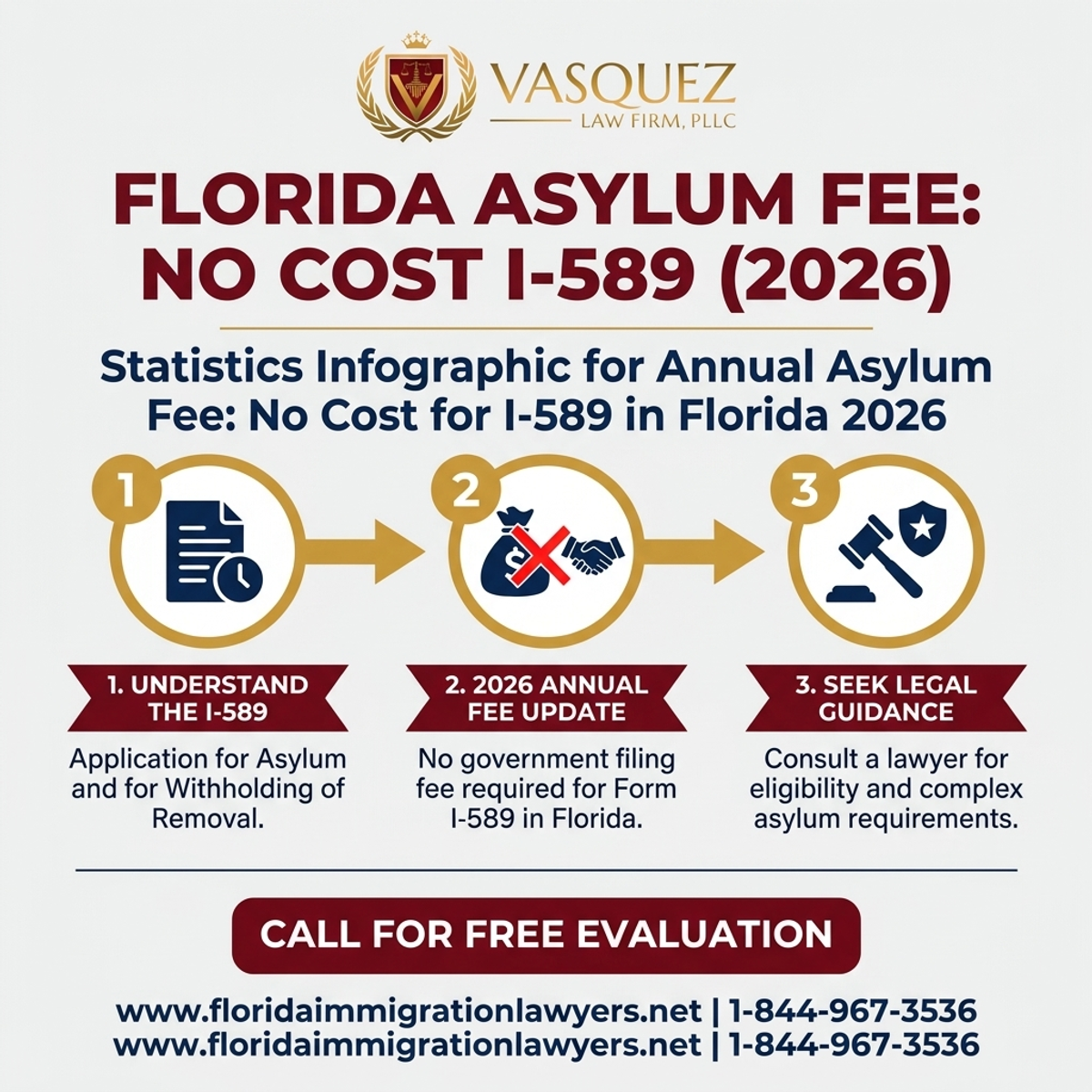
Key Statistics — Annual Asylum Fee: No Cost for I-589 in Florida 2026
It's important to note that these are general estimates for 2026. The actual timeline can be shorter or significantly longer. The current administration's policies, as seen in news about expanding deportations of non-criminals, can also impact processing priorities and overall speed. Proactive follow-up and legal representation can help manage expectations and address potential delays.
Do not navigate this process alone. Contact Florida Immigration Lawyers today for personalized legal assistance and to ensure your asylum application is handled with the utmost care and experience.
Understanding the Costs Associated with Seeking Asylum in Florida
While we've established that there is no annual asylum fee for filing Form I-589 itself, it's crucial for applicants in Florida to be aware of other potential costs associated with the asylum process. These indirect expenses can add up and should be factored into your planning. Understanding these costs can help you prepare financially and avoid unexpected burdens.
| Item | Typical Fee (Estimate) | Notes |
|---|---|---|
| Form I-589 Filing Fee | $0 | No fee for the asylum application itself. |
| Attorney Fees | Varies widely ($3,000 - $15,000+) | Highly recommended for guidance, document preparation, and representation at interviews/hearings. Costs depend on case complexity and attorney experience. |
| Document Translation Fees | $20 - $50 per page | Required for any document not in English. Must be certified translations. |
| Expert Witness Fees | Varies ($500 - $3,000+) | For country condition experts, psychological evaluations, or forensic examinations, if applicable. |
| Travel Expenses | Varies | For biometrics appointments (e.g., Orlando ASC), asylum interviews (Miami Asylum Office), or immigration court hearings. |
| Postage/Courier Fees | $20 - $100+ | For sending applications and supporting documents securely. |
| Employment Authorization Document (EAD) | $410-$555 (Form I-765 fee, subject to change) | Required if you apply for work authorization while your asylum case is pending. Fee waivers may be available for eligible low-income applicants. |
While the direct asylum application remains free, these associated costs underscore the financial commitment involved. Legal representation, in particular, can be a significant investment but often proves invaluable, especially for complex cases or those in removal proceedings. Our firm offers free case reviews to help you understand potential costs and determine the best approach for your specific situation.
What Happens After You File Form I-589 in Florida?
Once you submit your Form I-589, the journey is far from over. The subsequent steps are crucial and require continued attention and preparation. After filing, USCIS will send you a receipt notice confirming they have received your application. This is an important document to keep for your records.
Next, you will receive a notice for a biometrics appointment at an Application Support Center (ASC) in Florida. This appointment is mandatory for security checks. Following biometrics, your case will enter a queue for an asylum interview at the USCIS Miami Asylum Office. Due to backlogs, this waiting period can range from several months to several years. During this time, you may be eligible to apply for an Employment Authorization Document (EAD) if your application has been pending for at least 180 days, allowing you to work legally in the U.S.
The asylum interview is a pivotal moment. You will meet with an asylum officer to discuss your fear of persecution. If the asylum officer determines you qualify, you will be granted asylum. If they do not, and you are not in lawful immigration status, your case will typically be referred to an immigration judge for defensive asylum proceedings. This means your case will be heard in an immigration court, such as the Orlando Immigration Court, where you will present your asylum claim as a defense against removal from the United States. This stage is more formal and often involves multiple hearings. Legal representation is particularly critical during immigration court proceedings to navigate the complex rules of evidence and procedure, as well as to challenge any government arguments against your claim.
Common Mistakes to Avoid in Your Asylum Application
The asylum process is fraught with potential pitfalls that can jeopardize your case. Avoiding these common mistakes is crucial for a successful outcome:
-
Missing the One-Year Filing Deadline: Generally, you must file your Form I-589 within one year of your last arrival in the U.S. Failing to meet this deadline without a valid exception can lead to automatic denial. Documenting any exceptional circumstances that prevented timely filing is extremely difficult.
-
Incomplete or Inaccurate Form I-589: Submitting a form with missing information, inconsistencies, or errors can lead to delays, requests for evidence, or even outright denial. Every question must be answered truthfully and thoroughly.
-
Insufficient Evidence of Persecution: A successful asylum claim requires compelling evidence. Simply stating fear is not enough. Without strong supporting documents, country condition reports, and a detailed personal statement, your claim may be deemed unsubstantiated.
-
Lack of Coherence or Credibility: Your testimony and written statement must be consistent and credible. Inconsistencies, even minor ones, can significantly undermine your case and lead an asylum officer or judge to question your honesty.
-
Failing to Articulate a Protected Ground: Your fear of persecution must be clearly linked to one of the five protected grounds (race, religion, nationality, political opinion, or particular social group). Many applicants fail to adequately connect their experiences to these specific categories.
-
Not Disclosing All Relevant Information: Hiding past arrests, previous immigration applications, or other critical facts can be detrimental. USCIS conducts thorough background checks, and non-disclosure will be viewed negatively and can lead to denial or accusations of fraud.
-
Attending Interviews/Hearings Unprepared: Going to your asylum interview or immigration court hearings without having reviewed your application, practiced your testimony, or gathered original documents can severely weaken your position. Being unprepared can lead to confusion and miscommunication.
-
Not Seeking Legal Representation: The asylum process is incredibly complex. Navigating it without an experienced immigration attorney significantly reduces your chances of success. An attorney can help prepare your application, gather evidence, prepare you for interviews, and represent you in court.
When to Call a Lawyer for Your Asylum Case in Florida
While the idea of applying for asylum independently might seem appealing to avoid costs, the complexities and high stakes involved make legal representation invaluable. You should call Florida Immigration Lawyers immediately if any of these scenarios apply to you:
- You are approaching the one-year filing deadline: This is a critical deadline, and missing it can be fatal to your case.
- You have a complex persecution claim: If your fear of persecution doesn't neatly fit into obvious categories, or if your case involves multiple forms of harm, an attorney can help frame your narrative legally.
- You have a criminal history or previous immigration violations: These issues can complicate your eligibility for asylum and require expert legal analysis.
- You are already in removal (deportation) proceedings: This is a defensive asylum case, and legal representation in immigration court is essential.
- You need help gathering evidence or writing your personal statement: An attorney can guide you in collecting necessary documents and crafting a compelling narrative.
- You are unsure about any part of the application or interview process: Clear, professional guidance can prevent costly mistakes.
- You received a Request for Evidence (RFE) or Notice of Intent to Deny (NOID): These require precise and timely responses.
- You fear returning to your home country but are unsure if you qualify for asylum: We can assess your situation and advise on your eligibility and other potential immigration relief.
Florida Immigration Lawyers serves clients across the entire state, including Orlando and Central Florida. Our team understands the nuances of asylum law and is dedicated to protecting your rights. We offer comprehensive services, from initial consultation and application preparation to representation at interviews and court hearings. Do not face this challenge alone.
About Florida Immigration Lawyers
Florida Immigration Lawyers is a leading law firm dedicated to providing compassionate and effective legal representation to immigrants across the entire state of Florida. With a deep understanding of U.S. immigration law and a commitment to protecting the rights of our clients, we stand as a beacon of hope for individuals and families navigating complex immigration challenges. Our attorneys are highly experienced in all facets of immigration law, including asylum, deportation defense, family-based petitions, business immigration, and naturalization.
We pride ourselves on offering personalized legal strategies tailored to each client's unique circumstances. We understand the profound impact immigration matters have on individuals' lives and approach every case with empathy, diligence, and unwavering advocacy. Our firm is available 24/7, offering free case reviews to ensure that everyone has access to initial legal guidance. Serving all of Florida, including our Central Florida office in Orlando, we are here to fight for your future. Se Habla Español. Contact us today to schedule a free consultation and learn how we can assist you.
Sources and References
- U.S. Citizenship and Immigration Services (USCIS) - Asylum
- Executive Office for Immigration Review (EOIR)
- U.S. Department of State - Country Reports on Human Rights Practices
- 8 U.S.C. § 1158 - Asylum (Immigration and Nationality Act Section 208)
- 8 CFR Part 208 - Asylum and Withholding of Removal
- USCIS Policy Manual, Volume 7, Part A - Asylum
Related services: refugee status and resettlement.
This article provides general legal information and is not intended as legal advice. Every case is unique, and outcomes depend on specific facts and circumstances. Contact an attorney for advice about your particular situation.
Seeking asylum is a fundamental human right, and understanding the process, including the costs and timelines, is your first step towards safety and stability. While the Form I-589 itself carries no filing fee, preparing a strong case and navigating the legal system effectively requires careful planning and often, professional assistance. Do not let fear or confusion deter you from seeking the protection you deserve. Florida Immigration Lawyers is here to guide you through every stage of your asylum application. Call us today at 1-844-YO-PELEO for a free case review. Se Habla Español - Estamos aqui para ayudarle.
If you need legal assistance, learn more about Florida asylum legal team, or call us at 1-844-967-3536 for a free case review.
Do Not Navigate This Process Alone
Our experienced immigration attorneys are ready to fight for you. Get a free, confidential case review today.
Se Habla Español
Or leave your details and we’ll call you:
Free Evaluation in 24 Hours
Or talk to us right now

AI voice assistant — available 24/7
FreeFrequently Asked Questions

William J. Vásquez
Founding Attorney · Vasquez Law Firm
U.S. Air Force veteran and immigration attorney with years of hands-on U.S. immigration experience. J.D., NCCU School of Law. AILA member. Admitted to the 4th, 5th, and 11th Circuit Courts.
Available 24/7 - Free Evaluations
Reviewed for legal accuracy by William J. Vásquez
Licensed in North Carolina; U.S. immigration is federal practice.
Related Legal Services
Our Florida immigration attorneys can help you with asylum protection, citizenship and naturalization and immigration practice areas. Call today at 1-844-YO-PELEO for a free case review.
Related Links
Related Topics
Free Legal Case Review
Discuss your case with our experienced attorneys. We're available 24/7.
Se Habla Español - Estamos aquí para ayudarle.
Related Articles
Certificate of Eligibility for Expungement in Florida 2026
For non-U.S. citizens in Florida, understanding how a state expungement impacts immigration status is critical. A certificate of eligibility for expungement in Florida allows a criminal record to be sealed or expunged under state law. However, federal immigration agencies often disregard such state-level relief, still considering the original criminal offense as a conviction for immigration purposes. This can have severe implications for visa applications, green card eligibility, naturalization, and even lead to deportation. This guide clarifies the Florida expungement process, its limited effect on federal immigration law, and key steps to protect your status in 2026. Learn about common mistakes, required documents, timelines, and when to seek expert legal counsel from Florida Immigration Lawyers to navigate these complex issues effectively.
Immigration Lawyer Orlando Free Consultation in Florida
For individuals and families in Orlando, Florida, navigating the complexities of U.S. immigration law requires expert guidance. An immigration lawyer in Orlando offers crucial support for everything from visa applications and green card processes to naturalization and deportation defense. This comprehensive guide details what a free consultation covers, providing a step-by-step overview of immigration pathways, essential document checklists, and expected timelines in 2026. We also highlight common mistakes to avoid, discuss the critical role of legal counsel in deportation and asylum cases, and explain why choosing a local Orlando immigration attorney is beneficial. Florida Immigration Lawyers is dedicated to serving the diverse community of Orlando with compassionate, effective legal solutions, ensuring you receive personalized advice and robust representation for a successful immigration journey.
Work Permit EAD Application Process in Florida 2026
Applying for a work permit, or Employment Authorization Document (EAD), in Florida is a crucial step for many non-citizens seeking to work legally in the U.S. This comprehensive guide from Florida Immigration Lawyers details the 2026 application process, including eligibility criteria, necessary documentation for Form I-765, typical processing times, and associated costs. We highlight the importance of accurate submission and offer insights into common pitfalls to avoid. Our firm, based in Orlando, Florida, provides expert legal assistance for asylum seekers, adjustment of status applicants, and other eligible individuals. Learn how to prepare for your EAD application and understand when professional legal counsel can make a significant difference in achieving a successful outcome. Secure your right to work with knowledgeable support.
Change of Status B-2 to F-1 in Florida: Key Steps
Changing your status from a B-2 tourist visa to an F-1 student visa in Florida involves several crucial steps. This guide provides a comprehensive overview, including the 2026 I-539 processing times, document requirements, and common pitfalls to avoid. Learn how to navigate the process effectively with help from Florida Immigration Lawyers.