L-1 Visa Transfer: Florida Company Guide 2026
For Florida companies looking to transfer executives, managers, or specialized knowledge employees from an overseas office, the L-1 visa is a vital tool. This comprehensive guide for 2026 delves into the eligibility requirements for both the U.S. employer and the foreign employee, outlining the meticulous step-by-step application process with USCIS. We cover essential documentation, expected processing times, and the various cost factors involved, including government fees and legal expenses. Understanding these elements is crucial for a successful intracompany transfer. Furthermore, we highlight common mistakes to avoid that could jeopardize your petition and explain when professional legal assistance from Florida Immigration Lawyers becomes indispensable. Our firm is dedicated to helping Florida businesses navigate these complex immigration pathways efficiently and effectively.
Quick Answer: L-1 Visa Transfer for Florida Companies
An L-1 visa transfer allows multinational companies with qualifying relationships to transfer executives, managers, or employees with specialized knowledge from an overseas office to a U.S. office, including those in Florida. This nonimmigrant visa is crucial for businesses expanding or maintaining operations in the U.S. It facilitates the smooth movement of key personnel, ensuring business continuity and growth. The process involves demonstrating a qualifying relationship between the entities, the employee's eligibility, and the U.S. entity's operational capacity, especially for new offices. Navigating the detailed requirements demands careful preparation and often legal guidance to ensure a successful petition.
- L-1 visas are for intracompany transferees: L-1A for executives/managers, L-1B for specialized knowledge.
- Requires a qualifying relationship between the foreign and U.S. entities (parent, subsidiary, affiliate, branch).
- Employee must have worked for the foreign entity for at least one continuous year in the past three years.
- The U.S. company, particularly in Florida, must be actively doing business or preparing to do so.
- Legal assistance is highly recommended to manage complex documentation and regulatory compliance.
Moving key personnel across international borders can be a complex challenge for any multinational company. If your business operates in Florida and needs to transfer a vital executive, manager, or an employee with specialized knowledge from an overseas office, the L-1 visa is often the most effective solution. This nonimmigrant visa category is specifically designed to facilitate intracompany transfers, allowing global businesses to maintain operational continuity and leverage their talent worldwide.
Florida, with its strategic location, diverse economy, and growing international business community, is a prime destination for companies utilizing the L-1 visa. From the bustling financial centers of Miami to the tech hubs of Orlando and the burgeoning businesses in Coral Springs, understanding the intricacies of an L-1 visa transfer is vital for sustainable growth. This comprehensive guide will walk you through the essential requirements, the application process, common pitfalls, and how to successfully navigate the L-1 visa journey for your Florida-based company in 2026.
The process can seem daunting, but with the right information and professional support, your company can successfully bring its invaluable talent to the Sunshine State. Don't let the complexities of immigration law hinder your business's potential. Call Florida Immigration Lawyers at 1-844-967-3536 for a free consultation to discuss your specific L-1 visa needs today.
Understanding the L-1 Visa for Florida Businesses
The L-1 visa category is a nonimmigrant visa that enables U.S. employers to transfer an executive, manager, or a professional with specialized knowledge from one of its affiliated foreign offices to one of its offices in the United States. This visa is particularly beneficial for Florida companies looking to expand their operations, establish new branches, or integrate international talent into their existing U.S. workforce. It acknowledges the global nature of modern business and the necessity of seamless personnel movement.
There are two main subcategories of the L-1 visa: the L-1A visa for executives and managers, and the L-1B visa for employees with specialized knowledge. An L-1A visa holder can initially stay for up to three years, with extensions possible up to a maximum total of seven years. L-1B visa holders also receive an initial three-year stay, but their maximum total stay is five years. These visas provide a clear pathway for essential personnel to work legally in the U.S. and contribute to your Florida business's success.
For a Florida company, utilizing the L-1 visa means you can bring in leadership that understands your global strategy or specialized experts whose unique skills are critical to your U.S. operations. This can be particularly impactful in Florida's competitive markets, where specific industry knowledge or management expertise can provide a significant advantage. The L-1 visa is also unique in that it offers a path to permanent residency for L-1A visa holders through the EB-1C multinational executive or manager green card category, making it an attractive option for long-term planning. This demonstrates the U.S. government's recognition of the value such transferees bring to the economy, as outlined in the Immigration and Nationality Act (INA) section 101(a)(15)(L).
Eligibility Requirements for an L-1 Visa Transfer
To successfully obtain an L-1 visa for an intracompany transfer to a Florida company, both the petitioning employer and the transferring employee must meet specific eligibility criteria set forth by U.S. Citizenship and Immigration Services (USCIS). Understanding these requirements is fundamental to preparing a strong and approvable petition. Failure to meet any of these can lead to significant delays or outright denial, impacting your business operations in Coral Springs or elsewhere in Florida.
Employer Requirements
The U.S. employer, which must be a qualifying organization, needs to demonstrate a specific relationship with the foreign entity. This relationship can be that of a parent, subsidiary, affiliate, or branch office. Both the U.S. and foreign entities must be actively doing business, or preparing to do business, in their respective countries. For new U.S. offices, the petition must show that the company has secured sufficient physical premises and has the financial capacity to commence operations and compensate the employee. This is particularly important for startups in Florida looking to leverage international talent.
Employee Requirements
The employee must have worked for the qualifying foreign organization for at least one continuous year within the three years immediately preceding their transfer to the U.S. This employment must have been in an executive, managerial, or specialized knowledge capacity. The employee must also be coming to the U.S. to fill a position in one of these same capacities. USCIS carefully scrutinizes job duties to ensure they align with the L-1A (executive/manager) or L-1B (specialized knowledge) definitions, as outlined in 8 CFR 214.2(l).
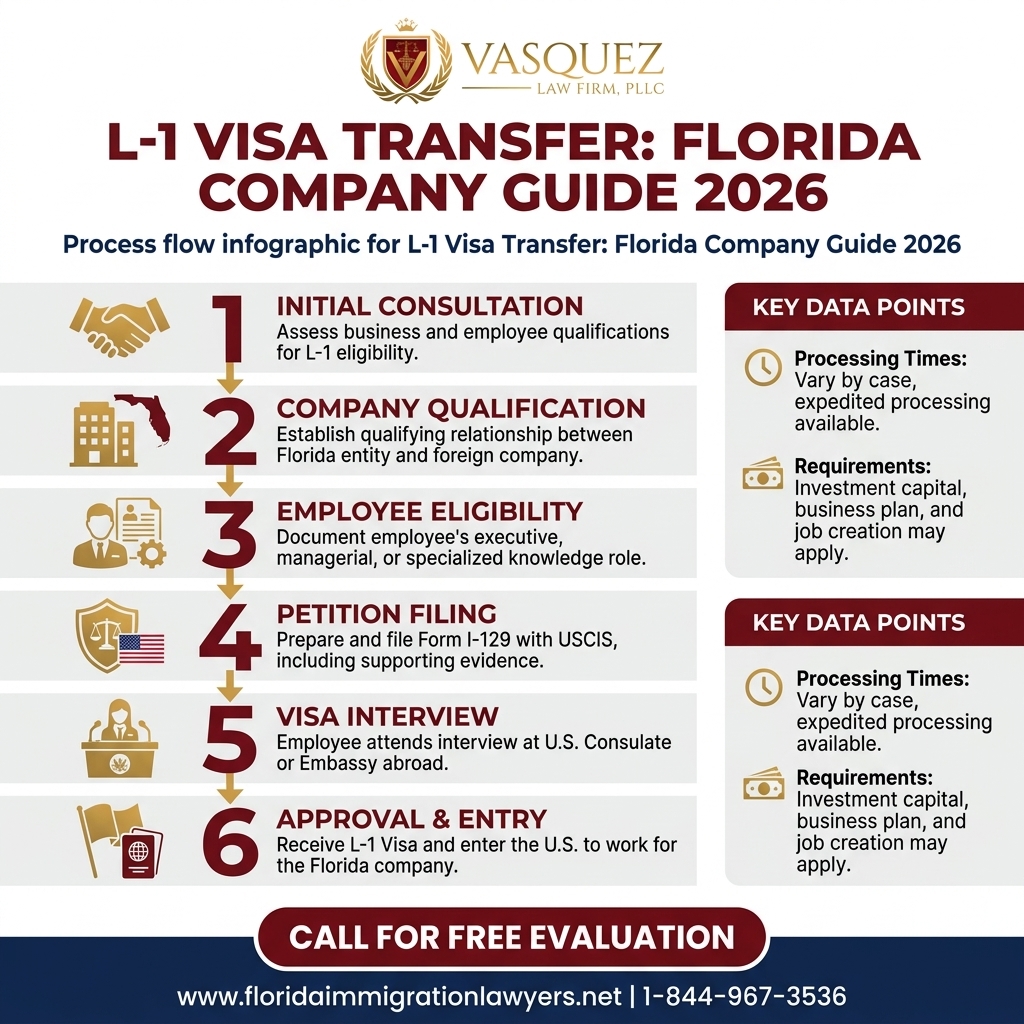
For L-1A, the position must involve directing the organization, a department, or a function, supervising other managers or professionals, or managing an essential function within the organization at a high level without direct supervision. For L-1B, specialized knowledge refers to proprietary knowledge of the company's product, service, research, equipment, techniques, management, or other interests, and its application in international markets, or an advanced level of expertise in the organization's processes and procedures. It is crucial for your Florida company to clearly define these roles and responsibilities in the petition to avoid any ambiguity.
The Step-by-Step L-1 Visa Application Process
Navigating the L-1 visa application process requires meticulous attention to detail and adherence to specific procedural steps. For a Florida company, understanding this sequence is key to a smooth and timely transfer of your essential personnel. While each case has its unique nuances, the general path remains consistent.
-
Establish Qualifying Relationship: Before filing, the U.S. petitioner must ensure a qualifying corporate relationship (parent, subsidiary, affiliate, or branch) exists and can be proven between the U.S. and foreign entities. This is the foundational step for any L-1 petition.
-
Prepare and File Form I-129, Petition for a Nonimmigrant Worker: The U.S. employer files Form I-129, Petition for a Nonimmigrant Worker, along with the L Supplement and all required supporting documentation, with USCIS. This comprehensive package must clearly demonstrate eligibility for both the company and the employee. The petition should be sent to the correct USCIS Service Center based on the U.S. company's location, for instance, the Vermont Service Center or California Service Center typically handle these, depending on the U.S. entity's address.
-
Respond to Requests for Evidence (RFE) (If Applicable): USCIS may issue an RFE if they require additional information or clarification on any aspect of the petition. A timely and thorough response is crucial to keep the process moving forward. This often happens when the initial documentation is insufficient to establish eligibility.
-
Petition Approval: If the petition is approved, USCIS will send an I-797 Approval Notice. This notice is essential for the next step, whether the employee is already in the U.S. or applying from abroad.
-
Consular Processing or Adjustment of Status:
- Consular Processing: If the employee is outside the U.S., they will apply for the L-1 visa stamp at a U.S. embassy or consulate in their home country. This involves scheduling an interview, submitting required documents, and attending the interview. The U.S. Department of State's Bureau of Consular Affairs provides guidelines for this process.
- Adjustment of Status: If the employee is already legally in the U.S. in another nonimmigrant status, they may be eligible to file Form I-485, Application to Register Permanent Residence or Adjust Status, concurrently with the I-129 or after its approval, if they are eligible for a green card (typically L-1A to EB-1C). However, for a simple L-1 transfer from another nonimmigrant status, they would file Form I-539 to change status to L-1.
-
Visa Interview and Entry to U.S.: For consular processing, a successful interview leads to the visa stamp in the passport. The employee can then travel to the U.S. and present their passport and visa at the port of entry, such as Miami International Airport or Orlando International Airport, where a Customs and Border Protection (CBP) officer will make the final decision on admission and issue an I-94 record. For those adjusting status, once approved, they can begin working for the Florida company under L-1 status.
Essential Documents for Your L-1 Visa Petition
A successful L-1 visa petition hinges on providing comprehensive and accurate documentation to USCIS. For your Florida company, gathering these essential documents systematically will streamline the application process and significantly strengthen your case. The more evidence you can provide to support your claims of eligibility, the better your chances of approval. This checklist covers the primary categories of documents typically required.
- Forms:
- Form I-129, Petition for a Nonimmigrant Worker, and the L Supplement.
- Form G-28, Notice of Entry of Appearance as Attorney or Accredited Representative (if applicable).
- Evidence of Qualifying Relationship:
- Corporate documents: Articles of incorporation, bylaws, stock certificates, partnership agreements, organizational charts.
- Proof of ownership and control between the U.S. and foreign entities (e.g., share registers, annual reports).
- Evidence of Active Business:
- Financial statements, annual reports, tax returns for both entities.
- Business licenses, contracts, invoices, lease agreements for office space.
- For new U.S. offices: Business plan detailing proposed operations, financial projections, and staffing plans.
- Employee's Qualifications and Role:
- Letter from the foreign employer verifying the employee's employment for one continuous year within the last three years, detailing their position, duties, and salary.
- Organizational charts for both the foreign and U.S. entities, clearly showing the employee's position and reporting structure.
- Detailed job description for the proposed U.S. position, emphasizing executive, managerial, or specialized knowledge duties.
- Employee's resume or curriculum vitae, educational degrees, and professional licenses.
- Proof of salary and benefits from the foreign employer.
- Employee's Personal Documents:
- Copy of passport biographical page.
- Previous U.S. visa stamps and I-94 records (if applicable).
- Marriage certificate and birth certificates for any accompanying family members (L-2 visa applicants).
L-1 Visa Processing Times and What to Expect in Florida
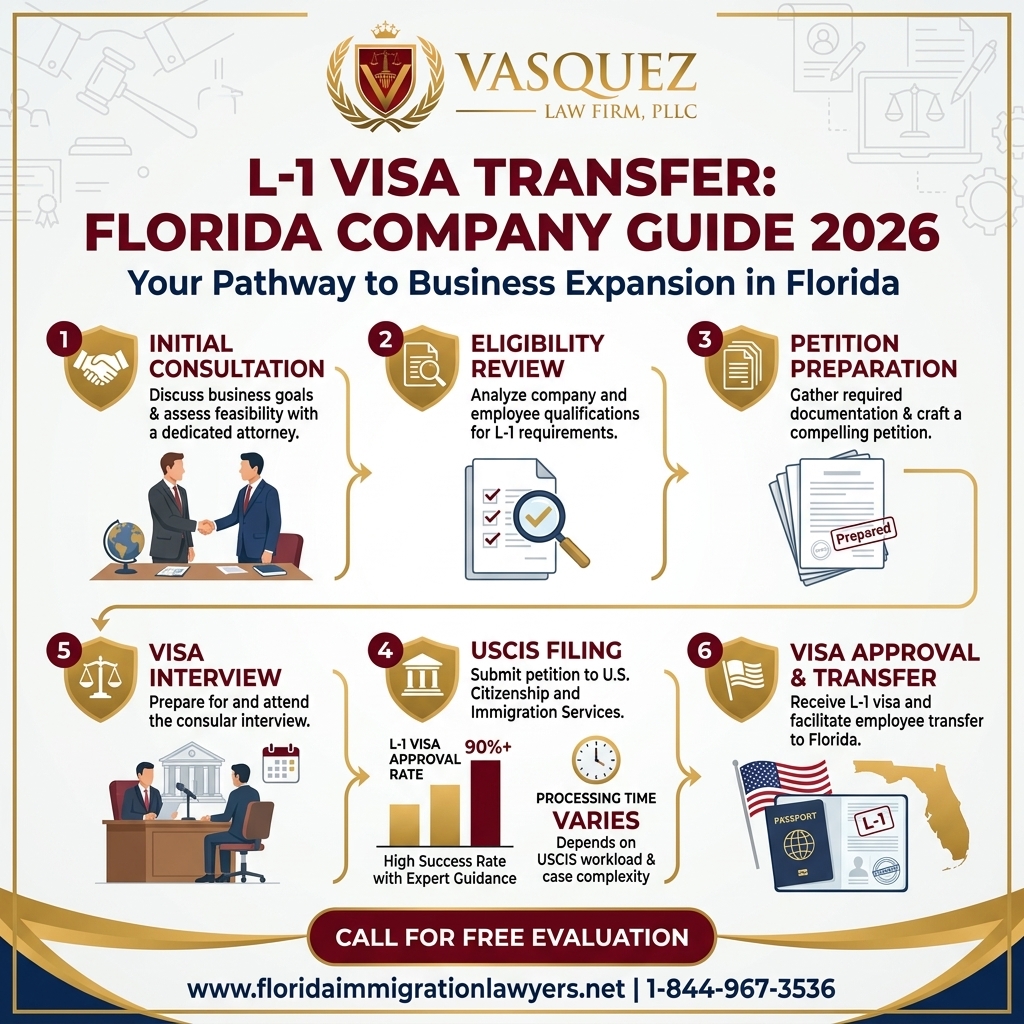
Understanding the typical processing times for an L-1 visa petition is crucial for any Florida company planning an intracompany transfer. These timelines can vary significantly based on several factors, including the specific USCIS Service Center handling the petition, current caseloads, and whether premium processing is utilized. While USCIS provides estimated processing times on its website, these are subject to change and should be monitored regularly.
For standard processing, L-1 petitions can take anywhere from 4 to 12 months, or even longer in some instances, to receive an initial decision. This lengthy wait can be challenging for businesses needing to quickly deploy critical personnel. It is important to factor these potential delays into your business planning, especially if the employee's presence in your Coral Springs or Miami office is time-sensitive. The U.S. Department of Justice's Executive Office for Immigration Review (EOIR) often deals with complex cases, but initial L-1 petitions are handled by USCIS.
To expedite the process, petitioners have the option of utilizing Premium Processing Service. For an additional fee, USCIS guarantees a response (an approval, denial, or Request for Evidence) within 15 calendar days. This can be an invaluable option for Florida companies with urgent staffing needs. However, it's important to note that a Request for Evidence (RFE) will reset the 15-day clock once a response is submitted. Even with premium processing, if consular processing is required, the visa interview scheduling and actual travel will add to the overall timeline.
After a petition is approved, if the employee is outside the U.S., they must undergo consular processing. This involves scheduling an interview at a U.S. embassy or consulate, which can take several weeks to months depending on the specific post's availability. Once the visa is issued, the employee can travel to the U.S. It is essential for your Florida company to plan for these various stages to ensure a smooth transition for your employees and avoid operational disruptions.
Cost Factors and Fees for an L-1 Visa Transfer
Understanding the financial implications of an L-1 visa transfer is a critical aspect of planning for any Florida company. The total cost involves several components, including government filing fees, legal fees, and potential additional expenses. While specific fee amounts are subject to change by USCIS and should always be verified on the official USCIS website, here's a general breakdown of what to expect.
The primary government fees for an L-1 petition include the base filing fee for Form I-129. Additionally, an L-1 petition typically requires a Fraud Prevention and Detection Fee. For companies with 50 or more employees, where more than 50% of their U.S. workforce are H-1B or L-1 nonimmigrants, an additional American Competitiveness and Workforce Improvement Act (ACWIA) fee may apply. These fees are paid directly to USCIS at the time of filing the petition.
Beyond the mandatory government fees, the most significant variable cost will likely be legal fees. Engaging an experienced immigration attorney, like those at Florida Immigration Lawyers, is highly recommended due to the complexity of L-1 petitions. Legal fees cover the attorney's time and expertise in preparing the petition, compiling supporting documentation, responding to RFEs, and advising on compliance issues. These fees can vary widely depending on the complexity of the case, the attorney's experience, and the level of service provided. Investing in expert legal counsel can prevent costly mistakes and increase the likelihood of a successful outcome.
Furthermore, if you opt for Premium Processing Service to expedite USCIS's review, there is a separate, substantial fee for this service. Other potential costs include translation fees for foreign documents, courier services for sending documents, and travel expenses for the employee's consular interview (if applicable). For accompanying family members seeking L-2 visas, there will also be separate application fees. A thorough financial assessment at the outset will help your Florida company budget appropriately for the entire L-1 visa transfer process.
Do not navigate this complex process alone. The success of your L-1 visa transfer can significantly impact your Florida company's operations and growth. Contact Florida Immigration Lawyers today at 1-844-967-3536 for expert guidance and support.
Common Mistakes to Avoid During Your L-1 Visa Application
Applying for an L-1 visa involves intricate details, and even minor errors can lead to significant delays, Requests for Evidence (RFEs), or even outright denials. For Florida companies, understanding and avoiding these common mistakes is crucial for a successful intracompany transfer.
-
Insufficient Proof of Qualifying Relationship: Failing to provide clear, robust evidence of the parent-subsidiary, affiliate, or branch relationship between the U.S. and foreign entities. USCIS requires verifiable documentation of ownership and control.
-
Inadequate Documentation of Active Business: Forgetting to demonstrate that both the U.S. and foreign entities are actively engaged in business operations. This includes financial statements, tax returns, contracts, and lease agreements.
-
Failing to Meet the One-Year Foreign Employment Requirement: The employee must have worked for the foreign entity for at least one continuous year within the past three years. Gaps in employment or insufficient proof can cause problems.
-
Misclassifying the Employee's Role (L-1A vs. L-1B): Incorrectly categorizing an employee as a manager/executive (L-1A) when their duties do not meet USCIS's strict definitions, or claiming specialized knowledge (L-1B) without sufficient evidence of proprietary expertise.
-
Vague Job Descriptions: Submitting generic or unconvincing job descriptions for the U.S. position that do not clearly demonstrate executive, managerial, or specialized knowledge responsibilities. Specificity is key.
-
New Office Petitions Lacking Detail: For new U.S. offices in Florida, failing to provide a detailed business plan, proof of physical premises, and evidence of financial viability to support the new operation and the L-1 employee.
-
Ignoring Visa Overstays or Status Violations: If the employee is already in the U.S., any previous overstays or violations of immigration status can jeopardize the L-1 petition or subsequent adjustment of status.
-
Incomplete or Incorrect Forms: Simple clerical errors, missing signatures, or overlooked sections on Form I-129 and its supplements can lead to an RFE or outright rejection.
-
Not Responding Timely or Adequately to RFEs: Receiving an RFE means USCIS needs more information. Failing to respond within the deadline or submitting an incomplete response often leads to denial.
-
Lack of Organizational Charts: Not including clear organizational charts for both the foreign and U.S. entities that visually represent the employee's position and reporting structure.
When to Call a Florida Immigration Lawyer
While the information provided here offers a comprehensive overview, the complexities of an L-1 visa transfer often necessitate the expertise of a seasoned immigration attorney. For Florida companies, particularly those in areas like Coral Springs, Miami, or Tampa, engaging legal counsel from Florida Immigration Lawyers can make a significant difference in the success and efficiency of your L-1 petition. Our experienced legal team is well-versed in the nuances of U.S. immigration law, including specific requirements for businesses operating in Florida.
You should consider calling an immigration lawyer if your company is:
- Establishing a New U.S. Office: New office L-1 petitions are particularly scrutinized by USCIS and require a robust business plan and detailed evidence of financial viability and active business intent.
- Dealing with Complex Corporate Structures: If your multinational company has a convoluted ownership structure, proving the qualifying relationship can be challenging without legal guidance.
- Facing a Request for Evidence (RFE): An RFE indicates USCIS has concerns or needs more information. A lawyer can help craft a comprehensive and persuasive response.
- Experiencing a Previous L-1 Denial: If a prior L-1 petition was denied, an attorney can help analyze the reasons for denial and strategize a stronger new filing or appeal.
- Unsure About Employee Eligibility: If the employee's role or specialized knowledge is ambiguous, an attorney can help assess whether it meets USCIS definitions.
- Seeking to Transition to Permanent Residency: For L-1A visa holders, an attorney can advise on the EB-1C green card process and help navigate the path to permanent residency.
- Concerned About Compliance: An attorney ensures all documentation adheres to the latest immigration regulations and policies, preventing future issues.
Our firm, Florida Immigration Lawyers, offers dedicated support for business immigration matters, including L-1 visas. We understand the unique needs of Florida businesses and are committed to providing personalized, strategic legal advice to help you achieve your immigration goals.
About Florida Immigration Lawyers
Florida Immigration Lawyers is a leading immigration law firm dedicated to serving individuals and businesses across the entire state of Florida. With offices strategically located to assist clients from Coral Springs to Miami, Orlando, Tampa, and beyond, our experienced team provides comprehensive legal services in all areas of immigration law. We understand that navigating the U.S. immigration system can be overwhelming, and our mission is to offer clear, compassionate, and effective legal representation.
Our firm specializes in a wide range of immigration services, including family-based immigration, business immigration, deportation defense, asylum, and citizenship applications. We pride ourselves on our client-focused approach, ensuring that each case receives the meticulous attention it deserves. Our skilled attorneys are committed to staying abreast of the latest developments in immigration law to provide the most current and effective strategies for our clients.
At Florida Immigration Lawyers, we believe everyone deserves access to quality legal representation. We offer free consultations, are available 24/7, and provide bilingual services (English and Spanish) to ensure effective communication and understanding. Trust us to be your dedicated advocates throughout your immigration journey. Call us today at 1-844-967-3536 or visit floridaimmigrationlawyers.net to learn more about how we can assist you.
Sources and References
- U.S. Citizenship and Immigration Services (USCIS) - L-1A Intracompany Transferee Executive or Manager
- U.S. Citizenship and Immigration Services (USCIS) - L-1B Intracompany Transferee Specialized Knowledge
- U.S. Department of State - L Visas: Intracompany Transferee
- Executive Office for Immigration Review (EOIR)
- 8 U.S.C. Chapter 12 - Immigration and Nationality Act (INA) Section 101(a)(15)(L)
- 8 CFR 214.2(l) - Petitions for L-1 nonimmigrant classification
Related services: H-1B specialty occupation visas, L-1 intracompany transfer visas, work visas for professionals, investment and entrepreneur visas.
This article provides general legal information and is not intended as legal advice. Every case is unique, and outcomes depend on specific facts and circumstances. Contact an attorney for advice about your particular situation. Immigration laws are subject to change.
Securing an L-1 visa for your essential personnel is a strategic move for any Florida company looking to thrive in the global marketplace. Don't leave your business's future to chance. Our dedicated team at Florida Immigration Lawyers is ready to provide the expert guidance you need. Call us now for a free consultation at 1-844-967-3536. Se Habla Espanol - Estamos aqui para ayudarle.
Do Not Navigate This Process Alone
Our experienced immigration attorneys are ready to fight for you. Get a free, confidential consultation today.
Se Habla Español
Or leave your details and we’ll call you:
Free Evaluation in 24 Hours
Or talk to us right now

AI voice assistant — available 24/7
FreeFrequently Asked Questions

William J. Vásquez
Founding Attorney · Vasquez Law Firm
U.S. Air Force veteran and immigration attorney with years of hands-on U.S. immigration experience. J.D., NCCU School of Law. AILA member. Admitted to the 4th, 5th, and 11th Circuit Courts.
Available 24/7 - Free Evaluations
Reviewed for legal accuracy by William J. Vásquez
Licensed in North Carolina; U.S. immigration is federal practice.
Related Legal Services
Our Florida immigration attorneys can help you with experienced immigration attorneys, business immigration and asylum protection. Call today at 1-844-967-3536 for a free consultation.
Related Links
Related Topics
Free Legal Consultation
Discuss your case with our experienced attorneys. We're available 24/7.
Se Habla Español - Estamos aquí para ayudarle.
Related Articles
How to Choose an Immigration Lawyer in Florida 2026
Selecting the right immigration lawyer in Florida is a critical decision that can profoundly impact your future. With complex regulations and varying case types, finding an attorney who specializes in your specific needs, possesses a strong reputation, and communicates transparently is paramount. This guide from Florida Immigration Lawyers provides actionable steps, from verifying credentials with the Florida Bar and understanding fee structures to recognizing common pitfalls like 'notario' scams. Learn how to effectively vet potential legal counsel, prepare necessary documents, and set realistic expectations for your immigration journey in 2026. Empower yourself to make an informed choice and secure expert legal representation for your family, business, or defense immigration needs in Orlando and across Florida.
VAWA Immigration Lawyer: Your 2026 Guide in Florida
For individuals in Florida experiencing domestic abuse from a U.S. citizen or lawful permanent resident, VAWA (Violence Against Women Act) immigration relief offers a confidential pathway to a green card. This article, updated for 2026, provides a comprehensive guide to understanding VAWA self-petitioning, including eligibility criteria, the step-by-step application process, essential documentation, and expected timelines. Learn about the crucial role of a VAWA immigration lawyer in navigating complex requirements, ensuring confidentiality, and protecting your rights throughout the process. We cover common mistakes to avoid and highlight when to seek expert legal counsel to secure your safety and immigration status in Florida. Florida Immigration Lawyers offers free case reviews and compassionate support.
U Visa Certification in Florida: Law Enforcement Guide 2026
For non-citizen crime victims in Florida, the U visa offers a vital path to protection and legal status. This comprehensive guide details the crucial process of obtaining U visa certification from law enforcement, a mandatory step for victims who have suffered substantial abuse and are willing to assist in criminal investigations. Learn about eligibility criteria, the role of agencies like the Orlando Police Department, the step-by-step application process, and expected timelines for 2026. We also cover cost factors and common pitfalls to avoid. Florida Immigration Lawyers provides expert assistance for victims across Florida, ensuring they can navigate these complex legal challenges with confidence and compassion. Discover how our dedicated team can help you pursue justice and secure your future.
Family Petitions for Citizenship Through Father's Family
For individuals in Florida seeking U.S. citizenship through their father's family, understanding the legal pathways is crucial. This comprehensive guide from Florida Immigration Lawyers explains the process, from filing a family petition (Form I-130) to naturalization. We cover derivative and acquired citizenship, step-by-step procedures, required documents, and typical timelines as of 2026. Learn about the cost factors, common mistakes to avoid, and when to seek professional legal assistance from an immigration lawyer in Orlando or anywhere in Florida. Our firm provides expert guidance for complex cases involving paternity, criminal records, or USCIS appeals, ensuring your application for citizenship through a father's family is meticulously prepared. Contact Florida Immigration Lawyers for a free case review.