L-1 Visa Transfer to Florida Company
Discover how the L-1 visa can help transfer employees to your Florida company. Learn about the process, documents, and potential costs involved.

L-1 Visa Transfer to Florida Company: Your Comprehensive Guide
The L-1 intracompany transferee visa is a crucial non-immigrant visa category designed to allow international companies to transfer executives, managers, and employees with specialized knowledge to their U.S. offices. For businesses looking to expand or establish a presence in the dynamic Florida market, understanding the intricacies of the L-1 visa transfer process is paramount. Florida, with its robust economy, strategic location, and diverse industries, offers an attractive destination for global companies. This comprehensive guide will walk you through everything you need to know about securing an L-1 visa transfer to a Florida-based company, ensuring a smooth transition for your key personnel.
Understanding the L-1 Intracompany Transferee Visa
The L-1 visa facilitates the temporary transfer of qualified employees from a foreign parent, subsidiary, affiliate, or branch office to an existing or new U.S. office of the same employer. It is divided into two primary subcategories:
- L-1A Visa for Executives and Managers: This category is for individuals who will be employed in an executive or managerial capacity in the U.S. An executive primarily directs the management of the organization or a major component, while a manager supervises other supervisory, professional, or managerial employees, or manages an essential function within the organization. L-1A visas are initially granted for up to three years and can be extended for a maximum total stay of seven years. A significant benefit of the L-1A visa is its potential pathway to permanent residency through the EB-1C multinational manager or executive green card category.
- L-1B Visa for Employees with Specialized Knowledge: This category is for individuals who possess specialized knowledge of the petitioning organization's product, service, research, systems, proprietary techniques, management, or procedures. This knowledge must be unique and not readily available in the U.S. labor market. L-1B visas are initially granted for up to three years and can be extended for a maximum total stay of five years.
To qualify for either L-1A or L-1B, the employee must have been employed abroad by the qualifying organization for at least one continuous year within the three years immediately preceding their application for admission to the U.S. The U.S. employer must also demonstrate a qualifying relationship with the foreign entity and show that both entities are actively doing business. Navigating these specific requirements often necessitates the expertise of an immigration attorney.
Why Florida for Your L-1 Transfer?
Florida stands out as an exceptionally attractive destination for international businesses and their L-1 visa transferees for a multitude of compelling reasons. The Sunshine State boasts a robust and diversified economy, consistently ranking among the top states for business growth and innovation. Its pro-business policies, competitive tax environment (including no state income tax), and streamlined regulatory processes create an inviting landscape for companies looking to establish or expand their U.S. operations. This economic vitality translates into ample opportunities across various sectors, from advanced manufacturing and aerospace to finance, healthcare, and information technology.
Geographically, Florida holds a strategic advantage as a gateway to Latin America and a crucial hub for international trade. Its extensive network of deepwater ports, international airports, and well-developed infrastructure facilitates seamless global logistics and supply chain management. Major cities like Miami, Orlando, and Tampa serve as bustling centers for international commerce, attracting multinational corporations and fostering a diverse, multilingual workforce. For companies with operations in Central or South America, a Florida presence can significantly enhance regional coordination and market access.
Beyond the economic incentives, Florida offers an unparalleled quality of life that is highly appealing to transferees and their families. The state is renowned for its beautiful beaches, vibrant cultural scene, world-class entertainment, and abundant recreational activities. Excellent educational institutions, a lower cost of living compared to other major U.S. business hubs, and a warm climate year-round contribute to a high standard of living. This combination of professional opportunity and personal well-being makes Florida an ideal choice for employees transitioning from abroad, helping companies attract and retain top talent. Whether your business is in tech, tourism, or international trade, Florida provides a fertile ground for growth and a welcoming environment for your L-1 visa holders. For further assistance in understanding how Florida's unique environment can benefit your business, consider reaching out to our team.
The L-1 Visa Transfer Process: Step-by-Step
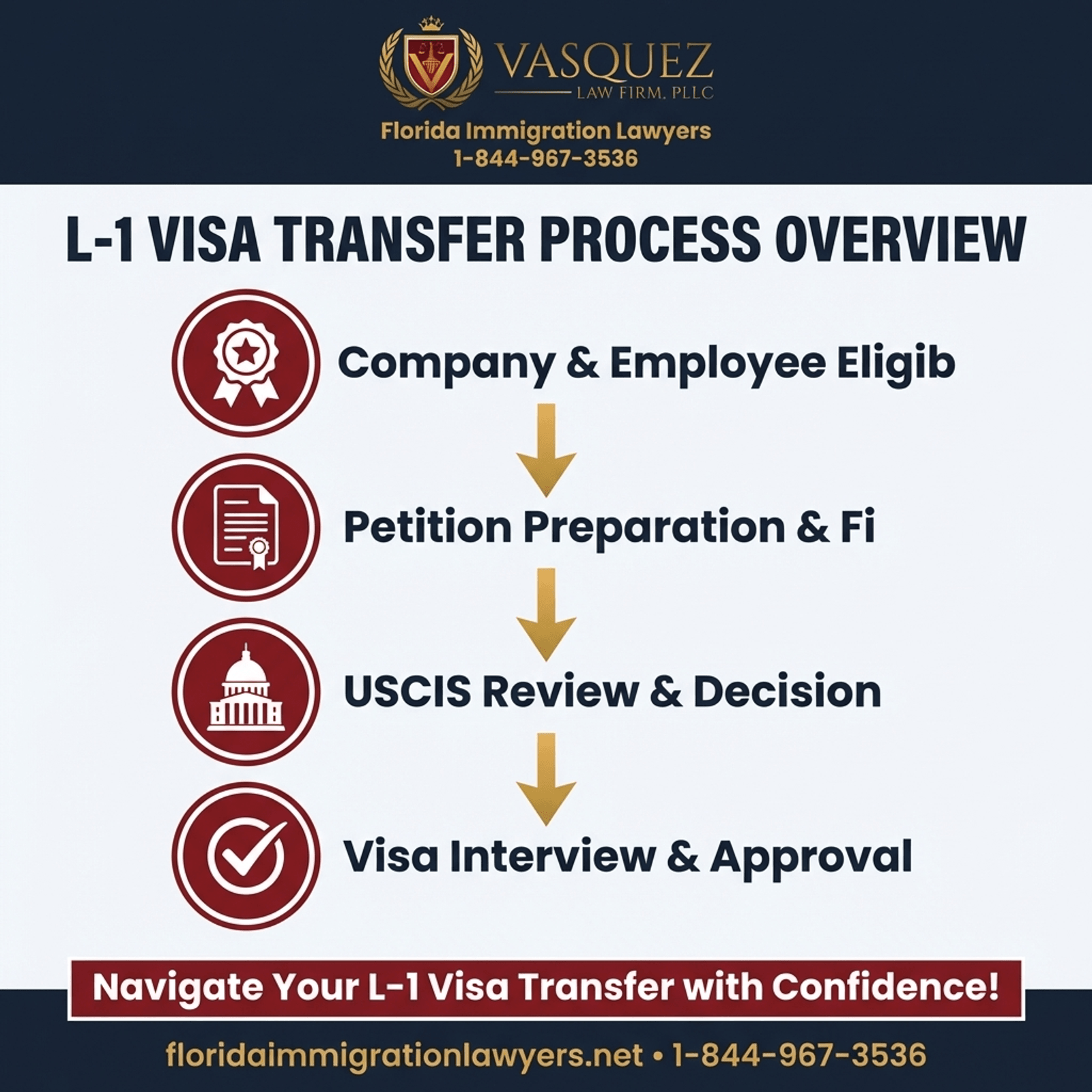
The process of obtaining an L-1 visa involves several critical steps, each requiring meticulous attention to detail and thorough documentation:
- Initial Assessment and Eligibility: The first step is to determine if both the petitioning U.S. company and the foreign employee meet the stringent L-1 visa requirements. This includes verifying the qualifying relationship between the U.S. and foreign entities, the employee's continuous employment abroad, and their role (executive, managerial, or specialized knowledge).
- Petition Filing (Form I-129): The U.S. employer files Form I-129, Petition for a Nonimmigrant Worker, along with the L Supplement, with U.S. Citizenship and Immigration Services (USCIS). This petition must be accompanied by extensive supporting documentation.
- Required Documentation: This is perhaps the most crucial part of the application. It includes corporate documents demonstrating the qualifying relationship (e.g., articles of incorporation, stock certificates, financial statements), evidence of the employee's foreign employment (pay stubs, employment letters), detailed job descriptions for both foreign and U.S. positions, organizational charts, and evidence of the company's ability to pay the employee's salary. For L-1B petitions, compelling evidence of specialized knowledge is essential.
- Premium Processing Option: Employers have the option to pay an additional fee for Premium Processing, which guarantees USCIS will take action on the petition within 15 calendar days. This can significantly expedite the process, which is often beneficial for urgent transfers.
- Consular Processing vs. Change of Status: If the beneficiary is outside the U.S., they will undergo consular processing at a U.S. embassy or consulate in their home country after the I-129 petition is approved. If they are already in the U.S. on another nonimmigrant visa and are eligible, they may apply for a change of status.
- Interview Preparation (if applicable): For consular processing, the beneficiary will attend an interview. Thorough preparation is key to clearly articulate their role, the company's business, and their eligibility.
- Approval and Visa Stamping: Upon approval, the beneficiary receives their L-1 visa stamp in their passport (for consular processing) or their I-797 approval notice (for change of status).
Given the complexity, working with an experienced immigration lawyer can streamline this process and significantly increase the chances of a successful outcome.
Challenges and Considerations in L-1 Transfers
While the L-1 visa offers significant advantages, applicants and employers often face specific challenges:
- Proving "Specialized Knowledge" or "Managerial Capacity": USCIS scrutinizes these definitions closely. For L-1B, merely having technical skills is often insufficient; the knowledge must be proprietary or unique to the organization. For L-1A, the role must involve managing professionals or a key function, not just supervising lower-level employees or performing operational tasks.
- New Office Petitions: Establishing a "new office" in the U.S. comes with additional requirements. The U.S. entity must demonstrate that it has secured sufficient physical premises, has the financial ability to commence business, and will support an executive or managerial position within one year. These petitions are initially granted for a shorter period (one year) and require a subsequent extension with proof of sustained business operations.
- Maintaining Status and Compliance: L-1 visa holders must adhere to the terms of their visa, including working only for the petitioning employer in the approved capacity. Any significant changes in job duties or employer structure must be reported to USCIS. Non-compliance can lead to severe consequences, including deportation defense issues.
- Potential for Requests for Evidence (RFEs): USCIS frequently issues RFEs when they require more information or clarification on an application. Responding comprehensively and promptly to an RFE is critical and often requires legal expertise.
- Impact of Immigration Policy Changes: Immigration policies and interpretations can change, affecting processing times, evidentiary standards, and overall success rates. Staying informed and adaptable is key.
Bringing Your Family: L-2 Dependent Visas
One of the significant benefits of the L-1 visa is the ability for immediate family members to join the principal visa holder in the U.S. Spouses and unmarried children under the age of 21 are eligible for the L-2 dependent visa.
- Eligibility for Spouses and Children: L-2 dependents can apply for their visas concurrently with the L-1 principal or at a later date. They generally receive the same period of stay as the L-1 visa holder.
- Work Authorization for L-2 Spouses: L-2 spouses are eligible to apply for an Employment Authorization Document (EAD) from USCIS, which allows them to work for any employer in the U.S. without restriction. This provides valuable flexibility and financial support for families.
- Education for L-2 Children: L-2 children can attend U.S. primary and secondary schools, as well as colleges and universities, without needing a separate student visa.
Transitioning to Permanent Residency (Green Card) from L-1
The L-1 visa, particularly the L-1A category, offers a direct and often expedited pathway to U.S. permanent residency (a Green Card). L-1A executives and managers are typically eligible for the EB-1C Multinational Manager or Executive immigrant visa category. This category is highly advantageous because it does not require a PERM labor certification process, which can be lengthy and complex. The requirements for EB-1C largely mirror those of the L-1A, making the transition relatively smooth for qualified individuals.
For L-1B specialized knowledge holders, while there isn't a direct EB-1C equivalent, they may still pursue other employment-based green card categories such as EB-2 (for professionals with advanced degrees or exceptional ability) or EB-3 (for skilled workers, professionals, or other workers). These categories typically require a PERM labor certification, demonstrating that there are no qualified U.S. workers available for the position. Consulting with an immigration lawyer early in your L-1 journey can help you strategize the most efficient path to permanent residency.
The Role of an Experienced Immigration Attorney
Navigating the complex landscape of U.S. immigration law, especially for business visas like the L-1, is a challenging endeavor. An experienced immigration attorney plays an indispensable role in ensuring a successful outcome:
- Navigating Complex Regulations: Immigration laws are constantly evolving. An attorney stays abreast of the latest regulations, policy changes, and USCIS interpretations, ensuring your petition is compliant and robust.
- Preparing Compelling Petitions: Attorneys are skilled at gathering, organizing, and presenting the extensive documentation required for L-1 petitions. They help articulate the qualifying relationship, managerial/executive capacity, or specialized knowledge in a way that meets USCIS standards.
- Responding to RFEs: If USCIS issues a Request for Evidence, an attorney can formulate a comprehensive and persuasive response, providing additional documentation and legal arguments to address the agency's concerns.
- Strategic Planning for Long-Term Goals: Beyond the initial L-1 approval, an attorney can help plan for extensions, changes of status, and ultimately, the transition to permanent residency, ensuring a seamless journey for the employee and the company.
- Representation and Advocacy: In some cases, attorneys can represent clients during interviews or in complex administrative proceedings.
Don't leave your L-1 visa transfer to chance. Partnering with a knowledgeable legal team can save time, reduce stress, and significantly improve your prospects of success. If you're considering an L-1 transfer to Florida or need assistance with any immigration matter, we invite you to contact us for a consultation.
Beyond L-1: Other Work Visa Options
While the L-1 visa is excellent for intracompany transfers, it's important to recognize that it's just one of many avenues for foreign nationals to work in the U.S. Depending on the individual's qualifications, the nature of the job, and the employer's needs, other non-immigrant work visas might be more suitable. For instance, the H-1B visa is popular for professionals in specialty occupations, typically requiring a bachelor's degree or higher in a specific field. The E-2 investor visa is available to nationals of treaty countries who make a substantial investment in a U.S. business. The O-1 visa is for individuals with extraordinary ability in the sciences, arts, education, business, or athletics. Each of these visas has its own unique set of requirements, application processes, and limitations. Exploring all available options with an immigration expert can help identify the best fit for your specific circumstances and long-term goals. Understanding the full spectrum of work visa options is crucial for comprehensive immigration planning for both individuals and businesses.
What if Things Go Wrong? Understanding Deportation Defense
While the goal of any visa application is a smooth and successful entry into the U.S., it's also prudent to be aware of potential complications and how to address them. Non-compliance with visa terms, overstaying a visa, or committing certain offenses can lead to serious immigration consequences, including the initiation of deportation defense (removal) proceedings. These proceedings are complex and can be incredibly stressful, threatening an individual's ability to remain in the U.S. If you or someone you know faces such a situation, it is critical to seek immediate legal counsel. An experienced deportation defense attorney can assess your case, identify potential defenses, and represent you in immigration court, fighting to protect your rights and your ability to stay in the country. Proactive compliance and understanding the terms of your visa are the best ways to avoid such situations, but having expert legal support is invaluable if they arise.
Seeking Asylum in the U.S.
While distinct from employment-based visas like the L-1, it's important to acknowledge other critical pathways within U.S. immigration law, such as asylum. Asylum is a form of protection granted to individuals who are unable or unwilling to return to their country of origin due to a well-founded fear of persecution based on race, religion, nationality, membership in a particular social group, or political opinion. The process for seeking asylum is separate from visa applications and involves demonstrating a credible fear of persecution to U.S. authorities. Asylum seekers can apply affirmatively through USCIS or defensively in immigration court if they are already in removal proceedings. This path is a fundamental aspect of humanitarian immigration and provides a lifeline for those fleeing danger and seeking safety in the United States.
Conclusion
The L-1 visa offers a powerful tool for multinational companies to transfer essential talent to their U.S. operations, with Florida presenting an especially attractive environment for growth and success. While the process is detailed and requires careful preparation, the benefits of establishing or expanding your presence in the U.S. through this visa category are substantial. From understanding the nuances of L-1A and L-1B requirements to navigating the application process and planning for a potential green card, each step demands precision and expertise. By partnering with experienced immigration professionals, you can ensure a smooth and efficient L-1 visa transfer, allowing your key personnel to contribute to your Florida company's success without unnecessary delays or complications. Don't hesitate to reach out for personalized guidance. Contact us today for a free consultation at 1-844-967-3536 to discuss your L-1 visa needs and how we can assist you.
Frequently Asked Questions About L-1 Visa Transfers to Florida
1. What is an L-1 visa?
An L-1 visa is a non-immigrant visa that allows international companies to transfer executives, managers, and employees with specialized knowledge from their foreign offices to their U.S. offices.
2. What are the two types of L-1 visas?
There are two types: L-1A for executives and managers, and L-1B for employees with specialized knowledge.
3. How long can I stay in the U.S. on an L-1 visa?
L-1A visa holders can stay for a maximum of seven years, while L-1B visa holders can stay for a maximum of five years, including extensions.
4. Can my family come with me on an L-1 visa?
Yes, your spouse and unmarried children under 21 can apply for L-2 dependent visas. L-2 spouses can also apply for work authorization.
5. What are the main requirements for the U.S. company?
The U.S. company must have a qualifying relationship (parent, subsidiary, affiliate, or branch) with the foreign company and be actively doing business.
6. Is it possible to get a Green Card through an L-1 visa?
Yes, L-1A visa holders (executives and managers) often have a direct path to permanent residency through the EB-1C Multinational Manager or Executive category.
7. What if the U.S. office is new?
New office L-1 petitions are initially granted for one year and require the company to demonstrate a plan for growth and the ability to support an executive or managerial position within that year.
8. Why is Florida a good choice for an L-1 transfer?
Florida offers a strong economy, strategic location for international trade (especially Latin America), diverse industries, and a high quality of life, making it attractive for businesses and transferees alike.
Do Not Navigate This Process Alone
Our experienced immigration attorneys are ready to fight for you. Get a free, confidential consultation today.
Se Habla Español
Frequently Asked Questions

William J. Vásquez
Founding Attorney · Vasquez Law Firm
U.S. Air Force veteran and immigration attorney with thousands of cases resolved. J.D., NCCU School of Law. AILA member. Admitted to the 4th, 5th, and 11th Circuit Courts.
Available 24/7 - Free Evaluations
Related Legal Services
Our Florida immigration attorneys can help you with business immigration, asylum protection and deportation defense. Call today at 1-844-967-3536 for a free consultation.
Related Links
Related Topics
Free Legal Consultation
Discuss your case with our experienced attorneys. We're available 24/7.
Se Habla Español - Estamos aquí para ayudarle.
Related Articles
F-1 Reinstatement Student Visa Process in Florida | VLF Florida
F-1 reinstatement allows students in Coral Springs, Florida, to regain their student visa status if they have fallen out of status. This comprehensive guide covers eligibility, application steps, and common pitfalls, ensuring you are well-prepared. Contact Florida Immigration Lawyers at 1-844-967-3536 for a free consultation.
U Visa for Crime Victims in Florida: Key Insights | VLF Florida
Discover how the U Visa offers critical immigration relief for crime victims in Florida. Learn about eligibility, application steps, and why professional guidance is crucial. Call Florida Immigration Lawyers for expert assistance.
Find an Immigration Lawyer in Cape Coral | VLF Florida
Navigating immigration in Cape Coral and Southwest Florida requires expert guidance. Learn how to choose the right lawyer and understand local immigration processes. Contact Florida Immigration Lawyers for personalized assistance.
E-2 Visa for Florida Business Investors | VLF Florida
Learn about the E-2 investor visa for Florida business opportunities, tailored for Fort Lauderdale entrepreneurs. Discover the process, requirements, and common pitfalls. Contact Florida Immigration Lawyers for expert assistance.
