Citizenship Interview Tips Florida: Your Guide to Naturalization
Preparing for your citizenship interview in Florida is a crucial step towards becoming a U.S. citizen. This comprehensive guide from Florida Immigration Lawyers offers expert tips for the naturalization interview, covering eligibility, document checklists, and what to expect at USCIS field offices in St. Petersburg, Tampa, and other Florida locations. Learn how to prepare for the English and civics tests, avoid common mistakes, and understand the cost factors involved. We also highlight when it's essential to seek legal counsel for complex cases or to ensure a flawless application. Contact our firm for a free consultation to secure your path to citizenship.

Preparing for your citizenship interview in Florida is a critical step towards becoming a U.S. citizen. The interview assesses your eligibility, knowledge of U.S. history and government, and English language proficiency. Success hinges on thorough preparation, including reviewing your N-400 application, studying civics questions, and practicing English. Understanding the process, anticipating potential challenges, and knowing what to expect at your local USCIS field office, such as those serving St. Petersburg or Tampa, can significantly boost your confidence and chances of approval. Seek legal guidance for complex cases or to ensure your application is flawless.
- Review your N-400 application thoroughly.
- Study the 100 civics questions and practice English.
- Gather all necessary documents for the interview.
- Understand the oath of allegiance and good moral character requirements.
- Consider legal assistance for complex immigration histories.
Embarking on the journey to U.S. citizenship is a momentous occasion for many residents of Florida. For those living in St. Petersburg, Tampa, Orlando, or anywhere across the Sunshine State, the naturalization process culminates in one of the most important steps: the citizenship interview. This interview is your opportunity to demonstrate your eligibility, your commitment to the United States, and your understanding of its history and government. It can feel daunting, but with the right preparation and support, you can approach it with confidence.
At Florida Immigration Lawyers, we understand the hopes and anxieties that come with pursuing U.S. citizenship. Our firm is dedicated to guiding individuals through every stage of the naturalization process, ensuring they are fully prepared for their interview at USCIS field offices throughout Florida. This comprehensive guide will provide you with essential tips, insights into the process, and common pitfalls to avoid, helping you navigate your path to becoming a proud American citizen. Don't leave your future to chance. Call Florida Immigration Lawyers at 1-844-967-3536 for a free consultation today and let us help you achieve your American dream.
Understanding the Naturalization Interview Process in Florida
The naturalization interview is a formal meeting with a USCIS officer, typically held at a local field office in Florida, such as those in Tampa, Miami, or Orlando. This interview serves several crucial purposes. First, the officer will review your N-400 Application for Naturalization to confirm the accuracy of the information you provided. They will also assess your English language proficiency in speaking, reading, and writing, and test your knowledge of U.S. history and government, known as civics.
For many applicants in Florida, this interview is the most anticipated part of the citizenship journey. It is a chance to personally convey your eligibility and commitment. The officer will ask questions about your background, family, employment, travel history, and any other details from your application. They will also verify that you meet all statutory requirements for naturalization, including continuous residence, physical presence, and good moral character, as outlined in the USCIS Policy Manual and the Immigration and Nationality Act (INA).
The interview is conducted in English, unless you qualify for an English language exemption based on age and length of lawful permanent residency. For example, applicants who are 50 years old and have lived in the U.S. as permanent residents for at least 20 years (50/20 rule) or 55 years old with 15 years of residency (55/15 rule) may take the interview in their native language with an interpreter. Even with an exemption, you must still answer the civics questions. Understanding these requirements is fundamental to your preparation, especially if you reside in the diverse communities of St. Petersburg or its surrounding areas.
Eligibility Requirements for U.S. Citizenship in Florida
Before you even receive an interview notice for your naturalization interview, you must meet several key eligibility criteria established by the U.S. government. These requirements are outlined in the Immigration and Nationality Act, specifically INA § 316 (8 U.S.C. § 1427) and others. Meeting these criteria is non-negotiable and forms the foundation of your application. If you have any doubts about your eligibility, it is crucial to consult with an experienced immigration attorney in Florida.
General Eligibility Criteria:
- Age: You must be at least 18 years old at the time of filing your N-400 application.
- Green Card Holder: You must be a lawful permanent resident (Green Card holder) for at least 5 years. This period can be reduced to 3 years if you are married to a U.S. citizen and meet other specific requirements.
- Continuous Residence: You must have resided continuously in the U.S. as a lawful permanent resident for at least 5 years (or 3 years if married to a U.S. citizen) immediately preceding the date of filing your application.
- Physical Presence: You must have been physically present in the U.S. for at least half of the continuous residence period (e.g., 30 months out of 5 years).
- Residence in USCIS District: You must have resided for at least 3 months in the state or USCIS district where you file your application. For those in St. Petersburg, this would typically fall under the Tampa Field Office jurisdiction.
- Good Moral Character: You must demonstrate good moral character for the statutory period (5 or 3 years). This is a broad requirement that considers your criminal record, tax compliance, and other aspects of your conduct.
- English Language Proficiency: You must be able to read, write, and speak basic English.
- Civics Knowledge: You must have a basic understanding of U.S. history and government.
- Attachment to U.S. Constitution: You must show an attachment to the principles and ideals of the U.S. Constitution and be willing to take the Oath of Allegiance.
Ensuring you meet all these criteria before applying is essential. Any discrepancies or unaddressed issues can lead to delays or even denial of your application. Our team at Florida Immigration Lawyers can help you assess your eligibility and address any concerns specific to your situation in Florida, making sure your journey to citizenship is as smooth as possible.
Preparing for Your Citizenship Interview in Florida: A Step-by-Step Guide
Thorough preparation is the cornerstone of a successful citizenship interview. For residents of St. Petersburg and across Florida, dedicating time to prepare can alleviate stress and significantly improve your chances of approval. This guide breaks down the essential steps you should take before your scheduled interview at the local USCIS office.
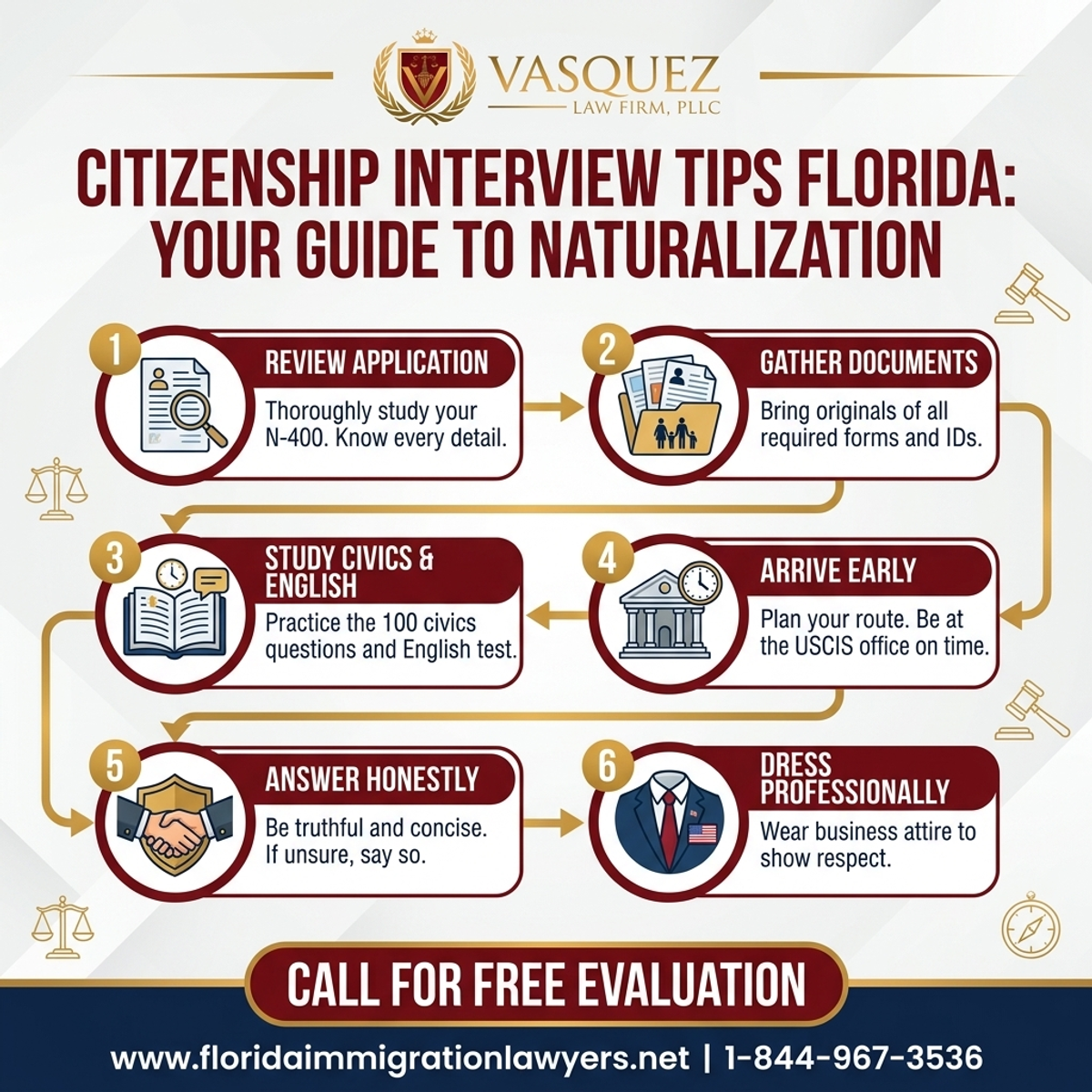
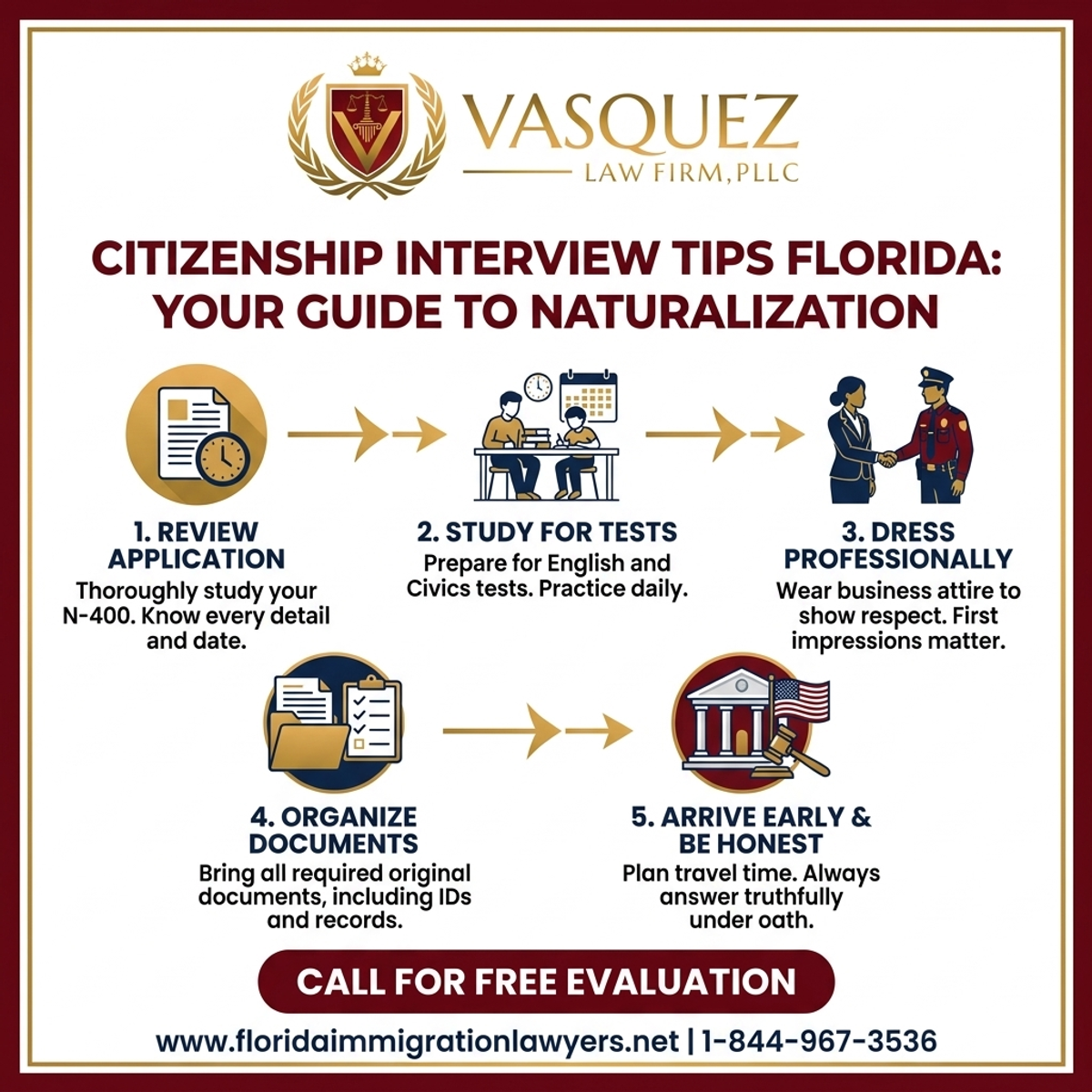
1. Review Your N-400 Application:
This is perhaps the most crucial step. Go through your entire N-400 application form, question by question. Ensure you remember every answer you provided. The USCIS officer will refer to this document and ask questions based on its contents. Any inconsistencies between your spoken answers and your written application can raise red flags. If you made any changes or updates since filing, bring documentation to support them.
2. Study for the English and Civics Tests:
The English test assesses your ability to understand, speak, read, and write simple English. You'll be asked to read one of three sentences correctly and write one of three sentences correctly. For the civics test, you will be asked up to 10 questions from a list of 100 civics questions. You must answer 6 out of 10 correctly to pass. All 100 questions and their answers are publicly available on the USCIS website. Practice regularly, perhaps daily, to commit these to memory. Many Florida community centers and libraries offer free citizenship classes to help with this.
3. Gather All Required Documents:
On your interview day, you must bring a specific set of documents. This includes your interview notice, Green Card, passport, and any other identification. You should also bring all original documents that you submitted copies of with your N-400, such as birth certificates, marriage certificates, divorce decrees, tax returns, and travel records. If you have had any arrests, even minor ones that were dismissed, bring all court dispositions. Having everything organized in a folder will demonstrate your preparedness and attention to detail. This is vital for any applicant in St. Petersburg or elsewhere in Florida.
Document Checklist for Your Interview:
Step-by-Step Process — Citizenship Interview Tips Florida: Your Guide to Naturalization
- Your interview appointment notice.
- Your Permanent Resident Card (Green Card).
- Your state-issued identification (e.g., Florida Driver's License or ID card).
- All passports, current and expired.
- Original or certified copies of any documents you submitted with your N-400 application (e.g., birth certificates, marriage certificates, divorce decrees, adoption decrees).
- Evidence of your marital status (if applicable): marriage certificate, divorce decrees for all prior marriages of you and your spouse.
- Evidence of your spouse's U.S. citizenship (if applicable): birth certificate, naturalization certificate, or U.S. passport.
- Evidence of financial support for dependents (if applicable): tax returns, pay stubs.
- Proof of selective service registration (for male applicants aged 18-26).
- Certified court dispositions for any arrests, citations, or detentions, even if charges were dismissed or expunged.
- Proof of payment for child support or alimony (if applicable).
- Any other documents requested in your interview notice or that you believe are relevant to your application.
Organizing these documents well in advance will prevent last-minute stress. Consider making copies of everything you bring, keeping the originals separate but accessible.
Do not navigate this process alone. The complexities of immigration law, especially during a naturalization interview, can be overwhelming. Contact Florida Immigration Lawyers today at 1-844-967-3536 for expert guidance and support tailored to your unique situation in Florida. We offer free consultations to help you understand your options and ensure your application is as strong as possible.
What to Expect During Your Naturalization Interview
On the day of your citizenship interview, arrive early at the designated USCIS field office in Florida, whether it's in Tampa, Miami, or another location. Give yourself ample time to account for traffic, parking, and security checks. Dress professionally, as this is a formal government proceeding. Your demeanor and appearance can make a positive impression on the interviewing officer.
The Interview Process:
- Check-in and Waiting: Upon arrival, you will check in at the front desk and proceed through security. You'll then wait in a designated waiting area until your name is called.
- Oath and Verification: The USCIS officer will call your name and lead you to their office. They will ask you to raise your right hand and swear to tell the truth. They will then verify your identity by checking your Green Card and appointment notice.
- Review of N-400 Application: The officer will go through your N-400 application with you, confirming the information, asking for clarifications, and noting any changes since you filed. Be honest and consistent with your answers. They may ask about your travel history, employment, marital status, and good moral character.
- English Language Test: This involves reading a sentence aloud and writing a sentence dictated by the officer. The officer will also assess your ability to understand and speak English through the questions they ask during the interview.
- Civics Test: You will be asked up to 10 civics questions from the official list of 100. You must answer 6 correctly to pass.
- Decision: At the end of the interview, the officer may tell you immediately if your application is recommended for approval, continued for further review (N-14 notice), or denied. If recommended for approval, you will typically receive a notice for your Oath of Allegiance ceremony.
The interview typically lasts between 20 to 45 minutes, though it can be longer depending on the complexity of your case. Maintain a respectful and polite attitude throughout the process. Answer all questions truthfully and to the best of your knowledge. If you do not understand a question, politely ask the officer to repeat or rephrase it. Do not guess.
Potential Outcomes and What Happens After Your Interview
After your citizenship interview at a Florida USCIS office, there are several possible outcomes, each with its own next steps. Understanding these can help manage expectations and prepare you for what comes next in your naturalization journey. Whether you are in St. Petersburg, Miami, or Jacksonville, the process generally follows similar patterns.
Possible Interview Outcomes:
- Recommended for Approval: This is the most favorable outcome. The officer believes you meet all eligibility requirements. You will typically receive a Form N-652, Naturalization Interview Results, indicating this. The next step is usually receiving a notice for your Oath of Allegiance ceremony.
- Continued: If the officer needs more information or documentation, or if you fail a portion of the English or civics test, your case may be continued. You will receive a Form N-14, Request for Additional Information or Documents. This form will specify what you need to provide or if you need to return for a second interview (e.g., to re-take the English or civics test). This is a common occurrence and not necessarily a sign of denial.
- Denied: If USCIS determines you do not meet the eligibility requirements, your application may be denied. You will receive a written explanation of the reasons for denial. You have the right to appeal this decision by filing a Form N-336, Request for a Hearing on a Decision in Naturalization Proceedings, within 30 days of the denial decision.
Timeline After the Interview:
The timeline from interview to Oath Ceremony can vary. In many Florida USCIS field offices, if approved, the Oath Ceremony notice might arrive within a few weeks, and the ceremony itself could be scheduled within one to three months. However, processing times are subject to change and can be influenced by factors such as the volume of applications and specific office workloads. You can check the status of your case online using your receipt number on the USCIS Case Status website.
Key Statistics — Citizenship Interview Tips Florida: Your Guide to Naturalization
The Oath of Allegiance ceremony is the final step. During this ceremony, you will take an oath, officially becoming a U.S. citizen. You will then receive your Certificate of Naturalization, which is proof of your U.S. citizenship. This document is vital and should be kept safe. It allows you to apply for a U.S. passport and register to vote, fully exercising your rights as a citizen.
Cost Factors and Fee Breakdown for Naturalization in 2026
Understanding the costs associated with your naturalization interview and the overall citizenship application is an important part of your preparation. While USCIS fees can change, it's essential to be aware of the typical expenses involved. These fees are set by the government and are generally non-refundable, even if your application is denied. As of 2026, applicants in Florida should budget for specific costs.
Primary USCIS Fees:
- Form N-400, Application for Naturalization Filing Fee: This is the main fee for processing your application. USCIS periodically adjusts this fee, so it is crucial to check the most current fee on the official USCIS website before filing.
- Biometrics Services Fee: This fee covers the cost of collecting your fingerprints, photograph, and signature, which are used for background checks. This fee is often combined with the N-400 filing fee.
It is important to note that certain applicants may be eligible for a fee waiver or a reduced fee. Eligibility for fee waivers is based on income guidelines relative to the Federal Poverty Guidelines. If you believe you might qualify for a fee waiver, you must submit a Form I-912, Request for Fee Waiver, along with your N-400 application. This can significantly reduce the financial burden of applying for citizenship for eligible individuals in Florida.
Other Potential Costs:
- Attorney Fees: While not mandatory, hiring an immigration attorney is a valuable investment, especially for complex cases or if you want to ensure your application is meticulously prepared. Attorney fees vary based on the complexity of the case and the services provided. Florida Immigration Lawyers offers transparent fee structures and free initial consultations to discuss your needs.
- Document Translation Fees: If any of your supporting documents are not in English, you will need to provide certified English translations. Professional translation services incur additional costs.
- Travel Expenses: Factor in costs for transportation to the USCIS field office for your biometrics appointment and interview, especially if you are traveling from St. Petersburg or other distant parts of Florida to a major city like Tampa or Miami.
- Postage and Photocopying: Small but necessary costs for mailing your application and preparing copies of all documents.
Always verify the most current fees directly on the USCIS website (www.uscis.gov) or consult with an immigration attorney before submitting your application. This proactive approach helps prevent delays due to incorrect payments and ensures a smoother process for your naturalization interview.
Common Mistakes to Avoid During Your Citizenship Journey
Navigating the naturalization process can be complex, and even minor errors can lead to significant delays or even denial of your application. Being aware of these common pitfalls can help you avoid them, ensuring a smoother path to your citizenship interview in Florida.
- Failing to Disclose All Arrests/Citations: Many applicants mistakenly believe that minor infractions, expunged records, or arrests without conviction do not need to be disclosed. USCIS requires disclosure of ALL arrests, citations, or detentions, regardless of the outcome. Failure to disclose can lead to a finding of lack of good moral character and denial.
- Inconsistent Information: Providing different answers on your N-400 than what you previously submitted on other immigration forms (e.g., Green Card application) or during the interview can raise credibility issues. Always review your past applications.
- Insufficient Physical Presence or Continuous Residence: Miscalculating the required time spent in the U.S. can lead to ineligibility. Long trips outside the U.S. can break continuous residence.
- Poor English Language Skills: While basic English is required, many applicants underestimate the importance of practicing speaking, reading, and writing. Failing the English test requires a second interview.
- Lack of Civics Knowledge: Not adequately studying the 100 civics questions. You must pass this test, and failing means you will be re-interviewed on it.
- Not Bringing All Required Documents: Forgetting to bring original documents, updated evidence, or court dispositions can lead to a continuance and delay your case.
- Lapses in Good Moral Character: Engaging in activities that demonstrate a lack of good moral character during the statutory period (e.g., tax evasion, failure to pay child support, certain criminal offenses) can result in denial.
- Missing Deadlines: Failing to respond to Requests for Evidence (RFEs) or N-14 notices within the specified timeframe can lead to application abandonment or denial.
- Not Updating USCIS of Address Changes: Moving without informing USCIS can result in missed notices, interview appointments, or other critical communications, potentially causing delays or even denial if you miss an important appointment.
- Failing to Register for Selective Service: Male applicants between 18 and 26 years old must register for Selective Service. Failure to do so can jeopardize naturalization, unless you can prove you were not required to register.
- Ignoring Legal Advice: Attempting to navigate a complex case without legal counsel, especially when there are criminal issues, long absences, or previous immigration violations, is a significant risk.
When to Call a Florida Immigration Lawyer for Your Citizenship Interview
While the naturalization process is designed to be accessible, certain situations warrant the expertise of an experienced immigration attorney. If you're preparing for your citizenship interview in St. Petersburg, Tampa, or anywhere in Florida, knowing when to seek legal counsel can be the difference between approval and denial. Florida Immigration Lawyers are here to provide the guidance you need.
You should strongly consider contacting an attorney if:
- You have a criminal record, regardless of how minor or old the charges are. Even expunged records can impact your good moral character assessment.
- You have had long absences from the U.S. or traveled extensively, which could affect your continuous residence or physical presence requirements.
- You have previously been denied a Green Card or had other immigration applications denied.
- You have ever been placed in deportation or removal proceedings.
- You have failed to register for Selective Service (for male applicants).
- You have issues with child support or alimony payments.
- You have filed for bankruptcy or have significant tax issues.
- You have any doubts about your eligibility or concerns about specific questions on the N-400 application.
- You struggle with English and are unsure about qualifying for an exemption, or if you simply want extra preparation for the interview.
- You received a Request for Evidence (RFE) or an N-14 notice after your interview.
An immigration lawyer can review your entire immigration history, identify potential issues, help you gather necessary documentation, and prepare you thoroughly for your interview. They can also represent you at the interview, offering invaluable support and advocacy. Our team at Florida Immigration Lawyers is well-versed in the nuances of U.S. immigration law and dedicated to protecting your rights and interests throughout the naturalization process. Don't take chances with your future; let us help you achieve your goal of U.S. citizenship.
About Florida Immigration Lawyers
Florida Immigration Lawyers is a leading immigration law firm dedicated to serving individuals and families across the entire state of Florida. From the vibrant communities of St. Petersburg and Tampa to Miami, Orlando, and Jacksonville, our experienced attorneys provide compassionate and effective legal representation for a wide range of immigration matters. We understand the profound impact immigration decisions have on your life and are committed to helping you navigate the complexities of U.S. immigration law.
Our firm specializes in areas such as family immigration, business immigration, asylum, deportation defense, and, of course, the naturalization process. We pride ourselves on offering personalized attention, clear communication, and strategic legal solutions tailored to each client's unique needs. We believe everyone deserves high-quality legal representation, which is why we offer free consultations and are available 24/7 to answer your questions and provide peace of mind. Our bilingual team, fluent in English and Spanish, ensures that language is never a barrier to receiving the legal support you deserve. When you choose Florida Immigration Lawyers, you choose a partner committed to your success.
Sources and References
- U.S. Citizenship and Immigration Services (USCIS)
- Executive Office for Immigration Review (EOIR)
- U.S. Department of State - Bureau of Consular Affairs
- Immigration and Nationality Act (INA), 8 U.S.C. Chapter 12
Related services: immigration practice areas, family immigration services.
This article provides general legal information and is not intended as legal advice. Every case is unique, and outcomes depend on specific facts and circumstances. Immigration laws are subject to change. Contact an attorney for advice about your particular situation.
Don't let the complexity of the citizenship interview process deter you from pursuing your dream of becoming a U.S. citizen. With proper preparation and experienced legal guidance, you can navigate this important step with confidence. Florida Immigration Lawyers is here to support you every step of the way, offering dedicated assistance for individuals across Florida, including St. Petersburg. Take the first step towards your future today. Call us at 1-844-967-3536 for a free, confidential consultation. Se Habla Espanol - Estamos aqui para ayudarle.
If you need legal assistance, learn more about citizenship lawyers in Florida, or call us at 1-844-967-3536 for a free consultation.
Do Not Navigate This Process Alone
Our experienced immigration attorneys are ready to fight for you. Get a free, confidential consultation today.
Se Habla Español
Frequently Asked Questions

William J. Vásquez
Founding Attorney · Vasquez Law Firm
U.S. Air Force veteran and immigration attorney with thousands of cases resolved. J.D., NCCU School of Law. AILA member. Admitted to the 4th, 5th, and 11th Circuit Courts.
Available 24/7 - Free Evaluations
Related Legal Services
Our Florida immigration attorneys can help you with free immigration consultation, experienced immigration attorneys and business immigration. Call today at 1-844-967-3536 for a free consultation.
Related Links
Related Topics
Free Legal Consultation
Discuss your case with our experienced attorneys. We're available 24/7.
Se Habla Español - Estamos aquí para ayudarle.
Related Articles
Biometrics Appointment in Florida: What to Expect in 2026
Navigating a biometrics appointment in Florida is crucial for your USCIS process. Learn what to expect, how to prepare, and common pitfalls to avoid. Florida Immigration Lawyers are here to help with personalized guidance and support.
Withholding of Removal Explained: Florida Defense in 2026
For those in Florida facing deportation and fearing persecution or torture in their home country, understanding withholding of removal is critical. This form of protection prevents removal to a dangerous country, though it differs significantly from asylum in its eligibility criteria and benefits. It requires proving a "more likely than not" chance of persecution based on protected grounds or torture, a higher standard than asylum's "well-founded fear." While withholding of removal does not lead to a Green Card, it offers mandatory protection if the stringent criteria are met, even for some individuals barred from asylum. The process involves complex legal proceedings before an immigration judge, often in Miami or Orlando immigration courts. A comprehensive application, detailed testimony, and robust supporting evidence, including country conditions reports and affidavits, are essential. Given the high stakes and intricate legal requirements, securing the expertise of a Florida immigration lawyer is paramount to building a strong defense and navigating the path to safety.
US Visa Policy Changes July 2026: What Students in Florida
As of July 2026, international students in Florida seeking a change of status to an F-1 student visa must prepare for potential adjustments to U.S. visa policies. This comprehensive guide from Florida Immigration Lawyers explores the anticipated policy changes, detailing their potential impact on application requirements, processing times, and eligibility criteria. We provide a step-by-step overview of the change of status process, including a document checklist, expected timelines, and cost considerations. Understanding these complexities and avoiding common mistakes is crucial for a successful application. With potential changes approaching, proactive planning and expert legal guidance are more important than ever. Our firm is dedicated to helping students in Tampa and across Florida navigate these challenges, offering tailored advice and robust representation. Learn how to protect your academic future and ensure a smooth transition to F-1 student status.
Dual Citizenship Lawyer: Your 2026 Guide to Naturalization
Achieving U.S. citizenship is a profound milestone, but the path to naturalization, especially with dual citizenship in mind, is fraught with legal intricacies and a critical interview process. This comprehensive guide from Florida Immigration Lawyers demystifies the journey, offering essential citizenship interview tips and highlighting the invaluable role of a dual citizenship lawyer. We cover eligibility, document preparation, timelines, and common pitfalls, all tailored for Florida residents in areas like Pembroke Pines. Discover how expert legal counsel can prepare you for your naturalization interview, address dual nationality concerns, and ensure a smooth, successful application. From initial assessment to interview representation, we provide the support needed to navigate USCIS requirements confidently. Call Florida Immigration Lawyers for a free consultation to start your journey.
