Immigration Documents Checklist Florida: Your 2026 Guide
Navigating the U.S. immigration system in Florida requires a precise understanding of required documentation. This 2026 guide from Florida Immigration Lawyers provides an essential checklist for your immigration documents, covering everything from identity proofs and financial records to specific USCIS forms. We detail the paperwork needed for various processes like family-based petitions, employment visas, asylum applications, and naturalization. Learn how to organize your documents, understand processing timelines, and identify common mistakes to avoid. With a focus on St. Petersburg and the broader Florida context, this article also addresses state-specific requirements like proof of residency. For personalized legal assistance, contact Florida Immigration Lawyers for a free consultation.

For immigrants in Florida, a comprehensive immigration documents checklist is crucial for any USCIS application or interaction. This includes identity proofs, financial records, and specific forms like the I-94 or green card. Proper organization and timely submission of all required paperwork are essential to avoid delays and ensure a smooth process.
- Always keep original documents secure and provide copies.
- Understand specific requirements for each application type.
- Proof of Florida residency is often needed for state-level services.
- Consult an immigration attorney for complex cases.
- Regularly check USCIS processing times and updates.
Immigration Documents Checklist Florida: Your 2026 Guide
Embarking on an immigration journey in Florida can feel overwhelming, especially when faced with a mountain of required documentation. The process demands meticulous attention to detail, from identifying the correct forms to gathering all necessary supporting **immigration documents**. Whether you are applying for a green card, seeking asylum, or pursuing U.S. citizenship, having a clear **checklist** is your first step towards success.
Florida, with its diverse population and bustling cities like St. Petersburg, is home to countless individuals navigating the U.S. immigration system. Understanding the specific **paperwork** and requirements is vital to avoid costly delays or even denials. This comprehensive guide from Florida Immigration Lawyers provides a detailed **immigration documents** checklist for 2026, helping you prepare your case with confidence.
Do not navigate this complex process alone. For personalized guidance and to ensure your **immigration documents** are perfectly prepared, **call Florida Immigration Lawyers at 1-844-967-3536 for a free consultation** today. We are here to help you every step of the way.
Understanding Your Immigration Documents in Florida
Properly managing your **immigration documents** is not just a recommendation; it is a necessity. Every application, petition, and interview with U.S. Citizenship and Immigration Services (USCIS) or the Executive Office for Immigration Review (EOIR) depends on accurate and complete **paperwork**. Missing even a single document can significantly delay your case or lead to a Request for Evidence (RFE).
For residents of St. Petersburg and across **Florida**, the types of **immigration documents** you will need vary greatly depending on your specific immigration goal. These documents typically fall into several categories: identity, eligibility, financial support, and biographical information. Organizing these effectively is key to a smooth process.
The U.S. immigration system is governed by federal law, primarily the Immigration and Nationality Act (INA), codified in 8 U.S.C. Chapter 12. This extensive legal framework dictates the requirements for various immigration benefits, making the **immigration documents** **checklist** a critical tool for compliance.
Importance of Accurate Paperwork
Submitting accurate and complete **paperwork** is paramount. Errors or omissions in your **immigration documents** can lead to significant setbacks, including delays, requests for additional evidence, or even denial of your application. This can be particularly frustrating and costly for applicants.
Ensuring every form is filled out correctly and every supporting document is included can save you time, stress, and money. It also demonstrates your diligence and commitment to the immigration process, which can reflect positively on your case. Always double-check every detail.
Florida-Specific Context
While federal law governs immigration, certain state-level considerations exist in **Florida**. For instance, obtaining a driver's license or state identification card requires specific proof of identity and legal presence. This often includes your **immigration documents** such as an I-94 record, a valid visa, or a Permanent Resident Card (Green Card).
Florida's large immigrant population, particularly in areas like St. Petersburg, Miami, and Orlando, means that USCIS field offices and immigration courts here are consistently busy. Being well-prepared with your **immigration documents** can help you stand out and streamline your interactions with these agencies.
Navigating Common Immigration Processes and Their Document Needs
The specific **immigration documents** you need will depend on the type of immigration benefit you are seeking. Each pathway has its unique set of forms and supporting evidence. Here, we outline the general document requirements for some common immigration processes.
Family-Based Petitions
Family-based immigration is a common path for many individuals seeking to live in the U.S. This process often involves filing Form I-130, Petition for Alien Relative, followed by an application for adjustment of status (Form I-485) or consular processing. Crucial **immigration documents** include:
- Proof of relationship (birth certificates, marriage certificates).
- Sponsor's proof of U.S. citizenship or lawful permanent residency.
- Sponsor's financial documents (Form I-864, Affidavit of Support, tax returns, bank statements).
- Applicant's birth certificate, passport, and photos.
- Proof of legal entry and immigration history for adjustment of status.
Learn more about how we can assist with Family Immigration cases.
Employment-Based Visas
For those seeking to work in the U.S., employment-based visas require a different set of **immigration documents**. These often involve a petition from an employer, such as Form I-140, Immigrant Petition for Alien Worker, or an application for a nonimmigrant work visa like an H-1B.
- Employer's petition (e.g., I-129, I-140).
- Applicant's educational degrees, transcripts, and professional licenses.
- Letters of experience from previous employers.
- Proof of job offer and detailed job description.
- Applicant's passport and visa history.
Our firm also handles complex Business Immigration matters for companies and individuals.
Asylum and Refugee Applications
Individuals seeking protection in the U.S. through asylum or refugee status must provide compelling **immigration documents** to support their claim of fear of persecution. This process is highly sensitive and requires detailed evidence.
- Form I-589, Application for Asylum and for Withholding of Removal.
- Detailed personal statement describing persecution.
- Supporting evidence (police reports, medical records, news articles, affidavits from witnesses).
- Identity documents (passport, birth certificate, national ID).
If you are considering applying for asylum, our dedicated Asylum lawyers can provide critical support.
Citizenship and Naturalization
The journey to U.S. citizenship, known as naturalization, is the final step for many immigrants. This process requires demonstrating good moral character, continuous residency, and knowledge of U.S. history and government. The main form is N-400, Application for Naturalization.
- Form N-400, Application for Naturalization.
- Permanent Resident Card (Green Card).
- Marriage certificate (if applying based on marriage to a U.S. citizen).
- Proof of continuous residence and physical presence (tax returns, utility bills).
- Records of any arrests or citations, even if dismissed.
Explore our services for Citizenship and naturalization to understand your eligibility.
Your Essential Immigration Documents Checklist for 2026
Regardless of your specific immigration goal, there is a core set of **immigration documents** that are almost universally required. This **checklist** will help you gather the foundational **paperwork** needed for most **USCIS forms** and applications. Remember, always provide copies unless originals are specifically requested, and keep your originals in a safe place.
- Proof of Identity and Nationality: Valid passport from your country of origin, original birth certificate, national identity card (if applicable), and recent passport-style photographs.
- Proof of Legal Status: Your current I-94 Arrival/Departure Record, Permanent Resident Card (Green Card), Employment Authorization Document (EAD), or visa stamp.
- Financial Support Documents: Tax returns (Form 1040), W-2s, bank statements, employment verification letters, and any affidavits of support (Form I-864) from sponsors.
- Biographical Documents: Marriage certificates, divorce decrees, death certificates of previous spouses, adoption records, and any name change documents.
- Medical Records: Results from a USCIS-approved civil surgeon's examination (Form I-693), including vaccination records.
- Police and Court Records: Certified copies of any arrest records, court dispositions, or police reports, even for minor infractions.
- Educational and Professional Records: Diplomas, degrees, transcripts, and professional licenses, especially for employment-based petitions.
- Proof of Florida Residency: For state-level services like a driver's license, you will need two proofs of residential address. Acceptable documents include utility bills, lease agreements, vehicle registration, or a bank statement with your Florida address. This addresses a common query, "What are acceptable proofs of residency in FL?"
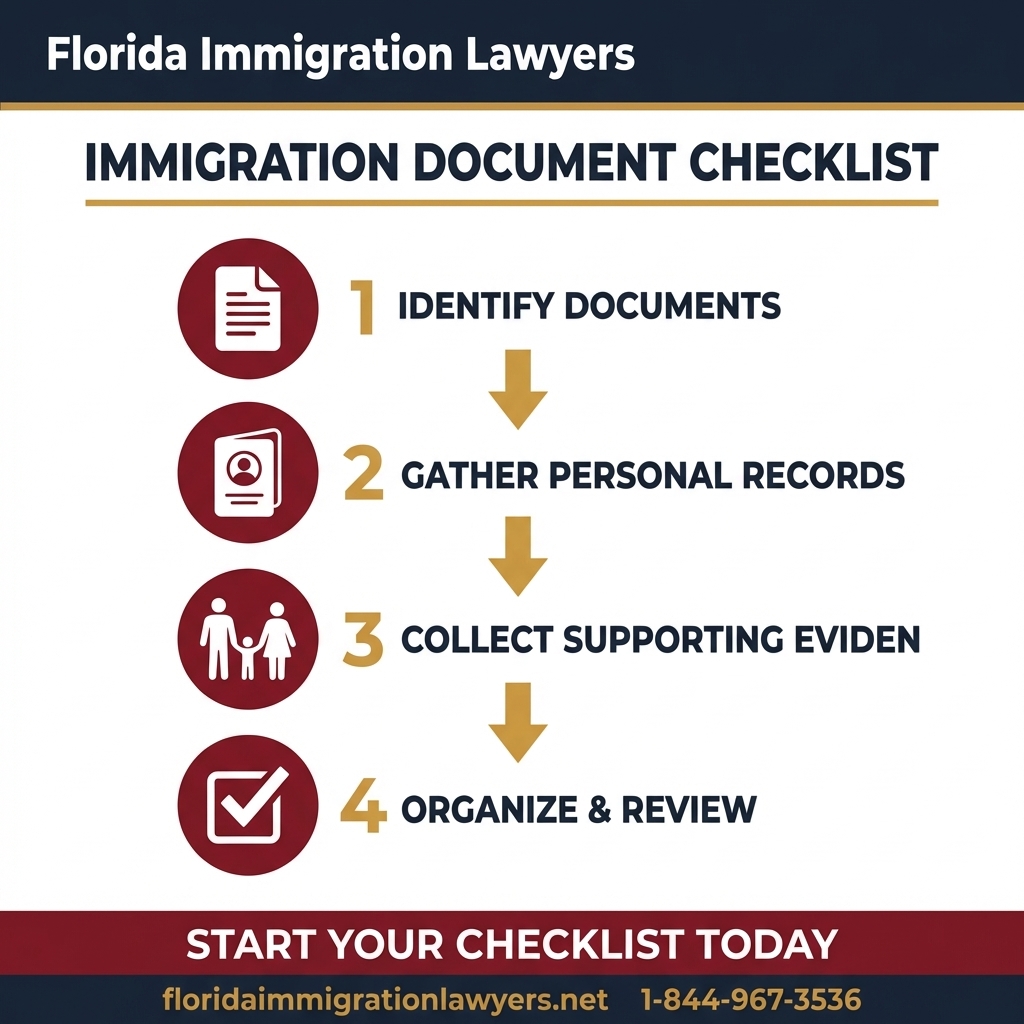
Step-by-Step Guide to Organizing Your Immigration Paperwork
Organizing your **immigration documents** systematically can significantly reduce stress and improve the efficiency of your application process. Follow these steps to ensure your **paperwork** is in order for 2026.
- Understand Your Specific Requirements: Before gathering anything, identify the exact immigration benefit you are seeking. This will tell you which **USCIS forms** to use and the specific supporting **immigration documents** required. Review the instructions for each form thoroughly on uscis.gov.
- Gather All Personal Information: Start with your foundational identity documents. This includes your passport, birth certificate, and any previous immigration records such as I-94s or old visas. Ensure all names match across documents.
- Collect Supporting Documents: This is often the most time-consuming step. Compile all necessary financial records, marriage certificates, police clearances, educational transcripts, and other evidence. For any document not in English, you will need a certified translation.
- Make High-Quality Copies: Never send original **immigration documents** unless specifically requested by USCIS. Make clear, legible copies of everything. It is wise to make multiple sets of copies.
- Organize and Label: Create a system for your **paperwork**. Use folders, binders, or digital files, clearly labeled by document type or application section. This helps both you and the immigration officer reviewing your case.
- Create a Master Checklist: As you gather each document, tick it off your personalized **checklist**. This ensures nothing is missed and provides a quick overview of your progress.
- Review and Double-Check: Before submission, meticulously review your entire package. Check for completeness, accuracy, and consistency across all **immigration documents**. Ask a trusted friend or family member to review it as well for fresh eyes.
- Keep a Complete Copy for Yourself: Always retain a full, identical copy of everything you submit to USCIS. This copy will be invaluable for your records, future reference, and any interviews or follow-up requests.
- Seek Professional Legal Review: The best way to ensure your **immigration documents** are complete and accurate is to have them reviewed by an experienced immigration attorney. They can spot potential issues and advise on the best course of action.
Timeline and Processing Expectations for Florida Applicants
Understanding the timeline for your immigration case can help manage expectations. Processing times for **immigration documents** and applications vary significantly based on the type of application, the specific USCIS service center, and the applicant's unique circumstances. While federal, these times can be influenced by local caseloads in **Florida**.
USCIS provides estimated processing times on its website, which you should check regularly for updates. For those in St. Petersburg and the surrounding Tampa Bay area, your case might be handled by the USCIS Tampa Field Office or other service centers. Similarly, immigration court proceedings for deportation defense cases would take place at courts like the Orlando or Miami Immigration Courts, which fall under the Executive Office for Immigration Review (EOIR).
Factors that can influence your timeline include the completeness of your **immigration documents**, responses to Requests for Evidence (RFEs), interview scheduling, and background checks. It is crucial to respond promptly and accurately to any USCIS communications. Delays are common, so patience and proactive follow-up are essential.
Cost Factors and Fee Breakdown for Immigration Applications
The cost of pursuing an immigration benefit in the U.S. involves several components. These fees are subject to change, so it is important to always check the most current information on the USCIS website. Our firm never guarantees specific fee amounts, as they are set by the government.
- USCIS Filing Fees: Each **USCIS form** has an associated filing fee. These can range from a few hundred dollars to over a thousand, depending on the application.
- Biometrics Fees: Many applications require biometrics (fingerprints, photographs, signature) appointments, which have a separate fee.
- Medical Examination Fees: If you need a medical exam (Form I-693), the cost is paid directly to a USCIS-approved civil surgeon. This fee varies by provider.
- Attorney Fees: Hiring an experienced immigration lawyer to assist with your **immigration documents** and application is an investment. Legal fees vary depending on the complexity of your case and the services required.
- Translation Fees: If any of your supporting **immigration documents** are not in English, you will incur costs for certified translations.
- Postage and Copying: While seemingly small, these costs can add up, especially for extensive **paperwork**.
It is important to budget for all potential costs. In some cases, fee waivers may be available for certain **USCIS forms** if you meet specific income guidelines. Always consult with an attorney to understand the full financial implications for your specific case.
Do not navigate this process alone. The complexities of immigration law and the sheer volume of required **immigration documents** can be daunting. **Contact Florida Immigration Lawyers today** for expert assistance and peace of mind. We are here to support you.
Common Mistakes to Avoid with Your Immigration Documents
Even small errors can lead to significant delays or denials in your immigration case. Being aware of these common pitfalls can help you avoid them when preparing your **immigration documents**.
- Submitting Incomplete Forms: Failing to fill out every required field on a **USCIS form**, even if it seems irrelevant, can lead to rejection or an RFE. Always write "N/A" if a field truly does not apply.
- Missing Supporting Documents: Forgetting to include a crucial piece of evidence from your **immigration documents checklist** is a frequent error. This signals to USCIS that your application is not ready for review.
- Providing Inaccurate Information: Any false or misleading information, whether intentional or accidental, can have severe consequences, including accusations of fraud and potential bars to future immigration benefits.
- Sending Expired Documents: Ensure all passports, visas, and other identity documents are valid and unexpired at the time of submission. An expired document is not acceptable proof.
- Poor Quality Copies or Originals: Submitting blurry copies, documents with unreadable text, or originals when only copies are needed can cause issues. Always ensure clarity and follow instructions.
- Not Keeping Copies of Everything: Failing to retain a complete copy of your submitted **paperwork** means you have no record for your files, interviews, or if the original submission is lost.
- Failing to Notify USCIS of Address Changes: Immigrants in the U.S. must inform USCIS of any address change within 10 days using Form AR-11. Failure to do so can result in missed notices and potential complications.
- Ignoring Deadlines: Missing a deadline for an RFE response, an appeal, or an interview can lead to the denial or closure of your case. Pay close attention to all dates.
- Not Carrying Essential Documents: While you do not need to carry your entire file, immigrants should generally carry proof of their legal status (e.g., Green Card, EAD, I-94) at all times. This addresses the PAA query: "What documents should immigrants carry at all times?"
- Misunderstanding Legal Terminology: The language used in **USCIS forms** and instructions can be complex. Misinterpreting terms can lead to incorrect answers or choices on your application.
- Not Preparing for Interviews: Many immigration processes require an interview. Failing to review your submitted **immigration documents** and understand your case can lead to inconsistencies during the interview.
- Attempting to Navigate Complex Cases Alone: Cases involving criminal history, previous denials, or complex legal issues are best handled by an experienced immigration attorney.
When to Call a Florida Immigration Lawyer
While this guide provides a comprehensive overview, the nuances of immigration law are vast. There are many situations where the expertise of a dedicated immigration attorney from Florida Immigration Lawyers becomes invaluable. Our team is particularly adept at handling complex cases for individuals and families in St. Petersburg and throughout **Florida**.
Consider seeking legal counsel if your case involves:
- A prior denial of an immigration application.
- Any criminal history, no matter how minor.
- Previous deportation orders or removal proceedings.
- Complex family relationships or adoption issues.
- Applications for asylum or protection from removal.
- Difficulty understanding **USCIS forms** or instructions.
- If you are facing deportation defense.
- If you need assistance with general immigration matters.
Our attorneys can help you gather and organize your **immigration documents**, prepare compelling arguments, and represent you in interviews or court proceedings. Do not wait for a problem to arise; proactive legal guidance can prevent issues before they occur. Visit our attorneys page to learn more about our team.
About Florida Immigration Lawyers
Florida Immigration Lawyers is a leading immigration law firm dedicated to serving individuals and families across all of **Florida**, including the vibrant community of St. Petersburg. Our mission is to provide compassionate, effective, and results-driven legal representation for all immigration matters.
We understand the profound impact immigration decisions have on your life and future. Our experienced attorneys specialize in a wide range of services, from family-based visas and employment immigration to asylum applications and deportation defense. We pride ourselves on clear communication, meticulous preparation of **immigration documents**, and unwavering advocacy for our clients.
Why choose Florida Immigration Lawyers? We offer free consultations, are available 24/7, and provide bilingual services (English and Spanish) to ensure every client feels heard and understood. We are committed to helping you achieve your American dream. For trusted legal support, call us at **1-844-967-3536** or visit our website at https://www.floridaimmigrationlawyers.net.
Sources and References
- U.S. Citizenship and Immigration Services (USCIS)
- Executive Office for Immigration Review (EOIR)
- 8 U.S.C. Chapter 12 - Immigration and Nationality Act
- 8 CFR Part 204 - Immigrant Petitions
- Immigration and Nationality Act (INA) Section 212(a) - General Classes of Aliens Ineligible for Visas and Admission
This article provides general legal information and is not intended as legal advice. Every case is unique, and outcomes depend on specific facts and circumstances. Contact an attorney for advice about your particular situation.
Your immigration journey is important, and having the right **immigration documents** is fundamental to its success. Do not leave your future to chance. **Contact Florida Immigration Lawyers today for a free consultation at 1-844-967-3536.** We are here to help you navigate every challenge. **Se Habla Español - Estamos aquí para ayudarle.**
Do Not Navigate This Process Alone
Our experienced immigration attorneys are ready to fight for you. Get a free, confidential consultation today.
Se Habla Español

William J. Vásquez
Founding Attorney · Vasquez Law Firm
U.S. Air Force veteran and immigration attorney with thousands of cases resolved. J.D., NCCU School of Law. AILA member. Admitted to the 4th, 5th, and 11th Circuit Courts.
Available 24/7 - Free Evaluations
Related Legal Services
Our Florida immigration attorneys can help you with deportation defense, citizenship and naturalization and family immigration services. Call today at 1-844-967-3536 for a free consultation.
Related Links
Related Topics
Free Legal Consultation
Discuss your case with our experienced attorneys. We're available 24/7.
Se Habla Español - Estamos aquí para ayudarle.
Related Articles
J-1 Waiver for Physicians in Florida: A 2026 Guide
Navigating the J-1 waiver process in Florida can be challenging for foreign physicians. Learn how the Conrad 30 program facilitates placements in underserved areas like Homestead, ensuring a successful application. Call Florida Immigration Lawyers today for expert guidance.
Naturalization Process Florida Timeline 2026 Guide
The naturalization process in Florida, culminating in U.S. citizenship, involves several key stages including eligibility assessment, filing Form N-400, biometrics, an interview, and the Oath of Allegiance. As of 2026, the typical timeline for this process in Florida ranges from 18 to 24 months, though individual experiences can vary. This guide from Florida Immigration Lawyers provides a comprehensive overview, covering requirements, step-by-step procedures, potential costs, and common pitfalls. We emphasize the importance of understanding Florida-specific nuances and the benefits of legal counsel to navigate this complex journey effectively. Contact us for a free consultation.
H-2B Visa for Florida Hospitality Seasonal Workers
Explore the H-2B visa process for seasonal workers in Florida's hospitality industry. Learn about costs, timelines, and common mistakes. Contact Florida Immigration Lawyers for expert assistance.
Military Naturalization Expedited at Florida Bases
Explore expedited military naturalization for service members stationed in Florida, including MacDill Air Force Base. Learn about eligibility, application steps, and how Florida Immigration Lawyers can assist you.
